
Iwagumi Stones Raising KH: Test Before Algae Starts
Iwagumi stones raising KH? Use a fizz test and 7-day bucket test before algae starts. Learn when to keep, manage, or replace rock.
Elena Vargas · Published 2026-07-09 · 24 min read
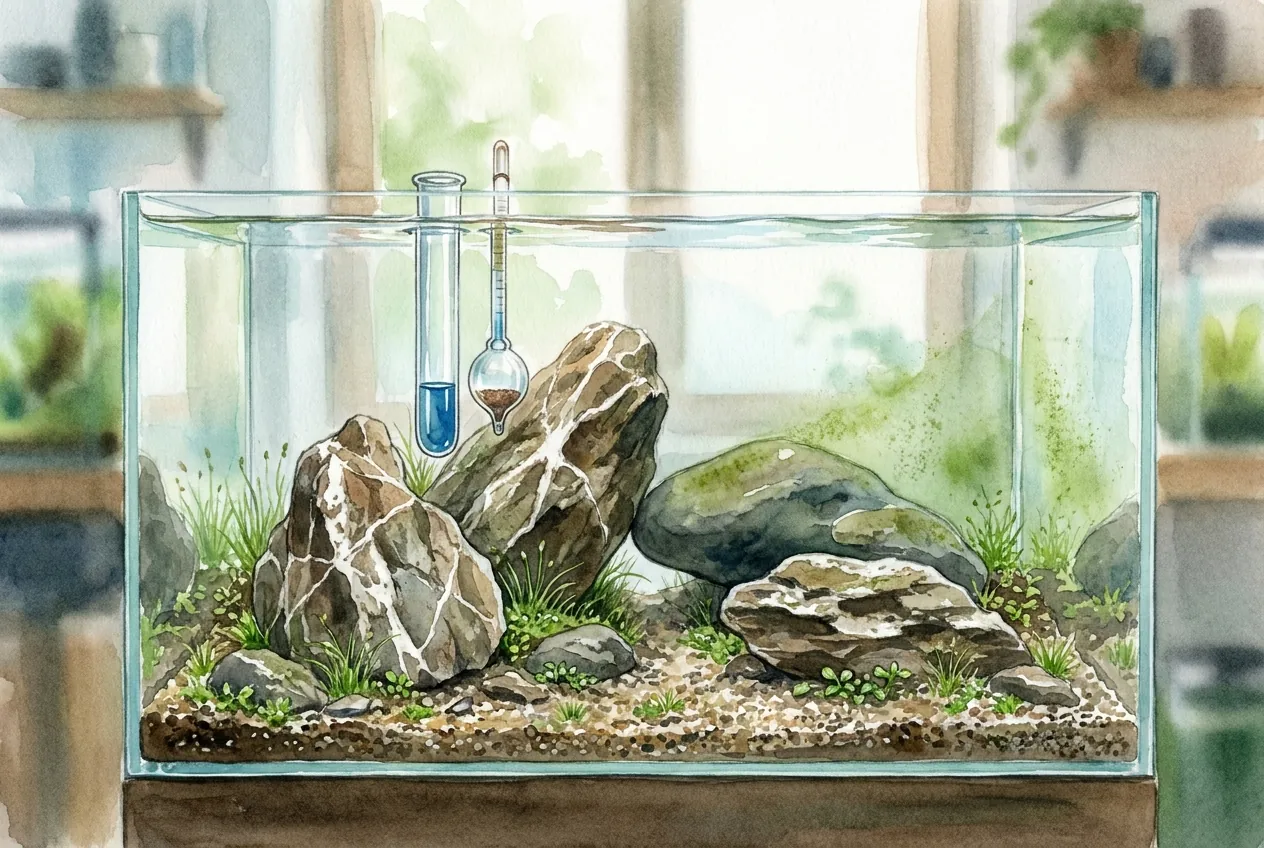
Key Takeaways
- Test Iwagumi stones before planting. Rock names do not prove they are inert.
- A bucket comparison is a screening test, not a safe or inert verdict. Judge each stone against the water your livestock actually need.
- KH creep can complicate CO2 and pH routines. It does not directly feed algae.
- Water changes lower the concentration but do not remove a continuing carbonate source. Replace rock that keeps a soft-water tank out of range.
Iwagumi stones raise KH when the rock contains reactive carbonate minerals, usually calcium carbonate.
The practical step is to test the stone before it enters the aquarium. First use an acid fizz screen, then run a seven-day bucket test that measures KH, GH, and pH against your source water.
The problem is not that every gray aquascaping stone is bad. The problem is that a gray stone can still release measurable minerals over time.
In a soft-water planted tank, that slow release can move the tank away from the CO2, livestock, and plant conditions you designed around.
Use a pre-tank screening test, then read the results against your own water before deciding whether a stone suits the livestock you keep.
Treat the numbers as decision points to check against your species, not fixed safety limits.
Why do Iwagumi stones raise KH?
Start With the Chemistry
Iwagumi stones raise KH when they dissolve enough carbonate or bicarbonate into the water to increase alkalinity.
In aquarium terms, KH is the carbonate buffer that resists pH movement. In water-chemistry terms, it is part of alkalinity, the water’s acid-neutralizing capacity.
That distinction matters because pH alone is a weak diagnostic. A tank can show a tolerable pH today while KH is slowly climbing underneath it.
I record the dry stone mass and actual water volume. I then test the tank and a covered source-water blank immediately after a water change and again after 24 and 72 hours and seven days. Every reading is taken at the same clock time before CO2 starts, keeping the source-water baseline and daily pH swing separate from carbonate drift.
I repeat the same sequence after the next water change. Agreement between both weeks is stronger evidence of continuing stone release than one rise caused by a dosing or test error.
If adjustment is needed, I remove or isolate one noncritical stone and repeat the zero-, 24-, 72-hour, and seven-day sequence after the next water change. A smaller KH rise under the same routine shows how much that piece contributed while preserving tank stability.
What is KH in a planted aquarium?
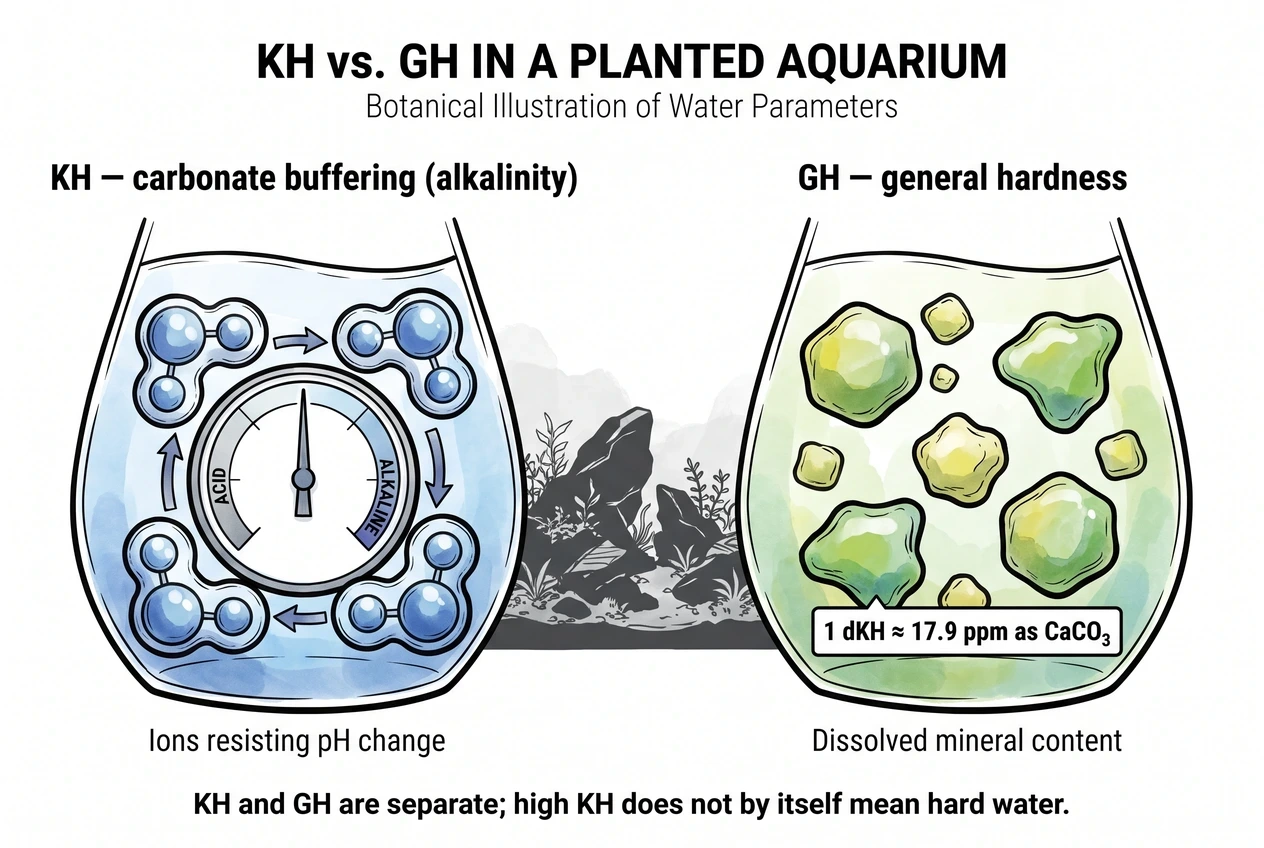
In aquarium practice, KH is treated as the carbonate and bicarbonate buffer that keeps pH from moving too easily.
A higher KH means more acid must be added before the pH shifts. At a lower KH, the same acid or base load moves pH more.
Strictly, alkalinity can also include phosphate, silicate, hydroxide, and organic anions, so a KH reading is a close proxy in most tanks rather than pure carbonate.
Most aquarium kits report KH in degrees KH, or dKH. One dKH is about 17.9 ppm as CaCO3, so a shift from 2 dKH to 6 dKH is a four-degree increase in buffering capacity, which is meaningful in a soft-water aquascape.
For a high-tech Iwagumi, KH matters because CO2 tuning is often built around a target pH drop from the degassed baseline.
If the buffer changes week by week, that pH-drop reading is no longer measured against the same baseline, so it needs rechecking.
It does not by itself prove the dissolved CO2 rose or fell, because bubble count and pH drop are only proxies for CO2, not calibrated measurements of it.
The Fish Keeper’s Guide to pH, GH, and KH
Alkalinity and Water
Why does carbonate stone change GH and KH together?
Carbonate stone often changes GH and KH together because calcium carbonate contributes both sides of the problem.
Calcium raises general hardness, while carbonate raises carbonate hardness.
That is why a reactive carbonate stone can show up as two moving numbers, not one. KH creeps up and GH creeps up together.
Before blaming the hardscape, rule out source water, dosing, and substrate, because CO2 swings, shrimp behavior, and plant melt each have several possible causes.
A rock is one candidate to test, not an automatic diagnosis.
Limestone, marble, coral, shell, and many decorative calcareous stones belong in the same risk category.
The label on the retail bin is less important than whether your exact stone reacts and changes your water.
Beginner. Water Chemistry
Hardness of Water
How do you test Iwagumi stones before the tank is built?
Use a Two-Stage Screen
Use two tests. The acid fizz test screens for obvious carbonate. The bucket test tells you whether the stone changes your actual source water enough to matter.
Do not skip the second test. Vinegar can miss a slow-reacting surface. A fizzing chip does not tell you how much a full hardscape will move KH in a real layout.
What does the vinegar fizz test prove?
The vinegar test proves only that the surface can react with weak acid. Rinse the stone, put it dry on a towel, add several drops of white vinegar to a fresh scratch or broken edge, and watch for active fizzing.
Keep it clear of your eyes and work in a ventilated spot.
Fizzing means the stone is calcareous enough to treat as a KH/GH risk. No fizz means the stone passed the first screen, not that it will leave your specific water unchanged. Confirm that with the bucket test.
Do not use stronger acids for routine home rock screening. Vinegar is enough for the first screen, and the bucket test is the safer way to catch slow mineral release.
| Result | Meaning | Next move |
|---|---|---|
| Fast fizz on vinegar | Strong carbonate signal | Avoid for soft-water Iwagumi or run a bucket test only if you accept hard water |
| Weak fizz on scratched edge | Possible slow carbonate source | Run the seven-day bucket test |
| No fizz | No obvious weak-acid reaction | Still run the bucket test if the tank depends on low KH |
Do Rocks Affect the pH of Aquarium Water?
5.10 Total Alkalinity
How do you run the seven-day bucket KH test?
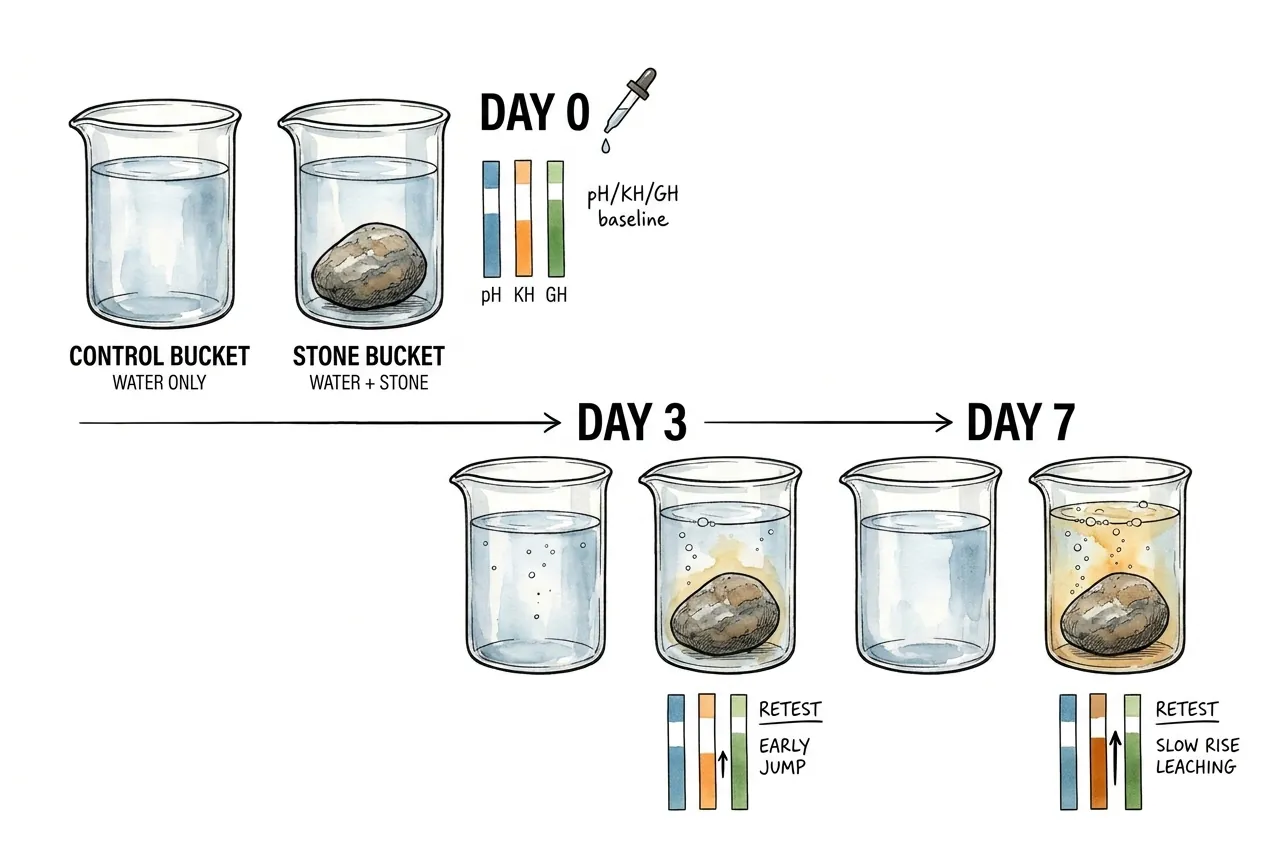
Treat this as a screening test, not a safe/inert verdict. It compares a stone against your source water under still, room-air conditions. A tank with injected CO2, active soil, and circulation can dissolve carbonate differently, and hard tap water already near carbonate saturation may react less.
Run the bucket test with the same water you plan to use in the tank. Fill one clean control bucket with water only.
Fill a second test bucket with the stone and the same water volume, using the same container type for both.
Test both buckets at the start for pH, KH, and GH, ideally with a calibrated pH meter. Cover both buckets the same way to keep gas exchange and evaporation matched, and keep them at the same temperature, away from substrate, soil, fertilizers, and livestock.
Add a midweek check if you can, then compare both buckets again after seven days. Where possible, run more than one stone bucket, since a single reading can be off by a drop.
Use enough stone, and enough freshly exposed surface, to mimic the tank ratio. If the aquascape will use a heavy stone mass, do not test one small pebble in a large bucket and read that as the whole layout.
| Checkpoint | Control bucket | Stone bucket | What matters |
|---|---|---|---|
| Start | pH/KH/GH baseline | pH/KH/GH baseline | Both should start close |
| Midweek | Optional retest | Optional retest | Early jump reveals reactive surfaces |
| Seven days | Retest | Retest | Slow rise reveals long-tail leaching |
What matters is the control-corrected change. How far the stone bucket moved beyond the control, and whether it is still climbing at day seven.
A small rise that is barely larger than the control, and near the resolution of a drop-count test, tells you little on its own.
A clear, repeatable rise that keeps climbing is the signal to weigh against your plan. The tighter your target, the more that matters for soft-water fish, sensitive shrimp lines, and CO2-tuned carpeting layouts.
Do Rocks Affect the pH of Aquarium Water?
The Fish Keeper’s Guide to pH, GH, and KH
Which test tools make the bucket result reliable?
Use liquid tests for the decision, not only multiparameter strips. The whole point is to notice a small KH/GH trend before livestock and plants are involved.
Strips are easy to misread when two colors sit close together.
The minimum useful kit is a dedicated GH/KH liquid test and a separate pH or master freshwater kit. A TDS meter is useful for RO water and remineralizing.
It cannot tell you whether the extra dissolved solids are carbonate, calcium, fertilizer, or something else.
A dedicated GH & KH liquid test kit is the core tool for the bucket test. Look for one that measures both general hardness and carbonate hardness. A typical hardness kit ships with two reagent bottles (one for GH, one for KH) and two capped glass tubes, which is exactly enough to run a control bucket and a stone bucket side by side.
It works by adding reagent drop by drop to a 5 mL sample and counting drops to the color endpoint (KH blue to yellow, GH orange to green), so each degree is one drop.
That makes small trends hard to read reliably. Repeat the test and keep the same reader, lighting, and fresh reagent.
Follow the safety instructions, since the GH reagent contains triethanolamine. Wear eye and skin protection and keep it away from children and pets.
It measures GH and KH only, not ammonia, nitrite, nitrate, or pH, so it is not a full new-tank safety kit.
A general freshwater master-style kit gives you a baseline once the Iwagumi tank is built. Kits at this level usually bundle around seven reagent bottles and four tubes and cover pH, high-range pH, ammonia, nitrite, and nitrate. Note that these kits almost never include GH or KH, so a master kit alone will not answer the stone-leaching question. Also read any headline test count carefully. An advertised figure like 800 tests is the combined total across all parameters, not 800 of each.
It covers the pH and nitrogen-cycle side of the diagnosis while the GH/KH kit tracks hardness.
Follow each test’s shaking and timing steps, read colors in consistent light, and mind reagent storage and expiry.
If you already own equivalent liquid kits, use those. The important part is measuring the control bucket and the stone bucket with the same kit, under the same light, and at the same checkpoints. If you are still deciding what to buy, choose a water test kit by the parameters you need to measure.
The 16 Best Aquarium Water Test Kits
What can make the bucket test mislead you?
The result is only as good as the setup. Different water volumes, different evaporation, different covers, different room light, or a dusty stone in one bucket and a scrubbed stone in the other can all create noise, so an uncontrolled design or a misread endpoint, not the stone, drives the difference.
Scrub the stone with plain water before the test, and treat both buckets the same way, since scrubbing can expose fresh reactive surface.
Do not use soap, vinegar residue, peroxide, fertilizers, or dechlorinator in only one bucket.
If the tank will use dechlorinated tap water, dechlorinate both buckets the same way.
Evaporation matters because it concentrates minerals even when the stone is inert. If both buckets evaporate at the same rate, the control catches that drift.
If only the stone bucket is left uncovered near a fan, the test will exaggerate the stone’s effect.
Substrate is another trap. Do not add aquasoil, crushed coral, shells, botanicals, or fertilizer capsules to the bucket test.
The question is whether the stone moves KH/GH by itself. Mixing materials turns a clean diagnostic into a guess.
What KH rise is acceptable in an Iwagumi tank?
Set the Water Target First
There is no single dKH number that is safe for every tank. The honest answer is that acceptable rise depends on your starting water, the species you keep, the size and reactivity of the stone, temperature, and how much CO2 and active soil you run.
A low-tech tank with adaptable fish has more room than a soft-water shrimp carpet tank running pressurized CO2.
Rather than a fixed cutoff, read the control-corrected change against those specifics.
The key is consistency. A stable moderate-KH tank is easier to manage than a tank that drifts from very low KH to moderate KH every week.
How much KH movement is a warning sign?
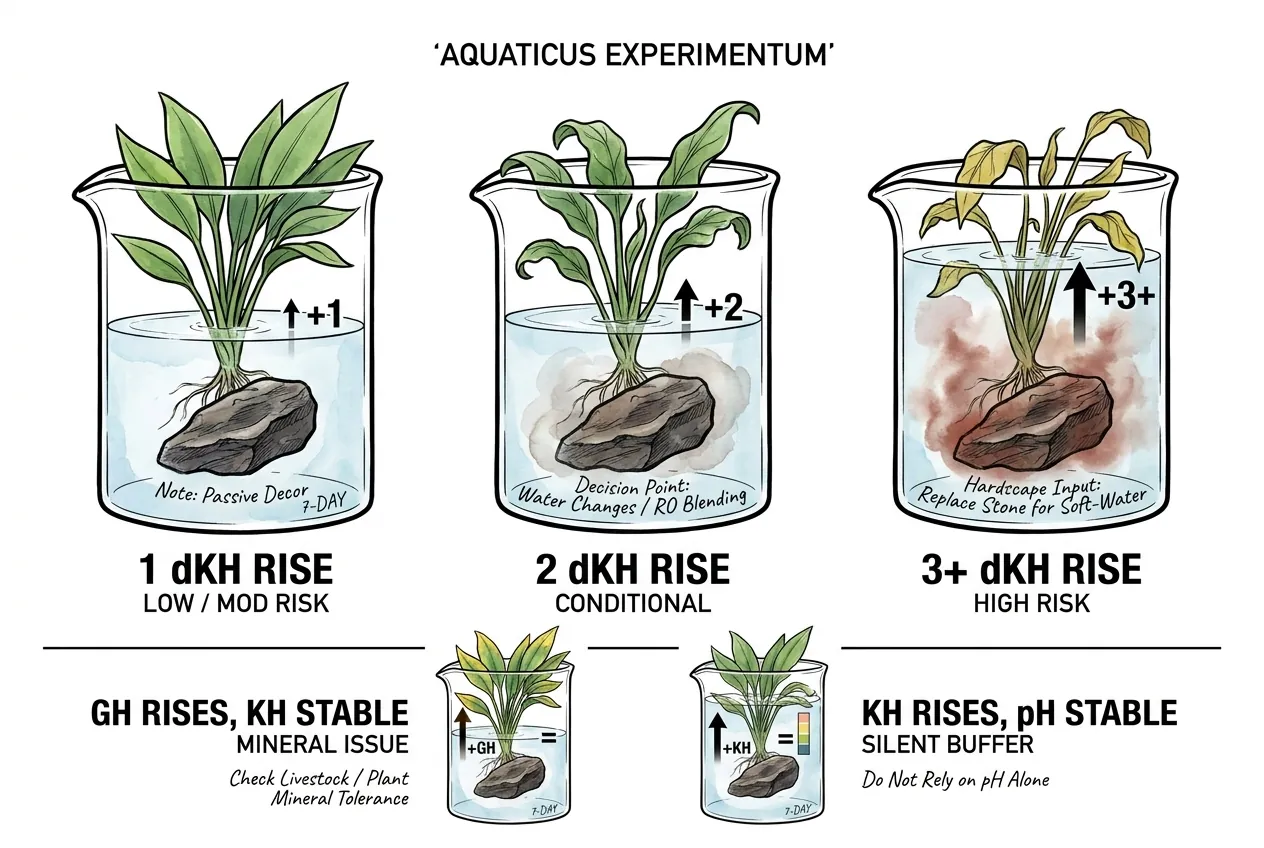
The useful signal is not a magic number but the size and repeatability of the change relative to the control.
A tiny rise near the resolution of a drop-count test is a note to watch. A larger rise that shows up again on retest tells you the hardscape is chemically active, not passive decor, and needs weighing against your water target.
Stay cautious in a new tank. You are already managing ammonia from some aquasoils, immature biofilm, plant transition, light intensity, and CO2 tuning.
A moving buffer adds one more variable during the least stable month, which is a good reason not to add a reactive stone to a soft-water plan without a plan for it.
| Seven-day stone-bucket pattern (vs. Control) | What it suggests | Best call |
|---|---|---|
| No clear rise beyond the control | No strong signal under these conditions | Reasonable to use if livestock and plants fit the final water. Retest if the tank runs CO2 or active soil |
| Small rise, near test resolution, not clearly climbing | Uncertain. Possibly manageable | Retest for repeatability. Use only with planned water changes or RO blending, matched to your species |
| Larger, repeatable rise still climbing at day seven | Chemically active hardscape | Weigh against a soft-water plan. Consider replacing the stone or switching to a hard-water layout |
| GH rises but KH does not | Mineral-hardness input, not carbonate buffer | Check livestock and plant mineral tolerance |
| KH rises but pH barely moves | Buffer changed without an obvious pH cue | Do not rely on pH alone. Measure KH directly |
5.10 Total Alkalinity
The Fish Keeper’s Guide to pH, GH, and KH
How does aquasoil change the reading?
Aquasoil can make the first month harder to interpret, but it is not one uniform product. Some active soils are designed to pull the tank toward a softer, more acidic direction and can release ammonia early on, while a carbonate stone pushes the other way.
How strong that effect is depends on the specific soil, its age, and your source-water KH, so check your product rather than assume a single behavior.
That tug-of-war is why a bare bucket test matters. If you test the stone in a bucket without aquasoil, you learn what the rock does by itself.
If you test only the finished tank, you are reading stone, soil, water changes, fertilizer, CO2, and plant uptake at the same time.
In a new aquasoil Iwagumi, watch the direction of the trend rather than a single number. If KH rises after each water change even while pH stays muted, the stone may be adding buffer while the soil masks some of the pH movement.
The practical move is simple. Keep the stone-bucket result as the hardscape baseline, then track the tank separately.
When both the bucket and the tank point upward, the hardscape is a strong suspect, but confirm it against source-water variation, test bias, dosing, and a reactive substrate before acting.
When only the tank moves, look for substrate, water-change, or dosing variables before tearing out rock.
How should RO water change the decision?
RO water makes the stone test stricter because it starts with little buffering. A small amount of carbonate release is easier to see in low-mineral water than in hard tap water.
That does not mean every RO-based tank must use inert-looking black rock. It means the keeper has less room for surprise.
If the plan is RO water plus remineralizer, test the stone in the same remineralized water you plan to use, not in raw RO and not in untreated tap.
For shrimp tanks, the real question is not whether the stone moves one test tube color. The question is whether the final stable water matches the GH, KH, and TDS range your specific shrimp species needs.
If your remineralized water is already close to that target, a reactive stone can push the tank out of range, and sensitive lines can react to drift they are not adapted to.
For a community planted tank with adaptable livestock, the same rise may be manageable. That is why the bucket result is a decision tool rather than an automatic ban.
What if your tap water is already hard?
Hard tap water can make a reactive stone harder to detect, because the starting KH is already high and water near carbonate saturation dissolves less.
If the control bucket and stone bucket both stay high but move together, the stone may not be adding much that matters.
If the stone bucket keeps climbing while the control stays stable, the hardscape is still active.
This is where the control bucket does its work. Without it, a keeper may blame the rock for tap-water hardness, or blame tap water while the rock is adding a second layer of carbonate.
Comparing the two buckets separates those cases.
If your household water is consistently hard, a soft-water Iwagumi is an uphill task. You can use RO blending, choose livestock that fit local water, or choose a different hardscape.
The move to avoid is building a low-KH layout and hoping repeated water changes will make a reactive stone behave like inert slate.
For hard tap water, the bucket test is still useful before you buy plants. It tells you whether the stone is neutral enough for your existing water or whether it pushes an already hard system even harder.
How should CO2 users read KH drift?
CO2 users should treat KH drift as a recalibration cue. If the buffer changes, the pH-drop reading is now measured against a different baseline, so it needs rechecking. The drop-checker color and bubble rate are also only proxies, and a changed KH does not by itself tell you whether dissolved CO2 rose or fell.
Do not respond by chasing a lower pH number on the same day you discover KH movement. First check whether fish are breathing normally, whether plants are responding, and whether the source water still matches your expected baseline.
If fish are gasping at the surface, losing balance, or crowding the outflow, treat that as possible CO2 distress. Stop or cut injection and add aeration before adjusting anything else.
If the tank is planted but not stocked, you have more room to slow down. Keep the photoperiod modest, hold CO2 steady unless you suspect an overdose, and retest the buffer trend before making livestock commitments.
If the tank is already stocked, prioritize animal behavior over the ideal aquascape number.
The main mistake is treating CO2 as the only knob. In an Iwagumi, the stones, substrate, source water, CO2, and water-change rhythm all affect pH and the carbonate balance.
Fixing the wrong one can make the tank look busier while the real mineral source keeps working.
Which livestock makes the call stricter?
Soft-water species make the call stricter. Many Neocaridina, livebearers, and farmed community fish tolerate moderate mineral levels, though this varies by strain, source, and acclimation.
The Caridina genus is large rather than a single soft-water group. Amano shrimp (Caridina multidentata) keep well across a wide hardness range, and cardinal shrimp (Caridina dennerli) come from alkaline Lake Matano.
The strict cases are specific low-mineral lines such as crystal and bee shrimp, so check the GH, KH, and TDS target for your exact species and strain rather than treating the genus as one rule.
Plants are not all equally sensitive either. Java fern, Anubias, Bucephalandra, and many stem plants tolerate a fairly wide range, though not every plant adapts equally to every hardness.
The classic Iwagumi difficulty is a carpet plant like Monte Carlo or dwarf hairgrass being asked to root while CO2 and KH are both moving, alongside substrate, light, and nutrient factors that also affect carpeting.
Do not choose stone first and livestock later. Pick the water target first, then choose hardscape that does not fight it.
Seiryu stone/pH/gH/kH question
How does KH creep lead to algae in a planted Iwagumi?
Treat KH as a Stability Variable
KH creep does not directly feed algae. What it can do is add instability while you are already juggling other variables. CO2 targets shift, plants may pause, and the aquarist keeps changing light, fertilizer, and gas at the same time.
Algae growth has many drivers, including light, nutrients, organics, biofilm, grazing, flow, and recent disturbance, so a moving buffer is one contributing factor, not a proven single cause.
In other words, the stone is not fertilizer for algae. At most it is a hidden variable that can make an anti-algae routine harder to keep consistent.
Why does CO2 tuning get harder?
CO2 tuning gets harder because many planted-tank keepers use pH drop as a proxy for dissolved CO2.
That method compares the current degassed baseline pH against the pH under injection, and it works as a rough proxy mainly in carbonate-dominated water.
If KH changes, the baseline moves and the reading has to be re-established. A changed pH drop does not, on its own, prove dissolved CO2 went up or down, and active soil, organic acids, or phosphate can throw the inference off further.
A low KH does not make heavy CO2 safe. Pearling is oxygen supersaturation rather than proof of a stable or safe system, and no pH number substitutes for watching the animals.
Read pH, KH, and calibrated CO2 delivery together, alongside fish and plant behavior.
A possible pattern, not a rule, starts with low KH. The aquarist tunes CO2 around a familiar pH drop.
Then the stone slowly raises KH, plants stop pearling as expected, and the aquarist may increase light or fertilizer instead of retesting KH.
When black beard algae, green dust, or hair algae then appears, it is usually responding to some mix of light, nutrients, CO2, organics, and disturbance rather than to carbonate as food.
Different algae have different triggers, so identify what you are seeing before treating it.
Alkalinity and Water
What should you adjust before adding algaecide?
Retest first. Measure source water, tank water before CO2 turns on, tank water at peak CO2, KH, GH, nitrate, phosphate, and photoperiod.
Then simplify. Reduce light modestly or temporarily shorten the photoperiod while you stabilize CO2, unless you are handling an emergency like CO2 distress, where animal safety comes first.
Avoid changing light, fertilizer, gas, and hardscape on the same day.
Keep water changes predictable and consistent. Remove damaged carpet leaves so they stop decaying in the flow-shadow around stones.
Be cautious with acid-based pH-down products as a quick pH fix in a planted tank. Some are phosphoric-acid based, which adds phosphate, and using acid to chase a continuing carbonate source tends to rebound. Check the ingredients and dose.
Added phosphate does not automatically cause algae, but it is one more variable you may not want to introduce mid-problem.
Beginner. Water Chemistry
5.10 Total Alkalinity
What if the Iwagumi tank is already built?
Prove the Trend Before Acting
If the tank is already built, do not panic-strip the layout on day one. First prove the trend.
If KH rises after every water change while source water stays low, the hardscape or substrate is adding buffer.
Once you prove the trend, choose between management and removal. Management works when the rise is slow and the livestock fit the final water. Removal is better when the tank requires low KH.
Can water changes solve stone-driven KH?
Water changes can slow stone-driven KH, but they rarely solve a strongly reactive hardscape.
Every water change resets the number. The stone starts dissolving again.
RO blending can work if your target is moderate and the stone rise is small. For example, source water may start near very low KH and drift into a moderate range over a week.
If your livestock are fine at that final range, you can manage the tank with consistent water changes.
But if your goal is very low KH for a soft-water shrimp line or biotope, that is different.
A hardscape that keeps adding buffer week after week is the wrong material for that target, and you will be correcting for it for the life of the tank.
Do Rocks Affect the pH of Aquarium Water?
Alkalinity and Water
When should you remove the stone?
Remove the stone when the tank’s required water is consistently softer than the stone allows. That is the core principle.
In practice, that means removal when the bucket shows a clear, repeatable rise that keeps a soft-water target out of range, when your target species need very low KH that the stone will not permit, or when pH and CO2 targets keep shifting after water changes and the source water is confirmed stable.
Base the call on measured, control-corrected change and your species’ needs, not a fixed dKH number.
If the layout is mature, plan the structure first. Pulling a keystone piece can destabilize the rest of the layout.
Where it is safe, remove stone in stages, make a normal partial water change, wait through a short settling window, and retest.
Do not combine rock removal, filter cleaning, substrate disturbance, and CO2 changes on the same day.
The exception is an acute problem, such as livestock in visible distress or a rock-fall hazard, where waiting is riskier than acting.
Seiryu stone/pH/gH/kH question
Which rocks are safer for a low-KH Iwagumi?
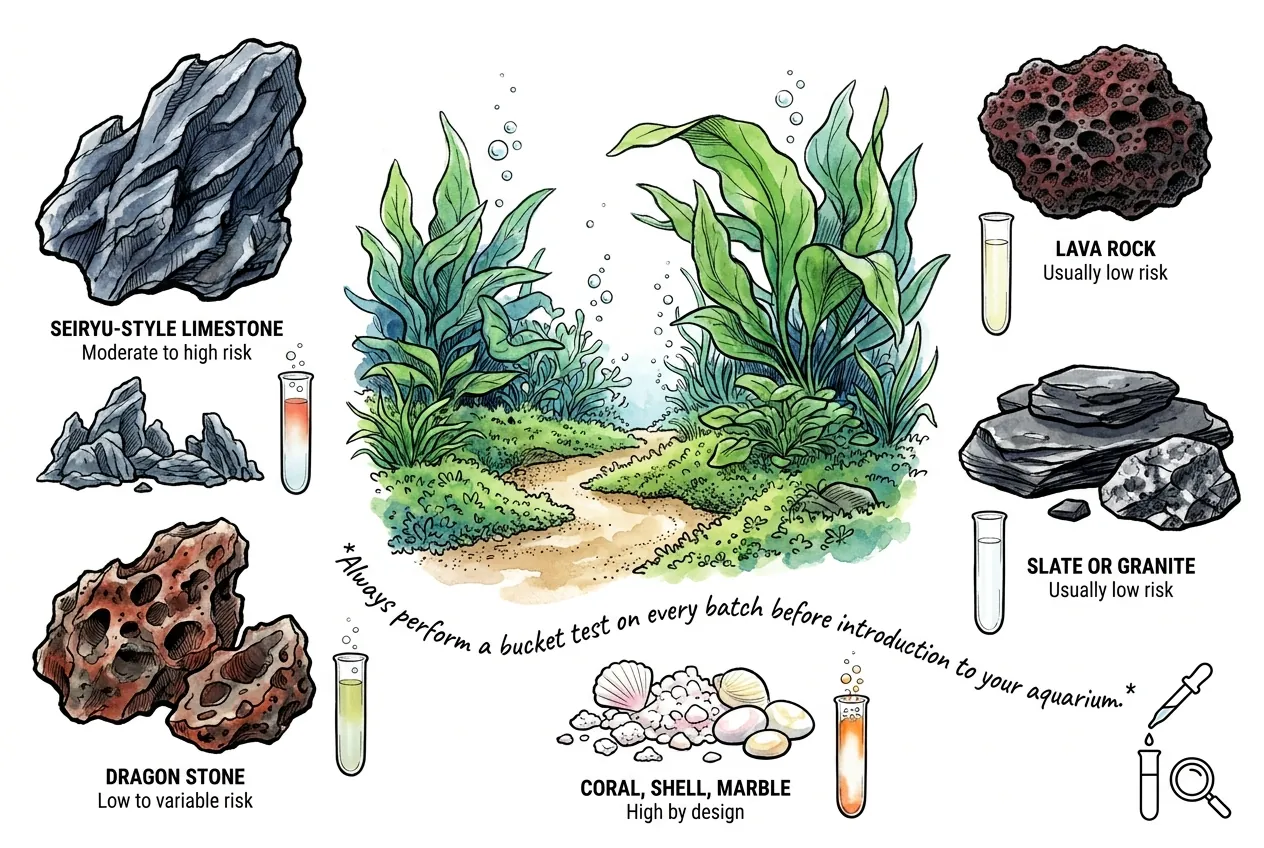
Safer low-KH choices are rocks that pass both tests, not rocks with prettier marketing names.
Many aquascapers reach first for lava rock, slate, granite, or dragon-stone-style materials when they want a lower carbonate risk. Treat that as a shopping shortlist, not proof.
If you want the sharp blue-gray Iwagumi look, test first and design around the result. If the stone raises KH but you love it, build a hard-water layout with compatible livestock.
Do not force that stone into a soft-water plan.
| Hardscape type | Rule-of-thumb KH/GH risk | Best use |
|---|---|---|
| Seiryu-style limestone | Moderate to high | Hard-water or tested moderate-KH layouts |
| Dragon stone | Low to variable | Test for dust and carbonate pockets |
| Lava rock | Usually low | Shrimp moss layouts and planted hardscape |
| Slate or granite | Usually low | Low-KH aquascapes after bucket test |
| Coral, shell, marble | High by design | Raising KH/GH, not soft-water Iwagumi |
Beginner. Water Chemistry
Hardness of Water
What is the practical Iwagumi stone rule?
Use the Control-Corrected Change
Never build a low-KH Iwagumi around an untested stone. Test the exact rock, in your exact source water, before planting, so you know whether it is carbonate-reactive at all.
Instead of a fixed dKH cutoff, read the control-corrected change against your specifics. A small, non-repeating rise near test resolution is usually workable. A clear rise needs a livestock and water-change decision. A larger, repeatable rise that keeps climbing points toward replacing the rock in a soft-water tank.
What counts as acceptable depends on your species’ target range and how much uncertainty your setup leaves.
That one week of testing is cheaper than replacing carpet plants or chasing CO2, and cheaper than tearing down a layout later.
Catching a moving buffer early, by measuring it, beats discovering it after the tank has drifted.