
Aquarium Filter Media Product Chooser: Mechanical, Bio
An aquarium filter media product chooser: pick mechanical, biological, and chemical media by spec, and stack them in the right flow order.
Priya Patel · Published 2026-08-05 · 14 min read
Key Takeaways
- Buy mechanical and biological media first because they remove debris and support the bacteria that process ammonia. Chemical media is an optional polish.
- Choose biological media by published surface area in m2/L because that number sets how many attachment sites the biofilm has. Match the total bed to the tank’s ammonia load.
- Load media in flow order with mechanical first, biological second, and chemical last. This protects the biofilter from clogging and lets carbon or resin polish clarified water.
- Replace carbon when it is exhausted and never replace all biological media at once. A staged maintenance routine protects the established colony.
- Undersized biological media is a common cause of an ammonia spike after stocking. Confirm the diagnosis with an ammonia and nitrite test before adding more products.
Start with two media types. Mechanical media traps particles, biological media supports the bacteria that process ammonia, and chemical media is an optional polish.
Choose what fits your filter and maintenance routine, then load it in the actual direction of water flow.
What filter media should you actually buy first?
Buy mechanical media and biological media first, because those two do the non-negotiable jobs. Mechanical media catches debris.
Biological media grows the nitrifying bacteria that convert toxic ammonia into far less toxic nitrate.
Chemical media, meaning activated carbon or an adsorptive resin, is a targeted polish. It is genuinely optional in a stable, well-planted tank. You add it to solve a specific problem, not by default.
The order you load them matters as much as the products. Water must meet mechanical media first, biological media second, and chemical media last in the flow path.
Get that sequence wrong and each stage undermines the next.
Before you buy, know your numbers. You need to measure the ammonia and nitrite the biofilter is fighting, which is what an aquarium water test kit is for. Buying media without a test kit is guessing.
I empty one clean filter basket and measure its usable internal dimensions, then make a paper template that includes the handle, bypass gaps, and the direction of flow. Media volume printed on a box is useless if the bag blocks the basket seal or forces water around it.
An assembly photo preserves each layer while I record the clean-flow baseline. At maintenance, the photo prevents accidental restacking and the flow comparison tells me whether fine mechanical media is consuming more capacity than the tank needs.
How does filter media actually clear ammonia?
Nitrifying bacteria living on your biological media convert ammonia to nitrite, then nitrite to nitrate.
Ammonia-oxidizing bacteria such as Nitrosomonas handle the first step. Nitrite-oxidizing bacteria such as Nitrobacter and Nitrospira handle the second.
Several kinds of microbes can carry out those steps. For maintenance, the important point is simpler. These microbes live as a film on wet media and need steady, oxygenated flow.
Why does biological surface area (m2/L) decide biofilter capacity?
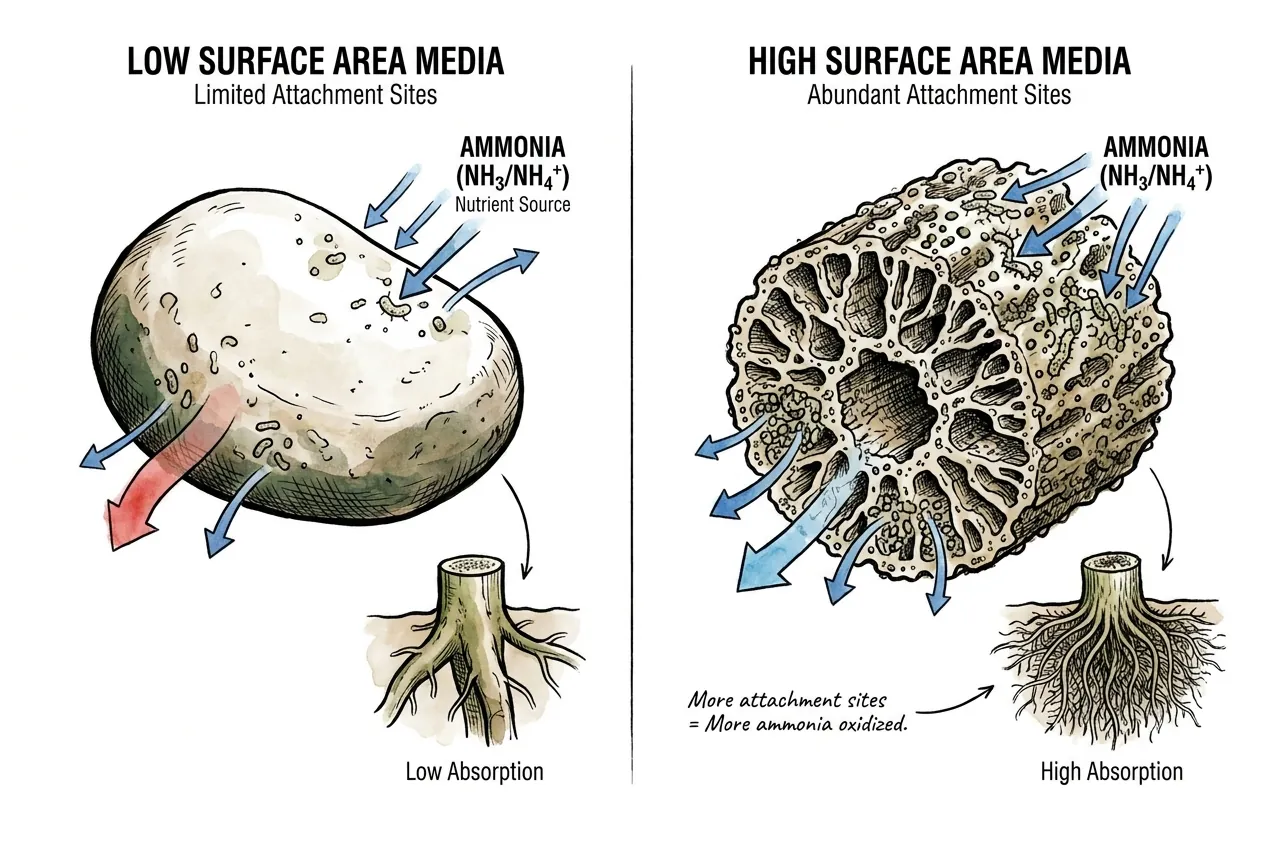
More porous media can offer more room for biofilm, but an advertised surface-area number is not a complete capacity rating. Filter volume, flow, stocking, oxygen, and how often the media clogs matter too.
Use enough biological media to fill the available basket without restricting flow, then confirm that the tank stays at zero ammonia and nitrite as stocking increases.
Flow feeds the biofilm. Oxygen and ammonia reach the bacteria by water movement, so anything that chokes flow starves the colony. Good surface gas exchange keeps that oxygen supply healthy.
What ammonia and nitrite levels are actually toxic?
Ammonia and nitrite become more hazardous as pH and temperature rise, and livestock tolerance varies. Treat a detectable rise during cycling or after a filter problem as a reason to stop adding livestock and investigate the biofilter.
Keep ammonia and nitrite at zero on the test you use. Carbon and resin do not replace a healthy biological colony.
How does activated carbon remove tannins and medication?
Activated carbon works by adsorption, meaning organics stick to its enormous internal pore surface.
Granular activated carbon is a highly porous solid, and tannins, dissolved organics, odors, and residual medication bind to those pores as water passes through.
The catch is exhaustion. Once the available pore sites fill, the carbon stops adsorbing.
It does not become toxic. It simply becomes inactive, which is why carbon has a replacement interval while biomedia does not.
That saturation behavior is the dividing line between chemical and biological media. Bacteria reproduce and self-renew, while carbon is a consumable that empties out.
Which specs should decide your purchase?
Choose by job first. Mechanical media must fit and preserve flow, biological media must fit without packing the filter too tightly, and chemical media should match a temporary water-quality problem.
The table below is a practical selection check, not a ranking based on one manufacturer number.
| Role | Measurable spec to buy on | What good looks like | Why it matters |
|---|---|---|---|
| Mechanical | Fit and coarse-to-fine structure | Coarse pad facing flow, fine polish behind | Traps debris before it clogs downstream media |
| Biological | Porous medium that fits without choking flow | Enough volume for the filter and stocking level | Gives the bacterial colony a stable place to grow |
| Chemical carbon | Temporary purpose and easy replacement | Used for tannins, odor, or medication cleanup | Adsorbs dissolved compounds until it saturates |
| Adsorptive resin | Clear regeneration plan | Used only when you will follow the full recharge process | Polishes dissolved organics |
What is the best mechanical filter media to buy?
Buy a bonded dual-density pad and cut it to fit, because coarse-to-fine sequencing is what preserves flow.
The coarse side faces incoming water and grabs large debris, while the fine side polishes smaller particles behind it. That order stops the fine layer from clogging instantly.
Aquatic Experts Bonded Pad
The Aquatic Experts pad suits a canister or hang-on-back filter when you want one cut-to-fit sheet with a coarse side followed by a fine side. It is not the right choice if your filter requires a shaped cartridge or has too little space for a thicker pad.
The honest tradeoff is that this is a bulk roll, not a drop-in branded cartridge. Skip it if you specifically want a pre-cut cartridge for one filter model.
Filter floss is also disposable, so plan to replace the fine layer rather than deep-clean it forever.
Use this as the upstream first stage in any canister or HOB. Rinse or replace it when flow visibly drops, which protects the biomedia sitting behind it.
What is the best biological filter media for surface area?
Choose a porous medium that fits your filter without restricting flow. Surface-area claims are useful background, but they cannot predict capacity by themselves in a stocked aquarium.
Seachem Matrix
Seachem Matrix suits a filter basket that can hold irregular porous pieces and a keeper who wants durable biological media. Rinse the initial dust and leave established media in place unless it is breaking down or preventing flow.
The honest tradeoff is that Matrix pieces are irregular and dusty on the first rinse. Skip it if you want uniform rings that seat neatly in a specific canister basket, since its denitrification benefit is modest in high-flow canisters anyway.
Fluval BioMax
Fluval BioMax suits Fluval trays or another filter that is easier to pack with uniform rings. If you replace worn media, change only part of it at a time so the biofilter is not stripped at once.
Marineland Bio Media
Marineland bio media is sized for Marineland C-Series and Magniflow canisters. That fit only helps if you own one of those filters.
Size the biological bed to your ammonia load, not to spare basket space. Use the per-gallon guideline as a floor and add more surface area if your stocking is heavy.
When should you buy activated carbon or a resin?
Buy chemical media to solve a specific water problem, not as a permanent stage. Activated carbon pulls tannins, dissolved organics, and residual medication, while an adsorptive resin polishes organic waste and is regenerable.
Both go last in the flow path and neither replaces biological media.
Fluval Carbon
Reach for carbon when you need a short, broad cleanup. The Fluval Carbon is convenient when your filter uses a final basket and you want pre-bagged media. Replace it when the problem returns or after the label’s stated use period rather than treating it as permanent media.
The honest tradeoff for carbon is recurring cost and speed of exhaustion. Skip continuous carbon in a stable planted tank that wants its tannins and trace organics kept.
Remember that carbon strips dissolved medication, so pull it while dosing meds, then add it back afterward.
Carbon polishing also helps in the organic-heavy conditions that feed black beard algae.
Seachem Purigen
For long-term polishing, a resin can be the better tool. Seachem Purigen suits a keeper who wants reusable organic polishing and will follow the complete regeneration process. Skip it if bleach handling and complete dechlorination are not practical for your setup.
It removes organic nitrogenous waste before it breaks down into ammonia and nitrite.
The honest tradeoff for Purigen is the recharge protocol. The bleach regeneration must be followed exactly with full dechlorination, or leftover oxidizer harms fish.
Treat it as a consumable if you will not follow that step.
Purigen is a polish, not a substitute for a properly sized biological bed. Planted and CO2-injected tanks often favor resin because it clears organics without stripping the nutrients plants use.
How do you stack filter media in the right order?
Arrange media so water meets mechanical first, biological second, and chemical last. Mechanical first keeps debris from clogging the biomedia pores and the chemical media, which preserves the flow that feeds the biofilm.
Chemical last means the carbon or resin sees already-clarified water and lasts longer.
Canisters differ in flow direction, so read the manual before packing. Some draw water in at the bottom and some at the top, and you arrange media to match the actual water path, not the physical top or bottom.
What does the media stack look like in cross-section?
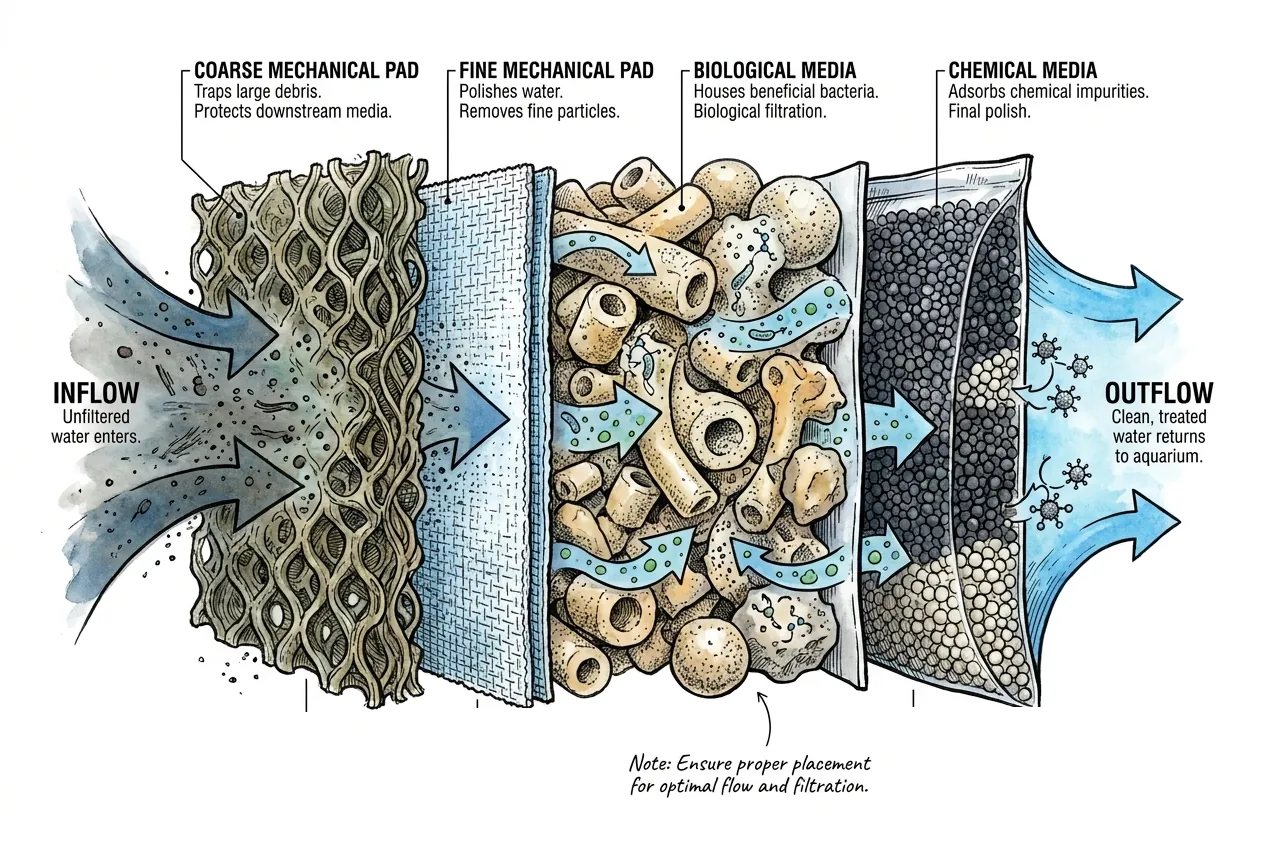
Picture the filter as a wall of layers the water crosses in turn. The coarse mechanical pad faces the incoming water, and the fine polish sits behind it.
The porous biological bed fills the middle, and the chemical polish caps the far end before the outflow.
The coarse pad shields everything downstream from debris. The biological bed sits protected in the middle where clarified, oxygen-rich water reaches the bacteria.
The chemical polish caps the far end so it treats water that is already clean.
What is the target sequence for a canister?
The sequence below is the target for a canister with generous tray space. In a small HOB with one media slot, prioritize a thin mechanical pre-layer plus biological media, and treat carbon as an optional swap-in.
| Flow stage | Media | Job |
|---|---|---|
| 1 (first contact) | Coarse mechanical pad | Trap large debris |
| 2 | Fine mechanical polish | Catch small particles |
| 3 (middle) | Biological media | Host nitrifying bacteria |
| 4 (last, optional) | Carbon or resin | Polish organics before outflow |
What are the common filter media failure modes?
The top failure is undersized biological media, which lets ammonia and nitrite spike after stocking.
The fix is to add surface area, stock slowly, and confirm with a test kit. This is why matching biomedia volume to ammonia load matters more than filling every tray.
A clogged mechanical layer is the second failure, because it drops flow and starves the bio-bed of oxygen and ammonia.
Rinse or replace the floss on a schedule so the colony keeps its supply. Channeling is a related problem where water bypasses packed media through a gap, solved by packing media snugly and using bagged media.
The subtle failure is replacing all biological media at once, which strips the colony and triggers a mini-cycle.
Never swap more than about a third of your biomedia in one session.
| Media class | Maintenance action | Interval |
|---|---|---|
| Mechanical (floss/pad) | Rinse or replace when flow drops | ~2 to 4 weeks / as needed |
| Biological (Matrix/rings) | Rinse gently in tank water. Never replace wholesale | Rarely. Never all at once |
| Chemical carbon (GAC) | Replace as it saturates | ~3 to 4 weeks |
| Adsorptive resin (Purigen) | Regenerate or replace when dark | When exhausted |
Who should not buy each media class?
Skip continuous carbon if you run a stable planted tank that wants its tannins and trace organics retained.
Carbon strips exactly the dissolved compounds a mature planted system often benefits from keeping. Use it as a short problem-solver instead of a fixture.
Skip Purigen if you will not follow the exact bleach-and-dechlorinate recharge protocol. A half-done regeneration leaves oxidizer that harms fish, so treat the resin as a plain consumable in that case.
It is a polish, not a substitute for biological capacity.
Skip bulk Matrix if you only need a small drop-in cartridge for a compact HOB. A fit-matched ring product wastes less space in a single small slot.
The right buy is the one whose spec matches your filter volume and your maintenance rhythm.
Frequently asked questions about filter media
Do you even need chemical media? No, it is optional. Mechanical and biological media are the mandatory pair, and carbon or resin only polish specific problems like tannins or post-medication residue.
How much biological media is enough? Match the surface area to your ammonia load and use the manufacturer per-gallon guideline as a floor. Heavy stocking needs more surface area than the minimum.
Can you replace the carbon and clean the sponge on the same day? Avoid disturbing everything at once.
Stagger maintenance so you never knock back mechanical flow and the bacterial colony in a single session.
Will carbon remove my fish medication? Yes, it adsorbs dissolved medication. Remove carbon while you dose meds, then add fresh carbon afterward to clear the residual drug.
Key Takeaways
- Buy mechanical and biological media first. Chemical media is an optional polish.
- Choose biological media by surface area in m2/L, since that sets ammonia capacity.
- Stack the flow path mechanical first, biological second, chemical last.
- Replace carbon every 3 to 4 weeks. Never swap all biological media at once.
- Undersized biological media is the top cause of an ammonia spike after stocking.
Affiliate Disclosure
This article contains Amazon affiliate links. As an Amazon Associate I earn from qualifying purchases. If you use these links, the site may earn a commission at no extra cost to you. Product availability, price, and specifications can change. Check the current listing before buying.