
How to Get Rid of Black Beard Algae: July Flow Fix
How to get rid of black beard algae: identify it, assess flow and CO2, and remove it with the lowest-risk methods for a stocked, planted tank.
Marcus Hale · Published 2026-07-01 · 33 min read
Key Takeaways
- BBA is a freshwater red alga. Hobbyists most often associate it with low or unstable CO2 and weak flow, though light, nutrients, organics, and plant health also matter.
- Aim for even, gentle circulation so no leaf sits behind a stagnant film. Keep CO2 as steady as your setup allows.
- Work through a checklist rather than assuming one cause. Check CO2 method, flow, light, nutrients, organic load, plant condition, and what you recently added.
- Physically remove or trim what you can first. In-tank chemical spot-dosing carries real livestock risk and should be a last resort, not a routine.
- Prevent recurrence with consistent husbandry, a reasonable photoperiod, and quarantining new plants and hardscape.
Your tank looked clean through spring, and now dark fuzzy tufts are creeping across your spray bar, driftwood edges, and oldest Anubias leaves.
Warmer summer water can make things worse, since it holds less oxygen and off-gasses CO2 faster, but heat is one factor among several rather than a single proven cause.
Black beard algae (BBA) is a freshwater red alga. In planted-tank experience it is often linked to low or unstable CO2 and weak circulation, but light, nutrients, organic load, plant health, and what you recently introduced all belong in the picture too.
What is black beard algae, and why does it look black if it is a red algae?
Identify the Growth Before Treating It
Black beard algae is a freshwater red alga (Rhodophyta). Hobby sources often name the genus Audouinella, but naked-eye appearance alone cannot confirm a genus or species. Some Audouinella-like freshwater growths have turned out, under DNA analysis, to be the juvenile stage of other red algae.
What is reliable is that it is a red alga, not a green alga, not a plant, and not cyanobacteria.
Knowing it is a red alga helps narrow your options, because red and green algae respond differently, but it does not by itself pick one fix.
It looks dark green, grey, or near-black because red algae carry accessory pigments called phycobilins, which absorb wavelengths (roughly the 500 to 650 nm range) that chlorophyll uses less efficiently and can mask the underlying red.
The exact appearance depends on the pigment mix and lighting.
Soaking a tuft in isopropyl alcohol can break down water-soluble pigments and flush a red alga pink or red, which is a useful supporting clue rather than a definitive test.
A red flush is consistent with BBA or staghorn. No change points away from red algae. It is not conclusive on its own, since some cyanobacteria also carry phycobilin pigments and extraction results vary with solvent, time, and sample condition, so weigh it alongside texture and attachment.
How do I tell BBA apart from staghorn, cyanobacteria, and hair algae?
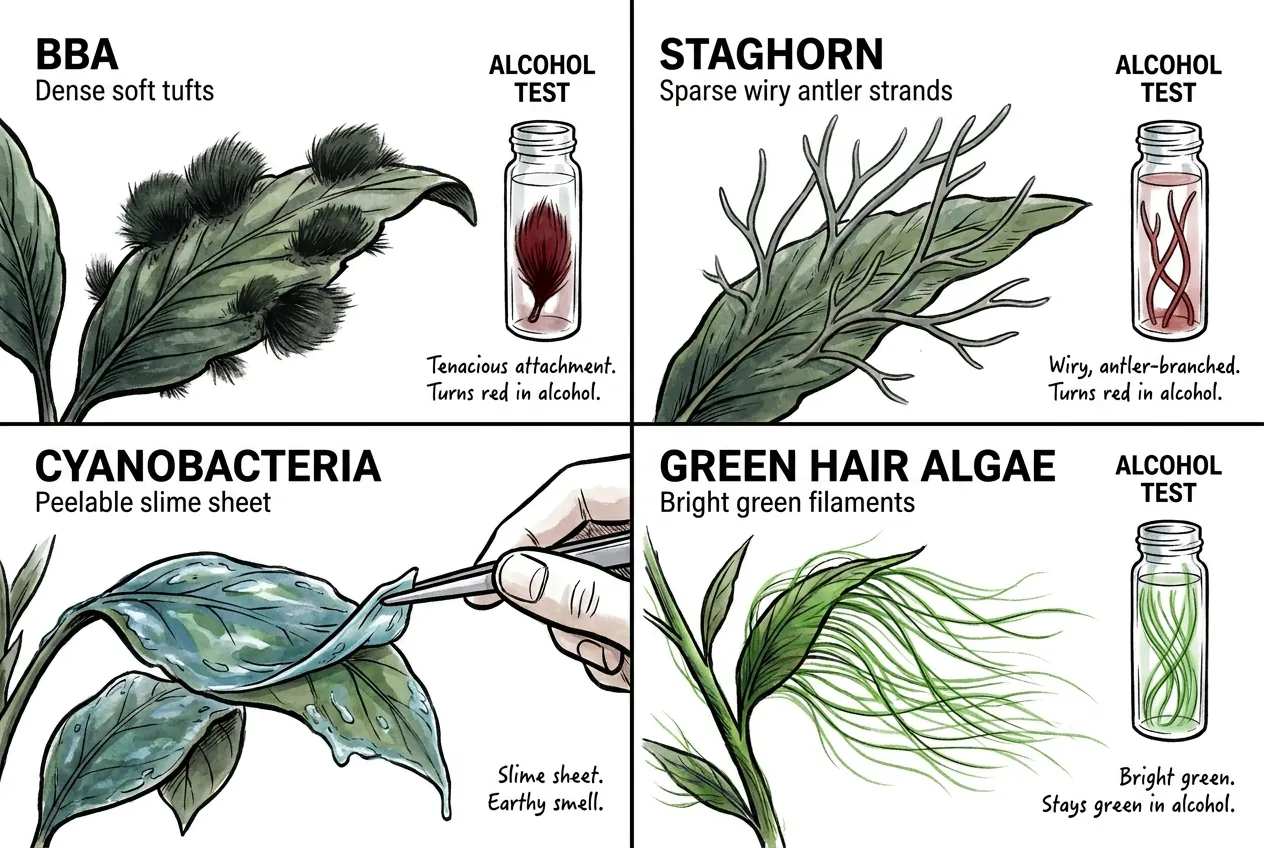
Texture and attachment are more useful than color, which can mislead. BBA typically forms dense, soft, bushy tufts, often around a quarter inch long, clinging firmly to edges and equipment, though length varies with growth stage.
Staghorn is also a red alga (hobbyists often call it Compsopogon, but morphology alone does not confirm the species), so it responds similarly to the alcohol soak, yet it grows as sparse, wiry, antler-branched strands.
Bushy tufts versus sparse antlers is a helpful distinction.
Cyanobacteria is a bacterium, not an alga. Its peelable, often earthy-smelling slime sheet is a common giveaway, though smell and alcohol response alone are not conclusive.
Green hair or thread algae tends to stay green in alcohol because green algae lack the masking phycobilins. The table below is a quick screen, not a diagnostic test.
Algae ID at a glance
| Growth | Texture and shape | Alcohol test | Smell | Commonly associated with |
|---|---|---|---|---|
| BBA | Dense soft tufts, ~1/4 in, tenacious | Turns red | None | Often weak flow or unstable CO2 |
| Staghorn | Sparse wiry antler strands | Turns red | None | Often low or unstable CO2 |
| Cyanobacteria | Peelable slime sheet | No change | Earthy, musty | Slow flow, excess organics |
| Green hair/thread | Long silky green strands | Stays green | None | Excess light or nutrients |
Where BBA grows can be a useful clue
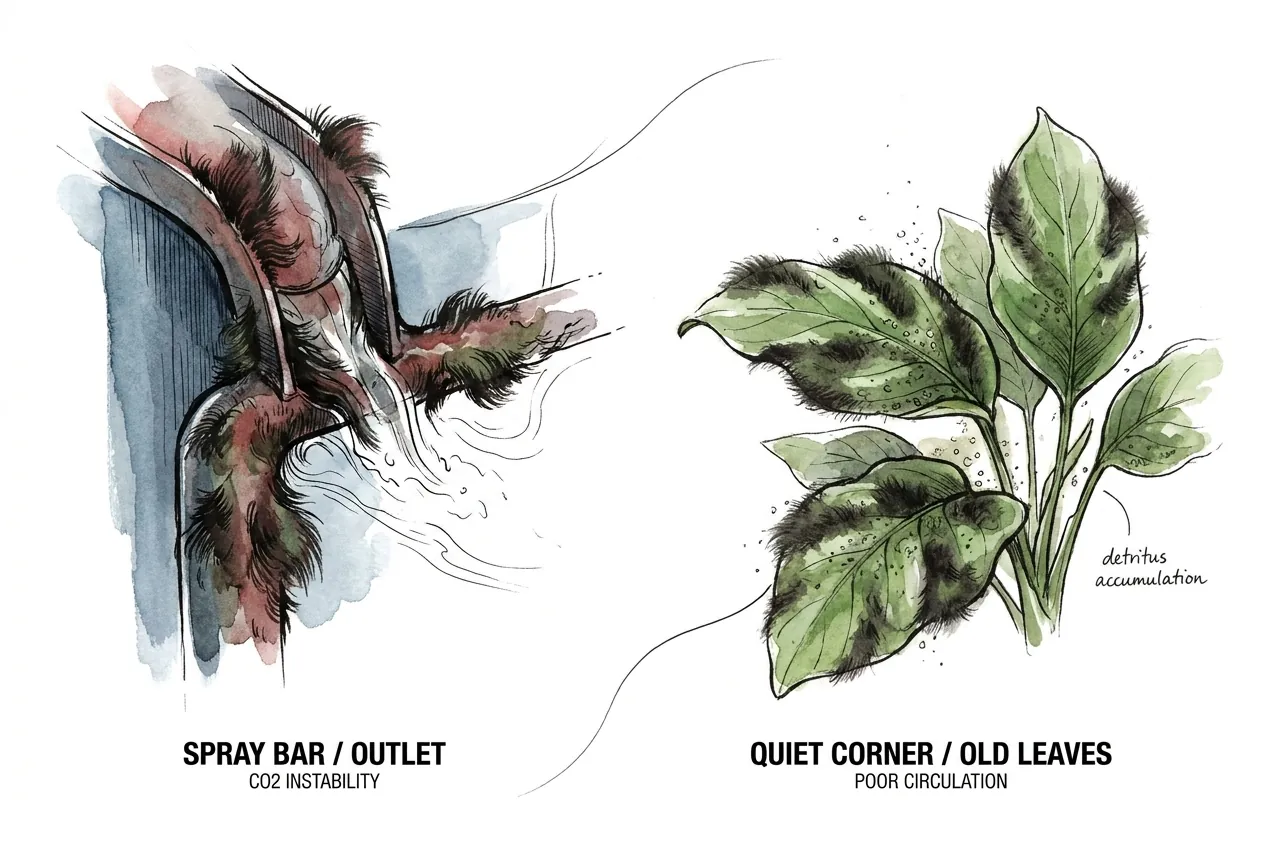
Note where it grows. BBA often attaches to hardscape edges, filter intakes and outlets, spray bars, inline diffuser outlets, and the older, slow-growing leaves of plants like Anubias, Bucephalandra, and Java fern.
Two patterns are worth investigating. Beard on the spray bar and filter outlet is consistent with CO2 or flow instability near the injection path, though light, oxygen, and the surface itself also concentrate there, so it is a hint to check rather than proof.
Beard on detritus-loaded old leaves in a quiet corner is consistent with poor circulation, but old leaf age and slow growth are confounders in their own right.
Treat location as one input alongside your other checks, not a stand-alone verdict.
Audouinella
Phycobilin
16.5. Black Beard Algae
How to Get Rid of Blue-Green Algae in Freshwater Aquariums
How Do Algae Concentrate CO2 to Increase Photosynthetic Carbon Fixation?
Can summer heat make black beard algae worse?
Read Heat Through Oxygen and CO2
Warmer water can add stress in a couple of ways, though whether it is the reason BBA appears in a given tank depends on that tank’s actual temperature, CO2, light, and oxygen, which you should measure rather than assume.
Indoor tanks with room air conditioning behave very differently from tanks exposed to room heat.
As a rough guide for fresh water at sea level, oxygen saturation falls from about 14.6 mg/L near 0°C to roughly 7 to 7.5 mg/L near 30°C, so the oxygen buffer shrinks as water warms.
If you inject CO2, off-gassing can also change with temperature, so a bubble rate that held steady in cooler months may read differently in summer.
These are reasons to keep monitoring, not a fixed formula for your tank.
Respiration also rises with temperature. Reported temperature sensitivity varies by system. One study of oxygen demand found Q10 values around 1.4 to 2.1, meaning demand roughly 1.4 to 2 times higher per 10°C, not a fixed multiple across every organism in a home tank.
The practical takeaway is simply that heat squeezes oxygen supply while raising demand, so watch livestock closely in summer.
What are the measurable warning signs that heat is destabilizing my tank?
Watch a few signals together. A drop checker that reads greener in the morning and drifts bluer by late afternoon can indicate CO2 being driven off during the warmest hours, though injection timing, plant uptake, surface exchange, and the indicator’s own lag all affect the color too.
Reduced pearling at the same setting is a second, non-specific hint. Fish gasping at the surface at dawn is a more urgent oxygen or CO2 warning that needs immediate attention in its own right, rather than a BBA diagnosis.
Pure gas solubility changes only modestly at hobby CO2 levels, so faster off-gassing and higher biological demand matter more than lost saturation.
Plant carbon demand does rise with temperature, but by an amount that depends on species, light, and acclimation rather than a single fixed percentage.
The cooling-fan trap
There is a trade-off to be aware of in summer. Surface fans, extra agitation, and stronger flow increase air-to-water contact, which helps oxygen but can also drive off more injected CO2.
So added surface agitation may lower your dissolved CO2. If that happens, adjust injection gradually and re-check with your drop checker and by watching fish behavior, rather than reflexively cranking CO2 up the same day.
Never raise CO2 to chase a color while livestock might be oxygen-stressed.
The safety priority is fixed. When livestock are oxygen-stressed, add aeration and cooling first, then re-tune CO2 slowly against measured pH and fish behavior.
Never push CO2 higher while fish are gasping.
Dissolved Oxygen. Fundamentals of Environmental Measurements
The Impact of Water Temperature on Oxygen Saturation
Temperature sensitivity of oxygen demand varies as a function of organic matter source
CO2 Q&A. The Science Behind
How do I diagnose the flow dead-spots that grow black beard algae?
Map the Stagnant Film
A dead spot is a zone where water, and therefore dissolved CO2, barely moves, so the still film clinging to each leaf is slow to renew.
That film is the diffusion boundary layer. On aquatic leaves it can be on the order of half a millimeter and noticeably thicker than on land plants, though the exact thickness depends on flow velocity, leaf shape, and temperature.
Because CO2 diffuses far more slowly in water than in air (by several orders of magnitude), a thick boundary layer is a real bottleneck.
Where flow is poor, a leaf can be locally carbon-limited even if your drop checker near the outlet reads a comfortable green.
Some algae, and many aquatic plants, can also use bicarbonate when free CO2 is scarce, so which one gains in a low-flow microzone is not settled by carbon strategy alone. It also depends on light, nutrients, and the plant’s condition.
Improving flow in these zones is still worthwhile.
This is one reason simply adding more CO2 sometimes fails. In some tanks distribution matters as much as dose.
In others the limiting factor may be light, biomass, or nutrients, so check flow as part of the wider picture rather than as the sole fix.
How can I map dead spots for free?
Two cheap tracer tests help reveal stagnant zones, with no special instrument needed. They show coarse water movement, not leaf-level mass transfer, so treat them as qualitative screens.
The food-particle test
Turn off the CO2, then drop a pinch of fine food near a suspect zone. Good spots to test are back corners, behind or under hardscape, low near the substrate, or the far end from the filter return.
Where particles hang, swirl slowly, or sink and sit, that settling zone is a dead spot.
Where they move off quickly, coarse flow reaches that spot, though very fast jets can also stress fish and a visible particle path does not capture the whole leaf boundary layer.
The CO2 mist trace
If you run pressurized CO2 through a fine diffuser, watch the fog travel across the tank toward the filter outlet side.
If it does not reach the far side, flow may be weak or the diffuser coarse, though bubble size, dissolution, and viewing angle also affect what you see, so absence of visible mist is not proof of a dead spot on its own.
Map every BBA tuft
Photograph or mark each tuft, then compare against your food and mist tests. Tufts at high-flow edges and tufts in quiet corners point toward different flow and CO2 situations to check, but read them as hints to test, not a map that fixes the cause by location alone.
I place small removable tape marks along the outside edges of the front glass and use them as coordinates for each tuft and tracer test. The camera stays in one position while I record the filter setting and spray-bar angle. I repeat the food-particle path after cleaning the filter or moving the outlet.
Only one piece of flow equipment changes between recordings. Without fixed coordinates, a tuft can appear to be in the same place after a hardscape change even though the local current has moved, which makes the comparison nearly useless.
How much flow does a planted tank actually need?
Consider total turnover as well as distribution, since you cannot distribute flow you do not have.
A commonly cited hobby rule of thumb is roughly 10x tank volume per hour, partly because real filters under-deliver their rated GPH once media and hose head-loss are counted.
A canister rated at 260 GPH on a 40-gallon tank looks like 6.5x on paper but often delivers less.
Others prefer a gentler 4 to 6x for CO2 preservation, and well-distributed lower flow can work better than poorly-aimed high flow.
These are starting points, not universal targets. Your stocking, plants, tank shape, and species’ flow tolerance should guide adjustments, and it is worth measuring or estimating actual output rather than trusting the rated number.
Aquatic Plant Physiology
Photosynthesis by Aquatic Plants. Effects of Unstirred Layers
Black Beard Algae. Causes and Fixes
Trying to eradicate a dead spot / flow distribution
How do I fix flow dead-spots with circulation and spray-bar aiming?
Spread Flow Without Blasting the Tank
The goal is a gentle, tank-wide circular loop that reaches most surfaces, not simply more raw flow.
Water should reach, but not blast, plants and hardscape, keeping CO2-rich water moving. Some livestock and refuge areas do better with slower flow, so even coverage matters more than hitting every square inch.
Higher velocity can thin the rate-limiting boundary layer and vent oxygen that builds up at the leaf surface, which can lift photosynthesis.
In one study of freshwater Vallisneria, downstream photosynthesis at low CO2 rose with water velocity under that experiment’s specific conditions.
A separate marine study reported net photosynthesis rising 1.9 to 3.5x when flow was switched on in corals, a benthic alga, and seagrass.
Those results show the mechanism is real, but the exact multipliers come from different organisms and conditions and should not be read as the gain from a powerhead in your freshwater tank.
How should I aim the spray bar and powerhead?
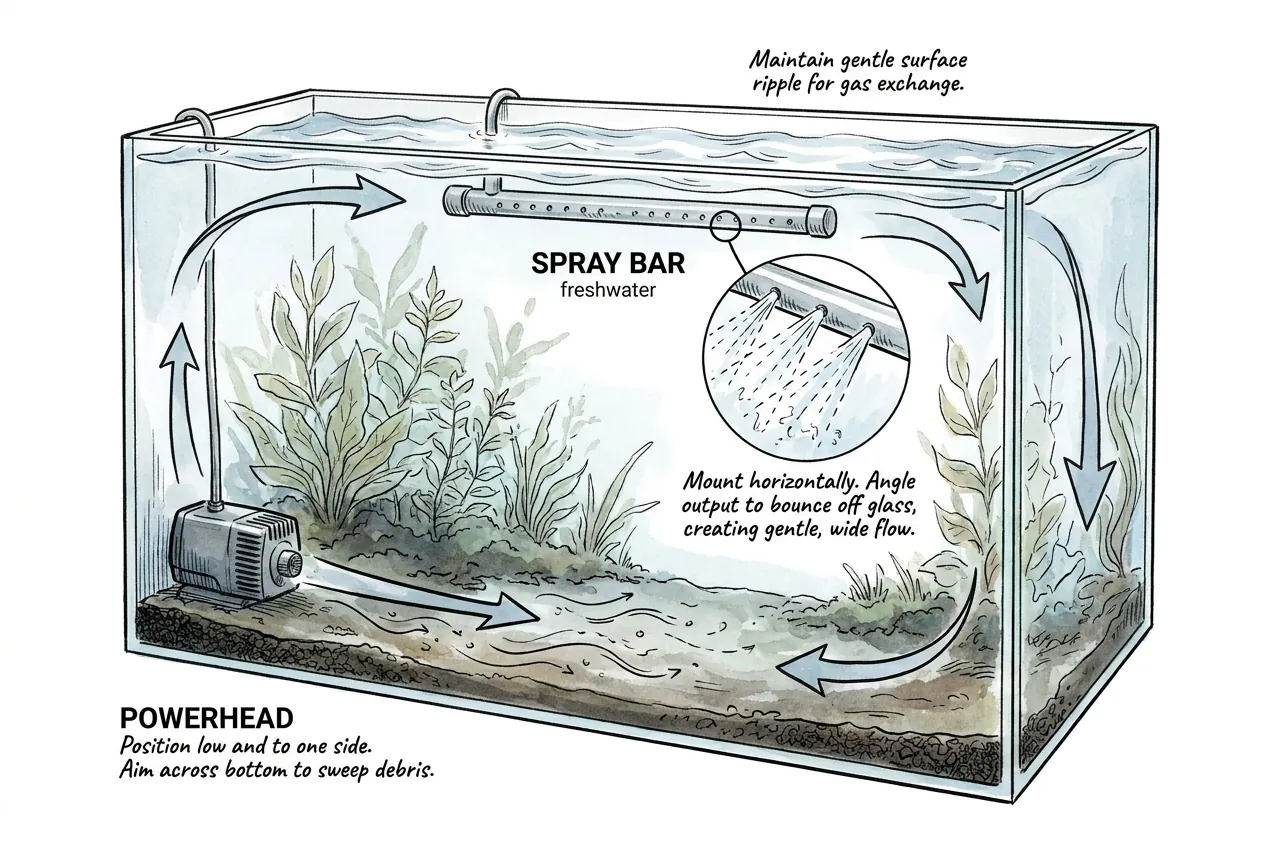
One workable starting point is to aim outputs to build a rotating current. Across the top, down the far end, along the bottom, and back up.
Mounting the spray bar horizontally along the back wall with holes angled slightly toward the glass lets the spray bounce off and lose force before it churns the surface, spreading momentum rather than stripping one spot bare.
Intake position and tank shape change what actually happens, so verify with a tracer test.
If a corner stays stagnant, a powerhead low and to one side, aimed across the bottom toward the front glass, can help sweep the substrate line where detritus settles.
Keep the surface ripple gentle, enough for gas exchange but not a rolling boil, since heavy churn off-gasses CO2 and can stress some fish and shrimp depending on species and velocity.
What powerhead should I actually buy?
If you decide a corner needs extra help, a supplemental powerhead with adjustable output lets you use the gentlest setting that still clears the stagnant zone without bending foreground plants or pinning fish.
Choose by footprint, plants, fish swimming ability, intake safety, glass thickness, and noise, not tank gallons alone.
hygger Lite Wave Maker fits a small-to-medium planted tank when you need to turn supplemental circulation down to a gentle level. It can still be too strong for a very small tank, so begin at the lowest constant setting and watch plants and livestock before trying pulse modes.
What to keep in mind
At full power in a small tank it is far too strong, so treat the 792 GPH as headroom and, in constant mode, run it low.
Skip it entirely if a well-aimed spray bar already reaches the areas you need. Compare non-affiliate options on the same specs before buying.
hygger Double-Head Wave Maker fits a larger tank where one return cannot reach every corner. Its heads can be aimed, but the output is not adjustable, so it is a poor fit for small tanks or livestock that cannot tolerate strong current.
What to keep in mind
2100 GPH is a lot of raw flow with no way to reduce it, so aim the heads at the glass to disperse momentum rather than blast the scape, and watch that it does not over-churn the substrate or stress livestock.
It is oversized for tanks under about 40 gallons, and an adjustable-output pump is a better fit if you need to run flow gently.
Flow enhances photosynthesis in marine benthic autotrophs
The interaction of CO2 concentration and spatial location on O2 flux in Vallisneria
How to Increase Water Circulation and Get Faster Flow in Your Aquarium
Creating Gentle Water Movement. How to Use Spray Bars Effectively
How do I stabilize CO2 to discourage black beard algae?
Stabilize the Daily Carbon Pattern
If you inject CO2, aim for a steady daily level rather than a bigger number. A common hobby view is that BBA is associated with fluctuating CO2 more than with a low but steady level, though this is experience-based rather than shown in controlled aquarium trials.
Aquariadise makes the case that the issue is fluctuation rather than simply too much or too little CO2.
The practical illustration is that a tank held steady around 20 to 25 ppm may fare better than one that spikes to 35 and crashes to 10, treated as a plausible example rather than a proven threshold.
The usual explanation is plant acclimation. Plants tune their carbon-fixing machinery to the CO2 they experience, so day-to-day swings can force repeated re-acclimation and less efficient photosynthesis.
Whether that translates into leaked carbon feeding BBA is a proposed mechanism, not something demonstrated for aquarium BBA, so hold it loosely.
How do I verify stable CO2 with a drop checker?
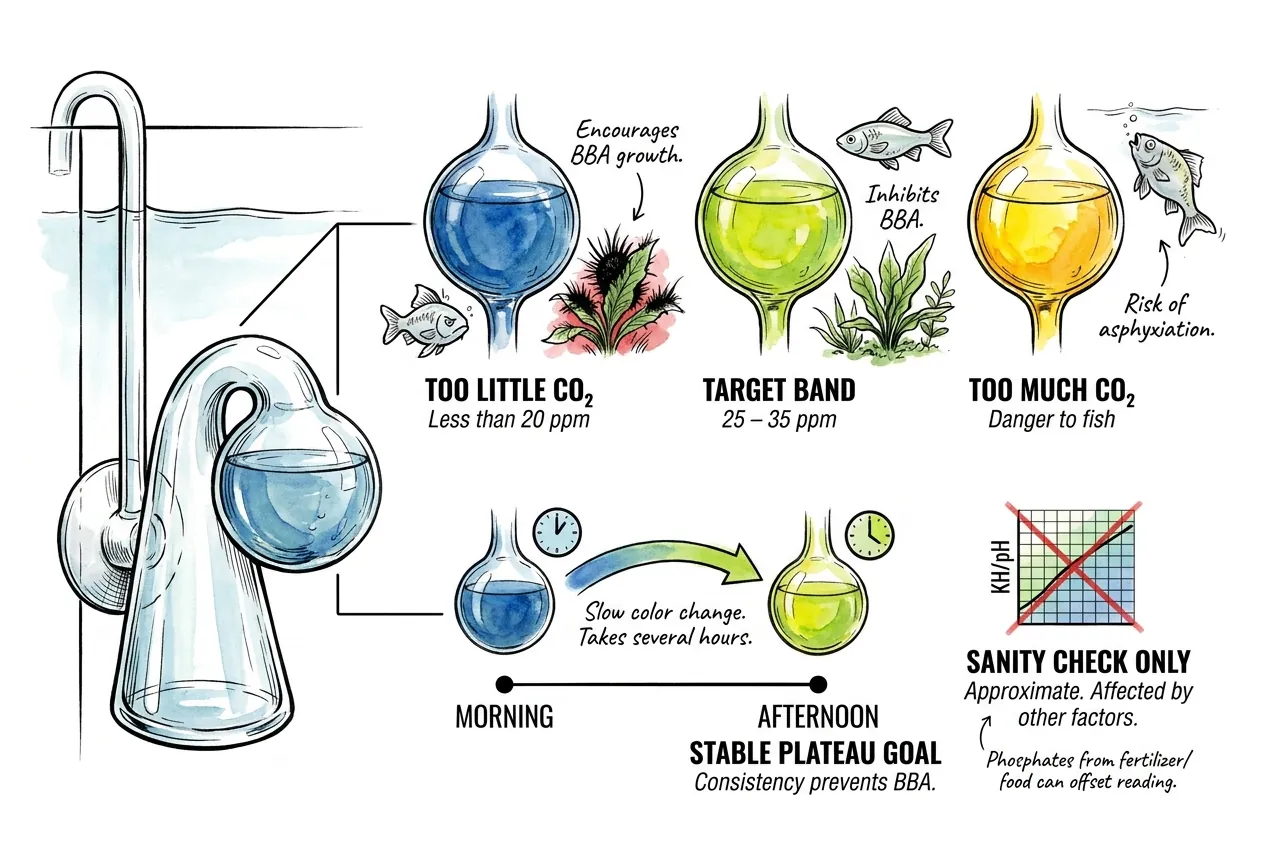
Use a drop checker charged with a 4 dKH reference solution and bromothymol blue, then read it at the same time each afternoon.
Broadly, blue suggests lower CO2, green sits in the commonly cited 25 to 35 ppm range, and yellow suggests too much and possible danger to fish.
Read these as approximate. Temperature, lighting, and your own color perception all shift the reading, so watch fish behavior and pH change rather than chasing an exact shade.
Treat it as a slow trend gauge, not a spike detector. Its solution can take several hours to change color, useless for catching short spikes but ideal for confirming the stable day-long plateau you care about for BBA.
If it reads blue in the morning and green by night, a late-ramping injection may be one cause worth checking, so try bringing the ramp-on earlier.
Note that an overnight or lights-off blue can also be normal, so do not treat every color shift as harmful instability.
The KH/pH chart is a rough sanity check, not a precise meter. The approximate formula is CO2 ppm ≈ 3 × KH × 10^(7 − pH). By that math, KH 4 at pH 6.6 lands near 30 ppm.
Treat it loosely. It assumes a carbonate-only system, so phosphates from fertilizers and food, aquasoil, organic acids, and gas equilibration all shift the relationship, and the charts will not hold exactly.
How do I engineer stability with a solenoid and timer?
A solenoid valve on a timer makes it easier to deliver CO2 at the same level and time each day than adjusting a valve by hand, though careful manual operation and low-tech, non-injected tanks are also valid setups.
A common starting schedule turns CO2 on 1 to 2 hours before lights come on, and off about 1 hour before lights go off.
Ramping on early lets CO2 equilibrate so plants have a supply when lights strike. Turning off early lets the last of the day’s CO2 get consumed before dark.
Response times vary between tanks, so adjust to your own pH profile and livestock rather than treating these hours as fixed.
CO2Art PRO-SE dual-stage regulator helps reduce output-pressure drift and end-tank dump if you run pressurized CO2 and want steadier delivery.
It has an integrated solenoid for a timer schedule plus a needle valve and bubble counter to set and hold your target.
Its specs check out, but no product on its own is proven to clear BBA, and it is worth comparing against other regulators.
What to keep in mind
This is a serious investment compared with a single-stage regulator, and it only makes sense on a pressurized CO2 tank, not on a low-tech or liquid-carbon-only setup.
It uses the CGA320 North American cylinder thread.
JARDLI Glass CO2 Drop Checker Kit is an inexpensive way to watch whether CO2 is holding steady.
It ships with a pre-mixed 4 dKH reference solution, which is the standard used for these checkers, since random tank water gives false readings.
Indicator accuracy, calibration, and shelf life vary between units, so treat it as a trend tool.
Fill it half full and suction-cup it opposite the diffuser to watch for a summer drift toward blue.
What to keep in mind
The multi-hour lag means it will never catch a fast spike, so use it as a day-to-day trend gauge, not an alarm.
How do I adjust CO2 for summer degassing?
Expect to re-tune. The same bubble rate that read green in April can read blue in July with nothing else changed, because warm water off-gasses CO2 faster.
Nudge the bubble rate up or ramp CO2 on earlier to bring the reading back toward green, and re-check the drop checker weekly through the hot months, watching pH and fish behavior as you go.
Because warm water holds less oxygen, a small night airstone can defend oxygen. Note that added aeration also off-gasses CO2, so the two partly offset and you should adjust gradually rather than pushing both hard at once.
Never push toward yellow. Gasping fish means back off CO2 toward green and increase surface exchange immediately, because livestock oxygen always outranks plant CO2.
Black Beard Algae
Measuring CO2 (Drop Checkers)
How to Set Up a CO2 System (Timer, Solenoid, Airstone)
Aquarium CO2 System Guide
What Do Soda and the Oceans Have in Common?
How do I remove the black beard algae that is already there?
Remove the Existing Growth Before Chemical Steps
Existing BBA cemented to hardscape and slow leaves is unlikely to disappear on its own when you improve flow and CO2, so plan to remove it physically or, as a last resort, treat it.
Physical removal and trimming are the lowest-risk options and should come first.
Some hobbyists spot-treat with a liquid-carbon supplement or dilute hydrogen peroxide. Both carry real risk to fish, shrimp, and filter bacteria, and neither is sold or recommended by its maker as an aquarium algaecide, so approach them cautiously and never as a routine.
Dying BBA often turns red or pink, then pale, over several days, but color change is a weak indicator and timing varies.
If you do treat in the tank, turning the filter and powerheads off concentrates the dose near the algae.
This does not guarantee fish avoid the plume, so watch livestock closely and stop at any sign of distress.
What should I know before spot-dosing liquid carbon?
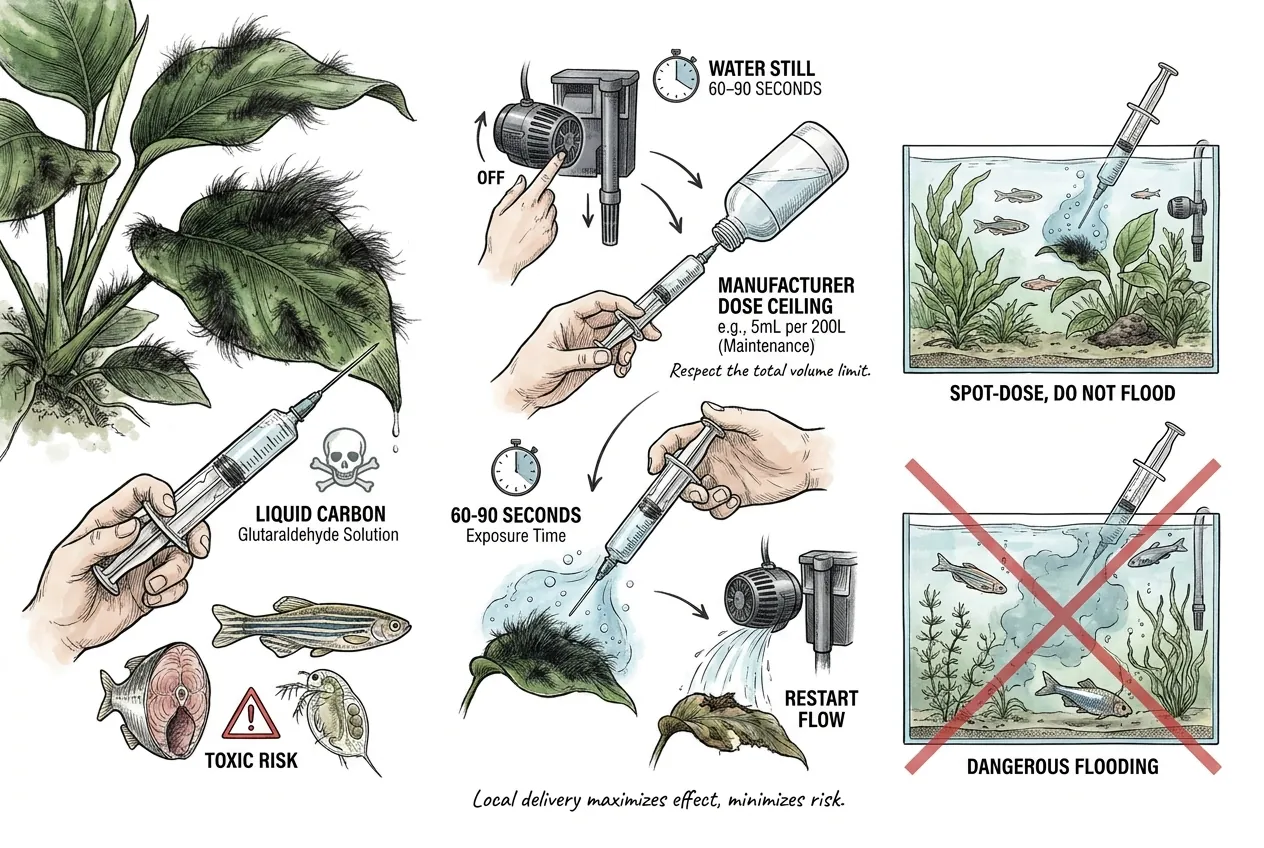
Seachem Flourish Excel is not glutaraldehyde, according to Seachem. Its active ingredient is 2.0% polycycloglutaracetal, and Seachem does not market or recommend the product as an algaecide.
Older hobby lore that calls these products liquid glutaraldehyde and applies glutaraldehyde toxicity figures to them is inaccurate.
Because Excel is a different compound, published glutaraldehyde toxicity numbers do not set a safe dose for it.
The general lesson is only that carbon supplements can harm sensitive plants and are not risk-free around livestock, so any off-label use is at your own risk.
Seachem’s official directions are whole-tank water-column doses. They do not approve a concentrated, filter-off spot plume, which produces much higher local exposure.
Seachem also notes that direct spot treatment or overdosing can damage plants. In their own testing, Vallisneria grew at the recommended dose, with some melting reported only at higher doses, so a blanket claim that Excel melts Vals is not accurate. Sensitivity depends on dose and species.
What to keep in mind
Flourish Excel is a supplement, not an algae treatment its maker endorses. If you keep sensitive species such as some Vals, mosses, or Anacharis, dose conservatively at the recommended water-column rate and watch plants, or simply remove and clean items rather than dosing the whole tank.
What are the risks of using hydrogen peroxide around livestock?
Hydrogen peroxide oxidizes BBA and breaks down into water and oxygen, leaving little lasting residue once it has decomposed.
That decomposition is why it is sometimes used to add oxygen in emergencies. It does not mean the treatment itself is safe, because the oxidative damage happens before it breaks down and depends on concentration and contact time.
Before it breaks down, peroxide is harmful to filter bacteria, shrimp, and scaleless fish.
In a commercial recirculating-aquaculture study, dosing a biofilter section directly with 64 mg/L reduced its ammonium-removal rate (from about 0.60 to 0.13 g N per m² per day). That is a change in efficiency at a high, direct dose, not a measured 80% bacterial kill in a home tank.
Reports of aquaculture overdoses killing most of the fish exist but usually lack the species, product concentration, and exposure needed to set a safe home-tank dose.
If you use it, use only 3% hydrogen peroxide and never a stronger stock. What matters is the final concentration and exposure, not the stock strength alone.
There is no peroxide dose that is safe for every stocked tank. Fish, shrimp, temperature, and water quality all change the risk, so do not treat a hobby recipe as a livestock-safe ceiling. Avoid dosing a stocked display when physical removal or treatment outside the tank can solve the problem.
When is manual removal or an out-of-tank dip the fastest path?
For a heavily encrusted removable rock, hardy plant, or non-biological hardware, taking it out and cleaning it is safer than spot-dosing every tuft, and trimming BBA-cemented old leaves is usually smarter than trying to save them.
If the item is a filter sponge carrying your nitrifying bacteria, factor its removal or treatment into your cycle before acting.
An out-of-tank dip can be stronger than anything safe in a stocked tank, but dip safety depends heavily on plant species, tissue condition, and the exact concentration and time, none of which are well established across the board.
Treat the times below as retailer-recipe starting points, not validated safety limits, and test on a small piece first.
For a peroxide dip, a short soak of a few minutes in 3% hydrogen peroxide followed by a thorough rinse in fresh dechlorinated water is a common approach.
For a bleach dip, use only plain unscented household bleach with no detergents or splash-less additives, mixed roughly 1 part bleach to 20 parts water.
Household bleach strength varies, so the ratio alone does not fix the final concentration.
BBA pales quickly in bleach, so keep dips brief and matched to plant hardiness, and rinse and neutralize thoroughly afterward.
Out-of-tank bleach dip times by hardiness
These are hobby-retailer starting points in 1/20 unscented bleach, not tested safety limits.
Skip bleach entirely for the most delicate species, such as Vallisneria and delicate crypts, and prefer to trim and discard heavily affected material.
Test any plant on a small piece first.
| Item | Dip time in 1/20 unscented bleach |
|---|---|
| Less hardy plants (test first. Skip the most delicate species) | Up to about 90 seconds |
| Average stem plants | About 120 seconds |
| Hardy Anubias, Java fern, hardscape | Up to 150 seconds |
After any bleach dip, rinse the item thoroughly in fresh dechlorinated water, then soak it in a dechlorinator solution before returning it, to reduce residual chlorine before it reaches the display.
To be confident it is gone, use enough conditioner for the water volume and, if you can, test for residual chlorine rather than assuming a single soak clears it.
Seachem Prime Water Conditioner is a concentrated chlorine and chloramine conditioner suitable for this rinse-and-soak step. Dose it for the volume of your rinse water per its label.
What to keep in mind
Prime is a water conditioner, not an algae killer, so it does nothing to the BBA directly.
Avoid bleach-dipping the most delicate species, such as Vallisneria and delicate crypts, and just trim and discard anything you can.
From sub cellular to community level. Toxicity of glutaraldehyde to several aquatic organisms
Seachem Flourish Excel Dosing Instructions
Use Hydrogen Peroxide to Boost Dissolved Oxygen Levels in an Emergency
6 Easy Steps to Bleach Dip Aquarium Plants
How to get rid of Black Beard Algae (BBA)
Which algae eaters help, and how do I lower the risk of treatments?
Keep Livestock Safety Ahead of Algae Removal
The Siamese algae eater (sold under the name Crossocheilus, with several species in the trade) is among the few freshwater fish commonly reported to graze BBA, but it eats mainly soft young tufts and will not clear an established mat.
Treat any fish as a slow supplement to fixing flow, CO2, and husbandry, and only if you can house it properly long-term, not as a quick fix.
Identification helps, since stores often sell similar-looking fish that ignore BBA. A true SAE typically shows a single ragged black stripe running from snout into the tail fin, no gold band above the stripe, and clear fins without black edging.
These are screening clues, not a guarantee of species, since several look-alikes exist and markings vary.
Black edging on the top or bottom fins points away from a true SAE, as that pattern is often a Flying Fox, but confirm with a knowledgeable seller rather than relying on one marking.
Before buying, plan for adult size, group behavior, swimming space, tank compatibility, and a complete diet. Do not buy a fish as a tool or deliberately underfeed it.
What are realistic expectations for biological control?
Even the right fish will not clear a tank quickly. It may not eat fast enough to keep up, and hardened mature mats often get ignored in favor of soft tufts or fish food.
As SAEs age, their appetite for algae tends to drop. BBA can take many months to establish, but the time it took to appear does not set how long removal will take, so judge progress by results rather than a fixed timeline.
Amano shrimp (Caridina multidentata) tend to nibble only BBA already weakened by other treatment and will not eliminate it. They are more useful on soft green and hair algae.
Invertebrates are generally sensitive to the chemical treatments above, so keep them out of harm’s way during any dosing and think of them as post-treatment cleanup, not a front-line fix.
How do I reduce the risk if I treat a stocked tank?
There is no fully safe chemical dose for a stocked tank, so weigh whether physical removal or dipping removable items would avoid dosing your display at all.
If you still choose to treat in-tank, put oxygen first. Warm summer water already holds less oxygen, and aeration is your main safety control.
Peroxide itself breaks down to release oxygen. The risk is its oxidative toxicity before it decomposes, not a drop in dissolved oxygen.
A lower-risk treatment sequence
| Step | Action |
|---|---|
| 1. Aerate first | Add an airstone or extra surface agitation before dosing to keep oxygen up |
| 2. Spot-dose, filter off | Syringe the dose onto the algae, filter and powerheads off 15 to 20 minutes |
| 3. Keep doses low and local | No dose is safe for every tank. Hobby peroxide figures (about 8 to 12 mg/L) overlap concentrations some ornamental fish do not tolerate. Test on a small subset first and stay well below hobby maxima |
| 4. Watch closely | If any fish gasp or shrimp go pale, do an immediate 25 to 50% water change and stop treatment |
Invertebrates are sensitive to these treatments, so watch shrimp as your first warning sign and keep doses at the low end.
In the glutaraldehyde study, invertebrate and fish endpoints were similar (invertebrate EC50s around 3.6 to 6.6 mg/L and adult zebrafish LC50 around 5.5 mg/L, with no significant difference reported between trophic levels), so the sensitivity gap is smaller than often claimed.
If you move shrimp out during treatment, do it properly with matched temperature, oxygen, cover, and acclimation, since a bare bucket can be more stressful than staying put.
A blackout has limited effect on established BBA. If you try one, keep it short, leave filtration and aeration running throughout, and skip it for heavily stocked or shrimp-dominant tanks, since oxygen can fall in a dark, sealed tank while slow-growing BBA is unlikely to starve out in a few days.
Siamese algae-eater (Crossocheilus oblongus)
How to get rid of black beard algae (BBA). Aquarium Co-Op FAQ
Use of Hydrogen Peroxide in Finfish Aquaculture (UF/IFAS FA157)
How do I keep black beard algae from coming back next summer?
Turn the Diagnosis Into Routine Husbandry
Prevention is ongoing husbandry, not a one-time treatment. BBA tends to return when several things drift together. Unstable CO2, weak flow with dead spots, accumulating organic waste, and lapses in maintenance, with heat as one aggravating factor.
Keep CO2 as steady as your setup allows, maintain gentle flow that reaches most of the tank, and use a reasonable photoperiod.
Around 6 to 8 hours is a common starting point, but the right length depends on your light intensity and plants, so adjust rather than treating it as a hard cap.
Keep plants healthy so they compete well, and dose nutrients consistently rather than starving the tank.
Ranges such as nitrate 10 to 20 mg/L and phosphate 0.5 to 1 mg/L are common hobby targets, not universal requirements. There is no reliable figure showing a specific small nitrate swing triggers an algae spike, so aim for consistency rather than chasing exact numbers.
How do I keep flow from silently collapsing into summer?
Clean the filter before flow noticeably drops rather than on a fixed date. Monthly is a rough guide, sooner if heavily stocked, but let measured or observed flow and your filter’s capacity set the interval.
As media clog, less water moves through, and weaker circulation plus settling detritus can quietly recreate low-flow zones.
Rinse pre-filter, sponge, and intake in dechlorinated tank water rather than hot tap water to spare your nitrifying bacteria, and clean biomedia less often than mechanical media.
Recheck flow with the food-particle test after any rescape, since new hardscape and dense planting reshape flow paths.
How do I stop importing BBA on new plants and hardscape?
Quarantine and dip new arrivals to lower the chance of reintroducing BBA, keeping in mind no dip guarantees zero reintroduction, since fragments and untreated water or equipment can still carry it.
For plants, use the shortest effective dip from the times above, and skip bleach on the most delicate species, then rinse and soak in a dechlorinator solution.
For inert new hardscape (rock or wood, not plants or livestock), a longer soak in dilute bleach or 3% peroxide can be used, followed by a thorough scrub, rinse, and dechlorinating soak. Match the time to the material and never apply long bleach soaks to plants.
Optionally quarantine new plants for 2 to 3 weeks before they join the display.
What early-warning signs let me catch it before July?
Watch a few early signals together rather than any one in isolation. The first tufts on intakes and edges, a drop checker drifting from green toward blue mid-photoperiod, and reduced pearling on otherwise healthy plants can each point to carbon delivery or flow issues worth checking, though none is a specific diagnosis on its own.
When you notice them, review your CO2 timing, confirm flow reaches the affected spot, and adjust the photoperiod while the tank re-stabilizes.
If cooling is needed, manage temperature to what your specific livestock prefer rather than a single number. A target near 28°C suits some warm-water species but is already too warm for cold-water fish.
A surface fan gives a few degrees of evaporative cooling, so top off more often to offset the faster evaporation.
The freshwater red alga Batrachospermum turfosum acclimates to a wide range of light and temperature
Algae Control in the Planted Aquarium (Seachem Knowledge Base)
Canister Filter Maintenance
The bottom line on beating July black beard algae
Use the Lowest-Risk Sequence First
BBA is not a mysterious curse. It is a freshwater red alga that often reflects something about your tank’s flow, CO2, light, nutrients, or organic load, so where it grows is a clue to investigate rather than a fixed verdict.
Work through it in order. Map low-flow zones with a food or mist trace, improve circulation so it reaches most of the tank, and keep CO2 as steady as your setup allows.
Then remove or trim what remains, treating in-tank chemistry as a cautious last resort with the filter off and livestock watched closely.
Let algae-grazing fish and a healthy plant mass help over time, keep up consistent maintenance, and watch the early signals so you can act before it spreads.
Affiliate Disclosure
This article contains Amazon affiliate links. As an Amazon Associate I earn from qualifying purchases. If you use these links, the site may earn a commission at no extra cost to you. Product availability, price, and specifications can change. Check the current listing before buying.