
Aquarium Surface Film in Summer: Cause and Fix
Summer aquarium surface film comes from surface-active organics collecting on a still surface. Learn how to diagnose it, why warm water raises the stakes, and how surface movement clears most films.
Priya Patel · Published 2026-06-28 · 25 min read
Key Takeaways
- Surface film needs both surface-active organics and a still surface. Restore surface movement and check the organic sources feeding the film.
- Warm freshwater holds about 17 percent less oxygen at saturation from 20°C to 30°C. Surfactant films also slow gas exchange, although the largest published reductions come from ocean CO2 studies.
- Poking the film gives a clue, not a diagnosis. Re-forming swirls suggest organic film, a persistent rainbow sheen suggests oil, and cloudy water throughout suggests a bloom.
- Match the tool to the failure mode. A skimmer removes the top layer, a circulation pump keeps the surface moving, and an airstone provides overnight oxygen insurance.
- Fish gasping at the surface is an emergency. Aerate immediately, then check ammonia, nitrite, CO2, temperature, and filter flow before assuming low oxygen.
Someone tells you to stop overfeeding the second a greasy sheen shows up. That is part of the picture, but rarely the whole story.
Overfeeding adds organics, yet a film needs a still surface to persist.
It is really two factors working together. Surface-active organics collecting at the top, and a still surface that lets them build up.
Warm summer water also holds less oxygen than it did in spring, which raises the stakes. Restoring surface movement clears most films quickly, but you still want to check what is feeding them.
What is the film on my aquarium surface actually made of?
The film is usually an organic layer at the water’s surface, not spilled oil. Dissolved proteins, fats, plant residue, food, and bacterial growth can collect there when the surface stays still.
This is why wiping it once usually does little. The film regenerates from the dissolved-organic pool below, so it typically returns within hours of skimming.
It is mostly generated inside the tank, though external contamination like hand oils or spilled oil can also contribute.
I film the same surface area for five minutes before feeding, after normal feeding, and after filter maintenance. A fixed reflection line on the glass shows where ripples stop and film gathers.
Outlet angle or surface skimming changes one step at a time before I repeat the filming. A film that returns only after feeding points to a different maintenance problem from one that persists despite strong, even surface movement.
Why does it sit only at the very top?
Some dissolved compounds naturally collect where water meets air. A ripple continually breaks up that layer. A glass-smooth surface lets it rebuild.
How thick is this layer?
The layer is thin, but it can matter because gas exchange happens at the surface. The exact thickness and bacterial makeup have not been measured for a typical home aquarium.
When a film keeps returning, restore a visible ripple and remove the organic sources feeding it instead of trying to identify its microscopic composition.
The sea-surface microlayer is a gelatinous biofilm
Microbiology of aquatic surface microlayers
Sea surface microlayer (encyclopedic synthesis of the SML literature)
High wind speeds prevent formation of a distinct bacterioneuston community
Protein skimmer, mechanism of surface-active organic removal
How do I tell scum from real oil, algae, or a bacterial bloom?
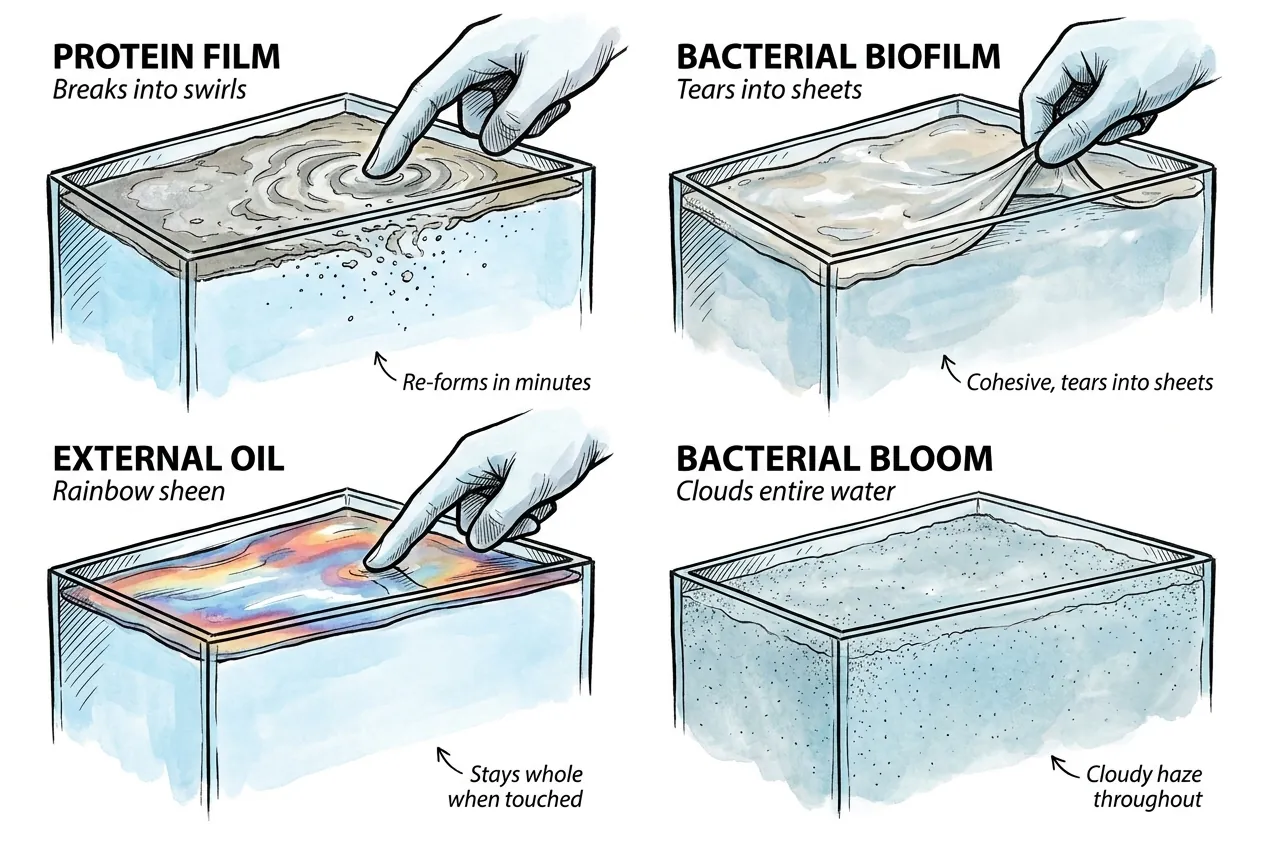
Poke the film and watch what it does. Organic surface film tends to break into swirls and disperse when you disturb it, then re-form from below over the following minutes.
That behavior points toward a microlayer rather than a contaminant, but it is a clue, not proof.
True oil contamination usually behaves differently. It often shows a rainbow, glossy sheen and does not disperse easily when touched, because it is a continuous hydrophobic layer.
It also tends not to regenerate once you remove the source. Thin-film optics and mixed films can blur these signs, so treat them as suggestive.
A bacterial bloom is a third thing. It clouds the whole water column, not just the top millimeter, so the location of the haze is the most useful tell.
A surface film and a water-column bloom can also occur at the same time.
| Look and behavior | Diagnosis | The real fix |
|---|---|---|
| Dull gray-to-tan, breaks into swirls, re-forms in minutes | Likely protein film | Add surface agitation |
| Milky, slimy, cohesive, tears into sheets | Likely bacterial biofilm | Agitation plus remove organics |
| Rainbow sheen, stays whole when touched, no regrowth | External oil | Find and remove the source |
| Cloudy throughout the water column | Bacterial bloom | Filtration / cycling issue |
These are observational clues, not confirmed tests, and the protein-film and biofilm rows are not a fixed time sequence.
When it matters, back them up with a water test and a look at recent tank history rather than the touch behavior alone.
Why does summer heat and still water make the film so much worse?
Summer does not invent the film. It removes the safety margins that normally keep the surface clean.
Warm water holds less oxygen, heat speeds up bacterial metabolism and organic decomposition, and skipped maintenance leaves the surface stagnant.
How much less oxygen does warm water hold?
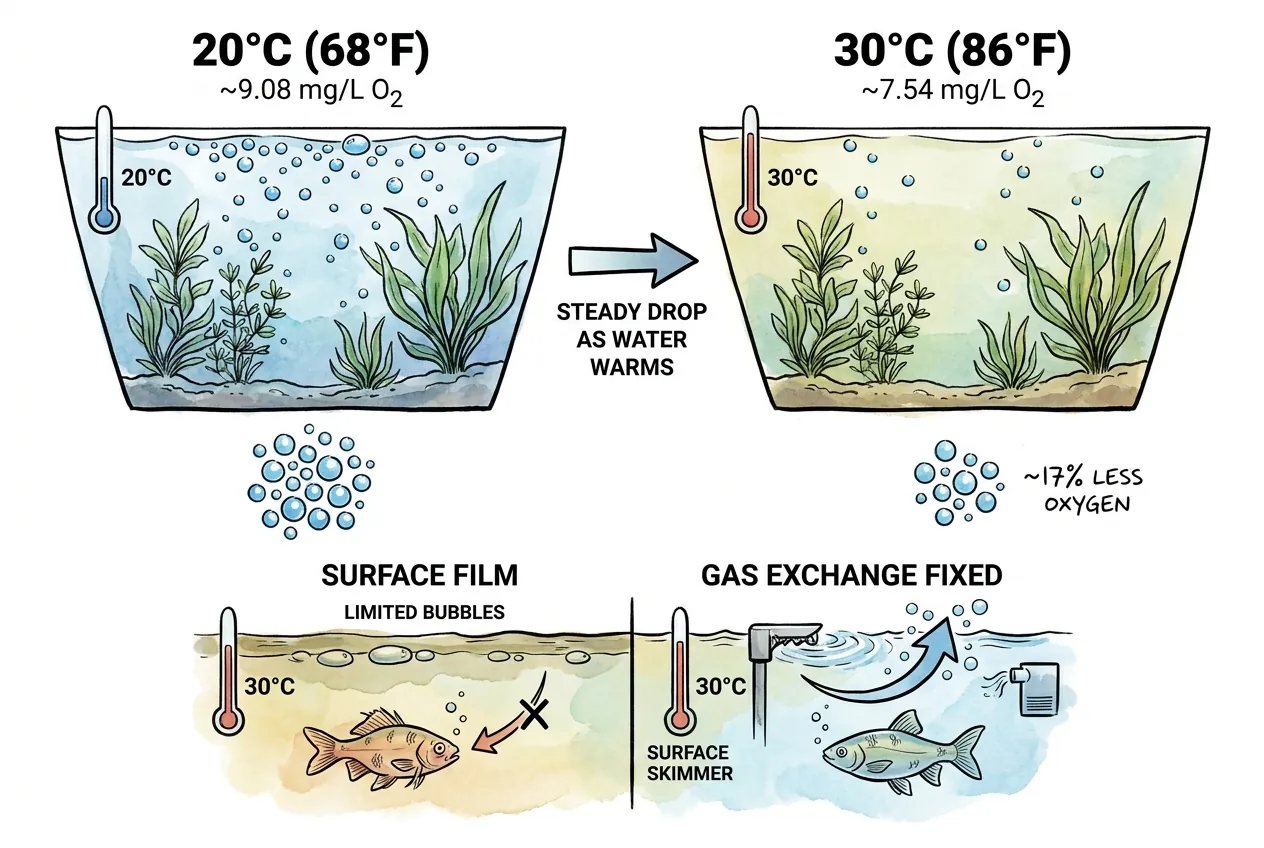
Warm water holds less oxygen than cool water, so a summer tank has less margin for heavy stocking, overnight plant respiration, a clogged filter, or a sealed surface.
In hot weather, keep the surface moving and respond quickly if fish gasp, filter flow drops, or the tank runs warmer than normal.
Dissolved Oxygen (FAO aquaculture training manual, Section 4)
Dissolved Oxygen for Fish Production (University of Florida IFAS Extension, FA002)
Does heat actually speed up the bacteria that build the film?
Warming generally raises the rate at which bacteria consume oxygen and decompose organic matter, which tightens the same squeeze.
Whether it also increases the supply of film-forming proteins, lipids, and surfactants specifically is less clearly established, so treat that link as plausible rather than proven.
Warm water also speeds decomposition, so the feeding and maintenance routine that worked in spring may leave more organics available in summer.
Microbial Respiration, the Engine of Ocean Deoxygenation
Potential changes in bacterial metabolism with increased water temperature (tropical humic lagoons)
Why does evaporation and skipped maintenance matter?
Three summer side-effects compound the problem. Faster evaporation concentrates dissolved organics in a shrinking water column and changes the water level relative to your return, which can shift how much the surface breaks.
Warm surface water also tends to float on cooler water below, so in a poorly mixed tank the top can become a stagnant skin.
Then the husbandry lapses pile on. Vacations, dialed-back filters, and skipped water changes reduce surface turnover and maintenance.
As agitation drops, the surfactant layer stops getting disrupted and the biofilm can consolidate into a continuous, oily-looking film.
Summer is a good time to check surface agitation rather than coast. The reliable rule is to watch the surface itself. Keep a visible ripple, and adjust your spray bar, top-off, and water level so that ripple is maintained as the tank evaporates.
Why is a sealed surface the real danger, not the film itself?
Most of a tank’s exchange between water and air happens across the top fraction of a millimeter of water, so a continuous film can throttle it there.
Rising bubbles from an airstone also transfer some gas directly, so the surface is the main route but not the only one. This is why surface renewal matters as much as it does.
How does gas exchange actually work at the surface?
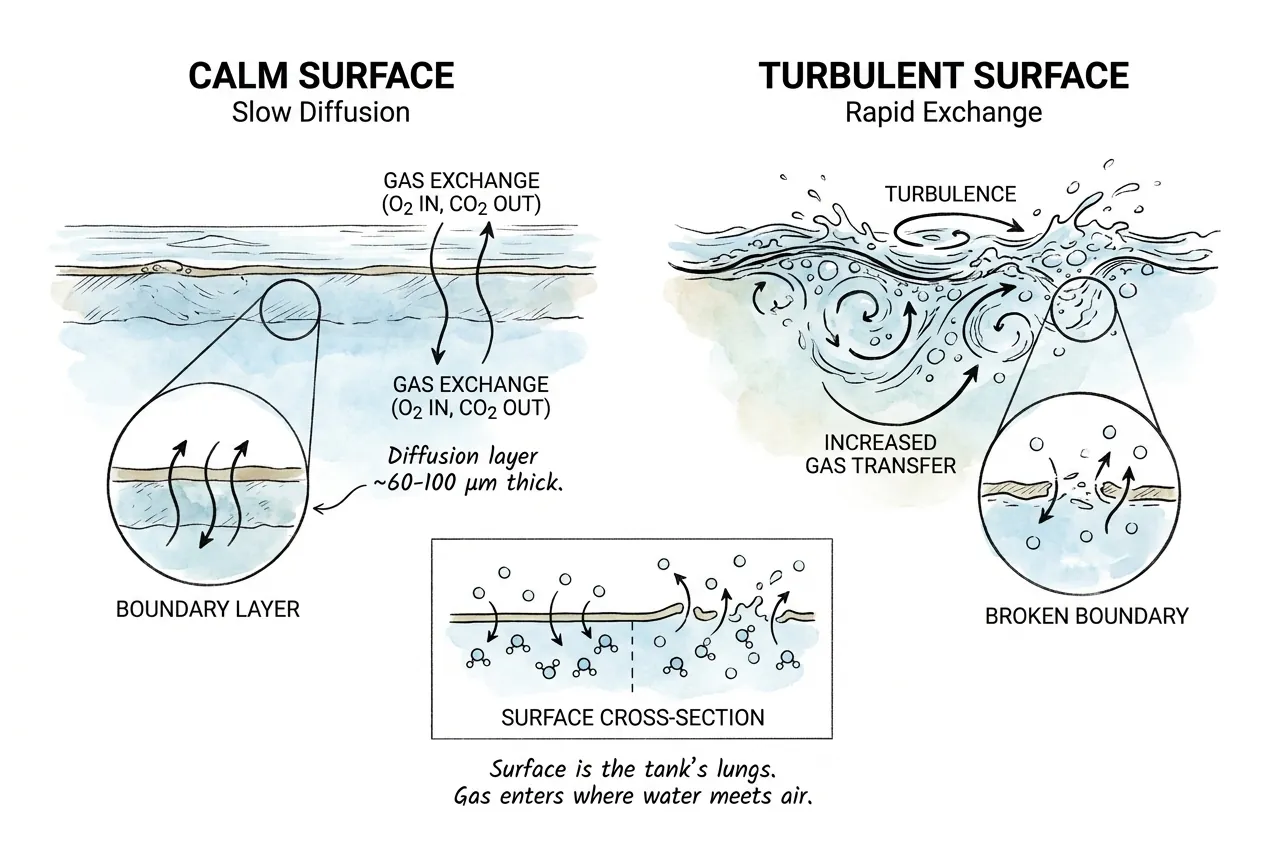
Gases do not just mix into water. They diffuse across a thin liquid boundary layer where turbulence dies out and slow molecular diffusion moves gas.
Reported thicknesses vary with conditions and method. Some studies put the controlling layer at roughly 60 to 100 micrometers, while field microsensor work in a low-turbulence seawater tank measured an oxygen boundary layer near 1.1 mm. Take these as order-of-magnitude, not a single fixed number.
Molecular diffusion through that skin is a slow step, which makes the surface a major control on how fast a still tank takes up oxygen.
Turbulent eddies normally sweep up, strip away the gas-depleted skin, and replace it with fresh water.
Note that in the seawater-tank study above, bulk biological processes still dominated the tank’s oxygen changes, with the surface neuston contributing a smaller share.
This is why surface renewal is so important. Pumping water only near the bottom does little on its own to add oxygen. Gas exchange happens mainly where water meets air, and largely as fast as the surface skin is renewed.
Whether oxygen enters or leaves depends on its gradient, so a supersaturated tank can even off-gas oxygen.
Global reduction of in situ CO2 transfer velocity by natural surfactants
Oxygen Profiles Across the Sea-Surface Microlayer
How much does a film actually cut gas exchange?
No clean aquarium figure is available, so use the research below for direction and rough scale rather than as a number for your tank.
The studies use different gases, water types, surfactants, turbulence levels, and apparatus, so their percentages should not be merged into a single range.
In a controlled study dosing the detergent SDS into a stirred reactor and hydraulic channel, the film cut the surface reaeration coefficient (an oxygen measure) by about 20% when stirred, and by about 15% at higher agitation. The same study noted the effect can be negligible at low agitation.
Separately, in the ocean, natural surfactant films suppressed CO2 gas-transfer velocity by about 23% at modest concentrations and up to 62% in heavy slicks, and another field-and-tank study reported roughly 12% CO2 suppression in a productive ocean filament, rising to 46% to 63% in enriched wind-wave tank experiments.
Those larger numbers are marine CO2 results, not measured aquarium oxygen losses.
The underlying mechanism is easier to state with confidence than the magnitude. An elastic surface layer damps the micro-ripples that renew the boundary layer, and the packed molecular layer adds some diffusion resistance.
Both slow the same surface chokepoint. How much depends on the tank.
The effect of SDS surfactant on surface reaeration coefficient (Revista Ambiente and Agua / SciELO Brazil)
Variability of the Sea Surface Microlayer and Influences on Gas Exchange
Global reduction of in situ CO2 transfer velocity by natural surfactants
Why is the danger worst overnight in summer?
When the lights are off, plants stop photosynthesizing but every organism keeps respiring and consuming oxygen.
Dissolved oxygen falls through the dark period and is typically lowest just before the lights come back on (in a naturally lit tank, around dawn).
Warm water starts that period at a lower ceiling, and a sealed surface slows the atmospheric resupply that would otherwise buffer the drop.
Some published bands give a rough sense of scale. Aquaculture and pond guidance often recommends at least 5 mg/L for optimum health, flags 2 to 4 mg/L as stressful, and treats prolonged exposure below about 1 to 2 mg/L as dangerous for warmwater fish.
These come from aquaculture settings and vary with species, temperature, and exposure time, so use them as context rather than fixed thresholds.
So in summer a heavy film can add to overnight oxygen stress. Fish gasping at the surface on a hot morning and easing off once the tank warms and lights up can point to a nighttime oxygen sag, but a thin film alone does not confirm it, and the same symptom has other causes covered below.
Can I run agitation without losing my injected CO2?
In an injected tank, surface agitation tends to off-gas dissolved CO2 while it helps oxygen exchange, because each gas moves along its own gradient across the same boundary layer.
So a high-tech CO2 tank cannot treat extra agitation as a free win.
One common approach is to split the jobs by clock. Gentler daytime surface movement while CO2 is on, then stronger timed agitation overnight when CO2 injection is off and plants are consuming oxygen.
This is optional and mainly relevant to injected tanks, not something every tank needs.
Should I just add flow, or do I need a surface skimmer?
A surface skimmer is the main powered tool for pulling the film into filtration rather than stirring it back in. It draws in the topmost millimeter, where the surfactant layer and its biofilm sit, and traps particulates and biofilm in its sponge.
That material only leaves the system when you remove and rinse the sponge. Dissolved organics are not all captured.
Manual methods like a paper towel, cup-skim, water change, or an overflow also remove surface film.
Why does skimming beat just adding flow?
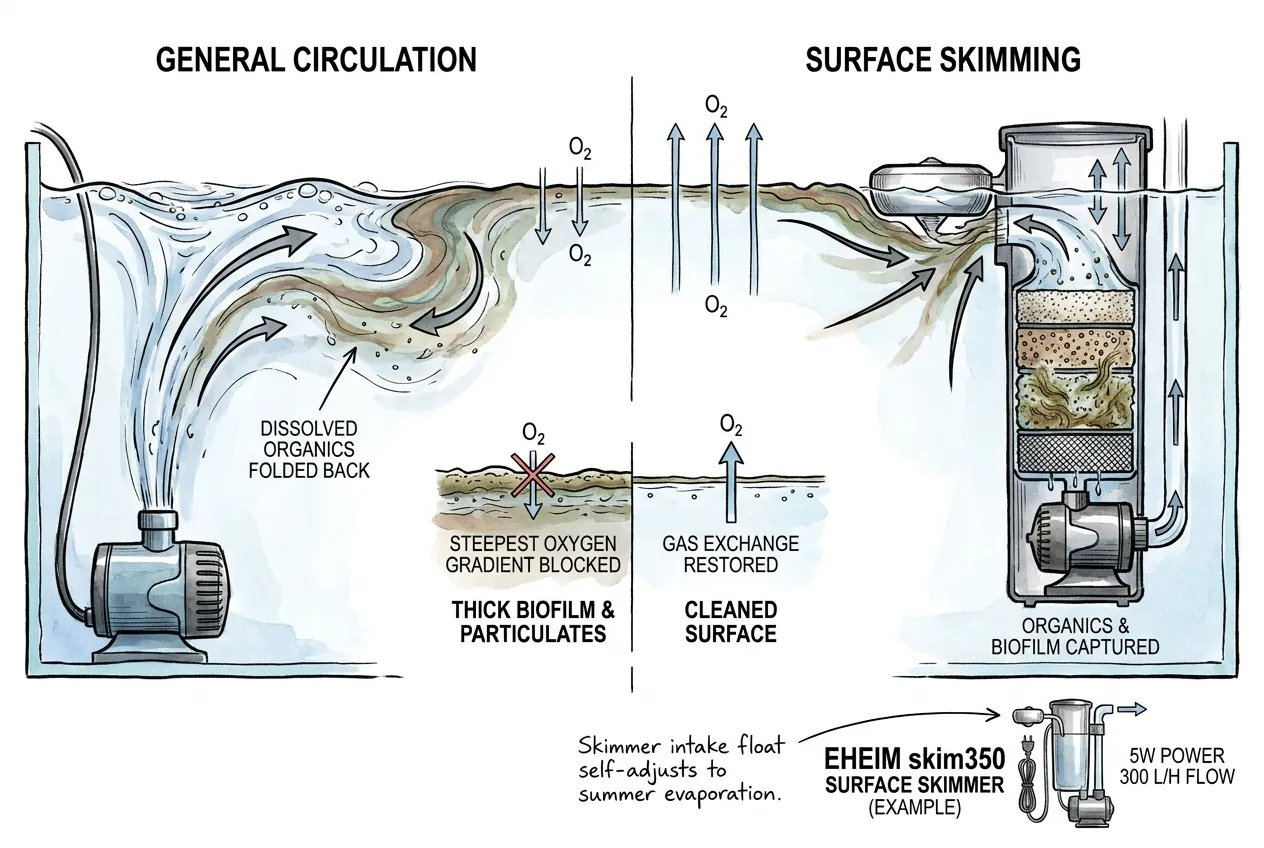
General circulation prevents a film by keeping the surface moving, but it folds surface organics back into the tank rather than removing them.
A skimmer routes the surface layer through its sponge, where biofilm and particulates are captured until you rinse it out. Fine dissolved organics still largely pass through.
The top millimeter is also where the surface gas exchange is concentrated, so keeping it clear and moving helps exchange where a film was blocking it.
If your tank already has decent oxygen and you only want to prevent a film, agitation alone may be enough.
For an existing film you want gone quickly while also pulling out some organics, a skimmer is a targeted tool, and it works alongside agitation rather than instead of it.
What should I buy for targeted film removal?
You want a powered skimmer whose flow rating matches your tank, with an intake float that self-adjusts to a dropping summer water line.
That float helps because a falling water level is a common reason skimmers start slurping air.
EHEIM skim350 Surface Skimmer
The EHEIM skim350 Surface Skimmer suits a tank where the main problem is a film that keeps collecting at the top despite adequate filter flow. It removes the surface layer but does not remove every dissolved organic in the water, so pair it with maintenance and surface movement.
Clean its sponge whenever flow falls, and avoid it if added surface splash would disrupt a high-CO2 setup more than the film does.
It is oversized for nano tanks, and if you inject CO2 you may prefer a passive intake attachment instead.
EHEIM skim350 Surface Skimmer (manufacturer first-party product page)
How do I keep a skimmer from slurping air or eating shrimp?
Set the float so the slot sits flush with the surface and you can see a slight inflow dimple. Skimming only works in the top millimeter. Too high and it sucks air, too low and it ignores the film.
For shrimp and snail tanks, run lower flow and use a sponge-covered or guarded intake, keeping in mind that a guard can reduce flow.
Some keepers run the skimmer in short periods rather than 24/7 while watching for inhabitants.
Rinse the sponge often, and more frequently on high-organic tanks, or flow drops and the film clears more slowly. EHEIM recommends cleaning it thoroughly after each use.
Aeration and Oxygenation in Aquaculture (FAO, Chapter 21)
Which flow tool prevents the film, and how do I tune it?
The most reliable preventive fix is mechanical surface motion that constantly renews the interface.
A gentle, whole-surface ripple, not violent splashing, is usually enough to break the film and improve gas exchange, though it does not by itself fix a high organic load, a toxin problem, or failing filtration.
Three tools do this with different tradeoffs.
How do I set up a spray bar without nuking CO2?
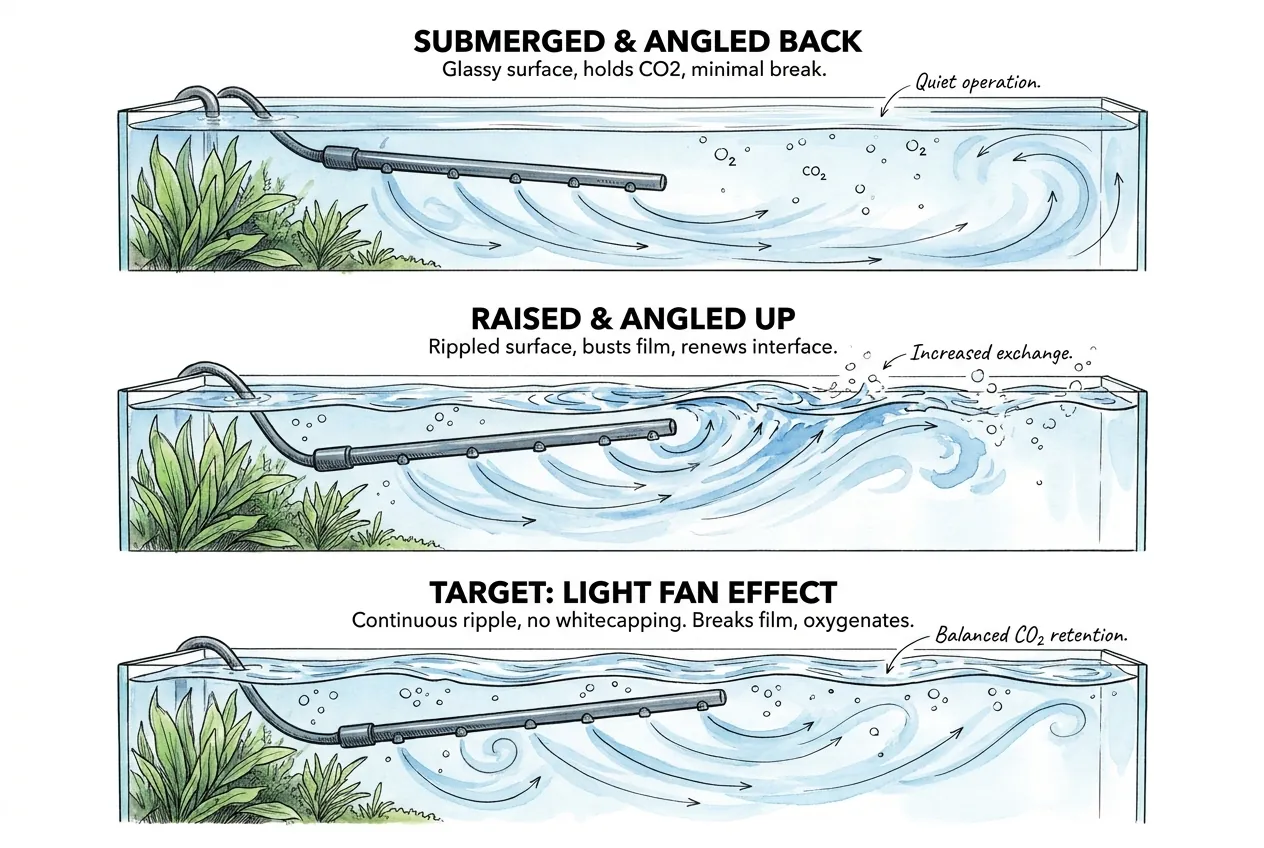
The spray bar’s depth and angle is one of the cheapest and most tunable surface controls you have.
The same return can run a glassy CO2-friendly surface or a rippled film-busting one. Aim is a major factor, though flow rate, water level, hole size, and tank geometry matter too.
Submerged a couple of inches and angled along the back glass, it tends to make a horizontal current with minimal surface break, which helps hold CO2.
Raised toward the surface or angled up, it dimples and renews the interface. One optional approach in injected tanks is to lower the outlet during the photoperiod to retain CO2, then raise it at lights-out to drive overnight exchange, watching for abrupt CO2 swings.
A useful target is a surface that looks like a light fan is blowing across it. A continuous ripple, no whitecapping.
That level generally breaks the film and aids gas exchange without maximizing CO2 loss. Where it matters, measure dissolved oxygen rather than judging by ripple alone.
When do I need a circulation or wavemaker pump instead?
On larger or heavily scaped tanks, the filter return alone can leave stagnant corners where the surface goes still and film collects.
A separate circulation or wavemaker pump adds aimed flow to push surface water toward those dead zones and keep the whole top moving.
A common hobby guideline is roughly 4 to 6 times tank-volume turnover per hour from all sources combined, though this is a rule of thumb rather than a measured requirement and the right number varies by scape and species.
To find a dead spot, watch where fine debris or a pinch of food drifts and settles while everything is running, then aim the pump to clear it. Note that this shows bottom flow more than surface flow, and food also adds organics.
What should I buy for dead-spot circulation?
You want a controllable DC pump so you can dial flow down to a surface ripple rather than a sandstorm, with a livestock-safe intake, a sensible minimum flow, and ideally a guard.
A magnetic mount and broad aiming help for planted scapes.
hygger Cross Flow Wave Maker
The hygger Cross Flow Wave Maker suits a larger tank with a genuine dead spot that a spray-bar adjustment cannot reach. It can be too forceful for a small tank, loose substrate, or delicate plants and fish. Aim it to create a gentle, visible surface ripple, then reduce or redirect it if it scatters livestock, plants, or CO2.
Its 18 W draw is higher than a skimmer, and the pump body is visible in the scape.
Is an airstone worth it just for surface film?
For overnight summer oxygen insurance, yes. Rising bubbles agitate the surface mechanically and raise dissolved oxygen.
A good share of that boost comes from the surface disturbance the bubbles create rather than gas dissolving from the bubbles themselves, though the balance depends on depth and bubble size.
The catch is that aeration off-gasses CO2. In an injected tank it is often run on an overnight timer, when CO2 is already off and plants are consuming oxygen.
A finer airstone helps. Pond-scale figures put diffused-air oxygen transfer efficiency at about 9% to 10% for fine bubbles versus 3.5% to 5% for coarse.
Those are aquaculture-scale numbers that depend on depth and system, so treat them as a reason to prefer fine bubbles rather than a guaranteed aquarium efficiency.
What should I buy for overnight aeration?
You want a pump sized to your tank, paired with a fine airstone, airline tubing, and a check valve to prevent back-siphon.
An air pump usually does not include these, so budget for them separately. Low noise matters for a unit you run overnight near a bedroom.
Tetra Whisper Air Pump
The Tetra Whisper Air Pump is useful as overnight oxygen insurance in a warm tank, paired with an airstone, airline, and a check valve. Choose the model for your tank size rather than assuming this linked unit fits every aquarium. It can drive off CO2 and increase evaporation, so an injected planted tank may need it only overnight.
Match the model to your tank size and depth, or a small unit can under-aerate a larger tank.
| Tool | Surface effect | CO2 retention | Noise | Best use |
|---|---|---|---|---|
| Spray bar (retuned) | Tunable ripple | Higher when submerged | Filter noise only | Everyday day/night tuning |
| Circulation pump | Aimed, broad | Moderate, adjustable | Low hum | Dead-spot fix on big tanks |
| Air pump + airstone | Bubble-driven | Lowest retention | Pump hum | Overnight O2 insurance in heat |
These are relative, qualitative comparisons based on typical use, not measured values. Actual CO2 loss and noise depend on tank depth, flow rate, bubble size, splash, and the specific model.
FAO Aeration and Oxygenation, diffused-air oxygen transfer efficiency
Is surface film really caused by overfeeding?
Not exactly. Overfeeding does contribute. Uneaten food is a significant organic source, and some guides list it and oily foods among the most common causes of protein film.
But it is one input among several, and a still, unbroken surface is what lets any of these organics build up into a persistent film.
Both the organic load and the surface renewal are worth checking.
What actually feeds the film if not food?
Surface-active organics come from many sources. Fish continuously shed a slime coat containing glycoproteins and fatty acids, some of which behave as surfactants.
Decaying plant matter and trimmings leach dissolved organic carbon, and fish waste, dosing residues, dechlorinator ingredients, and skin oils add more.
Uneaten food belongs on this list too.
Uneaten food adds organics and consumes oxygen as it decomposes. Feed only what fish reliably finish, then remove leftovers and decaying plant material rather than assuming food is the only source.
Decomposition of organic matter in aquaculture systems (Global Seafood Alliance)
Epidermal mucus, a major determinant in fish health
The Dangers of Uneaten Fish Food (Aqueon)
Why do clean, low-organics tanks still film?
Because it is the surface-active fraction, not the total organic load, that mostly plates out.
In a natural-seawater wind-wave experiment, bulk dissolved organic carbon barely concentrated at the interface (enrichment factor about 1.0 to 1.6), while amino acids enriched much more strongly (about 13 to 48).
Those are marine measurements, so read them as showing the pattern rather than aquarium values.
The organics do not need to be abundant to film. They mainly need a still surface to migrate to and a chemistry that draws them there.
In that same experiment, surfactant coverage built from the existing bulk organic pool rather than requiring recent autotrophic production, and it recovered over a period of days after disturbance rather than minutes.
That recovery cuts both ways. A film tends to reform if you stop agitating, and it is harder to sustain while you keep the surface moving.
Agitation is the fastest lever for clearing a film, but it works best alongside controlling the organic sources, not instead of it.
Organic Matter in the Surface Microlayer, wind-wave channel experiment
Surface Film On Aquarium Water, causes and fixes (FishLab)
How do I diagnose and fix my film step by step?
Work through the likely causes in order, but do not defer water chemistry when anything looks wrong with the fish.
Confirm it is organic film, check surface movement, temperature and oxygen, and organic inputs, and test ammonia, nitrite and CO2 if the fish show any distress.
There is one safety interrupt at the top of the list.
What do I check first?
Look across the water surface at eye level. Glass-smooth and mirror-still is a strong clue that low agitation is a major contributor, since organics are nearly always present in a stocked tank.
It is usually the dominant factor, but source load, filter problems, or contamination can also be at play.
Run the checks in this order.
First, surface movement. Is the surface dead-still? Second, temperature and oxygen. Is the tank running warm for its species, say around 27 to 28°C or above, where saturation drops toward 7.5 to 7.8 mg/L?
Measure dissolved oxygen if you can rather than assuming it, and test ammonia and nitrite at the same time.
Third, recent organic inputs like feeding, dosing, trimmings, and hands-in-tank oils.
Address the first failing check, but if more than one is failing, such as low oxygen alongside a toxin, deal with them together rather than strictly one at a time.
What do I do if my fish are gasping at the surface?
Aerate immediately, then find out why. Fish hanging at the surface with rapid gill movement often means acute low oxygen, but the same behavior can also come from ammonia, nitrite, excess CO2, chlorine or chloramine, or gill disease.
Aerating is a safe first step regardless of the cause.
Add an airstone or increase surface agitation right away. At the same time, test ammonia, nitrite and, if you can, CO2, and check temperature and filter flow so you treat the actual cause.
If a toxin is involved, a 30% to 50% water change with temperature-matched, dechlorinated water helps dilute it. Match temperature and pH to avoid shocking the fish, and size the change to the problem.
The film diagnosis comes after the fish are stable.
Dissolved Oxygen Management in Aquaculture (Global Seafood Alliance)
What are the quick stopgaps before I buy gear?
You can lift the film off by hand right now. Lay a clean, unbleached, fragrance-free paper towel flat on the surface for 1 to 2 seconds and lift, which absorbs the surface layer.
Or cup-skim with a clean, residue-free cup, tilting its lip just below the surface so the film flows in.
Then do a water change, which also removes some of the organics feeding the film, and adjust the water level or spray-bar aim so the surface breaks more, watching the ripple to confirm it.
These treat the immediate problem. The longer-term fix is continuous surface agitation, and a well-maintained surface shows a constant fine ripple.
Which fix matches which failing check?
Match the gear to the failure mode, keeping in mind these often combine rather than compete.
A dead-still surface that needs prevention calls for added agitation, a spray bar angled to ripple or a circulation pump.
A film that keeps re-forming, or a tank where you want active removal of the top layer, calls for a surface skimmer, which can run alongside agitation.
A hot summer with overnight oxygen risk calls for a timer-controlled airstone overnight as a heat-season safety net.
If the organics check points to overfeeding or decaying matter, reduce feeding and remove the debris straight away rather than waiting. Agitation and cutting the organic source are complementary, not either/or.
Key Takeaways
- Look at both the food and the surface. A persistent film needs surface-active organics and a still surface together. Restoring agitation clears most films quickly, but reduce overfeeding and decaying matter too.
- The surface is where most gas exchange happens. Surfactant films measurably slow it, and warm summer water also holds about 17% less oxygen at saturation. The large percentage figures come from ocean CO2 studies, so treat them as directional, not an aquarium oxygen number.
- Poking the film gives a clue, not a verdict. Swirls that re-form suggest organic film, so add agitation. A rainbow sheen that stays whole suggests external oil. Cloudy water throughout is a bloom. Confirm with tests where it matters.
- Match the tool to the job, and combine them. A skimmer pulls the top layer into filtration, a circulation pump keeps the surface moving, and an overnight airstone on a timer is heat-season oxygen insurance.
- Gasping fish is an emergency. Aerate immediately, then test ammonia, nitrite, CO2 and temperature before assuming low oxygen. A temperature-matched, dechlorinated partial water change helps if a toxin is involved.
Affiliate Disclosure
This article contains Amazon affiliate links. As an Amazon Associate I earn from qualifying purchases. If you use these links, the site may earn a commission at no extra cost to you. Product availability, price, and specifications can change. Check the current listing before buying.