
Fern Fronds Turning Brown: Diagnose and Fix the Cause
Diagnose brown fern fronds by texture and pattern, then fix dry-air VPD, salt buildup, soggy roots, weak light, or pests without overcorrecting.
Samuel Reed · Published 2025-12-20 · 18 min read

Key Takeaways
- Brown fronds are a symptom, not a single disease. Dry-air stress is common. Many tropical ferns rely largely on passive hydraulic stomatal control, so in a low-humidity room they can lose water faster than the roots resupply and the tips crisp first. Some ferns show conditional active closure, so the response varies by species and acclimation.
- VPD depends on temperature as well as humidity, not just the humidity reading. To raise sustained humidity, a humidifier or an enclosure works better than misting, whose effect fades quickly and can leave leaves wet.
- Salt buildup can make the root zone too concentrated for roots to take up water. Fertilizer, softened water, and high-mineral water can all contribute. Check your water and leach the pot when needed, then switch to distilled, reverse-osmosis, or rainwater and feed lightly.
- Overwatering can brown a fern by starving its roots of oxygen. Damaged roots cannot take up water well, so a fern can look dry in a soggy pot. Use an airy, moisture-retentive mix and a pot or removable liner that drains.
- Use the browning pattern as a clue, then confirm the cause before treating. Crispy tips point toward humidity or salts, a mushy base toward overwatering or poor drainage, and spotty leaves toward pests. Neat rows of brown dots under a frond are usually sori, which are normal spore cases.
You bought a lush fern, and now the fronds are turning brown. The first instinct is often to add more water, but that’s frequently the wrong move. Heated indoor air is usually much drier than the humid habitats many popular ferns come from, so brown fronds are often a sign the environment is off rather than a lost cause. Work out whether humidity, water quality, root-zone moisture, light, or pests caused the damage before changing your watering. The pattern and texture of the browning narrow the first check.
1. Why Fern Fronds Turn Brown
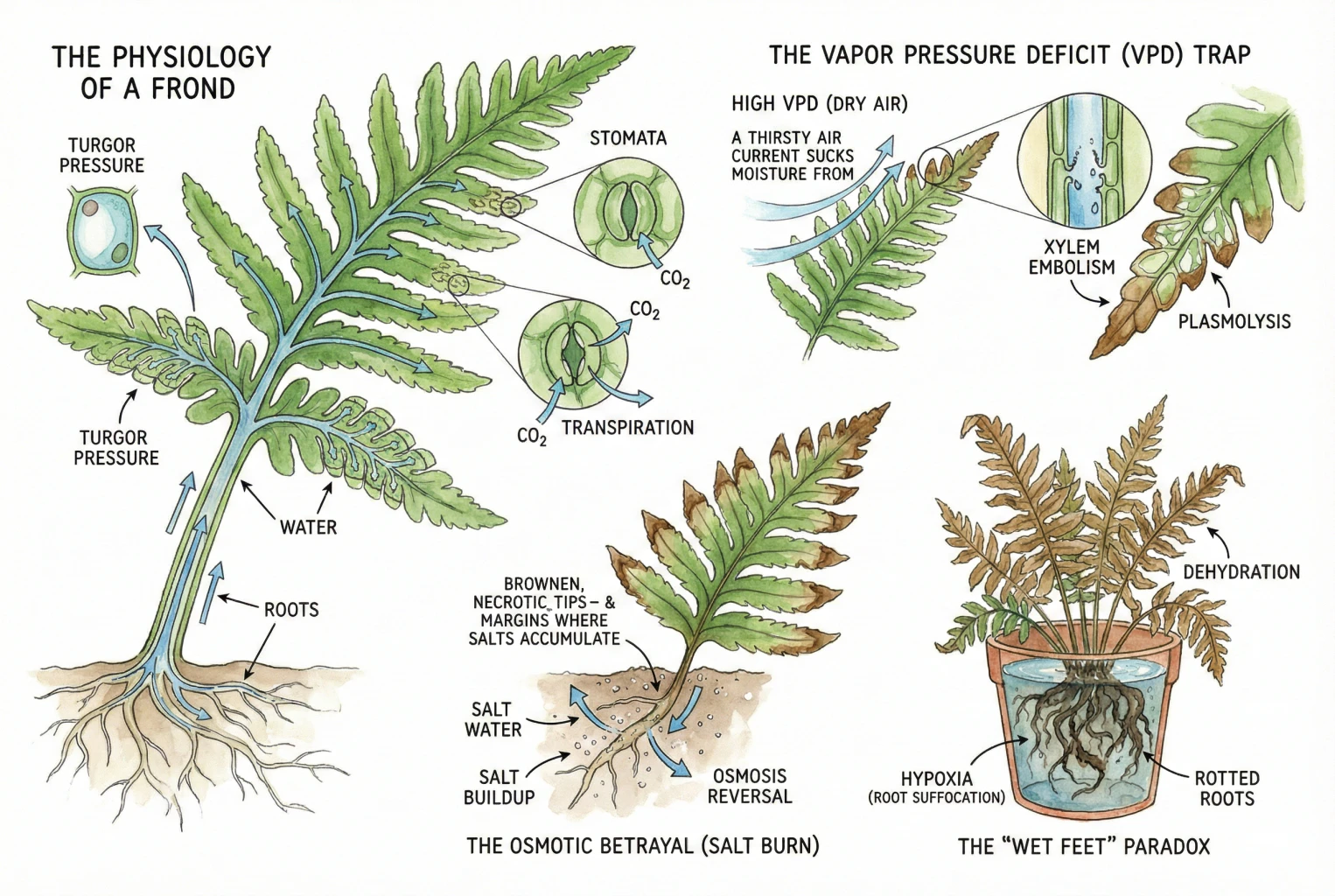
To work out the browning, it helps to know what brown usually means. It usually means dead or dying leaf tissue.
It is often not an infectious disease, but it can be, so treat the pattern as a clue rather than a diagnosis.
I mark old, mature, and newly unfurling fronds on a whole-plant photo before diagnosing browning. Brown outer fronds with healthy new croziers tell a different story from damage starting in every new frond.
The next frond generation is how I judge a care change, rather than waiting for brown tissue to turn green. Dead tips remain as history even after the cause is corrected.
Pot weight is paired with moisture checks near the crown and outer wall. Dense fern roots can leave one zone dry while water channels through another, which a single finger test misses.
The Physiology of a Frond
Fern fronds lose water through tiny pores. In dry, warm air, many indoor ferns can lose water faster than their roots replace it, which often browns the tips first.
Evolution of the Stomatal Regulation of Plant Water Content
The Vapor Pressure Deficit (VPD) Trap
Dry indoor air is a common stressor, and it helps to think in terms of VPD, not just humidity percentage.
VPD is the difference between how much water vapor the air is holding and how much it could hold at a given temperature, so the same relative humidity means a higher VPD in a warm room than a cool one.
In high VPD, meaning warm and dry air, the air pulls moisture from the leaves, and if the roots cannot keep up the plant runs a water deficit, often showing at the frond tips first, farthest from the roots.
In severe cases plants can suffer xylem embolism, when air breaks the water column, but that is a serious failure rather than something an ordinary living room reliably causes. Think of dry air as raising demand rather than instantly damaging the plant.
So managing transpiration demand, humidity, temperature, and airflow, is one important part of fern health, alongside root-zone moisture, light, and feeding.
Minimizing VPD Fluctuations Maintains Higher Stomatal Conductance and Photosynthesis, Resulting in Improvement of Plant Growth in Lettuce
Salt Injury
Sometimes the air is fine but the fern still browns because soluble salts have built up in the root zone.
Roots take up water when their internal solute concentration is higher than the surrounding medium (lower water potential), as salts accumulate, that gradient shrinks and uptake gets harder.
The usual culprits are over-fertilizing and, importantly, softened water (high sodium) or hard/high-mineral water, not chlorine per se.
When salinity is high, water uptake is impaired and salts can concentrate at leaf tips and margins, where the tissue browns (marginal and tip necrosis).
A soil-moisture check plus leaching the pot with clean water, and, for sensitive plants, switching to distilled, RO, or rainwater, is more reliable than assuming any one cause.
The Wet-Feet Problem
What Low Oxygen Changes
Roots need oxygen as well as water. If the mix stays waterlogged, air pockets disappear and root rot becomes more likely. The same moisture-versus-oxygen check appears in the Alocasia root-rot diagnostic.
Why Wet Roots Can Look Dry
Roots damaged by rot cannot take up water well, so a fern can look dehydrated and brown even in a soggy pot. Overwatering is one of the most common ways indoor ferns fail, though not every soggy pot means active root rot, so check the roots to confirm.
2. Build a Setup That Prevents Repeat Browning
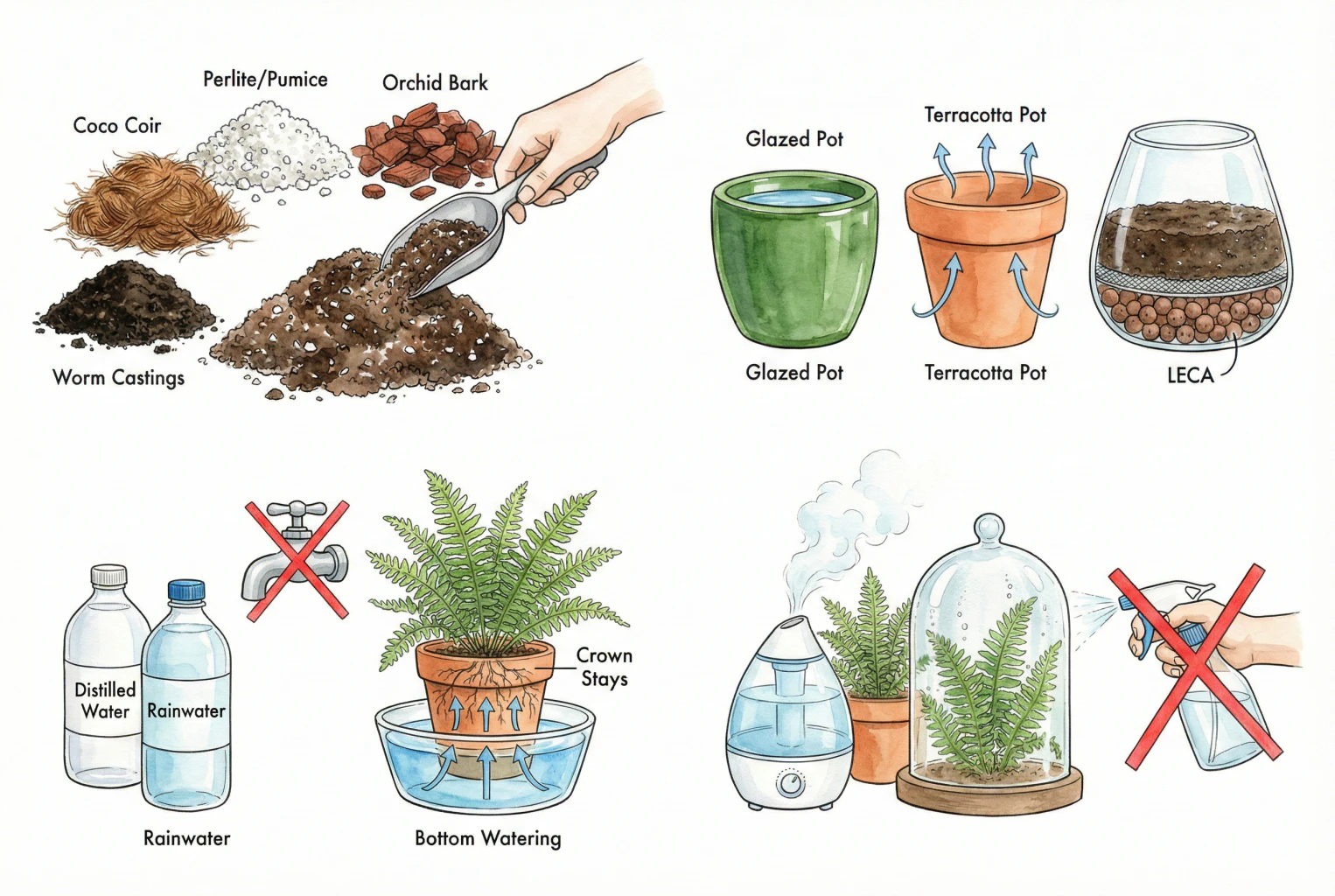
You can’t change the plant’s biology, but you can adjust its environment to match what it needs.
Step 1. Soil
Skip heavy garden soil. Most ferns want a porous mix with air at the roots. A commercial peat-rich houseplant mix that stays porous and moisture-retentive is a fine starting point.
If you mix your own, a common blend for a terrestrial fern is roughly 40% coco coir (holds moisture), 30% perlite or pumice (air pockets), 20% fine orchid bark (structure), and 10% worm castings (mild organic nutrients).
Treat these ratios as a starting point, not a universal recipe. Epiphytic, lithophytic, and mounted ferns (like Platycerium) and terrarium species have different substrate, pH, and nutrient needs.
Coir and peat also vary batch to batch in pH, salinity, and structure, so buy quality and adjust to your plant.
Step 2. The Pot
Plastic and glazed ceramic hold moisture longer. Unglazed terracotta breathes and dries faster, so you’ll usually water more often (how much more depends on pot size and thickness, the mix, light, and humidity).
The most reliable choice is a pot with a drainage hole, or a decorative cachepot with a removable inner pot you can lift out to drain.
In a closed glass vessel with no drainage, a gravel or LECA layer does not drain excess water out of the container and can create a perched, saturated zone above the layer, if you go that route, keep the water volume low, watch for condensation, and don’t treat the layer as rot-proof.
Step 3. Water Quality
Tap water is fine for most houseplants, so do not assume it is the cause. More consistent risks are softened water with high sodium and very hard or high-mineral water. If a sensitive fern is browning, check your water report and compare options in the houseplant water guide before switching water sources. Use tepid water.
Step 4. Humidity
Measure Before Raising Humidity
Ferns respond to sustained humidity, not brief misting. Check the room with a hygrometer first.
A humidifier can raise a room’s relative humidity, while grouping plants or using an enclosure works on a smaller zone.
For the room as a whole, the US EPA suggests keeping indoor humidity roughly in the 30–50% range and below 60% to limit condensation, mold, and dust mites. Many ferns do well toward the upper part of that band, and a delicate fern can be kept in a closed terrarium at higher humidity where you can watch condensation and ventilation separately from the rest of your home.
Choose a Room Humidifier Deliberately
Buy a whole-room humidifier only when repeated hygrometer readings show that the room stays too dry and several plants will benefit.
Skip it for one small fern that fits an enclosure, when the room already holds the target humidity, or when daily tank care and regular cleaning will not happen.
Levoit Classic 300S Humidifier
Levoit Classic 300S Humidifier fits a medium room where a 6 L top-fill tank, humidity sensor, and app control reduce repeated manual adjustments.
It is ultrasonic, so use low-mineral distilled water, empty and refill the tank daily, and clean it on schedule to limit white mineral dust and microbial spread.
Choose an evaporative model instead if buying distilled water or managing ultrasonic residue is a poor fit.
A humidifier corrects measured dry air. It does not repair dead tips or compensate for soggy roots. Hold the room below the condensation and mold range, then judge new growth rather than expecting old brown tissue to turn green.
Step 5. Choose a Pruning Tool
Cut Back to Healthy Tissue
When you remove dead or badly damaged fronds, use a clean, sharp, appropriately sized tool. A clean cut is easier for the plant to seal off than a ragged, crushed one, and reduces entry points for rot.
Plants do not heal a cut the way animals do. They wall it off. For fine fronds like maidenhair, micro-tip snips or clean scissors give you more control than a full-size pruner.
Whatever you use, wipe the blades with isopropyl alcohol between plants.
Match Tool Size to the Plant
Fine snips or clean scissors are usually easier to control on delicate fern fronds. A full bypass pruner earns its cost only when the same tool will also cut woody houseplant stems, shrubs, or young branches.
Felco F2 Pruning Shears
Felco F2 Pruning Shears fit that broader workload. The repairable right-handed pruner is sized for large hands and rated for cuts up to 25 mm.
Skip it for fern-only work, left-handed use, or small-to-medium hands. In those cases a properly sized fine snip gives better control for less money.
Feed Lightly in the Setup
For feeding, ferns are light feeders, so go easy. Over-fertilizing is a common cause of tip burn.
That doesn’t mean synthetic fertilizer is off-limits. A conventional houseplant fertilizer at half strength, used sparingly during active growth, is fine per extension guidance.
Worm castings are a mild, slow-release organic option some growers prefer, but they aren’t a guaranteed non-burning cure or a root-rot control product.
Choose Amendment Size for the Collection
A 15-lb bag of castings makes sense when you are repotting a collection or mixing several batches of substrate.
Skip it for one fern, an active salt-injury case, or a root zone that is already wet and failing. A smaller local bag or no amendment at all is the cheaper correction.
Wiggle Worm Worm Castings
Wiggle Worm Worm Castings are pure castings sold in a 15-lb, 0.5 cu ft bag. Use only the label rate and keep watching substrate salts. Castings are not fern-specific fertilizer and do not reliably suppress Pythium. Compost suppressiveness varies by batch and cannot replace drainage or a root inspection.
3. Terrarium, Pruning, and Light Adjustments
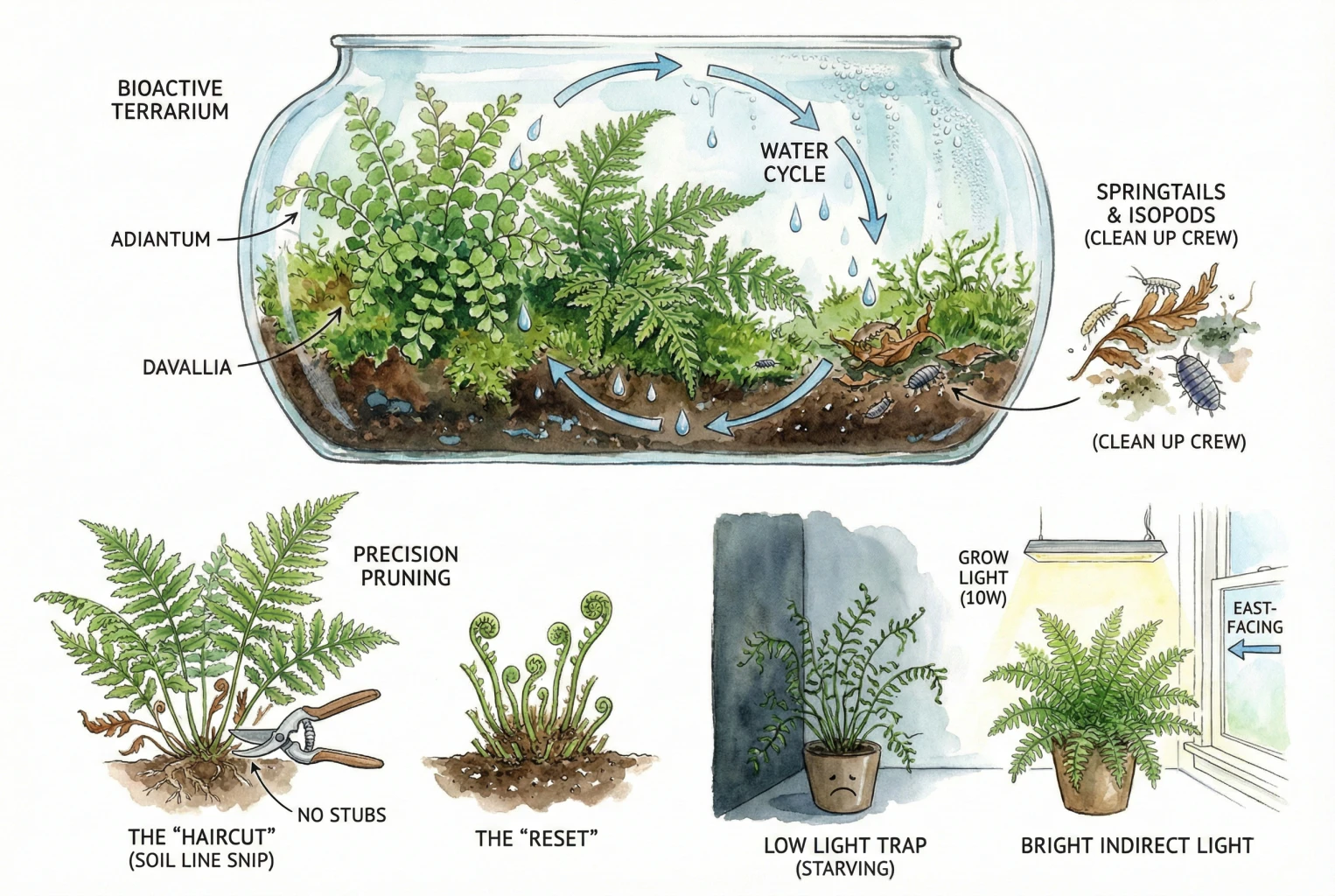
Some growers keep small ferns in a bioactive enclosure. It is an optional way to create a humid microclimate, not something every fern needs.
The Terrarium Advantage
Closed-Container Water Cycle
Delicate ferns such as maidenhair and rabbit’s-foot often do better away from dry room air.
In a closed jar the water largely recycles (the plant transpires, it condenses on the glass and drips back) so you’ll water much less often, though how often still depends on the vessel, ventilation, and plant size.
Keep an eye on condensation and rhizome exposure rather than assuming a fixed schedule.
Cleanup Crew Has Limits
A clean-up crew of springtails and isopods can help by consuming decaying matter and fungi and contributing to nutrient cycling.
It is not truly self-cleaning, though. You still manage the population, ventilation, and any excess dead material, and note that some springtails and isopods will also nibble living roots and foliage.
A beginner terrarium build by Worcester Terrariums.
Pruning
Prune to Healthy Tissue
Remove fully dead or diseased fronds, cutting back to the base or to healthy tissue, and don’t leave long dead stubs.
Where you cut depends on the species and its growth form. Follow the frond to the crown or rhizome and cut there.
Try to keep still-green tissue, since it’s still photosynthesizing (a partly brown frond isn’t automatically worth removing).
Check the Crown Before Hard Pruning
If most of the top growth is dead, check whether the crown or rhizome is still firm and alive before cutting hard.
Some rhizomatous ferns can regrow from a living rhizome after severe top loss, but that depends on the species and the underlying cause, and there’s no guaranteed timeline. Keep the mix lightly moist and give it time.
Lighting (The Low-Light Trap)
General fern care overview (Tye-Dyed Iguana).
Shade Is Relative
The advice that ferns love shade is easy to misread, because outdoor shade under a tree is still far brighter than a dim indoor corner.
If your fern sheds green leaflets or grows spindly, stretched stems, low light may be part of the problem, though water, acclimation, and pests can cause similar symptoms, so light is not the only thing to check.
Measure Leaf-Level Light
Most ferns want bright indirect light. An east window is a common example, and a full-spectrum LED can supplement. Wattage alone does not show leaf-level light, so use the PPFD and DLI guide if you need to measure it.
4. Troubleshooting (Q&A) (Common Myths)
Misting Is Not a Humidity Plan
Why Misting Fades
Misting raises humidity only briefly before it evaporates, so it does little for sustained room humidity, and prolonged leaf wetness can raise the risk of Botrytis (gray mold) and leaf-spot diseases.
Wet leaves don’t automatically get infected, but repeated wetting isn’t a reliable humidity strategy.
Use Sustained Humidity
For sustained humidity use a humidifier or an enclosure. (A pebble tray does very little for room humidity.)
If you rinse the foliage, that’s to remove dust, not to hydrate the plant. A gentle lukewarm rinse works well.
Ice-Cube Watering Is Not a Fix
Better to skip the ice. Cold water can stress the roots of warmth-loving tropical ferns, so use tepid, room-temperature water instead.
Brown Dots May Be Sori
Recognize Normal Sori
Usually not (on many ferns they’re sori (clusters of spore cases), a normal reproductive structure).
Sorus shape and arrangement differ by species (round, linear, or along the margins), so they’re not always in neat rows.
Check Before Removing Brown Dots
Confirmed sori shouldn’t be scraped off. If you’re unsure whether you’re looking at sori or scale insects, use a hand lens and a species reference. Scale insects are raised bumps that can often be dislodged and may leave sticky honeydew, whereas sori are attached in a species-typical pattern and shed dusty spores.
5. Check Detailed Root, Light, and Pest Clues
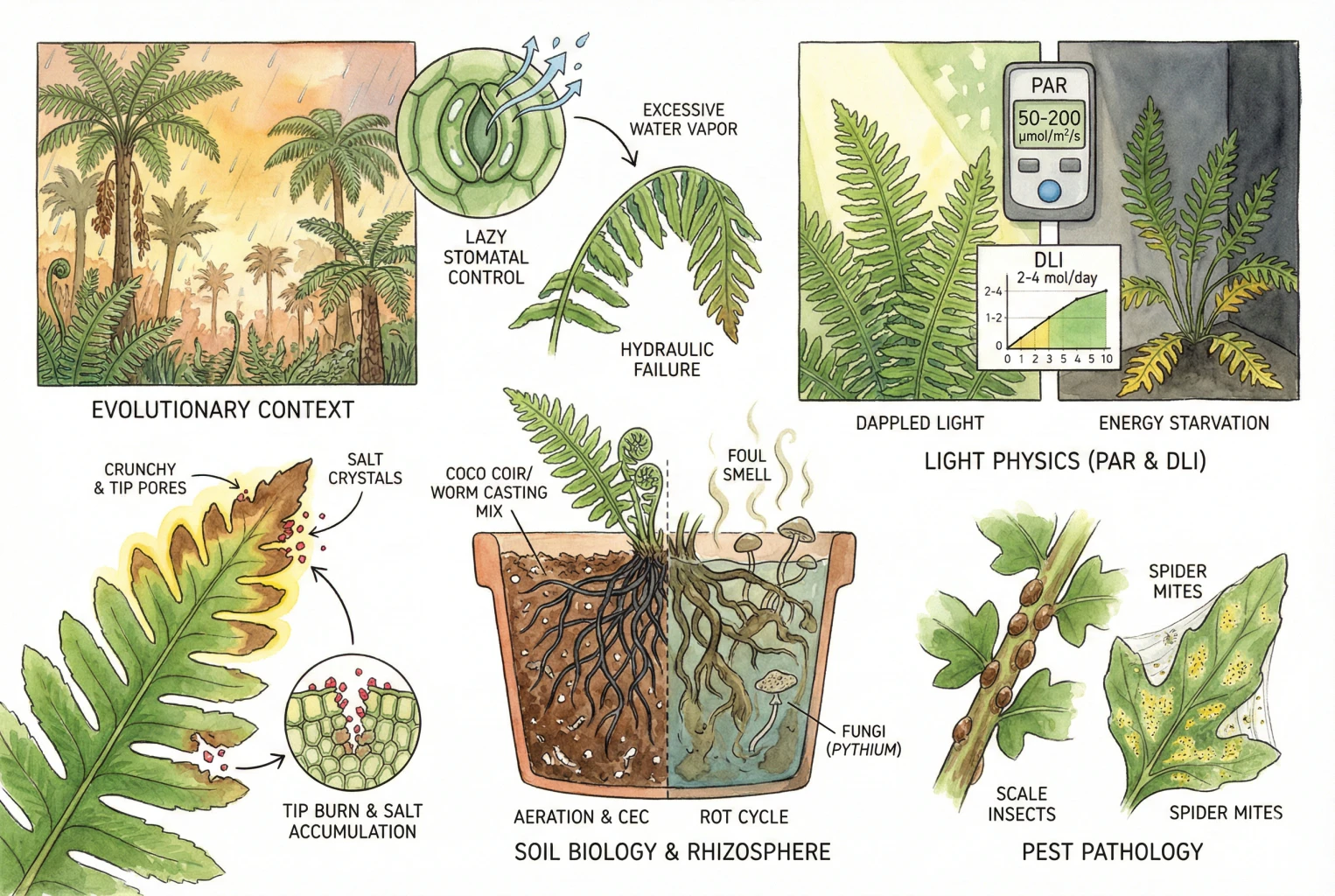
5.1 Water Balance in Ferns
Fern Water Control Varies
Ferns are an ancient lineage, and the group first diversified long ago, but many of the ferns we grow today are relatively recent polypods that diversified in the shade of flowering-plant forests, so it’s a mistake to picture all modern ferns as unchanged relics.
Compared with typical angiosperms, some ferns appear to rely more on passive stomatal control, though the evidence remains debated and varies by species.
Dry-Air Stress Is a Water-Balance Problem
A vigorous fern like Nephrolepis (Boston fern) can noticeably stress in very dry indoor air, losing water faster than the roots resupply and browning at the tips.
That is a water-balance problem shaped by species, temperature, and root supply, not proof that the plant lacks any stomatal response.
5.2 Why Tips Often Show Damage First
Salt Can Accumulate at Leaf Tips
The transpiration stream carries dissolved ions toward the leaf edges and tips. Where salts accumulate, they can reach injurious concentrations, which is one reason salt-related damage often appears at tips and margins, sometimes with a yellowing edge.
Note that not every tip or margin browning is salt injury. Nutrient disorders, scorch, and disease can look similar.
The Longest Hydraulic Path Fails First
The tips are also the end of the longest hydraulic path from the roots, so during water stress the most distal tissue tends to be affected first.
Water moves through the xylem by cohesion-tension, not through a literal pump.
5.3 Roots and Soil
Normal Fern Root Color Varies
Healthy fern roots are naturally dark and wiry or fuzzy-brown in some species, so beginners who expect bright white roots can misread normal roots as rot.
Both coir and peat are common in fern mixes. Each has trade-offs and both vary batch to batch in pH, salinity, and structure (coir does have cation-exchange capacity, contrary to a common claim).
Worm castings add a little nutrient-holding capacity and slow-release nutrients, but they aren’t a substitute for choosing a stable, porous mix.
Waterlogging and Root Rot Are Not Identical
Persistent waterlogging lowers oxygen in the root zone. Root cells decline, and rot organisms can take hold. Pythium is an oomycete (a water mold), not a fungus, and a foul smell can indicate anaerobic decomposition, but smell and mushy roots alone don’t confirm a specific pathogen, and not every wet root turns to mush.
For severe or persistent rot, a diagnostic lab or a qualified horticulturist can identify what’s actually present.
5.4 Light (PAR and DLI)
Translate PPFD to DLI
Many ferns do well in moderate light rather than deep shade. Daily light integral (DLI) is PPFD integrated over the photoperiod, so a single PPFD figure doesn’t map to one DLI number. About 50 µmol/m²/s over 12 hours is roughly 2 mol/m²/day, while 200 µmol/m²/s over the same period is roughly 8.6 mol/m²/day.
A production study of Nephrolepis found cultivar quality improved across a range of DLI, often around 10–12 mol/m²/day.
In a very dim corner, a fern may not gain enough carbon to maintain older fronds, and it can pull mobile nutrients from the oldest leaves into new growth, so lower leaves yellow and then brown.
This light shortfall is easy to mistake for a watering problem.
5.5 Pests
Scale and Mites Leave Different Clues
Sometimes browning is caused by sap-feeding pests. Scale insects look like small brown bumps and feed on the plant. Armored scale carry a protective covering that makes some contact sprays less effective, while soft scale differ (and may leave sticky honeydew).
Manual removal helps, and horticultural oil can be an option, but test it on a small area first, since ferns can be sensitive to oils, and follow the product label.
Use Pest Treatments Carefully
If you consider a systemic insecticide, note that neonicotinoids are toxic to pollinators. Keep any use label-directed and think about whether the plant will later go outdoors, where pollinator exposure is more likely. Spider mites tend to build up in hot, dry conditions, causing fine stippling and bronzing and sometimes delicate webbing (browning plus fine webbing points toward mites).
6. Keep a Recovering Fern Growing
Feed Lightly
Ferns are generally light feeders, and over-fertilizing is a common cause of tip burn. Diluting liquid feed to half or quarter strength is a safe habit, and gentle organics (fish emulsion, seaweed) work well. Feed mainly when the plant is actively growing.
Under strong indoor lighting some ferns grow year-round, so match feeding to growth rather than the calendar, and follow the label rate. Full strength isn’t guaranteed to burn, but there’s rarely a reason to push it.
Prune Wisely
Sanitation pruning removes dead or diseased tissue back to healthy growth. But some structural browning is normal. Staghorn (Platycerium) shield fronds turn brown and papery to form a protective basket, so do not remove them.
The Summer Break
In a temperate climate, moving tropical ferns outside into shade for summer, with natural humidity, airflow, and rain, can spur strong growth.
Do it once night temperatures are reliably warm, acclimate the plant gradually to brighter light and wind, make sure pots drain, and inspect (and quarantine) for pests before bringing them back indoors.
7. Choose One Correction and Watch the Trend
Read the Pattern Before Treating
Brown is a symptom, not a diagnosis. Use the pattern as a starting point, then confirm.
Crispy tips point toward humidity, VPD, or water-quality checks, while a mushy brown base points toward overwatering, poor drainage, and a root inspection.
Spotty Brown Leaves
Check for pests or infection. Ferns aren’t especially difficult, but they are specific about light, water, and air, and species differ.
The goal is to match the environment to the plant rather than force it into a dry, dark spot.
Which fixes you actually need depends on what you find. Leach or change your water only if salts are the issue, add humidity if a hygrometer shows the air is too dry, and consider an enclosure for species that want it.
There’s no need to do all three at once.
Affiliate Disclosure
This article contains Amazon affiliate links. As an Amazon Associate I earn from qualifying purchases. If you use these links, the site may earn a commission at no extra cost to you. Product availability, price, and specifications can change. Check the current listing before buying.