
Staghorn Fern Brown Leaves: Shield Frond or Rot?
Tell normal brown staghorn shield fronds from root or crown rot using texture, location, smell, moisture history, root condition, and spread rate.
Jordan Cole · Published 2025-12-22 · 23 min read
Key Takeaways
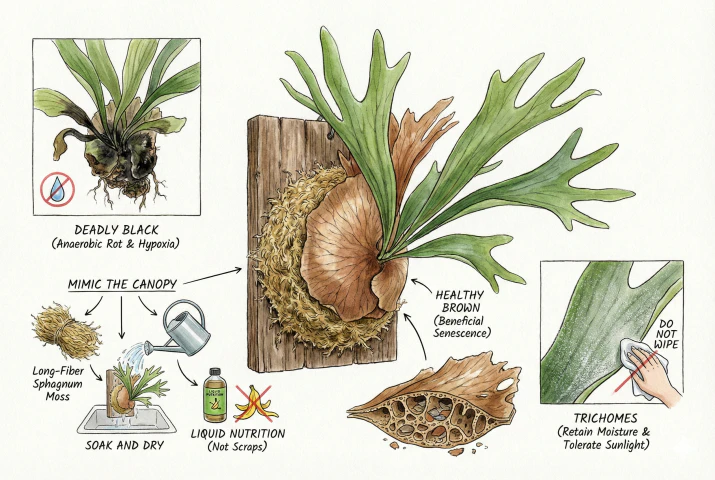
- A firm, dry, papery brown shield frond is usually normal aging. Soft, slimy, or blackening tissue that is spreading is a warning sign worth investigating, but color alone does not confirm a cause.
- Leave a healthy brown shield frond in place. It anchors the plant, traps litter, and holds water against the roots, so cutting a sound one off exposes the rhizome unnecessarily. Diseased tissue, natural detachment, and deliberate dividing or remounting are exceptions.
- Overwatering harms roots mainly by reducing aeration. Saturated moss displaces air, which slows root function and can favor water molds in wet conditions. Diagnosing a specific pathogen by eye is not reliable.
- Water by soaking, then let the mount drain and partly dry. A quick misting does not wet roots buried deep in moss behind the shield frond.
- Skip raw banana peels and leaf shine. A complete liquid feed is a cleaner nutrient source than decomposing peel, and the white trichome coating should stay on the leaves because it slows water loss.
Start With Texture, Not Color
In the houseplant world, brown often reads as failure. With many foliage plants that reflex is roughly right, though brown can also mean normal aging or old damage.
Apply that same reflex to a Staghorn fern (Platycerium), though, and you can do more harm than good because its shield fronds are part of the plant’s support system.
A common mistake is to see a browning shield frond, assume the plant is thirsty, and water more, when the shield frond is supposed to brown. These are epiphytes, not terrestrial garden ferns.
Those brown basal fronds are usually a functional structure, not a death sentence. On a staghorn, a sound papery-brown shield is part of how the plant works, so it is worth learning to read it rather than reacting to the colour alone.
The useful skill is telling natural aging, or senescence, from actual rot, or necrosis, by checking texture, location, and rate of spread instead of color alone. A staghorn needs a different reading than a bedding fern because its brown shield can remain functional.
I divide the shield into upper, lower, center, and advancing-edge zones on a photograph and record firmness without scraping the surface. Normal aging often keeps a firm organized edge, while rot may soften one wet contact zone first.
The map is compared after the same drain interval rather than immediately after watering. Wet color and temporary softness can otherwise exaggerate concern.
A short video records where irrigation enters and exits the mount. If water pools behind one shield edge, I correct angle and delivery before reducing all watering to save that local pocket.
Why Shield Fronds Turn Brown
Most Platycerium species are native to tropical and subtropical parts of Africa, Southeast Asia, and Australia, with one species reaching into South America. Staghorns are epiphytes that grow on branches and trunks rather than in mineral soil, so rain runs off quickly and their nutrients come from leaves, dust, bird droppings, and material that collects on bark.
They are built for this niche through frond dimorphism, with two types of leaves that have different jobs.
Shield Fronds Become Structure
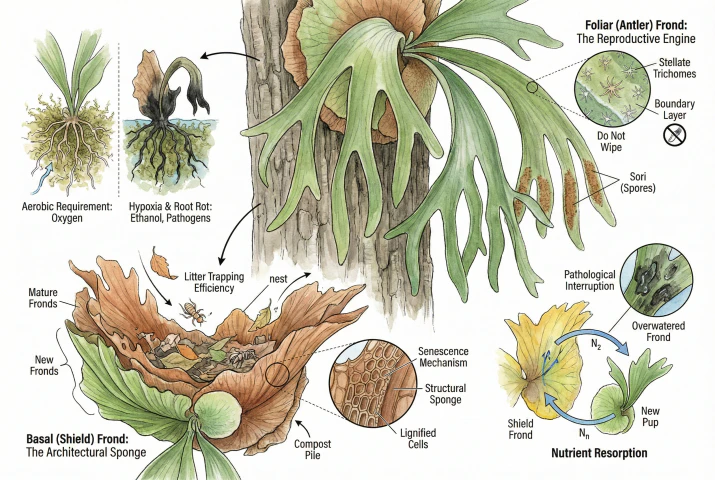
The first type of leaf is the sterile basal frond, usually called the shield frond. It looks like a plain round leaf at the base, but it does several useful jobs.
A Living Flowerpot
Young shield fronds contain chlorophyll and do some photosynthesis, but their main roles are mechanical and hydraulic. A shield frond grows flat against the host, anchoring the plant, and in many forms the upper edge flares outward into a nest or basket shape. How pronounced this is varies by species and by the plant’s position in a colony.
Trapping Litter
That basket-like shape passively catches falling debris, leaves, twigs, and other detritus, which accumulates behind the shield and slowly breaks down. In effect the fern collects its own pocket of humus-like material in a place with no soil, which helps feed it.
The Senescence Mechanism
This is the key point for telling healthy brown from rot. Once a shield frond has reached full size, it ages and browns. As in many leaves, the plant appears to recover mobile nutrients (nitrogen, phosphorus, potassium) before the tissue dies, and the browning colour comes from pigments such as tannins and lignins left behind as chlorophyll breaks down. The important, observable point is that this browning is normal, not a failure. The dry, lignified cells are tough and persistent. They do not turn to mush like a lettuce leaf. They stay in place as a papery, sponge-like layer that holds water against the roots and shelters them.
A shield frond turning brown and papery is usually moving from a green growth phase into a structural role, not showing that the plant has failed.
Cutting off a sound brown shield removes that structure and exposes the rhizome and roots to dry air, which sets the plant back for no reason. Leave a firm, papery shield in place. The exceptions are tissue that is genuinely diseased, fronds that have naturally detached, and cases where you are deliberately dividing or remounting the plant.
On the selective advantage of coloniality in staghorn ferns (Platycerium bifurcatum)
Antler Fronds Carry Spores and Trichomes
The second leaf type is the antler frond. These are the pendulous or erect structures that give the plant its common name, and it is the mature ones that eventually bear spores (not every antler frond is fertile at once).
Gas Exchange and Transpiration
On a mature plant the antler fronds do most of the photosynthesis. They are covered in stellate trichomes (microscopic, star-shaped hairs that create a boundary layer of still air against the leaf surface). This layer helps slow transpiration (water loss).
Many well-meaning owners wipe their staghorn leaves to remove dust, which rubs off those trichomes.
Leave the fuzzy white coating on. It is a normal, protective layer, not dirt, and a polished-looking staghorn leaf has lost part of that protection.
Why Saturated Moss Damages Roots
Now to how overwatering actually causes harm. The problem is usually less about the volume of water than about how long the roots sit without air.
Most of the damage traces back to hypoxia (too little oxygen at the roots), which is why watering frequency and drainage matter as much as amount.
The Aerobic Requirement
Platycerium roots need oxygen for respiration to power nutrient uptake. In the wild their roots sit in loose organic debris and moss on bark. They get drenched by rain but then drain and dry relatively quickly.
Saturation Displaces Air
Keep a fern in dense, constantly saturated moss or heavy potting mix and the pore spaces stay full of water instead of air. Root oxygen drops, and root function suffers.
Low Oxygen Can Precede Root Damage
With little oxygen, roots shift toward anaerobic metabolism, which can generate byproducts such as ethanol and acetaldehyde. Persistently wet conditions also favour water molds such as Pythium and Phytophthora, oomycetes that cause root and crown rots. Note that low oxygen does not automatically produce these pathogens, and stressed roots do not always become infected. This is a plausible chain, not a fixed sequence. As roots fail, they commonly go from firm and pale to dark, soft, and slimy, but confirming a specific pathogen needs a lab, not a glance.
The Visual Signal
If enough roots stop working, the plant can wilt even while sitting in wet moss, because it cannot move water up to the fronds. The antler fronds droop. As a rough contrast, a drought-stressed plant tends to feel dry and crispy, while a waterlogged one often feels soft and heavy, sometimes with dark, soft tissue near the base. Treat this as a clue to investigate, not a definite diagnosis. Drought, heat, cold, transplant shock, and other causes can look similar.
Mechanisms of Waterlogging Tolerance in Plants. Research Progress and Prospects
Normal Aging Fades in an Orderly Pattern
How the plant recycles nutrients helps explain the difference between healthy browning and rot.
Habit varies by species. P. bifurcatum, for example, produces offsets from the rhizome and can form clumps, while species such as P. superbum and P. grande are typically solitary.
In a clumping species, older parts of the colony may eventually die back or serve mainly as support. Throughout, the plant tends to conserve nutrients.
Translocation
As a leaf ages, plants generally break down proteins and chlorophyll and move mobile nutrients to new growing tissue. In a shield frond this shows up as a gradual yellowing that transitions to brown (the ordinary pattern of leaf senescence).
When Rot Interrupts It
If tissue is damaged by prolonged waterlogging or by a pathogen, this orderly fade does not happen. Instead you tend to see dark, wet, spreading lesions rather than the dry, even browning of senescence. The dark colour signals damage. It does not tell you the exact cause on its own.
Build an Airy, Drainable Root Zone
Many everyday browning problems come down to how the plant is set up and watered rather than to disease. Get the medium and moisture right and the plant’s own biology does most of the work, while infection and abiotic causes such as cold, sunburn, or fertilizer injury still need separate consideration.
Dense, water-holding material that never dries makes root problems much more likely.
Choose an Open Mounting Medium
In the wild, staghorns grow on bark, where the root mat has open surfaces and rain can drain away. In cultivation, use a medium that holds some moisture while preserving that airflow.
Long-Fiber Sphagnum Holds Air and Water
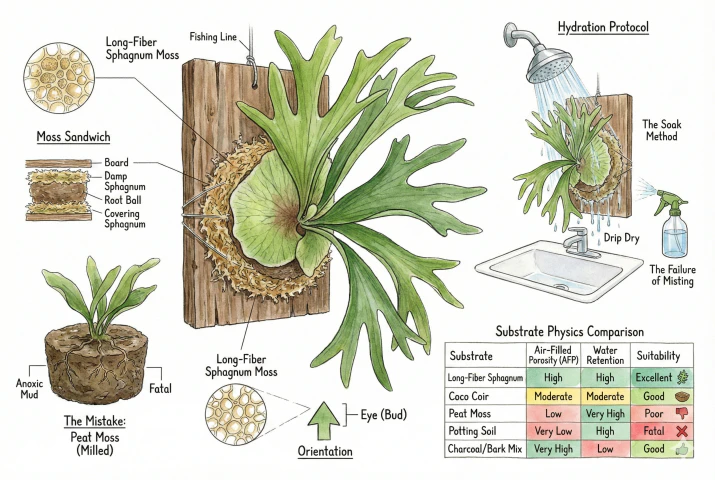
Long-fiber sphagnum moss, for example Sphagnum cristatum or similar long-fibre grades, behaves like a sponge lattice. Water is held inside the strands while the spaces between them stay open for air. Bark or cork slabs, orchid baskets, and osmunda or coir blends can also work. The goal is a medium that holds some moisture yet drains and re-aerates.
Why Fine Media Stay Wet
Using fine peat, milled moss, or a dense potting mix on a mount is risky, especially when it compacts. Once compressed and kept wet, fine material holds little air and stays soggy, which is the condition roots struggle in. The issue is particle size, compaction, and constant saturation rather than the name of the ingredient. In a well-drained container, a small plant can grow in a richer mix.
Long-Fibre Sphagnum as a Mounting Medium
Long-fibre sphagnum is one good option. Growers who use it pair the moss with a draining board or basket. When comparing grades, look for long, intact strands and a stated low soluble-salt level. It is one reasonable choice among several, not the only usable medium.
When Long-Fibre Moss Helps
A compressed long-fibre pack suits a small or medium mount, where long strands make the root ball easier to wrap. Compression and expanded yield differ by supplier, so size the purchase from the stated expanded volume rather than carrying one package’s dry-weight conversion over to another. Check species, grade, soluble salts, and cleanliness, then inspect the hydrated material before wrapping roots in it.
When It Is Not the Fix
If you only need decorative top-dressing, a mount that needs a larger board, or a setup that stays saturated regardless of the moss, a different grade will not solve the underlying problem. Judge value by delivered expanded volume and quality. Replace the moss when its condition and drainage decline, not on a promised schedule.
The staghorn sphagnum replacement guide shows how to judge compaction, salt crust, odor, and drainage before disturbing the root mass.
Keep the Growth Point Up and Moss Loose
DIY Staghorn Fern Mount by Flora, Fun, & Food, demonstrating a board-and-moss mounting method.
Mounting a staghorn is partly aesthetic and partly practical. You want the plant held securely and the roots able to drain and breathe.
1. Orient the Growing Point Upward
Position the eye, the active growing point, facing upward or slightly outward. Mounted more or less upright, the shield fronds are better placed to catch litter and the antler fronds can grow toward the light without contorting.
2. Build the Moss Sandwich
A common method is to sandwich the roots in moss against the board in three layers.
Layer One
Place a bed of damp sphagnum on the board.
Layer Two
Set the fern’s root ball on the moss. If it came in a dense, water-holding nursery mix, gently ease some of it away, but do not tear up healthy roots to do so.
Layer Three
Cover the roots and the base of the shield with sphagnum, keeping the growing point exposed rather than buried.
3. Pack Moss Firmly, Not Tightly
Pack the moss firmly enough to hold the plant, but not so hard that it turns dense. Over-compression is what squeezes out the air.
Soak, Drain, Then Recheck
The reliable way to water a mounted staghorn is to wet it thoroughly, let the free water drain, and re-water only after the medium has partly dried.
Misting Does Not Wet Buried Roots
Misting mainly raises humidity briefly around the leaves. It does little to wet roots buried deep in moss behind the shield frond, so it is not a substitute for a proper soak.
Soak the Mount
Take the mount to a sink or shower, or dunk it in a tub, and drench the basal frond and moss with room-temperature water until the medium is saturated. A minute or two is usually enough. Adjust to your mount’s size.
Let the Mount Drain
Let the free water drip off before hanging it back up, so air pulls back into the root zone. A drained mount has stopped running off but is not bone-dry.
Judge Frequency by Mount Condition
In hot, dry, bright conditions a mount may need water every few days. In cool, dim conditions it may go a week or two. Rather than a fixed calendar, judge by how the mount feels. For a given mount, note its weight right after watering and again when it is due, and let that trend, plus recent weather and the plant’s response, guide you.
Compare Mounting Media
| Substrate | Air / drainage | Water holding | Verdict |
|---|---|---|---|
| Long-fiber sphagnum | High (open lattice) | High, inside the strands | The standard. Holds water and air at once |
| Fine peat / dense potting mix (on a mount) | Low when compacted | High | Tends to stay soggy on a mount. Better suited to a well-drained container |
| Bark / cork slab | Very high | Low | Naturalistic. Pair with a moss pad behind the roots |
These ratings are general and qualitative, not measured values. What actually drives risk is a combination of particle size, how compacted the medium is, its age, the thickness of the mount, and how often you water. No single ingredient decides the outcome by itself.
Choose Care Tools by Their Limits
Skip Banana Peels. Use a Complete Feed
Plant social media often promotes a banana-peel hack. The pitch is simple. Staghorns use potassium, bananas contain potassium, so tucking a peel behind the shield frond is said to feed the plant naturally.
A banana peel is a poor choice for a mounted staghorn because its nutrients become available slowly, it can attract pests and mold, and it adds wet organic matter directly to the root zone.
Slow Nutrient Release
The nutrients in a peel are tied up in plant tissue and are released only gradually as the peel decomposes, not the moment you add it. So a fresh peel does little for the plant in the short term.
Pests and Mold
A decomposing peel indoors can attract fruit flies and fungus gnats and grow mold, which is why compost is a better place for it than your plant.
Wet, Decomposing Mass on the Roots
Piling rotting material directly on the root zone adds moisture-holding organic matter right where you want air, which can work against the drainage a staghorn needs.
Use a Complete Liquid Feed
A clean, water-soluble fertilizer is a simpler option than a decomposing peel. The plant takes up potassium as an ion (K+) regardless of whether it came from fruit or a bottle, and a diluted liquid feed avoids the pests and decomposing mass of a peel.
A Complete Foliage Feed
A complete, water-soluble foliage feed is one good choice. Extension guidance also accepts balanced fertilizer, so there is no single required formula.
What to Look for on the Label
Choose a complete fertilizer that supplies nitrogen, phosphorus, potassium, calcium, magnesium, and micronutrients. There is no established universal NPK ratio for staghorn ferns, so compare the guaranteed analysis and nitrogen forms on the exact product rather than treating one foliage fertilizer’s ratio as the default. Start conservatively at the label rate for ferns or ornamental foliage and adjust to growth and salt buildup.
Dilute Feeding and Salt Control
A common approach is a dilute feed, well below full label strength, during active growth. Follow the product’s label rate and directions. Whatever the product, any fertilizer can cause salt buildup if over-applied or if the medium isn’t occasionally flushed, so err on the weak side and rinse the mount when you soak it.
When a Complete Liquid Feed Helps
A single measured liquid feed suits a small collection because one bottle supplies nitrogen, phosphorus, potassium, calcium, magnesium, and micronutrients without putting decomposing scraps on the mount. Because you dilute it well below full strength, a small bottle in the 8 oz range lasts a long time on a handful of mounts, so buy for how many plants you feed rather than the largest jug available.
Use a Suitable Fertilizer You Already Own
If you already own a complete fertilizer suitable for ferns, use it rather than buying a second product. Verify that you can measure a suitably dilute dose and follow its label.
When to Hold Off on Feeding
Pause feeding while the mount is stressed by rot and correct the moisture problem first. If you cannot measure the dilution reliably, wait until you can. Resume with a measured dose only after the moisture issue is stable.
Watch the Crowns of Nest-Forming Species
The common Platycerium bifurcatum is fairly forgiving. Larger nest-forming species such as P. superbum and P. grande can be more sensitive to overwatering.
Rather than one huge leaf, they build up successive sterile shield fronds into a large, upright nest that acts as a catchment.
If the plant is P. ridleyi, use the species-specific Ridleyi rot-prevention and mounting guide, because its gutter-like fertile fronds and crown architecture change where water collects.
Warning Signs in the Nest
If water sits in the centre of that nest for long stretches with little airflow, the crown can develop problems. A dark, wet patch that is spreading in the centre of the shield is a warning sign to act on, though the exact cause, whether bacterial, fungal, or simply prolonged saturation, cannot be confirmed by eye.
Keep the Crown Dry
Keep the centre of the nest from staying wet for these species. Water the root mass behind the shield rather than pooling water in the crown, and improve airflow. If you see a fast-spreading dark lesion on a valued plant, seek a proper diagnosis rather than guessing at a treatment. The staghorn fungicide guide explains why water molds, true fungi, and bacteria require different responses. Home remedies such as cinnamon powder are not a proven cure for crown rot, and an unspecified bactericide is not advisable without knowing what you are treating.
Know the Limits of a Moisture Meter
If lifting the mount is impractical because it is on a heavy log or high wall, a moisture meter can provide a rough aid. Use it with an understanding of its limits.
Why Soil Meters Mislead on Mounts
An inexpensive analog soil moisture meter uses a needle-and-dial probe. These meters are designed for soil in pots, not loose sphagnum or bark. Without firm contact, the reading can be inaccurate or the needle may barely move. The probe can also jab roots or the rhizome if pushed in blindly.
For a mounted staghorn, skip buying a soil meter as the primary watering tool. Track the same mount’s wet and dry weight, feel the moss at more than one depth, and consider recent temperature and airflow instead. A soil probe may be useful for separate soil-filled houseplants, but its numbered dial is not calibrated for a loose sphagnum mount.
Use Meter Readings as Clues
If the meter does register, a low reading suggests the medium is drying and a high reading suggests it is still wet, but on a loose mount these are only hints. Cross-check against weight and feel before watering rather than following the dial’s numbered zones as if they were calibrated for sphagnum.
Staghorn Brown Frond FAQ
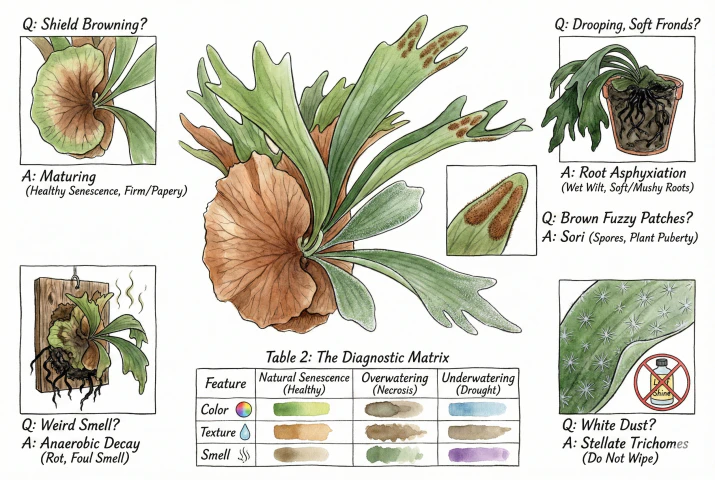
| Feature | Often normal senescence | Points toward waterlogging/rot | Points toward drought |
|---|---|---|---|
| Usual location | Shield (basal) fronds | Base of antler fronds / rhizome | Antler frond tips |
| Colour | Green → yellow → cinnamon brown | Green → dark brown / black | Green → grey → brown |
| Texture | Papery, firm, dry | Soft, mushy, slimy | Brittle, crinkly, dry |
| Smell | Neutral / earthy | Sometimes foul or sour | Neutral |
| Attachment | Firm (structural) | May loosen | Firm |
Compare texture, location, and spread before deciding whether a brown area needs action.
Is a shield frond that is brown only at the bottom dying?
Brown Shield Frond or Rot
Most likely it is just maturing, especially if the tissue is firm and papery, but check the texture before deciding.
- Shield fronds commonly brown from the older tissue toward the newer rim as the frond ages. If the brown tissue is firm, dry, and papery, that is the normal pattern.
- If the tissue is firm and dry, do nothing and do not cut it off because it is structure for the next layer. If the browning area is soft, wet, or spreading quickly, treat it as a possible problem and check moisture and the base rather than assuming it is healthy aging.
Why are the antler fronds drooping even though the mount is wet?
Wet Mount with Drooping Fronds
A soft droop on a plant that is sitting wet often points to a root problem rather than thirst, so resist the urge to add more water until you’ve checked.
- If roots have been starved of oxygen in constantly wet moss, they can stop working, and the fronds lose turgor and droop even though the plant is wet. As a rough guide, a thirsty plant tends to feel dry and crispy, while a waterlogged one feels soft and heavy. Drought, heat, cold, transplant shock, and crown damage can also cause drooping, so this is a clue, not a verdict.
- Stop watering and let the mount dry down. Improve airflow moderately, using gentle air movement rather than a fan blasting directly on stressed fronds, and check that temperature and humidity are reasonable. If you can, inspect the roots. Firm, pale, resilient roots are fine. If some are dark, soft, and mushy, trim clearly dead tissue with clean tools and remount in fresh, airy sphagnum. Avoid pouring household chemicals such as hydrogen peroxide on the rhizome because home dilutions have no established concentration or contact time for this and can damage tissue. For a valued plant or a fast-spreading problem, get a proper diagnosis before doing anything drastic.
Are brown fuzzy patches under the antler tips fungus or bugs?
Fuzzy Patches Are Usually Sori
Most likely neither. A regular, felt-like patch under mature antler tips is probably a spore-producing sorus rather than fungus or an insect.
- Sori are clusters of spore-bearing sporangia, usually forming a felt-like patch along the underside of mature antler tips. This is how the fern reproduces, and it usually indicates a mature frond, though sori alone do not guarantee the whole plant is thriving.
- People sometimes scrape sori off thinking they are scale insects. Sori are a continuous, symmetrical, felt-like band integrated into the leaf, so scraping them damages the frond. Scale and mealybugs, by contrast, are discrete bumps or cottony spots that can be dislodged. If you are unsure, look with a hand lens for a regular spore pattern versus individual insects, honeydew, or crawlers before touching the leaf.
Should I use leaf shine on the white coating?
Leave the Trichome Coating in Place
Skip the leaf shine because the white coating is a protective layer rather than dirt.
- The fuzzy coating is made of stellate trichomes, or star-shaped hairs, that help hold a still layer of air against the leaf and slow water loss. Leaf-shine products are not needed on staghorns and can coat the surface and mat those hairs down.
- Leave the matte, dusty look alone because it is normal on a staghorn. If the coating looks like powdery patches or cottony spots rather than an even fuzz, rule out powdery mildew or mealybugs before assuming it is trichomes.
What does a sour or swampy smell mean?
Inspect Moisture and Tissue After a Sour Smell
A sour or swampy smell can point to waterlogged, decomposing medium, but treat it as one clue, not proof of disease.
- Damp organic material has a natural earthy smell from microbial activity. A distinctly sour, swampy, or sulfurous odour tends to go with medium that has stayed saturated and is breaking down anaerobically. On its own, smell does not confirm a specific pathogen.
- Do not tear the plant apart on smell alone. First check the mount’s weight and moisture and look for visible spread and the condition of the roots and growing point. If the medium is sodden and clearly breaking down, or you see soft, spreading rot, remove the degraded material and remount in fresh, airy sphagnum. Start with the least invasive step and escalate only if the problem is real and spreading.
A Triage Checklist
When a staghorn worries you, work through this checklist before doing anything drastic. Start with texture and moisture, then inspect the growing point and roots if the pattern is spreading.
| What you see | What to check next | When to get help |
|---|---|---|
| Firm, dry, papery brown on a shield frond | Confirm it is firm and not spreading. Note where it is (usually older shield tissue) | Usually no help needed. Leave it alone |
| Soft, wet, or blackening tissue, especially near the base or crown | Feel whether it is soft and mushy. Check how fast it is spreading and whether the medium is sodden | If it is spreading fast or the plant is valuable, seek a diagnosis (e.g. An extension clinic) before treating |
| Fronds drooping though the mount is wet | Check root firmness, medium moisture, and recent temperature/light. Rule out heat, cold, and transplant shock | If roots are widely dark and soft, get advice before major cutting or chemicals |
| Sour or swampy smell | Check the mount’s weight/moisture and look for visible rot and its extent | Remount if the medium is clearly broken down. Escalate only if rot is real and spreading |
Texture, weight, location, rate of spread, and smell are useful clues, but no single one is a diagnosis.
When in doubt, favour the least invasive step and, for severe or spreading problems on plants you care about, get a proper diagnosis rather than guessing.
Make the Least Invasive Diagnosis
Growing Platycerium well largely comes down to adjusting your expectations about brown. On a staghorn, a firm, papery brown shield frond is usually part of how the plant works, not a sign that something is wrong.
That brown shield helps shelter the rhizome, and it collects litter that slowly feeds the plant.
The brown spore patches on the antler tips are a separate thing, the fern’s reproduction, not the same as browning fronds.
Distinguishing healthy browning from rot is mostly a matter of careful observation, though it isn’t always certain, which is why persistent or spreading problems are worth a proper diagnosis.
- Touch it. Firm, dry, and papery usually means healthy senescence. Soft, wet, and spreading is a warning sign to investigate.
- Weigh it. For the same mount, track its weight after watering versus when it’s due. A lighter mount signals it’s drying out, a still-heavy one that it can wait.
- Smell it. An earthy smell is normal. A distinctly sour or swampy odour is a clue that the medium may be staying too wet.
In practice, staghorns do better with an airy, well-draining setup than with heavy, constantly wet soil.
Whether mounted or grown in a well-drained basket or container, the pattern is the same. Wet the medium thoroughly, let it drain, and let it dry out somewhat before the next watering.
Leave a healthy brown shield frond in place, while keeping the disease, natural-detachment, and remounting exceptions in mind.
Good long-fibre moss, a complete liquid feed, and a sensible mount all help, but none guarantees an outcome on its own.