
Fungicide for Staghorn Fern: A Careful Approach to Rot
Diagnose staghorn fern rot before using fungicide. Compare water molds, fungi and bacteria, correct wet media and airflow, then follow the product label.
Priya Patel · Published 2025-12-25 · 26 min read

Key Takeaways
- Symptoms alone cannot identify the organism. Wet, mushy rot and dry, black lesions are useful clues, but bacteria, fungi, water molds, normal aging, and environmental injury can look alike. A lab sample is the only way to confirm the cause.
- Correct the growing conditions before you reach for a spray. A wet-dry cycle, airy media, and good airflow prevent much of the rot seen in cultivation. A Bacillus biological can be a lower-risk first option, while stronger chemicals should wait until the target is known.
- Phosphonates target water molds rather than true fungi. Pythium and Phytophthora belong to the water-mold group, so a labeled phosphonate can be reasonable after a lab confirms an oomycete. It can manage disease without guaranteeing a cure.
- White fuzz on antler fronds is usually normal trichomes. Do not scrub it as if it were mildew. Copper and neem products can injure ferns under some conditions, so spot-test and follow the current label.
- Much apparent disease is caused or amplified by poor culture. Old, compacted sphagnum drains and aerates poorly. Remount when the medium has declined, use an airy mix suited to the setup, and water early enough for the plant to dry before night.
Why Staghorn Ferns Are Prone to Rot
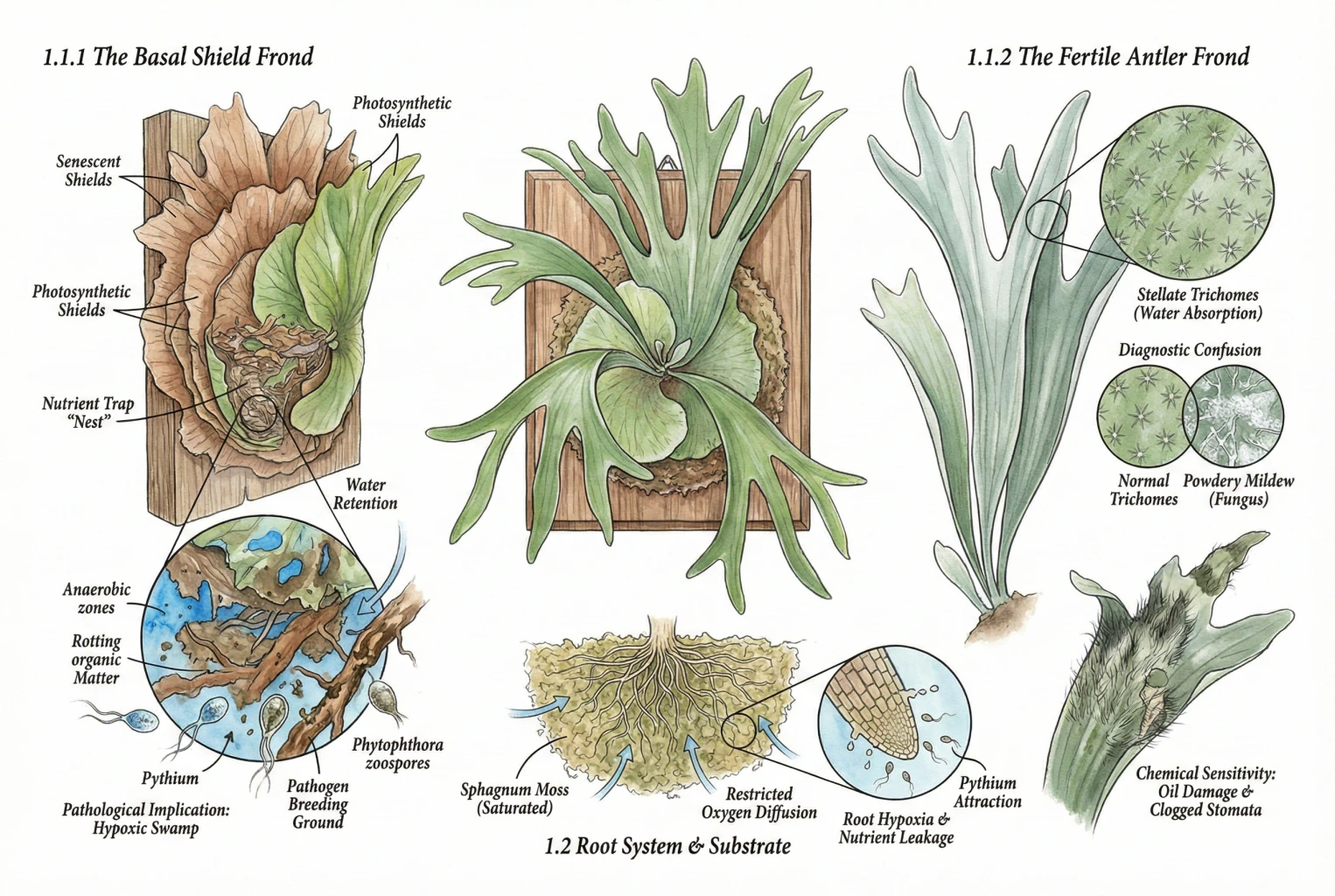
Understanding a little about the staghorn fern’s biology helps explain why it is prone to root and crown rot when kept too wet.
The genus Platycerium is epiphytic, growing on trees rather than in soil.
That lifestyle favors efficient water capture but leaves the plant intolerant of prolonged saturation.
When cultivation keeps the root zone wet, the risk of rot rises. Correct the growing conditions first, then reserve fungicides for a diagnosed problem that appears on the product label.
I photograph and trace the lesion boundary before applying any labeled product, then record which frond surface and shield layer were treated. A dark area can keep changing color after growth stops, so color alone is a poor efficacy measure.
Boundary expansion and new tissue are compared while watering and airflow changes stay in the same log. If several controls change together, I do not credit the fungicide alone.
Before mixing, I confirm the current label covers the plant, site, disease target, rate, and application method. A product called fungicide is not automatically approved for an indoor mounted fern or every pathogen.
Shield Fronds Hold Water and Debris
The genus has heterophylly, which means it produces two frond types. Each type serves a different role in water capture, protection, and reproduction, so each can show different signs when the plant is stressed.
How the Basal Shield Protects the Plant
The basal fronds are shield-like structures that clasp the host tree or mounting substrate. Botanists call them sterile because they do not bear spores, not because they are germ-free. They are green and photosynthetic when young and later become brown and papery as they age. Their main functions are as follows.
- They anchor the fern to its vertical support.
- They cover the root mass and protect it from drying and physical damage.
- They form a basket that collects leaf litter, animal waste, and water.
Why this matters for rot
The trapped litter and overlapping dead shields are a normal part of the plant’s structure.
In the wild, air movement in the canopy helps them dry between rains. On a mount indoors, the same layers can hold moisture against the rhizome, and if that moisture never cycles from wet to dry, the root zone can stay saturated.
Persistent saturation, rather than the debris itself, is what raises rot risk. It lowers oxygen at the roots and stresses the plant.
Whether disease actually develops depends on how long the tissue stays wet, on temperature and airflow, on which pathogens are present, and on the plant’s condition, not on the presence of a nest alone.
Water molds such as Pythium and Phytophthora, and various fungi that live on decaying organic matter, can become a problem when a stressed or wounded plant meets the right conditions.
Antler Fronds Have Protective Trichomes
These are the erect or pendulous fronds that produce spores and carry out much of the plant’s photosynthesis, though green basal fronds also photosynthesize and the balance shifts with species and life stage.
They are covered in a dense layer of stellate trichomes (star-shaped hairs), which give the plant a glaucous, silvery appearance.
Why this matters for disease management
The trichomes form a surface layer that influences water retention and reflectance. Claims that they directly absorb atmospheric water vapor are not well established, and the plant takes up most of its water through the fronds and roots after wetting. Two practical points follow.
- Growers can easily mistake this normal fuzz for powdery mildew or fungal hyphae, which can lead to unnecessary and damaging fungicide sprays.
- The dense hairs can hold liquids against the leaf surface longer than a smooth leaf can. Oil-based treatments such as neem oil may mat the hairs and contribute to injury on a stressed plant in strong light or heat, so spot-test before spraying.
On the selective advantage of coloniality in staghorn ferns (Platycerium bifurcatum)
Roots Need an Airy Mount
Unlike terrestrial ferns that forage deep into mineral soil, Platycerium roots are fine, fibrous, and confined to the area immediately behind the shield fronds.
They are adapted to rapid uptake of water from fleeting rainfall events. In cultivation, these roots are typically embedded in sphagnum moss, a substrate with high water-holding capacity.
Root health depends heavily on how much oxygen reaches the roots. When sphagnum moss stays saturated, oxygen diffusion to the roots is restricted, and prolonged low oxygen can stress or damage roots.
Keep the Root Zone Aerated
In plants generally, oxygen-starved roots can lose membrane integrity and leak solutes, and root exudates influence the microbes around the root.
Stressed roots may be more vulnerable to opportunistic water molds, but the specific claim that sugar leakage acts as a chemical beacon drawing Pythium to staghorn roots has not been demonstrated for Platycerium.
Keep the root zone from staying saturated, because saturation stresses the roots and favors rot.
Plant responses to soil waterlogging and oxygen deficiency
Which Organisms Cause Staghorn Rot?
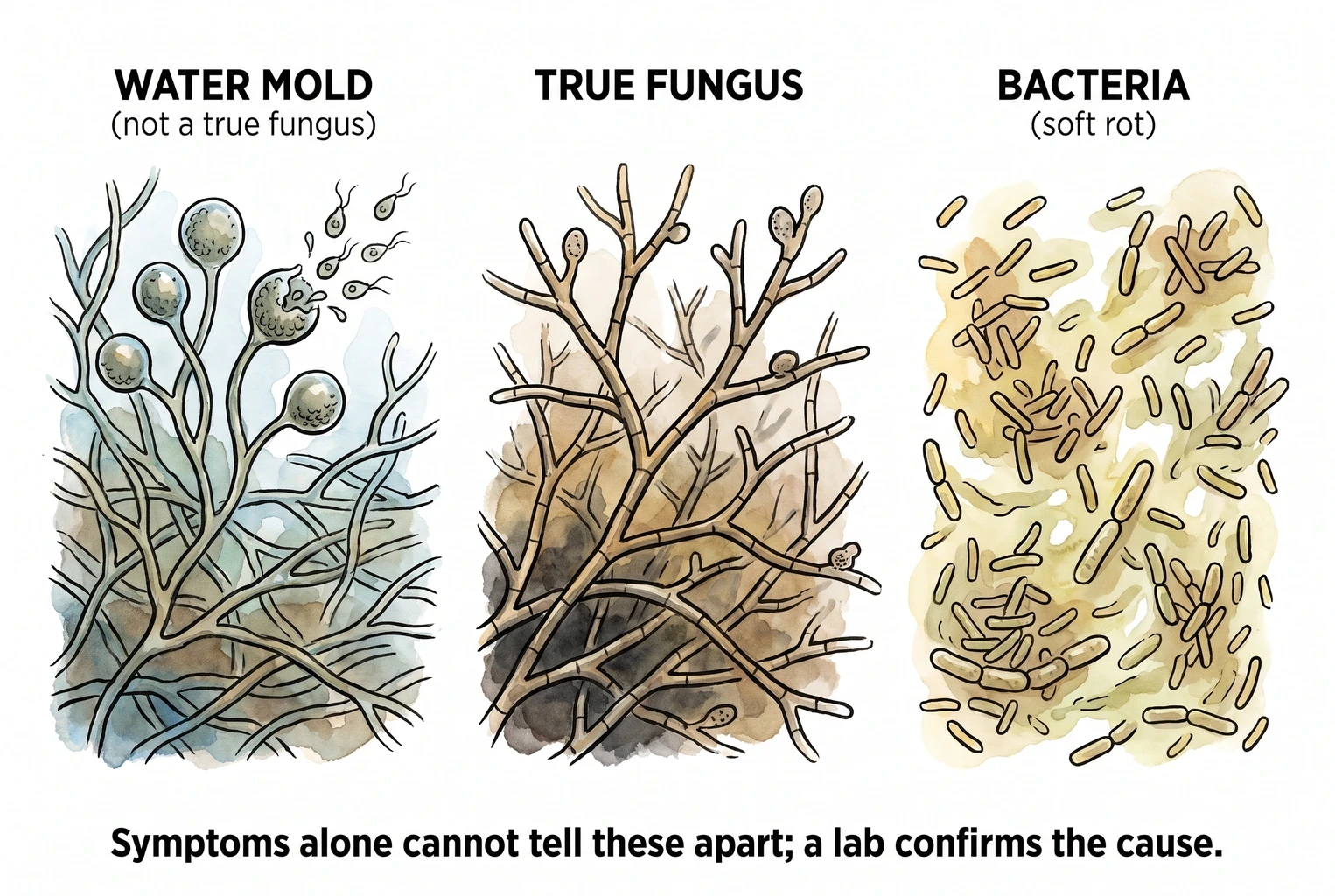
Treatment works best when you know what you are treating. The word fungus is often used loosely, but rot can involve true fungi, water molds called oomycetes, or bacteria.
Because these groups differ, a product effective against one may do little against another. Symptoms can narrow the possibilities, but culture, microscopy, or an extension diagnostic lab is needed to confirm the organism.
Water Molds (Pythium and Phytophthora)
These organisms, commonly called water molds, are not true fungi but stramenopiles. Their cell walls are dominated by cellulose and β-glucans rather than the chitin that is prominent in many true fungi.
The picture is not a clean either/or, though. Cell-wall composition varies by species and life stage, and some oomycetes carry chitin-related components and even chitin synthase genes.
The practical point is that oomycetes and true fungi respond differently to fungicides, so a product that suppresses one group may not suppress the other.
Which product actually works depends on the confirmed pathogen, the product’s labeled diseases and sites, its mode of action, and resistance management. It cannot be decided from a single chitin rule of thumb.
Pythium
Pythium can cause root rot in staghorn ferns kept too wet. It is often described as an opportunist that enters through stressed or wounded tissue and becomes destructive once established. How common it is on staghorns specifically is not well documented, so treat the idea that it is the usual culprit as a general impression rather than a confirmed fact.
- Many Pythium species produce swimming spores that move through water films toward roots and durable spores that can survive in media or dirty pots. Details vary by species. For a species-specific prevention protocol, see the Platycerium ridleyi rot guide.
- Pythium can produce enzymes that break down cell walls, turning tissue soft and water-soaked until roots become slimy and disintegrate. A foul smell may accompany this, but odor often comes from secondary bacteria and oxygen-poor decomposition, so it is not specific to Pythium.
Phytophthora
Phytophthora is also an oomycete. Some species can invade the rhizome and crown, not just the feeder roots, and may cause rapid collapse.
Both genera contain many species with different behavior and temperature preferences, so rules such as always more aggressive or always warmer are not reliable ways to tell them apart. A lab is still required.
Phytophthora diseases can be a significant problem in warm greenhouse production.
Rhizoctonia
Rhizoctonia is a true fungus and a different kind of problem. Its common asexual state spreads mainly by hyphal growth across surfaces and often does not produce spores, which is why it is sometimes called sterile mycelium. That label is incomplete because related taxa have a sexual basidiomycete stage and can form sclerotia, which are survival structures.
- Rhizoctonia generally favors humid but aerated conditions rather than standing water and lives on soil surfaces and organic debris. On a staghorn, persistently moist dead shield tissue can act as a bridge for hyphae to reach living tissue.
- It can form infection cushions, which are dense masses of hyphae that press on and enzymatically penetrate the plant surface. These structures are microscopic and cannot be confirmed by eye.
- It tends toward drier, more defined lesions or cankers that may be sunken and reddish-brown to black rather than water-soaked and mushy. This is a comparison clue, not a diagnosis, because other causes can overlap.
Secondary and Opportunistic Pathogens
- Botrytis cinerea, often called gray mold, can attack tender new growth in high humidity and poor airflow and produce fuzzy gray spore masses. Gray, raised, dusty tufts point toward Botrytis, whereas uniform white or silvery felt is usually normal trichomes. Mites, mealybugs, and harmless molds can also be mistaken for it, so confirm before treating.
- Bacteria can follow other infections and drive rapid, slimy, foul-smelling decay. The main soft-rot bacteria have been reclassified into genera such as Pectobacterium and Dickeya, while older texts may call them Erwinia. There are no reliable systemic chemical cures for bacterial soft rot in ferns, so removing affected tissue and strict sanitation remain the mainstays. A lab can confirm whether bacteria are involved.
Diagnose Before You Treat
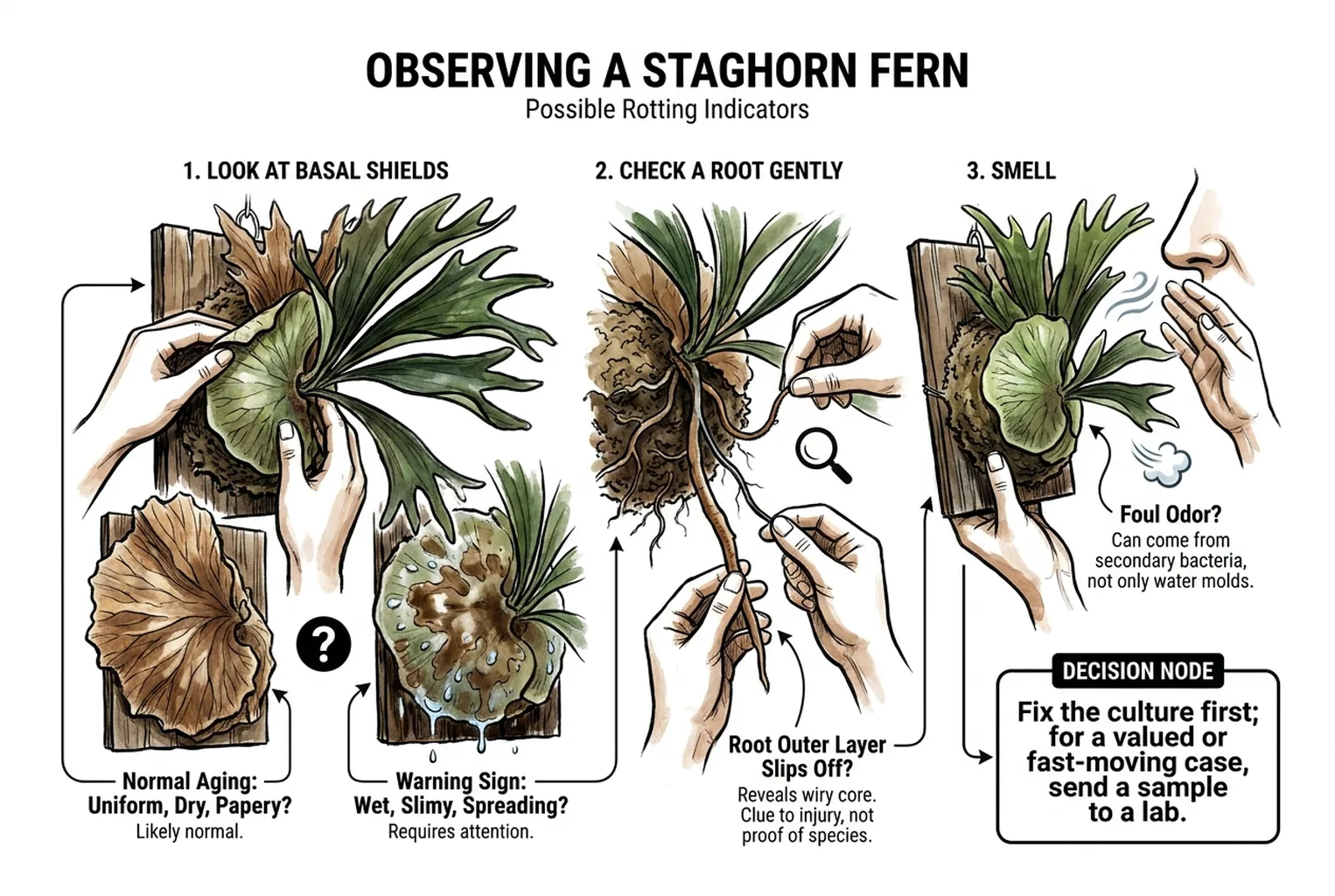
Getting the cause right matters, because a phosphonate aimed at water molds will not control a true fungus like Rhizoctonia, and vice versa.
Visible signs are clues, not proof. Use them to narrow the field and choose safe first steps, but confirm the organism by culture, microscopy, or an extension lab before using a targeted pesticide.
Separate Disease From Environmental Stress
Normal Brown Shield or Rot?
The natural lifecycle of the shield frond is a common source of false diagnosis. Use the brown shield-frond versus rot guide when the change is firm and papery rather than wet or spreading.
- As a new shield frond matures, it forms a tight layer over the previous one. The old frond naturally turns brown, and this normal browning is uniform, dry, and papery.
- If a young, green shield frond develops localized black spots or the browning is wet and slimy, the change is more concerning. A growth eye that turns black or mushy indicates critical decline.
Can a Root Tug Test Confirm Rot?
Because staghorn roots are hidden behind the shields, they are hard to inspect without damaging the plant.
Look only as far as you can with minimal disturbance, and if you plan to send a sample to a diagnostic lab, keep a piece that spans the boundary between healthy and affected tissue. If the plant is mounted so you can reach the back, or is in a basket, a gentle check can add another clue.
- Gently pull on a dark root. If the outer cortex slips off like a sleeve and leaves a wire-like core behind, the root is dead or badly damaged. This is consistent with water-mold rot, but it does not confirm Pythium because bacterial rot and other causes can look the same. Treat it as a reason to investigate and, for a valued plant, to submit a sample.
- Dry, brittle roots or defined lesions suggest a drier process than water-mold rot, but they can also reflect drought, salt injury, aging, or other fungi. They are a clue rather than a verdict.
Compare Signs Before Choosing a Product
This comparison is a starting point for narrowing the field, not a diagnostic key. The signs are non-specific, and bacterial rot, Phytophthora, Botrytis, abiotic injury, and mixed infections can overlap.
Use it to choose safe first steps and to decide whether to send a sample, not to lock in an organism.
| Observation | Possible cause(s) | What would help confirm | Reasonable first steps |
|---|---|---|---|
| Basal fronds show dry, spreading black spots and little or no smell. | The cause could be Rhizoctonia, another fungus, or environmental injury. | Compare the humidity and airflow, then use lab culture or microscopy on affected tissue. | Reduce humidity, improve airflow, and remove clearly dead tissue. A Bacillus biological is a lower-risk option. Use a labeled fungicide only for a confirmed disease. |
| Basal fronds are mushy, slimy, and black with a rotten smell. | The cause could be a water mold such as Pythium or Phytophthora, with possible bacterial soft rot. | Check for saturated substrate and sloughing roots. A lab sample can distinguish an oomycete from bacteria. | Stop saturating the mount, improve drainage, remove decayed tissue, and sanitize tools. Consider a labeled phosphonate only after a lab confirms an oomycete. |
| Antler fronds have uniform white, fuzzy coverage. | The appearance is usually normal trichomes. | Uniform coverage that cannot be wiped away without damaging the leaf supports this interpretation. | Leave the surface alone. Do not scrub or apply oil. |
| Antler tips have raised, dusty gray growth. | The cause may be Botrytis, although mites, mealybugs, and other molds can look similar. | Cool, damp, stagnant air and gray sporulation support the possibility of Botrytis rather than flat white felt. | Increase airflow and remove affected tissue. Use a labeled disinfectant only according to its directions. |
| Leaf tips are brown and crispy without lesions at the base. | The pattern is more consistent with environmental stress. | Check humidity and watering, then compare the timing with recent changes in the growing conditions. | Adjust humidity and watering. A fungicide is not needed for this pattern. |
The comparison below puts the same clues side by side. Use it to record what you see, not to make an organism-level diagnosis, because none of these rows confirms a specific pathogen.
| Sign | Water-mold-type (wet) rot | Fungal-type (dry) rot | Normal senescence |
|---|---|---|---|
| Texture | Slimy, mushy. Roots may slough off | Dry, sunken cankers | Dry, papery |
| Color | Water-soaked brown/black | Reddish-brown to black lesions | Uniform brown |
| Smell | Foul (often from secondary bacteria) | Little | None |
| Where | Roots, base, crown | Can spread from dead shields | Oldest shield fronds |
| First response | Dry out. Remove decay. Confirm before any phosphonate | Airflow. Remove tissue. Biological or labeled fungicide only if confirmed | Leave it alone |
Choosing a Product After Diagnosis
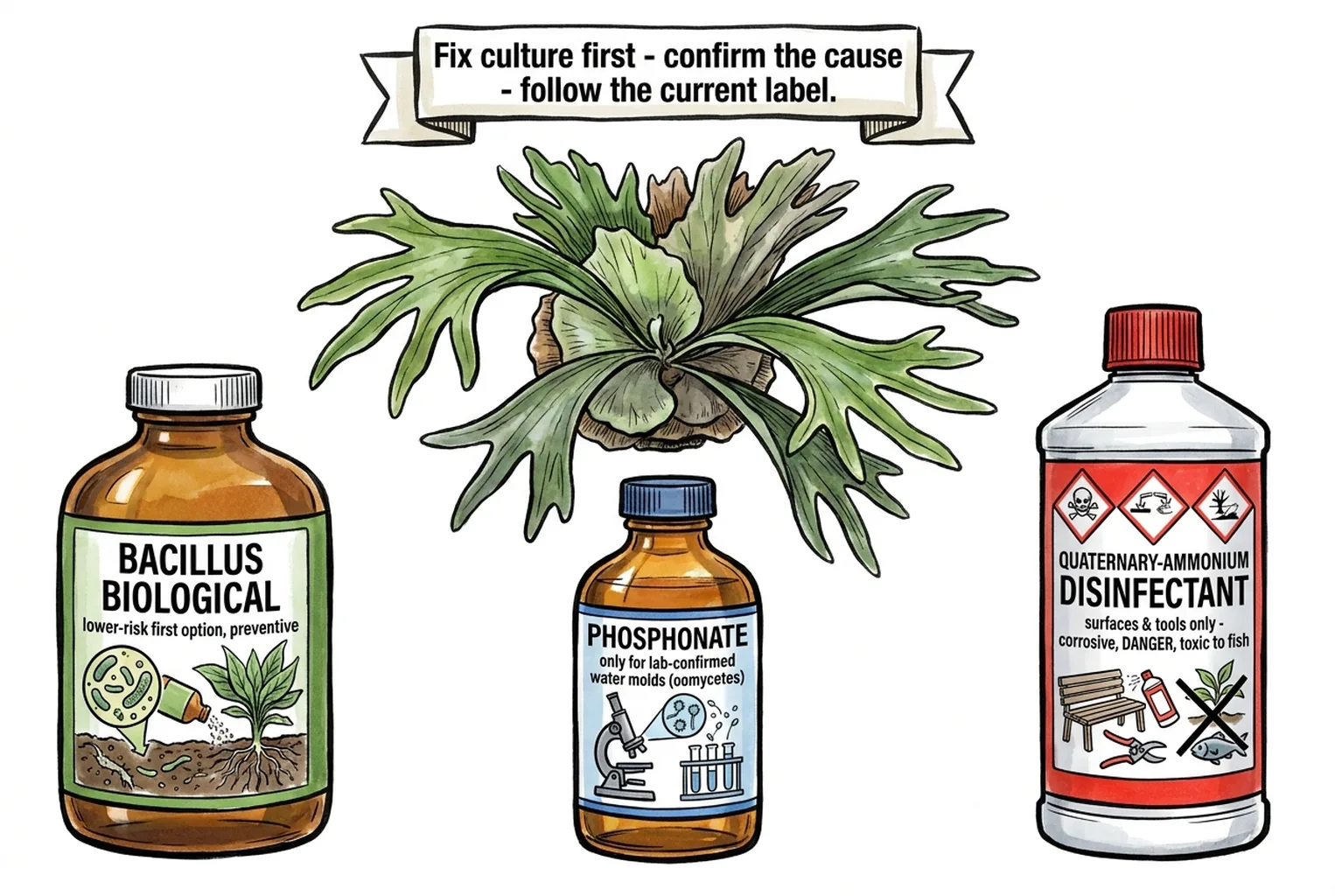
Ferns can be sensitive to sprays. Correct the culture, identify the likely cause, and choose the least-hazardous product whose current label covers the plant, disease, and site. None of these products guarantees recovery from advanced rot.
Is a Bacillus Biofungicide Worth Buying?
Choose Bacillus for Labelled Preventive Support
Choose it for preventive or early support against a label-listed disease such as Botrytis, gray mold, or certain leaf spots after watering and airflow have been corrected.
Skip Bacillus for Advanced or Unknown Rot
Do not rely on it for fast-moving mushy decay, an unknown cause, or an assumed Pythium or Rhizoctonia infection. A biological is not a reliable rescue for advanced rot.
Southern Ag Garden Friendly Fungicide
Southern Ag Garden Friendly Fungicide is a biological product built around Bacillus amyloliquefaciens strain D747. In plain terms, beneficial bacteria occupy space and use nutrients that harmful microbes also need, and they may produce compounds that suppress some diseases. Results still depend on the confirmed disease, the growing conditions, and applying it early enough.
There is an important label discrepancy to resolve before buying. The manufacturer’s product page markets the product for Pythium and root rot, while the downloadable package label does not name Pythium or Rhizoctonia. The current container label and local registration control. Do not extend the marketing claim to an unlabeled disease.
Use the foliar or drench method, rate, and interval only where the current label permits the intended ornamental and disease. A stronger rate or shorter interval is not permission to treat an unlabeled problem.
Southern Ag Garden Friendly Fungicide product page
Southern Ag Garden Friendly Fungicide package label
When Does Garden Phos Make Sense?
Choose Garden Phos for Confirmed Oomycetes
Choose it for a lab-confirmed Pythium or Phytophthora problem when the current local label covers the plant and treatment site.
Skip Garden Phos for Fungi or Unknown Causes
Do not use it for Rhizoctonia, bacteria, an unknown cause, or any setup where you cannot meet the PPE and phytotoxicity-test directions. Phosphonates target oomycetes, not true fungi.
Monterey Garden Phos
Monterey Garden Phos is a phosphonate treatment containing salts of phosphorous acid. The plant can absorb and move it internally, which is why it is considered systemic. It can help manage water-mold disease, but pathogen sensitivity and resistance mean it does not guarantee eradication.
The official Garden Phos directions separate foliar and root-drench uses. It names ferns in a bedding-plant table but does not name staghorn fern specifically, so verify the exact ornamental, site, disease, and method before treating. Never copy a foliar rate into a drench.
Before first use, treat only a small number of plants and wait the label’s 3–7 days for phytotoxicity. Wear protective eyewear, long sleeves and pants, waterproof gloves, and shoes with socks as directed.
Monterey Garden Phos product page and label
When Is Physan 20 the Right Tool?
Choose Physan 20 for Isolated Hard-Surface Sanitation
Choose it for reusable tools, benches, pots, and other hard-surface sanitation when you can preclean, keep the surface wet for the labeled contact time, wear the required PPE, and contain the waste.
Skip Physan 20 in Occupied or Aquatic Setups
Do not use it in an occupied vivarium, any aquarium or fish-adjacent setup, for routine spraying of mystery rot, or in a workspace where you cannot isolate, rinse, dry, and dispose of the solution safely.
Physan 20 Disinfectant
Physan 20 disinfectant is a quaternary-ammonium surface disinfectant that works by contact. It is intended for tools and hard surfaces rather than as a cure for infected fern tissue. Its EPA label carries the signal word DANGER. The concentrate is corrosive, can cause irreversible eye damage and skin burns, and is toxic to fish, so wear the specified protective clothing and eyewear and keep it out of aquariums, ponds, drains, and natural water.
For hard, nonporous work surfaces, preclean first and follow the label’s exact dilution and wet contact time. Other tasks use different directions. Although the manufacturer provides some plant and fern directions, there is no staghorn-specific entry, so do not treat one table as universal.
In a vivarium, remove or fully protect animals, water, plants, and substrate before any labeled surface treatment, then complete the required rinse and dry steps before reassembly. If safe isolation and waste control are not possible, use another sanitation method.
Physan 20 EPA label
Chemicals That Need Extra Caution
Copper Fungicides
Copper is a traditional fungicide, such as copper sulfate or copper octanoate, that works against bacteria and some fungi. It can injure some ferns under particular products and conditions, so it deserves care. Extension diagnostic services sometimes list a copper-based fungicide among the options for suspected Rhizoctonia on staghorns. Check the specific label and diagnosis rather than banning copper or using it blindly.
- Applied too strongly, in heat, or on wet foliage, copper can cause frond burn and leaf drop.
- Before using it, confirm that the specific product is labeled for ferns and for the disease you are treating. Follow the label’s rate and temperature guidance, spot-test on a single frond, and wait a couple of days before treating the whole plant. Where available, follow your local extension’s recommendation for the confirmed disease.
Horticultural Oils (Neem Oil)
Neem oil is often suggested for pests and is labeled for some fungal problems such as powdery mildew, though its registered uses and phytotoxicity depend on the specific product. It is not a substitute for diagnosing the actual disease.
- Staghorn fronds carry a dense trichome layer, so oil sprays can mat the hairs and linger on the surface. On a stressed plant in strong light or heat, that residue can contribute to leaf injury. Claims that oil clogs the stomata and suffocates the leaf overstate a mechanism that is not well documented. The practical concern is surface residue combined with heat and light stress.
- Prefer avoiding oils on Platycerium when possible. If you do use one, choose a lighter labeled formulation, spot-test first, apply a light mist rather than saturating the trichomes, keep the plant out of direct light until dry, and provide airflow. Match the product label to the fern and the target problem.
Prevent Rot Before It Needs Fungicide
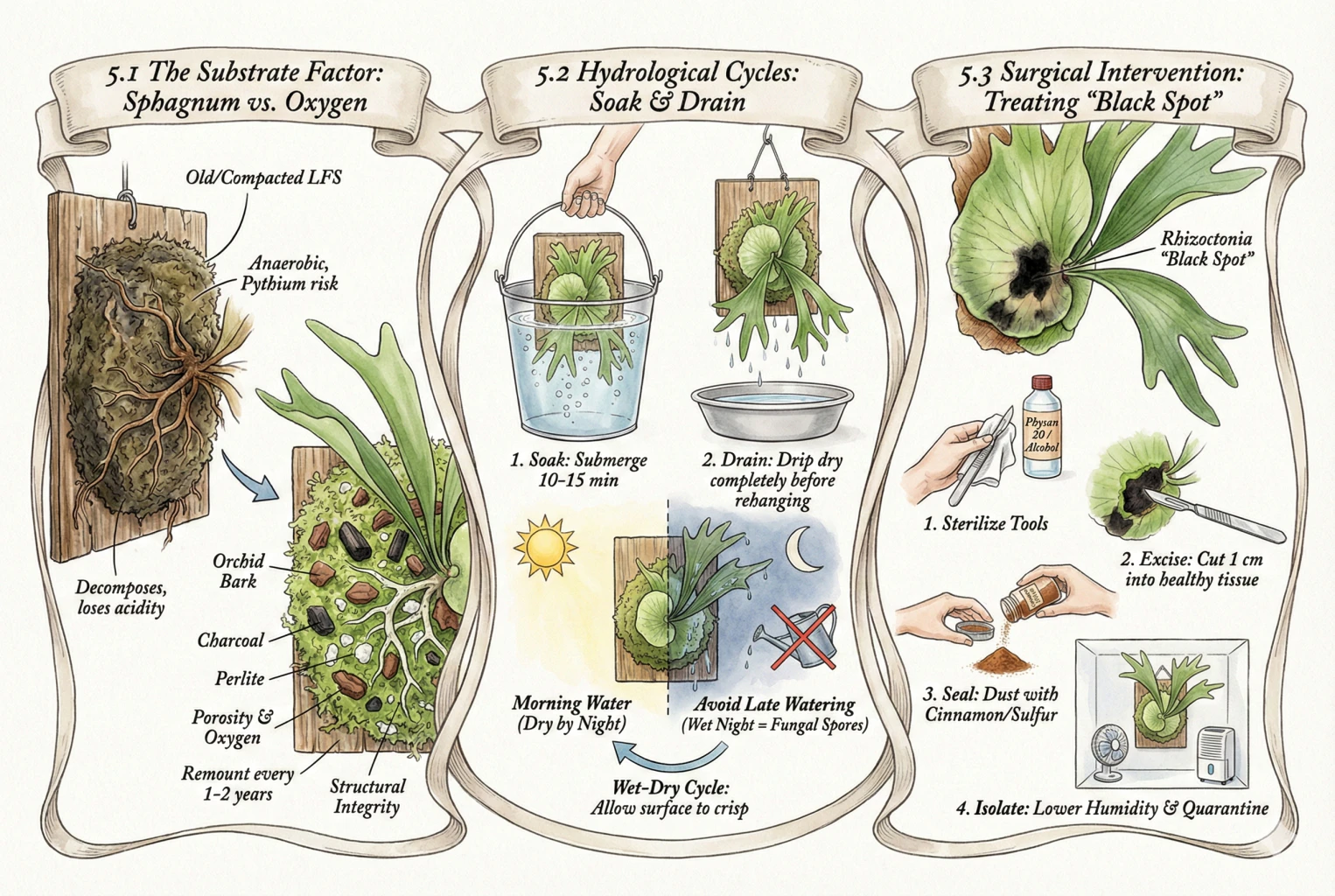
Chemicals should be a late step, not the first, because cultural hygiene prevents much of the rot seen in cultivation. If rot is active and spreading, do not let that sequence delay containment or a sample submission. Take both actions in parallel.
Replace Sphagnum by Condition
Many commercial staghorn ferns are sold mounted with long-fiber sphagnum (LFS) moss, though this varies with the source and growing region.
- Fresh sphagnum has been studied for some antimicrobial chemistry, but the effect varies. What matters most in practice is that over time the moss breaks down and compacts, so it drains and aerates more poorly and holds water against the roots for longer. There is no reliable timeline for its acidity to stop mattering. Judge by the condition of the medium, not the calendar.
When to remount
Rather than following a fixed one-to-two-year schedule, remount when the medium has broken down and stays wet, drainage is poor, or the basal fronds reach the edges of the mount. The sphagnum replacement guide gives a closer condition checklist. UF/IFAS guidance also ties remounting to the plant outgrowing its mount, and staghorns tolerate some crowding.
- A more open mix can help drainage. For example, coarse orchid bark, charcoal, or perlite can add air space to sphagnum. A completely sphagnum-free rule is too absolute, because the right mix depends on your mount type, climate, and watering habits. Very open media dry faster and need more frequent watering, and there is no single validated recipe for staghorns.
Restore a Wet-Dry Cycle
- Platycerium are adapted to intermittent moisture. Let the surface of the medium dry before watering again, and avoid both bone-dry and constantly-wet extremes. Persistent saturation is a major contributor to root and crown rot, though it is not the only factor.
How to water
Soaking the whole mount in water for 10–15 minutes is one good way to hydrate the core, while misting the surface alone is often not enough. This is a convenient method rather than the only correct one, so adjust it to your plant and mount size. For a large specimen, soaking may be impractical.
- Let the mount drip-dry completely before rehanging. Once surface dripping stops, the interior of the sphagnum can still hold water, so factor in how quickly your setup actually dries.
- If you suspect disease, do not soak an affected plant in a bucket reused for healthy plants. Use fresh, clean water to avoid spreading propagules.
- Water in the morning when possible so fronds dry before night. Long overnight leaf wetness can raise the risk of some foliar diseases, although the actual risk depends on the pathogen, temperature, and how long the tissue stays wet. This is a reasonable precaution rather than a guarantee.
Remove Diseased Tissue Carefully
If a spreading, defined lesion appears on a basal shield, collect a sample for diagnosis before cutting when possible. Remove the lesion only when you can work carefully around the crown and rhizome.
- Wipe a sharp knife or scalpel with a labeled disinfectant or isopropyl alcohol. Remove debris first and allow the recommended contact time.
- Cut back into healthy tissue while staying clear of the growing crown. A margin is useful, but a fixed 1 cm is not a validated rule. Remove what is clearly dead or diseased while preserving as much healthy tissue and the growth point as possible.
- Some growers dust cuts with cinnamon or sulfur. Sulfur has some labeled wound or disease uses, and cinnamon has shown antifungal activity in lab tests, but neither kitchen cinnamon nor powder dusting is a registered, proven treatment for staghorn wounds. Treat this as optional rather than a reliable seal.
- Move the plant somewhere with lower humidity and good airflow so the wound can dry, while keeping the rest of the plant adequately hydrated.
Adjust Treatment to the Growing Space
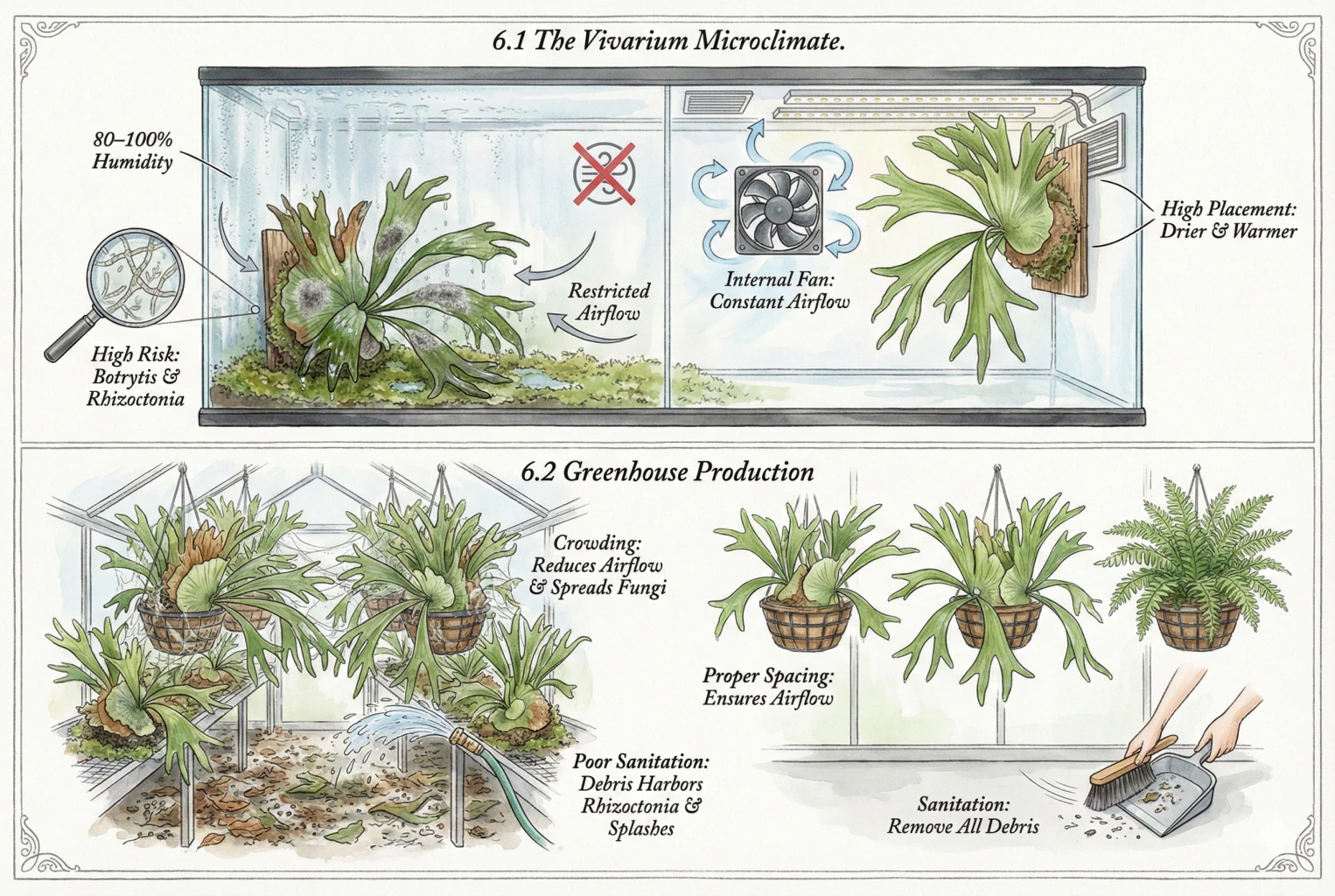
Vivarium Airflow and Placement
Glass-enclosed vivaria are often 80–100% humidity with restricted airflow. High humidity alone is not automatically high risk because day and night cycling, condensation, the species involved, and whether a pathogen is present all matter. What raises risk is persistent leaf wetness with stagnant air, so that is what to watch for and manage.
- Moving air helps prevent condensation from sitting on the fronds and is one of the more effective preventives in an enclosure. A small fan is often useful, but it does not need to run continuously in every setup. Constant airflow can over-dry fronds or stress animals, so balance ventilation against desiccation, noise, heat, and the inhabitants’ needs.
- Higher spots near vents or lights tend to be drier and warmer than the substrate floor, which can reduce standing wetness. They can also create more heat and light stress, so use measured temperature and light and an animal-safe layout rather than assuming higher is always better.
Greenhouse Spacing and Sanitation
Larger collections and commercial growing need a more deliberate sanitation routine.
- Crowding plants reduces airflow and allows fungal webs to bridge from plant to plant, so space baskets far enough apart that fronds do not touch.
- Remove dead leaves and debris from the floor because they can harbor pathogens. Splashing water is one route of spread, but contaminated media, tools, and direct contact between plants matter as well. Follow product labels at home, while commercial production must also follow its own regulatory requirements.
Troubleshooting and Recovery
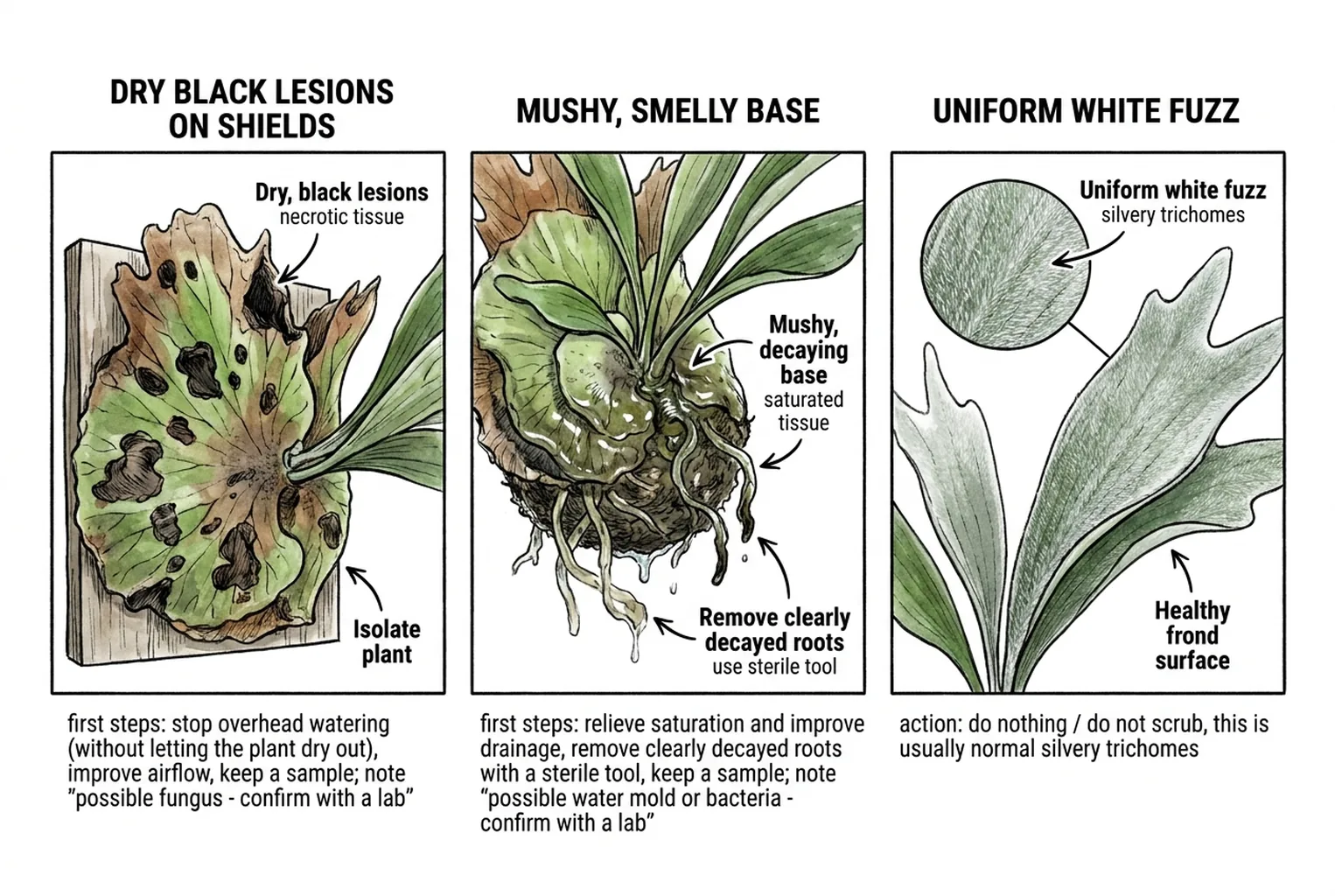
Start with what you observe, not an assumed organism. Take safe first steps and decide whether to confirm with a lab. A named product applies only when the corresponding cause and label use match.
What should I do about dry black lesions on staghorn shields?
- Dry, defined black lesions on basal shields that spread toward the center need evaluation. They can fit a fungal cause such as Rhizoctonia, but environmental injury and other organisms can look similar.
- Isolate the plant and stop overhead watering or misting while keeping the plant itself from drying out.
- If you plan to confirm the cause, keep a sample of healthy-to-affected tissue for a lab before cutting. Then remove clearly diseased tissue if practical, protecting the crown.
- A Bacillus biological is a lower-risk option for diseases listed on its label. Do not use a systemic such as thiophanate-methyl unless the disease is confirmed and the product is registered for this crop, disease, and site, with resistance management in mind.
- Improve light and airflow to shorten how long tissue stays wet. Avoid a fixed drying schedule and instead monitor the medium’s moisture and the plant’s water status, since a living epiphyte can be harmed by prolonged drought.
What should I do when the staghorn base is mushy, smelly, and wilted?
- A soft, squishy base, rotten smell, and wilting call for urgent root and crown investigation. They can fit a water mold such as Pythium, but bacterial soft rot, Phytophthora, and oxygen-poor decay can look the same, so this is not a confirmed diagnosis.
- Relieve saturation by checking whether the mount is waterlogged and improving drainage. Rather than stopping water entirely for a set period, reduce it and check moisture so the remaining healthy roots and fronds do not severely dehydrate.
- Inspect the roots by unpotting or checking the back of the mount, and keep a sample if you intend to confirm the cause. Remove fully decayed, slimy roots with a sterile tool while protecting the crown and healthy tissue.
- If a lab confirms an oomycete, a labeled phosphonate such as Monterey Garden Phos can be used under the applicable root-drench table. Never copy its foliar rate into a drench. It can help manage oomycete activity but will not guarantee a cure.
- Move to fresher, coarse, airy media to reduce saturation, while weighing the stress that remounting places on an already-sick plant. Sanitize tools and dispose of old media.
- Do not bury the plant in soggy medium immediately. There is no good evidence that withholding water for days helps fern roots form a protective seal. Keep remaining healthy tissue from drying out and manage moisture by the medium’s condition.
Is white fuzz on staghorn fronds a disease?
- Uniform white felt on antler fronds is almost always the plant’s normal trichomes, not mildew. Do not scrub it or spray oil. If you see distinct, raised, dusty gray tufts instead, Botrytis is one possibility, but rule out mites, mealybugs, and other molds first. For a suspected Botrytis problem, increase airflow and use a labeled disinfectant such as Physan 20 only according to its label.
The Root Culturist’s video on identifying and troubleshooting weather-related stress in staghorn ferns covers environmental stress. It does not diagnose white fuzz or Botrytis, so use an extension or plant-pathology source for those symptoms.
The Treatment Order That Avoids Guesswork
Managing staghorn health starts with recognizing that not all rot is the same and that symptoms alone rarely name the cause.
The most reliable path is to correct the culture first, confirm the organism when it matters, and then use a product that is actually labeled for that disease and site. A lab sample is especially valuable for a fast-moving problem or a plant worth saving.
Used that way, phosphonates for confirmed water-mold root rots and biologicals for some fungal problems can help, but they manage disease rather than guarantee a cure. Disciplined watering, airy media, and good airflow remain the most dependable prevention.
Disclaimer
Pesticide registrations, rates, and legal uses vary by region and change over time. Always read and follow the current product label, and use each product only on the plants, diseases, sites, and at the rates and intervals the label specifies. Where possible, confirm the cause and check treatment options with your local extension service.
Safety
Follow each product’s own PPE and handling instructions because they differ by product. Garden Phos requires eye protection, long clothing, and waterproof gloves. Physan 20 concentrate is corrosive and toxic to aquatic life, while systemic chemicals such as thiophanate-methyl should be a label-directed last resort used only where registered after biological and cultural controls. Spot-test on a small area before any full application.
Affiliate Disclosure
This article contains Amazon affiliate links. As an Amazon Associate I earn from qualifying purchases. If you use these links, the site may earn a commission at no extra cost to you. Product availability, price, and specifications can change. Check the current listing before buying.