
Platycerium Ridleyi Dwarf Care: Light, Water & Mounting
Grow Platycerium ridleyi dwarf with balanced airflow, measured light, soak-and-dry watering, an airy sphagnum mount, light feeding, and careful rot checks.
Priya Patel · Published 2026-01-29 · 15 min read
Key Takeaways
- Pair humidity with air circulation and drainage. Water trapped in ridged shield fronds without air movement is a common route to rot, so neither humidity nor airflow works well alone.
- Keep both frond types. Brown, papery shield fronds still cover the roots and capture moisture and litter, while the stiff branching antlers are fertile fronds that carry spore-producing lobes.
- Treat ridleyi as a bright-light epiphyte. Give it bright indirect or filtered light and measure intensity at the plant instead of assuming a fixed number.
- Use a wet-and-dry watering cycle. Let the moss dry between waterings, then rehydrate it, and keep standing water out of the central growth bud.
- Build an airy root zone. Long-fiber sphagnum on an untreated board is one option, but an open orchid pot or basket can also work when aeration, drainage, and bud orientation are correct.
Identify the Dwarf Trade Label
Platycerium ridleyi (Christ) is an accepted species (a wet-tropical epiphyte native from Peninsular Thailand across western Malesia). Dwarf is a trade label rather than a botanical taxon recognised by Kew or NParks, and the market mixes several such names, including Dwarf, Dwarf Silver, and Dwarf Wide. Unless the plant comes with a specific cultivar or clone identity, treat dwarf as a description of a compact plant rather than a guarantee of fixed size, light, or feeding behaviour.
P. ridleyi has two frond types with different jobs.
I save the seller’s exact dwarf name, source, parent or clone claim, plant photo, and invoice without shortening the wording. Similar compact Ridleyi can be sold under inconsistent labels, and appearance alone does not prove a clone.
If the plant is divided, the original claim passes forward unchanged. Growth under my conditions becomes a separate observation rather than retroactive proof of identity.
A full-watering photograph shows how water exits beneath the shield and mount. Compact growth can hide a pocket that stays wet long after the visible moss drains.
The Shield Fronds (Basal)
Shield-Frond Structure and Function
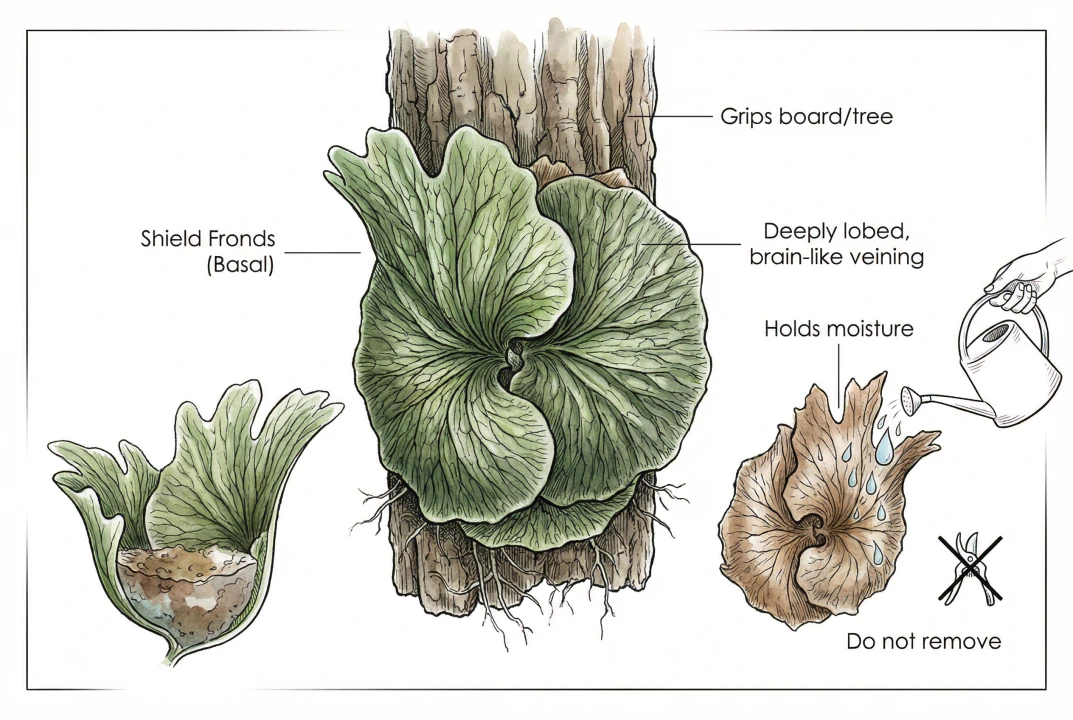
These are the rounded shield fronds at the base. In ridleyi they are corrugated and overlap to form an enclosed chamber over the roots.
Their role is to clasp the tree (or board), protect and cover the roots, and capture leaf litter and water, not simply to act as a sponge.
Handle with care
Avoid cutting these off for appearance, even when they turn brown and papery, because a normally aged shield is still part of the structure protecting the roots.
This is different from disease. If a shield goes soft, slimy, or actively rots, that is soft rot, not normal browning, and suspect tissue should be assessed and dealt with case by case rather than left untouched by rule.
Firm, papery browning and wet tissue collapse require different responses. The shield-frond versus rot checks prevent a healthy protective frond from being cut away.
The Fertile Fronds (Antlers)
Fertile-Frond Form
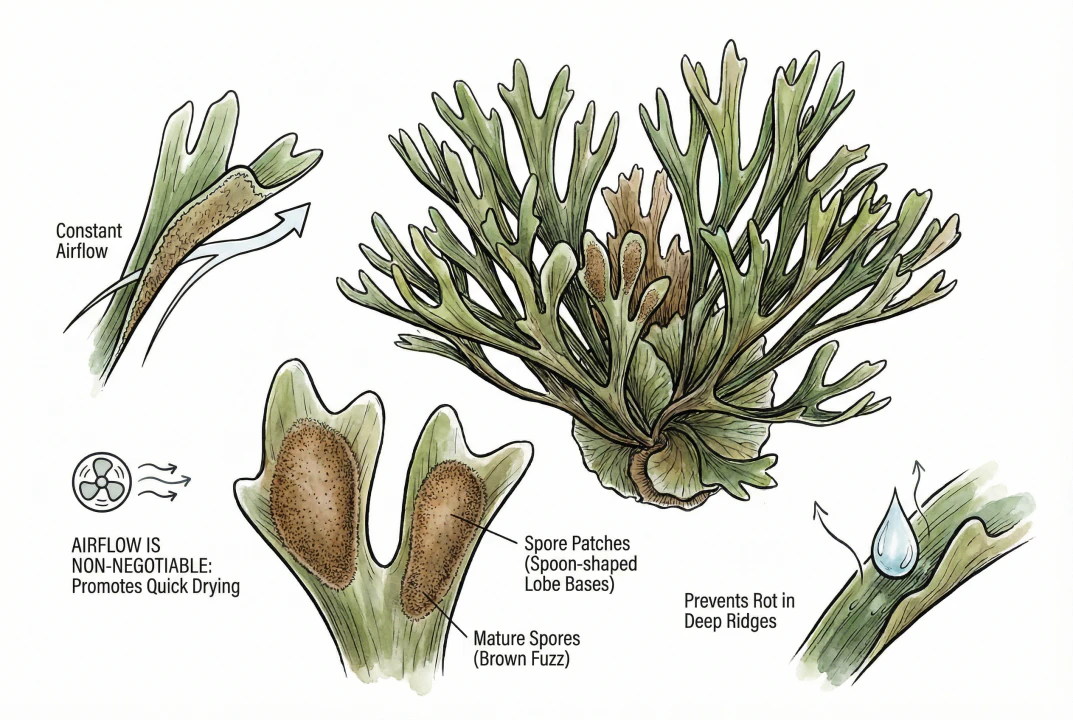
These are the upright, stiff fertile fronds that grow up above the shield. On compact, dwarf-labelled plants they tend to stay short and branch densely, giving a tight look. How short and dense they stay depends on the specific clone and on growing conditions.
Sori Are Spore-Bearing Structures
The spores are borne in specialised, stalked, spoon-shaped fertile lobes. The visible brown patches on these lobes are dense clusters of sporangia (sori). The actual spores are microscopic (NParks notes up to 8 spores per sporangium), so the brown area is the spore-bearing structure rather than the spores themselves.
Unlike the common Platycerium bifurcatum, Ridleyi is solitary. It does not produce pups (offsets).
On the selective advantage of coloniality in staghorn ferns (Platycerium bifurcatum, Polypodiaceae)
Air Circulation and Standing Water
Manage Airflow and Moisture Together
Effective Platycerium ridleyi rot prevention balances ventilation with watering. Both matter, and neither substitutes for the other.
High humidity in stagnant, saturated conditions is a common route to rot, so treat air movement and moisture as a pair rather than ranking one over the other.
In the wild, P. ridleyi grows high in the canopy where it is soaked by rain and then dried by moving air.
That drying phase is part of why prolonged leaf wetness and a constantly saturated medium are worth avoiding indoors.
Watch the Shield Ridges
Still, saturated crevices are associated with rot, but pooled water alone does not diagnose a specific pathogen because several problems can look alike.
Use Gentle Air Movement
A small fan can help, but there is no measured basis for keeping it always on, and direct wind can dry and stress the fronds.
AC Infinity Multifan S5
AC Infinity Multifan S5 fits a cabinet with a dry mounting position, USB power, and a need for gentle adjustable circulation.
It is an electronics-cooling unit, not a wet-enclosure fan, so keep the fans and connection out of condensation and skip it in a saturated cabinet.
Skip it when
You have a saturated cabinet that regularly exceeds that humidity range or a single open-room plant that already dries evenly.
Air circulation and moisture are two variables to balance, not a single equation. Whether a plant thrives also depends on root-zone aeration, water quality, temperature, light, plant size, how tightly the moss is packed, and acclimation. High airflow will not fix a permanently saturated root zone on its own.
Light
Start With Measured Light
This is not a low-light fern, and it is unlikely to do well in a dark corner.
Light Intensity
Aim for bright indirect light to filtered sun. NParks lists the species for semi-shade to full sun. You may see specific foot-candle targets quoted online, but there is no published light-response trial for a dwarf clone, so measure the actual intensity at the plant rather than trusting a fixed number. Morning sun is generally gentle. Strong midday and afternoon sun through glass can scorch the fronds.
Light Direction
In the Northern Hemisphere a south- or west-facing window with a sheer curtain is often bright enough. In the Southern Hemisphere the aspect is reversed. Because glass temperature, season, and distance change how much a west window heats up, judge by the light and leaf temperature at the plant rather than by the compass alone.
Artificial Lighting
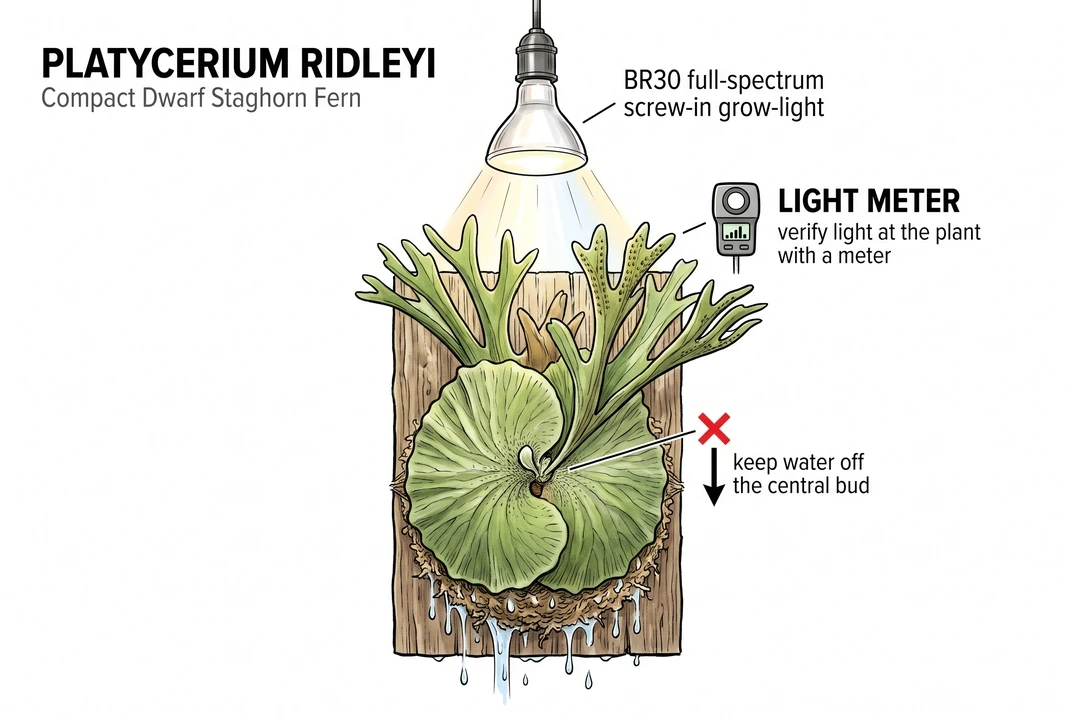
For a compact, dwarf-labelled plant grown indoors, a grow light can be a practical supplement, especially through the darker months.
A common starting range is 12–14 hours a day, but distance is not interchangeable. With a single bulb the intensity at the plant drops sharply as you move it away (SANSI’s own figures for their 36 W BR30 bulb show center light at 1 ft falling to roughly a quarter of that at 2 ft) so the same lamp at 12 versus 24 inches is not the same light.
Enough light helps keep growth compact and reduces stretching (etiolation), though light alone does not guarantee a dwarf clone keeps its form.
SANSI 36W Grow Light
SANSI 36W Grow Light fits one mounted fern when an open, properly rated fixture can aim at the plant and the intensity can be checked at both shield and antler tips.
Skip a point-source bulb for a wide plant wall or a closed fixture that traps heat, because a center reading does not prove even vertical coverage.
Watering (The Soak and Dry Method)
Let the Mount Dry Between Waterings
Prolonged saturation is a leading cause of failure, so let the moss dry out between waterings rather than keeping it constantly wet.
How far and how fast it dries depends on plant size, how much moss there is and how tightly it is packed, the mount material, temperature, humidity, airflow, and how actively the plant is growing. A small tissue-culture plant and a mature, enclosed shield will not dry on the same schedule.
The Mounting Medium
Long-fiber sphagnum on a mount is common, but it is not the only option. A looser, coarser mix or an open pot or basket can also work.
When to Water
Surface dryness and a lighter board are useful hints, but they tell you about the outside of the moss, not the center of the root ball. On a small plant especially, these signs can appear while the core is still moist, so check gently rather than watering by weight alone.
How to Water Safely
One approach is to soak the board or pot from the bottom in a basin until the moss is rehydrated. A loose, small mount may need only a short soak, while a large, dry sphagnum mass can take longer, so let the moss rather than a fixed number of minutes be the guide. A shared basin can transfer pests or pathogens, so pay attention to water quality, EC, alkalinity, and drainage afterward. You can also water the moss around the shield directly.
Watch the growth bud
Avoid leaving standing water in the central growth bud (the eye), where prolonged pooling around the meristem can invite rot.
This is about water sitting for a long time, not about a single splash. Drying time, temperature, and any pathogens present all factor in, so the goal is to let wet areas dry rather than to treat every drop as dangerous.
Mechanisms of Waterlogging Tolerance in Plants. Research Progress and Prospects
Humidity and Temperature
Balance Temperature and Humidity
Temperature
It is a wet tropical lowland species, so treat it as a warm-growing plant and protect it from frost. General staghorn guidance suggests most struggle below about 55°F (13°C), so ordinary warm room temperatures suit it and cold drafts are best avoided. There is no species-specific data pinning down exact thresholds, and how much cold harms it depends on duration, acclimation, the plant’s water status, and airflow, so avoid freezing rather than assuming a precise cutoff.
Humidity
It favours humidity on the higher side, and growers widely report it doing well there, but the exact preferred range varies with clone, size, temperature, and watering. It can adapt to average home humidity if you water attentively. Browning leaf tips are sometimes blamed on low humidity, but they can also come from salts, water quality, underwatering, or heat and root stress, so do not assume humidity is the only cause. When you raise humidity, manage condensation and prolonged leaf wetness too. A brief misting will not lift a room’s ambient humidity for long, but NParks does list occasional misting as a care attribute and it can briefly wet exposed roots and mount surfaces. A humidifier is more effective for sustained humidity. Avoid leaving leaves and the bud wet for long or using contaminated water.
Mounting (The Art of the Mount)
Choose an Airy Attachment Medium
As an epiphyte, it grows attached to trees rather than in dense soil, so a heavy, soil-like potting mix is the thing to avoid.
Mounting on a board is one good method. An open orchid pot, a basket, or a fern-root slab with a very airy, shallow, well-drained medium can also work.
What matters is aeration, drainage, the moisture profile, and keeping the growth bud oriented correctly, not mount versus pot in itself.
Board size, hardware, shield clearance, and attachment order are easier to set before the roots are exposed. Plan those dimensions with the staghorn mounting sequence.
Besgrow NZ Sphagnum Moss
Besgrow NZ sphagnum moss is useful when a bare-root plant needs a new mount that holds moisture without dense soil.
Buy it for several mounts or future remounting, not when the existing moss is still springy, clean, and evenly drying. Tight packing prolongs saturation, and compression and decay eventually require replacement. The sphagnum replacement checks distinguish old-but-functional moss from a collapsing root zone.
Board Material and Hardware
An untreated, rot-resistant board is preferable. Cork bark is a common choice. Cedar or teak can work, but the wood species alone is not a safety guarantee. Check that the board is untreated (no preservatives, resins, or oils), avoid copper hardware and sharp edges against the plant, and consider board thickness and moisture against the wall.
Positioning the Growth Bud
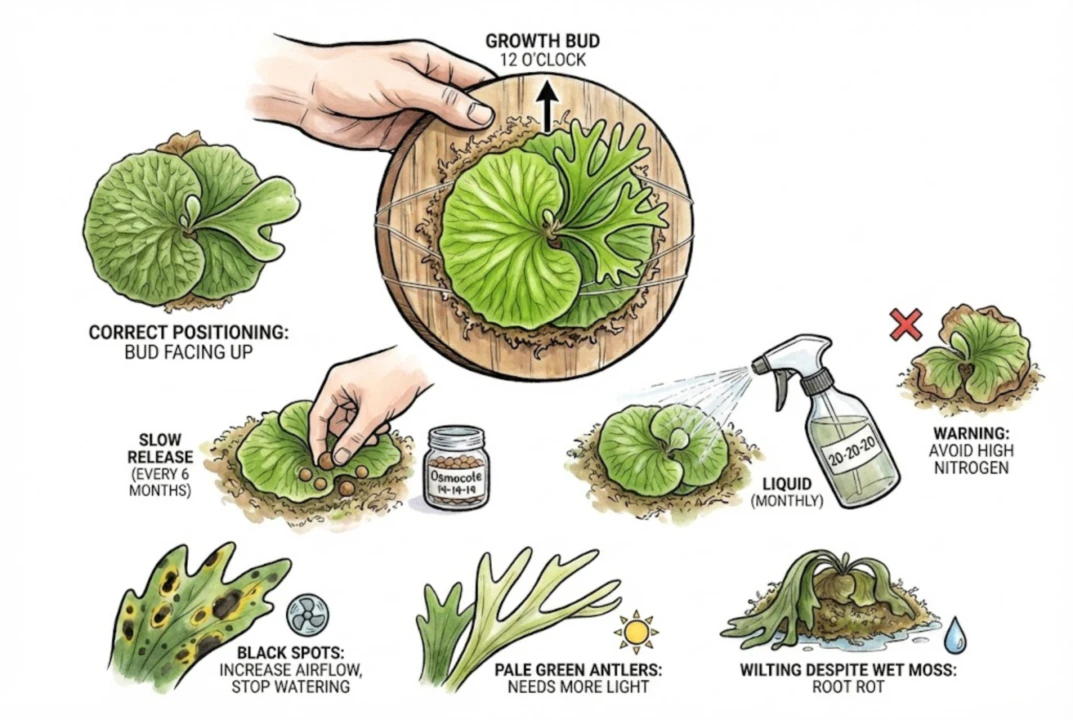
Orient the plant so the growth bud faces roughly up. The fertile fronds naturally grow upward and the nest fronds form the chamber, so keeping the existing growth orientation helps new growth develop cleanly and keeps water from pooling.
Mounted sideways or inverted, new fronds may bend or twist. Growth turning toward a light source is one factor, but not the only explanation for awkward twisting. On a juvenile plant the bud and fertile-frond direction can also be hard to read, so identify them carefully before you fix the orientation.
Berkley Trilene Line
Clear 10 lb Berkley Trilene line is nearly invisible and resists rot in damp moss, making it useful when several mounts or fishing work will use the 300-yard spool.
Skip that quantity for one small fern if a short length of clean monofilament is already available. Thin line under tension can cut into the root ball, fronds, or growing point, so keep it gentle, route knots away from the bud, check it periodically, and remove it after the plant anchors.
Feeding
Feed Lightly During Active Growth
It is not a heavy feeder, but it benefits from light feeding during active growth. Pick one feeding method rather than stacking slow-release and liquid fertilizer, since combining them raises the risk of salt buildup.
Osmocote Flower & Vegetable
The 8 lb bag of 14-14-14 Osmocote Flower & Vegetable only makes economic sense when a larger plant collection or garden will use the same labelled fertilizer. It feeds for up to four months under label conditions, with faster release possible in warmer media. Skip the large bag for one ridleyi and use a precisely measurable small pack or diluted liquid feed instead. Keep pellets off the stem and bud, and never combine a full slow-release dose with regular liquid feeding.
Liquid Fertilizer Option
Alternatively, a diluted balanced liquid fertilizer such as 20-20-20 applied to the moss during the growing season works. Dilute per the label, and flush the moss occasionally to limit salt buildup.
Nitrogen and Salt Load
Over-feeding can cause soft growth and salt injury, so it is worth going easy on nitrogen. There is no controlled data showing that nitrogen makes a specific dwarf clone lose its compact form, so treat that as a general caution against over-feeding rather than a proven rule.
Troubleshooting Guide
Diagnose Before Treating
Each sign has more than one possible cause, so inspect the tissue, roots, and recent care changes instead of making a one-symptom, one-cure diagnosis.
For a valuable, uncommon plant, confirm the problem before reaching for a chemical.
Black Spots on the Shield
Possible causes include bacterial or fungal blight, but also normal senescence, bruising, cold or water spotting, and chemical injury. First isolate the plant, check drainage and airflow, ease off watering, and inspect the tissue rather than assuming rot.
Pale Green Antlers
This could be new growth or a light, nutrient, root, pH, or water issue. Check recent growth and the root zone before changing anything instead of simply adding light or fertilizer.
Wilting Despite Wet Moss
This can indicate root rot from a saturated, low-oxygen root zone, but crown damage or heat stress can look similar, and not every root will be dead. Unpot or unmount to inspect the roots, remove clearly rotted tissue with a sterile tool while keeping viable roots, and improve drainage and airflow. If a labelled chemical is still warranted, compare diagnosis requirements and application limits before choosing any fungicide for a staghorn fern. Physan 20 has fern uses on its label but is not a proven cure for established root rot.
White Cottony Fluff
This may be mealybugs, but Platycerium fronds also carry pale, star-shaped hairs and a waxy coating, and fungal growth can look similar, so confirm with a close look (crawlers, a segmented body, honeydew) before treating. Prefer isolation, magnified inspection, and gentle removal over jabbing the ridges with a toothpick, which can damage the frond or bud, and keep monitoring.
Brown Bumps
These may be scale, a well-known staghorn pest, though there is no survey ranking it the number-one pest for ridleyi, and scale can be confused with sporangia, so check under magnification. For a mild case, dabbing individual insects with a cotton swab of 70% isopropyl alcohol is a common first step, but test it on a small area first, as alcohol and horticultural oils can damage the fern’s thin tissue and hairs. Horticultural oil is used against fern scale in some guidance but discouraged on ferns in others, so only use an oil whose label lists ferns, and follow its rate, interval, and temperature and light instructions. Systemic insecticides such as imidacloprid are neonicotinoids that are highly toxic to bees and other pollinators. Only use a product whose label covers your plant and pest, follow it exactly, and be aware that keeping a fern away from flowering plants does not remove the environmental risk once a systemic is applied, so handle treated plants, spilled granules, and discarded moss according to the label.
Final Thoughts
Keep Checks Practical
A compact, dwarf-labelled Platycerium ridleyi is not a water-and-forget plant. It responds to its environment, so it rewards regular observation.
Most of what makes it succeed comes down to a few things you can actually check. Air circulation and drainage, light measured at the plant, watering to a wet-and-dry cycle, water quality, and leaving the shield fronds in place unless they are genuinely diseased.
Keep the open questions in view, especially what dwarf means for your specific plant and whether a pest or disease has been confirmed before treatment. That gives you a realistic basis for growing this fern well.
Affiliate Disclosure
This article contains Amazon affiliate links. As an Amazon Associate I earn from qualifying purchases. If you use these links, the site may earn a commission at no extra cost to you. Product availability, price, and specifications can change. Check the current listing before buying.