
Types of Ferns: Science-Based Care by Species
A species-by-species care guide to common indoor ferns: what leaf micromorphology and chamber research actually show about dust and VOCs, why the Boston fern struggles in dry winter air, why staghorn scales and blue-star wax should not be wiped, and the light and substrate each species really wants.
Marcus Hale · Published 2025-12-31 · 29 min read
Key Takeaways
- Chamber studies show that ferns can deposit some particles and take up some VOCs, but a single potted plant has a very small real-room effect compared with ventilation.
- Match cleaning to the leaf surface because staghorn scales should not be wiped, blue-star wax marks easily, and bird’s-nest fronds tolerate gentle wiping but not water sitting in the crown.
- Boston fern has high leaf area and little drought tolerance, so dry heated winter air can cause crisping and shedding before you notice the root problem.
- Ferns are not all low-light plants. Judge each species by adequate PPFD, photoperiod, placement, and heat rather than one color-temperature rule.
- Most ferns need air around their roots, but the mix depends on whether the species is terrestrial, epiphytic, rosette-forming, or mounted.
Introduction
If you have watched a lush Boston fern turn into a crispy haystack, you know that a blanket low-light, easy-care label can set a beginner up to fail. Different ferns have different light, water, and root-zone needs, and generic advice often leads to soggy roots or drying leaves.
Leaf surfaces and root zones explain much of everyday fern behavior.
Leaf micromorphology, desiccation-tolerance research, and controlled chamber studies show where species-specific care is useful and where broad claims stop. Resurrection species, water-repellent fronds, and ordinary indoor ferns each need different expectations, so practical care cannot be reduced to one formula.
Ferns Are Not Room Air Cleaners
A potted fern cannot replace ventilation, source control, or an appropriate air cleaner. Leaves can collect some dust and a root zone can remove some gases in a sealed chamber, but those effects are too small to clean a normal room.
Keep Fronds Clean for the Plant
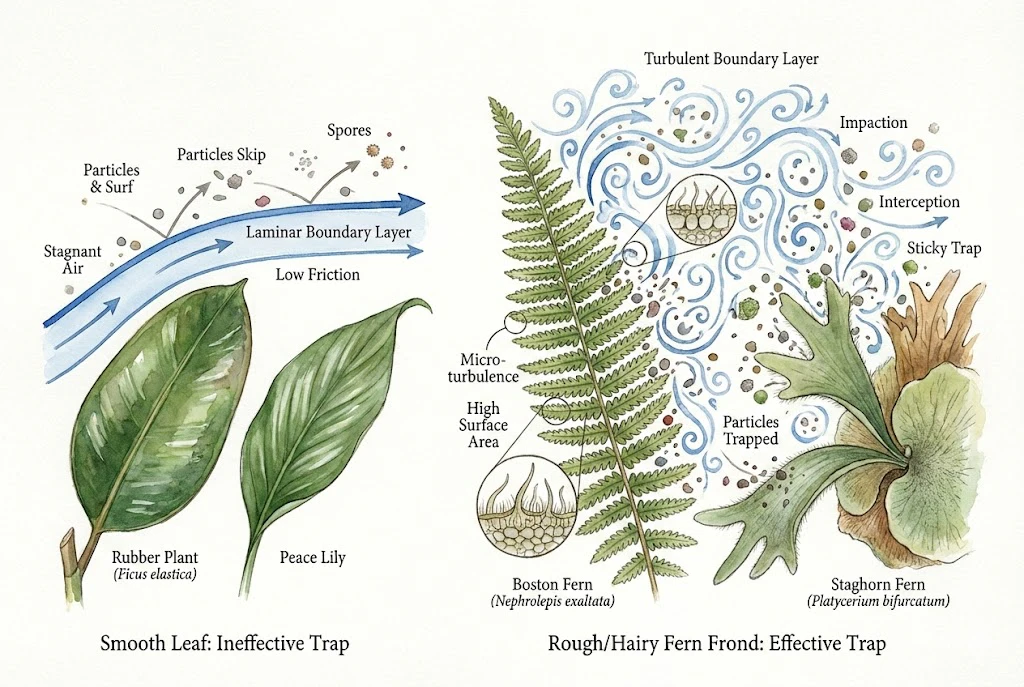
Every object in a room, a table, a screen, a leaf, is surrounded by a thin layer of slower-moving air called the boundary layer.
When air moves across a surface, friction slows it down. Over a broad, smooth leaf such as a rubber plant (Ficus elastica) or a peace lily, that layer tends to be relatively thick and smooth-flowing (laminar), though its thickness also depends on leaf size, orientation, and how fast the air is moving.
Airborne particles such as dust, some mold spores, and microplastics can follow the airstream around a smooth surface. Smooth leaves still collect particles by sedimentation, diffusion, interception, and impaction. Deposition may be lower under some conditions, but it is not zero.
Many ferns have dissected, pinnate fronds, and some carry hairs (trichomes) or scales. Studies of leaf traits suggest that rough, hairy, or high-surface-area foliage can, under some conditions, collect more particulate matter than a smooth leaf.
How Frond Structure Changes Deposition
A complex frond can create small-scale turbulence. Where flow swirls, particles with enough mass and momentum cannot always follow tight turns, so some leave the airstream and deposit on the surface through impaction. This is plausible, but the actual flow field around fern fronds has not been measured in the sources reviewed here.
Once a particle reaches a surface it has to be retained. Trichomes and wax microstructure can influence how well particles stick, though thick or smooth wax can also lower retention or wash off more easily. No single leaf trait reliably predicts capture. A 2021 systematic review found no strong consensus on the most influential trait, and species rankings shift with particle size, airflow, weather, washing, resuspension, and measurement method.
Leaf traits and particulate matter accumulation (2021 systematic review)
Passive Pots vs. Engineered Biofilters
Separate Passive Plants From Active Filters
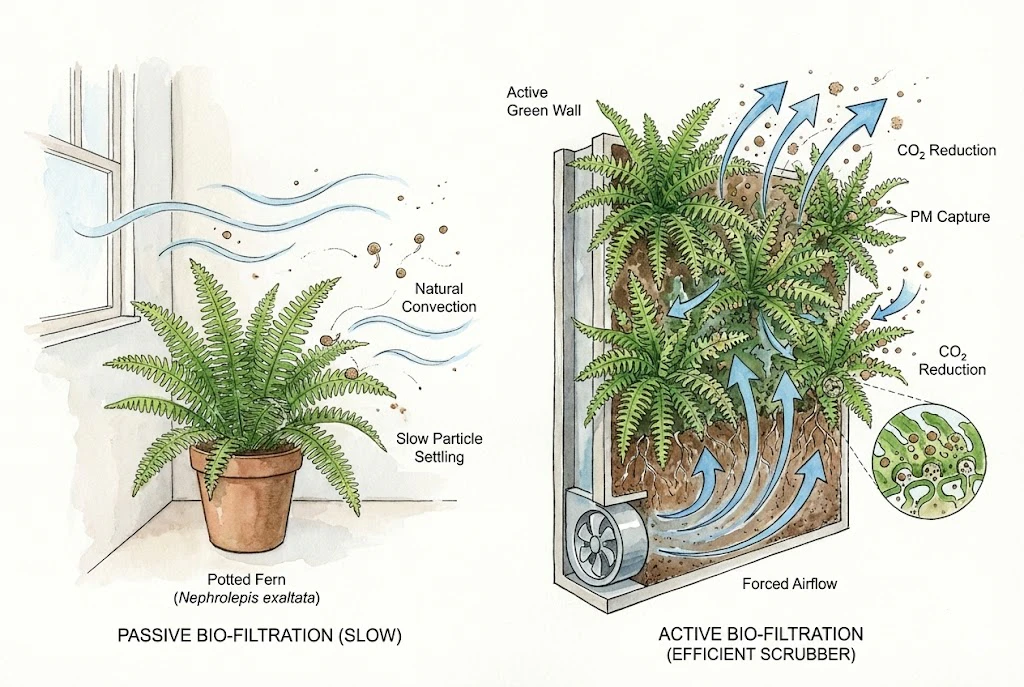
Three different systems are often lumped together. One is a plant sitting in a room. Another is a plant built into a fan-driven system that forces air through its substrate. The third is a conventional HVAC filter or portable air cleaner. Only the last two move meaningful air volumes on purpose.
A single fern in a room depends on natural air currents to bring particles and gases into contact with its leaves and pot. This does happen, but the effect is very small relative to normal ventilation.
Active green walls, or biowalls, are a genuine research area. Air is mechanically pushed through foliage and root-zone substrate, where much of the VOC removal occurs. Performance depends on fan flow rate, pressure drop, substrate depth and moisture, microbial community, pollutant load, and maintenance rather than on a fixed plant property.
The practical point is that airflow through a substrate, not the plant alone, does the work in these systems. Terms such as CADR, scrubber, and filter do not describe a single potted fern with no fan, engineered substrate, or measured airflow.
Formaldehyde (What Chamber Screening Does and Doesn’t Show)
Read Formaldehyde Screening as Chamber Evidence
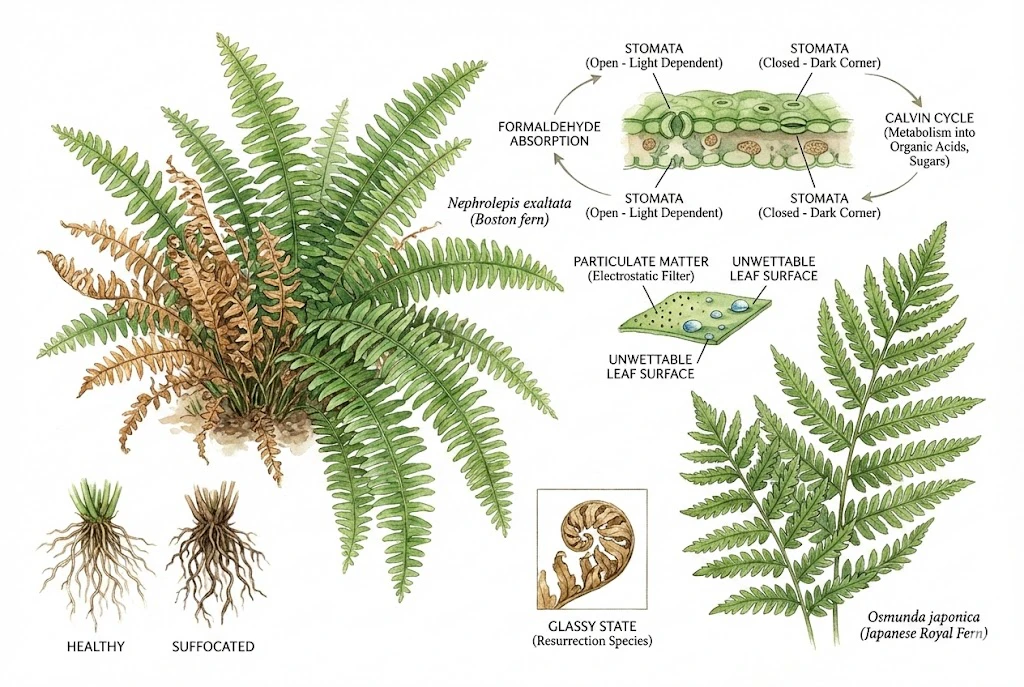
Some ferns rank well in controlled formaldehyde screening, but the test conditions matter. A widely cited 2010 screening exposed 86 species in a sealed 1.0 m³ chamber to roughly 2 ppm formaldehyde for about 5 hours. On a leaf-area-normalized basis, Osmunda japonica, or Japanese royal fern, removed the most, and Boston fern was also among the higher performers.
Those are high-concentration, sealed-chamber conditions. They show that a plant can take up formaldehyde, but they do not translate into an effective filter or health benefit for a renovated room with different concentrations and ventilation. In an off-gassing room, source control, ventilation, and, if needed, a certified air cleaner matter far more than which fern is in the corner.
Removal in these chambers involves physical sorption onto leaf and pot surfaces, uptake through open stomata and the cuticle, plant metabolism, and root-zone microbial activity. Where the plant metabolizes formaldehyde, it is first oxidized to formate and then toward CO₂, and that carbon can enter normal carbon metabolism. It is not simply broken down into organic acids, amino acids, and sugars through the Calvin cycle.
Composite wood and furnishings are real formaldehyde sources, but a plant is not eating your furniture. Uptake capacity is limited, surfaces can saturate, and room ventilation and exposure dominate the outcome.
Light affects gas exchange. In low light, stomata may be less open and leaf uptake can fall, but cuticular sorption and root-zone pathways remain. The more reliable reason not to keep a light-hungry fern in a dark corner is the plant’s own health.
Air cleaning performance of two species of potted plants and different substrates
Part II. The Boston Fern (Nephrolepis exaltata)
The Boston fern is one of the most common indoor ferns, with full arching fronds and a lot of leaf area for its size. That leaf area is why it appears in air-quality experiments and why it is sensitive to dry air.
Leaf Area and the Chamber Results
Read the Boston Chamber Result Correctly
A 2025 recirculating-chamber study measured PM2.5 in a sealed setup with several potted plants. Its leaf-area figures were for two pots combined. Boston fern measured 0.6716 m², spider plant 0.3871 m², prayer plant (Maranta) 0.3318 m², and pothos 0.2325 m². It did not test Monstera. Boston fern had the largest leaf area of the four, but 0.67 m² was not a single specimen and does not support a simple multiple compared with the other plants.
After four hours, measured PM2.5 was 58.03 µg/m³ in the control, 38.36 with Boston fern, 45.91 with spider plant, 46.16 with prayer plant, and 48.77 with pothos. Within this recirculating chamber, the Boston fern treatment ended lowest. That is a real but conditional result inside a sealed fan-mixed box rather than a real-room clean-air delivery rate.
A divided frond lets air pass through the clump rather than only around it, which plausibly changes particle deposition compared with a solid leaf. Pressure drop and processed air volume were not measured, so treat this as structure rather than a filtration rate.
A Boston fern packs a lot of leaf area into a small pot, which is part of why it transpires heavily and needs steady moisture. That is a care fact rather than an air-cleaning specification.
Transpiration and the Crispy Problem
Because of its leaf area, a Boston fern transpires a lot of water for its size, which is one reason it dries out and crisps in dry indoor air. Whether it transpires more than nearly any other houseplant is not established by a standardized dataset, so treat that as a tendency rather than a ranking.
Moisture released by a fern may change how hygroscopic particles settle, but this depends on particle composition and RH thresholds. No measurement shows a single fern creating a humidified zone that meaningfully removes room dust or protects lungs. Treat dust-raining claims as speculation rather than a benefit.
The everyday complaint is that a Boston fern sheds everywhere. Turgor keeps small leaflets firm, and dry air makes them lose water and drop. Vapor pressure deficit, or VPD, depends on temperature and humidity rather than RH alone, which is why a heated winter room can be very drying.
Mechanism
A large leaf area loses water quickly. If roots cannot resupply water fast enough, the plant is under water stress and older tissue suffers first.
Response
Browning and shedding of older fronds is a common drought symptom. If the rhizome stays healthy, the plant can push new growth. A specific abscisic-acid mechanism has not been directly studied in this fern, so treat it as a possibility rather than a fact.
Check
Before concluding that dry air is responsible, rule out root damage or rot, uneven watering, salt buildup, low light, and pests.
Practical Fix
| Feature | Boston Fern (Nephrolepis) | Rubber Plant (Ficus) |
|---|---|---|
| Surface Structure | Dissected, porous, high leaf area | Broad, smooth |
| Likely deposition mode | Impaction / interception in the canopy | Settling onto flat surfaces |
| PM2.5 in chamber tests | Deposited more in one recirculating study | Not directly tested here |
| Water Usage | High (transpires heavily) | Lower, more conservative |
Check Before Adding More Water
If the soil is already wet and the plant is still crisping, adding more water is usually not the answer. Before watering again, check root health and rot, uneven wetting, salt buildup, and light level.
If a hygrometer confirms that the room is genuinely dry, you can lower demand on the plant by raising humidity, lowering temperature slightly, reducing drafts, grouping plants, using an enclosure, or moving the fern away from heat sources. Occasional misting raises humidity only briefly and is not a substitute for these measures.
A room humidifier is one straightforward way to raise whole-room RH when a hygrometer shows it is low and the species genuinely wants more. It is an option, not the only fix.
Choosing a Humidifier
An ultrasonic humidifier sized to your room can make sense when a hygrometer shows the air is dry, but pick capacity and coverage for the space rather than by brand. Follow EPA maintenance guidance for ultrasonic units. Use distilled or low-mineral water, empty and refill daily, clean at least every third day, keep RH at or below 50%, watch for condensation, and remember that ultrasonic humidifiers can aerosolize minerals and microbes around children and pets.
Vapor pressure deficit fluctuation, stomatal conductance and growth (controlled lettuce study)
Part III. The Staghorn Fern (Platycerium)
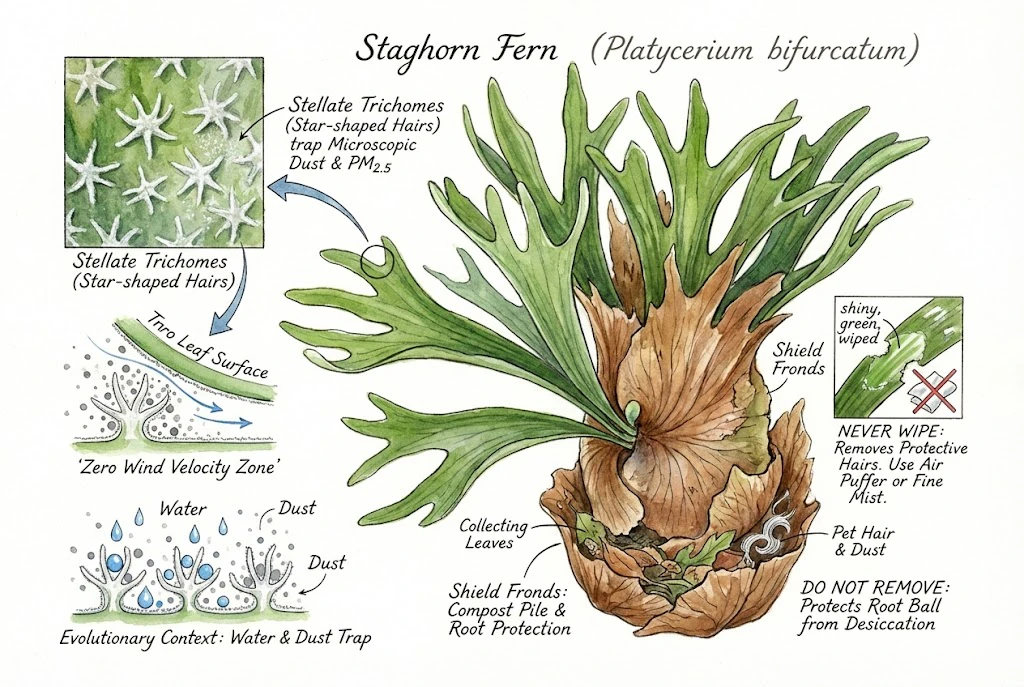
Staghorn fronds carry surface hairs and scales. In plants generally, these structures serve functions like protection and water interaction rather than existing to trap household dust.
Surface structure explains why staghorn scales should remain intact. For mounting, see the staghorn fern mounting guide.
The Stellate Scales
Platycerium bifurcatum, the common staghorn fern, can look as if it is dusted with white felt. That coating is a layer of stellate, or star-shaped, scales rather than dust, and it should not be rubbed off.
Under magnification these are not simple hairs. Several arms radiate from a central point, a bit like a starfish or umbrella.
Surface hairs and scales can increase particle deposition under some conditions. Claims that staghorn scales are exponentially superior to smooth leaves for capturing PM2.5, or that they lock dust away long-term, are not supported by a study on this species. Those data come from other plants and conditions and should not be transferred here.
What the scales clearly do for the plant is slow water loss and provide some sun protection, which is exactly why the care advice is to leave them intact.
Why the Scales?
Leave Staghorn Scales Intact
The staghorn is an epiphyte that grows attached to trees rather than rooted in ground soil. Its roots anchor it and absorb water and nutrients from substrate that collects around its base.
Surface scales help capture and hold moisture from humid air and reduce evaporation. These traits evolved for life on a tree rather than indoor air cleaning. Dust that settles on them indoors is incidental and is not an air-quality benefit to count on.
The Shield Fronds
Platycerium also produces shield, or basal, fronds, which are the round brown papery leaves at the base.
- Function In nature the plant grows on a vertical trunk, and the shield fronds form a basket that catches falling debris and rainwater. That material breaks down into a substrate the fern roots into. In effect, the fern builds its own pocket of soil on the tree.
- Indoors Shield fronds can collect dust and pet hair. This debris is not a nutrient resource or an air-quality feature worth preserving. If allergens, pests, or excess debris build up, remove them gently without damaging the scales, following horticultural guidance for the species.
- Common mistake Beginners often peel off the brown shield fronds, thinking the plant is dying. A healthy brown shield is normal and helps protect the root area, so leave it in place. Rot is the exception. Black, mushy, or foul-smelling tissue, or damage at the growing point, indicates a problem rather than a healthy shield.
Care Advice
Do not wipe a staghorn frond with a cloth to clean it, since that strips the scales.
Removed scales may not be fully restored on that mature frond, and the leaf can then lose water faster and be more prone to sun damage. The degree depends on how much was removed.
If a frond is dusty, a gentle outdoor rinse followed by good drainage is safer than scrubbing. A camera air puffer can blow spores, dust, and allergens back into the room, so it is not ideal indoors.
Staghorn Fern (Platycerium bifurcatum). University of Wisconsin Horticulture
Part IV. The Blue Star Fern (Phlebodium aureum)
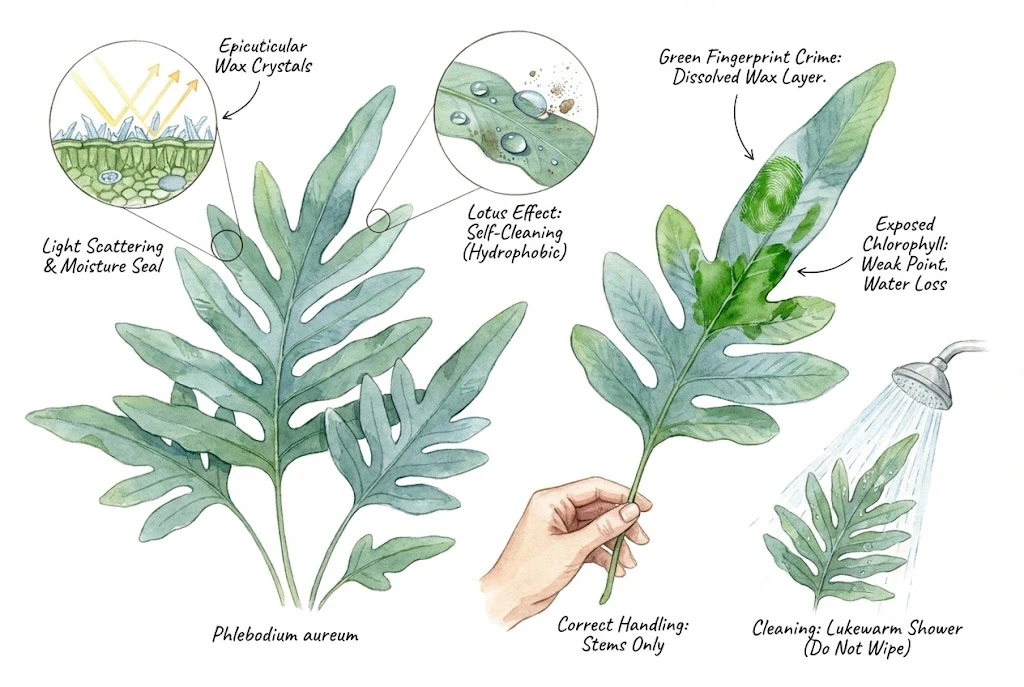
The blue star fern (Phlebodium aureum) has a distinctive chalky, blue-green look. That glaucous appearance is associated with a surface (epicuticular) wax layer rather than being purely a pigment (structural scattering from the wax and the leaf’s green tissue both contribute to the color you see).
It is a rhizomatous epiphyte that likes bright indirect light and moist-not-soggy conditions, and it tolerates some drying (closer in habit to the staghorn than to a thirsty terrestrial fern).
The Waxy Surface
Epicuticular wax crystals can scatter light and help reduce water loss, and a bluish glaucous bloom is a common visible result. Attributing the color and any UV protection specifically to this fern as one adaptive story goes beyond what has been measured, so treat it as general botany rather than a proven Phlebodium finding.
Wettability. Studies of contact angle and wettability show that waxy, water-repelling leaves can interact with water and particles differently from hairy leaves, but which studies, species, and particle sizes matters, and hydrophobicity alone does not reliably predict dust capture or retention.
Droplet Self-Cleaning Is Unconfirmed
On strongly superhydrophobic micro- and nanostructured surfaces, rolling droplets can carry off contaminants. Whether the blue star fern meets that threshold has not been shown, so describing it as designed to self-clean overstates the evidence.
Indoors Without rain, dust simply settles on the surface. An occasional gentle wash can help remove it. How strongly dust adheres depends on the particle type and humidity.
Handling and the Green Mark
The glaucous bloom is easily disturbed by handling, so touch these fronds as little as possible. Skin oils dissolving the wax has not been demonstrated for this species. Mechanical abrasion or matting is at least as likely an explanation for a mark.
Touching a frond can leave a greener spot where the bloom is disturbed and the underlying surface shows through. A single fingerprint causing measurably faster water loss and sunburn is plausible but has not been tested on P. aureum. Handle gently as a precaution rather than treating the mark as a proven weak point.
- Care implication. Handle the plant by the petioles where you can. To clean, a lukewarm gentle rinse is preferable to wiping. Keep water off a wet crown or rhizome for long and let it drain and dry.
Part V. The Bird’s Nest Fern (Asplenium nidus)
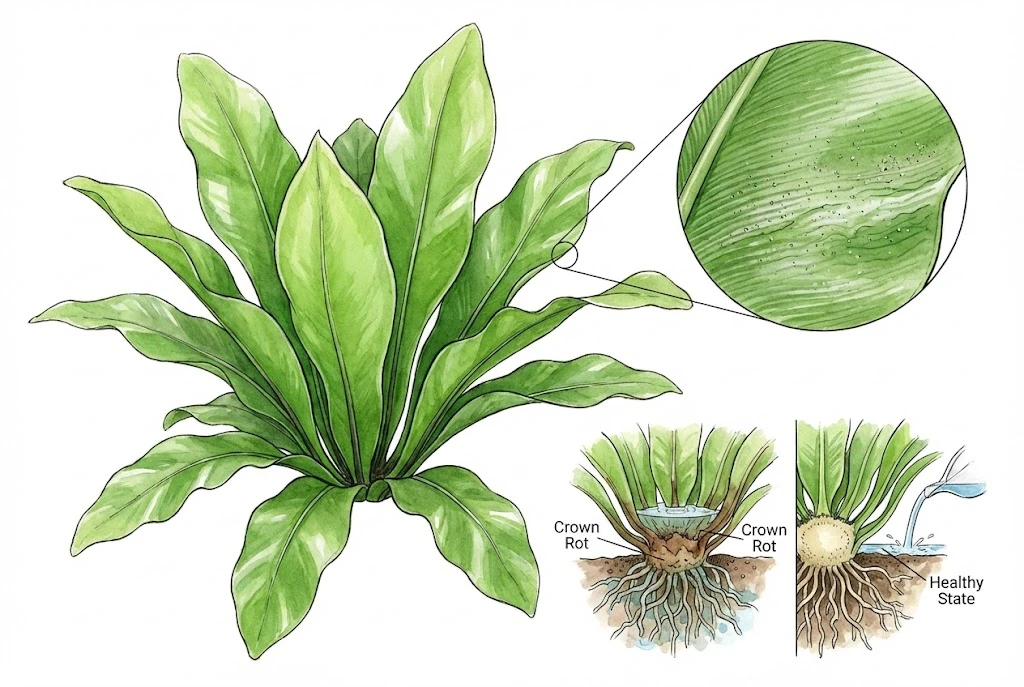
The bird’s nest fern (Asplenium nidus) takes a different form. Broad, smooth, glossy fronds arranged in a funnel-shaped rosette, without the hairs or fine leaflets of the others.
The Rosette and Its Surface
The defining feature is the rosette. In the wild, the funnel catches falling litter and channels water and nutrients toward the center and root zone. That is ecology, not a watering instruction for a pot indoors.
Leaf orientation can influence where particles settle, but the claim of a massive role for this fern is not backed by Asplenium-specific data with an effect size or comparator.
Surface texture. Even a leaf that looks smooth has microscopic grooves and undulations where particles can lodge. This is a general observation from similar leaf surfaces. The bird’s nest fern’s own performance has not been measured here.
Easy to Clean
The broad, leathery fronds are more practical to wipe with a damp cloth than fragile Boston fronds or scaly staghorns. In a kitchen, mind grease aerosols, cleaner residue, low window light, and food-area hygiene rather than treating it as a high-efficiency filter.
Watering Caution
Keep Water Out of the Crown
Indoors, water left in the center of the rosette raises crown-rot risk, especially in still, cool conditions. This is conditional rather than inevitable because pot angle, airflow, temperature, water volume, and drainage all matter. A safe habit is to water at the base and avoid leaving water in the crown.
Part VI. The Maidenhair Fern (Adiantum raddianum)
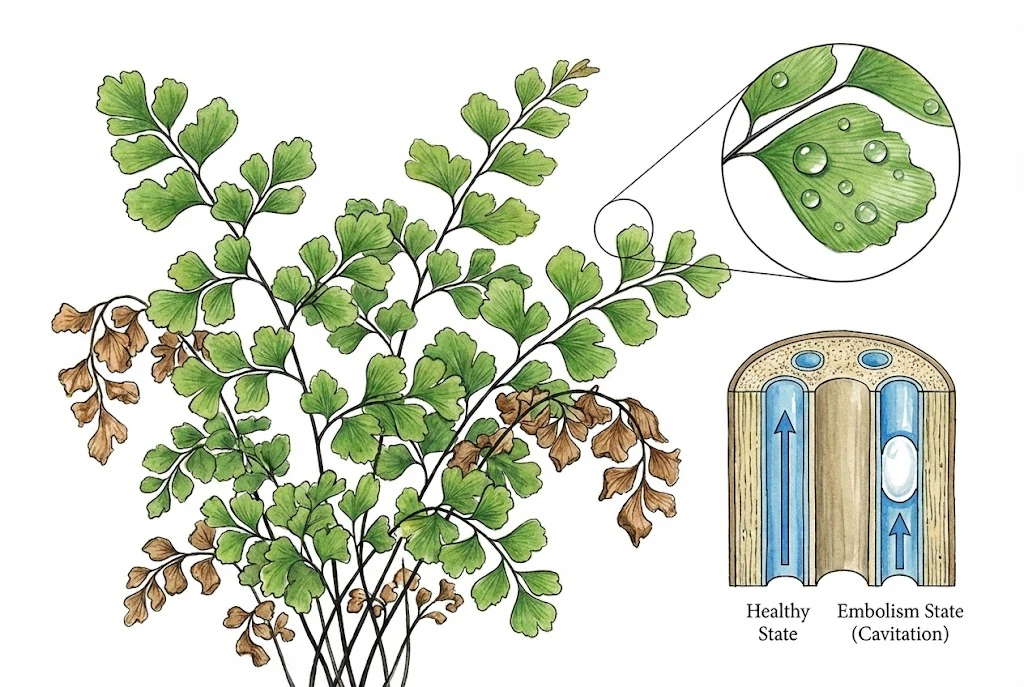
The maidenhair fern (Adiantum raddianum) has thin delicate fronds and a high moisture requirement, which makes it demanding indoors. Its surface is also strongly water-repelling, which makes its care counterintuitive.
Maidenhair Baseline Care
Keep it evenly moist rather than waterlogged, provide suitable ambient humidity and bright indirect light, and pay attention to the root zone.
The Non-Wetting Fronds
The name Adiantum comes from the Greek for unwetted. Misted water tends to bead and roll off the fronds, which is generally attributed to a dense, fine wax structure. Exact contact-angle figures for this cultivar are not established here.
The Apparent Paradox
It is described as loving humidity, yet its leaves shed liquid water.
What Matters
It needs ambient humidity, adequate root-zone water, suitable temperature, and air movement. A persistent film of liquid water over stomata can limit gas exchange in principle, but ordinary household misting suffocating the plant is not backed by a measured threshold. Keep foliage from staying wet for long stretches rather than fearing every mist.
Drying and Xylem Embolism
Read Fern Stomata Without a Slogan
Fern stomatal behavior differs from that of flowering plants. Reviews describe a largely passive hydraulic closure model in many ferns, an ongoing debate about ABA responses, and observations that some ferns close their stomata within minutes and before cavitation. Describing fern stomatal control as very poor overstates and partly misreads that literature.
Cavitation
Under severe dehydration, tension in the water column can become high enough for the column to break and an air bubble to form. The threshold depends on species, water potential, and acclimation and is not quantified for this fern in the sources here.
Recovery
A badly embolized crispy frond usually will not green up again, so cut it at the base and let a viable rhizome push new growth. Embolism is not always an absolute dead end in ferns. Some desiccation-tolerant species recover mesophyll function through foliar water uptake even with embolized xylem.
Evolution of the Stomatal Regulation of Plant Water Content (2017 review)
Part VII. Desiccation Tolerance in Different Types of Ferns
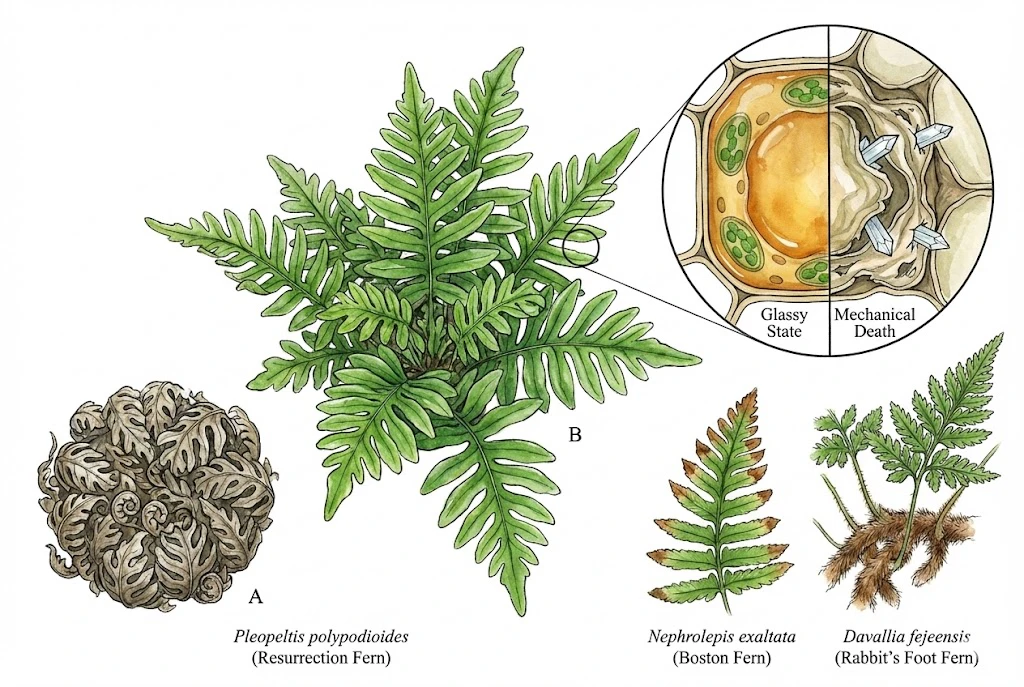
Separate Poikilohydry From Desiccation Tolerance
Most common ferns are homoiohydric, which means they work to keep internal water content stable. A few plants are poikilohydric and let water content track the environment. Poikilohydry and desiccation tolerance are related but not synonyms. Desiccation tolerance specifically means a plant can survive drying and then repair and resume function.
The Glassy State and Its Limits
Why does the resurrection fern (Pleopeltis polypodioides) curl up, look dead, and then green again after rain, while a Boston fern that dries out simply dies?
Resurrection-plant biology has been studied across many taxa, and several protective mechanisms are well established. This is not a single recent discovery.
1. Compatible Sugars
Accumulation of sugars such as sucrose and trehalose can help protect cells during drying. Whether both occur in massive amounts specifically in Pleopeltis is not established here.
2. LEA Proteins
Late Embryogenesis Abundant proteins are a well-known part of desiccation tolerance, and dehydrins have been reported in resurrection ferns.
3. Vitrification
As cells dry, the cytoplasm can enter an amorphous glass-like state that stabilizes membranes and macromolecules and limits crystallization damage. Describing compounds as turning the cell solid or crystals as puncturing membranes oversimplifies complex glass-transition chemistry.
On Rehydration
When water returns, the glassy matrix can plasticize and metabolism can resume. In strongly desiccation-tolerant species this can happen within hours, but timing and completeness depend on species and conditions.
P. polypodioides can recover photosynthesis within hours of severe drying and restore mesophyll function through foliar water uptake even when its xylem is embolized. This is a counterexample to the idea that embolism is always a point of no return.
The Limits
Boston and maidenhair ferns are not resurrection ferns. Their leafy fronds have little or no such tolerance. They rely on avoidance through steady root-zone moisture rather than surviving full drying. No direct head-to-head study places the two at exactly the same tolerance level, so this is a general contrast.
The Exceptions
Some plants genuinely tolerate the dry/wet cycle. Pleopeltis polypodioides is a true desiccation-tolerant fern. Selaginella lepidophylla, or rose of Jericho, is often mentioned alongside it, but it is a lycophyte rather than a fern.
It is tempting to conclude that any epiphytic fern, such as Davallia fejeensis, shares this ability. Ordinary tolerance of occasional drying is not the same as extreme desiccation tolerance, and there is no clear evidence that Davallia has the latter.
Part VIII. Light Beyond the Low-Light Label
Not every fern is a low-light plant, and light needs vary by species. Many ferns do grow in forest understories, but that covers a wide range of conditions, and older fern lineages and open-habitat species exist too.
The Blue-Light Study
A 2021 primary study (Cai et al.) is the direct source here. Under defined lab conditions (dark adaptation, then 475 ± 25 nm blue light at 100 µmol m⁻² s⁻¹ for 100 minutes) some modern leptosporangiate ferns (Polypodiales), including Nephrolepis exaltata, showed a faster blue-light stomatal response than ancient fern lineages and Arabidopsis, with a dose response.
What the Study Shows
Certain tested lineages open their stomata relatively quickly under blue light. That is a controlled gas-exchange measurement, not evidence that all ferns respond instantly or a story about evolutionary purpose.
What Matters Indoors
For growth, prioritize adequate canopy PPFD, photoperiod, and daily light integral for the species rather than one color temperature. Blue is one component of a full spectrum, but it cannot wake a plant that lacks enough overall light.
On color temperature. There is no need to exclude warm-white (3000 K) or to treat 5000–6500 K as a universal optimum. A good full-spectrum LED at an adequate level works. Distance, coverage, and heat matter more than the CCT slogan.
If a fern is genuinely under-lit, adding a full-spectrum grow light at an appropriate level and distance is a reasonable option. Judge that on your measured light deficit rather than blue light alone. Similar-output alternatives exist, and a smaller or lower-heat fixture may suit a single plant better.
Full-Spectrum Grow Bulbs
A full-spectrum E26 grow bulb is a simple option for a single under-lit fern. Look at the rated PPF and the PPFD at your intended mounting distance rather than wattage alone, and check fixture load, heat and enclosed-fixture limits, mounting distance, and actual coverage before relying on it. Use the general grow-light guide to choose by measured PPFD and DLI, then apply the target for your specific fern and shelf.
Rapid blue-light stomatal response in modern ferns (Cai et al., 2021)
Part IX. The Substrate & Root Zone
It is not just the leaves. The root zone matters too, but for the plant’s health first.
Keep Root-Zone Evidence in Context
In sealed chamber studies, rhizosphere and substrate can account for a large share of measured VOC removal. In the study cited earlier, bare soil removed more formaldehyde than the plant. That is a chamber finding rather than evidence that a healthy root zone purifies a room. It means the substrate did most of the small amount of work under those conditions.
Roots, Oxygen, and Drainage
Root exudates feed rhizosphere microbes, and some soil microbes can metabolize compounds such as formaldehyde or benzene. Whether fern-pot bacteria meaningfully consume these VOCs in an actual room is not established, so keep this as background rather than a purification claim.
What Is Supported
Roots and aerobic microbes need oxygen, so drainage and air-filled porosity matter for plant health.
Common Mistake
Heavy, compacted, waterlogged medium can starve roots of oxygen. Particle size, amendments, pot drainage, and watering determine whether a peat-based mix becomes muddy.
The Fix
Use a porous, well-drained but moisture-retentive mix chosen for the species. Prioritize moisture retention, air-filled porosity, pH or EC, and pot drainage over a fixed component list.
There is no single chunky mix that suits every fern because a terrestrial Boston, rosette epiphyte, mounted staghorn, and outdoor deciduous Osmunda live very differently. The table below gives adjustable starting points rather than one recipe.
| Fern type | Example | Root-zone approach |
|---|---|---|
| Terrestrial, fine-rooted | Boston, Maidenhair | Moisture-retentive but well-drained mix (e.g. Coir/peat with perlite and some fine bark). Do not let it compact. |
| Rhizomatous epiphyte | Blue Star (Phlebodium) | Chunky, very airy epiphyte mix (bark-heavy with perlite/charcoal). Keep the rhizome on the surface, not buried. |
| Rosette epiphyte | Bird’s Nest (Asplenium) | Open, well-drained organic mix. Keep the crown clear and avoid standing water in the center. |
| Mounted epiphyte | Staghorn (Platycerium) | Mounted on a board with sphagnum. Soak then let it partly dry, with good airflow. |
| Outdoor deciduous | Japanese royal (Osmunda) | Consistently moist, humus-rich soil. A wet-margin, outdoor plant rather than a typical houseplant. |
Charcoal vs. Activated Carbon
Charcoal Is Not a Filtration Engine
Horticultural charcoal adds some structure and modest adsorption. Activated carbon has far more surface area and can adsorb some compounds, but it saturates and depends on contact and airflow. Adding 10% charcoal does not create a self-cleaning buffer that stores toxins for bacteria to consume later. Treat charcoal as an optional structural amendment rather than a filtration engine.
Species Profiles (Five Common Ferns)
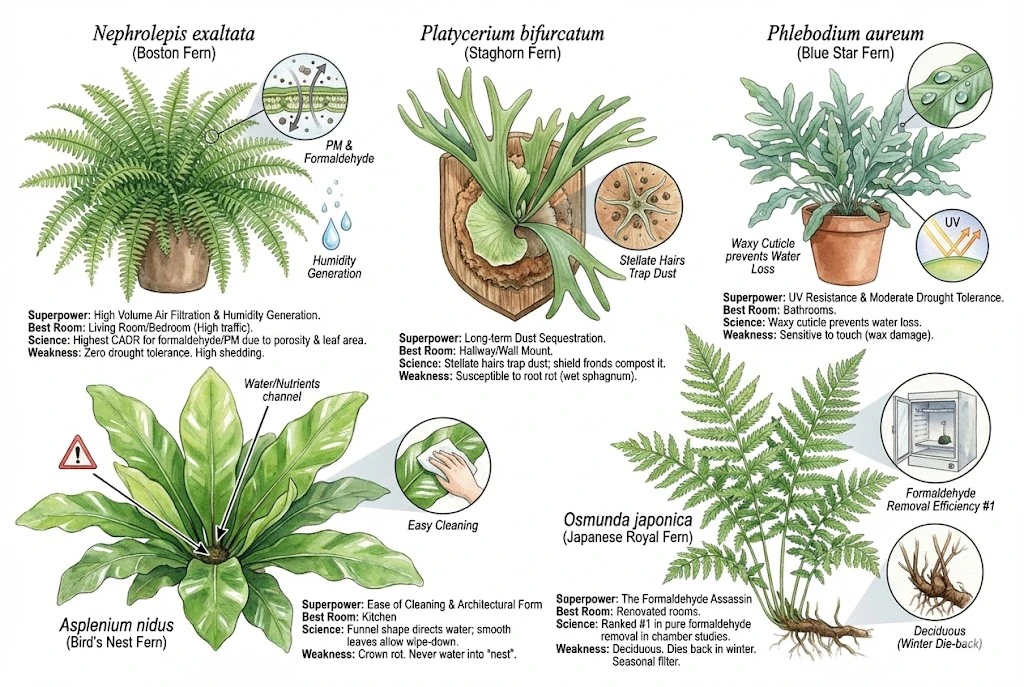
Compare Species by Care Signals
Each species is summarized by observable and manageable traits, including appearance, light and moisture needs, substrate or mounting, failure signs, and maintenance. They are not ranked for air cleaning because no same-condition, head-to-head data supports such a ranking.
I photograph one mature frond and each newly unfurling frond against the same background, then note which fronds formed after a care change. Old brown tips remain visible long after the stress has ended, so judging the whole fern by damaged legacy foliage can lead to repeated overcorrection.
The same symptom must appear on the new generation before I change water, humidity, or fertilizer again. This is especially useful with dense ferns where fresh central growth can improve while the outer skirt continues to age.
1. Nephrolepis exaltata (Boston Fern)
Look and Size
Full, arching fronds with high leaf area. Classic hanging or tabletop fern.
Light and Moisture
Bright indirect light. Keep evenly moist and give steady humidity. Sensitive to dry, heated air.
Substrate
Moisture-retentive but well-drained terrestrial mix.
Common Failure Signs
Browning and heavy shedding in dry air. Rule out root rot, salts, and low light too.
2. Platycerium bifurcatum (Staghorn Fern)
Look and Size
Antler-like fronds with whitish scales, plus brown basal shield fronds. Usually mounted.
Light and Moisture
Bright indirect light and good air circulation. Soak, then let it partly dry.
Substrate and Mounting
Mounted on a board with sphagnum.
Common Failure Signs
Root rot if the moss stays soggy. Leave the whitish scales and healthy brown shields in place.
3. Phlebodium aureum (Blue Star Fern)
Look and Size
Glaucous, blue-green fronds. A rhizomatous epiphyte with creeping rhizomes.
Light and Moisture
Bright indirect light. Keep it moist rather than soggy, and allow some occasional drying.
Substrate
Chunky, airy epiphyte mix. Keep the rhizome on the surface.
Common Failure Signs
Rot from a constantly wet rhizome. Handle gently to avoid marking the waxy bloom.
4. Asplenium nidus (Bird’s Nest Fern)
Look and Size
Broad, smooth, glossy fronds in a funnel-shaped rosette. Strong architectural form.
Light and Moisture
Bright indirect light. Keep the mix moist but avoid standing water in the crown.
Substrate
Open, well-drained organic mix.
Common Failure Signs
Crown rot when water sits in the center. Water at the base and keep the crown clear.
5. Osmunda japonica (Japanese Royal Fern)
Look and Size
Larger, upright deciduous fern. More of an outdoor or wet-margin plant than a typical houseplant.
Light and Moisture
Consistently moist, humus-rich soil.
Common Failure Signs
It dies back in winter, so expect seasonal dormancy rather than year-round foliage.
Air-Quality Context
It ranked highest for leaf-area-normalized formaldehyde removal in one 2010 sealed-chamber screening of 86 species at about 2 ppm for 5 hours. That is a controlled result, not a reason to rely on it as a room air cleaner after renovation.
Choosing a Fern
Ferns interact physically with a room. Leaves can deposit some particles, and root zones can take up some VOCs in chamber tests. Those effects are small in a real room, so choose a fern for how it looks and how you enjoy it rather than as an air cleaner.
Keep the Research Topics Separate
Leaf-surface deposition, blue-light stomatal responses, and resurrection-fern drying tolerance are separate phenomena in different species under specific conditions. They are not one package that every fern performs.
- The Boston fern is a lush, high-humidity plant. It is worth having if you can keep it evenly moist and out of dry, heated air. Check RH with a hygrometer before assuming it needs a humidifier.
- The staghorn and blue star fern are more forgiving of occasional drying, but they have different water and root needs, and their scales and waxy bloom should be left alone, not wiped.
- The bird’s nest fern has a bold form and wipe-clean fronds. Keep water out of the crown, and mind airflow and drainage rather than following an absolute rule blindly.
Leaf micromorphology and ecology affect both care and how you clean a plant, but the idea that hairier leaves always scrub air better and hydrate less easily is not a reliable law. Systematic reviews find no single dominant leaf trait, and drought tolerance varies by species.
Choose a fern by understanding the specific species’ needs, light, moisture, substrate or mounting, and its common failure signs, rather than by an air-cleaning score.
Table 1 (Care Summary by Species)
| Species | Common Name | Light & moisture | Main watch-out |
|---|---|---|---|
| Nephrolepis exaltata | Boston Fern | Bright indirect. Evenly moist, steady humidity | Browns and sheds in dry air. Little drought tolerance |
| Platycerium bifurcatum | Staghorn Fern | Bright indirect, good airflow. Soak then partly dry | Rot if moss stays soggy. Leave scales and brown shields |
| Phlebodium aureum | Blue Star Fern | Bright indirect. Moist-not-soggy, tolerates some drying | Rot from a wet rhizome. Bloom marks when handled |
| Asplenium nidus | Bird’s Nest Fern | Bright indirect. Keep mix moist, crown clear | Crown rot if water sits in the center |
| Osmunda japonica | Japanese Royal Fern | Consistently moist, humus-rich soil | Deciduous. Dies back in winter. Topped one chamber formaldehyde screening (controlled conditions only) |
| Adiantum raddianum | Maidenhair Fern | Bright indirect. Evenly moist, ambient humidity | Very sensitive to drying out. Do not let foliage stay wet |
Table 2 (Leaf Surface & How to Clean It)
| Leaf surface | Example | Dust behavior (tendency) | How to clean safely |
|---|---|---|---|
| Dissected, porous | Boston | Particles can deposit within the canopy | Too fragile to wipe. Rinse gently and let it drain |
| Scaly (stellate scales) | Staghorn | Surface scales can hold some particles | Do not wipe. Gentle outdoor rinse, then dry with airflow |
| Waxy (epicuticular) | Blue Star | Sheds water. Dust may adhere less firmly | Handle by the petioles. Lukewarm rinse, do not wipe |
| Smooth, leathery | Bird’s Nest | Settles into micro-grooves | Wipe gently with a damp cloth |
| Non-wetting, waxy | Maidenhair | Repels liquid water | Rely on ambient humidity. Avoid soaking the foliage |