
Self-Watering Planters: A Practical Guide to Reducing Root-Rot Risk
A practical guide to self-watering (sub-irrigated) planters: how capillary wicking and an air gap work, how to choose a substrate, and the dry-phase and salt-flush habits that lower root-rot risk. Results depend on plant, medium, and water quality.
Marcus Hale · Published 2025-12-30 · 10 min read

Key Takeaways
- A self-watering planter can make moisture more consistent, but it cannot compensate for a waterlogged mix, blocked overflow, poor light, salt buildup, or diseased roots.
- Roots need an aerated root zone and a functioning air gap or overflow, so reservoir level and medium structure matter as much as the planter itself.
- Choose the system for the plant’s water demand because gentle terracotta wicking, mineral reservoirs, and larger crop planters do not deliver moisture at the same rate.
- Reservoir systems can concentrate salts near the surface, so periodic top-flushing with suitable water and occasional EC checks are part of maintenance.
- Bad odors call for source control, cleaning, and aeration rather than an improvised peroxide dose whose final concentration and plant safety are unknown.
Common Self-Watering Planter Designs
Reservoir Grow-Box Kits
A reservoir grow-box kit is a sub-irrigated planter with a water reservoir beneath the growing box. It can reduce daily watering for heavy-feeding crops, but the reservoir still needs monitoring and is not a cure for an unsuitable, waterlogged mix.
Wicking Corners and Air Gap
The design uses two wicking corners that dip into a roughly 3-gallon reservoir, an aeration screen, about 2 cubic feet of growing medium, a fill tube, and a plastic mulch cover.
Mulch Controls Evaporation
The mulch cover reduces surface evaporation, so more water leaves through the plant, but it does not stop all water loss.
What the Design Does and Doesn’t Do
Steady Moisture Can Help Calcium Delivery
Because water moves upward and evaporation is limited, more of it passes through the plant, and steady moisture supports calcium movement because calcium travels with water.
That can help with blossom-end rot, but it does not solve it. Even the guidance that ships with these kits notes that blossom-end rot can still occur when you follow the instructions to the letter. The usual advice is to keep the reservoir full for tomatoes, mix in dolomite, and manage calcium as needed.
Blossom-end rot is a physiological disorder tied to inconsistent water, rapid growth, salinity, and calcium delivery, so no planter prevents it outright.
Surface Fertilizer Can Create a Salt Zone
The surface fertilizer strip creates a concentrated, high-salt zone with a locally lower water potential. With surface evaporation limited, those salts diffuse down into the moist medium toward the roots rather than crusting on top.
Follow the Maker’s Chart
If you use one, follow the official chart for medium, dolomite, fertilizer placement, and refill frequency.
I assemble the exact pot, wick, and medium without a plant, then fill the reservoir to its marked maximum and record the water volume in milliliters. The moisture front is marked after one, four, eight, and 24 hours. The fixed fill line and four checkpoints separate the early rise from the overnight plateau without changing reservoir depth between tests.
If the upper root zone becomes continuously wet, I lower or shorten the water path before using valuable roots. The first plant should not be the only sensor in an untested design.
The reservoir log includes fill date, volume, empty date, pot weight, and plant condition. A reservoir that stops dropping can indicate inactive roots or a blocked wick even while the indicator still moves.
Mineral-Reservoir Planters
This second design is usually sold for indoor use, with an emphasis on longevity and appearance.
It suits plants with modest water demand, though that is a practical use case rather than a published performance specification.
A Mineral Layer Feeds the Reservoir
These planters place a layer of inert mineral substrate, typically an expanded-clay or pumice granulate, the same family as LECA, at the base, with the potting medium above it, plus a water-level indicator and a reservoir.
Wicking Reduces Direct Immersion
The mineral layer wicks water up from the reservoir and hands it off to the medium above, so the organic medium is less likely to sit directly in standing water.
An Overflow Does Not Eliminate Rot
This reduces the chance of the medium becoming waterlogged, which lowers one risk factor. It does not eliminate anaerobic rot. Roots can still grow down into the mineral layer and reservoir, and overfilling, a blocked overflow, the wrong medium, poor establishment, or a root pathogen can still cause problems.
Terracotta Wicking Systems
These rely on the material properties of fired clay rather than wicks or baffles.
Terracotta Wicks Through Ceramic Pores
Unglazed terracotta is a porous ceramic, so water moves through the clay wall’s micropores by capillary transfer toward the drier medium inside. It is not a selective filter.
Terracotta Delivers Moisture Slowly
Water passes through the ceramic slowly, so these planters deliver moisture at a low rate.
Match Low Flow to Plant Demand
Because they release water gently, terracotta systems suit small plants that like steady, modest moisture. Good candidates include pothos, fittonia, and peperomia, while cacti and succulents, which want a hard dry-down between waterings, are a poor match.
A fast-growing plant in high light may use water faster than the clay supplies it, but no flow-rate comparison establishes that outcome for a specific plant.
Terracotta Pots With Glass Reservoirs
Some terracotta wicking sets pair a small unglazed clay pot with a visible glass reservoir, which makes the water level easy to read. Check the exact pot and reservoir capacities rather than treating one set’s dimensions as standard. Glass can break, mineral crust can form on the clay, and a design without a bottom drain gives you less control over flushing. Refill interval depends on reservoir volume, exposed surface area, plant use, temperature, and airflow, not on a shallow-versus-deep shape alone.
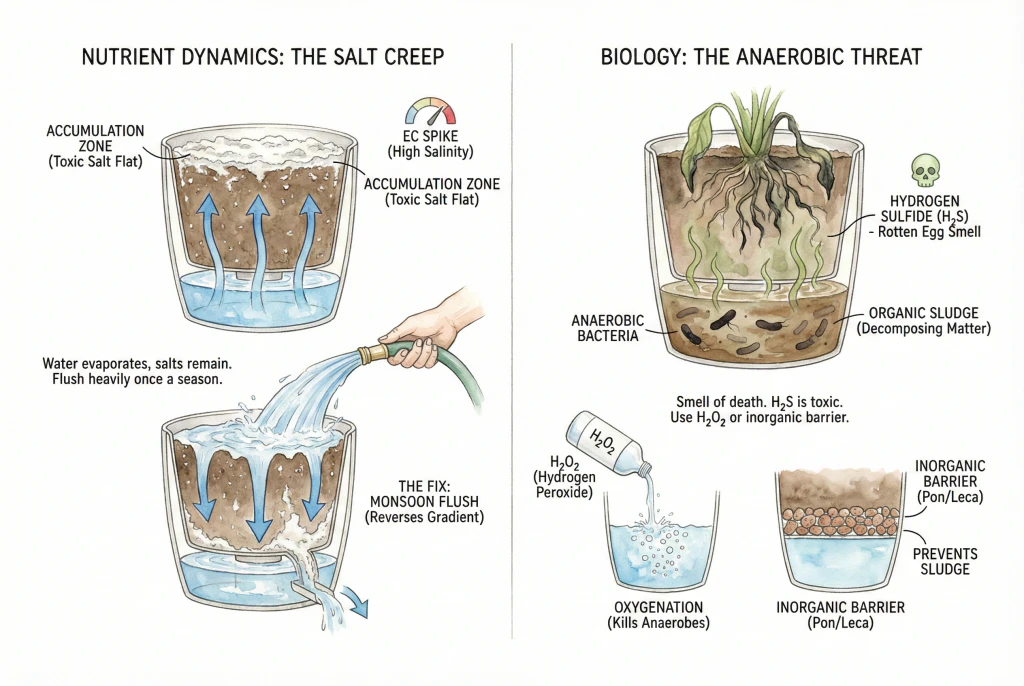
Nutrient Dynamics (Salt Build-up)
Top Watering Can Leach Salts
Salinity is worth watching. In a standard pot, watering from the top until it drains out the bottom leaches the medium (carrying away excess salts (such as hard-water carbonates and unused fertilizer salts), as long as enough low-salinity water passes through and exits).
Hardness and Fertilizer Salts Differ
Note that these are different chemistries lumped together. Calcium carbonate is an alkalinity/hardness deposit, while fertilizer salts contribute to salinity and possibly sodicity. They are not one category.
Reservoir Systems Concentrate Salts Upward
In a SIP, water largely moves up and evaporates from the surface, which can leave salts concentrated near the top.
Measure Salt Load With EC
Salts can build up toward the surface over time. How fast, and whether the level actually harms roots, depends on your fertilizer, water quality, and the plant’s tolerance, so an EC meter tells you far more than the visible crust. Treat a rapid surface buildup as a rough caution, not a measured threshold.
Flush the Medium Periodically
Periodically leach the medium by top-flushing with low-salinity water so it passes through and exits via the overflow, or remove the pot and flush it separately. Avoid heavy indoor flooding, which risks media loss, nutrient leaching, and spills. Follow the maker’s drain design and check EC where you can.
Flushing Reverses the Upward Gradient
This flushing reverses the usual upward gradient and carries surface salts down and out. How often you need it depends on the measured salt load, not a fixed calendar.
Odor and Low-Oxygen Reservoirs
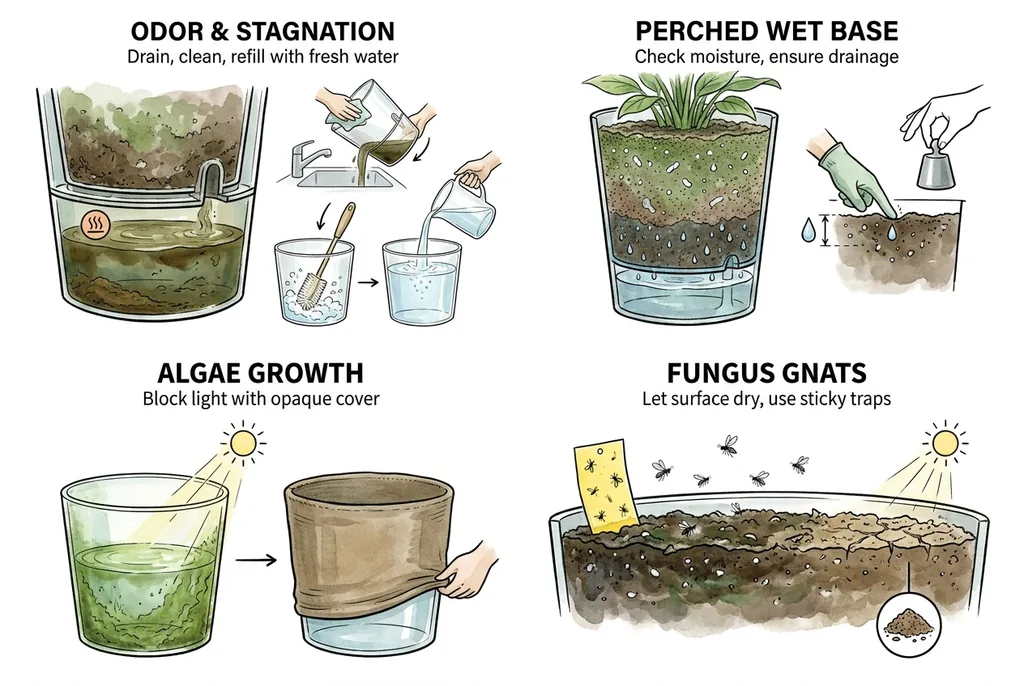
Treat Odor as a Warning Signal
A rotten-egg or sewer-like odor from a reservoir may indicate hydrogen sulfide (H2S), which can form in oxygen-starved, reduced conditions.
Smell alone does not confirm the gas or its source, though. Sewage-like odors can come from other compounds too.
Organic Load Can Deplete Oxygen
If organic debris such as peat or leaves collects in the reservoir while dissolved oxygen is low, anaerobic decomposition can occur. A deep reservoir is not automatically low in oxygen because organic load and lack of circulation matter more than depth alone.
Hydrogen Sulfide Can Injure Roots
Hydrogen sulfide can impair root respiration and water or nutrient uptake, which can contribute to wilting, although it is not the only possible cause of a wilting plant.
Source Control Comes First
For source control, ventilate the area and avoid inhaling the gas directly. If it is safe, keep electrical equipment away, drain the reservoir, inspect the roots and overflow, discard the contaminated solution, and clean the empty system according to the manufacturer’s directions before refilling with suitable water or nutrient solution and restoring aeration and light exclusion. If the problem recurs or the roots look diseased, get a proper diagnosis.
Why Peroxide Is Not a Default Fix
Some guides suggest adding 3% H2O2 to a reservoir, but a 3% stock is roughly 30,000 mg/L, and without a specified final concentration, contact time, and plant tolerance it is easy to use a harmful dose.
H2O2 is a non-selective oxidizer. It can damage living root tissue and beneficial microbes, not just anaerobes, and it breaks down quickly, so it does not replace source control, cleaning, and aeration.
Because stock strength, exposure time, and plant tolerance vary, no universal reservoir dose is safe to assume. If you ever consider it, verify an exact final concentration, contact time, PPE, and rinse or disposal procedure against an authoritative, plant- and product-specific source first.
To reduce debris reaching the tank in the first place, a mineral layer such as LECA or a similar expanded-clay granulate at the base can help keep coarse organic particles out, though fines and dissolved organics still pass through, so it is a partial measure rather than a complete barrier.
Detailed Troubleshooting Guide
(1) Wet base while the surface is dry (perched water)
Perched Water Can Hide Below a Dry Surface
The plant may decline while the top of the medium looks dry.
Several Causes Mimic a Perched Table
A fine, very water-retentive medium can hold a saturated zone near the base even when the surface is dry. But a dry surface plus root decay does not confirm this. Pathogens, overfilling, a blocked overflow, salt or fertilizer injury, temperature, and already-damaged roots can all look similar. The height of any saturated zone depends on the medium and container, so there is no fixed depth that applies to every pot.
Check the System Before Repotting
Before anything drastic, feel the medium’s weight and moisture, check the reservoir and overflow, inspect the roots for firmness, color, and smell, and measure EC or pH if you can. If the medium really is too fine and airless, repotting into a coarser blend can help, but unpotting a sick plant also risks further root damage, so weigh it case by case rather than automatically mixing in a fixed amendment percentage.
(2) Algae in the reservoir
Confirm Algae Before Treating Slime
Green slime on the wicks or in the water gauge can be algae, although some slime is bacterial biofilm and should be confirmed visually.
Light Drives Reservoir Algae
Light reaching the water is the usual driver because algae need light to grow.
Exclude Light Before Using Chemicals
Exclude light from the reservoir. With a clear DIY container, use an opaque cover or paint, but check that any paint or tape is compatible with the container and safe for food crops because coatings can leach. Cleaning the system and managing nutrients also helps. A rinse and refill usually beats reaching for chemicals, and an improvised H2O2 dose is not a safe default for algae.
(3) Fungus gnats
Identify the Fly Before Control
Tiny flies around the medium may be fungus gnats, but shore flies and fruit flies look similar, so confirm the identity.
Moist Organic Surfaces Attract Gnats
A persistently moist organic surface attracts fungus gnats. Adults lay eggs in moist organic media, and larvae feed mostly near the surface rather than at one fixed depth.
Prioritize Moisture Management and Labeled Controls
Let the surface dry more between waterings and reduce loose organic debris. Monitor adults with yellow sticky traps and, if needed, use a labeled larvicide such as Bti or beneficial nematodes according to the product label. A coarse top-dressing may hinder egg-laying and emergence somewhat, but it does not physically destroy larvae or form a perfect barrier, and it changes the moisture profile. Confirm the pest and prioritize moisture management and labeled controls.
Wrapping Up
Consistency Is Not a Guarantee
A self-watering planter mainly makes watering more consistent, which removes one common source of stress for container plants.
It is a useful tool, not a guarantee. The plant, medium, container, water quality, and light all still matter, and other things (pathogens, salinity, temperature) can go wrong regardless.
Match the System to the Plant
Keeping an air gap or overflow, using a well-aerated medium, and following the maker’s watering routine for your specific system will get you most of the benefit.
Match the plant to the system, watch the reservoir and the roots, and adjust based on what you observe rather than a fixed formula. And keep dense garden or field soil out of containers.