
Tomato Fertilizer 2026: Silicon, Biostimulants & BER, Reviewed
Beyond N-P-K: what the silicon, seaweed-biostimulant, and calcium-transport research actually shows for tomatoes under heat (sorted by evidence level, with the caveats and the limits).
Elena Vargas · Published 2025-12-31 · 22 min read
Key Takeaways
- Standard N-P-K alone may not hold high-value tomatoes through extreme heat, but newer inputs remain evidence-limited. Silicon, seaweed biostimulants, and calcium-transport management are worth testing, not settled field practice.
- The best-known silicon result came from a small 2025 greenhouse trial with one cultivar and three one-plant pots per treatment. It does not test heat, drought, pests, nitrogen reduction, or field return on investment.
- The roughly 86% seaweed heat effect came from one proprietary formulation in a company-supported growth-room study. There is no basis to transfer that result to a generic retail seaweed product.
- Blossom End Rot usually reflects calcium delivery to fruit rather than a whole-soil calcium shortage. Soil calcium, pH, root injury, salinity, even moisture, drainage, and cultivar still need checking.
- Treat single-trial percentages and brand-specific claims with caution. Validate any input on a small block before scaling and prioritize University Extension data over manufacturer testimonials.
1. Looking Beyond N-P-K
Recent hot seasons have renewed interest in whether standard N-P-K programs are enough for high-value tomato production under heat.
Blossom drop and abortion are driven mainly by temperature, humidity, cultivar, and how long the heat lasts, not by the choice of fertilizer.
University of Maryland Extension notes that in many cultivars, days at or above about 90°F combined with nights above about 70°F can cause poor fruit set. The exact threshold varies by cultivar and conditions, so there is no single 95°F cliff.
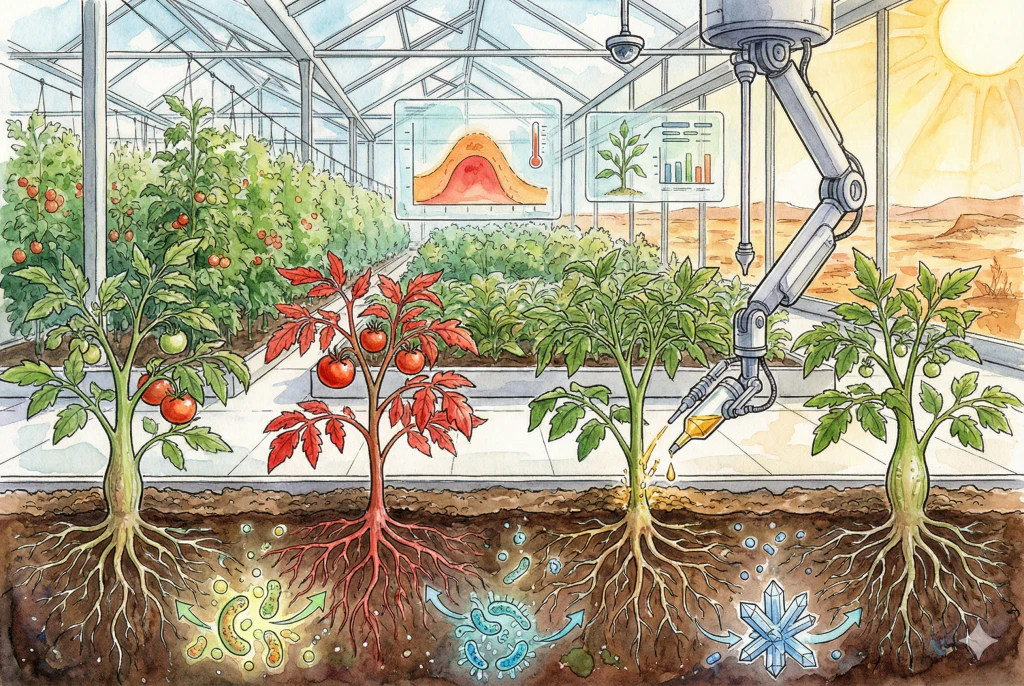
Three adjustments may improve heat resilience. Silicon can support plant structure, some biostimulants can alter stress responses, and blossom end rot management depends on calcium delivery rather than simply adding more calcium.
The evidence and limitations differ for each option, so use the measured results below without extending them to untested products or conditions.
2. Silicon (Si) – A Beneficial, Non-Essential Element
For decades, Silicon (Si) has occupied a strange limbo in plant nutrition. It is not counted among the 17 essential elements because most plants can complete their lifecycle without it.
For tomato specifically, Si is classified as a beneficial but non-essential element. Tomato is a silicon non-accumulator (excluder), not an accumulator like rice.
That means Si can improve growth and stress responses under some conditions, but it is not required nutrition and its benefits are conditional on cultivar, dose, and environment.
2.1 The Structural Mechanism
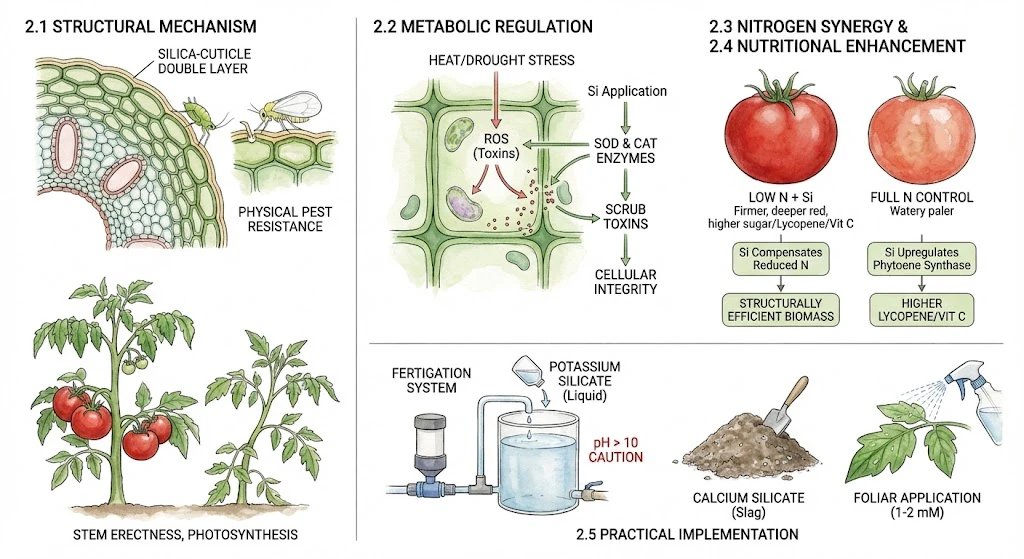
One proposed mode of action for silicon is structural reinforcement. Silicon is taken up mainly through the roots (largely as monosilicic acid, H₄SiO₄) and deposited in cell walls, including in the epidermis. Uptake and deposition vary by genotype, organ, and whether the route is active or passive.
(For a separate, houseplant-focused discussion of silicon in soil, see our article on silicon for indoor plants. It is background reading, not evidence for the tomato claims here.)
In accumulator species this can form a silica-cuticle layer. The clearest direct evidence for that double layer comes from rice. How far it applies to tomato skin, a non-accumulator, is less well established, so treat the reinforced skin picture as a working analogy rather than a measured property of tomato fruit.
Stem and height
In the 2025 BMC Plant Biology greenhouse trial (Ailsa Craig, three one-plant pots per treatment, normal conditions), soil-applied silicon at 45 kg/ha Na₂SiO₃ increased stem diameter by 53.57% and plant height by 11.34% versus untreated pots. Whether thicker stems translated into better fruit support, leaf angle, or photosynthesis was not measured in that trial, and taller is not automatically better.
Possible pest and pathogen effects
There is a research literature on silicon-associated insect and disease resistance, but responses are specific to the pest, cultivar, and application. This trial did not test pests, so a general claim that aphids, whiteflies, or fungi are held off in tomato is not supported here. Any such effect would be a partial, passive contribution, not a pesticide substitute. Keep monitoring and IPM.
2.2 Metabolic Regulation (Antioxidant Enzymes)
Silicon has also been associated with changes in a plant's stress-response chemistry.
In the same 2025 BMC Plant Biology greenhouse trial, silicon at 45 kg/ha (as Na₂SiO₃) was reported to raise the activity of the antioxidant enzymes Superoxide Dismutase (SOD) and Catalase (CAT) and to lower hydrogen peroxide and lipid-peroxidation (MDA) in the fruit.
Reactive Oxygen Species (ROS) accumulate under heat and drought and, in excess, can damage lipids, DNA, and proteins.
ROS are not simply waste, though. At controlled levels they are normal signaling molecules, so toxins to be scrubbed is an oversimplification.
Because this trial was run under normal greenhouse conditions rather than heat or drought stress, the enzyme changes are a correlation observed without applied stress. They should not be read as proof that silicon maintains cellular integrity specifically when temperatures soar.
2.3 Silicon and Nitrogen
Excess nitrogen can drive vegetative growth, delay fruiting, and increase pest and disease susceptibility, so more N is not automatically more marketable yield.
One line of research asks whether silicon changes that balance.
A 2021 greenhouse study is often cited here. Its best result came from a specific combination of roughly four times the organic-fertilizer rate, 0.6 times the chemical-nitrogen rate, and silicon.
Even without silicon, the treatment with four times the organic rate and 0.6 times the nitrogen rate yielded about 12.8% more than a full-rate chemical-nitrogen control. Adding silicon improved it further.
The large increase in organic input is doing much of the work. This is a conditional result from one greenhouse, not a general rule.
Mechanism (unverified)
It is sometimes proposed that silicon compensates for lower-nitrogen vigor or curbs luxury nitrogen consumption. That mechanism was not directly tested in the trial and should be treated as a hypothesis, not an established effect.
Implication
Any nitrogen-reduction plan should rest on soil and tissue tests and local recommendations, not on this single study. Treat a lower-N-plus-silicon program as something to validate on a small block first.
2.4 Nutritional Quality (Lycopene and a Trade-Off)
In the same 2025 BMC Plant Biology trial, silicon upregulated carotenoid-pathway gene expression and raised lycopene by 66.74%, vitamin C by 114.27%, and total carotenoids in the harvested fruit, alongside the yield increase of 33.81%.
These are large percentages from a small trial (one cultivar, three one-plant pots per treatment), so read them as a promising signal rather than a field-scale expectation.
The same trial also reported reductions in some minerals (root potassium down about 23%, root zinc down about 50%, and shoot zinc down about 14%).
Any nutritional-quality benefit therefore comes with a possible mineral trade-off that needs to be weighed, not just the headline gains.
2.5 Practical Implementation for US Systems
Tomato is classified as a silicon non-accumulator (excluder), so it takes up less silicon than an accumulator such as rice.
It can still respond to supplementation, but non-accumulator is an accepted classification, not a myth to be debunked.
Sources
Potassium silicate (liquid) is a common soluble source for fertigation, and it also contributes potassium. Calcium silicate (slag) can serve as a slower-release soil source and may contribute calcium. Choose based on the product's solubility, plant-available silicon, K/Ca contribution, effect on soil pH, any heavy-metal content, and its label, not on the word standard alone.
Application rates
The 45 kg/ha figure is the specific Na₂SiO₃ rate used in the 2025 trial above. It is not a universal recommendation and does not convert directly into a product dose. Some tomato studies use foliar rates around 1 mM, but the right rate depends on the formulation, its silicon equivalent, pH, and spray-injury risk. Follow the current product label and your own water/soil analysis rather than a single study rate.
Tank-mixing caution
Soluble silicate products are often highly alkaline (pH > 10) and can precipitate other nutrients (such as calcium) or affect pesticides. Follow each product's own label for mixing order and compatibility rather than a generic rule (see the mixing section below).
Soluble potassium-silicate products
Soluble potassium-silicate supplements differ in guaranteed analysis, declared silicon form, density, potassium contribution, pH, labeled dilution, package size, and shelf life. Compare the delivered plant-available silicon and potassium per treatment rather than treating one product’s grade or container as typical. These are supplements, not complete fertilizers. The sodium-silicate result above used a different compound and does not certify how a commercial potassium-silicate product performs on tomatoes.
Use the manufacturer’s mixing sequence. The usual pattern for soluble silicates is to add the silicate to fresh water first and mix thoroughly, then add base nutrients and any other supplements, and adjust pH last, but directions differ by formulation, so follow the label.
Read the label and safety data sheet before handling. Soluble silicates are commonly classified as serious eye irritants (SDS Category 2A), which calls for eye and face protection, hand washing after handling, and a known eye-rinse procedure.
Compare cost per unit of plant-available silicon (it usually runs higher than bulk slag) and make sure the formulation is labeled for your irrigation method, since these products suit drip or fertigation better than a watering can.
Only tank-mix it with a pesticide if both product labels permit that combination.
Silicon application improves tomato yield and nutritional quality
3. Biostimulants (Seaweed and Microbes)
The biological-products sector is often described as a multi-billion-dollar global market. A precise figure requires a dated market report and defined geography.
For some specific products, seaweed extracts and microbial inoculants have shown effects in university trials.
That a product class has been studied does not mean any given commercial product works, so the useful question is how to tell which claims are supported.
3.1 Seaweed Extracts (Ascophyllum nodosum)
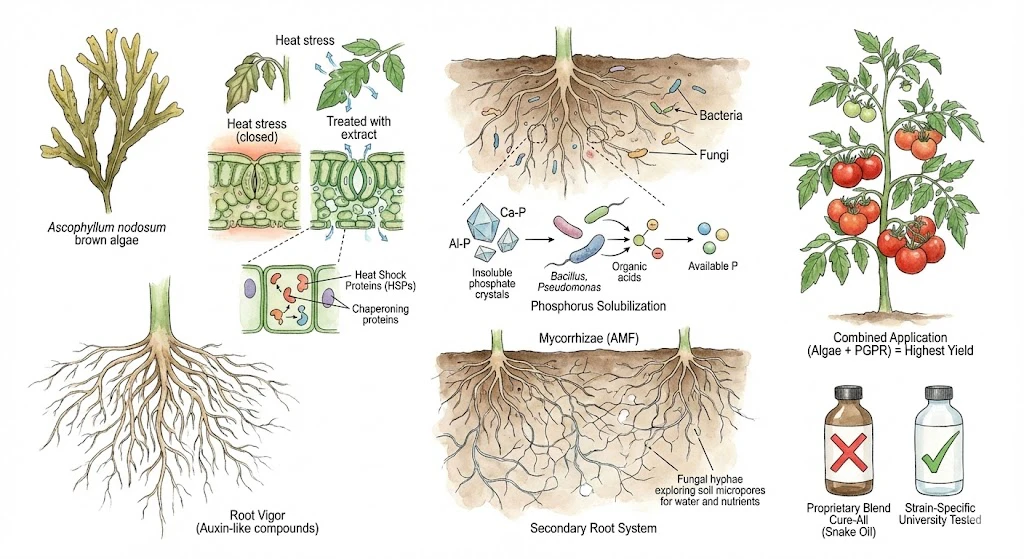
Extracts from the brown alga Ascophyllum nodosum are a major commercial source. They are low-NPK products rather than full fertilizers, but how much potassium and trace elements they contribute depends on the specific product analysis and rate, so negligible minerals is not accurate across the board.
They contain compounds such as alginates, mannitol, and fucans, and some carry hormone-like activity that has been linked to cytokinins.
The extraction process, molecular weight, and dose all affect what ends up in a given product, and the strength of any hormone-like effect remains uncertain. It should not be attributed to the cocktail as a whole.
3.1.1 Proposed Mechanisms of Heat Tolerance
Heat can reduce pollen viability and fruit set and can impair stomatal and photosynthetic function.
It does not follow that pollen simply denatures or that closed stomata mean photosynthesis fully stops, and not every seaweed product primes plants.
The mechanisms below come mainly from one study of a specific formulation (see 3.1.2) and are proposed effects, not general properties of seaweed extracts.
Stomatal conductance
Some formulations have been reported to help maintain partial stomatal conductance during heat, but this was not the main measured endpoint of the linked study, and it is an overreach to say untreated plants uniformly shut down.
Heat-shock proteins. HSPs act as molecular chaperones
In the linked study, flower HSP transcripts changed under the proprietary formulation PSI-494. That is a transcript-level result for one product, not evidence that seaweed extracts generally raise HSP protein abundance or function.
Root effects
Seaweed products can influence root branching, and auxin-like compounds are one proposed reason. Whether heat causes root dieback that these products then reverse, and whether that drives water uptake, was not established in the linked trial.
3.1.2 The Heat Trial, in Detail
The main evidence here is a controlled-environment study, not a field trial. Micro Tom tomato plants were grown in a growth room at 31/24°C for 14 days, and two proprietary formulations from Brandon Bioscience, C129 and PSI-494, were compared at 0.106%.
Around fruit set, the extract raised soluble sugars and HSP transcripts in flowers, and the roughly 86% increase in fruit number was seen only with PSI-494, a lower-molecular-weight extract made by high-temperature alkaline processing.
The other formulation, C129, did not significantly increase heat-stressed fruit number (p = 0.455).
One author received salary from Brandon Bioscience and the company supplied the products.
So the strong result belongs to a specific, company-supported, proprietary formulation on a model cultivar in a growth room, not to seaweed extracts in general or to any retail bottle.
The trial did not directly compare applying the product before versus after heat, so it does not establish that a post-damage spray does little. Results vary by formulation, rate, and timing.
Straight retail seaweed extracts
Commercial Ascophyllum nodosum products differ in guaranteed analysis, extraction, additives, and labeled crops. Treat a low-analysis seaweed extract as a biostimulant rather than a complete nutrient source. Before using one on tomatoes, read its current label and safety data sheet. A product restricted from food crops does not belong on tomatoes. A generic seaweed product is also not equivalent to the proprietary PSI-494 formulation from the study, so the 86% figure cannot be carried over to it.
Ascophyllum nodosum Extract Biostimulant Processing and Its Impact on Enhancing Heat Stress Tolerance During Tomato Fruit Set
3.2 Microbial Inoculants (Engineering the Rhizosphere)
Soil-microbiome research is active, and two functions get particular attention. Phosphorus solubilization and drought response.
These are genuine research areas, but singling out just these two, and describing the field as having simply shifted, reflects emphasis rather than a systematic survey.
3.2.1 Legacy Phosphorus
Some soils hold phosphorus (P) that is chemically bound with calcium or aluminum and less available to plants. Phosphate-solubilizing bacteria (PSB), including certain Bacillus and Pseudomonas strains, can secrete organic acids (such as gluconic acid) and phosphatases that help release some of it.
How much a given inoculant helps depends on the strain, its viable count, the inoculation route and timing, soil pH and P form, the native microbiome, and the crop's demand, and total soil P is not the same as a recoverable reserve.
The mining idea
PSB may raise the availability of some legacy P, but you should not trim applied P on that basis without soil and tissue tests confirming that tissue levels hold. Phosphate prices do change over time, but that is a general observation here rather than a dated figure.
3.2.2 Mycorrhizae
Arbuscular mycorrhizal fungi (AMF), including Glomus spp. And relatives, extend their hyphae into soil micropores and depletion zones that roots reach less easily, which can aid water and phosphorus acquisition.
Some tomato deficit-irrigation trials report that AMF inoculation helps hold yield under reduced water and nitrogen, but that outcome is specific to the fungal strain, soil, phosphorus status, any fungicide use, and how well the roots are actually colonized.
Calling AMF a secondary root system is a metaphor, not a literal structure.
Consortia
In some trials a consortium (for example an N-fixer paired with Trichoderma) has outperformed a single inoculant on measures like leaf water potential and canopy temperature. Reproducing those results depends on the exact strains, treatment, crop, and water/nitrogen rates, which vary between studies.
3.3 Combining Inputs
One 2022–2023 organic tomato field study in Italy (three split-plot replicates) found that a combination of plant-growth-promoting microbes plus 1% algal biostimulant reached about 67.2 t/ha, versus 26.0 t/ha for the untreated control.
That is a promising result for a specific product combination in an organic field system. It does not establish that stacking always beats applying inputs separately, since the comparison was mainly against an untreated control rather than a full individual-versus-combined design.
It is sometimes said that foliar algae feed carbon to the root bacteria in a feedback loop.
That specific carbon transfer was not measured in the trial, and given that the algae were foliar-applied, it is a hypothesis rather than a demonstrated mechanism.
3.4 How to Read Biostimulant Claims
With many products on the market, a few practical checks help.
Naming the strain or source
Efficacy tends to be strain- and formulation-specific, so a named organism or source is more informative than proprietary blend. That said, a proprietary composition is not automatically a red flag if it comes with real efficacy data. Conversely, a named strain like Bacillus subtilis QST 713 is the active ingredient of registered biocontrol products (the Serenade line) rather than a generic PGPR, so match the claim to what the strain is actually registered to do.
Cure-all claims
Be skeptical of products promising to replace all fertilizer, eliminate pests, and end drought stress. Biostimulants may improve efficiency in specific conditions. They are not a guaranteed substitute for fertility, pest, or water management.
Regulatory status
The US has no single federal biostimulant category. Depending on a product's composition, intended use, and label claims, it may be treated as a plant nutrient, inoculant, or soil amendment, or, if it makes plant-regulator claims, as a pesticide under FIFRA. The EPA's 2025 draft guidance says biostimulants judged to be plant regulators fall under FIFRA. State fertilizer and soil-amendment registration rules also apply. This is a matter of how a product and its claims are classified, not evidence that companies register as soil amendments to dodge testing. Lean on University Extension data over manufacturer testimonials.
4. Blossom End Rot and Calcium Transport
Blossom End Rot (BER) shows up as a dark, sunken lesion on the blossom (distal) end of the fruit, which usually makes it unmarketable.
Despite the name, it is a physiological disorder rather than an infection, though secondary pathogens can move into the damaged tissue. Early symptoms and severity vary by cultivar.
Simply adding more calcium often does not help, because in many cases the issue is calcium delivery to the fruit rather than a whole-soil calcium shortage.
But low soil calcium, unfavorable pH, root damage, and salinity are also real causes, so this is not purely a transport problem. Start with a soil test rather than assuming.
4.1 How Calcium Moves
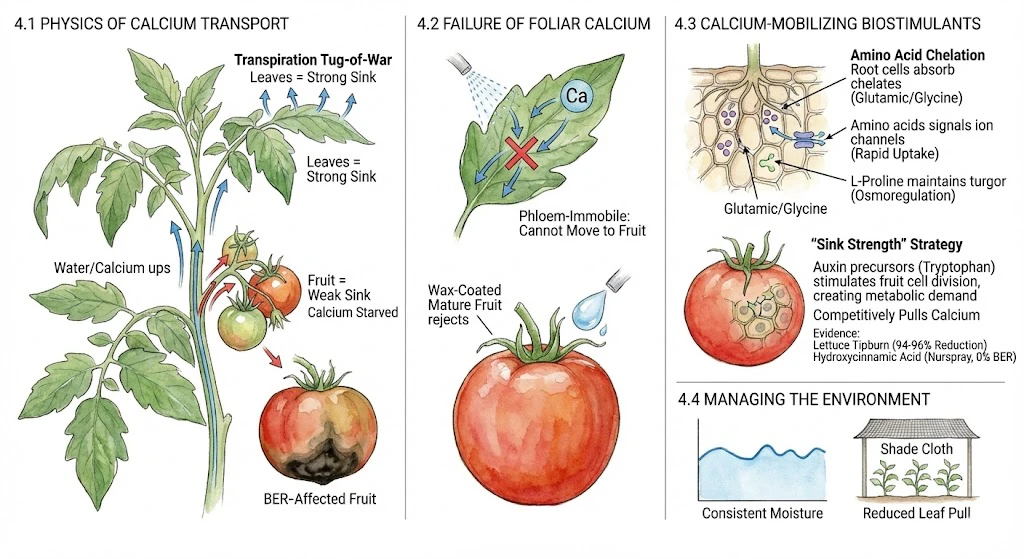
Calcium (Ca²⁺) behaves differently from nitrogen or potassium. It moves mainly through the xylem (the water-conducting vessels), largely with the transpiration stream, and has low phloem mobility.
Fruit xylem functionality and the balance of apoplastic and symplastic transport add nuance, so it goes only where the water goes is a simplification.
Leaf–fruit competition
In hot, dry weather, large leaves transpire strongly and can pull water and dissolved calcium toward themselves. Developing fruit, which has few stomata and low transpiration, may receive relatively less. This is one plausible contributor to BER, but humidity, root water flow, fruit growth rate, and fruit vascular development all matter too. It is not a single tug-of-war.
The result
When calcium delivery to the blossom end falls short during rapid fruit growth, cell membranes and walls there can fail and the lesion forms. This can happen during early-season heat even where soil calcium is adequate, which is why a soil test plus even watering matters more than simply adding calcium.
4.2 The Limits of Foliar Calcium
Spraying calcium chloride or nitrate on the foliage is a common response, but calcium is largely phloem-immobile, so it is not readily loaded into the phloem and moved from the leaves down to the fruit.
Leaf-applied calcium therefore translocates poorly to the fruit.
That is a real limitation, not a blanket failure. A spray that directly reaches the fruit surface can help in some conditions, though the fruit skin becomes more waxy and less permeable as it matures, and results vary with growth stage, formulation, and surfactant.
Label-approved direct-fruit or young-tissue sprays have conditional evidence behind them, and foliar calcium can also be useful for diagnosing deficiency, so use it as part of a plan that starts with a soil test and soil/root management, not as a reflex to dismiss outright.
Uptake and Transport of Calcium and the Possible Causes of Blossom-end Rot in Tomato
4.3 Calcium-Mobilizing Biostimulants (An Emerging Idea)
Some research interest has turned toward influencing how the plant moves calcium rather than just adding more of it.
This is an emerging area, and it does not replace the basics (correcting a genuine deficiency and managing water, roots, and EC still come first).
The specific product mechanisms below are hypotheses, not settled effects.
4.3.1 Amino-Acid Chelation
Chelation refers to calcium coordinating with a ligand such as an amino acid. It is often said that chelating calcium with L-amino acids like glutamic acid and glycine neutralizes the ion's charge and reduces precipitation with soil phosphates.
In reality the charge is not simply cancelled, and whether such complexes stay plant-available depends on pH, chemical speciation, and the specific product (this needs testing rather than assertion).
Amino acids can play roles in signaling generally, but there is no direct evidence that an exogenous amino-acid calcium product improves tomato calcium uptake or reduces BER.
Osmotic role
Proline is involved in osmotic adjustment and stress responses. Jumping from that to an exogenous proline product maintains turgor, which moves calcium, which controls BER skips over dose, application route, and the plant's own metabolism, so treat it as speculative.
4.3.2 The Sink Strength Idea
Auxins and peptides can influence cell division and source–sink relations, so it has been proposed that products containing auxin precursors (like tryptophan) or specific peptides might make fruit a stronger sink and draw more water and calcium toward it.
There is no direct tracer or BER data showing this happens in tomato, so treat it as a hypothesis rather than an established mechanism.
Lettuce tipburn (a related disorder)
A 2025 deep-water-culture trial in Rex lettuce (two blocks) tested a proprietary product, Croda CC US-2105 (a calcium ammonium nitrate, zinc nitrate, and ethoxylated-alcohol mixture), with and without vertical airflow fans. Tipburn-free plants were 94–96% at 21 days after treatment, falling to 71–75% at 28 days. This is a lettuce-specific signal from a proprietary mixture, not amino-acid evidence, and it does not transfer directly to tomato BER.
Nurspray tomato trial
A 2020 field trial in Napoli (Taylor F1, four randomized blocks, product applied at 1 L/ha across three timings) reported BER at 5% in the control and 0% in two treatment timings. Total yield was similar across treatments, and treated plots actually had a lower fruit count. The trial was funded by an EIC/Fyteko project with Fyteko staff involved. The 0% figure is a brand-specific, preliminary result. The vascular flow / cell-wall reinforcement explanation was not directly measured, and independent replication is needed before treating it as a general effect.
4.4 Managing the Environment
Whatever role a biostimulant might play, the reliable levers for BER are cultural. For a home grower these come first, not any spray.
Consistent moisture
Swings in soil moisture disrupt the steady flow of calcium, so keeping moisture even helps maintain a baseline supply. Regular irrigation plus mulch is one of the strongest general recommendations for home-garden BER, consistent with University of Minnesota Extension.
The rest of the checklist
Alongside even watering, avoid overwatering, ensure good drainage, protect roots from injury, run a soil test, and watch excess nitrogen or salts (including high K, Mg, ammonium, or sodium). Cultivar choice matters too, since susceptibility varies.
Shade as a heat option
Some growers use light shade cloth during extreme heat, mainly to reduce heat and water demand. It is plausible that lower leaf transpiration leaves more calcium available to the fruit, but that specific diversion effect is not well established, and too much shade trades against yield and can raise sunscald risk.
5. Integrated Management (Putting It Together)
These components are worth trialing rather than adopting as a fixed protocol. Silicon applied early, biostimulants timed ahead of heat windows, and calcium managed mainly through consistent water rather than reactive sprays.
The right program depends on your soil and media, cultivar, irrigation, climate, and base-nutrient analysis, so validate on a small block before scaling. If controlled-release fertilizer is part of that base program, use the vegetable slow-release fertilizer guide to match coating duration and crop timing before layering these experimental inputs on top.
5.1 Tank Mixing and Compatibility
Mixing chemistry matters, and the safest guide is each product's own label.
Silicon pH
Concentrated soluble potassium silicate is strongly alkaline, often pH > 10, and can react with calcium to form insoluble silicates or affect pesticide mixtures. The common order of addition is to add the silicate to fresh water first, then base nutrients and supplements, and adjust pH last, so do not buffer pH before the other products go in. Follow the product’s own instructions, though, because formulations do not share one universal sequence. A jar test can reveal gross physical incompatibility, but it does not establish pesticide-label permission, crop safety, or efficacy.
Microbial viability
Living inoculants can be harmed by copper fungicides or strong bactericides, so apply them in separate passes or via irrigation injection. Check the specific organism and product labels, along with water sanitizer, injector residue, and flush intervals, rather than assuming survival.
Decide Whether a New Input Earns Its Place
Do not treat silicon, seaweed extracts, or microbial products as a replacement for nutrients shown on a soil or tissue test. Their cost and value depend on the product, rate, weather risk, crop price, labor, and the actual response on your ground.
Keep soil-test-based fertility and consistent water management as the foundation, then trial one new input on a small block before expanding it. Compare it with an untreated area and scale only a result that holds up under your own conditions and label limits.
I lay out four adjacent blocks before a forecast hot period, and a coin flip assigns one five-plant row section in each block to the new input and the paired section to normal care. I measure only the middle three plants in every section, keeping cultivar, irrigation, shade, and base fertility the same, and record blossom end rot, flower loss, marketable fruit weight, and input cost. Four randomized pairs follow Extension trial guidance, while excluding the two end plants from measurement reduces spray and root-zone spillover between sections.
If I change shade or watering to protect the crop, I mark the trial as interrupted rather than pretending the original comparison survived. Protecting the plants matters more than preserving a neat result, but the ledger should still tell the truth about what was tested.