
Tonatico Tomato Guide: Growing the AAS-Winning F1 Cherry Tomato
Grow the AAS-winning Tonatico F1 cherry tomato: stage-based feeding options, consistent watering to reduce cracking, two-leader pruning, its disease-resistance codes, and harvest and storage tips.
Marcus Hale · Published 2026-01-22 · 17 min read
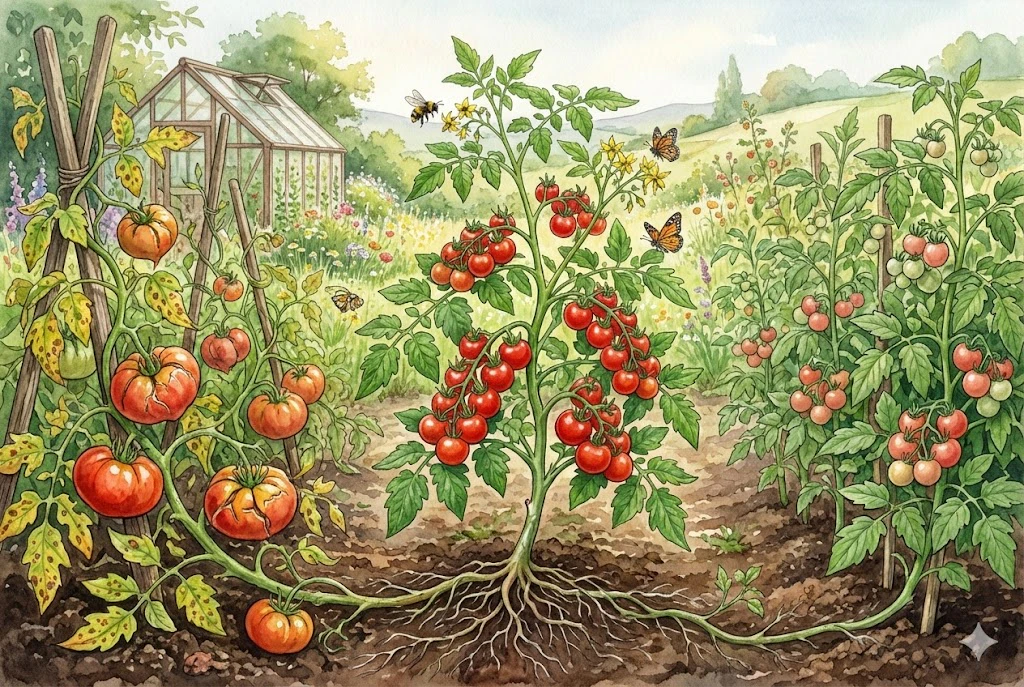
Key Takeaways
- Tonatico is a 2025 All-America Selections regional winner. It is an indeterminate cherry tomato from Bejo USA, noted by AAS for high yield, long easy-to-harvest trusses, and less cracking. Retail Brix and fruit-count figures are vendor claims, not trial data.
- Match feeding to soil or media tests and the plant’s response. Nitrogen supports early growth, while phosphorus, potassium, and calcium matter through flowering and fruiting. Do not simply cut nitrogen at first flower.
- Consistent moisture helps reduce cracking and blossom end rot. BER is often a calcium transport issue linked to erratic watering rather than low soil calcium, so test before adding calcium.
- Manage the vigorous vine with training and strong support. A two-leader system, Florida weave, heavy wire cages, and gradual lower-leaf removal are workable tools.
- Use resistance codes as a watch list, not a guarantee. Check your seed packet because codes vary by region, then monitor for diseases the variety is not protected from. In sustained heat, afternoon shade can help fruit set. Store ripening fruit at room temperature and refrigerate fully ripe fruit only briefly if needed.
Getting to Know Tonatico
Tonatico is a 2025 All-America Selections (AAS) regional winner for the Northeast and Mountain/Southwest regions, an indeterminate cherry tomato from Bejo USA. AAS notes it for high yield, long easy-to-harvest trusses, and reduced cracking.
AAS and Bejo do not publish a specific breeding objective, so treat claims that it was bred specifically to fix cracking and disease as inference rather than stated fact.
Growing it well is mostly about consistency. Matching water and nutrients to the plant’s stage and conditions, and managing its vigorous indeterminate habit with training and support.
Retail listings advertise up to ~200 fruits per plant, but that is a vendor figure without a stated trial location or comparison, so results in your garden will vary.
Tomato Tonatico F1
What F1 Means for Your Garden
Tonatico is an F1 hybrid, so saved seed is unlikely to grow into plants that match the parent. Buy fresh seed when you want the same known traits. Its parent lines and a direct comparison with open-pollinated tomatoes are not published, so treat claims about a measured vigor advantage as unconfirmed.
Growth Habit and Fruit Expectations
Tonatico is an indeterminate cherry tomato. Unlike determinate bush types that stop after a terminal flower cluster, it keeps a vegetative growing tip, so the central vine grows indefinitely until frost or pruning stops it.
Expect round, bright-red cherry tomatoes with a sweet flavor. Fruit-size and sweetness figures vary among sellers and are not a guarantee for a particular garden, so use them only as a rough expectation.
Environmental Setup
Build the root zone before chasing yield
The growing environment shapes what a plant can do. Yield depends on several interacting factors, including light, water, temperature, fertility, pests, and cultivar, so it is hard to single out one weakest link. Getting the basics right with adequate sun, well-drained soil, and steady moisture gives Tonatico room to perform.
Prepare Soil That Drains and Holds Moisture
Tomatoes generally do best in soil that lets oxygen reach the roots while holding enough moisture.
A sandy loam is a good target. Heavy clay can restrict root expansion and drainage, while pure sand drains and leaches nutrients quickly.
Genetic resistance to Fusarium crown and root rot is biological, not physical. Waterlogging still suffocates roots regardless of pathogens, so drainage matters on its own.
A pH of roughly 6.0–6.8 is a reasonable target, but confirm it with a soil or media test. Nutrient availability shifts gradually across the pH range rather than switching off at a sharp cutoff. Very low pH can reduce calcium and magnesium availability, and high pH can reduce iron and manganese availability.
Texture, organic matter, and cation balance all factor in, so a test is more reliable than assuming from pH alone.
For in-ground beds, incorporating mature compost improves structure, water retention, and nutrient supply, but check the source, maturity, and how much organic matter your soil already has, and follow local soil-test recommendations.
Avoid fresh manure in a food garden for food-safety reasons. Adding a little sand to heavy clay is not reliable. Fine sand can actually worsen pore space and drainage, and coarse sand only helps at high proportions.
Raised beds, added organic matter, and avoiding compaction are more dependable. A mycorrhizal inoculant is optional (see below).
A granular mycorrhizal inoculant works only if viable propagules of a compatible fungus contact living roots. Check the exact species, propagule disclosure, expiry, storage, crop directions, and application rate. A number from one formulation does not describe another.
Most healthy garden and native soils already contain mycorrhizal fungi, so store-bought inoculants may be unnecessary. Heavy phosphorus can also suppress colonization, and an inoculant will not revive an already-struggling mature plant.
Container Growing and Mix
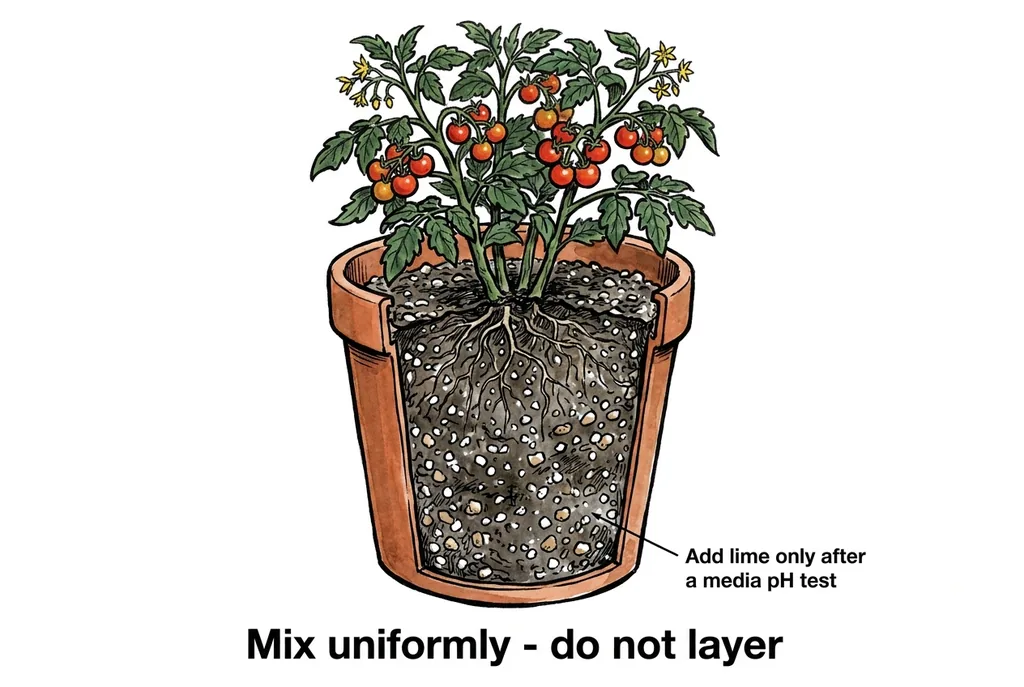
Tonatico does well in containers, but volume matters. AAS notes it can be grown in a 5-gallon (~19 L) container. For an indeterminate tomato, UC guidance suggests 10 gallons or more is more forgiving.
In hot climates or with infrequent watering, 5 gallons is a lower bound that demands closer attention, since larger volumes hold moisture more consistently and help buffer the water swings that drive cracking.
Mix quality potting medium, mature compost, and an aeration aggregate such as perlite or pumice uniformly rather than layering them. This distributes water and air more evenly through the pot.
Avoid the layered mix and blanket lime dose shown in some diagrams. If you add lime, base the amount on the starting medium pH, peat or coir content, and irrigation water. Pre-limed commercial mixes and buffered coir may need none.
Give Full Sun and Protect Fruit Set in Heat
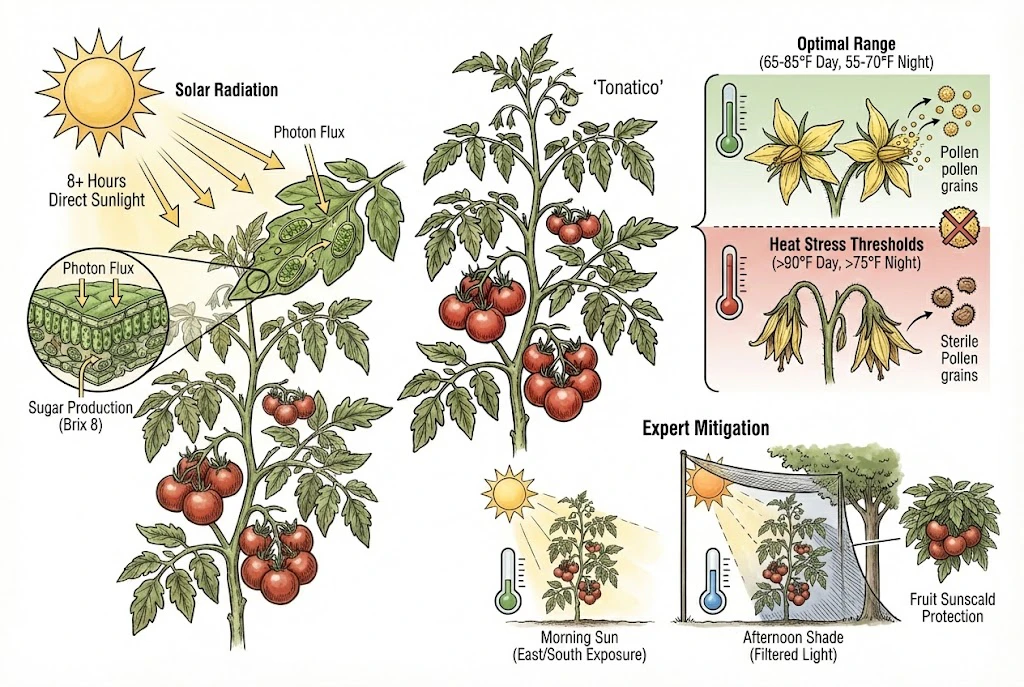
Tomatoes need substantial light for good growth and flavor (aim for roughly 6–8+ hours of direct sun).
Being a regional AAS winner doesn’t by itself prove heat tolerance. Fruit set commonly suffers under sustained high heat, often when days stay above about 90 °F (32 °C) and nights above 70–72 °F (21–22 °C), but this depends on duration, humidity, and cultivar rather than a single sterilizing cutoff.
In hot, sunny regions, morning sun with some filtered afternoon shade can help. Foliage shades fruit from sunscald, while the flowers remain the more heat-sensitive part.
Dense canopy has a trade-off, though. It can reduce airflow, so balance shading against disease pressure.
Raise and Harden Off a Strong Seedling
Protect the seedling before transplanting
A strong start helps. Stress during the seedling stage, severe root binding, low light, or nutrient imbalance, can set a transplant back and reduce how well it establishes and performs later, so it’s worth getting these weeks right.
Start Seeds Warm, Then Grow Them Cooler
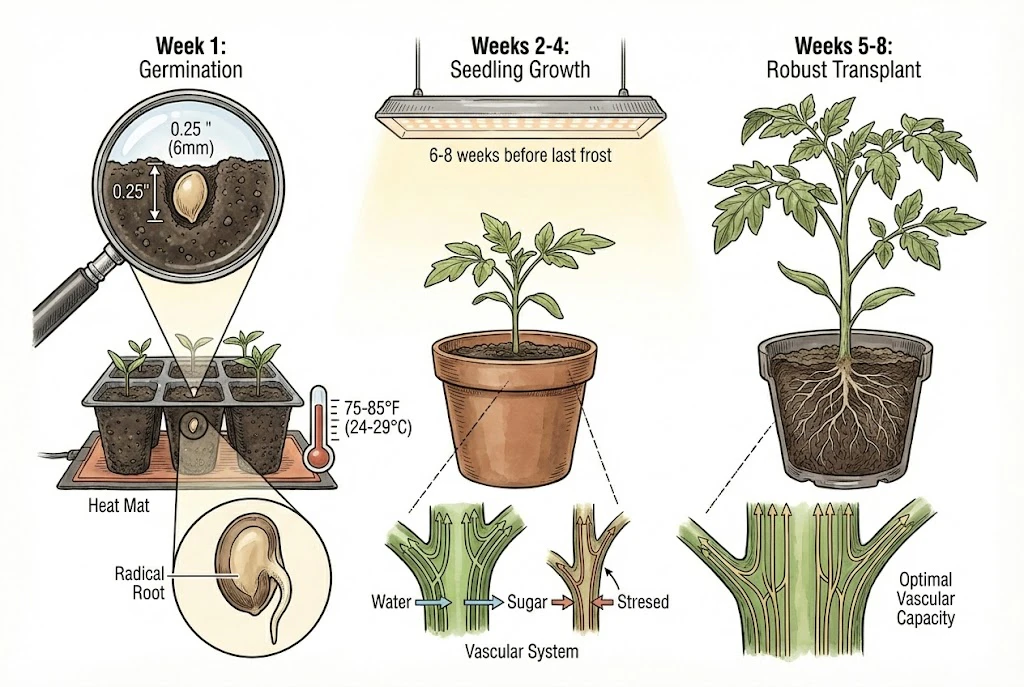
Start seeds indoors before your last frost. AAS suggests about 4–6 weeks, and other extension guidance often uses 5–6 weeks. 6–8 is a broader range. Tonatico matures early (about 60 days from transplant).
Keep soil temperature at 75–85 °F (24–29 °C) until emergence for fast, even germination. A heat mat helps here, but move seedlings to cooler conditions (media around 70 °F) once they emerge.
Cold, wet soil slows germination and leaves seedlings exposed longer, which raises damping-off risk. Sow seeds 0.25 inch (6 mm) deep.
Keep Seedlings Short and Sturdy
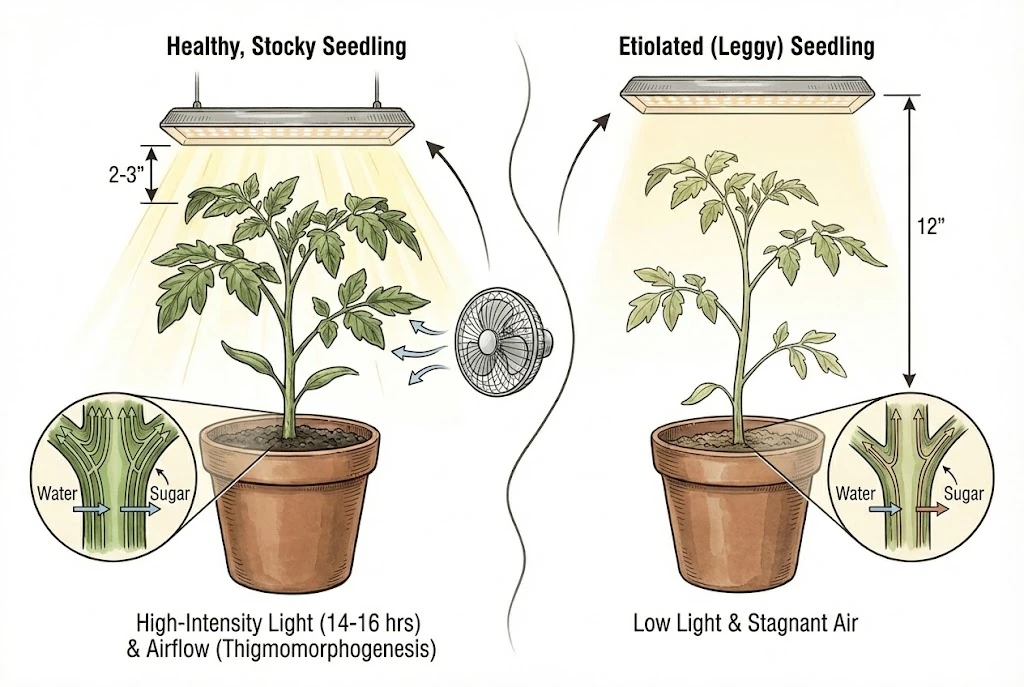
Seedlings that get too little light stretch and grow thin, weak stems. Give them bright overhead light (LED or T5 fluorescent) for 14–16 hours a day.
Set the distance based on your fixture’s output and heat and on how the plants respond (there’s no single correct height for all lights, so watch for stretching (too far) or scorch (too close)).
A gentle breeze from an oscillating fan encourages thicker, shorter, sturdier stems (a response to movement). Avoid excessive airflow that dries seedlings out.
Pot Up Before Roots Become Crowded
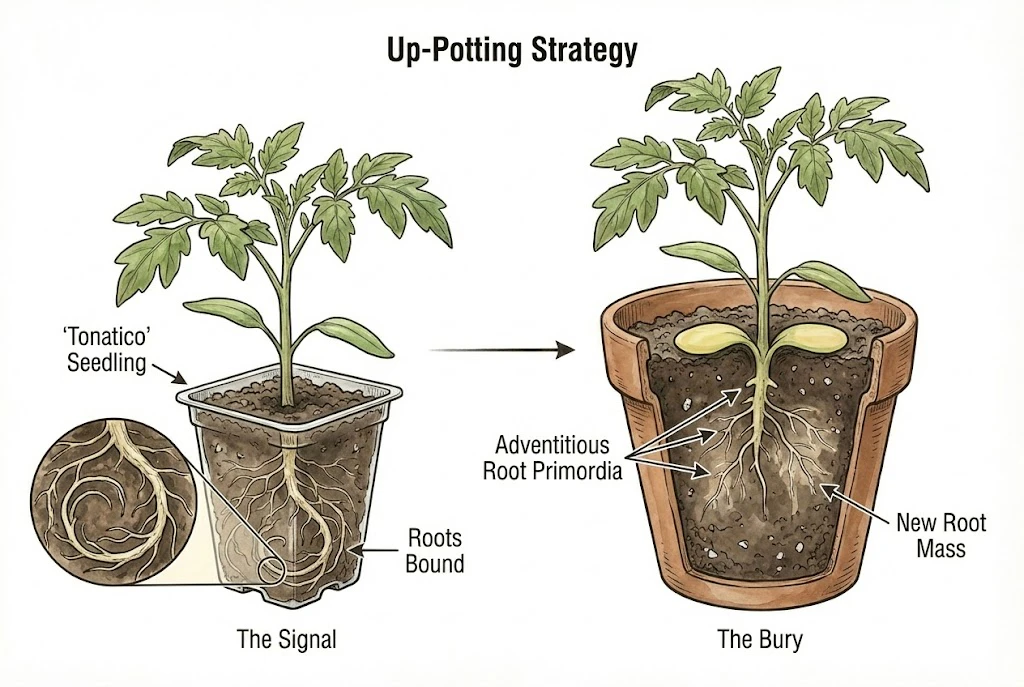
Try not to let seedlings become severely root-bound. Judge timing by checking the root ball (circling roots, slower drainage) along with growth rate rather than leaf position alone.
When you pot up to a 4-inch pot, you can bury the stem up to the cotyledons (seed leaves).
Tomatoes root along buried stems, so deeper planting can add root mass. Do this in well-drained, not cold or waterlogged, media to avoid stem rot.
Acclimate Seedlings Before They Go Outside
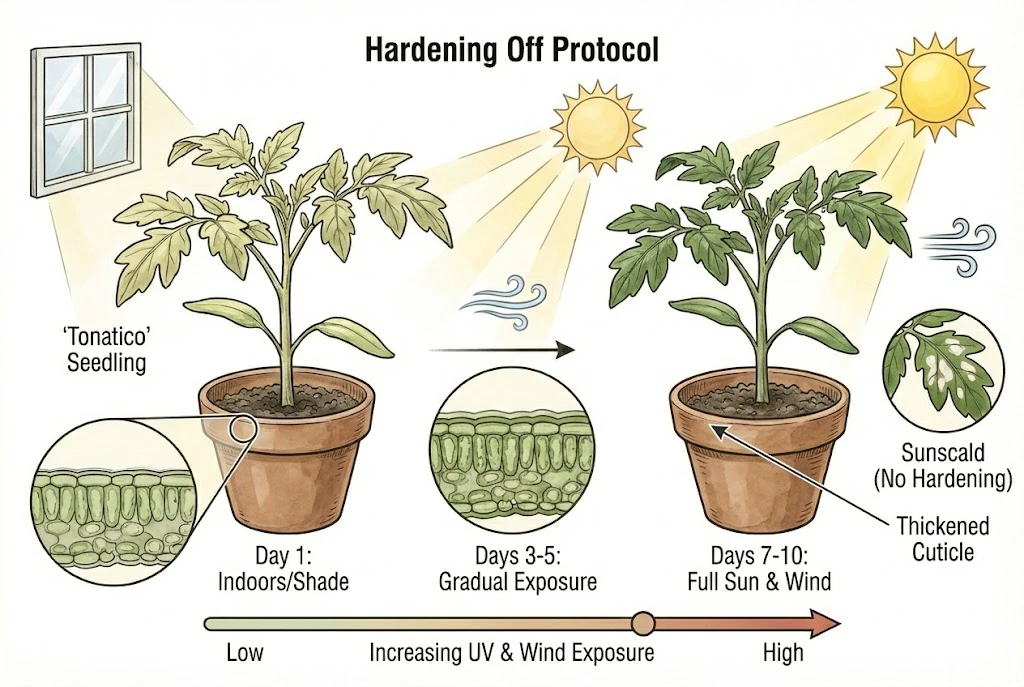
Before transplanting outdoors, harden the plant over 7–10 days so it acclimates to stronger light, wind, temperature swings, and higher water demand.
This gradual toughening includes changes to the leaf surface and reduces transplant shock.
Start with about an hour of shaded, sheltered outdoor time and increase exposure to sun and wind daily.
Easing into full sun helps avoid the sunburn that damages tissue, which can then be more vulnerable to secondary infection.
Feeding Through the Season
Feed the stage, not a rigid recipe
Nutrient needs and uptake change with growth stage and environment, but a plant draws on nitrogen and other nutrients continuously, including during fruiting.
Rather than switching between rigid formulas, base feeding on a soil or media test, the fertility already present, and how the plant responds.
The stage notes below are general options, not universal prescriptions. Rates should come from your product label and test results, not fixed cups and teaspoons.
Early Growth (Weeks 1–4 Post-Transplant)
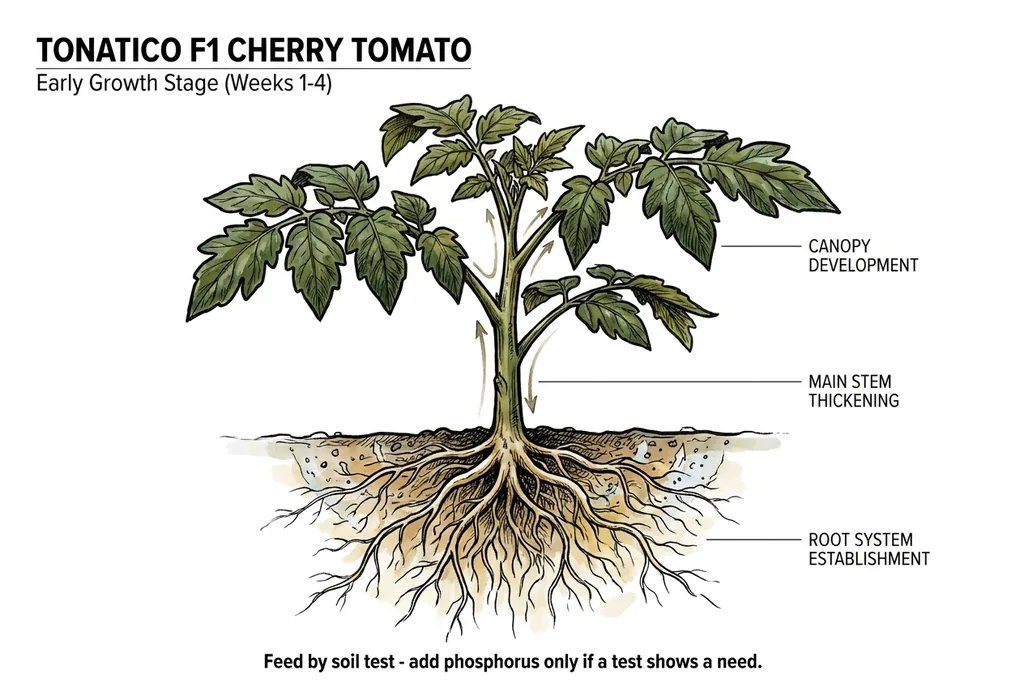
Early on, the focus is main-stem, canopy, and root development. Excess nitrogen can delay flowering and produce thick, curling growth, so aim for balanced nutrition guided by a soil test rather than pushing nitrogen.
Many garden soils already have adequate phosphorus, so add it only if a test indicates a need.
A moderate nitrogen source such as fish emulsion (5-1-1) or blood meal can support early growth if your base fertility is low. Follow the label rate.
Don’t re-apply a mycorrhizal inoculant without checking whether it’s warranted (see the note above).
Keep Feeding Balanced at Flowering
Phosphorus and potassium matter for flowering and fruit, and very high nitrogen can favor foliage over fruit.
But the plant still needs nitrogen through this period, so don’t cut it off entirely. Poor fruit set is more often driven by heat, water, or pollination than by nitrogen alone.
If a soil test shows a need, slow-release sources such as bone meal (phosphorus and calcium) and kelp meal (some potassium and trace elements) are options.
Match amounts to your soil test, pH, and the product label rather than a fixed cup measure, since over-applying phosphorus wastes money and can run off.
Fruit Set and Maturation
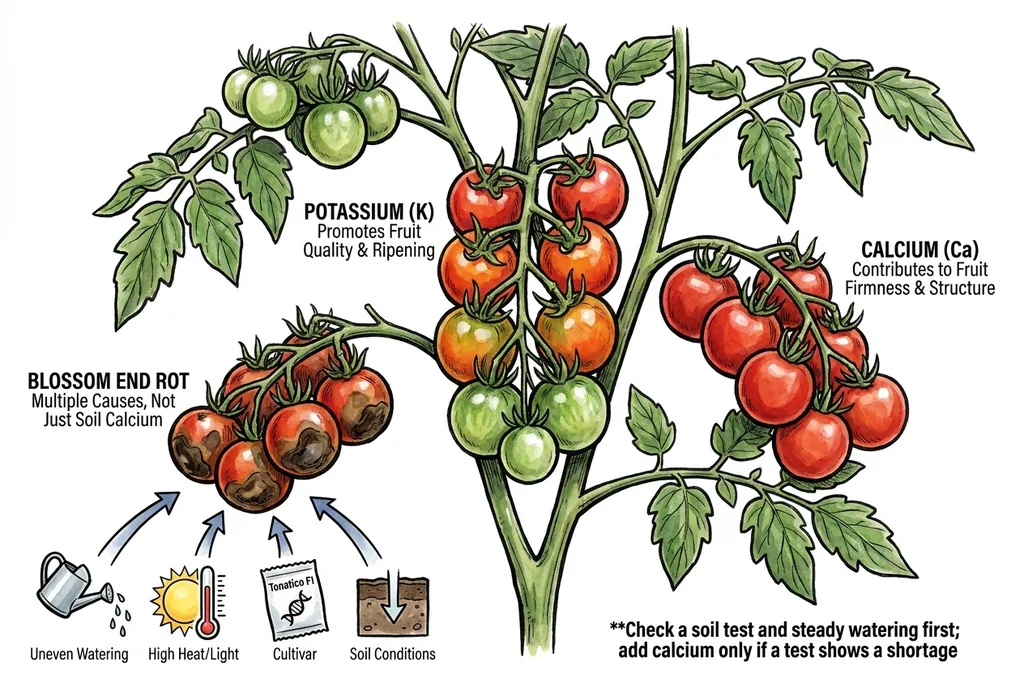
During fruiting, potassium and calcium both play roles in fruit quality. Potassium status is one factor in issues like yellow shoulders and sweetness, and localized calcium shortage in the fruit contributes to blossom end rot, but these disorders have multiple causes (heat, light, cultivar, water) and can’t be pinned on a single nutrient.
If a soil test shows genuinely low calcium, a labeled calcium amendment can help. Skip the molasses drench. There’s no reliable crop evidence that molasses improves tomato sweetness, potassium, or yield, and feeding sugar to soil microbes can create pest, odor, and produce-safety concerns.
Kelp/seaweed products are biostimulants and minor potassium/trace-mineral sources, not complete fertilizers, and check the current product label, since some are not cleared for use on food crops.
Blossom end rot deserves special note. It is often a calcium-transport issue rather than a soil shortage.
Calcium moves with water in the xylem, so erratic watering, root damage, excess salts or nitrogen, or rapid growth can all trigger it.
Before adding calcium, check soil test results, irrigation uniformity, drainage, and root health. Soil calcium is frequently adequate, though not always.
Uptake and Transport of Calcium and the Possible Causes of Blossom-end Rot in Tomato
Ongoing Care for water, heat, and weather
Keep water and heat stable
Growing Tonatico means responding to the plant’s signals and the weather.
Watering
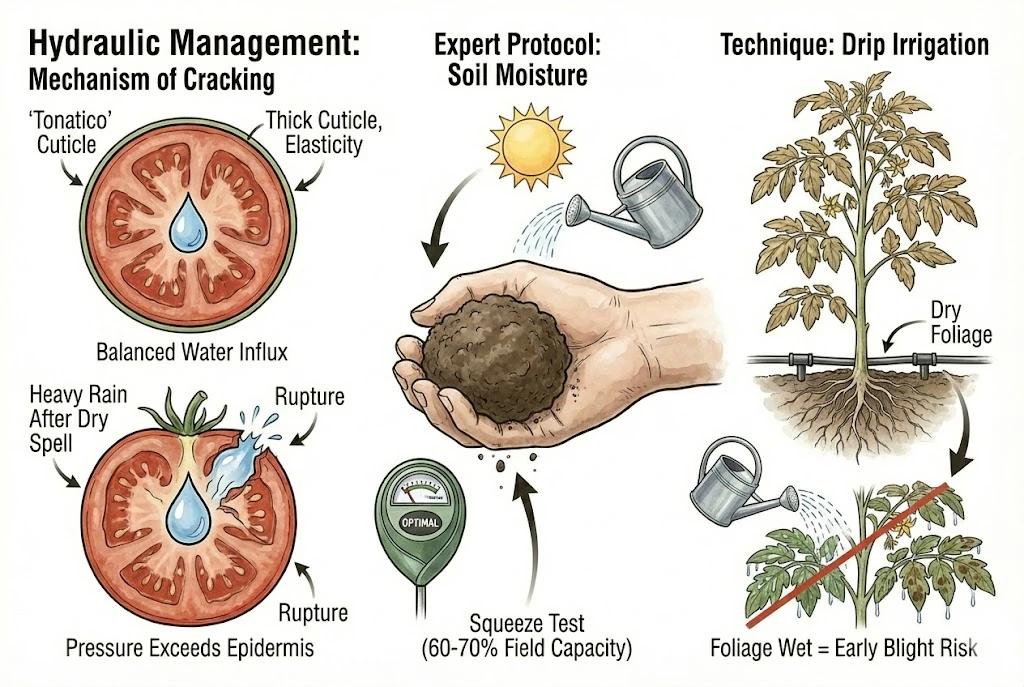
Water transports nutrients and maintains turgor. Tonatico is crack-resistant, not crack-proof. Cracking is associated with rapid fruit growth and a sudden influx of water, classically when heavy rain or watering follows a dry spell, along with cultivar susceptibility and fruit maturity.
The best defense is steadiness. Rather than a hard-to-verify 60–70% of capacity number, check the root zone with a trowel and water deeply and regularly so the soil stays evenly moist but not saturated. Mulch helps buffer swings.
Watering in the morning and using drip irrigation keep foliage drier, which is one useful way to reduce fungal diseases like early blight, which Tonatico is not fully resistant to, alongside crop rotation, sanitation, spacing, clean tools, and scouting.
I place matching catch cups under the first, middle, and last emitter for one complete scheduled cycle, recording its start time, stop time, and line pressure. Their collected volumes are compared before I blame the cultivar for uneven growth. A narrow trowel check beside those same plants shows how far the water moved below the surface.
If the cups differ, I fix pressure, clogging, or line length before changing fertilizer. If the cups match but the soil checks do not, I look for texture, compaction, or root differences. This separates delivery problems from what happens after water enters the bed.
Pruning and Support
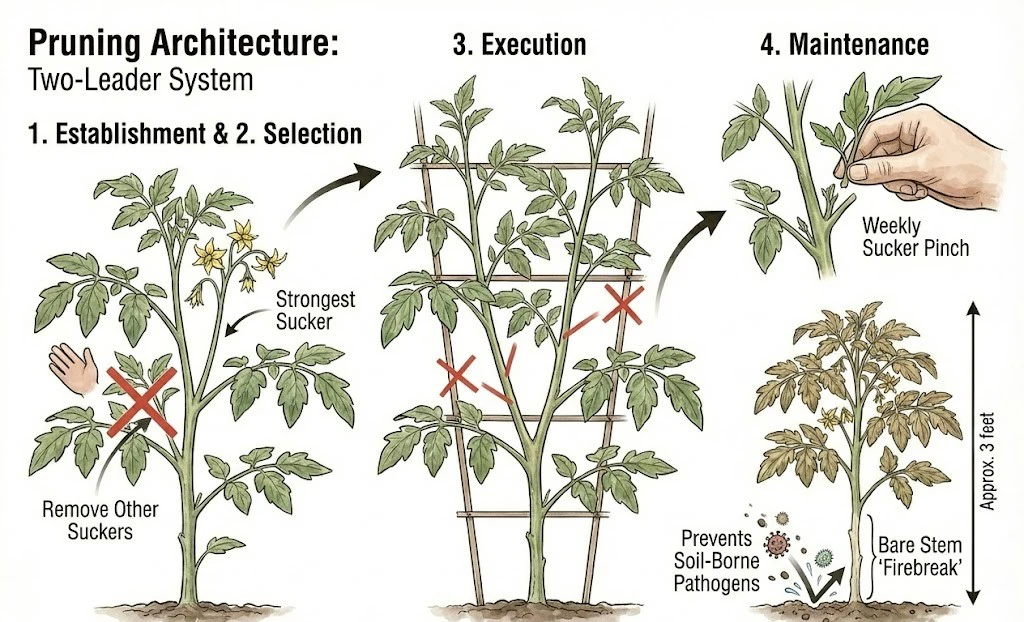
Left unpruned, this vigorous vine grows dense, which can lower airflow. Training is optional and involves trade-offs. Little pruning tends to give more, smaller fruit, while moderate pruning can give fewer, larger fruit, and the best choice varies with cultivar and fertility.
A two-leader system is one workable approach. Keep the main stem plus the strong sucker (axillary shoot) just below the first flower cluster as a second leader, and remove other suckers periodically.
It’s worth trying a small comparison rather than assuming one method is optimal for Tonatico. Prune when plants are dry to reduce disease spread.
Removing the lowest foliage as the plant grows taller can reduce soil splash onto leaves and improve airflow.
It lowers risk but does not stop disease, so remove leaves gradually while keeping enough healthy leaf area and watching for exposed-fruit sunscald.
Indeterminate tomatoes carry a heavy load, so use strong support. The Florida weave (stakes every 2–3 plants with twine woven to sandwich them) suits rows, while heavy-duty 5-foot concrete-reinforcing-wire cages suit single plants.
Match stake spacing, height, and anchoring to your plant spacing and site.
Flimsy conical hardware-store cages are generally too weak for a vigorous indeterminate tomato and can bend or topple under the load.
Disease Resistance and Diagnosis
Treat resistance as a watch list
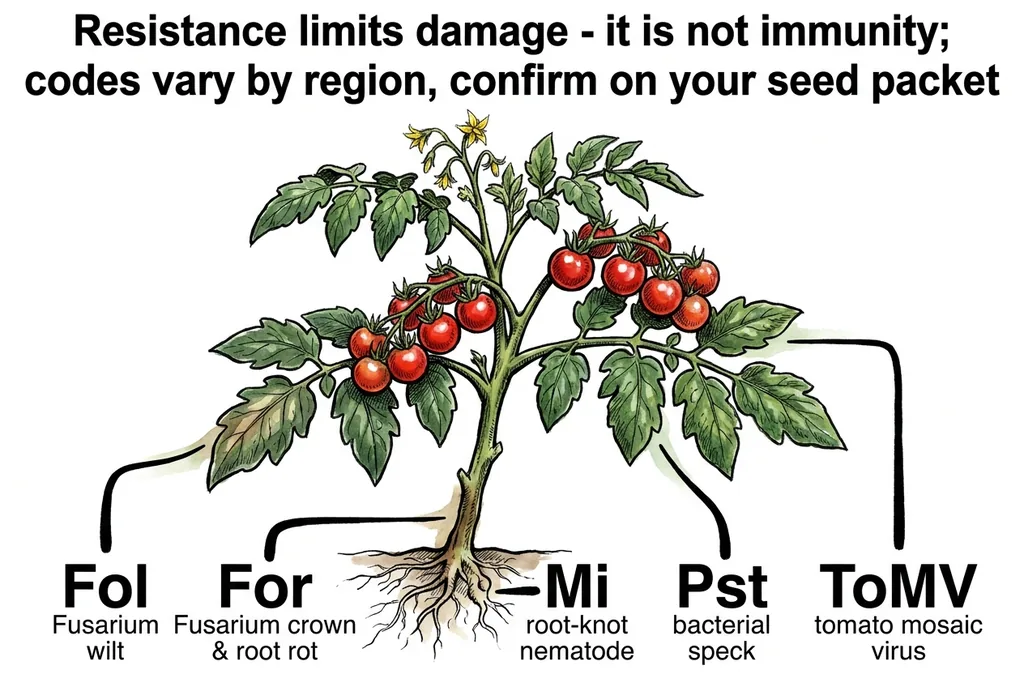
Correct identification matters as much as prevention. Tonatico is commonly listed with a resistance package, often written as Fol, For, Mi, Pst, ToMV, but Bejo lists different codes by region, so check the codes on your actual seed packet.
Importantly, resistance limits how much a pathogen grows and damages the plant compared with a susceptible variety. It is not immunity.
Under high disease pressure, new strains, or stressful conditions, a resistant plant can still show symptoms.
Working With Genetic Resistance
| Resistance Code | Pathogen | Plain-Language Explanation | What to Keep in Mind |
|---|---|---|---|
| Fol | Fusarium oxysporum f.sp. Lycopersici | Soil fungus that clogs water tubes (xylem), causing wilt. | Codes may cover one or more races. Note that EU/ISF numbering (Fol. 0,1,2) corresponds to US races 1,2,3, so confirm which your packet lists. Wilt has other causes too, including Verticillium and drainage problems. |
| For | Fusarium Crown & Root Rot | Rotting of the stem at the soil line, common in cool soils. | Resistance reduces risk but stem rot can still occur. Physical damage and other pathogens (such as Sclerotinia/white mold) look similar. |
| Mi | Meloidogyne incognita | Root-Knot Nematodes. Microscopic worms causing root galls. | Mi resistance can weaken in warm soil (above roughly 85 °F / 28 °C), and some nematode populations overcome it. Galls warrant a closer look, not a fixed conclusion. |
| Pst | Pseudomonas syringae pv. Tomato | Bacterial Speck. Tiny black specks with yellow halos. | Speck, bacterial spot (Xanthomonas), and Septoria overlap visually and often need lab confirmation to tell apart. |
| ToMV | Tomato Mosaic Virus | Viral infection causing mottled leaves and stunting. | Mottling can also come from other viruses (such as CMV) or herbicide drift. Diagnosis may need testing. |
These codes correspond to Fusarium wilt (Fol), Fusarium crown and root rot (For), root-knot nematode (Mi), bacterial speck (Pst), and tomato mosaic virus (ToMV).
Because resistance isn’t immunity, symptoms resembling these diseases are still possible. Don’t rule them out by variety alone.
The variety also has no listed resistance to early blight, late blight, Septoria leaf spot, or bacterial wilt (Ralstonia), so those, along with insects, other viruses, and disorders, are worth watching, with airflow, sanitation, and dry foliage as sensible practices.
When in doubt, use an Extension decision aid or a plant diagnostic lab.
Use Home Checks Only as Clues
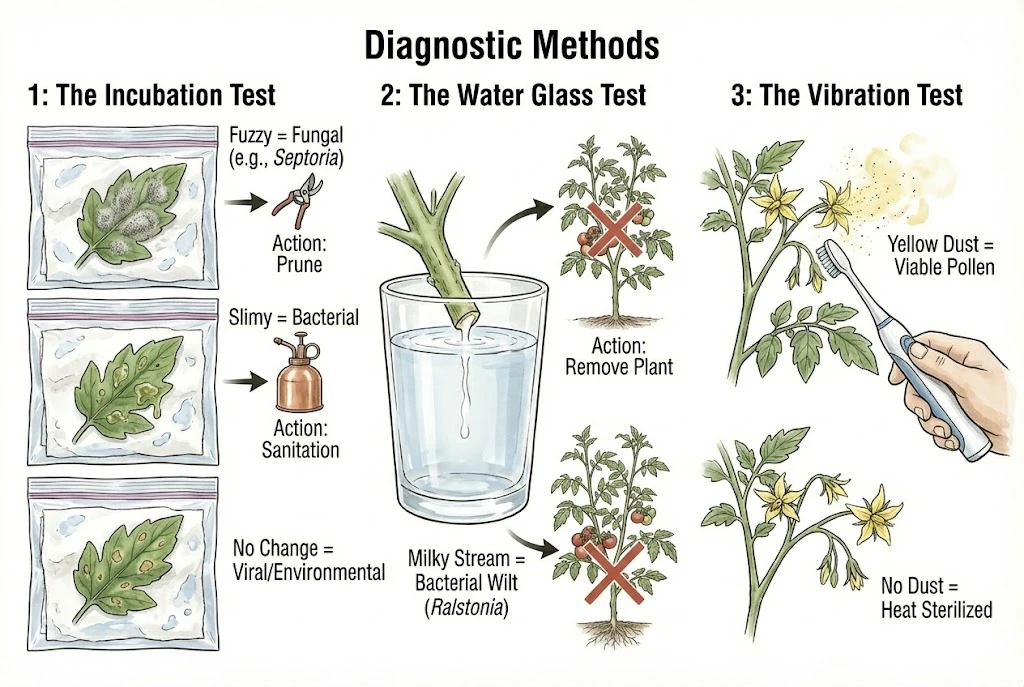
Use home checks to decide whether to isolate a plant or ask for help, not to name a disease. A cut lower stem that releases a milky stream in clear water can point to bacterial wilt. Isolate that plant, sanitize tools, and confirm the diagnosis with Extension or a diagnostic lab before disposing of it under local guidance.
A damp-bag test can grow unrelated organisms and cannot distinguish fungal, bacterial, viral, or environmental problems. Vibrating flowers can aid pollination, but it does not show whether pollen is viable. Judge poor fruit set alongside recent heat, humidity, flower age, and water or nutrient stress.
Environmental Stress Management
Buffer weather before it becomes damage
Even a resistant hybrid contends with weather, so plan ahead. In sustained heat, shade cloth (commonly 20–50% depending on region and setup) during the hottest part of the day can ease stress, and 3–4 inches of mulch helps keep the root zone cooler and reduce evaporation. Watch that mulch doesn’t pack against the stem.
Note that red-pigment (lycopene) formation can slow when fruit temperatures reach roughly 85–86 °F and tends to recover in cooler periods, which is a different process from the higher temperatures that impair pollen and fruit set.
Heavy rain can reduce root-zone oxygen and contribute to cracking, though not every vine fruit will split.
Ensure good drainage (clear drainage holes, remove standing saucers, and use a porous mix rather than relying on pot feet alone).
If a big storm is forecast, harvesting mature fruit at the breaker stage (first blush of color) to finish ripening indoors is a reasonable precaution.
Harvest and Store for Flavor
Harvest by fruit stage
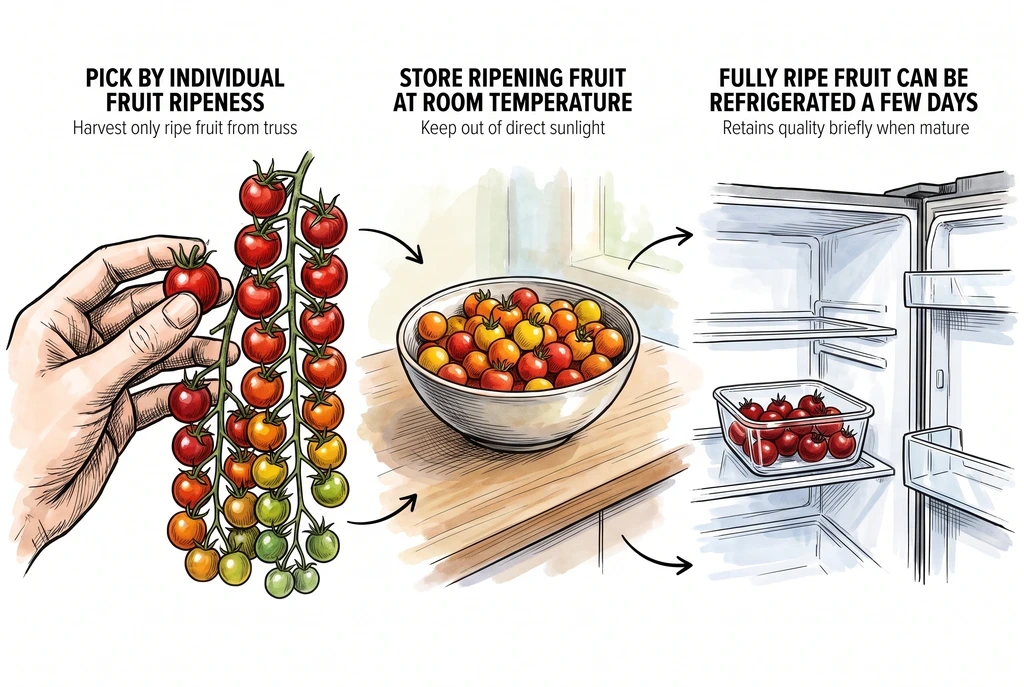
Tonatico is early-maturing (about 60 days from transplant) with long, easy-to-harvest trusses.
Harvest by individual fruit color and ripeness rather than clipping a whole cluster on a percentage rule.
From the breaker stage onward, a picked fruit ripens on its own using its internal ethylene and stored compounds (not energy drawn from the truss stem) so any less-ripe fruit you pick will continue to color up off the vine.
For best flavor, store ripening tomatoes at room temperature (about 65–70 °F) out of direct sun.
Refrigeration isn’t forbidden. Prolonged cold can cause chilling injury and dull flavor, but UC guidance gives maturity-based storage temperatures, roughly 55–60 °F for mature-green, 50–55 °F for light-red, and 44–50 °F for firm-ripe fruit for a few days, and fully ripe tomatoes you can’t eat right away can be refrigerated for a few days, ideally brought back to room temperature before eating.
Guidance on stem orientation isn’t settled. Current UC consumer advice actually suggests storing with the stem scar facing up.
More important are gentle handling, some airflow, and eating the fruit within a few days.
Steady Routine Rewards This Cherry Tomato
Keep the routine consistent
Tonatico F1 is a capable home-garden cherry tomato. Its resistance package (commonly listed as Fol, For, Mi, Pst, ToMV. Check your packet) reduces the risk of several common diseases, while its indeterminate habit and sweet flavor can give a long harvest.
Match feeding to a soil test, keep root-zone moisture steady, and identify disease before treating it.
Results depend on your climate, soil, and routine, so treat numerical ranges as starting points rather than guarantees.