
Begonia Melting: Reducing the Risk of Rot and Collapse
Why rare begonias melt into slime. A practical look at the several conditions that can cause it (bacterial leaf spot, soft rot, Botrytis, root rot, edema, cold and shipping damage) and the airflow, humidity, and substrate habits that lower the risk.
Elena Vargas · Published 2025-12-20 · 15 min read

Key Takeaways
- Melting is a hobbyist description of tissue that turns soft and slimy, not a single disease. Several unrelated problems produce that look, so identify the cause before you treat.
- Long-lasting leaf wetness raises the risk of several problems, so reducing splash and standing water on foliage is one of the best-supported habits. High humidity, condensation, and crowding also matter, so ventilation and spacing help too.
- Gentle air movement helps dry leaf surfaces and even out humidity. A small fan run at low speed is a reasonable tool, but no single humidity or VPD number fits every species and setup.
- An airy, fast-draining substrate keeps oxygen at the roots and lowers the risk of root and stem rot. No specific recipe or ingredient guarantees prevention because physical behavior depends on particle size, ratio, container, and watering.
- When tissue is clearly rotten and mushy, remove it with a sterilized blade, quarantine the plant, and keep foliage dry. Use root and crown firmness, moisture, lesion pattern, odor, and spread to decide whether the plant can be saved.
You buy a rare jewel begonia, keep it at very high humidity, and wake up to a pile of brown slime. That’s what hobbyists call begonia melt.
Melt is a description, not a diagnosis. The same soft, slimy collapse can come from bacterial leaf spot, bacterial soft rot, Botrytis, root rot, edema, or simple cold and shipping damage.
Check the roots and crown, how wet the medium is, whether lesions are spreading, and whether the tissue smells before choosing a response.
Heavy misting plus stagnant, saturated air can set the stage for several problems, but so can under-care and physical damage.
What’s Going On and Why
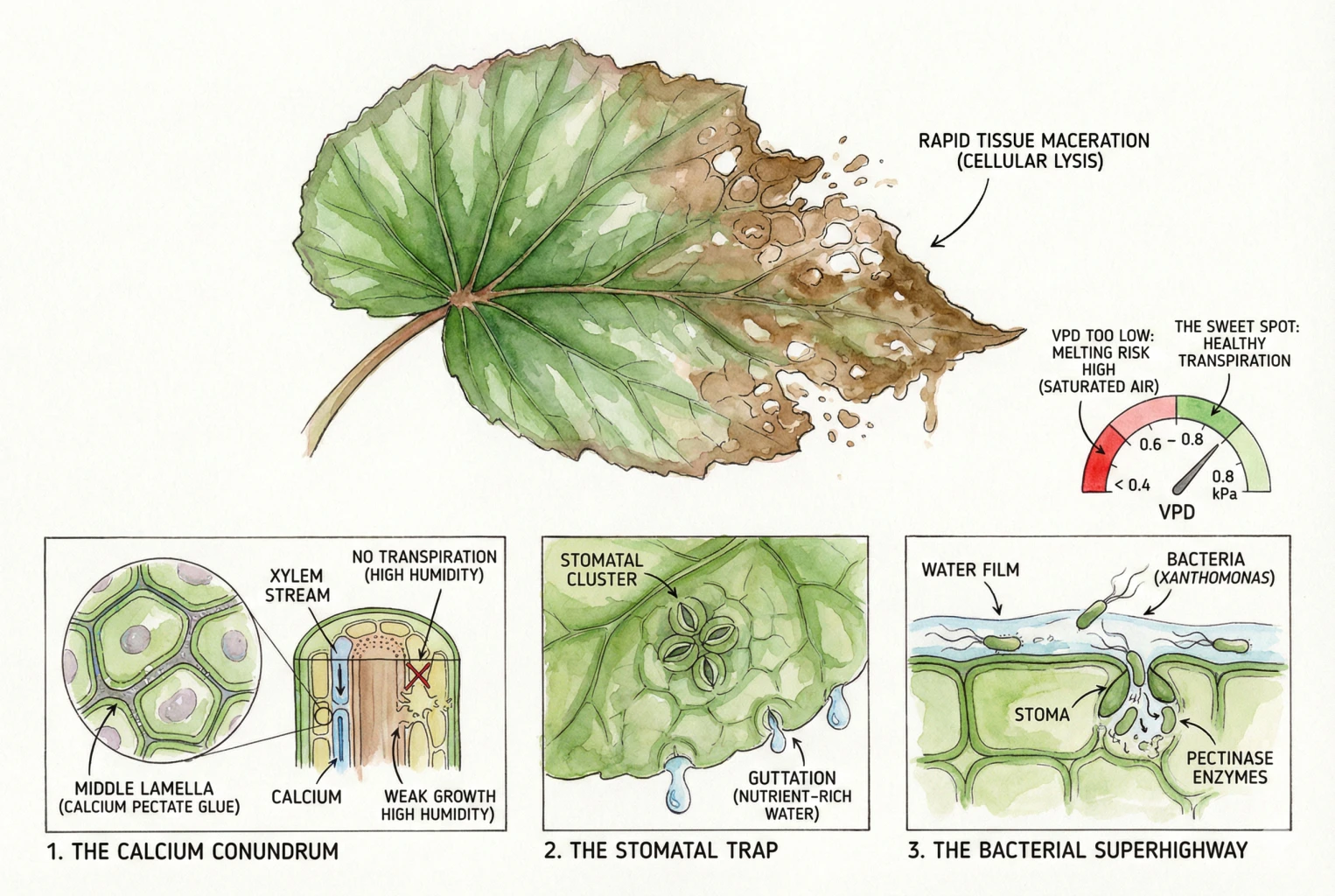
Melting isn’t a textbook term. It describes an appearance, tissue that goes soft, water-soaked, and slimy, which can result from tissue maceration and cell breakdown.
Maceration is one possible process, but the word covers several different causes rather than one specific event.
Normal aging usually turns a leaf yellow and dry rather than soft and slimy. Calcium supply, humidity, leaf wetness, and bacteria are separate factors that can contribute to damage. Do not treat them as one guaranteed chain of cause and effect.
At the first translucent patch, I photograph the petiole base, rhizome or crown, and both leaf surfaces. Begonia collapse can race through tissue, and a later photo of slime loses the starting point.
After isolating the plant, I mark the edge without repeatedly touching it. If new damage begins at a wet crown while the original leaf edge stops, I correct water placement rather than treating every translucent area as the same event.
1. Support New Growth Without Overdiagnosing Calcium
Calcium helps new plant tissue keep its structure. It is one part of the picture, not an explanation for every collapsing begonia leaf.
Calcium mobility in new growth
Calcium has low mobility in the phloem. Unlike nitrogen, phosphorus, and potassium, it isn’t readily pulled from old leaves and resent to new ones, so young, expanding tissue can be vulnerable if supply is limited.
New leaves depend heavily on water moving from the roots, so persistently saturated, still air can make their conditions less favorable over time. It does not stop calcium delivery completely, and it does not prove that calcium deficiency caused a melt.
Keep the roots healthy, avoid waterlogged medium, and give humid plants gentle air movement. That supports new growth without treating calcium as a cure for an active rot.
Calcium in Plants
2. Keep Leaves From Staying Wet
Near-saturated air can leave droplets on leaf margins and slow drying after misting or condensation. That prolonged wetness, rather than a specific stomatal pattern, is the practical concern because it gives disease organisms a route to spread.
3. Bacteria on Wet Leaves (Xanthomonas)
One cause of spreading, water-soaked collapse is begonia bacterial leaf spot caused by Xanthomonas. It needs a film of water to spread, so wet foliage from misting or condensation is a real risk.
Bacterial soft rot, Botrytis, and root rot can look similar but need different responses. Treat bacterial leaf spot as one possibility, not the automatic diagnosis for every soft, slimy leaf.
Extension pathologists are consistent on control. Bacterial leaf spot spreads by splashing water and wet foliage, so minimizing leaf wetness, avoiding overhead water, reducing crowding, and practicing sanitation are the key defenses.
They also advise discarding severely or systemically infected plants.
Bacterial Leaf Spot of Begonia. MSU Extension
Balance Humidity With Airflow
High humidity can help sensitive begonias avoid drying out, but still, saturated air keeps leaves wet and raises disease risk. There is no single humidity target for every species.
Give the plant enough humidity to prevent dry edges, then add gentle airflow so foliage and the growing medium do not stay wet. Adjust from the plant’s response rather than trying to hold a calculated VPD number.
Build a Stable Growing Setup
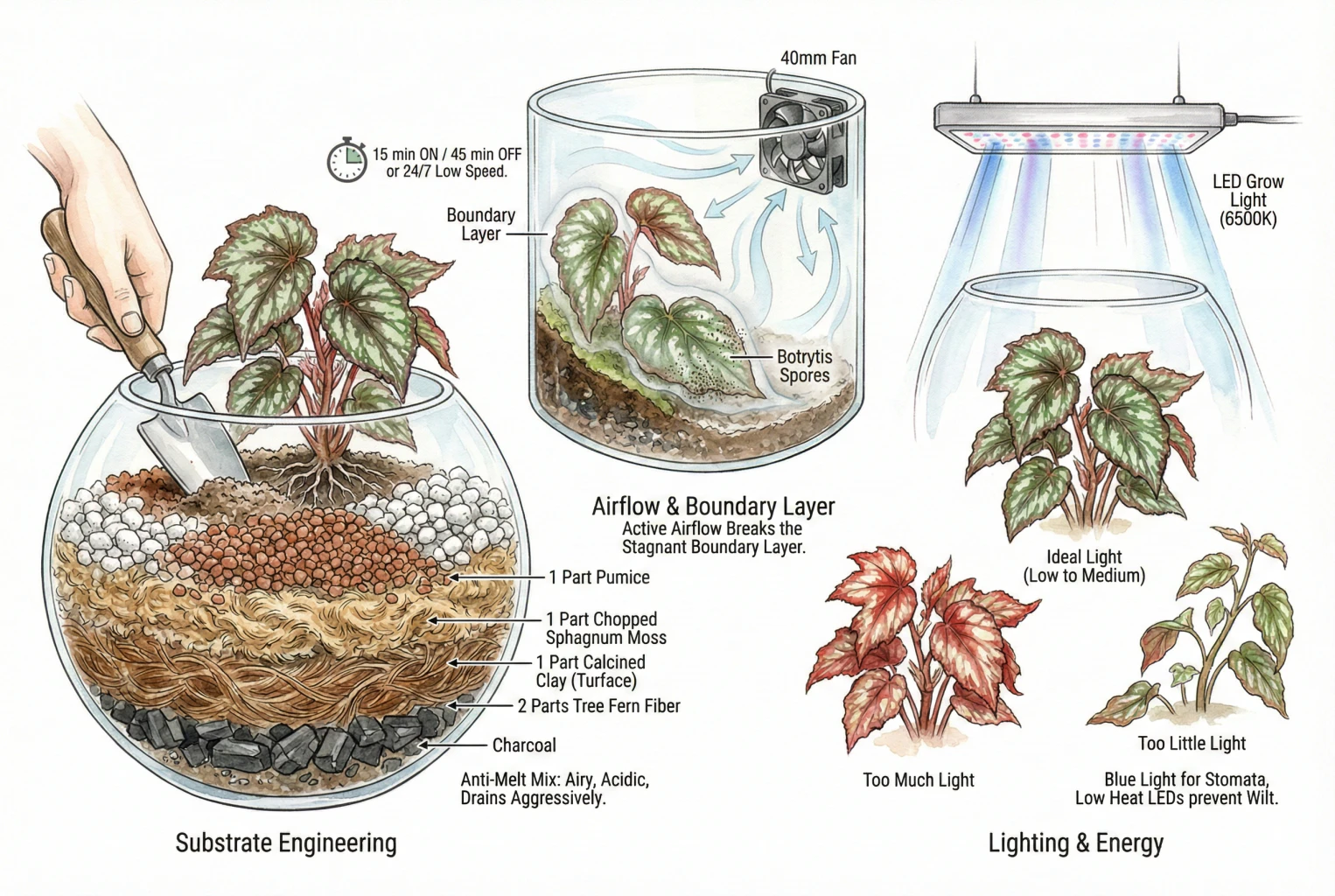
Rather than dropping a sensitive begonia straight into a jar, it helps to set up an environment that balances humidity with airflow.
1. Substrate (Keep It Open and Draining)
Dense, water-retentive potting soil is a poor choice. It can stay saturated and low in oxygen, which favors root and stem rots such as Pythium.
An airy, slightly acidic, fast-draining mix keeps more oxygen at the roots. A workable starting blend is roughly 2 parts tree fern fiber (fibrous, slow to break down, good airflow), 1 part chopped New Zealand sphagnum, 1 part calcined clay, 1 part pumice or perlite, and 1 part horticultural charcoal.
Treat the ratio as a starting point, not a proven anti-melt formula. How a mix actually drains and holds water depends on particle size, packing, container height, and how you water, so no ingredient list guarantees prevention.
Blend the materials together. Don’t stack them in layers, since a boundary between coarse and fine material can slow drainage and shift where water sits.
Longer-fiber New Zealand sphagnum tends to hold its structure longer than short, degraded moss, though how long depends on how it’s used, and no moss is sterile.
NZ sphagnum moss
NZ sphagnum moss suits a mix that needs long fibers for moisture retention without packing as quickly as short, degraded moss. It is not a stand-alone anti-rot material, so blend it with other open components and adjust watering to the pot and enclosure.
NZ sphagnum tradeoff
Premium long-fiber moss costs more than big-box moss and generally resists compaction longer, but choosing it is about physical structure and drainage, not a guarantee against disease.
Cheaper, shorter moss can compact faster. Evaluate any moss by particle size, rinsing, and how you water rather than by brand alone.
Calcined clay such as Turface keeps the mix open and adds moisture buffering. It is a hard-fired sports-field conditioner that holds some water and nutrients. It does not, by itself, eliminate a perched water table or guarantee a dry mix.
Turface MVP
Turface MVP fits a blend that needs a durable, moisture-buffering mineral component. It is not a drainage layer or a cure for overwatering, and its weight may be unnecessary when a lighter mix already stays open.
Turface tradeoff
Calcined clay adds weight and cost versus straight perlite, but it buffers moisture and nutrients while helping keep structure open.
Turface MVP is marketed as an athletic-field conditioner, so treat it as a structural component in a blend, not as a layer or a validated begonia-specific product.
2. Airflow (Break the Boundary Layer)
Still, saturated air lets a humid boundary layer build up against the leaf. Passive ventilation (mesh tops, vents) helps in some designs but may not be enough in a tall or tightly sealed enclosure, so gentle active air movement is often worthwhile.
A small fan mounted near the top and aimed across the glass can move air without blasting the leaves. Start at low speed, watch for dry edges or condensation, and adjust to the enclosure and species rather than following one timer setting.
AC Infinity Multifan S7
AC Infinity Multifan S7 can suit a ventilated cabinet where you need gentle, adjustable air movement rather than a strong breeze on the leaves. It is not rated for direct wetting or a sealed enclosure with persistent condensation, so keep the fan and power supply outside the wet zone.
Fan humidity caveat
Its official operating-humidity range is about 35–85% RH. It is not rated waterproof or for condensing vivarium conditions, so it is not a good match for a sealed enclosure held at 90–100% RH.
If you run any mains- or USB-powered fan near a humid enclosure, treat electrical safety as essential. Keep the fan and power supply out of direct wetting and condensation, use a GFCI outlet, and leave a drip loop in the cable.
For a continuously very humid setup, look for a fan the manufacturer actually rates for that humidity.
3. Lighting
Begonias are shade plants, but tropical shade is still reasonably bright, and they need light to grow well.
A full-spectrum LED is a fine choice. Color temperature (for example ~6500 K) describes the light’s appearance, not how much usable light reaches the plant.
What matters more is intensity and duration at leaf level, PPFD, daily light integral, mounting distance, and photoperiod, so set the light by how the plant responds. Bleached or crispy leaves mean too much, stretched, weak growth means too little.
LEDs generally give off less radiant heat than incandescent bulbs, which helps keep leaf temperature and VPD in check, but they still produce heat and are not IR-free. Check the temperature near the leaves.
Recovery and Diagnosis
1. The Lidded-Box Method for New Plants
The video above is one hobbyist’s terrarium tour and personal care routine, shared as an example rather than a controlled test. Results vary by plant and setup, as the creator notes.
A mail-ordered begonia arrives stressed, often with damaged roots and time spent in a dark box, and moving it straight into a bright, breezy tank can shock it.
A gentler recovery approach
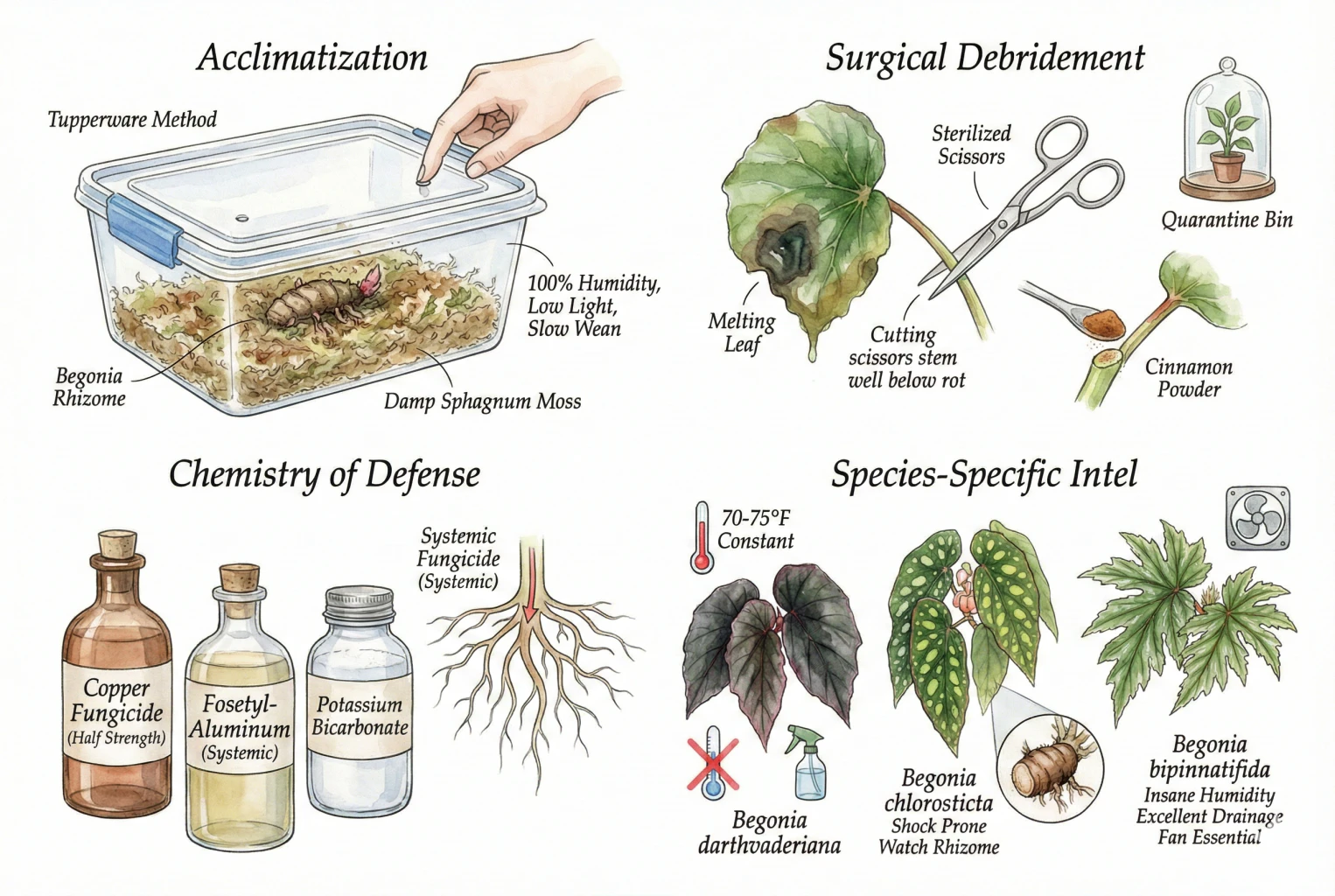
Inspect and trim any obviously rotten roots, rest the rhizome (don’t bury it deep) on damp, not soggy, sphagnum in a clear lidded bin, and keep it in low light and high humidity while it recovers.
A short, fully sealed period can hold humidity while roots re-establish, but it works differently from a plant’s long-term home. A sealed box also encourages fungal growth, so check every day or two for mold or rot rather than leaving it untouched for a fixed two weeks.
Then vent it gradually, for example open the lid a little more every few days, so it adjusts to lower humidity before you move it out.
There is no proven universal timetable. Go by how the plant looks, and be more cautious with rot-prone species.
2. Removing Damaged Tissue
When tissue is clearly rotting, soft, mushy, or slimy, spreading rather than static, it will not recover, and removing it promptly can slow the spread.
But not every water-soaked spot is the same problem, so first look at the whole plant (root and crown firmness, how far lesions extend, any foul smell).
If the rot is systemic or the crown is affected, the plant may need to be discarded rather than trimmed.
To trim, sterilize your blade with alcohol, cut back to firm, healthy tissue (disinfect between cuts), bag and discard the removed material, and quarantine the plant so splashing water can’t carry bacteria to the rest of your collection.
Household cinnamon or sulfur powder is sometimes used on cuts, but neither is a sterilant or a proven treatment for begonia bacterial disease. If you use sulfur, follow its label, keep it away from oils and high heat, and avoid skin and respiratory exposure.
3. Pesticides (Only With a Diagnosis and the Label)
Cultural controls, airflow, dry foliage, sanitation, removing rotten tissue, come first, and they resolve most problems.
Reach for a pesticide only after you have identified the actual disease, because different products target different things and none is a general melt cure.
Copper products are preventive bactericides/fungicides that can suppress some bacterial and fungal diseases but do not cure an established, systemic infection, and several begonias are prone to copper injury.
Fosetyl-aluminum targets oomycetes such as Pythium and does nothing for a bacterial disease like Xanthomonas.
Potassium bicarbonate is for powdery mildew, not for soft rot or leaf spot.
Follow the product label exactly. The label is the legal instruction set. It lists the crops and sites it is registered for, the target pests, the correct concentration, PPE, and re-entry intervals, and registrations differ by region.
Don’t invent an off-label rate. Mixing a pesticide at an arbitrary reduced strength contradicts following the label, and if a product isn’t labeled for your plant and problem, it shouldn’t be used.
When in doubt, get the disease identified (for example through a local extension or diagnostic service) before treating.
4. Notes on a Few Species
These are general hobbyist observations rather than measured comparisons between species. Begonia darthvaderiana is often described as sensitive to leaf wetness and temperature swings, and many growers keep it stable at roughly 70 to 75 °F. Begonia chlorosticta often slumps after shipping but can recover if the rhizome stays firm. Watch the rhizome rather than reacting to a few dropped leaves.
Begonia bipinnatifida (fern leaf) is generally grown warm and very humid with good drainage. Horticultural sources describe it as liking high humidity and a moist but well-drained medium, with occasional misting, so it isn’t a species to keep bone-dry.
As with any begonia, gentle air movement helps, but the claim that it needs a fan more than other begonias is anecdotal.
Why Gentle Airflow Matters
In a still enclosure, humid air and droplets can remain against the leaf. A little air movement helps leaves dry after misting or condensation without turning the enclosure into a dry draft.
Choose Light by Plant Response
Color temperature does not tell you whether a light is right for a begonia. A daylight-white or dedicated grow light can work when the intensity is appropriate. Judge it by healthy, compact growth rather than the color of the bulb.
7. Melt vs. Wilt and Why More Water Can Backfire
Wilting (limp, drooping leaves with flexible, not mushy, stems) and melting (soft, mushy, slimy tissue) can look similar but need different responses, and a plant can have more than one problem at once.
Don’t rely on a simple water-it-and-see test. root rot also causes wilting, and adding water then makes it worse.
Equally, cutting off all substrate water because leaves look bad can dehydrate a healthy root system.
Instead, check several things before acting. How firm the roots and crown feel, how wet the substrate actually is, where lesions are and whether they’re spreading, any foul smell, and the plant’s overall state.
Dry substrate with firm roots points toward simple wilting from dryness. Soft, foul-smelling roots point toward root rot (don’t add water). Spreading, water-soaked, slimy lesions point toward an active rot or leaf spot (remove affected tissue, keep foliage dry, quarantine).
When it’s unclear, a local extension or plant-diagnostic service can identify the cause.
8. Growth Habit and Water
Leaves that lie flat against wet substrate, in the stillest part of an enclosure, stay wet longer and get less air movement, which can raise disease risk, so a creeping plant sometimes does better trained up a piece of wood into moving air.
(This is about airflow and leaf wetness, not botanical section. Don’t read it as a rule tied to a particular begonia group.)
On pH, be cautious about the idea that acidity acts as a barrier against bacteria. There isn’t good evidence that a substrate pH of about 5.5–6.0 blocks Xanthomonas. In fact, transmission experiments have produced disease in potting mix adjusted to that range.
A slightly acidic mix is normal for sphagnum- and tree-fern-based media and is fine for the plants, but treat it as suitable growing conditions, not disease control.
For watering, what matters most for pH drift is the water’s alkalinity, not just its pH reading, and tap water varies widely by location. Rainwater isn’t automatically clean or a fixed pH either.
Reverse-osmosis or rainwater can lower mineral content, but whether to add a cal-mag or other supplement depends on your actual water and fertilizer. Test rather than assume, since blindly adding cal-mag to already-hard water can create its own imbalances.
Prevent Melt With Airflow and Dry Foliage
Begonia melt isn’t a single curse to defeat. It’s a label for soft, slimy collapse that can come from several different problems.
Most of them share a few sensible habits. Keep foliage from staying wet (go easy on misting), give steady gentle air movement, use an airy, fast-draining substrate to protect the roots, and watch closely so you catch trouble early.
A little consistent care with humidity and light supports healthy new growth.
When something does go wrong, slow down and identify the cause before treating. Check roots, crown, moisture, lesions, and smell, remove clearly rotten tissue, quarantine, and reach for pesticides only with a diagnosis and the product label.
When you’re unsure, a local extension or diagnostic service is worth the effort.
Gradually acclimating a plant to a bit less humidity and a bit more light and airflow can make it sturdier over time, but hardening doesn’t make a plant immune (infection still depends on moisture, wounds, sanitation, and the specific pathogen).
Aim for a stable, well-ventilated setup and steady observation rather than a sealed, static box.
Affiliate Disclosure
This article contains Amazon affiliate links. As an Amazon Associate I earn from qualifying purchases. If you use these links, the site may earn a commission at no extra cost to you. Product availability, price, and specifications can change. Check the current listing before buying.