
Rhizomatous Begonia Trellis: A Guide to Vertical Culture
How to trellis root-climbing, trailing-scandent begonias: how they climb, choosing documented species, cedar-plank and moss-pole mounting methods, and troubleshooting.
Elena Vargas · Published 2025-12-13 · 14 min read
Key Takeaways
- The begonias worth mounting are root-climbing, trailing-scandent species. Several, notably B. convolvulacea and B. glabra, climb tree trunks in habitat, so a trellis lets them express that habit indoors. They also grow well trailing from a hanging basket, so vertical mounting is a choice, not a requirement.
- Begonias do not twine, they climb by adventitious roots that emerge along the stem. Contact and a moisture-retentive surface help these roots establish, but a bare surface is not automatically fatal. B. convolvulacea has been photographed climbing bare metal pipes at the Montreal Botanical Garden.
- Choose documented root-climbers such as B. glabra and B. convolvulacea. Heavy, mounding creepers like many B. rex and Rex Cultorum hybrids are not built to scale a support.
- Two mounting options cover most situations. Use a cedar plank for shinglers in a terrarium or a sphagnum moss pole for bigger plants and drier rooms. Secure the stem gently over the internodes, never through it, with a tie that will not cut in, and keep the moss damp but never waterlogged.
- Keep humidity in a plant-appropriate range with good airflow. Water the mount at its base rather than misting foliar fertilizer, which can burn leaves and spread leaf disease.
Begonias are often reduced to colorful bedding annuals, but a subset of trailing and scandent species are genuine root-climbers. In habitat they attach to tree trunks and ascend toward light.
The American Begonia Society treats rhizomatous for ground-hugging stems and trailing-scandent for trailing or trunk-climbing stems as separate horticultural groups. The species that actually mount well fall in the latter. Rhizomatous here is a loose popular label, not a precise claim that these are ABS rhizomatous types.
Mounting one of these climbers lets it express a habit it cannot show flat in a pot. It is not the only good way to grow them. Several species also cascade well from a hanging basket.
Choose a documented root-climber, match the mount to its size and your room humidity, and secure the stem without compressing it.
Choose a Stem That Can Root-Climb
How the Climbing Stem Works
To trellis a begonia, drop the assumption that it behaves like a typical vine. These species generally lack twining stems and grasping tendrils. The root-climbers among them ascend by a different mechanism.
I mark each node that touches the trellis and photograph whether roots emerge before tightening any support. A petiole resting on the trellis is not the same as a rhizome node making useful contact.
Loose ties that can be removed without scraping the stem are checked as the rhizome thickens. The trellis should support growth without becoming a hidden constriction.
After wetting the substrate and trellis fully, I test the pot’s stability before training the plant higher. The assembly is heaviest and easiest to topple after watering, not when it is displayed dry.
1.1 The Climbing Stem
The creeping or climbing stem stores carbohydrates and carries the growth points the plant uses to attach.
It’s built of nodes (where petioles and adventitious roots emerge) and internodes (the segments between).
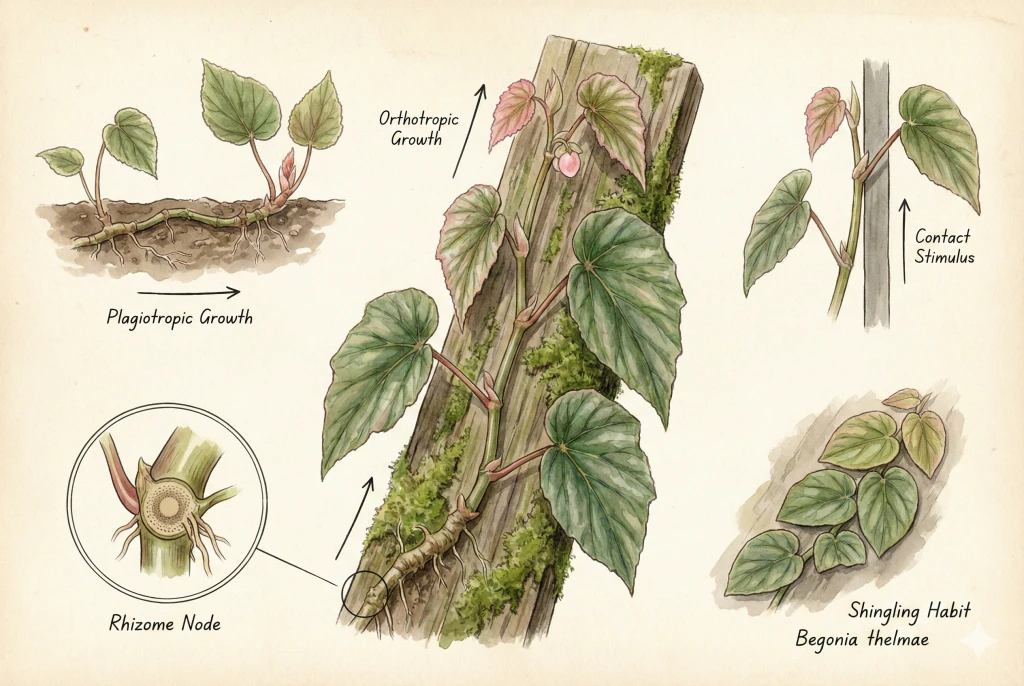
Internode length and stem thickness vary a lot between a rope-like liana such as B. glabra, a small trailing-scandent epiphyte such as B. thelmae, and a true ground rhizome, so it’s worth identifying which kind of stem you actually have before mounting.
Choose Climbing or Trailing Growth
Many rhizomatous begonias grow sideways, which is why cultivars such as Iron Cross circle the pot rim. Root-climbing species can grow upward along a support or trail downward from a basket.
Do not expect contact with a support to switch on climbing. Choose a species that already has the habit you want.
Given a support, a root-climber can attach and climb. Given none, it will trail. Neither outcome is a failure. Trailing over the rim from a basket is a normal, healthy way to grow these plants.
Growth Habits of Begonias – Horticultural Classifications
1.3 The Physiology of Adventitious Rooting
These begonias cannot twine. They climb by pressing adventitious roots that emerge along the stem against the support.
Two things are usually said to help. Firm contact with the surface, and moisture to keep the young roots from drying out.
Both are reasonable general points. Note, though, that the specific idea of pressure-sensing cells synthesizing auxin at the contact point comes from general plant physiology, not from a measurement in these species, so I’m offering it as background rather than a proven begonia mechanism.
A moisture-retentive surface, sphagnum moss, damp cedar, or tree fern fiber, makes it easier for new roots to establish than a dry garden trellis.
That said, a bare surface is not automatically fatal. Martin Tebbitt’s begonia monograph documents B. convolvulacea climbing bare metal pipes at the Montreal Botanical Garden.
Read moisture as an aid to establishment, not an absolute requirement, and match it to the species and your room rather than assuming a dry support will kill the roots.
1.4 The Shingling Mechanism
Shingling (leaves pressed flat and overlapping like roof tiles) is a growth form you can see in some trailing-scandent begonias.
The flat leaves clearly sit against the trunk surface, and it is reasonable to suppose this reduces self-shading and may trap a more humid layer beneath the leaf.
This is a plausible explanation rather than a measured fact. Published light-interception or transpiration data for B. glabra and B. thelmae are not readily available.
The two species also differ in scale. B. glabra is a vigorous, rope-like climber that can reach several metres, while B. thelmae is a small trailing epiphyte, so do not treat them as interchangeable shinglers.
2. Taxonomy and Species Selection
Choose by Growth Habit
Not every begonia is a trellis candidate. Species and hybrids in the B. rex / Rex Cultorum group generally mound or creep across soil rather than scale a support, so they’re a poor fit for a pole. Individual cultivars vary, so this is a general tendency, not a rule for every plant labelled rex.
Success starts with documented trailing-scandent, root-climbing species.
Begonia glabra
Begonia glabra is a vigorous Neotropical root-climber that produces abundant adventitious roots. A rope-like liana that can reach several metres, so give it room.
It’s a reasonable species to start with, though ease depends on your light, space, and how large a plant you begin with.
Begonia convolvulacea
From southeast Brazil, this species is confirmed by both Kew and Tebbitt as a vigorous root-climber. Note that the same authoritative sources also grow it cool and as a hanging or cascading plant, so a sturdy wet pole isn’t the only correct approach.
Begonia thelmae
Begonia thelmae is a small trailing-scandent epiphyte from Brazil (Espírito Santo) whose leaves lie flat on a porous surface. No authoritative source establishes a specific humidity requirement above 60%, so treat sharp thresholds as unverified.
Begonia elaeagnifolia
Begonia elaeagnifolia (a synonym is B. schultzei Engl. ex R.Wilczek) is a West Central African epiphyte with semi-succulent, somewhat drought-tolerant leaves often mounted on cork. I’d present cork success as an option rather than a guarantee.
Begonia mazae and Nigricans
Do not choose B. mazae as a documented moss-pole climber. It is a compact rhizomatous foliage species, and no voucher, photo, or cultivation trial supports using it that way.
The name Nigricans is unreliable here. B. mazae f. Nigricans is listed by Kew as a synonym of B. mazae, so confirm the trade identity separately.
3. Vertical Mounting Methods
Choose the Mount to Fit the Species
Two methods cover most situations. The cedar plank (a good fit for flat-leaved shinglers such as B. thelmae) and the sphagnum moss pole (useful for larger, vigorous rooters such as B. glabra, or for drier rooms).
For either method, long-fiber sphagnum is a common choice. Its loose fibre holds moisture while still letting air through.
The real difference from milled peat is structure and how each behaves over time, not a simple acid-versus-alkaline story. Sphagnum is itself acidic at around pH 4, so excessive acidity is not the reason to skip peat.
Milled peat is finer and packs down, giving less air around aerial roots. Long-fibre sphagnum stays more open. Both eventually break down and need refreshing.
Sphagnum moss sold for reptile and terrarium bedding can work as pole filler, but its origin, horticultural grade, and fibre length often aren’t stated, so you can’t assume it’s the premium New Zealand long-fibre product often recommended for mounting.
If NZ long-fibre grade matters to you, verify the origin before buying, and treat any reptile-bedding moss for cleanliness and salt content before use. It can help to choose a moss pole material by fibre type and water retention.
Method A (The Cedar Plank)
This mimics a tree trunk and suits flat-leaved shinglers. Use a rough-cut cedar or redwood plank, monofilament fishing line, long-fiber sphagnum, and stainless staples.
Avoid unknown reclaimed or treated lumber. If you want to be conservative, untreated wood is the safe default.
Older CCA and creosote-treated timber is genuinely worth avoiding, but modern pressure-treatment types differ, so the claim that copper always equals plant toxicity overstates it.
Soak the plank for several hours so a dry board does not immediately wick moisture from the roots, and dampen the moss.
Skip fertilizer at this stage. Establish the plant on plain, low-mineral water first, since soaking new root initials in fertilizer can cause salt injury.
Spread a thin (~0.5 inch) bed of wrung-out moss down the centre of the board, leaving the wood edges exposed so the leaves can shingle onto them, and tack it with line or staples.
Identify the stem’s underside (where roots emerge) and top (petioles), place it on the moss bed with the growing tip pointing up, and tie it snugly over the internodes with fishing line (never over the petioles, and never tight enough to cut into or girdle the stem).
Check the ties periodically and loosen them as the stem thickens.
The aim is to hold the stem still enough for new roots to grow into the moss. Seat the bottom of the plank in a pot of a fast-draining, moisture-retentive mix so the base roots have a water source while the aerial roots establish. Adjust container depth and particle size to whether the plant is a shallow-rooted trailing type or a heavier stem.
Method B (The Sphagnum Moss Pole)
This suits larger species and lower-humidity rooms. Roll pre-soaked moss inside coated wire mesh (roughly ½-inch mesh works) around a rigid PVC or bamboo core, securing with UV-resistant zip ties.
Keep the moss packed loosely enough to stay open rather than sodden. A permanently saturated core has little oxygen and can encourage rot.
Note that a bamboo core will itself decay over time, and a fully wet pole is heavy, so anchor it well.
Seat the pole to the bottom of the pot before adding soil, then hold the stem against the moss with U-shaped floral pins placed over the internodes so nothing pierces the stem.
You don’t need to force every node into contact. Enough contact to keep the stem steady is the goal.
New aerial roots take time to establish, and you can reduce transpiration stress in the first weeks with a loose enclosure.
Rather than wrapping the wet stem directly in plastic, which traps condensation and heat and invites bacterial or fungal growth, tent the whole plant loosely (a clear bag or box), keep it out of direct sun, and open it daily to vent.
End the enclosure when you see new roots gripping, not after a fixed number of weeks.
4. Advanced Techniques
Once a plant is established, a few techniques can encourage fuller growth. Treat these as options, and match them to the species and how mature the stem is.
Encouraging Branching
An unchecked climber can form a single sparse line of leaves. The lowest-risk way to prompt side shoots is tip pinching or taking stem cuttings rather than wounding the growing plant.
Do not cut a notch into a wet-mounted stem. It creates an open wound on tissue you are trying to protect from rot.
Redirecting a long stem
A flexible trailing shoot can sometimes be curved back down the pole and pinned to fill bare spots.
Do this gradually and only with a genuinely pliable stem. A thick, fleshy rhizome can crack or bruise if you force a sharp bend, so stop if it resists.
Watering the pole
Roots growing into a plank or moss pole don’t reach the potting mix, so the mount itself needs watering, not just the pot.
Water the moss at its base rather than misting fertilizer onto the leaves. Foliar feeding is easy to over-concentrate and burn, and wetting the foliage repeatedly encourages leaf disease.
If you do feed, use a complete, balanced fertilizer at the label rate for active growth, applied to the root zone. Do not treat a urea-free, one-eighth-strength recipe as superior without evidence for it.
Sphagnum can hold salts, so flushing the mount occasionally with plain water helps (just make sure the flush drains away rather than pooling in the pot).
A wick system
Running a cotton or synthetic rope from the moss core down into a reservoir can help keep the pole from drying out between waterings.
It doesn’t guarantee even moisture (that depends on the rope, height, and how the moss is packed), and it shouldn’t be aimed at keeping the core continuously saturated, which risks the low-oxygen conditions that cause rot.
Keep the reservoir covered and clean it regularly so it doesn’t turn stagnant.
5. Substrate Comparison
Match Material to Moisture
Match the mount to the plant and the room. Cedar and cork are durable and natural-looking and suit flat shinglers, but they hold relatively little water, so they work best in a humid terrarium or greenhouse. Cork in particular repels water until it’s soaked well first.
Cedar’s tannins do make it decay-resistant, but that isn’t the same as protecting a plant from disease. Don’t rely on the wood as a fungicide. Sphagnum moss holds water well and is naturally acidic, which suits these begonias. Its slow decay owes something to the moss’s own chemistry, but that doesn’t guarantee it will prevent rot, and it still needs refreshing every year or two. Tree fern panels are rigid like wood yet porous like moss, which many growers like, but they’re expensive and, because some tree-fern taxa fall under CITES controls, you should confirm the species, country of origin, and legal/sustainable sourcing for the specific product before buying.
6. Troubleshooting
Rhizome/stem melt (soft rot)
A mushy, black, foul-smelling stem is serious rot, but smell alone does not identify the cause. Soft rot can involve bacteria or fungi and is often tied to waterlogging or injury.
First isolate the plant, check the mount for excess moisture and poor airflow, and inspect the roots. Cut well back into firm tissue with a sterile blade, reduce watering, and improve airflow so cut surfaces dry.
Do not rely on cinnamon or sulfur powder to treat bacterial soft rot. For a badly or systemically affected plant, discarding it is often safer than trying to save it.
Leaf drop / crisping edges
Yellowing lower leaves and brown crispy margins can come from water stress, but the same symptoms also follow from root rot, salt buildup, too much or too little light, cold or heat, incomplete acclimation, pests, and leaf disease.
Rather than assuming the mount dried out, work through those possibilities. Check root-zone moisture, mount moisture, room humidity and temperature, light, fertilizer/salt levels, and pests before settling on a cause.
If the mount has genuinely dried out, rehydrate it slowly. On humidity, aim for a plant-appropriate range with good airflow rather than a single high number. The general guidance for these trailing-scandent begonias is roughly 40–60%, and note that the EPA recommends keeping indoor humidity at or below 50% to limit mould and dust mites in the home.
A dedicated plant cabinet or terrarium can run more humid than an occupied room, so keep those two targets separate.
A room humidifier with a built-in humidistat and auto mode can hold humidity in a target band without constant attention, and a larger tank means fewer refills.
Ultrasonic units in particular can disperse minerals and microbes into the air, so the EPA advises using distilled or low-mineral water, emptying and drying the tank daily, cleaning it about every third day, and watching for condensation.
Size the unit to the room, and keep the target in a sensible range rather than pushing a whole room to 50–70%. To match a unit to an enclosed space, you can choose a plant-cabinet humidity control kit by cabinet size and target range.
Pair humidity with airflow. Stagnant humid air can invite powdery mildew, which is best managed first with better spacing and circulation. If you use a fungicide, choose one whose label lists begonia and indoor use, and follow its rate and temperature guidance.
Failure to attach
If the plant grows up but never grips the mount, the stem may be moving too much for new roots to catch hold. Firm the tie just enough to stop the stem shifting when brushed, and no more. Over-tightening can girdle or crush a living stem, which is worse than a little movement.
Rhizomatous Begonias. Care
7. Conclusion
What Successful Mounting Looks Like
Growing these root-climbing begonias vertically lets them show a habit they use in the wild, where they attach to trunks and climb toward light.
Your part is to provide a suitable support (a cedar plank or a moss pole) and steady, but not waterlogged, moisture while the adventitious roots establish.
It takes patience. A newly mounted begonia may settle for several weeks before it puts on much new growth.
How quickly it picks up, and how much larger or richer the foliage becomes, depends on the species, the season, light, and the plant’s health, so treat it as a gradual establishment rather than a guaranteed burst.
Start with a well-documented climber such as B. glabra or B. convolvulacea, pick a mount that fits your conditions (cedar for a humid terrarium, a moss pole for a more open room), secure the stem gently, and keep the mount evenly damp.