
Choosing Grow Lights: A Practical Horticultural Lighting Guide
How to choose a grow light by the numbers: PAR/PPFD/DLI explained, full-spectrum vs. red/blue, diodes and drivers, setup, safety, and common myths.
Elena Vargas · Published 2025-12-13 · 12 min read

Key Takeaways
- Judge a grow light by PPFD at the canopy, not by how bright it looks or by headline wattage. Lux and lumens are only rough proxies on a known white source.
- Full-spectrum white is a safe default for many plants because green light can penetrate deeper into a canopy. The best spectrum still depends on species, PPFD, and the growth trait you are optimizing.
- Match Daily Light Integral to the plant and refine it with species, cultivar, photoperiod, temperature, and CO₂. Published ranges are starting bands, not guarantees.
- Compare whole-fixture PPF and PPE, spectrum, uniformity, thermal design, safety listing, and warranty rather than relying on watts or brand names. Named diodes and drivers are useful signals but not proof of a good fixture.
- Start high and dim down to reduce center hotspots, then verify the canopy with a meter or a manufacturer PAR map. A dimmer percentage is not a photon reading, and circuit and eye safety still matter.
Choose by Light at the Canopy
The grow-light market is full of marketing buzzwords and 1000 W equivalent claims on fixtures that pull far less than 1000 watts from the wall.
Buying a light by how bright it looks to your eyes, or by a headline wattage, tells you little about the photon output your plants actually receive.
Choose and set a grow light by the light that reaches the plant canopy, not by apparent brightness or a headline wattage. Check the fixture’s measured output, coverage map, safety listing, and warranty before you buy.
I map the highest, lowest, center, and edge leaves at their actual heights after the fixture warms up. A single reading on an empty shelf describes the lamp, not the canopy that will intercept it.
Both low and high points stay in the map while I adjust plant placement before increasing power. Distribution fixes often solve a dark edge without overheating the center.
Before switch-on, I record leaf and shelf temperature at the final fixture height, dimmer setting, and operating orientation. I run the light for at least 30 minutes, then record both points three times at 10-minute intervals. I call the setup stable only when the highest and lowest reading at each point differ by no more than 0.5 °C, continuing every ten minutes until a three-reading window passes. I use the 0.5 °C band because smaller drift does not change my placement decision, and three readings keep one pause from looking like equilibrium.
Measure Plant Light, Not Brightness
Human vision and plant photosynthesis respond to light differently. Our eyes are most sensitive in the green-yellow band, where we judge brightness. Plants use a broader range of wavelengths to drive photosynthesis.
So a light that looks bright to you isn’t necessarily good for a plant.
Be careful with lux and lumens
Lux and lumens describe light for human vision, so they can misrepresent a grow light that is rich in red or blue. Use them only as a rough comparison for the same known white source, with a conversion factor made for that source.
For plants, compare photon output instead. PPF describes the photons a fixture emits. PPFD describes the photons that actually land on the canopy, which is the number that matters when placing a light. Keep conventional 400–700 nm PPFD separate from wider far-red ratings.
A light can have high PPF but miss much of the canopy if it is mounted poorly. A PAR meter measures PPFD directly. A phone app can give a useful estimate only when used with the supported phone, correct light setting, diffuser, and calibration. Do not treat it as equal to a quantum sensor.
Daily Light Integral. Measuring Light for Plants
Choose Spectrum for the Plants You Grow
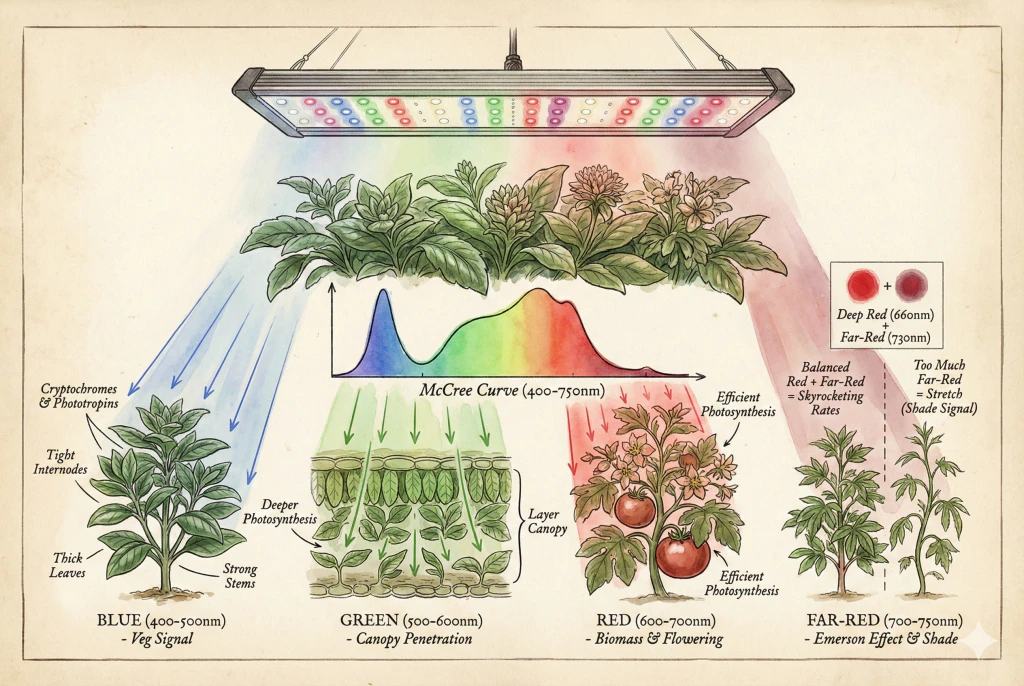
Plants use light across the visible PAR range, not only red and blue. That is why full-spectrum white is a sensible default for many home setups. Blue can encourage more compact growth, green can reach lower leaves in a dense canopy, and red contributes efficiently to photosynthesis.
These are tendencies, not switches. Choose a spectrum only after you have matched PPFD, daily light, and photoperiod to the species and the result you want.
Far-red (700–750 nm)
Far-red sits just outside conventional PAR. It can support photosynthesis when combined with other wavelengths, but a high far-red share often encourages stretching. Choose it when that shape suits the crop and avoid treating one red-to-far-red balance as right for every plant.
Set the Daily Light Total
More light isn’t automatically better. Most plants reach a light-saturation point, above which extra photons add little and can cause stress. Daily Light Integral (DLI) is the total PAR photons received over a day (mol/m²/d). If PPFD is how hard it’s raining right now, DLI is how much has collected in the gauge by day’s end.
Starting DLI bands
Many low-light houseplants such as Monstera and Philodendron do well around a DLI of 4–10, lettuce and herbs more around 12–17, and fruiting vegetables more still at roughly 30–45+. Treat these as starting bands because needs vary within every group. Too much light can bleach a shade plant, while too little produces weak growth and poor fruit set. Acclimation, day length, leaf temperature, watering, and cultivar all change the result.
Measuring Daily Light Integral (DLI) (Purdue Extension HO-238-W)
Compare the Fixture, Then Set It Up Safely
The diodes and the driver are two important components, but they aren’t the whole story. Also weigh whole-fixture PPF and efficacy (PPE), spectrum, thermal path, optics and uniformity, dimming behavior, electrical and photobiological certification, ingress rating, and warranty and service.
A named diode from an established maker is one useful signal, but it does not guarantee a good fixture. Efficiency and life also depend on how the fixture drives and cools the diode. Compare whole-fixture PPF and PPE instead of assuming an individual diode’s laboratory rating will reach the canopy.
On the driver, the power supply that converts wall AC to DC, compare rated temperature, dimming behavior, warranty, replaceability, and the fixture’s heat management. Warranty length varies by exact driver series and operating conditions, so verify the model rather than inferring quality from a fixture’s price tier.
Budget fixtures
Price alone doesn’t define a fixture’s output, coverage, electrical safety, or service life, so read the specification before treating a board as a budget value.
What to verify in the specification
Budget boards vary too widely for one wattage, diode count, or efficacy figure to describe the category. Before treating a low-priced fixture as a good buy, look for independently measured whole-fixture PPF or PPE, a PPFD map with height and footprint stated, the actual driver, a recognized safety listing such as ETL or UL, and clear warranty terms. Match the fixture to your plants by measured PPFD and target DLI, not by price tier or diode count.
Mid-to-high-tier main fixtures
A higher price does not establish the wattage, diode count, coverage, controls, or safety listing of a main fixture. Match its PPFD map to your actual canopy dimensions and mounting height, then compare whole-fixture PPF or PPE, dimming range, driver serviceability, controls, recognized safety listing, and warranty against alternatives rather than buying on reputation alone.
Supplemental bar kits
Supplemental and inter-canopy bar kits serve a different job from a main light. Judge a kit by its measured output and coverage at the intended position, and verify the water-resistance rating of the complete system, including connectors and driver. A bar format alone does not tell you whether it is too weak or strong for a canopy.
Bars are useful for filling a measured light deficit low in a canopy or in a narrow space. If you need a primary fixture, compare a full-canopy PPFD map and DLI at plant height instead of relying on the product category.
Driver quality, connector protection, enclosure design, serviceability, and a recognized electrical safety listing matter more than price-tier labels.
Step-by-Step Setup
Match the fixture to your footprint
Start with the plant’s target PPFD and the size of the lit area. A fixture’s measured PPFD map should show that it can cover the whole canopy at its stated height and dimmer setting.
Do not size a light from its wall wattage alone. Edge loss, mounting height, and dimming can make two fixtures with similar wattage perform very differently.
Hang high and dim down
Hanging close at full power creates a center hotspot that stresses the top while edges stay dim. Starting higher and lower generally gives more even coverage and a cooler-running driver.
Exact height and dimmer percentage depend on the fixture’s optics, power, and area (a dimmer number is not a PPFD reading) so use the manufacturer’s map and then verify with a meter on a canopy grid.
Don’t rely on the hand test
LEDs radiate less heat than old HPS bulbs, so a fixture can feel cool a couple of inches away while still delivering enough PPFD to bleach a leaf.
But the dimmer setting isn’t a measurement either (confirm intensity with a meter or validated PAR map, and watch how the plants acclimate and respond).
Set a schedule that fits the crop
Photoperiod interacts with a plant’s flowering response, which differs among short-day, long-day, and day-neutral species, and with the DLI you’re targeting.
Many growers run around 16–18 hours for leafy/vegetative growth. Short-day crops like some cannabis strains are flipped to 12 hours to trigger flowering, but day-neutral fruiting crops such as tomato are commonly grown under longer photoperiods, so don’t apply a 12/12 rule to every fruiting plant.
A smart plug or timer lets you set and verify the cycle remotely.
Choose a Fixture Format for Your Space
Choose the format for the canopy you need to light, then verify the exact model against its current specification and an independent PAR map. Configurations can change between model years.
Bar lights
LEDs on spaced bars can offer better uniformity and thermal distribution than a solid quantum board over a wide area, thanks to the spread-out layout and airflow between bars.
But whether a bar fixture beats a board depends on the area, diode spacing, optics, hang height, and how many boards you’d otherwise use. It isn’t automatic.
Diode configurations can change between model years. An efficacy or diode-brand claim in an old review may not describe current stock, so check the exact SKU and revision. Treat a maker’s lens and uniformity claims as claims until an independent map shows center, edge, and corner PPFD at the same mounting height and dimmer setting.
Controller-integrated fixtures
Some fixtures plug into the same controller ecosystem as a maker’s fans, with programmable scheduling, sunrise/sunset ramps, and a removable driver. Those are useful, verifiable features to evaluate on their own merits rather than a brand impression (confirm which fixtures and accessories actually share a protocol before assuming they interoperate).
Enclosed cabinet setups
For an enclosed cabinet, low-profile fluorescent-style or LED tube bars can be a sensible fit. Pick by shelf distance, ventilation, fixture heat, and measured PPFD across the whole shelf rather than by format alone, because a powerful board in a small sealed cabinet can overheat it.
Succulents and cacti generally need more light than shade plants, but the target varies by species. Set intensity, DLI, and photoperiod together, acclimate plants gradually, and check for hotspots. Vegetable starters do not require an expensive fixture. They require even measured light, appropriate day length, and hardening off before the move outdoors.
Diagnose Common Lighting Problems
Green light is not useless
Green light is not wasted. It can reach farther into a leaf and through a dense canopy than red and blue light that are absorbed nearer the surface. That makes full-spectrum white a useful default, but it does not make it best for every species or goal.
Twenty-four hours of light does not always grow plants faster
Usually not worth it. A common myth is that plants only respire in the dark. In fact respiration happens continuously, day and night.
Some species tolerate or even benefit from continuous light, while others (tomato among them) show injury under it, so the response varies by species and genotype, spectrum, temperature, and DLI.
And past a plant’s saturation point you’re mostly paying for electricity and heat it can’t use, so a dark period is a reasonable default for most setups.
Light burn versus nutrient burn
These can look similar. Excess light can bleach or scorch the upper leaves closest to the fixture, sometimes leaving pale tissue and upward-curling tips, but pale patches with green veins and upcurl aren’t a unique signature of light stress.
Fertilizer or salt injury often shows as brown, crispy leaf tips and margins and can appear on older, lower leaves, though it isn’t strictly limited to that pattern.
Because the symptoms overlap, diagnose using the whole picture, where on the canopy it appears, the light gradient, and your root-zone EC/pH and irrigation and feeding history, rather than assuming, and don’t flush the soil until you’ve identified the cause.
Make the Final Choice From Measurements
Compare whole-fixture output, canopy coverage, spectrum, heat handling, electrical safety, and warranty before buying a grow light. Then set intensity and schedule for the specific plant and growth stage, and confirm the result with a meter or a reliable PPFD map.
Check Moisture Protection and Build Quality
In a humid tent, check the moisture rating of the complete system, including its connectors and driver. An IP65 fixture resists dust and low-pressure water jets in a test, but it is not permission to mist a powered light.
Keep water away from live connections, switch the fixture off before maintenance, and use a GFCI outlet where appropriate. Moving a driver outside a small tent can reduce some heat inside, but the light itself still releases most of the power it uses as heat.
Daisy-chain dimming
Daisy-chain dimming can let several lights follow one control. Be aware that a shared connector shape (RJ11/RJ14) doesn’t guarantee compatibility. Pinout, voltage, and dimming protocol vary by manufacturer, so use the maker’s approved cables and controller rather than assuming any two fixtures will interoperate.
Protect the Circuit and Your Eyes
Do not overload the circuit. Use the fixture’s nameplate current, then include heaters, dehumidifiers, fans, and every other device on that circuit. Long-running lighting is treated as a continuous load, so consult a qualified electrician if you are near the circuit limit or unsure.
Keep cables organized with drip loops so water can’t run down a cord into the driver or outlet, and minimize direct eye exposure to a bright fixture.
Note that a 1000 PPFD figure describes photon density at the plant canopy, not an eye-hazard rating. A fixture’s actual optical safety is given by its photobiological classification (IEC 62471 / UL 8800) and the maker’s exposure guidance, and not every grow light emits a UV spike.
If you want eyewear, choose glasses whose wavelength range, optical density or visible-light transmission, color rendering, and certification are documented. A generic grow-room-glasses label alone doesn’t prove that it blocks harmful wavelengths and preserves true leaf color.
Then calibrate your dimmer and verify the light with a meter.