
Why Terrarium Plants Die: Bioactive Build Troubleshooting
Diagnose dying terrarium plants through root oxygen, water, light, mold, and substrate, then choose the right bioactive materials and tools for recovery.
Elena Vargas · Published 2025-12-13 · 15 min read
Key Takeaways
- Roots need oxygen, so a waterlogged, poorly aerated substrate can push the root zone toward low-oxygen conditions. A rotten-egg smell is a warning to ventilate and inspect, not a diagnosis by itself.
- A layered build with a reservoir, barrier, charcoal, and chunky ABG-style substrate can help, but water level, substrate contact, particle size, compaction, and maintenance determine whether it works.
- Springtails and dwarf white isopods can process leaf litter and debris, but they need the right species, density, moisture, temperature, and food to establish.
- Light, water, and mold are common failure points, but temperature, substrate chemistry, salts, pests, and disease matter too. Measure at the canopy and inspect before assuming a cause.
- Check source-water pH and EC/TDS, then match plants to the enclosure. Fittonia suits a humid but not waterlogged jar, while most succulents and herbs do not fit a sealed tropical setup.
Zero-maintenance apothecary jars look effortless in photos, but a jar that ends up with yellowing leaves and a swampy smell usually reflects a physical or biological problem worth diagnosing rather than a single piece of bad advice.
A successful terrarium matches its plants, drainage, substrate, and cleanup crew to the same moisture regime. See the bioactive terrarium guide for the wider setup.
1. Check Air, Water, and Decay First
Enclosures differ a lot. A fully sealed jar, a semi-closed jar, an animal vivarium, and an open terrarium each have different water, air, and maintenance needs.
A closed jar does buffer less than open soil in a garden, but many terrariums show real buffering and adaptation. Mistakes are recoverable more often than not.
I mark whether decline first appeared at the root, crown, oldest leaf, newest leaf, or exposed edge and place that point on a photograph of the enclosure. The final dead plant hides the sequence that would separate waterlogging, drying, light injury, and crown rot.
Patterns across species are compared before I replace anything. Several unrelated plants failing along one airflow or water zone point to the build, while one species failing everywhere points back toward its fit.
Gas Exchange
Root-Zone Oxygen
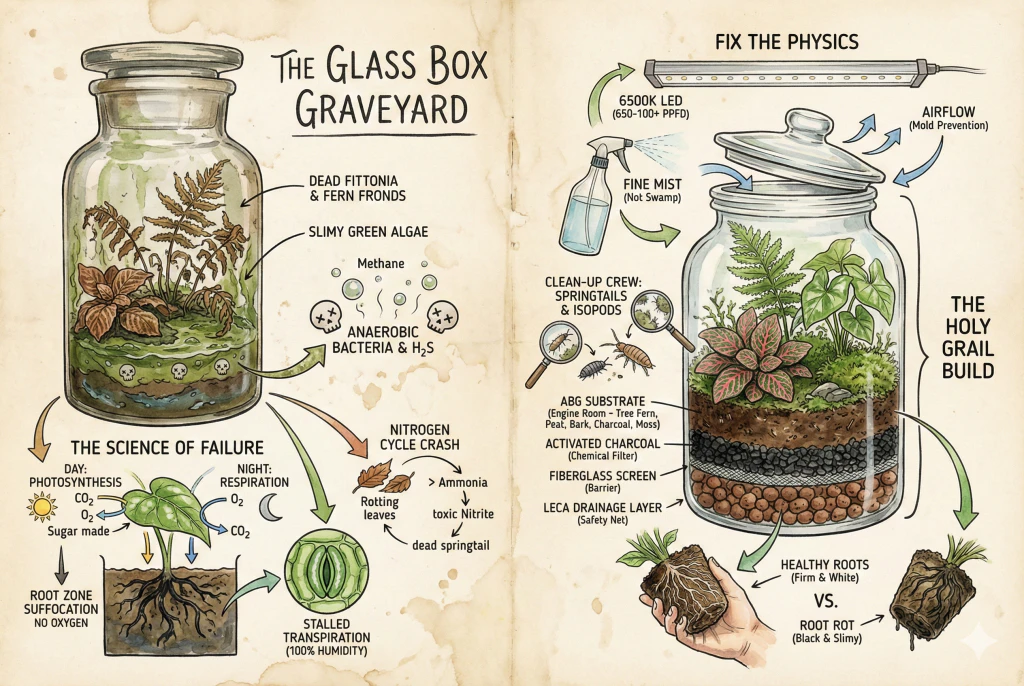
Gas exchange matters day and night. Plants photosynthesize in light (net CO₂ uptake, O₂ release) and respire around the clock (consuming O₂), and roots respire too, so they need oxygen at the root zone.
Warning Signs of Anoxia
When a substrate stays waterlogged, it has less air for roots. A rotten-egg smell is a warning to vent the enclosure and inspect the reservoir level, substrate saturation, and root firmness and color. It does not identify one specific pathogen by itself.
The Water Cycle
Transpiration and VPD
Plants release water through their leaves as well as from the substrate surface. That release slows when the air is very humid and still.
Low VPD Is Context-Dependent
Very high humidity and still air can slow drying and increase the risk of root-zone trouble, but the effect depends on plant type, temperature, light, airflow, and how wet the substrate is. Treat condensation as a clue to investigate, not proof that the plant is failing.
The Nitrogen Cycle
Multiple Nitrogen Pathways
Decomposition changes the nutrients and microbes in a terrarium substrate. A small amount of leaf litter can support the system, but excess decaying material in a wet, stagnant enclosure can become a problem.
Measure Before Calling It New-Tank Syndrome
Nitrifiers colonize many surfaces, not just charcoal or bark, so there is no measured basis for saying that without those materials ammonia inevitably builds up and chemically burns roots. New tank syndrome is an aquarium analogy. In a terrarium, do not treat it as a diagnosis without measuring ammonia or ammonium, nitrite, and nitrate.
2. A Layered Bioactive Build, Layer by Layer
Bagged potting mixes vary in particle size, total porosity, air-filled porosity, water retention, and compaction. Potting soil is not one uniformly suffocating material, and neither is backyard soil, although backyard sourcing carries its own tradeoffs. A well-built layered substrate can hold up for a long time, but its service life depends on media depth, particle size, compaction, watering, plants, and decomposition rather than a fixed number of years.
Step 1. Reservoir Layer
A Reservoir Is Not Drainage
This is better understood as a reservoir than as drainage. In a holeless jar the layer does not drain water out of the container. A barrier above it separates the reservoir from the root zone, and it only reduces risk when the water level stays below the barrier and the substrate is not in continuous contact that keeps wicking water up. LECA is porous and lighter than gravel, making it useful in a larger jar that may need to be moved. Porous LECA can still absorb and wick water, so it is not a dry humidity reserve. Rinsed gravel is adequate when weight is not a concern. Cracking risk depends on glass thickness, volume, support, and handling rather than the material alone.
Drainage Layer Evidence
A reservoir layer in a sealed jar does not drain water away. It only helps when you keep a clear maximum waterline, leave siphon access, and prevent the substrate from staying in constant contact with the water below.
Halatool Expanded Clay Balls
Choose Halatool Expanded Clay Balls for a medium-to-large build that benefits from a lightweight, visible reservoir and can use most of a 4-quart bag.
The 4–16 mm particles fit this role, but the quantity is wasteful for a small apothecary jar. Use rinsed gravel or a smaller LECA pack instead. Rinse the media first, keep the waterline below the barrier, and leave siphon access.
Step 2. Barrier Layer
Select the Barrier Material
A separator keeps substrate from washing down into the reservoir. Fiberglass window screen or horticultural mesh is commonly used, and rustproof stainless mesh is another option. Compare mesh opening, coatings or resin, wet-contact durability, and, if animals are present, whether the material is animal-safe. There is no verified basis for claiming that cheesecloth rots in exactly two months. The practical point is that untreated cloth breaks down faster than mesh.
Window Screen Repair Kit
The Window Screen Repair Kit makes sense when several enclosures need barriers or the remaining screen will be used for household repairs.
At 48×118 inches, it is oversized for one jar, and the included spline and tools add no terrarium value. Skip it if a clean fiberglass offcut or dedicated horticultural mesh is already available, especially in an animal enclosure where the coating and wet-contact safety must be known.
Step 3. Charcoal
Charcoal Is Not a Permanent Filter
Activated carbon is processed to create a large adsorbing surface, and its odor or impurity capacity depends on the target compound, concentration, contact time, moisture, particle size, and breakthrough, the point at which it stops capturing before it is fully saturated. A static layer of charcoal in substrate is not a general-purpose filter, and there is no measured basis for claiming that saturated charcoal reliably becomes a nitrifier housing. Charcoal can serve as structure and one of many colonizable surfaces, but odor removal and nitrifier colonization need separate evidence.
Use Horticultural Charcoal
Avoid fuel charcoal of unknown composition (some BBQ products contain lighter-fluid or ignition additives, though not all do). Use charcoal sold for horticultural use, and check what category it actually is.
Soil Sunrise Horticultural Charcoal
Buy Soil Sunrise charcoal when the substrate needs coarse hardwood particles for structure and air space.
It is horticultural charcoal at about 1/2 inch, not certified activated carbon, and the listing provides no surface-area or activation data. Skip it when the goal is continuous odor or contaminant filtration. It cannot support that claim.
Step 4. Substrate
ABG Mix Is a Starting Point
A dense, compacting mix reduces air-filled porosity, which is the property that keeps oxygen at the roots. A widely used tropical-vivarium recipe is ABG mix from the Atlanta Botanical Garden. It commonly uses 2 parts tree fern fiber, 1 part sphagnum peat, 2 parts orchid bark, 1 part charcoal, and 1 part sphagnum moss. Josh’s Frogs sells a ready-made ABG mix marketed for tropical vivariums, and vendor guidance suggests it can last several years when used appropriately. It is not a universal gold standard that stays airy for a decade even when wet. Depth, particle size, compaction, irrigation, and decomposition all change how it ages, so check aeration and refresh the top layer over time.
Josh’s Frogs ABG Mix
Josh's Frogs ABG Mix suits a humid tropical terrarium that needs a ready-made airy substrate. Skip it for an arid open setup or when you already have suitable components to mix more economically. Watch how it compacts and holds moisture after installation.
Step 5. The Cleanup Crew (Optional)
Cleanup Crew Needs
Detritivores can turn a dead leaf into processed litter rather than a mold patch, but they are helpful rather than essential. Springtails graze fungi and decaying matter, while dwarf white isopods (Trichorhina tomentosa) process larger debris and move through the substrate. Establishment depends on a suitable species, adequate numbers, appropriate moisture and temperature, ongoing leaf litter, and a calcium source for isopods. A culture may fail if food, numbers, or conditions are inadequate.
Live Tropical Springtail Culture
Seed the Live Tropical Springtail Culture before a bloom when the enclosure stays humid, contains pesticide-free leaf litter, and has time for the colony to establish.
The 8 oz listing does not confirm the species, so do not assume it is the Folsomia candida used in laboratory studies. Skip a live culture if the enclosure will dry repeatedly, receive fungicide, or remain saturated. Check the seller’s live-arrival policy and recent ratings before ordering.
Tradeoffs of a Layered Build
A chunky, layered build tends to dry faster and cost more than a jar of plain potting soil. Better aeration can reduce the risk of anaerobic rot, but that is not the only tradeoff. Drying speed, cost, and rot prevention also depend on the design, the plants, and your watering.
3. Light, Water, and Mold (Plus What Else to Check)
Light, water, and mold are common failure points, but they’re not the whole story. Temperature, substrate chemistry, salts and nutrients, pests, plant compatibility, and root disease all deserve a look.
Check these three first, then rule out the remaining causes.
Light
Measure Canopy Light
A room can look bright to you while a shaded corner delivers little usable light to a plant. Check the light at canopy level rather than judging the whole room.
Kelvin Is Not Intensity
Too little light can cause stretched, pale growth. Kelvin describes light color, not usable intensity. Match the light to the specific plant and check it at canopy height rather than trusting a bulb’s Kelvin label.
EWPJDK Clip Grow Light
Choose the EWPJDK Clip Grow Light only when a compact lamp fits the enclosure and you can check the resulting light at canopy height. Its listing does not provide verified output or coverage data, so skip it when the plants need a known intensity target. A spec-based grow-light comparison is more useful in that case.
Water
Read the Whole Water State
In a well-sealed jar much of the water recirculates, but it does not remain forever. Seal leakage, ventilation, plant biomass and pruning, and substrate exchange all remove or shift moisture. Constant fogging can signal too much water, but condensation also depends on the temperature difference between the glass and the room, so read it alongside other signs. A rotten-egg smell is a warning to check for anaerobic conditions. Yellow, mushy leaves have several possible causes, including overwatering, root dysfunction, chilling, bacterial soft rot, or normal aging, so examine roots, stems, and leaves rather than assuming cells are bursting.
Top-Ups Follow Observed Dryness
If a jar reads too wet, venting the lid can help, but skip the fixed twice-a-day misting schedule (it ignores jar size, plants, and current moisture, and many closed terrariums need very little added water).
Instead, look at the reservoir level, the glass, the substrate’s weight and moisture, and plant turgor, and add only small amounts when they actually indicate dryness.
Hula Home Sprayer
The Hula Home sprayer suits a planted surface that needs very small, even top-ups without disturbing moss or loose substrate.
Skip it when the reservoir is already visible, condensation is constant, or the substrate is wet. A mister does not solve overwatering. Use it from observed dryness rather than a fixed schedule.
Mold
Identify the Affected Material
Visible fuzzy growth can be a harmless saprotrophic fungus, a plant pathogen, an oomycete, or a mixed biofilm, and an early enclosure bloom does not always kill plants. First identify what is affected and remove affected tissue and decaying leaves, then adjust airflow and moisture and improve sanitation, escalating if it spreads. Adding more springtails is not itself a fix for the underlying cause, and in a bioactive setup with resident animals, sudden drying or strong airflow can harm the inhabitants, so make changes gradually.
Use Physical Fixes First
Once the decaying source is removed, the terrarium mold-control product chooser separates cases that need measurement, airflow, drainage, or cleanup-crew support.
Curved Aquarium Tweezers
Buy the Curved Aquarium Tweezers when a deep or narrow jar makes dead leaves impossible to remove cleanly by hand.
The 15-inch curved reach is unnecessary in a shallow open terrarium, and the sharp tip demands extra care around roots and animals. Sanitize before and after use and inspect the coating and metal for corrosion.
A grow light, mister, and long tweezers are inexpensive and can help with the issues above, though none prevents a failure mode on its own. Do not run a grow light so close or so long that it overheats a small sealed jar.
When the root zone is the problem, compare particle size, water retention, and layer depth in the terrarium substrate-mix recipes before rebuilding it.
4. Common Claims, Reconsidered
Succulents Need a Different Setup
Sealed Tropical Jars Are Not Xeric Setups
Most succulents are poorly suited to a sealed, humid, low-light tropical jar, where they tend to rot or stretch. An open dish garden with xeric species under strong light is a different setup that can work, and species vary.
A Reservoir Helps but Does Not Guarantee Aeration
Water Level Still Controls Aeration
A reservoir layer can add a margin against overwatering, but in a holeless jar it doesn’t remove the risk. Water can still saturate the substrate if the level rises or the substrate keeps wicking. No-layer setups can also work with careful water control. Treat the layer as one tool, not an insurance policy.
Outdoor Soil Has Sourcing Risks
Pasteurize with Measurement
Outdoor soil can introduce weed seeds, pathogens, and various small organisms, so its main drawback is uncertain sourcing rather than a fixed list of pests. Heat-treating soil is possible but easy to get wrong. Extension guidance is to hold the moist medium’s center near 180°F (about 82°C) for roughly 30 minutes using a thermometer, in a dedicated container, then guard against recontamination. Too-high or too-long heating can create phytotoxic compounds, and Penn State notes that killing off beneficial competitor microbes can actually make Pythium worse. For most readers, starting from a clearly sourced commercial or pasteurized medium is a safer comparison than baking backyard soil.
Charcoal Is Not a Permanent Filter
Charcoal’s structure can persist and it can act as one colonizable surface, but a useful, functioning nitrifier population isn’t something you can assume. Horticultural charcoal belongs in the substrate as structure, not as an ongoing water filter.
5. Deeper Notes That Actually Matter
These remaining checks are most useful when paired with observation and, where possible, measurement.
Feed a New Cleanup Crew
Provide Litter and Calcium
If you add isopods to fresh substrate with no decaying matter, they can run short of food. A die-off could add to the decomposing load. This isn’t inevitable or something you can quantify without measuring, but it’s a reason to provide food from the start.
Add dried leaf litter (oak or magnolia, from a pesticide-free source) at setup so a cleanup crew has food.
Rinse or briefly prepare it, add a modest amount, watch for mold, and offer a calcium source for isopods.
Choose Water by Testing It
Measure Source Water and Inputs
Repeated top-ups with hard or softened water can let salts accumulate. Test source water when possible and consider what the substrate, fertilizer, and hardscape add. Low-TDS water reduces added minerals, but it does not remove salts already in the enclosure and still needs an appropriate nutrient plan for the plants.
Match the Plant to the Enclosure
Humid, Not Soggy, Plants
Fittonia is a strong candidate for a warm, humid terrarium but dislikes waterlogged compost (humid, not soggy). Syngonium and creeping fig tolerate humidity but can quickly outgrow a small jar without pruning. Biophytum, many Peperomia and Begonias, and maidenhair ferns vary widely by species and cultivar in light, moisture, and mature size, so choose small forms and check individual needs rather than grouping them.
Plants That Do Not Fit a Sealed Tropical Jar
Most succulents, cacti, and culinary herbs are better in open, brighter, drier setups.
Venus flytraps in particular need a materially different regime, intense/full sun, low-mineral water, a permanently wet acidic carnivorous medium, and a cool winter rest, so they don’t belong in this tropical ABG jar, for reasons of medium and dormancy rather than humidity alone.
Use Your Nose as a Clue, Not a Diagnosis
Match Odors to Measurements
Smells point you to what to investigate, not to a single cause. An earthy, petrichor smell is often associated with actinomycetes but doesn’t confirm a healthy system. A sulfur/swamp smell suggests possible reducing decomposition. An ammonia smell suggests nitrogenous decomposition or a chemical source. A musty smell suggests microbial VOCs. Pair any of these with checks of reservoir level, substrate saturation, root firmness and color, temperature, recent inputs, and plant and inhabitant condition.
If it smells like a swamp, check for standing water in the reservoir, siphon out the excess, and vent the lid, while also inspecting substrate saturation, root condition, and any inhabitants before making bigger changes.
6. Conclusion
Diagnose the water level, root-zone air, canopy light, decaying material, and plant fit before you buy a new product or replace a plant. Excess moisture, stretched growth, and persistent mold each have more than one possible cause.
For a flooded jar, follow the overwatered terrarium recovery sequence before buying replacement plants or adding another cleanup crew.
Observe the jar and adjust in small steps. Check whether condensation changes with room temperature, whether inhabitants are active, and whether the substrate is holding air before you make a larger rebuild.
Affiliate Disclosure
This article contains Amazon affiliate links. As an Amazon Associate I earn from qualifying purchases. If you use these links, the site may earn a commission at no extra cost to you. Product availability, price, and specifications can change. Check the current listing before buying.