
Paludarium Climate Control: Airflow & Misting Science
Control paludarium airflow, VPD and misting without waterlogging the substrate. Compare fans, foggers and misters, then tune drainage and dry-down cycles.
Jordan Cole · Published 2025-12-21 · 30 min read
Key Takeaways
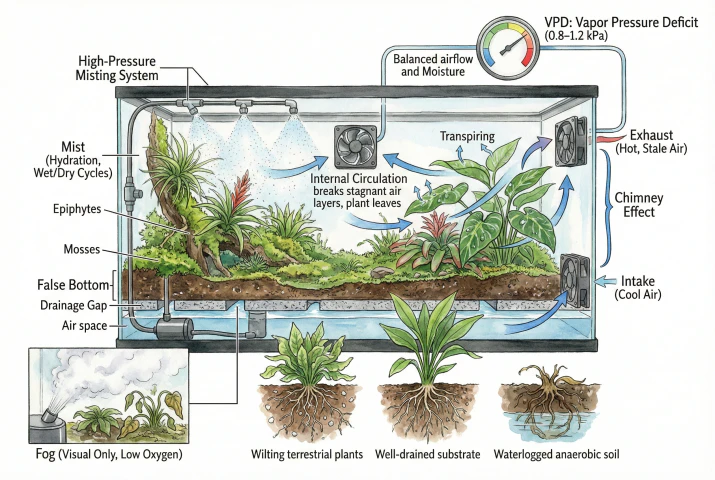
- Read relative humidity and temperature together, and use them to estimate vapor pressure deficit (VPD). Near-saturated air with no airflow slows transpiration, and because calcium reaches new growth largely in the transpiration stream, chronically saturated conditions can contribute to tip-burn on some plants. Reference VPD ranges, often cited around 0.8–1.2 kPa, come from greenhouse crops, so treat them as a starting point to verify in your own tank rather than a universal target for a mixed paludarium.
- Gentle air movement helps thin the wet boundary layer on leaves. Stagnant, wet air raises diffusion resistance and, over time, can favor some fungal problems. Internal circulation is useful in densely planted, sealed builds, though small enclosures with passive vents can also work, and too much airflow can desiccate or stress plants and animals.
- Mist and fog behave differently. A diaphragm-pump misting system delivers liquid water for real wet/dry cycles. Ultrasonic fog is a fine liquid aerosol that mostly raises humidity and deposits less liquid on surfaces. Fog does not create an oxygen-poor layer that suffocates plants. Poor ventilation and saturated substrate are what lower root-zone oxygen.
- Reduce direct soil-to-water contact with an air gap. A false bottom on stilts helps drainage but does not guarantee it. Roots, wicking, splash, or a high water line can bridge the gap, so plan an overflow or drain and check the water level.
- Match watering to the specific plants you keep. Many epiphytes tolerate a soak-then-dry cycle while terrestrials want steady moisture with oxygen at the roots, but orchids and bromeliads span C3 and CAM physiology. Schedules and dry-down times vary by species and should be dialed in by observation.
Prevent Odor, Mold, and Plant Decline
A paludarium is not simply a fish tank with less water. It is a coupled aquatic-terrestrial microclimate.
Many common failures (mold blooms, plants declining) come back to how airflow and hydrology are managed, though the causes are usually multiple.
I place lightweight thread indicators at several safe points away from animals and moving equipment, then film them through one fan and misting cycle. The video shows dead pockets and jets that a hand held at the door cannot feel.
After one fan or vent adjustment, I repeat the recording from the same angle. I remove every indicator before animals enter or resume normal access, and I use the film only as a coarse airflow map rather than a humidity measurement.
Balance Aquatic and Terrestrial Zones
You are balancing an aquatic zone that adds humidity with a terrestrial zone that needs gas exchange. How much each matters depends on tank size, temperature, cover and the species you keep.
Humidity, air movement, light, root-zone oxygen, water quality, and animal safety all work together. Manage the conditions you can observe instead of trying to solve every problem with more misting.
Balance Airflow, Humidity, and Root-Zone Oxygen
Use the measurements to make practical adjustments before a plant declines.
Read Humidity With Temperature
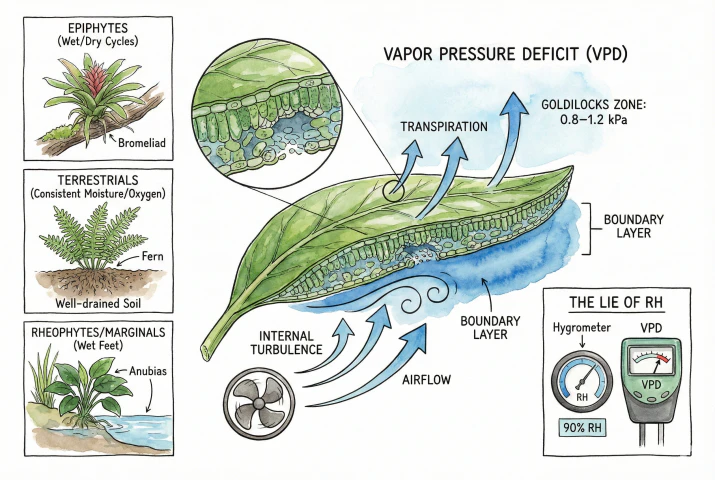
Everyone obsesses over humidity, and you may see forum posts insisting on 90%. Here’s the nuance. Relative humidity by itself doesn’t tell you how much water your plants are losing. It is still a useful measurement. You need it together with temperature to estimate VPD and to watch for condensation, mold risk, and animal comfort.
Relative humidity shows how full of moisture the air is at its current temperature. Vapor pressure deficit, or VPD, combines humidity and temperature to estimate how strongly air can pull water from a leaf.
High VPD Increases Drying Pressure
When VPD is high, the air is dry and evaporative demand is high. It can pull moisture from leaves faster than the roots replace it, which may cause crisping and desiccation. How fast this happens depends on the species and how much water is at the roots.
Very Low VPD Slows Transpiration
When VPD is very low and near zero, transpiration slows toward zero in the simplified case where leaf and air are at the same temperature. Because calcium moves to new tissue largely in the transpiration stream, chronically saturated air can contribute to calcium-related problems like tip-burn on susceptible plants. It does not shut off all nutrient uptake or all CO₂ and O₂ exchange because root uptake, root pressure, and diffusion continue.
Use VPD as a Starting Range
Reference VPD bands around 0.8–1.2 kPa come from greenhouse crops, so use them only as a starting point for a mixed paludarium. Watch the plants and animals, then adjust from their response. The VPD measurement guide explains how to take the reading.
This is also why a sealed box with permanently wet soil can be as hard on some plants as air that is too dry, though aquatic, marginal, and wetland species tolerate saturation well.
Minimizing VPD Fluctuations Maintains Higher Stomatal Conductance and Photosynthesis in Lettuce
Keep Leaf Surfaces From Staying Stagnant
Air moves slowly right against a leaf. In a stagnant tank, that humid film becomes thicker and exchange slows. It does not stop completely, but prolonged wetness and poor airflow can favor some fungal problems.
Prolonged wetness and poor airflow can also raise the risk of some fungal problems, given a susceptible plant, a pathogen present, and the right temperature and time.
Air Movement
It helps here, and not only fresh air from outside.
Gentle internal circulation can thin that boundary layer, mixing the stagnant, humid film with slightly drier air.
Aim for a light breeze, not a jet. Too much flow can injure or desiccate plants and small animals.
This is why internal circulation fans are a useful tool in densely planted, sealed builds.
They are not mandatory for every enclosure (small setups with good passive vents and natural convection can work too) so treat them as a design option, sized to your tank and species.
Match Root Moisture to the Plant
Match Dry-Down to Plant Type
Different plants handle water differently. These groups are useful rough categories rather than strict rules, so check the needs of your actual species.
Epiphytes and Wet-Dry Cycles
Many epiphytes, including some bromeliads and many orchids, grow on trees and are adapted to being drenched and then drying out. A number of them do best with wet/dry cycles, and their roots can rot if kept continuously wet. However, a one-hour dry-down is not universal, and neither is instant rot whenever roots stay wet. Orchidaceae and Bromeliaceae include terrestrial and moisture-loving members too.
Terrestrials Need Moisture and Root Oxygen
Many terrestrials, including begonias and ferns, grow in soil and generally want consistent moisture plus oxygen in the root zone. Begonias and ferns still differ from one another. Prolonged saturation lowers root-zone oxygen and can eventually lead to anaerobic conditions. Producing hydrogen sulfide, which causes a rotten-egg smell, is not automatic. It also needs sulfate, labile organic carbon, low redox, the right microbes, and time.
Rheophytes and Marginals Tolerate Wet Feet
Rheophytes and marginals, such as Anubias and Bucephalandra, grow on riverbanks and tolerate being submerged or splashed. They are examples of wet-tolerant plants, not the only ones. Many aquatic, marginal, and wetland species also handle wet feet.
Your job is to design watering that suits moisture-sensitive plants without keeping the whole substrate swampy, while accounting for evaporation off the water feature and the hydration needs of any animals.
Design a Climate System You Can Adjust
Build a system you can observe and adjust. Automation can keep a routine consistent, but it does not replace checking the tank.
Step 1. Separate the Water and Land Zones
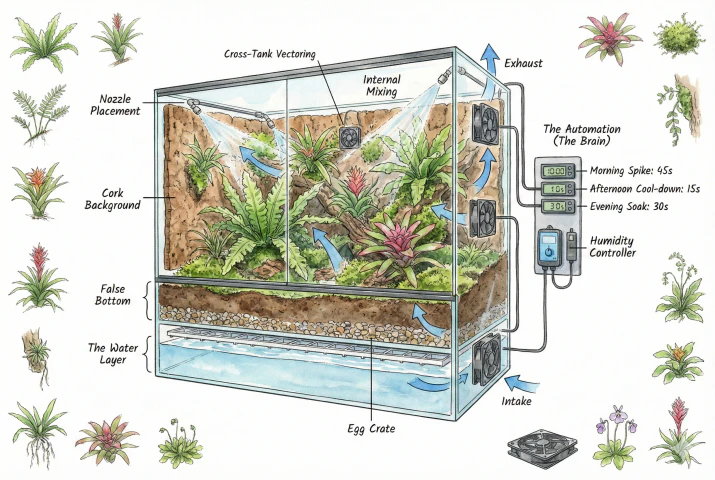
Rather than piling soil directly into standing water, separate the zones physically. Plan for load, an overflow or drain, water-level access, and a root barrier as part of that separation. The paludarium hardscape guide covers the layout and load-bearing side.
Water Layer
The water layer acts as a reservoir, adding thermal mass and a humidity source. How much it stabilizes temperature depends on its volume, the heat load, cover, and air exchange.
Build a Real Air Gap
Use egg crate, a light diffuser or a specialized mat such as Matala to raise the land section above the water line. Simply layering coarse gravel over fine soil does not reliably break capillary connection because a fine-over-coarse interface can hold a perched saturated zone. A stilted air gap with egg crate on supports more effectively reduces contact. Choose materials that are inert, load-bearing and will not leach.
Mounted Plant Surfaces
For mounted plants, options include cork bark, tree fern panels, or hygrolon. A vertical surface that holds some moisture but drains well is the goal. The right choice depends on the plants, mounting method, and how durable and available the material is.
Step 2. Plan Ventilation
Plan the Full Flow Path
A single top-mounted fan blowing in is one option, but it helps to think about the whole flow path and to work with the chimney effect where you can. Whether exhaust-only is best depends on your room and enclosure.
- Let air enter low near the water surface or through passive vents in front. Make sure intake mesh doubles as an escape barrier for any animals.
- Warm, humid air tends to rise, so a top-back exhaust is often effective. Lights, evaporative cooling, and room temperature can shift the gradient, so confirm it moves air the way you expect.
- Fans inside the tank that don’t exchange air with the room can stir the interior, thinning the boundary layer on leaves without venting your humidity. Before adding livestock, verify the flow path with a light ribbon or another enclosure-safe method, and keep blades guarded and wiring safe from animals and moisture.
Step 3. Set Up Watering
Hand spraying works for small, forgiving setups, but it depends on you being consistent and present. If you travel, an automated system covers the gaps.
An automated misting system can help with demanding plants or an owner who travels. A mister delivers liquid water, while an ultrasonic fogger mostly raises humidity and wets surfaces less. Use the vivarium misting-system chooser to compare pump, nozzle, timer, and reservoir requirements.
- Avoid pointing nozzles straight down where large leaves create dry rain shadows underneath. Check coverage by watching where water actually lands.
- Angling nozzles from the front corners toward the back center can improve coverage of foliage and the background. Whether this creates a useful vortex depends on your tank geometry and spray cone, so confirm by observation rather than assuming.
Diaphragm-pump misting systems are a common choice for vivariums, but noise, dry-running tolerance, duty cycle, pressure, and droplet distribution vary by pump and nozzle. Check the exact system’s documentation instead of treating one manufacturer’s droplet size as a class specification. The useful test is whether the installed system wets the intended foliage without saturating the substrate.
Lower-cost piston-pump misters also vary, and published comparative failure-rate data does not support treating all of them as short-lived or flood-prone.
Expandable multi-nozzle misting systems
Expandable kits vary in pump voltage, timer resolution, included nozzles, anti-drip hardware, reservoir fittings, tubing, and maximum supported nozzle count. Inventory the included parts and size any expansion from the exact kit’s pressure and flow documentation. Plan drainage and a stuck-on-pump failsafe before installation.
When an expandable system makes sense
Choose one when you need timed, repeatable watering across several nozzles and want a serviceable system that can grow with the enclosure.
When a single nozzle is enough
A single nozzle may be enough when its measured coverage reaches the intended plants without soaking the substrate, or when you cannot place a larger pump, power supply, reservoir, and leak containment safely outside the wet zone. Let observed coverage and drainage determine nozzle count, not tank size alone.
Step 4. Automate Carefully
Calibrate Misting Bursts
A timer with seconds resolution helps because effective misting bursts are short. Treat published durations as illustrative only. The water a burst delivers depends on nozzle flow, tank volume, planted area, runoff, light and season, so calibrate to your own tank.
- A short burst around sunrise can hydrate plants for the day.
- An optional afternoon top-up can cool leaves at peak heat. Skip it if humidity is already high or if it keeps leaves wet too long.
- Keep any evening watering light, and time it so leaves can dry before nightfall. Heavy evening soaks conflict with a dry-by-night goal and can raise disease risk.
- Internal circulation can run continuously or on a duty cycle. An exhaust fan can be triggered by a humidity controller or run for a few minutes after misting to help leaves dry. Pick thresholds by observing leaf wetness and your species’ needs, not from fixed numbers.
Build Failure Safeguards
A stuck-on pump, an empty reservoir, a leaking fitting or a blocked nozzle can flood or dry out a tank. Plan for those failure modes and check the system regularly.
Tune Leaf Dry-Down, Moss Watering, and Airflow
Use these checks to refine the schedule after the basic system is running.
Give Leaves a Chance to Dry
Keeping leaves wet around the clock isn’t ideal. A film of water on the leaf raises the resistance to CO₂ diffusion and can lower photosynthetic efficiency in many plants, though wet-adapted and aquatic species handle it fine and gas exchange usually continues at some level rather than stopping entirely.
Aim for leaves to dry out between waterings rather than staying wet all day. There is no universal two-hour-good, four-hour-bad cutoff. Acceptable wetness duration depends on the plant, the temperature, surface, and disease pressure, so watch how your plants respond.
Use Condensation as a Clue
If the front glass is fogged over around the clock, your cycle is probably too wet. Some morning condensation that clears later suggests things are drying. This is a useful visual clue, not a definitive test because surface temperature and room dew point also affect the glass.
Watering Moss
Water Moss With Liquid
Moss is easy to lose, and the reason is often the opposite of excessive humidity.
Most moss needs regular liquid water to stay active. Humid air alone is often not enough. Avoid hard, constant jets, permanent waterlogging, poor light, and contaminated runoff.
- Place moss near a waterfall splash zone or in the gentle path of the mist rather than under a hard direct stream, so it gets regular liquid water without being battered. Circulation fans help by keeping the air moving, but the moss still needs liquid water to stay active.
Nutrients in the Water Column
Use Animal Waste as a Managed Input
If you keep aquatic animals, their waste is a built-in nutrient source you can put to use.
- Fish waste and decomposition produce ammonia nitrogen. In the water this exists as ammonia (NH₃) and ammonium (NH₄⁺), and the toxic NH₃ fraction rises with pH and temperature, so this is a source to manage, not just a free perk.
- A small pump can drip aquarium water over the background as a drip wall, so terrestrial roots and mosses take up some nitrate. This can help export nutrients and reduce accumulation. Calling it a full closed-loop aquaponic system overstates it because you still need an established biofilter, oxygenation and regular testing of ammonia, nitrite and nitrate.
- Ensure the background material holds up to constant wetting. Some foams and cork can degrade over time. Synthetic panels like EpiWeb or Hygrolon are popular for drip walls, but comparative longevity and safety evidence is limited, so evaluate durability, animal safety, and cleaning for your build.
Managing the Chimney
Lights are often the main heat source and the water is often cooler, so a vertical temperature gradient can form, though LED layout, pump heat, and room conditions can change that.
- Using the gradient. A top exhaust can assist the natural upward flow of warm, humid air, drawing moist air up past the plants and reducing how much you need to spray. How well this works depends on your flow paths, so confirm it with a light ribbon and readings at several heights rather than assuming it’s automatic.
Quiet, variable-speed USB fans sold for cooling electronics are one option for internal circulation, but they are not substitutes for sealed, humidity-rated equipment.
Dual-fan USB circulation units
A speed-controlled USB circulation fan can provide gentle external airflow, but airflow, noise, operating-humidity limits, and water resistance vary by model. Electronics-cooling fans are often dry-location products rather than enclosure equipment. Keep an unrated unit outside the wet zone and select the exact fan for the humidity and splash exposure at its mounting point.
When a USB circulation fan works
It suits broad, adjustable circulation in a vented enclosure that stays within its humidity range and where you can keep the fan, adapter, and connections dry.
When to choose a humidity-rated fan instead
If the paludarium regularly exceeds the fan's rated humidity, direct mist or condensation can reach the unit, or animals could contact unguarded blades, a guarded, humidity-rated fan is the safer long-term choice.
Troubleshoot Mold, Wet Substrate, and Foggers
Should I spray paludarium mold with peroxide?
Why Early Mold Usually Needs Better Conditions
An early mold bloom is usually a symptom of startup conditions rather than a disease to attack chemically. The bioactive mold-control guide helps distinguish a startup bloom from a persistent moisture problem.
- New wood and fresh substrate release available organic carbon, and still, wet conditions let fungi grow. Moisture, the inoculum present, temperature, and material all play a part, not just sugars and stagnant air.
- Several measures tend to help with a startup bloom.
- Small detritivores such as springtails graze some fungi and detritus and can help manage a startup bloom. Springtails don’t define whether a tank is bioactive because bioactivity is the whole decomposer community and nutrient cycling. Before adding a large culture, check that it’s clean, an appropriate species, and compatible with any animals you keep.
- Drier, moving air discourages surface mold. Increasing general circulation is usually better than aiming a hard jet at one patch, which can spread spores and desiccate nearby plants. There’s no guarantee mold dies within a fixed 24 hours.
- A transient bloom during cycling often fades as the substrate settles and fauna establish. If it persists, look for a chronic water leak, a saturated substrate, or a problem material rather than just waiting.
Why are background plants dry while the paludarium bottom is swampy?
Why the Background Can Dry Above a Wet Base
This often reflects a vertical moisture gradient (water tends to run down) but heat, light, airflow, substrate, and root disease can contribute too, so don’t assume gravity is the only cause.
- Directing more water high on the background and less at the base can help. Remember that runoff still travels downward, so check where it actually ends up and how wet each zone gets.
Adjust and re-aim your nozzles, and test coverage per nozzle (a blocked nozzle can mimic this pattern).
- Add a background trickle line. Run small airline tubing from your pump to the top of the background and let it run down the wood to keep mounted plants wet without adding spray that settles in the soil. Pair it with runoff collection so you don’t worsen the wet bottom.
- Drain access for the false bottom. You need a reliable way to remove water from under the false bottom before the level rises into the soil. A dedicated, accessible siphon tube is the low-risk option. Tempered glass must not be drilled. If a bulkhead is required, use a panel confirmed by its maker to be non-tempered and suitable for drilling, complete the work before assembly, or have a professional prepare it. Never drill a filled tank or one containing livestock.
Why do paludarium plants struggle when I use only a fogger?
Why a Fogger Cannot Replace Liquid Water
Foggers (ultrasonic humidifiers) and misters do different jobs. Fog is great for atmosphere and raising humidity, but on its own it may not deliver the liquid water that some plants need.
- Fog droplets are very small and stay airborne longer, so they raise RH but tend to deposit less liquid on surfaces. Many epiphyte roots take up nutrients from liquid water, so if fog is your only source, they may not get enough. How much a fog actually wets a surface depends on deposition, contact time, and airflow.
- Cool air can sink, and standing water or a permanently saturated substrate can lower root-zone oxygen. Fog does not form an oxygen-poor blanket that suffocates plants and microfauna. Even a large increase in airborne water vapor barely changes the oxygen fraction of the air. If roots are struggling, look to ventilation and saturated substrate, not to fog displacing oxygen. Use fog to supplement humidity and a mister for liquid watering.
Operate the System Around Its Inhabitants
Building a paludarium is an exercise in balance. You set the rain, the wind, and the light, and with that comes responsibility for the plants and animals living in it.
Prevent chronic stagnation while keeping each plant and animal within its own moisture and airflow needs.
- Keep water circulating where your aquatic species and dead zones call for it (with guarded pump intakes).
- Manage air exchange and gentle circulation to suit your plants and animals, without over-drying them.
- Let moisture cycle where the plants benefit, while respecting aquatic, marginal, and amphibian hydration needs.
Circulation and periodic drying help in many builds, but they aren’t blanket rules. Moss, amphibians, and small fauna have their own needs, so tune drying to what you actually measure.
A rainforest’s moisture varies in space and time. A tank benefits from similar variation. The right targets come from your specific species, not from a metaphor.
A good misting system and measured airflow both help. Beyond that, dial in your watering by observation, keep the ferns from sitting in water, and enjoy the build.
Adjust the Climate for Plant Type
Very humid, still air can slow growth and contribute to weak new leaves in some plants. If new growth shows repeated tip damage, check root health, light, fertilizer, and salts as well as humidity. Make a small ventilation change and observe rather than adding more mist by default.
Many mounted orchids and bromeliads benefit from a thorough watering followed by drying around their roots. Species differ, and terrestrial orchids need a different setup. Use RO or distilled water for misting when it prevents scale, but provide needed minerals through the root zone or a suitable dilute fertilizer.
Use Gentle, Measured Airflow
Lights often warm the top of a paludarium while water keeps the lower area cooler. Check temperature and humidity at more than one height, then aim for a broad gentle flow rather than a narrow jet. Keep fan intakes clear and large enough for the fan to draw air easily. Strong airflow can over-dry plants, chill warmth-loving animals, and empty the reservoir faster.
9. Hydrochemistry (The Water that Feeds the System)
Water in a paludarium carries dissolved ions and organic compounds, and its chemistry strongly influences the health of the whole system.
9.1. The Nitrogen Cycle in Hybrid Systems
A paludarium adds a route for nutrient uptake through terrestrial plant roots, alongside the aquatic filter.
- Fish waste and decaying matter produce ammonia nitrogen. In water it exists as both ammonia (NH₃) and ammonium (NH₄⁺). The toxic NH₃ fraction depends on pH and temperature, so track total ammonia rather than assuming it’s all NH₃.
- Bacteria convert ammonia to nitrite and then nitrate through nitrification. This needs oxygen, adequate surface area, alkalinity, and an established biofilter, and it takes time to cycle.
- In a plain aquarium nitrate accumulates. In a paludarium, terrestrial plants such as Pothos, Monstera, and Philodendron with roots in or near the water can take some of it up. Plant assimilation of nitrate is a different process from microbial denitrification.
- Emersed terrestrial plants can grow vigorously with access to atmospheric CO₂ and aquatic nutrients. Whether they outgrow aquatic plants depends on species, light, nutrients, and root oxygen, so it isn’t always the case.
Use Planting Pockets as Nutrient Export
Routing pump output through a planting pocket of Epipremnum (Pothos) or peace lilies can boost nutrient uptake.
Treat it as a helpful vegetable-filter effect, not a complete filter. Check for clogging, root toxicity, animal safety, and monitor ammonia and nitrite.
A heavily planted, mature system may need fewer water changes, but running with zero water changes and top-off only is risky. Topping off evaporation doesn’t remove non-volatile salts or replenish alkalinity, and it can lead to alkalinity depletion and old tank syndrome. Set an exchange schedule based on regular water testing.
9.2. Dissolved Solids (TDS) and Misting
Dissolved solids are a major maintenance issue for misting systems and moss.
- Hard water, often tap water, contains dissolved calcium (Ca²⁺) and magnesium (Mg²⁺) ions plus bicarbonate or carbonate alkalinity. It is not simply solid CaCO₃ and magnesium.
- As water evaporates at the nozzle tip it can leave scale, which over time can clog fine nozzles. If a manufacturer publishes a droplet-size figure, do not mistake it for the nozzle orifice diameter. Droplet size also changes with nozzle design and operating pressure.
- Evaporating hard water can leave a white mineral film on leaves and moss. Depending on concentration, composition, and species this can affect gas exchange or scorch moss tips, but it doesn’t automatically block stomata or deprive the plant of oxygen.
- Reverse Osmosis (RO) or distilled water is a sensible choice for misting to reduce scale, especially with hard source water. Follow your nozzle maker’s water guidance and keep the reservoir clean. The paludarium RO guide covers filtration, remineralization, and monitoring.
RO Water Still Needs a Mineral Plan
RO water is very low in minerals (not literally zero. Residual ions depend on the membrane and source), and plants still need minerals.
- A workable split. Use RO for misting to keep lines and leaves clear, and provide minerals separately, for example remineralized water for manual root watering of the terrestrial section, dosed to your plants’ needs. Organic substrate breakdown supplies some ions but not a complete, balanced nutrient supply on its own.
9.3. Tannins and pH Buffering
Driftwood (Mopani, Malaysian driftwood) releases tannins and other colored dissolved organic compounds.
(Tannins and humic acids aren’t the same thing. Tannins are among the precursors of humic substances, not a synonym.)
- The leachate can tint water tea-colored. How dark depends on the amount of dissolved organic matter and the lighting.
- Organic acids can lower pH in low-alkalinity water. In well-buffered water, or with water changes and lower doses, the effect can be small, so it doesn’t always drop the pH of every tank.
- Some tannins and phenolics show specific antimicrobial activity, and many rainforest fish such as bettas and tetras and plants such as Cryptocoryne do well in soft, acidic blackwater. That doesn’t make mildly acidic water a broad disinfectant, though.
- You don’t have to remove every trace of tannin for aesthetics. The idea that wicked tannin-rich water reliably preserves the hardscape against mold isn’t well supported, so treat it as unproven rather than a feature.
10. Advanced Substrate Mechanics
Substrate is better thought of as a physical and biological system than as plain dirt.
10.1. The Drainage Layer (The Void)
The aim is a space where water can sit without keeping the soil saturated. (Note this suits many builds, not bog or marginal-plant designs that intentionally stay wet.)
- Use LECA, which is lightweight expanded clay aggregate, a Matala mat, or plastic egg crate. Check load capacity, that materials are inert and clean, and that there’s no gap where small animals can get trapped.
- LECA can wick water upward. If the water sits near the top of the LECA layer, the soil above can get wet. Exact figures such as a two-inch water depth and a 2.5-inch LECA layer depend on ball size, packing, and porosity, so use them as a caution rather than a precise rule.
- The air gap. A stilted false bottom (egg crate on PVC supports) creates an air gap that greatly reduces capillary contact and is a solid design. It doesn’t guarantee free drainage on its own, though. Roots, wicking material, mesh, splash, or a rising water level can still bridge the gap, so keep the water level in check and provide an overflow.
10.2. The Substrate Mix (ABG and Variants)
The Atlanta Botanical Garden (ABG) mix is a widely used airy, organic vivarium mix. It’s a strong hobby convention rather than a universal gold standard, and the ideal mix varies with your plants and fauna.
Its components each do a job.
Tree Fern Fiber and Orchid Bark
These components provide structure, resist compaction, and create air pockets. Consider tree-fern sourcing and remember that fiber decomposes over time.
Sphagnum Moss for Water Retention
Sphagnum moss holds water like a sponge. The right fraction depends on how much retention your plants need.
Charcoal Has Finite Adsorption
Charcoal adsorbs some compounds. Its capacity is finite and compound-specific, so treat claims that it absorbs toxins or keeps soil sweet as loose horticultural shorthand rather than a defined function.
Peat and Coco Coir
These materials provide base organic matter, but they differ in pH, salts, and sustainability.
11. Lighting (The Energy Source)
Lighting matters here because it’s often the heat source that drives evaporation and, in turn, your airflow needs.
11.1. PAR and Penetration
- In a tall paludarium measuring 24–36 inches, the light near the top is usually much stronger than at the bottom. The actual intensity at the top depends on the fixture, distance, spectrum, and shading, so measure PPFD rather than assuming it is massive.
- Choose plants by height.
- Many Neoregelia and similar bromeliads hold their color better in stronger light, though the exact intensity needed varies by cultivar.
- Many ferns such as Microsorum and Anubias tolerate lower light. Deep shade is relative. Too little light still limits growth, and requirements vary by species.
11.2. Managing Algae Pressure
Strong light plus water plus nutrients tends to encourage algae, though inoculum, CO₂, grazers, flow, and photoperiod all factor in, so it’s not a simple equation.
- The terrestrial plants may want strong light while that same light hits the water. Match brightness to the plants you actually chose and measure the output.
- Using hardscape such as branches or cork bark to shade the water section as a cave or overhang lowers irradiance there. This can reduce algae pressure and suit shade-preferring fish such as many tetras and rasboras, but it does not guarantee algae prevention. You still need to manage nutrients, photoperiod, and flow.
12. Plant-Specific Climate Examples
These species examples show why one airflow and misting schedule cannot fit every paludarium.
12.1. Marcgravia (Shingle Vines)
- These shingle vines are popular for climbing a background.
- Runners can dry out and detach. Causes can include dry surfaces, low light, pests, or transplant stress, so diagnose rather than assuming one reason.
- Many Marcgravia are hemiepiphytic climbers whose juvenile shingling form clings closely to the surface. Surface moisture and close root-to-surface contact support attachment. High humidity helps keep the surface moist but isn’t itself an adhesive.
- Placing them lower on the background can give better moisture access, but don’t assume the base is always wettest. Balance that against swamp risk and root oxygen.
- A moist, root-contactable surface helps. Cork bark alone can be too dry. A drip line or hygrolon fabric can keep it wet enough for adventitious roots to grip, though results depend on flow, contact, light, and species.
- Strong direct drafts can desiccate a young growing tip, so avoid aiming a fan straight at a new runner. Gentle circulation elsewhere is fine.
12.2. Bucephalandra
- Bucephalandra are often costly, iridescent plants from Borneo.
- A common failure is melting. This can be rhizome rot, acclimation leaf loss, or pathogen damage, which are worth distinguishing.
- Bucephalandra are Bornean rheophytes that grow on rocks in flowing streams. Microhabitat and clone variation matter.
- A splash zone with flow suits them, whether submersed or emersed. Stagnant, low-oxygen water or heavy organic load, rather than stagnant air alone, plus pathogens and rhizome burial are what tend to rot them.
- When moving a Buce from submersed to emersed, acclimate gradually and lower humidity slowly so leaves can adapt. A rigid schedule that holds 100% RH for exactly one week is not well supported. Watch how new versus old leaves respond and adjust.
12.3. Neoregelia (Tank Bromeliads)
- Neoregelia hold water in a central cup called a phytotelm. Cup volume varies by species, cultivar, and how they’re mounted.
- The crown or base where the plant meets the wood benefits from being airy. Rot there relates to crown depth, trapped debris, temperature, and species, so check those rather than blaming cup water alone.
- An angled mount can shed excess runoff. The cup is a natural, functional feature, so deliberately tilting every bromeliad to empty it isn’t always right and can conflict with keeping some water in the cup. Also consider any fauna or eggs that use the cup.
- Observing cup water quality and occasionally flushing debris can help, but heavy misting doesn’t guarantee it fully exchanges the water or prevents bacteria. Be mindful of cup-dwelling fauna and water chemistry.
Systemic Failures
13.1. Diagnosing a Rotten-Egg or Sewage Smell
- A rotten-egg or sewage smell appears when you open the enclosure.
- This often points to reduced sulfur and anaerobic decomposition in a saturated, low-oxygen substrate or from too high a water level. First localize the smell. It could also come from a drain trap, wood, animal waste, or the water zone, so a single anaerobic-bacteria diagnosis can miss other sources.
How to respond carefully
- Lower the water level and investigate. Do not simply drain the whole water section if you keep fish, amphibians, or invertebrates. A sudden full drain can shock animals and the nitrifying biofilter with temperature, oxygen, and ammonia swings. Plan livestock transfer to safe, aerated, treated water first, preserve filter media, and monitor ammonia and nitrite.
- Improve aeration cautiously. Gently opening up a compacted substrate can help, but poking with a chopstick risks damaging roots and fauna and doesn’t fix the underlying drainage problem.
- Do not improvise a hydrogen-peroxide dose from vague advice such as a small amount of 3%. H₂O₂ can harm roots, nitrifying bacteria, springtails, and aquatic animals in a dose-dependent way. If a labeled product is appropriate for the exact use, follow its directions and safety guidance rather than adding peroxide to substrate connected to livestock water. Its decomposition reaction is 2 H₂O₂ → 2 H₂O + O₂, but oxygen release does not make an unknown dose safe.
- Re-engineer if needed. After checking water level, overflow, a blocked drain, and any wick/root bridging the gap, you may need to rebuild the false bottom higher, with a livestock-safe plan in place first.
13.2. Fixing a Dry Upper Canopy
- Lower plants look fine, but moss or orchids near the top go crispy.
- A strong exhaust or hot lights can create a drier upper zone, but also consider a blocked nozzle, a low reservoir, root failure, high PAR, and ambient VPD before settling on one cause. Note moss and orchids have different needs, so don’t lump them together.
Adjustments to try
- A shorter timer or the fan’s own speed controller can lower excess upper-zone VPD. Use the manufacturer’s controller rather than arbitrarily dropping voltage, which can stall the fan or exceed its adapter spec, and keep a minimum ventilation level.
- Pumping water to the top helps hydration, but if the bottom is already too wet, add runoff collection and manage pump flow and overflow so you don’t make the swamp worse.
- A dedicated upper-zone nozzle can close a coverage gap. Re-check leaf wetness, total water use, animal exposure, and drainage after adding it.
- Covering part of a screen lid with glass or acrylic can retain humidity up top. Re-evaluate heat buildup, gas exchange, condensation drip onto electrics, and animal escape or ventilation before doing this because it isn’t a no-risk fix.
14. Final Thoughts on System Longevity
A paludarium is an ongoing commitment rather than a set-and-forget decoration, and it houses living animals whose welfare depends on you (worth remembering as you treat the whole system as something to care for).
How it develops over time varies with your design, species, and maintenance, but many keepers describe a rough arc.
- Some mold blooms and plant losses are common while you dial in the schedule, though they are not inevitable and are worth minimizing.
- As roots and moss establish, the system tends toward equilibrium, though the timeline isn’t fixed.
- Pruning becomes a bigger chore as plants fill in. Aging substrate, equipment wear, and changing animal populations still need attention.
Managing air, water, and moisture, and avoiding chronic stagnation, improves your odds of a stable, mature tank.
No design guarantees maturation. Results still depend on species selection, maintenance, and how the system changes over time.
A Starting Gear Checklist
Sizes, models, and safety details depend on your build, so verify each for your setup.
- Use a diaphragm-pump misting system as discussed above. Kits differ in nozzle count and components, so pick the one that matches your tank.
- Use internal circulation plus an exhaust fan. Choose humidity-rated, guarded fans where possible. If you use electronics-cooling fans, keep them within safe electrical practice and remember they aren’t rated for saturated air.
- Use a seconds-resolution timer for short misting bursts. Confirm the specific model’s load rating, wet-location suitability, and behavior after a power loss.
- Choose ABG-style mix components, whether DIY or premade, for your plants and fauna.
- Use cork bark for the background and spider wood for detail. Check wood species, stability, sharp points, and animal safety.
- Use an RO source for misting, sized with attention to maintenance and reservoir hygiene, plus a separate mineral plan for the plants.