
Paludarium Hardscape Guide: Depth, Flow & Golden Ratio
Design a paludarium hardscape with Golden Ratio focal points, safe stone and wood, forced perspective, structural supports, foam and a stability checklist.
Marcus Hale · Published 2025-12-21 · 33 min read
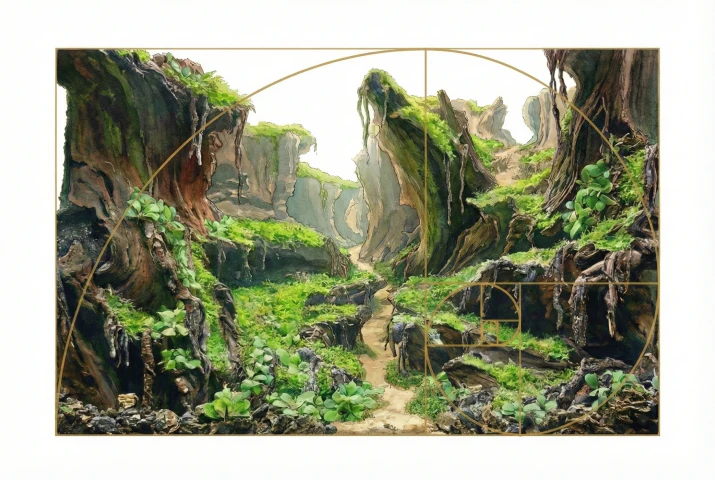
Key Takeaways
- The Golden Ratio is a composition aid, not a law of nature. Use it to choose an off-center focal point, then adjust for the tank, viewing angle, animals, and actual negative space.
- Hardscape changes the environment as well as the appearance. Stone can alter hardness and pH, wood can decay, and tall banks can place real loads on glass and supports.
- Mechanical support must carry heavy rock and wet substrate. Adhesive, foam, and silicone are secondary aids unless a product is specifically rated for the load and environment.
- Test materials in the water and setup you will actually use. Trade names and listing claims do not identify mineral composition, batch behavior, cure performance, or animal safety.
- Judge the finished layout as a living system. Keep access for cleaning, filtration, animal movement, plant growth, drainage, and long-term maintenance before appearance is finalized.
Choose a Focal Point Without Treating Math as a Rule
The Golden Ratio, written as Phi and approximated as 1.618, is often used as a visual guide for placing a focal point. It is a design convention rather than a guarantee that a layout will look natural.
Placing a focal rock off-center is a common composition heuristic, and the Golden Ratio is one way to pick that off-center point. It also turns up in some biological patterns, though it is not a universal law of nature.
Some plants form leaf patterns close to the golden angle, but that does not make the ratio a natural law for a hardscape. Use it only as a convenient way to test an off-center placement.
Use the Golden Ratio as a practical design convention for placing a focal point, not as proof that a layout is natural or that the eye is hard-wired to prefer it.
Biophysical optimality of the golden angle in phyllotaxis (Okabe, 2015)
In black and white, I photograph the dry hardscape and shrink the image until it is only a small thumbnail. If the main mass, open water, and negative space merge into one block, fine texture will not rescue the composition once plants grow.
For each revision, I move one major piece before repeating the test and adding details. The value test helps me build depth with large shapes first instead of using a ratio to justify a layout that is visually flat.
Where to Place the Focal Point
Using the Golden Ratio in aquascaping and paludariums is really about dividing the space so it does not feel evenly balanced. A rock placed dead center is symmetrical and settles the composition quickly, which can read as static or formal.
That is not always wrong because plenty of natural and designed scenes are symmetrical, and symmetry is extremely common in nature. An off-center focal point often reads as more dynamic, which is why many aquascapers prefer it. This is an aesthetic preference, not a measured fact about how the brain processes images.
Trees, for instance, often grow asymmetrically in response to wind, light competition, and root obstacles, and mimicking that irregularity can help a layout feel less placed.
To find a candidate off-center point for your Oyaishi or main driftwood trunk, you can calculate it rather than guess.
Try a Starting Position
| Tank Length (cm) | Tank Length (inches) | Golden Point (cm from edge) | Golden Point (inches from edge) | Composition note (subjective) |
|---|---|---|---|---|
| 30 cm | 11.8″ | 18.5 cm | 7.3″ | Small scale. Little room for negative space |
| 60 cm | 23.6″ | 37.1 cm | 14.6″ | Common layout proportion |
| 90 cm | 35.4″ | 55.6 cm | 21.9″ | More room for open negative space |
| 120 cm | 47.2″ | 74.2 cm | 29.2″ | Wide format. May benefit from a secondary point |
The inch column here is a direct conversion of the same length, not a separately rounded nominal tank size, so each row describes one tank in two units. The composition notes are subjective impressions, not measured effects.
Use the table only to find a starting point. Move the main stone if the viewing angle, open space, service access, or animal needs make a different position work better.
A Quick Calculation
Length / 1.618 = Major Section
| Tank length | Golden point (length ÷ 1.618) |
|---|---|
| 60 cm | ≈ 37 cm from one end |
| 90 cm | ≈ 56 cm (or ≈ 34 cm from the other side) |
| 120 cm | ≈ 74 cm |
On a 90 cm tank, rather than centering the main visual weight at 45 cm, many aquascapers place it around 34–35 cm from one edge, or 55.6 cm from the other. These are the same golden points measured from opposite ends. This is a starting point to try, not a fixed rule, because the subject, viewing angle, and space your animals need all matter.
The idea is that the eye lands on the focal point and then moves across the negative space to the other side, which many people feel makes a small enclosure read as larger. That is a common design impression rather than a measured effect.
The Fibonacci Spiral in Flow
In the Fibonacci sequence, the ratio of consecutive terms converges toward the Golden Ratio. In a paludarium you do not need a calculator. The useful idea is curvature.
A golden spiral widens by a factor of Phi for every quarter turn. When arranging driftwood or a stone ridge, letting the curve of the material echo that gradual expansion is one way to give it a flowing shape. A design option, not a requirement that natural wood or stone must obey.
Here flow means visual flow, the invisible line the eye tends to follow, rather than the actual water current.
If your driftwood branches all point in competing directions, the composition can look busy and the eye has no clear path through it.
- Start the spiral at the focal point, where you can place the highest detail, densest texture, or heaviest rocks.
- As the wood or rock extends away from the focal point, let the curves become gentler and the spacing widen. The branches can reach into the negative space while becoming thinner and sparser.
This guides the viewer’s eye smoothly out of the tank rather than trapping it in a chaotic mess of branches. It mimics the natural growth pattern of trees seeking light or water flowing around obstacles.
The Rule of Thirds (A Simpler Alternative)
A composition masterclass covering rule-of-thirds and golden-ratio placement in aquascaping (external YouTube, opens the source channel). Shown for general context, not as proof of any specific claim here.
If you don’t want to measure a golden point, the Rule of Thirds is a simpler alternative. Divide the tank into a 3×3 grid.
Place your main hardscape near one of the four intersections. It isn’t exactly Phi, but it’s close enough to be useful, and easy to judge by eye in a glass box.
2. Material Science (Geology and Botany of Hardscape)
Before you place a single stone, it helps to know what you are putting in your tank. Hardscape isn’t just decoration. It can affect water chemistry and structure, though filtration, water changes, stocking, and maintenance matter just as much.
Some rocks can shift water chemistry, including pH, carbonate hardness, and general hardness, which may stress sensitive inhabitants depending on the species, the amount of rock, and your source water. Test rather than assume. Softer or poorly chosen wood can also decay over time and lose its shape, so check its identity and preparation before it becomes load-bearing.
Geological Selection (The Hierarchy of Stones)
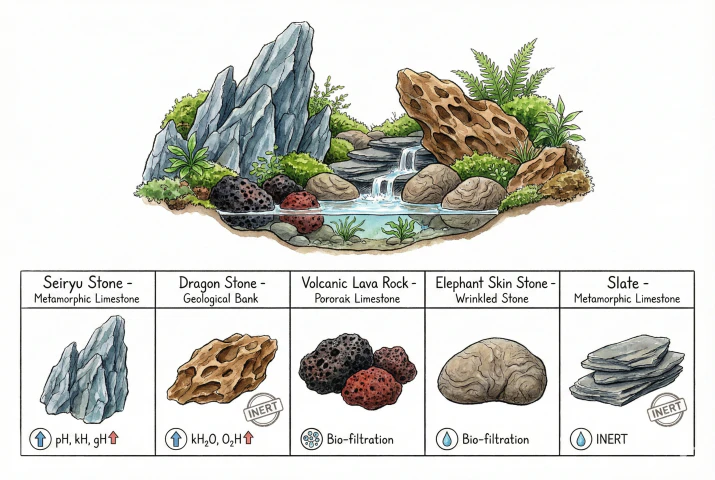
In the Iwagumi tradition, adapted here for vertical paludariums, stone selection tends to favor self-similar texture, meaning a surface that looks broadly consistent up close and from a distance. That consistency helps sell the illusion of scale, though real rock always carries grain, inclusions, and weathering that reveal its actual size.
A smooth, rounded river stone offers few of those texture cues, so it can be harder to read as anything but a pebble.
A piece of Seiryu stone, by contrast, has jagged fissures that can suggest a cliff or mountain range. A small piece framed carefully can stand in for a much larger rock face. This is a compositional effect rather than a fixed conversion ratio.
The Chemical Impact of Stone
Seiryu, Dragon or Ohko, and Elephant Skin are trade names rather than standard mineral names, so the actual rock and its water-chemistry behavior can vary by vendor and batch. Use any comparison as a rough guide and test each batch yourself with the fizz and soak tests described later.
| Stone Type | Typical classification (varies by source) | Texture Profile | Water Chemistry Impact | Best Use Case |
|---|---|---|---|---|
| Seiryu Stone | Usually a carbonate-bearing rock (trade name) | Jagged, deep fissures, grey-blue with white veins | Can raise hardness. Often carbonate-rich, so it can push up pH, kH, and gH depending on volume, alkalinity, CO₂, and surface area. Test before use. | Mountainscapes, cliffs. Best in hard-water tanks, or test/monitor carefully for soft-water species. |
| Dragon Stone (Ohko) | Usually a clay-rich sedimentary rock (trade name) | Holey, scale-like texture, warm browns and reds | Usually low impact, but not guaranteed inert. Test your batch. | Clay banks, eroded cliffs. Often used with soft-water species after testing. |
| Volcanic (Lava) Rock | Igneous (scoria) | Highly porous, rough, black or red | Usually low impact. Porous surface can host bacteria, but it only acts as biofiltration with adequate flow and colonization. | Substrate support, lightweight stacking (high friction). |
| Elephant Skin Stone | Trade name. Composition varies | Wrinkled, leather-like texture | May raise hardness depending on batch. Test. | Rounded, weathered hills. |
| Slate / Basalt | Slate is metamorphic (from shale/mudstone). Basalt is igneous | Flat, laminar layers (slate). Dense (basalt) | Usually low impact, but pyrite, veins, or contamination can occur. Test. | Waterfalls, layered cliff faces, ledges. |
| Stone | Effect on water chemistry | Best use |
|---|---|---|
| Seiryu / Ryuoh | Often carbonate-rich. Can raise pH and hardness. The actual pH reached depends on water volume, alkalinity, CO₂, and surface area, so test rather than assume a fixed figure. | Hard-water tanks. For soft-water species and amphibians, test the batch and monitor, or pick an inert stone instead. |
| Dragon Stone (Ohko) | Usually a clay-rich sedimentary rock with low chemistry impact, not universally inert, so test. | Many community and shrimp tanks (after testing) |
| Lava rock | Usually low impact and highly porous. Only acts as biofiltration with adequate flow and colonization. | Lightweight structural base |
| Slate / Basalt | Usually low impact. Pyrite, veins, or contamination can occur, so test. | Ledges, terraces, layered cliffs |
Practical tip for soft-water setups
If you are building a paludarium for soft-water species such as Dendrobates dart frogs, rasboras, or Caridina shrimp, be cautious with carbonate-rich stone like Seiryu. Raised hardness and higher pH can stress sensitive animals, but the exact effect depends on the species, the batch, your water volume, and buffering.
Rather than assuming, test the actual stone you have. Identify and label the batch, put a representative piece in a container of your source water, and log pH, GH, KH, and conductivity over days to weeks. If the readings drift outside your target range, choose an inert, traceable stone instead. Using only RO water does not neutralize carbonate. Low-alkalinity water can lose pH stability, and pure RO is not suitable animal water without remineralizing. A surface acid wash likewise does not stop carbonate leaching from the body of the rock, so it is not a reliable fix.
Seiryu (and its Ryuoh relatives) is a popular choice for jagged, cliff-like texture. Just plan for the hardness it can add, and confirm it batch by batch.
Seiryu Stones Aquarium Hardscape
Seiryu Stones Aquarium Hardscape is sold under mixed names such as Seiryu, slate, and dragon stone. The listing claim that it does not alter water quality conflicts with the carbonate-hardness behavior described above. There is no independent mineral or batch analysis, so treat any carbonate-bearing stone as needing your own fizz and soak tests, especially for soft-water or amphibian builds. For chemistry-sensitive setups, an inert, traceable stone may be the safer choice.
The Botany of Wood (Lignin vs. Cellulose)
A nano paludarium build showing hardscape and wood placement (external YouTube). General context only, not a source for the specific wood-durability figures below.
Not all wood behaves the same. In a paludarium, wood crosses the waterline between submerged and humid above-water zones, so decay resistance matters.
Submerged wood is not automatically anoxic. Oxygen at the surface depends on flow, biofilm, depth, and how much the wood is decomposing.
Wood decay is driven by fungi and bacteria that break down cellulose, hemicellulose, and lignin along different pathways.
Woods higher in lignin tend to resist decay longer, and tannins can slow some microbes, but neither gives a simple, universal durability ranking.
1. Bogwood or Mopani
Often dense with high tannin content. Denser pieces tend to sink and last a long time, but bogwood is a preservation and trade category rather than one species, and not every piece sinks on its own. Tannins can stain the water brown. Some keepers find blackwater conditions suit certain species, but this is not a universal health benefit and it changes the look.
2. Spider Wood
Often sold as azalea root and popular for root layouts because of its complex branching. It usually floats at first, so you may need to soak, glue, or weigh it down. It commonly grows a white biofilm for the first few weeks underwater. This mixed microbial film is usually harmless, though duration and animal response vary by piece and setup.
3. Manzanita
A hard, dense wood with smooth bark and spindly branches that suit fine canopy detail. It is often sold as fairly rot-resistant, but submerged lifespan depends on the exact wood and preparation.
4. Grapevine
Tends to be soft and can mold or decay quickly in humid or submerged conditions, so it is often a poor fit for a wet paludarium. It can still work in drier setups. Check the individual piece rather than treating the material as strictly forbidden.
Getting wood to sink
You have three common options for making wood stay submerged.
- Soak the wood until water replaces the trapped air. The time depends on density, size, and internal cavities and can range from days to weeks.
- Anchor the wood to a heavy rock. For a large or very buoyant piece, make sure the rock’s weight and the joint can hold the wood’s upward force. Mechanical anchoring is safer than relying on adhesive alone.
- Boiling can speed up waterlogging and clean the surface, but it does not fully sterilize large wood or remove all pathogens. It can also promote cracking or push out more extractives.
Lignin biodegradation by wood-decay fungi (review)
3. Iwagumi in 3D (Adapting Flat Rules to Vertical Space)
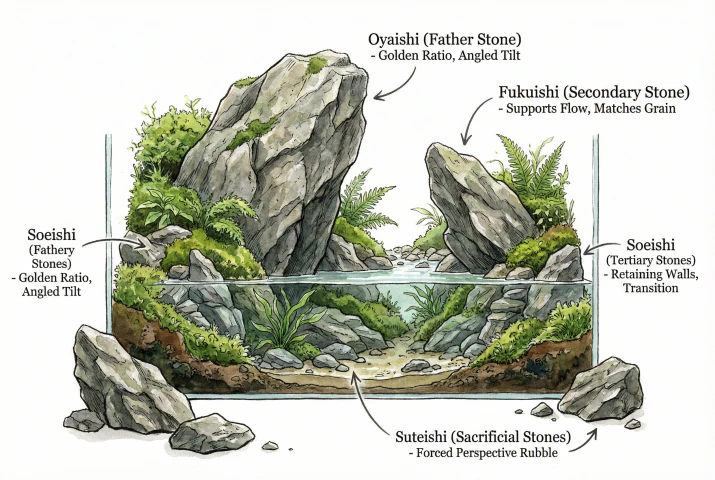
Iwagumi is a Japanese aquascaping style built around a small number of rocks. It is minimalist and hard to do well, and it follows several recognized conventions rather than one official rulebook.
Traditionally it is a fairly flat, low-relief layout on the aquarium bottom. In a paludarium, where you have tall land walls, these ideas need adapting so the result doesn’t read as a flat wall of rocks.
The Cast of Characters
Odd numbers of rocks are a common convention because three rocks tend to read as one grouping, while two can look like separate objects. This is an aesthetic guideline aquascapers use, not a proven law of how the brain counts.
1. Oyaishi (The Main Stone)
This is the largest, most textured rock (the visual anchor of the layout).
- Set the Oyaishi off-center. A golden point is one option, but the Golden Ratio at about 0.618 of the length is not the same as placing it two-thirds across. Choose a point that suits your subject rather than a fixed fraction.
- Many aquascapers tilt the Oyaishi slightly rather than standing it straight up, outside a deliberate pillar style, because the angle can suggest age and weathering. This is a visual choice rather than a requirement.
- In a paludarium the Oyaishi often forms the main cliff face between land and water. Letting it breach the surface can tie the two zones together. If it is tall or heavy, size and support it for the specific tank because a large stone against glass is a structural load, not an aesthetic two-thirds-height figure.
2. Fukuishi (The Secondary Stone)
The second stone supports the Oyaishi visually. If it also needs to brace a heavy main stone, treat that as a separate structural task with its own support design rather than only an aesthetic role.
- Set the Fukuishi on the opposite side or adjacent to the Oyaishi to balance the visual weight. Which way it leans is a composition choice.
- Matching the Oyaishi in color and grain helps the stones read as related rock. The strata do not have to align to an exact 45 degrees. The goal is geological consistency, as if the pieces came from the same source.
3. Soeishi (The Tertiary Stones)
These smaller stones soften the base of the larger rocks and ease the transition into the substrate.
- These smaller stones break up the straight line where the main rock meets the substrate and create a natural scree slope. They can help hold back a soil slope, but retaining a bank of soil or water is a structural job that requires attention to sliding, overturning, base bearing, drainage, and material durability. Prioritize stability, cleaning access, and gaps that cannot trap animals.
4. Suteishi (The Sacrificial Stones)
Basics of arranging hardscape rock (external YouTube). General context for stone placement, not a source for the exact figures in this section.
These are the small rubble pieces you scatter around. The term is often rendered as sacrificial or unobtrusive stones. The idea is that they look incidental rather than deliberately placed, as if they broke off the main rocks over time.
- Placing smaller chips toward the back and larger pieces toward the front creates a scale cue that can add depth. If you break stone to make small pieces, wear eye protection, control the dust, work on a stable surface, and keep fragments contained.
Make the Filled Tank Look Deeper
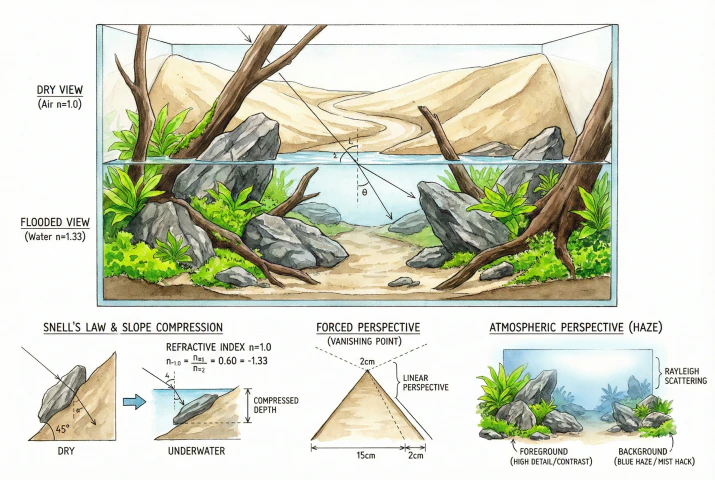
You may be working in a glass box only 18 inches deep while trying to make it feel as if it recedes into the distance. Two things help. Monocular depth cues and an understanding of how refraction changes what you see underwater.
Refraction and the Flat-Slope Effect
Water has a refractive index of about 1.33 and air about 1.0 (a room-temperature, visible-light approximation that ignores glass interfaces and wavelength).
Because of this, an object viewed straight down through a flat water surface appears at about three-quarters of its true depth. This is a small-angle approximation that depends on viewing angle. It does not mean everything in the tank looks 33 percent bigger and 25 percent closer. Looking through the front glass at an angle behaves differently.
- A slope can look less steep once the tank is flooded than it did dry because the apparent depth is reduced. The exact change depends on your viewing geometry.
- Some aquascapers build underwater slopes steeper than they want them to appear. There is no fixed 45-degree minimum or universal rule, and steep banks create real structural loads. Test the look with your own filled tank rather than trusting a set number.
Forced Perspective (The Vanishing Point)
In the Renaissance, painters learned that parallel lines converge at the horizon. We use this linear perspective to trick the brain.
- A sand path or riverbed reads as receding when it is wider at the front glass and narrows toward the back. The brain tends to read that convergence as distance. Scale the widths to your tank and leave room for animals to move and be seen.
- Raising the substrate toward the back corners strengthens the depth illusion, whereas a flat line against the back glass flattens it. How much you can bank depends on the tank, retaining structure, and glass support. A tall rear bank adds significant weight and side load, so design the support rather than aiming for a fixed height.
Atmospheric Perspective (Aerial Perspective)
A dragon-stone mountain hardscape tutorial (external YouTube). Shown as a forced-perspective example, not as evidence for the light or banking figures here.
Outdoors, nearby objects show high detail and contrast, while distant ones look softer, lower-contrast, and bluer. Over long distances this haze, called aerial perspective, is partly due to atmospheric scattering. Inside a tank a few tens of centimeters deep, the air path is far too short to produce that effect, so we simulate it with staging rather than physics.
- Use larger, heavily textured rocks and thicker branches in the foreground, with brighter, healthier-looking planting. Actual color depends on the lighting and species.
- Use smaller rubble and thin twigs in darker, duller tones in the background. If you crush stone to make gravel, use eye and respiratory protection, control the dust, and work away from animals.
- Frosted window film on the back glass, backlit with a cool-white LED, can imitate a hazy horizon glow so the background reads as sky rather than a plastic wall. Color temperature such as 8000–10000 K describes the light’s appearance but does not reproduce atmospheric scattering. Check that the lighting suits the plants and animals.
5. Structural Engineering (Building the Skeleton)
A paludarium is not just a picture. It carries real loads from water, substrate, gravity, and animals. Where those loads matter, such as with heavy stone, tall banks, or retaining structures, size the support for your specific tank rather than assuming a build will not collapse.
Piling loose soil high at the back tends to slump over time as it settles and water erodes it, so raised terrain usually needs structure and drainage behind it. How fast this happens depends on the material, compaction, and water flow, so there is no single timeline.
The Egg Crate (Light Diffuser) Framework
Plastic light-diffuser panels, often called egg crate, are a common lightweight DIY framework in this hobby. Grades vary from brittle polystyrene to PVC or acrylic, and none is a certified structural member, so use them for light framing and shaping rather than primary load-bearing.
- Cut the egg crate into strips and use zip-ties to build a terraced step structure like rice paddies. This holds substrate in place on steep slopes.
- Egg crate raised on PVC pipe sections creates a water reservoir under the land and separates soil from bulk water. Soil left sitting in water can become oxygen-poor, and under the right combination of low redox, sulfate, and microbes it can produce hydrogen sulfide. Waterlogged soil does not automatically generate toxic gas, and not all roots die in it. A false bottom still needs an overflow or drain, a cleanout, a vent, appropriate media grading, and a capillary break, so plan those features rather than assuming the grid alone keeps soil healthy.
- Silicone the egg crate vertically to the back glass so expanding foam has something to grip. Foam applied directly to smooth glass can eventually peel under the weight of wet soil, while the egg-crate grid provides a mechanical lock.
Expanding Foam (PU Foam)
Polyurethane foam such as Great Stuff Pond & Stone is a convenient shaping material for backgrounds and gaps. It is a black, closed-cell foam whose cured outer layer is water-resistant, and the manufacturer lists it as safe for ornamental fish and plants once cured. Read the label and safety data sheet before use because the uncured pressurized aerosol is flammable and can irritate eyes, skin, and airways. Use ventilation and PPE, keep ignition sources away, and keep animals out of the work and cure area.
For product classes, carving, sealing and cure checks, follow the full paludarium expanding-foam handbook.
- Spray it over the egg-crate framework in thin passes to build organic shapes.
- Once cured, carve it with a serrated knife. Trimming off the smooth outer skin gives silicone and coco fiber a rougher surface to grip. Cutting closed-cell foam exposes cut cells but does not turn it into a true open-cell product. Control dust while carving, and cover exposed foam that will see light because UV degrades it.
A pond-and-stone grade foam is convenient here because it is black, so exposed gaps read as shadow. The manufacturer’s stated scope is ornamental fish and plants and a water-resistant closed-cell foam. It is a decorative, gap-forming material rather than a rated amphibian-safe or load-bearing support, so do not use it to hold up heavy rock or wet substrate on its own.
Great Stuff Pond & Stone Foam
Great Stuff pond foam keeps expanding after you stop spraying, so work in thin passes. The manufacturer’s 8-hour cure figure assumes a specific temperature, humidity, and bead size, so deep cavities or multiple passes can take longer. Allow ample cure time, follow the SDS, and do not rely on it for structural load.
Weight Distribution
Glass can crack under a concentrated point load. Whether it fails is not determined by a single weight figure. It depends on the tank’s construction, including rimmed or rimless design, tempered or annealed glass, base support, and manufacturer limits, as well as contact area, edges, chips, and total water and substrate weight.
- A rigid layer that spreads a rock’s weight across a wider area can help avoid point loads. Confirm any material is aquarium-safe first because generic yoga or neoprene mats and egg crate can leach, compress over time, trap grit, or create their own concentrated loads. For heavy rock, use an approved rigid load-spreading base plus mechanical support and check the tank manufacturer’s guidance when possible.
Choose Adhesive by the Job
If you want to stack or cantilever heavy hardscape, don’t rely on balancing, or on adhesive alone.
For anything heavy, the load should be carried by mechanical support such as a stable base, pinned or interlocked stones, or a rock cradle that physically holds the piece. Adhesive should be a secondary restraint using an exact aquarium- or aquatic-rated product within its manufacturer’s ratings, not the thing keeping a heavy rock in the air. Compare cyanoacrylate, silicone, foam, and epoxy by task in the aquarium-safe adhesive guide.
Avoid Super Glue and Cellulose Filler
A popular hobby trick soaks paper towel, cotton, or a cigarette filter in liquid cyanoacrylate to build up a joint. Skip this. Cyanoacrylate reacts violently with cotton and other cellulose materials. It can polymerize fast enough to become very hot, smoke, and even ignite, and serious thermal burns have been documented. A cigarette filter is usually plasticized cellulose acetate with unknown additives and no known aquatic-safety data. The heat and fire risk cannot be managed with a simple warning, so this method has no place in a general how-to.
Cyanoacrylate on its own is brittle and stronger in tension than in shear, and it has not been shown to form a tested structural joint stronger than the rock. Use small amounts to tack light pieces together as a secondary aid, and let mechanical support carry the real load.
A thick cyanoacrylate gel is easier to control than runny liquid and grips porous rock and wood quickly. That suits small dry-fit repairs rather than gap-filling structural joints, which the maker does not rate it for.
Gorilla Super Glue Gel
Gorilla Super Glue Gel is intended for clean, dry surfaces and small amounts, and its maker does not rate it for gap filling or outdoor use. It sets in seconds with no second chances, so dry-fit first, keep fingers clear because it bonds skin quickly, and avoid fumes in eyes and airways. Treat it as a small-repair tack for light pieces rather than a submerged, load-bearing, gap-filling joint.
Cyanoacrylate adhesives in medical/oral applications (review)
Silicone (The Flexible Bond)
Silicone is a flexible elastomeric adhesive. It is useful for glass-to-glass bonds, background panels, and cosmetic coatings when the product is rated for the intended environment.
- Use it for gluing glass to glass when the product is rated for that application.
- Use it for attaching background panels to glass after checking the surface preparation and cure requirements.
- Pressing dry coco fiber into a thin silicone coat creates a plantable-looking surface that hides foam. This is a cosmetic coat rather than a structural bond, so do not rely on a thick silicone-and-fiber slurry for strength.
Silicone Types and Cure Conditions
Not all silicones are the same. Acetoxy types release acetic acid and have a vinegar smell, while neutral or alkoxy types do not. Cure works inward from the surface and depends on chemistry, bead depth, temperature, and humidity, so there is no universal 24–48-hour clock. Use an aquarium-rated product and follow its data sheet for full cure and safe animal re-entry.
Epoxy Putty
A hardscape-gluing walkthrough (external YouTube). General technique reference. Verify any product’s underwater and aquarium-safety claims against its own data sheet.
Some two-part epoxy putties are formulated to cure underwater and set very hard, which can help with rock stacking. This is formulation-specific because not every two-part putty is underwater-curing or aquarium-safe. Check the exact product’s data sheet for immersion, cure, and animal-contact instructions before use. A rock-hard cure is not the same as a rated load capacity or proof of fauna safety.
These putties often come in grey or purple, so you may want to cover them with moss or press rock dust in while still soft.
Keep Land Above the Waterline
The transition zone, where water meets land, is a common failure point. Water can wick up into the soil, turn it to mud, and rot terrestrial plant roots, so it’s worth designing deliberately.
The Wicking Barrier
You cannot simply pile soil on top of rocks or foam that sits in water because water will climb through the media by capillary action, also called wicking.
Keep the Root Zone Above Water
Use the egg-crate framework and a coarse layer such as LECA or clay balls to keep the root zone above the maximum water line. A coarse layer under fine soil does not drain the soil freely on its own. The pore-size change can perch water on top of the fine layer until it saturates, so provide a real drain or overflow.
Screen Does Not Create a Capillary Break
A layer of weed-barrier fabric or fiberglass window screen between LECA and soil keeps dirt from washing into the reservoir and reduces soil migration. It does not create a capillary break or guarantee free drainage, and water can still wick through it. Design a controlled overflow or drain, separate bulk water, and match media so the root zone gets both moisture and oxygen for the species.
Vertical Planting Surfaces (Hydro-engineering)
Plants don’t just grow on the floor. In a rainforest, the best real estate is on the trees (epiphytes). But how do you water a vertical wall without washing it away?
Synthetic Wicking Fabrics
Hygrolon or EpiWeb can wrap around driftwood or a back wall. With the bottom edge in water, these fabrics draw moisture up the surface so mosses and orchids can root on the vertical face. Wicking height and speed depend on fabric, orientation, contact, evaporation, and airflow. A permanently wet surface suits some mosses but can rot orchid crowns and roots, so aim for the wet-dry cycle and airflow your plants need.
Sticky Clay Soil for Planting Pockets
Sticky soil, sometimes called Keto or Muck, is a clay-based material used in bonsai and wabi-kusa. It holds vertical shapes and moisture for moss and small ferns when smeared onto rock or wood as planting pockets. Recipes and behavior vary, so check how it handles erosion, nutrient leaching, and submerged contact in the setup.
The Fogger Effect
Ultrasonic foggers do more than look atmospheric. They raise local humidity. Many also generate heat and can be damaged if they run dry, so check your model’s heat output and run-dry protection.
Placing the fogger in a dedicated, debris-guarded chamber in the water section with mist directed over the moss wall can raise humidity locally. To do this safely, manage electrical isolation, minimum water depth, mineral and microbial aerosol, an animal guard, cleaning, and airflow. A fogger raises humidity but does not recreate a cloud-forest environment by itself. Use the paludarium climate-control guide to coordinate fogging with ventilation and misting.
8. Specific Layout Styles and Geometric Nuance
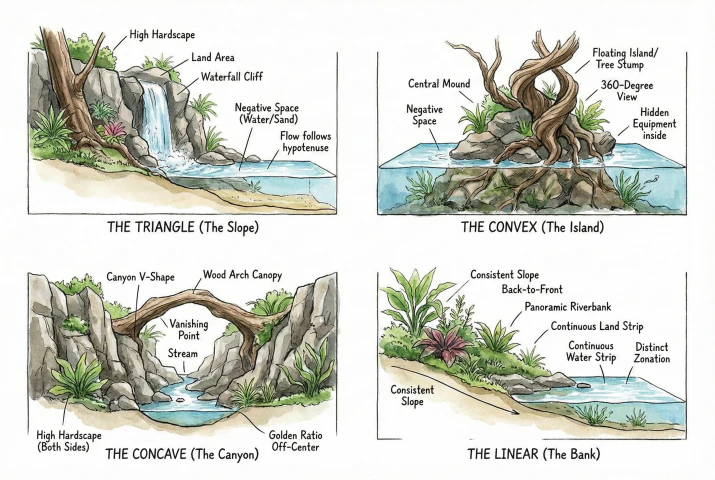
Rather than placing rocks at random, it helps to pick a layout archetype and commit to it. Mixing them can look busy, though skilled hybrids exist. Treat these as starting frameworks, not rules.
The Triangle (The Slope)
This is one of the most common archetypes, and many people find it the easiest to balance visually.
- Build high hardscape on one side, left or right, and slope it down toward negative space such as water or sand on the other.
- Let the grain of the wood and rock follow the hypotenuse of the triangle to reinforce the visual flow.
- Build a waterfall cliff on the high side and let water cascade into a pool in the negative space. The high side becomes land and the low side becomes the aquatic zone. Available swim space depends on pool volume, depth, and flow, while the land wall still needs to be stable and safe for inhabitants.
The Convex (The Island)
- Build a central mound of hardscape with negative space on both sides.
- This isolated, dramatic layout works well for tanks viewable from three sides when access and equipment routing allow it.
- A floating island or central tree stump can rise from the water. Because it is viewed from all sides, there is no background to hide equipment behind, which makes cable and pump routing harder. If you conceal a heater or filter inside a hollow stump, preserve the manufacturer’s heater clearance and thermal cut-off, unobstructed intake and flow, protected cabling, no animal entrapment, and tool-free service access. Concealing hardware should never compromise safety or maintenance.
The Concave (The Canyon)
- Build high hardscape on both sides and dip down to a low point near the middle, slightly off-center if that suits the composition.
- Many aquascapers find this the strongest archetype for depth because the V-shape draws the eye toward the back. Its effect still depends on viewing angle and tank shape.
- Build two cliff faces with a stream between them. A piece of wood bridging the top can form a canopy arch that frames the distant view and guides the eye toward the vanishing point. Check that the bridge has clearance, resists moisture decay, and allows access and animal movement.
The Linear (The Bank)
- Build a consistent slope from back to front across the whole length.
- The result is panoramic, like a slice of a riverbank.
- This works well for wide, shallow tanks with a continuous land strip at the back and a continuous water strip at the front. It allows distinct submerged, emersed, and terrestrial zones across the width.
9. Botanical Scale (Small-Leaved Plants and Plant Physiology)
You can build a convincing mountain range from Seiryu stone, lay out a good perspective path, and shape a waterfall, but planting a large Monstera deliciosa in the middle collapses the sense of scale. That is the botanical-scale problem.
To keep a small box reading as a large landscape, choose small-leaved, scale-compatible plants. A small leaf reads like a normal leaf seen from far away.
Microphylly is a specific botanical term for a leaf type, so it is not quite the right word for tiny leaves here.
The Distant Tree Mimics
| Plant Species | Mimics | Placement | Care Notes |
|---|---|---|---|
| Asparagus setaceus (Asparagus Fern) | Pine / Acacia Tree | Background / High Canopy | Not a true fern. Fast-growing, climbing and spreading, it can reach roughly 2–3 ft as a houseplant, so it needs frequent aggressive pruning to stay in scale and can escape a layout. Provide good light. |
| Biophytum sensitivum | Palm Tree | Jungle Floor / Midground | Leaves fold when touched. It needs high humidity and reads like a miniature palm. |
| Ficus pumila ‘Quercifolia’ | Oak Tree / Ivy | Background Wall / Driftwood | Oak Leaf Fig with small leaves around 5 mm. It is slower than standard creeping fig but still a spreading creeper, so trim it to keep it contained. |
| Ficus microcarpa (Ginseng Ficus) | Ancient Banyan Tree | Focal Point | Thick caudex roots resemble old trunks. Often sold as bonsai, it is a vigorous tree kept small by regular pruning and root management rather than a naturally miniature plant. |
These plants can mimic full-sized trees, but several are vigorous. A plant that stays small usually means it can be pruned to stay small, which is ongoing work.
Check each species’ mature size, growth rate, light, humidity, and any toxicity or animal-contact concerns before committing.
The Distant Shrub Mimics
These create the underbrush. Wet-adapted aquarium plants can work well here in emersed form, though whether they suit your setup depends on humidity, light, and substrate.
Anubias Pangolino
Anubias Pangolino is one of the smallest trade cultivars and can grow emersed in high humidity. It is hardy but not indestructible, so watch for rhizome rot, algae, and light requirements and confirm the trade identity.
Bucephalandra
Bucephalandra is a rheophytic or epiphytic group from Borneo with many small trade forms and often iridescent leaves, useful as miniature shrubs on cliffs. Cultivar names are taxonomically loose, and the plants need suitable light, flow, and humidity.
Hemianthus callitrichoides Cuba
Hemianthus callitrichoides Cuba is usually grown as an aquatic carpet, but it can grow emersed on damp soil into a dense tiny mat that reads as a distant meadow when given high light, humidity, nutrients, and a careful transition.
The Moss Factor
Choosing and growing vivarium plants (external YouTube). General reference for the plant section, not a source for the growth rankings below.
Moss is one of the best ways to suggest age and scale. A moss-covered rock reads as old.
Java Moss
Taxiphyllum barbieri grows fast and irregularly, making it useful as background filler when humidity, airflow, and an attachment method are available.
Christmas Moss
Vesicularia montagnei grows in triangular, branching fronds and can weep over branches when conditions and trimming are suitable.
Fissidens fontanus
This moss has a fine, feathery texture and grows slowly, making it useful for detail work.
10. Concrete Verification Criteria (How to Judge the Layout)
Before you add water or plants, judge the hardscape. Once the tank is flooded, moving a 20 lb rock can cloud the water for days. Be critical while the layout is still easy to change.
This practical set of tips evaluates hardscape appearance. It is not the official rubric of the IAPLC or the AGA. Those contests also weigh fish habitat, health, long-term maintenance, skill, originality, naturalness, composition, developed land and water, materials, harmony, fauna suitability, and year-long viability. Use the tips to judge aesthetics, but do not treat them as a substitute for animal welfare, mature-plant sizing, and long-term viability.
The Hardscape Checklist
- Step back and squint until the details blur. You should still read clear dark hardscape masses and light negative space. If the layout looks like a grey soup, open the negative space and adjust the viewing distance to the tank.
- Trace the lines of the driftwood and rock strata. Lines that flow into each other tend to read as cohesive, while many hard 90-degree crossings can look busy. This is a guideline rather than a rule, and deliberate contrast can work.
- Shine a flashlight from the top-front where the light will sit. Shadows under overhangs add volume, while flat even light reads flatter. Tilting rocks can deepen shadows, but check stability, glare, plant lighting, and animal hiding spots first.
- Look for visible egg crate, glue, or pump intakes and hide them with small stones or moss where possible. Never block an intake, inspection point, service access, or animal refuge just to hide equipment.
- Gently test the main stones for movement. A stone that shifts now can fall later as substrate settles. Improve mechanical support with a stable base, pinning, or a rock cradle rather than adding more glue, and do not use the super-glue-and-cellulose method described earlier.
The Time Machine Test
Ask yourself what this will look like in six months.
- Leave space for the plants to grow. Negative space can disappear when a fast-growing fern fills it.
- Check whether you can reach the glass to clean it. Hardscape against the front glass makes algae removal difficult, so leave enough space for your tools and check that gaps cannot trap animals.
The Art of the Living Box
Layout and visual-rules walkthrough for aquascaping (external YouTube). It is a closing overview of composition principles, not evidence for specific chemistry, structural, or safety claims.
A good paludarium isn’t about buying the most expensive gear. It’s largely about observation.
Go outside and look at a riverbank, where it’s legal and safe to do so.
Notice how tree roots tend to wrap around stones, how small rocks gather in the crevices of larger ones, and how vegetation gets smaller and hazier with distance.
Bring those observations back to the build. Use the Golden Ratio to frame the composition, sound mechanical support with adhesive as a secondary aid, and an understanding of refraction to enhance depth.
Getting the hardscape right is a strong foundation, but it does not run the tank on its own. Healthy plants and animals still depend on separate husbandry such as filtration, stocking, water chemistry, and ongoing maintenance. Good flow can help reduce dead spots but does not guarantee clean water by itself.
Keep safety ahead of appearance whenever you glue, cure, or lift anything heavy.
Affiliate Disclosure
This article contains Amazon affiliate links. As an Amazon Associate I earn from qualifying purchases. If you use these links, the site may earn a commission at no extra cost to you. Product availability, price, and specifications can change. Check the current listing before buying.