
Paludarium RO System: Water Quality & Remineralizing
Decide whether a paludarium needs RO water, test source water correctly, keep mist and animal water separate, remineralize to species needs, and maintain RO and misting equipment safely.
Samuel Reed · Published 2025-12-17 · 12 min read
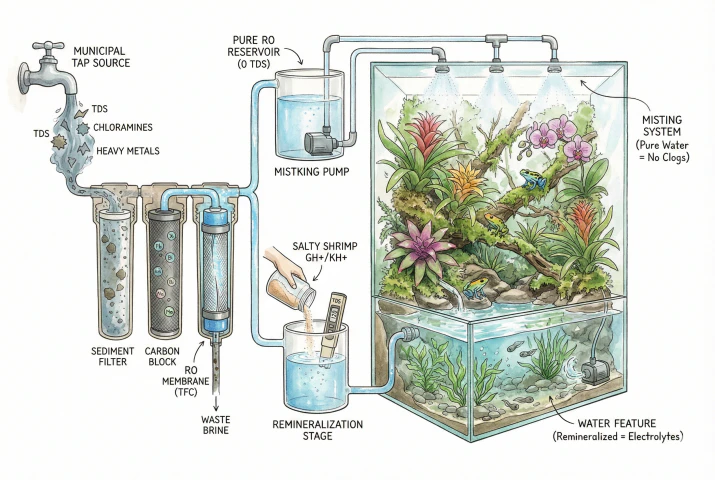
1. Decide Whether RO Water Helps
I label samples from tap water, RO output, remineralized reservoir, and the paludarium on the same day. The samples are tested in that order with the same calibrated tools and saved as one chain.
When the tank drifts, the chain helps me isolate where the change first appears across the source, membrane, mixing bucket, and enclosure. Testing only the final water can make an upstream failure look like a remineralization mistake.
Start With Source Water Testing
RO water is not mandatory for every paludarium. The decision depends on your tap water and the requirements of the plants and animals. Read the local water report and test your source water before choosing conditioned tap water, RO/DI, or reconstituted water.
1.1 Total Dissolved Solids (What a TDS Reading Does and Doesn’t Tell You)
A handheld TDS meter is a trend tool, not a complete water-safety test. It estimates dissolved solids from electrical conductivity. Use it to track source water and RO performance, not to identify GH, KH, individual ions, chloramine, metals, organics, pathogens, or animal safety.
Scale on Glass and Gear
Misting sprays water that evaporates while the nonvolatile solids stay behind. In hard water, that residue can build into visible scale on glass over time. How much, and how much of it is calcium carbonate, depends on the water’s actual hardness, alkalinity, and ion mix, not on the TDS number alone.
Clogging Risk
Mineral scale can build up on misting nozzles and eventually clog them, so lower-mineral water helps keep them clear. A working RO membrane can cut most of that dissolved load, though exactly how much varies as the membrane ages and the source water changes.
1.2 Chloramine (Why Letting Water Stand Isn’t Enough)
Letting water stand is not a reliable way to remove monochloramine. Many utilities use it as a longer-lasting secondary disinfectant made by combining chlorine and ammonia.
As of 2009 the EPA reported that more than one in five Americans were served water treated with chloramine. Whether yours is depends on your utility, and some switch disinfectants seasonally, so check your water utility’s report.
Because monochloramine is more persistent in distribution than free chlorine, chemically neutralize it with an approved conditioner or physically filter it.
Residual disinfectants can harm aquatic animals. Confirm whether the utility uses chlorine or chloramine, neutralize it with an appropriate conditioner or verified filter, and check removal with a low-range total chlorine/chloramine test.
1.3 How Reverse Osmosis Works
RO uses pressure to separate much of the dissolved load from water. It does not guarantee removal of every contaminant. Verify any specific contaminant-reduction claim for the exact unit, and investigate rising output TDS instead of assuming one failing part is the cause.
1.4 Why Pure Water Is Not a Finished Product (Osmotic Shock)
Ultra-pure 0-TDS water is not a finished long-term water for animals. Freshwater animals are generally hyperosmotic to their surroundings (their internal salt concentration is higher than the water) so they lose ions across permeable surfaces and must take them back up.
Amphibian skin in particular is a major route for water and electrolyte exchange, which is why deionized water should not be used as-is for long-term animal water.
Keeping animals in very low-ion water can cause ionic and calcium problems, and in some tadpole populations low-ion conditions have been linked to developmental problems.
But the exact safe threshold, exposure duration, and outcome are species- and life-stage-specific, so treat the warning about pure water as a reason to remineralize deliberately, not as a fixed prediction of immune failure or death for every animal.
For animal water, follow an authoritative species protocol or a veterinarian/collection plan, such as AZA-derived amphibian guidance, rather than one-size-fits-all numbers.
Watering plants and substrate with very low-nutrient water can also affect the substrate’s nutrient balance over time, though how much depends on your substrate, dosing, and plants.
Choose the Water Stream for Its Job
Use RO to start with more predictable water, then add only the minerals required by your plants or animals. Do not treat sodium as automatically harmful or harmless. The right mix and target come from a documented species protocol and measured tests.
2. Choose an RO System by Volume and Source
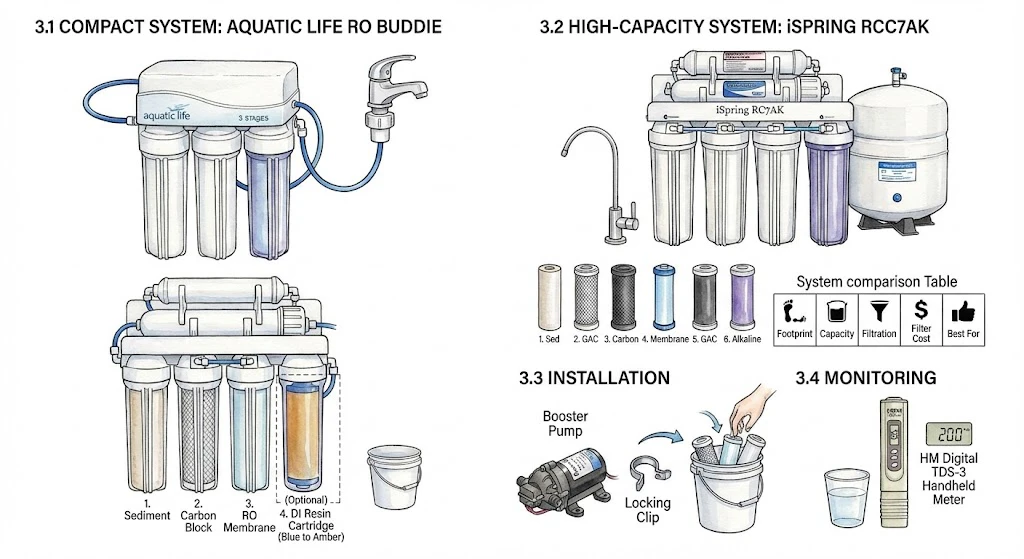
Choose the Unit by Volume and Source
Two common choices are a compact aquarium unit or an under-sink drinking-water unit. Other options exist too, appropriately conditioned tap water, purchased RO, or lab-grade reconstituted water, and the right pick depends on your source-water test and the volume you need.
2.1 The Compact Unit
If space is tight, a compact unit that hooks to a bathroom faucet, makes a few gallons, and stores in a closet can be enough.
A compact RO/DI unit can suit a small misting reservoir when it has a small footprint and you can make water ahead of time. Confirm the current stage configuration and connection type for the exact model.
What to Weigh in a Compact Unit
The RO Buddie suits a small misting reservoir when space is tight and you can make water ahead of time. It has no storage tank and produces waste water, so plan the collection and disposal. Test feed, RO output, and final DI output separately. Do not assume its standard carbon stage removes chloramine unless the correct cartridge is fitted and verified.
2.2 The High-Capacity Unit
For a larger collection or a dual-purpose home-and-hobby setup, an under-sink unit with a pressurized storage tank gives water on demand.
iSpring RCC7AK-BN suits a larger collection or a home-and-hobby setup that benefits from a storage tank. It is a drinking-water system with an alkaline remineralization stage, so take any vivarium water sample before that stage when you need raw RO water. Check the exact unit’s replacement parts and plumbing requirements before buying.
What to Weigh in an Under-Sink Unit
iSpring RCC7AK-BN costs more and needs plumbing. For vivarium use, take raw RO water before its alkaline stage and plan how you will keep the tank and tubing clean. Household drinking-water use may be convenient, but it does not make this a universal best choice for vivariums.
2.3 Installation Notes
Higher feed pressure generally improves permeate flux, rejection, and the waste ratio. Many small membranes are rated for around 60 psi, and on a well or weak supply (roughly 40 psi) you may waste more water to brine and produce slowly.
A booster pump can help in those cases, but the pressure a given unit needs (and whether a booster is warranted) depends on the manufacturer’s rated range, your feed temperature, and the pump’s shutoff controls, so follow the spec for your model rather than a blanket number.
2.4 Monitor It
Test at three points, not just one. The feed water, the RO permeate before the DI stage, and the final DI output.
If you only read the final output, the DI resin can mask a failing RO membrane by showing 0 until it exhausts.
A rising permeate reading (relative to your feed) flags a tiring membrane. Keep membrane rejection, carbon breakthrough, DI exhaustion, pressure, temperature, and the waste ratio as separate maintenance items.
A TDS meter will not catch carbon/chloramine breakthrough or microbiological issues, so those need their own checks. Trust the measurements, not just the calendar.
What to Weigh in a TDS Meter
HM Digital TDS-4 is useful for tracking feed, membrane, and remineralized-batch trends. It is not a pH, GH, KH, chloramine, copper, or individual-ion test, so pair it with the dedicated tests your water and animals require.
3. Remineralize Water for Its Actual Use
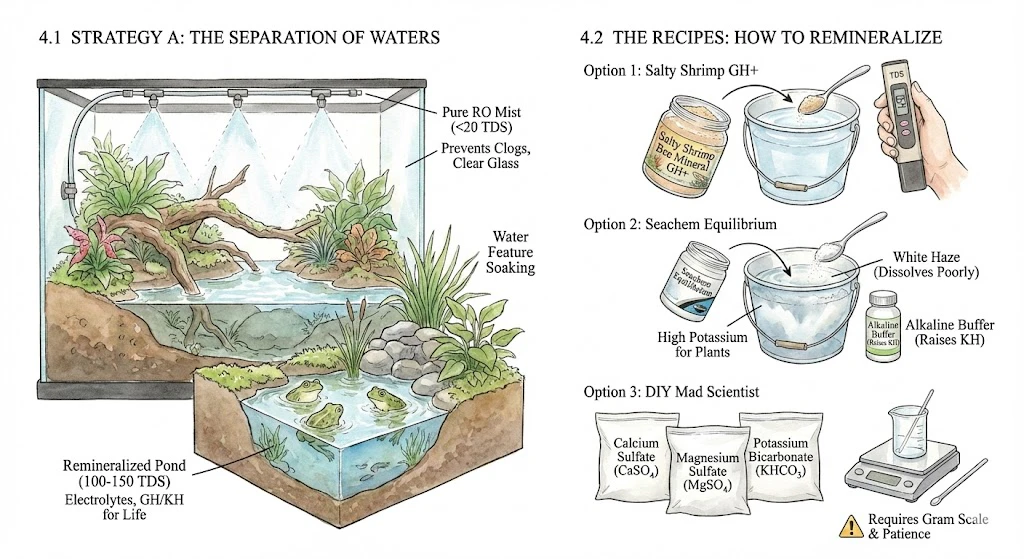
Separate Mist Water From Animal Water
With low-TDS water in hand, add minerals back for plants and animals without re-clogging the nozzles you protected. A useful practice is to separate your waters so you can control scale in the mist line and dose the pond deliberately. Confirm your specific animals and plants are served by whatever targets you choose.
3.1 Separation of Waters
Misting Reservoir
Low-mineral water keeps nozzles clear and glass cleaner. Whether pure RO mist is safe for your animals is not automatic, though. Many amphibians absorb water through skin and moist substrate rather than by drinking, so repeated misting can be a real part of their water exposure. Do not assume a mineral-rich pond, substrate, or leaf litter makes up the difference unless you know your species uses those sources. Measure mist dose and behavior for your enclosure rather than treating 0–20 TDS as a universal safe target.
Water Feature or Pond
Where animals soak, they need species-appropriate electrolytes and buffering. General hardness (GH) and carbonate hardness (KH). Note that it is alkalinity (KH), not GH itself, that buffers against pH swings. A TDS number alone does not tell you GH, KH, or whether the water suits your species.
3.2 Choose a Tested Mineral Approach
Plain aquarium salt is not a substitute for a balanced remineralizer. It does not establish the calcium, magnesium, and carbonate balance represented by GH and KH. Use a product or recipe only when it matches a target you can measure for the species in the enclosure.
A shrimp mineral can raise GH and KH together, but a shrimp-tank formula is not automatically suitable for a mixed frog, fish, and plant paludarium. Mix any mineral in a separate bucket, test GH and KH before it reaches the enclosure, and do not use one TDS reading as a complete recipe.
Salty Shrimp Mineral GH/KH+ costs more per gram than DIY salts but is convenient and consistent when you don’t want to weigh chemicals. You still need to test the resulting GH/KH rather than assuming a fixed dose.
Seachem Equilibrium can suit a planted water feature when you need to raise GH without using it in the mist line. It does not raise KH and includes plant nutrients, so it is not a complete animal-water formula. Check the species plan and test the finished batch before use.
A DIY approach exists, but a common formula using three parts calcium sulfate to one part magnesium sulfate plus potassium bicarbonate is not a usable recipe as written. A mass ratio does not fix the delivered moles because it depends on the exact hydrate form and purity of each salt, and it specifies no final concentration, Ca, Mg, GH, KH, sodium, or species target.
A gram scale alone does not make it safe. For animal water, use an authoritative species protocol or a veterinarian/collection plan rather than an unspecified DIY mix.
4. Set Up Misting Safely
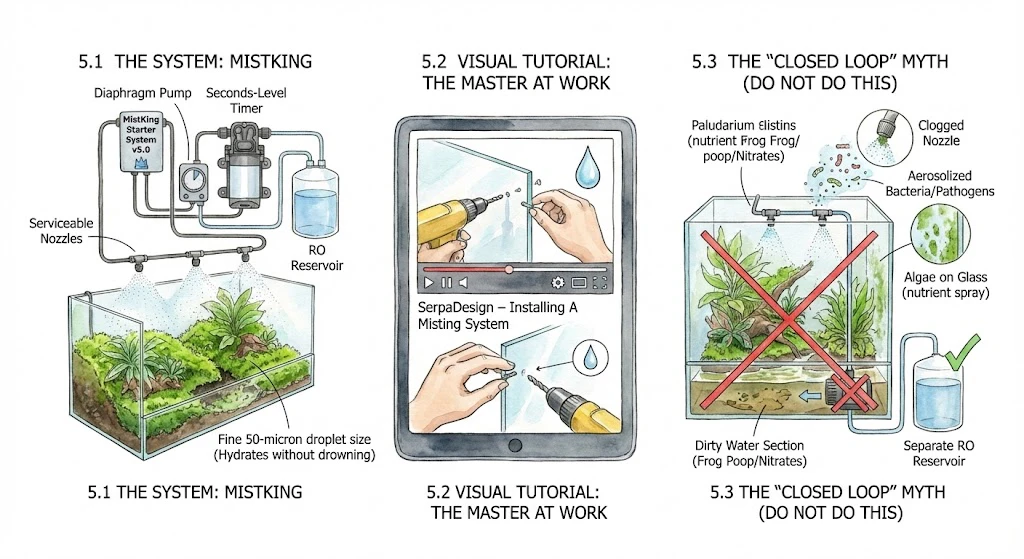
Choose Droplets, Drainage, and Safety
Automated misting is a common way to keep a planted paludarium humid, but it is not the only one, and a tank without it is not automatically a drying box. If you do automate, a system that delivers fine droplets on a timer can hydrate foliage while limiting how much you flood the substrate.
How well it does that depends on nozzle placement, dose, drainage, and the plants, so measure coverage and leaf wetness in your own enclosure rather than assuming a droplet size guarantees the result.
Low-mineral water helps keep the nozzles from scaling.
MistKing system suits an enclosure that needs scheduled, directed mist rather than a general humidity boost. Its timer and serviceable nozzles help control the routine, but drainage, nozzle placement, and inspection still prevent flooding. Choose the kit capacity and parts for your actual enclosure instead of assuming every MistKing kit is the same.
What to Weigh in a Misting System
A fogger mainly raises humidity, while a pumped misting system places water where the nozzles point. Choose the method by the plants’ and animals’ needs, then plan reservoir sanitation, a GFCI, a drip loop, and leak and flood fail-safes as part of the installation.
Don’t Recycle Tank Water Into the Misters
A common question is whether you can pump water from the paludarium into the misting system. As a conservative default, do not. Even filtered tank water carries biofilm and debris that can foul fine nozzles, and misting aerosolizes whatever is in the water.
Claims that this will spread Aeromonas or grow scrub-resistant nitrate-fed algae are plausible concerns rather than measured certainties. Nozzle hygiene and bioaerosol risk are still sufficient reasons to keep the systems separate.
Mist from a separate reservoir of RO water. Note that a separate reservoir also has no disinfectant residual, so biofilm can grow there too. Use an opaque, covered vessel with clean tubing, turn the water over regularly, and follow the manufacturer’s sanitation guidance.
5. Troubleshoot with Tests, Not Assumptions
Myth. RO Water Is Unnatural
Rain is also low in minerals, so the analogy is partly fair, but rainwater chemistry varies a lot with marine aerosols, dust, emissions, and the collection surface, and published urban and coastal samples fall outside a tidy 0–15 ppm range.
RO is not identical to rain because its storage microbiology differs. Treat this as an analogy for low mineral content, not a rule that the pond should mimic any fixed rainfall number.
Myth. Dripping Misting Nozzles Always Mean Pump Failure
Not necessarily. A drip can come from mineral debris on the check valve, but also from a worn check valve, retained line pressure, a siphon effect, a damaged tip, trapped air, a loose connection, or a pump/control issue, so diagnose before cleaning.
If the manufacturer confirms the nozzle material tolerates it, a white-vinegar soak can help with mineral buildup. Only use a specific cleaning agent at the concentration and contact time the manufacturer approves, with appropriate PPE, a thorough rinse, and the animals removed from exposure.
Don’t poke the orifice with a needle. You can damage the precision spray pattern. Follow MistKing’s maintenance and replacement guidance instead.
Myth. RO Automatically Changes pH
Pure RO has very low alkalinity, so its pH is easily shifted and can drift as it absorbs CO₂ into carbonic acid. Measuring pH in such low-conductivity water is itself tricky.
That is a reason the water feature needs some buffering, but a small RO top-off does not automatically crash a buffered system, and there is no single correct pH. Choose a target range and carbonate dose based on your tank’s alkalinity, substrate, gas exchange, and the needs of your species.
6. Conclusion
Start With Measurements
Start by testing, not by installing. Read your utility report and measure your source water for the disinfectant, GH, KH or alkalinity, pH, temperature, and any relevant ions. Then decide whether RO/DI, conditioned tap, or reconstituted water fits your source and species.
If you use RO, keep the mist reservoir separate from the tank and remineralize animal water to a verified species-appropriate target. Check feed, pre-DI, and final output separately. A TDS meter alone cannot confirm disinfectant removal, carbon performance, DI exhaustion, or animal safety.
Affiliate Disclosure
This article contains Amazon affiliate links. As an Amazon Associate I earn from qualifying purchases. If you use these links, the site may earn a commission at no extra cost to you. Product availability, price, and specifications can change. Check the current listing before buying.