
Driftwood Blackwater Paludarium: Tannins & Tint Guide
A practical look at driftwood blackwater: what tannins and dissolved organic matter can and can't do, the pH-crash concern in context, how to sink and anchor wood safely, managing tint, and handling biofilm and mold.
Elena Vargas · Published 2025-12-18 · 10 min read
Key Takeaways
- Driftwood tint is a mix of tannins and other dissolved organic matter rather than dirt, and any metal binding or fish-stress effect is conditional, so test rather than assume a benefit.
- The pH-crash concern is often overstated in buffered water, but alkalinity is consumed as acid and nitrification proceed, so low-KH water can still fall and should be measured before and after adding wood.
- Choose wood by species, density, dryness and contaminant history rather than a simple hardwood-versus-softwood rule, and avoid green or resinous wood.
- Scrub and boil or cold-soak to remove trapped air and surface tannins, anchor stubborn pieces mechanically, and never combine cotton or other natural fibers with cyanoacrylate glue.
- Manage tint with a suitable adsorption medium, expect early white biofilm on new wood, and add cleanup animals only after the tank is cycled and species-compatible.
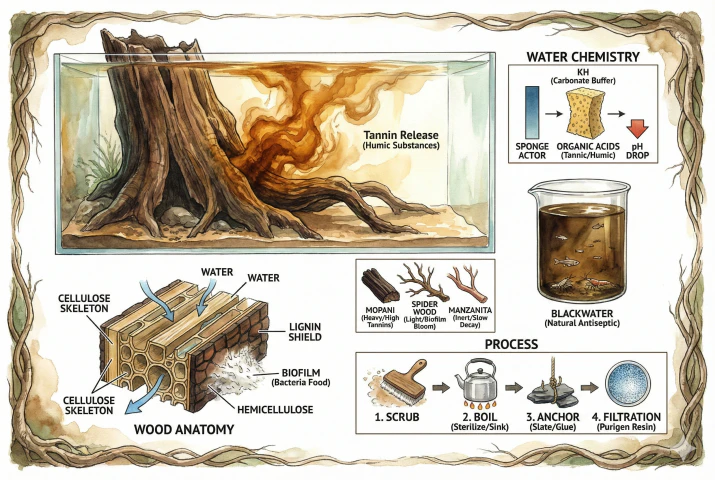
Submerged driftwood releases tannins and other dissolved organic matter that can tint the water tea-brown. The color is not dirt, but neither is it a treatment for water problems.
Choose verified, contaminant-free wood and decide whether its tint suits your livestock and water chemistry. Test the tank instead of assuming the color is helpful or harmful.
1. Know What the Wood Can Change
Wood type, condition, and contaminant history matter more than whether a piece is simply called hardwood or softwood. Identify the wood and prepare it carefully before it enters the tank.
I soak 50 grams of each dry candidate wood in separate covered containers holding one liter of source water and keep a water-only blank beside them. At zero, 24, and 72 hours and seven days, I photograph each container against white paper and record pH, KH, odor, and surface film. The fixed ratio and early-to-week checkpoints make pieces comparable without pretending the small trial predicts the finished paludarium concentration.
I use the series to separate a strongly staining piece from one that barely changes the source water and to choose which wood needs longer preparation. It is a comparison between candidates, not a forecast of the finished paludarium concentration.
What Wood Releases
Submerged wood takes on water, releases color, and may develop a white biofilm. Density, dryness, resins, and decay all affect how it behaves. A large, fresh piece can add more organic matter than an established tank can handle.
Brown water contains tannins and other natural organic compounds. These compounds can change how some metals behave in water, but they do not reliably detoxify a tank, prevent disease, or reduce stress for every fish. Manage the effect with water tests and livestock-specific care.
Check pH and KH Instead of Guessing
Measure KH Before Adding Wood
Driftwood does not usually cause a sudden pH crash in well-buffered water, but low KH can fall over time. Nitrification also uses alkalinity, so do not assume the buffer is permanent.
Measure source and tank pH, KH, GH, ammonia, and nitrite before adding wood, then watch the trend for several weeks. Secure any buoyant piece so it cannot damage the lid or equipment.
2. Prepare and Secure the Wood
Preparation is about control. Raw wood can float for weeks and can darken the water quickly, so a little prep saves trouble later.
2.1 Sourcing
Store-Bought Wood
Store-bought wood is usually easier to identify, but trade names and preparation still vary. Dense mopani often sinks sooner, while twisty spider wood or azalea root often needs more soaking and may develop early white biofilm. Treat those as tendencies, not guarantees.
Use Found Wood Only When Its History Is Clear
Free found wood carries higher risk. Avoid green live wood because sap and sugars can feed a bacterial bloom that drives up oxygen demand. Found wood can also carry species misidentification, pesticides or treated lumber, roadside or industrial runoff, marine contaminants and internal decay that a snap test cannot rule out. Confirm the species is safe and non-resinous, rule out chemical exposure, and do not use it if you cannot verify its history.
2.2 The Preparation Protocol
Step 1. Scrub
Wire-brush the wood to remove soft spots, loose bark and dirt. If it crumbles now, it will crumble in the tank. Check the brush for shedding metal bristles and knock down sharp edges. Scrubbing removes loose surface material but does not verify that the wood is contaminant-free or sound inside, so it is not a substitute for knowing the wood’s source.
Step 2. Boil or Cold-Soak
Simmering helps remove surface tannins and trapped air, which can help a piece sink. It does not sterilize a large porous log. For a large piece, a patient cold soak with water changes is usually safer than handling it in boiling water.
Boil With Realistic Safety Limits
If you do boil, work with good ventilation, use a dedicated pot because tannins can stain cookware, and account for the hazards of hours-long boiling. Scalding water and steam, the weight of a full pot, stove capacity and moving a hot heavy piece all matter.
CONCORD Stainless Steel Stock Pot
A CONCORD stock pot can suit a wood piece that will not fit a standard kitchen pot. Measure the wood, check your stove rating, and allow for water displacement before choosing a size. A large pot is bulky to store and unsuitable for some stovetops, but a dedicated one avoids staining cookware used for food.
Step 3. Soak
For pieces too big to boil, use a plastic tote of water and change the water regularly. A casual splash of 3% hydrogen peroxide is not a reliable way to disinfect wood. If you use any disinfectant, follow a proven concentration and contact-time protocol, rinse thoroughly, and protect your eyes and skin.
Sink time varies with size, density, and dryness (roughly a week for some mopani, longer (weeks) for stubborn pieces like manzanita).
Judge readiness by stable, fully submerged buoyancy, not by the calendar.
Step 4. Anchor
Still floating after weeks of soaking? Anchor it mechanically.
Slate Method
Drive a stainless-steel screw through the wood into a slate tile and bury the slate under substrate.
Confirm the screw is fully seated, use an appropriate stainless grade, and make sure no sharp screw point can protrude or press against the glass or reach animals.
Safety (Do Not Use the Cotton-and-Super-Glue Trick)
A widely shared method tells you to pack cotton or paper towel into a joint and saturate it with cyanoacrylate (super glue) gel. Do not do this. Cyanoacrylate reacts strongly with cotton and other natural fibers and can generate enough heat to cause burns or even ignite (Poison Control specifically warns against combining the two).
If you use super-glue gel at all for aquascaping, apply a small amount to a clean, dry surface without cotton filler, following the manufacturer’s directions.
A gel is easier to control on a vertical joint than liquid glue. Gorilla does not certify this product for aquarium use, continuous immersion, or animal contact. Use only a small amount on clean, dry surfaces and allow it to cure fully.
Gorilla Super Glue Gel
Gorilla Super Glue Gel suits a small, dry, vertical joint when you need glue that will not run immediately. It is not a manufacturer-certified aquarium adhesive, so do not use it as proof that a submerged or animal-contact joint is safe. Never combine it with cotton or other fibrous filler.
3. Manage the Tint and Early Biofilm
Keep Blackwater Clear
A blackwater tank can be tinted and still clear. Cloudiness, bad odor, unusual animal behavior, or poor water tests are warning signs to address, regardless of the color.
3.1 Filtration (Managing the Tint)
Dense wood can darken water quickly. If the tint does not suit the display or livestock, use an appropriate adsorption medium rather than repeatedly boiling the wood.
Choose an Adsorption Medium
Activated carbon removes organics, but its service life is not a fixed two weeks. It depends on media mass, organic load and flow, and its effect on trace elements depends on the media and the specific ions.
A regenerable alternative is Seachem Purigen, a macro-porous synthetic polymer that adsorbs organics and color. The beads darken as they load, and Seachem’s regeneration procedure is specific. Follow the full procedure, including the stated bleach, rinsing, dechlorination, buffering and chlorine checks, before returning it to the tank.
Poly-Bio-Marine Poly Filter Pad
Poly-Bio-Marine Poly Filter Pad is a disposable option when you want to reduce tannins and other organics without following a resin-regeneration process. The manufacturer says it cannot be safely cleaned or regenerated and must not be washed in bleach or chlorinated water. It can also adsorb phosphates, metals, and some medications, so replace it when spent. Use a regenerable resin only if you are prepared to follow that product’s full regeneration instructions.
3.2 The White Fuzz Phase
Watch Early Biofilm
Within the first weeks, new wood often grows a translucent white slime. This is common and usually a harmless microbial biofilm, though appearance alone cannot confirm exactly which organisms are present. Watch water quality, odor and animal behavior rather than diagnosing by looks. Timing varies from piece to piece and is not always exactly two weeks.
Some shrimp, including Amano or Neocaridina, and snails will graze this biofilm, which often recedes on its own. Add cleanup animals only when the tank is cycled, with ammonia and nitrite at zero, and the water chemistry matches each species’ needs. Check temperature, pH, GH and KH, and confirm that copper or medications are absent. Livestock compatibility comes before biofilm control.
Handle Mold Above the Waterline
Submerged wood often develops biofilm, while wood above the waterline can grow visible mold in high humidity. A white patch cannot be identified safely from appearance alone. Watch the water, the animals, and whether the growth keeps spreading.
A springtail and isopod cleanup crew in the terrestrial section can help graze some mold and detritus, but this is not guaranteed to eliminate mold in every setup. The result depends on the species, humidity, ventilation, substrate, escape barriers and available food. If mold persists, revisit ventilation and airflow.
You can also attach Anubias or Java moss near the waterline, where the wood may wick water up to the plant while the leaves take CO₂ from the air. Keep the Anubias rhizome unburied but moist. Wicking does not guarantee constant moisture or free growth, and Java moss can still struggle depending on light, flow and how wet it stays.
4. Troubleshooting (Q&A)
Salt in Collected Wood
Most aquarium wood is not salty, but beach-collected wood is different. Do not assume absorbed salt is negligible because the tank holds 20 or more gallons. The result depends on how much salt the piece holds and your water volume, while freshwater fish and shrimp differ in salt tolerance by species. Beach wood also carries marine contaminant and fouling risks. If you cannot confirm its history and rinse it well, leave it out of a freshwater setup.
Tannins and the Nitrogen Cycle
There is no established tannin threshold at which color alone stalls nitrification. What stresses nitrifiers is measurable pH, alkalinity, dissolved oxygen, temperature and organic load. In low-alkalinity water, falling pH can harm both fish and nitrifying bacteria, so if ammonia or nitrite rise, test and hold off on adding livestock.
Do not expect tannins to protect the filter while selectively controlling waterborne pathogens. Maintain the filter and water quality normally.
When Boiling Does Not Stop Tint
Boiling mainly extracts surface tannins. Dense pieces like some mopani can keep releasing color as water slowly reaches the core, sometimes for a long time. If the tint persists, measure pH, alkalinity and general water quality, then decide whether to keep the tint or run a polishing resin rather than continuing to boil.
5. Keep the Wood and Water Under Control
Driftwood slowly changes water color, light, and organic load. Those changes can suit a blackwater display, but they need monitoring.
Use verified wood, prepare and anchor it safely, and make water chemistry and livestock behavior the deciding tests. A tea-colored tank can be healthy and attractive without being a guaranteed cure for fish stress, algae, or water-quality problems.
Affiliate Disclosure
This article contains Amazon affiliate links. As an Amazon Associate I earn from qualifying purchases. If you use these links, the site may earn a commission at no extra cost to you. Product availability, price, and specifications can change. Check the current listing before buying.