
Wild Moss Quarantine for Paludarium: Reducing Risk
How to reduce the risk of wild moss in a paludarium: why it can carry pests and pathogens, an unvalidated trim-and-bleach-dip that lowers (but does not certify) risk, neutralizing, and a 2–4 week observation period. Captive-grown moss is the safer default.
Marcus Hale · Published 2025-12-17 · 17 min read

Key Takeaways
- The safest choice is not to use wild moss at all. Documented captive-grown or tissue-cultured moss of a known species is far lower-risk. Treat wild collection as the exception, and check landowner permission, local rules, and protected areas first. Plant collection is generally prohibited in National Parks and many protected sites.
- Wild moss can carry soil fauna, eggs, microbes, and potentially amphibian pathogens. This matters most in a closed enclosure that houses animals, where introductions are hard to reverse.
- A bleach dip can reduce some contamination but is not a validated sterilization. It does not certify that eggs, spores, or pathogens like chytrid (Bd), Bsal, or ranavirus have been cleared, and the same dilute concentration can kill the moss too.
- Bleach is hazardous and must be handled with gloves, splash goggles, and ventilation. Keep children, pets, and animals away, and never mix it with anything but water because acids, ammonia, and other cleaners release toxic gas.
- Visual observation cannot confirm that an enclosure is pathogen-free. Moss losses after transplant can come from the environment, water chemistry, or the bleach itself, and amphibian biosecurity is a veterinary question.
Harvesting wild moss looks like a free shortcut to an aged forest look, but a patch can carry hitchhikers you cannot see. These may include soil nematodes, flatworms, snail eggs, microbes, and amphibian pathogens of particular concern to frog keepers.
Before collecting, confirm that you have the landowner’s permission, collection is allowed at the site, and the species is not protected. Collection is generally prohibited in National Parks and many other protected areas.
In most cases, documented captive-grown or tissue-cultured moss is the safer starting point.
A closed enclosure behaves differently from open ground. Introductions are hard to reverse, and if the enclosure houses animals a bad introduction has real consequences.
That is the reason to be cautious with untreated wild material, not a guarantee that it will crash a tank.
A bleach dip and an observation period can reduce risk, but neither one is a validated sterilization. They do not certify that pathogens or eggs are gone, and the same dilute bleach that can damage contaminants can also kill the moss.
Moss is easy to injure, so there is a real trade-off between contaminant reduction and plant survival.
2. The Science (Why Wild Moss Quarantine for Paludarium is Critical)
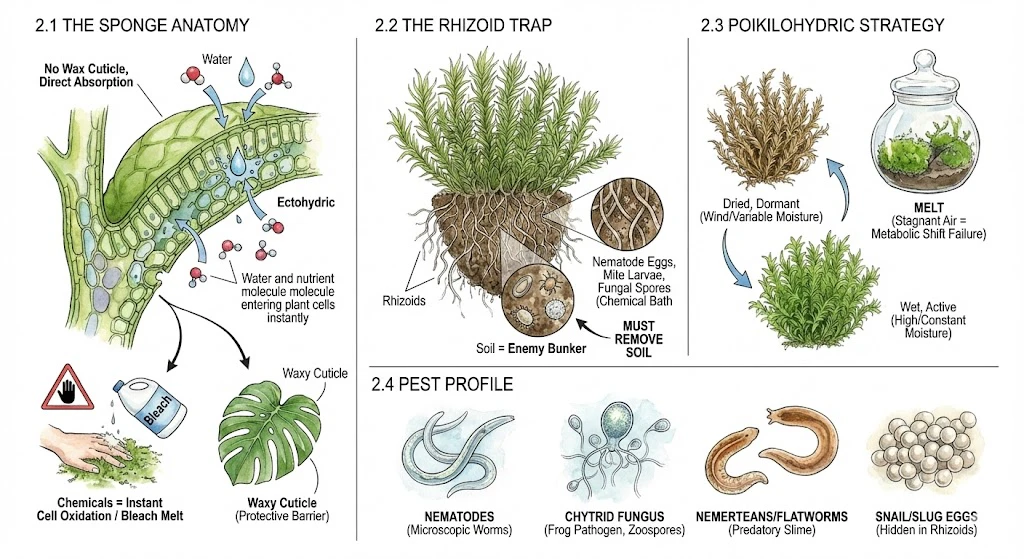
Moss isn’t a small version of a pothos. It’s a bryophyte, and its physiology helps explain why it can be sensitive to chemical dips, and why careful handling matters.
How sensitive a given moss is depends on the species, the formulation, and the exposure, so treat the points below as tendencies rather than fixed rules.
I process each collection location over its own white tray and photograph everything dislodged during inspection and rinsing. Tiny eggs, flatworms, snails, seeds, and arthropods are much easier to see against white than in a sink or dark bucket.
Tools and water stay separate between batches, and the quarantine container carries the exact collection source and date. If one batch develops a pest, I can discard or extend that quarantine without losing every moss sample.
2.1 Surface Water Uptake (Ectohydry)
Vascular plants generally move water through roots and limit surface loss with a waxy leaf cuticle.
Many mosses are ectohydric. Surface uptake of water across the shoot is important to them.
This isn’t universal. Mosses vary, some are more endohydric (conducting internally), and contrary to a common shorthand, cuticle and surface waxes have been documented in a number of moss species.
So no waterproof skin is a simplification, not a rule.
Because surface uptake matters, a moss shoot can take up whatever it’s dipped in fairly readily, and a strong oxidizer like bleach can damage the tissue.
How much damage depends on concentration, contact time, the presence of surfactants, and the species, not on a single fixed mechanism.
Every Dip Has a Survival Trade-Off
Any dip that’s strong enough to affect contaminants can also injure the moss, so there is no dose that is guaranteed to clean without risk.
2.2 Rhizoids and Trapped Soil
Mosses have no true roots. Instead they have rhizoids, hair-like filaments that anchor them and, in some species, also help conduct water. Dense mats trap soil among them.
That trapped organic matter can shelter nematode eggs, small invertebrate larvae, and fungal spores, and organic load is known to reduce how well any disinfectant works.
So removing visible soil and debris before a dip helps the treatment reach the surfaces it can act on, but it does not sterilize the moss, and residual eggs or microbes can remain.
2.3 Poikilohydry and Desiccation Tolerance
Many mosses are poikilohydric. Their water content tends to track ambient conditions rather than being tightly regulated.
That does not mean every moss can dry to a crisp and revive, or that any moss kept moist will drown. Desiccation tolerance and moisture preference vary a lot by species and habitat, so the right conditions depend on the moss you actually have.
Constant wetness with very little air movement can be hard on some field-collected mosses during acclimation.
But it is only one possible factor among several (light, temperature, substrate, water chemistry, species, and any chemical injury from a dip can all contribute) so it can’t be singled out as the main cause of losses.
Desiccation tolerance in bryophytes relates to elasticity but is independent of cell wall thickness and photosynthesis
2.4 What Might Hitchhike
Not everything in wild moss is a threat. Soil life includes many neutral and beneficial organisms. The categories below are worth recognizing, but treatment claims for each remain uncertain.
- Nematodes. Microscopic worms. Most nematode species are free-living (bacteria- and fungus-feeders). Only a minority are plant or animal parasites. Their tolerance to disinfectants varies by species and life stage, and eggs in particular can be hard to kill. Studies routinely recover viable root-knot nematode (Meloidogyne) eggs after minutes in bleach far stronger than a hobby dip. There is no generic bleach dose that reliably kills nematodes.
- Amphibian pathogens If you keep frogs, this is the main reason for caution. Chytrid (Batrachochytrium dendrobatidis, Bd) causes chytridiomycosis, but it is not the only concern. Bsal and ranavirus matter too, and published protocols note that Bsal can require a much stronger bleach concentration than Bd. The likelihood that wild moss carries any of these pathogens, and the method needed to clear them, are veterinary biosecurity questions that a plant dip cannot settle.
- Flatworms and nemerteans. Two different groups. Some terrestrial flatworms are predators of small invertebrates, and a few can regenerate from fragments, but this doesn’t apply uniformly to both groups, and neither is a guaranteed threat to a cleanup crew.
- Snail/slug eggs. Can hide in plant material and hatch. Whether a clutch becomes a problem depends on the species and your enclosure’s controls, not every snail damages plants.
3. The Setup / Process (A Risk-Reduction Dip)
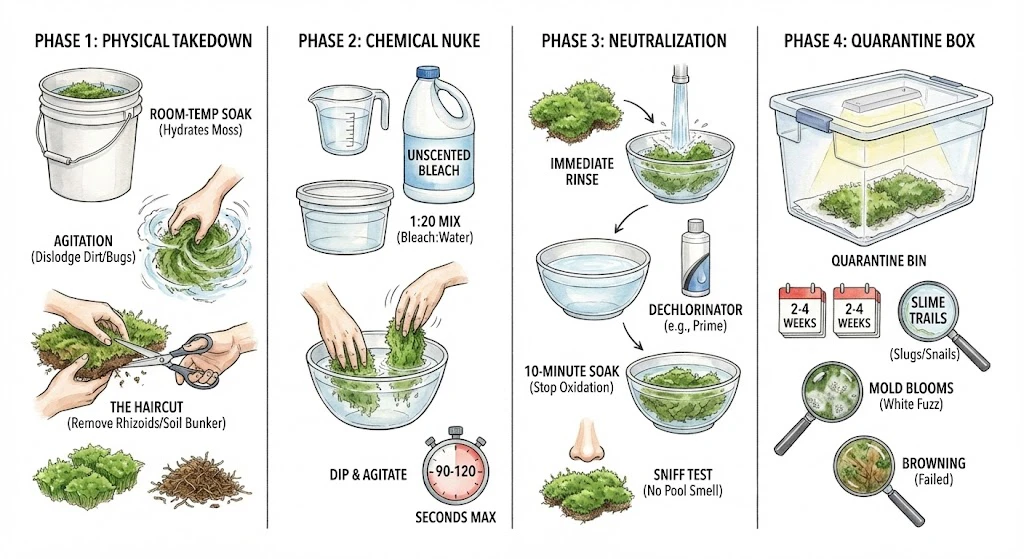
This procedure is intended to reduce risk, not to provide a proven cure. A dilute bleach dip strong enough to affect contaminants can also kill the moss, so moss that does not survive is not evidence that it was unfit for your tank. The dip itself may have caused the injury.
Safety first
Bleach is a hazardous chemical. Read the product label and safety data sheet. Work in a well-ventilated area, wear gloves and splash goggles, use room-temperature water, and keep children, pets, and animals away. Never mix bleach with anything but water (acids, ammonia, and other cleaners release toxic gas).
Mix a fresh solution for each use, have a plan for splashes, and dispose of used solution per your local rules rather than into a tank or a natural waterway.
Phase 1. Physical Cleaning
A disinfectant works better on surfaces it can actually reach, so remove loose soil and debris first.
- Soak the wild moss in room-temperature water for a while to loosen the dirt and rehydrate it before any dip.
- Trim away the brown, soil-laden base with clean scissors, keeping the clean green growth. There’s no exact percentage to remove. Remove obvious soil and dead material without cutting away so much living tissue that the moss can’t recover. If it falls into strands, you can replant them. This reduces trapped soil (and some of what’s in it) but does not remove all eggs or microbes.
Phase 2. The Bleach Dip (and its limits)
Sodium hypochlorite (bleach) can inactivate chytrid (Bd) in the lab, but the evidence has important limits.
The most-cited study exposed one Bd isolate in a clean 96-well culture. A 0.12% solution killed it in 30 seconds, 0.06% took 1–5 minutes, and 0.03% took 15 minutes. The authors cautioned that dirt, porous surfaces, low temperatures, and different isolates can reduce efficacy.
The study did not test living wild moss, nematode or snail eggs, flatworms, algae spores, or amphibian safety.
Bleach can therefore reduce Bd on clean surfaces, but this does not prove that a dip reliably kills chytrid, nematodes, and spores on soil-laden living moss.
A separate concern is the moss itself. Work on moss gametophytes has found that NaOCl around 0.25% killed protonema within a minute, and no reliable dilution was found that removed contaminants while keeping field-collected moss alive.
If You Still Choose to Dip
Understand these caveats before mixing any solution.
Calculate the Final Concentration
Concentration is not fixed by a volume ratio. Household bleach is typically 5–9% sodium hypochlorite and weakens with age, so a ratio such as one part bleach to 19 parts water gives roughly 0.25–0.45% NaOCl depending on the product. Check the label’s active percentage and calculate your final concentration.
Use Plain Unscented Bleach
Use plain, unscented disinfecting bleach rather than splash-less, fabric-guard, or scented laundry products whose additives can leave residues. Mix a fresh solution each time.
Do Not Treat Timing as Validated
There is no validated species-by-species timing. Popular recipes that promise a precise number of minutes are not backed by published trials. If you have no survival data for your species, treat the dip as an experiment on a small test batch rather than a recipe.
Minimum lethal concentration of sodium hypochlorite for the amphibian pathogen Batrachochytrium dendrobatidis
A method for eliminating bacterial contamination from in vitro moss cultures
Phase 3. Rinse and Neutralize
After the dip, rinse the moss well in fresh water, then soak it in water treated with an aquarium dechlorinator to neutralize residual chlorine.
Dose the dechlorinator to your measured water volume using the product’s label directions rather than pouring in a heavy amount. More is not a substitute for confirming the chlorine is gone.
Don’t rely on smell to judge safety. The absence of a pool odor doesn’t confirm a safe free-chlorine level, and some conditioners have their own sulfur smell.
If you want to confirm the water is chlorine-free, use a free-chlorine test rather than a sniff test, and rinse again if in doubt.
Phase 4. Observation
Because the dip does not sterilize (eggs, spores, and pathogens can survive it) the moss should be observed separately before it goes anywhere near a main enclosure.
Keep it in a lidded container over damp paper towel or clean sphagnum, in a separate space with no animal contact, and use dedicated tools so you don’t carry contamination back.
Observation Reduces Risk but Cannot Certify Clearance
Watching for a few weeks can reveal gross problems such as snails, slugs, mold, or whether the moss is surviving, but it does not clear invisible pathogens like Bd or Bsal, which visual inspection cannot detect. If you keep amphibians, treat pathogen clearance as a veterinary question.
Keep the Quarantine Container Ventilated
The container needs ventilation and pest-proof mesh so it does not become stagnant while still keeping small pests from escaping. Dispose of discarded moss or water so it cannot spread contaminants.
Watch for slime trails (surviving snails or slugs), unexplained mold or rot, or browning that suggests the moss didn’t make it.
If the moss or water looks contaminated, discard it rather than moving it to your display.
Gear (optional)
None of this is required, and generic equivalents work fine. A few dedicated items just make the process cleaner, and using tools kept separate from food prep reduces cross-contamination.
Seachem Prime Water Conditioner is one option for neutralizing residual chlorine after the dip. Dose any dechlorinator to the measured water volume exactly as its label directs rather than pouring by eye.
Choose a Measured Dechlorinator
Seachem Prime is a concentrated conditioner dosed by the drop, so a small bottle lasts a long time. A basic dechlorinator is a cheaper equivalent for this purpose. Check the current price and the label dose for your volume.
Stainless curved scissors and tweezers
These make trimming the mat and placing the moss easier, and stainless holds up to wet work.
This linked set is a Fistoy 4-in-1 aquascaping kit (curved scissors, straight and curved tweezers, and a spatula).
What matters more than the brand is cleaning and drying the tools after use. Published specs for steel grade and edge finish aren’t provided, so treat it as a generic option.
A budget aquarium aquascaping tool set is fine for trimming and planting moss. Any dedicated, cleanable pair of scissors and tweezers works.
Use a Separate Observation Container
A clear plastic Sterilite storage box can serve as a separate observation container. Its clip-on lid is not a pest-proof or humidity-tight seal, so add secure ventilation and plan lighting through an open or mesh top.
4. Deep Dive / Tips (Mastering Wild Moss Quarantine for Paludarium)
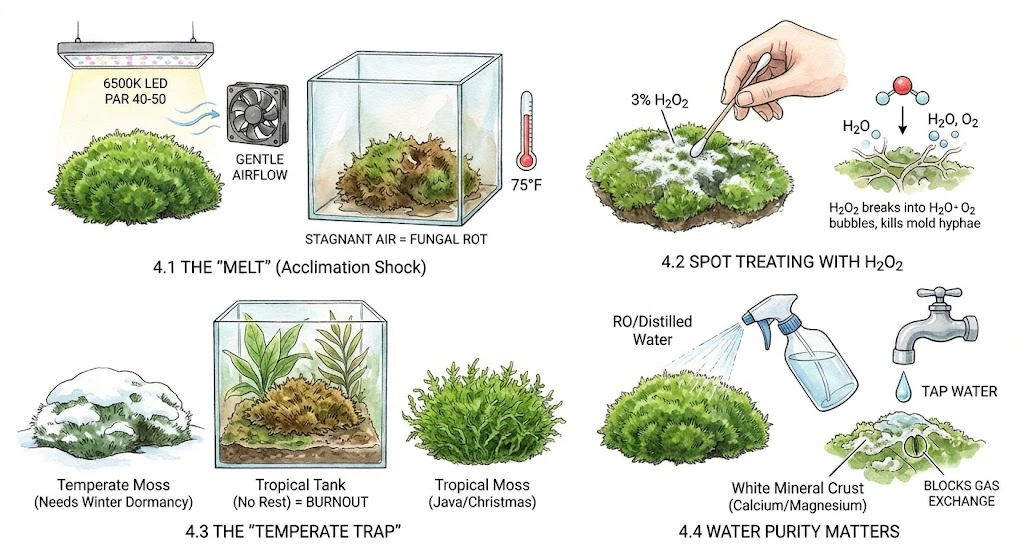
Care After Quarantine
A few care factors commonly cause trouble after transplant. The right values depend on your species and conditions, so measure where you can.
4.1 Acclimation Shock
Wild moss often struggles indoors, and the cause can be hard to pin down (moving a plant from a variable outdoor microclimate into a warm, enclosed box changes light, humidity, temperature, and air movement all at once).
Don’t assume the bleach was blameless, though. An over-strong or over-long dip can also injure the moss, and the two causes look similar.
Air exchange
Air exchange helps many mosses, and constant stagnant, saturated air can encourage rot. A small fan can improve air movement, but if you run one, mount it outside the enclosure or on the dry side with guarded blades and a GFCI/drip loop, keep it clear of water, and add a pest-proof vent. Note that this conflicts with a fully sealed bin, so you can’t have both.
For light, moss is shade-tolerant, not dark-tolerant. Aim for a modest measured light level (PPFD in µmol m⁻² s⁻¹) at the moss surface rather than a specific color temperature, and adjust to your species.
A given CCT like 6500 K is not itself a spectral requirement.
4.2 White Growth on the Moss
Fuzzy white growth can appear as moss copes with shock. Don’t assume it’s mold, and don’t assume a fix without evidence. There is no moss-specific data showing that dabbing 3% hydrogen peroxide reliably kills such growth while sparing the moss, and the usual cause is an underlying moisture or decay problem.
The more dependable response is to isolate or discard the affected piece, correct the airflow and moisture that let it start, and get an identification if you’re unsure what it is. If you do try a spot oxidizer on a small area, treat it as an experiment, not a proven cure, and never soak the whole plant.
4.3 Temperate vs. Tropical Origin
A moss’s origin affects how it does indoors. Many temperate mosses are adapted to seasonal cycles, and some may not thrive long-term in a constantly warm enclosure, but this isn’t a universal rule with a fixed timeline.
Claims that all snowy-region moss needs a winter dormancy or that a temperate moss grows for exactly ~3 months then dies of metabolic exhaustion are more precise than the evidence supports. The outcome depends on the specific species, its source population, and your temperatures.
If you want a moss suited to a warm, humid enclosure, a more reliable route than guessing is to use a documented captive-grown species with known care.
Warmth-tolerant options commonly kept in aquaria and paludariums include Java moss and Christmas moss. Note these are largely aquatic taxa, so match the species to whether you need a submerged or terrestrial mat.
4.4 Water Quality
Water chemistry can matter, but tap water always kills moss overstates it. Repeated misting with hard water can leave visible mineral residue on glass and foliage as water evaporates, and some acid-loving mosses are sensitive to high-mineral water, but the response to calcium and magnesium is species-dependent, and some mosses grow poorly in water that is too pure.
Low chlorine or chloramine from tap water is a more consistent concern than hardness for a moisture-loving plant.
Rather than a blanket rule, check your source water, chlorine/chloramine, hardness/alkalinity, EC or TDS, and pH, against what your species prefers.
Reverse-osmosis or distilled water avoids mineral residue and is a safe default for misting, but it isn’t mandatory for every moss, and very nutrient-poor water has trade-offs of its own over the long term.
5. Troubleshooting (Q&A) (Busting the Myths)
Blend the moss with yogurt to make it grow!
This trick is borrowed from painting moss onto outdoor bricks and doesn’t transfer well to a closed enclosure.
In a warm, humid paludarium, adding yogurt, beer, or milk is likely to feed unwanted microbial growth and cause odor rather than help the moss, so it’s not worth the risk.
To propagate, many mosses will regrow from fragments. Break the moss into small pieces and press them onto damp substrate.
New growth develops from the fragments (often via protonema, an early filamentous stage), so you don’t need the smoothie. Success varies by species and substrate.
Wild moss is fine if I just freeze it.
Household freezing may kill some adult invertebrates but is not a validated way to disinfect plant material. Many fungal spores and hardy nematode eggs can survive it, and some cold-adapted invertebrates accumulate cryoprotectants that let them tolerate freezing (this is species- and life-stage-specific, not a universal trait).
Note that the chemical dip described here isn’t a reliable substitute either. As covered above, it doesn’t dependably destroy eggs or spores. Neither method certifies the moss is clean.
I want the biodiversity (the bugs in the moss are good!)
Some are. The issue is that a closed enclosure has fewer of the checks that balance an outdoor food web, so an uncontrolled introduction can occasionally cause problems. An introduced population could outcompete your cleanup crew, or a predator could reduce your microfauna.
This is a possibility to weigh, not a certainty. It depends on the species, the food web, and population density.
A more predictable approach is to start from a known-source cleanup crew rather than whatever rides in on field moss, for example cultured Folsomia candida springtails and Trichorhina tomentosa isopods.
This isn’t sterilizing everything (a bioactive enclosure depends on a living microbiome, and this dip can’t sterilize anyway). It’s choosing organisms whose source health, enclosure compatibility, and escape risk you can assess.
6. Conclusion
It’s a fair amount of work for a patch of green, and it comes with no guarantees. Cleaning, an optional dip, and a few weeks of separate observation can lower the chance of introducing a problem, but none of it certifies the moss is pathogen- or pest-free, and losses can still happen.
If you keep amphibians, the safest choice remains not to use wild moss at all. A documented captive-grown or tissue-cultured species avoids most of this uncertainty, and true biosecurity for a frog enclosure is a veterinary question rather than something a home dip resolves.
If you do collect wild moss, do it legally and sustainably, keep suspect material well away from your animals until you’ve observed it, and accept that observation reduces risk without removing it.
Affiliate Disclosure
This article contains Amazon affiliate links. As an Amazon Associate I earn from qualifying purchases. If you use these links, the site may earn a commission at no extra cost to you. Product availability, price, and specifications can change. Check the current listing before buying.