
Planted Tank Substrate Chooser: Aquasoil vs Inert vs Tabs
Choose aquasoil, inert gravel, or root tabs by the plants you keep, your water chemistry, and the maintenance you are willing to take on.
Elena Vargas · Published 2026-08-04 · 16 min read
Key Takeaways
- Buy active aquasoil for soft-water high-tech root-feeders. Buy inert substrate for hard-tap or low-tech tanks.
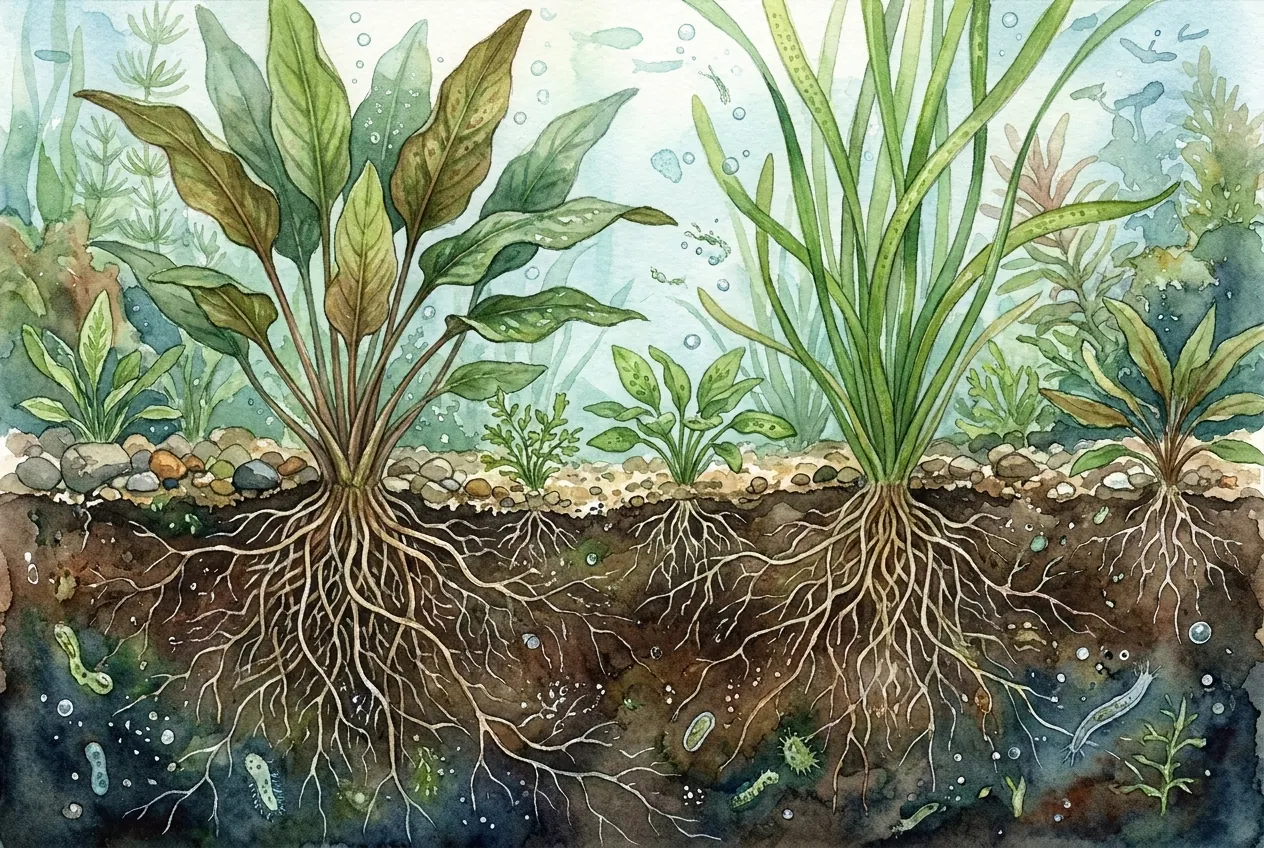
- Rooted plants draw most nitrogen and phosphorus from the sediment. Root-feeders therefore need a nutritive root zone or tabs.
- New aquasoil releases ammonia, so cycle first. Inert substrate skips the wait but never feeds plants.
- Inert gravel plus root tabs gives permanence with feeding. Replace the tabs every 3 to 4 months.
- A base nutrient layer belongs only in a high-tech tank you will not rescape soon.
The substrate is the single hardest thing to change once a planted tank is running, so buying the wrong class can mean tearing the whole scape down to fix it.
Choose the substrate from your plant mix, source water, and maintenance plan before choosing a brand.
Which substrate should you actually buy?
Match the Three Classes to the Tank
Buy the substrate class that matches your plants and your water, not the one with the best marketing. The decision collapses to three clean branches.
Active Aquasoil Branch
Buy a nutritive active aquasoil when your tank is soft-water or RO-based, CO2-injected, and planted heavily with root-feeders like stem plants, Amazon swords, and crypts.
Rooted submersed plants draw most of their nitrogen and phosphorus from the sediment, so a nutritive rooting zone is the mechanism that feeds them.
Inert Substrate Branch
Buy an inert mineral substrate when your water is hard tap, your tank is low-tech, or your plants are mostly epiphytes such as Anubias, Bucephalandra, and mosses.
Inert substrate never shifts your water chemistry and lasts the life of the tank.
Inert Substrate Plus Root Tabs
Buy inert substrate plus root-tab capsules when you want the permanence of inert gravel but still keep a few root-feeders.
The tabs deliver targeted nutrition to the root zone that the gravel cannot supply on its own.
Base Nutrient Layer
A base nutrient layer is an add-on, not a fourth choice. It sits under an aquasoil or inert cap in high-tech, root-heavy builds to front-load long-term root nutrition.
I place 100 grams of dry substrate in one liter of source water and keep a second one-liter jar of water without substrate. After covering and inverting both jars three times, I record pH, EC or TDS, KH, color, and fines after one, 24, and 72 hours. The fixed one-to-ten mass ratio makes batches comparable, while the blank separates substrate effects from source-water drift.
The jar is not a complete aquarium, but the paired blank shows whether the material itself is shifting the water before livestock and plants complicate the result. It also tells me how much rinsing or early water-change labor the setup may require.
How does substrate actually feed plants, and why does new aquasoil spike ammonia?
Read Nutrition and Cycling Together
Rooted aquatic plants get most of their nitrogen and phosphorus from the substrate, while potassium comes from the water.
Barko and Smart established this in their 1981 study. For every species they examined, nitrogen and phosphorus were readily mobilized from the sediment and concentrated in plant shoots above growth requirements.
This is the mechanism that makes substrate choice matter for root-feeders in the first place.
What is cation-exchange capacity, and why does it separate active from inert substrate?
Cation-exchange capacity, or CEC, is the property that decides whether a substrate can hold and trade nutrients.
Ohio State University Extension defines CEC as a fundamental property used to predict nutrient availability and retention, measured in milliequivalents per 100 grams.
A material with higher CEC holds more exchangeable cations such as calcium, magnesium, potassium, and ammonium, and releases them to roots on demand.
Active aquasoil is baked clay with high CEC. It grabs ammonium and other cations from the water, stores them at the root zone, and hands them to roots.
Inert substrate has near-zero CEC. It feeds nothing on its own and depends entirely on root tabs or water-column dosing.
How CEC Guides Substrate Choice
| Property | High-CEC active aquasoil | Low-CEC inert substrate |
|---|---|---|
| Holds cations for roots | Yes, high capacity | No, negligible |
| Feeds plants unassisted | Yes, until exhausted | No, never |
| Needs root tabs for root-feeders | No | Yes |
| Shifts water chemistry | Yes, buffers KH and pH down | No, chemically inert |
Why does a fresh active aquasoil spike ammonia, and how toxic is it?
New nutritive aquasoil releases ammonium as it settles, and a fraction converts to un-ionized ammonia, which is the form that harms fish and shrimp.
The US EPA states that pH and temperature control ammonia toxicity to aquatic life. As pH rises, the fraction of total ammonia present as toxic un-ionized NH3 climbs steeply, because the ammonium-ammonia equilibrium shifts hard toward NH3 with higher pH and temperature.
This is why a fresh aquasoil tank needs a cycling grace period. You either fishless cycle or run large early water changes until the ammonia clears.
An inert substrate leaches no ammonia, so it can be stocked far sooner. That difference is a real buying tradeoff, not a marketing point.
If you are cross-shopping the week-1 behavior of a new soil, the aquasoil ammonia leach walkthrough shows the cycle in detail.
What specs separate the three substrate classes?
Compare CEC, Chemistry, and Lifespan
The buying decision reduces to a short list of measurable properties. Match your tank to the column that fits, then buy any product that meets that column’s spec.
| Spec | Active aquasoil | Inert mineral substrate | Inert plus root tabs |
|---|---|---|---|
| Cation-exchange capacity | High | Low | Low substrate, tabs feed roots |
| Effect on KH, GH, pH | Lowers KH and pH | None | None |
| Grain size | ~2 to 5 mm baked granule | ~1 to 3 mm clay gravel | ~1 to 3 mm plus buried tabs |
| Ammonia release when new | Yes, needs grace period | No | No |
| Structural lifespan | Softens over ~1 to 2 years | Life of the tank | Life of the tank |
| Built-in nutrition | Yes, finite | None | Tabs, replaced every 3 to 4 months |
| Best buyer | Soft-water high-tech, root-feeders | Hard-tap or low-tech | Inert lovers who keep root-feeders |
The four decision axes behind that table are your plant mix, your source water, your CO2 setup, and how permanent you want the substrate to be.
If your water is soft or you already run RO, the buffering behavior of an aquasoil matters, and the RO remineralization chooser covers how to rebuild that water sensibly.
Which nutritive active aquasoil should you buy?
Choose Active Soil for Soft Water
Buy an active aquasoil when your tank is soft-water, CO2-injected, and heavy with root-feeders.
The role-1 spec is high CEC, ammonia and nutrient buffering, a roughly 2 to 5 mm baked grain, and a pH pull toward the acidic side.
UNS Controsoil Aquasoil for soft-water high-tech tanks
UNS Controsoil meets the role-1 spec because it is a volcanic-ash aqua soil that keeps alkaline water below pH 7 and comes in a Fine grade near 3 mm.
The manufacturer lists grain sizes of about 5 mm for Normal, 3 mm for Fine, and 1 mm for Extra Fine.
It also markets the soil as low-ammonia relative to older aquasoils. For a soft-water CO2 tank with stem plants, the Fine grade sits right in the target range.
Use this when you want a soil that actively buffers pH down for a high-tech scape. Skip it if your water is hard tap and you have no reason to soften it, since the buffering is wasted.
The honest tradeoff is that it is still an active soil. It releases ammonia when new and exhausts over one to two years, so it is far from a set-and-forget substrate.
Fluval Stratum for shrimp and mild buffering
Fluval Plant and Shrimp Stratum meets a softer version of the role-1 spec. It is a porous volcanic substrate that supports a neutral to slightly acidic pH with a light, non-compacting structure.
That gentler profile suits shrimp and plant tanks that want mild buffering rather than aggressive KH knockdown.
Use this when you keep Caridina shrimp or want mild acidity without a full aquasoil. Skip it if you need a deep pH drop for a blackwater biotope, because its buffering is milder and shorter-lived than a dedicated soil.
The honest tradeoff is that it can cloud the water if disturbed, and its buffering fades faster than a heavier soil.
If you are pairing an aquasoil with pressurized gas, the CO2 system chooser matches a regulator and diffuser to the same soft-water high-tech setup.
Which inert mineral substrate should you buy?
Choose Inert Soil for Permanence
Buy an inert mineral substrate when your water is hard tap, your tank is low-tech, or you simply want a substrate that never changes your water chemistry.
The role-2 spec is chemical inertness, a 1 to 3 mm grain, and structural stability for the life of the tank.
Flourite Black for a permanent inert base
Seachem Flourite meets the role-2 spec on its manufacturer specs. Seachem states it is a specially fracted stable porous clay gravel that is not chemically coated or treated and will not alter the pH of the water.
Seachem also states it is good for the life of the aquarium and need not be replaced. That is the textbook inert profile. No water-chemistry shift and permanent structure.
Use this when you want a substrate you install once and never think about again, especially on hard tap water.
Skip it if you expect the substrate to feed your plants on its own, because it carries no nutrients.
The honest tradeoff is that it is dusty and must be rinsed well before use, and any root-feeders in it will need tabs.
How do root tabs and a base layer feed roots in inert substrate?
Feed the Root Zone Without Rescaping
Root tabs and base layers exist because inert substrate carries no nutrition, so a root-feeder sitting in gravel needs targeted sediment dosing.
Tabs go under existing plants. A base layer goes under the whole substrate at setup.
Which root-tab capsules should you buy?
The role-3 spec is a declared nutrient profile including iron and micros, a stated 3 to 4 month replacement interval, and placement 2 to 3 cm below root crowns.
Seachem Flourish Tabs
Seachem Flourish Tabs meet this spec with a clear number set. The manufacturer lists iron at 2 percent plus manganese, magnesium, calcium, and potassium, and directs replacement once every three to four months.
It also states the tabs contain no phosphate or nitrate that would promote algae. That last point matters because it feeds roots without leaking algae fuel into the water column.
Use these when you keep root-feeders in inert gravel and want to avoid an algae bloom. Skip them as the sole feeder for a very hungry stem-plant carpet, since the deliberately low nitrogen and phosphorus may not be enough.
API Root Tabs
API Root Tabs are a lower-cost role-3 option that leans on iron, potassium, and carbon for strong roots.
Potassium is the nutrient sediment does not supply well, since Barko and Smart showed it comes mainly from the water, so a potassium-forward tab covers a real gap.
Use these when cost matters and you plant firmly. Skip them if you rescape often, because the softer capsule can dissolve if uprooted.
The honest tradeoff for both is that tabs are a recurring cost, and forgetting the three-to-four-month cadence slowly starves the plants above them.
Which base nutrient layer should you buy?
The role-4 spec is a thin base course placed under the main substrate cap for high-tech builds, with declared nutrient content.
It is capped by 3 to 4 cm of the main substrate so it never fouls the water column.
UNS ControBase Nutrient Layer
UNS ControBase nutrient layer meets this spec as a nutrient-rich under-layer that sits beneath a main aqua-soil cap.
It front-loads long-term root nutrition where the roots actually are.
Use this only for a high-tech, root-heavy tank you do not plan to tear apart soon. Skip it for a low-tech or rescape-heavy tank, because it must stay buried and clouds the water badly if disturbed.
The honest tradeoff is that it is not a standalone substrate, so it works only when capped under 3 to 4 cm of aquasoil or inert gravel.
How do you layer and set up the substrate correctly?
Layer From Nutrient Base to Cap
Set up the substrate in a fixed order that keeps nutrients buried and the water clear. The layering physics is the same for every high-tech build.
Layer the Base
Spread a thin course of a role-4 base substrate across the bottom, for high-tech root-heavy tanks only.
Add the Main Cap
Place 3 to 4 cm of your chosen aquasoil or inert substrate over the base, sloping deeper at the back, and fully cover the base layer.
Plant Into the Cap
Set root crowns at the cap surface. For inert substrate, push a root tab 2 to 3 cm down beneath each heavy root-feeder.
Fill the Tank Slowly
Pour water onto a flat plate or bag rather than straight onto the substrate, so you do not stir the base layer into the water column.
For dosing cadence, replace root tabs on the manufacturer interval of every three to four months, or sooner when older root-feeders show slowed or paler new growth.
Who should NOT buy each substrate class?
Read the Anti-Fit Cases
Skip the substrate class that fights your tank. Each class has a clear anti-fit, and buying against it wastes money and forces a teardown.
| Substrate class | Do NOT buy if | Because |
|---|---|---|
| Active aquasoil | Hard-tap, low-tech, or epiphyte-only tank | It buffers pH down for no reason, spikes ammonia when new, and exhausts in 1 to 2 years |
| Inert mineral substrate | Soft-water high-tech carpet with hungry root-feeders and no dosing plan | It feeds nothing, so carpeting stems starve without tabs or a base layer |
| Root-tab capsules | An all-epiphyte or moss tank | Anubias, Bucephalandra, and Java fern feed from the water column, so sediment tabs do almost nothing |
| Base nutrient layer | A low-tech or frequently rescaped tank | It must stay buried, and disturbing it clouds the tank and dumps nutrients |
Epiphytes feed from the water column, so a tank of Anubias and mosses gains nothing from a nutritive substrate.
That same water-column logic explains why over-dosing the water can feed nuisance growth like black beard algae, covered in the black beard algae removal guide.
What maintenance, failure modes, and replacement intervals should you expect?
Plan for the Failure Mode
Each substrate class fails in a predictable way, and knowing the failure mode tells you the maintenance it needs.
Aquasoil compaction and exhaustion
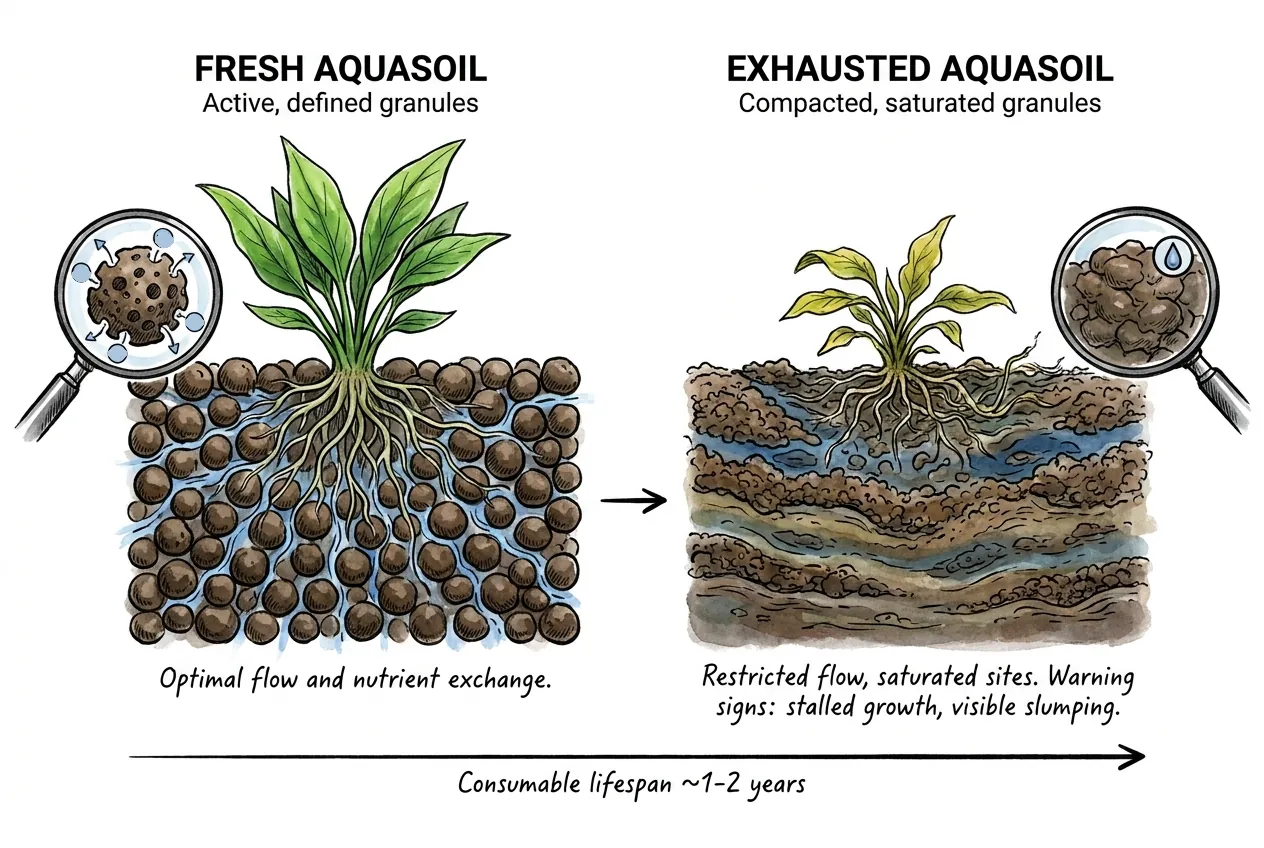
Active aquasoil is a consumable. Its cation-exchange sites gradually saturate and its granules soften and compact, which slows flow to the roots.
Plan to top up or replace aquasoil on the order of one to two years for a high-demand tank.
The warning signs are stalled new growth and a substrate that has visibly slumped.
The new-aquasoil ammonia spike
The classic week-1 failure is an ammonia spike from fresh soil. Because un-ionized ammonia is the toxic form and its share climbs steeply as pH rises, the fix is a cycling grace period before sensitive livestock go in. Monitor with a test kit rather than the calendar, and the water test kit chooser covers what to buy for that.
Inert substrate never exhausts, never feeds
Inert substrate has the opposite profile. It lasts the life of the tank, since Seachem states Flourite need not be replaced, but it never delivers nutrients.
The failure mode is silent starvation of root-feeders, and the fix is root tabs on a 3 to 4 month cadence or a base layer at setup.
Root-tab depletion
Root tabs deplete on schedule. The signal is slowed, paler new growth in the plants nearest an old tab.
Replace on the manufacturer interval instead of waiting for a visible deficiency.
Frequently asked buyer questions
Is aquasoil worth it if I already have hard tap water?
Often not. The pH-buffering benefit of an aquasoil is wasted on hard water, and an inert substrate plus root tabs is more durable for the same job.
Can I mix aquasoil and inert gravel?
Yes, as a capped base-plus-cap build. Keep the layers separate and do not stir them together, or you lose the point of both.
Do shrimp need active soil?
Caridina shrimp benefit from the low pH an aquasoil provides. Neocaridina shrimp in harder water do fine on inert substrate, so match the soil to the shrimp.
How long before I can add fish to a new aquasoil tank?
Wait until the ammonia has cycled out, which you confirm with a test kit rather than a fixed number of days.
New aquasoil releases ammonia, and adding fish too early is the most common early loss.
Will root tabs cause algae?
Micronutrient-forward tabs formulated with low phosphate and nitrate are designed to minimize the water-column leakage that feeds algae.
Seachem states its tabs contain no phosphate or nitrate for exactly this reason.
Affiliate Disclosure
This article contains Amazon affiliate links. As an Amazon Associate I earn from qualifying purchases. If you use these links, the site may earn a commission at no extra cost to you. Product availability, price, and specifications can change. Check the current listing before buying.