
Bucephalandra Emersed vs Submerged: The Full Guide
Bucephalandra emersed vs submerged, explained: how to tell the two forms apart, why the plant sheds old leaves and regrows aquatic ones, the water movement rheophytes benefit from, mounting without burying the rhizome, and buying tips.
Elena Vargas · Published 2026-02-09 · 11 min read

Key Takeaways
- Emersed and submerged leaves are two forms of one plant, so texture and color are clues rather than a reliable identity test. Emersed leaves tend to be firmer, more matte, and often plainer green, while submerged leaves are often thinner, softer, and more colorful. Leaf age, clone, light, and nutrition make the two forms overlap.
- Leaf loss after submersion can be normal, but a mushy, foul-smelling rhizome points to rot. The plant may shed air-adapted leaves and grow aquatic ones, while shipping, temperature or chemistry shock, and other stresses can create similar decline. Judge by the rhizome, not the leaves.
- As a rheophyte from Borneo’s fast streams, Bucephalandra benefits from steady circulation without dead spots. Aim for even movement rather than the strongest current possible. Flow does not by itself remove algae or prevent rot.
- Keep the rhizome exposed and out of stagnant, waterlogged organic media. Roots can sit in an inert inorganic medium, but burying the rhizome is what invites rot.
- Choose a seller by cultivation history and recent growth rather than leaf appearance alone. Tissue-culture cups and potted emersed clumps each have trade-offs that depend on the supplier, cultivar, and handling.
You bought a stunning, thick-leaved Bucephalandra, put it in your tank, and a couple of weeks later some leaves are turning to mush.
Often this is the plant shifting from emersed, or air-grown, to submerged, or aquatic, growth and shedding leaves in the process.
Leaf loss during the switch is common, but the same symptom can also come from a rotting rhizome or shock, which need a different response. Compare the rhizome condition, growth history, and newest leaves before choosing a treatment.
How do I tell the difference between emersed and submerged Bucephalandra?
Leaf texture and color give you useful clues, but they are not a definitive test. A more reliable read comes from the seller’s growth history and from watching the newest leaves the plant is putting out under your conditions.
Emersed leaves grew in air. Submerged leaves are the new leaves the same plant makes underwater.
The change is a normal response to the growing environment, not a change in the plant’s identity.
On arrival, I photograph the rhizome and number the existing leaves on the image rather than tagging the delicate plant. Every leaf produced after the water transition gets added to the same sequence.
New growth is what I use to judge adaptation, while old-leaf melt remains part of the plant’s history. This prevents me from repeatedly moving a healthy rhizome because leaves formed in the seller’s conditions continue to decline.
What does emersed Bucephalandra look like?
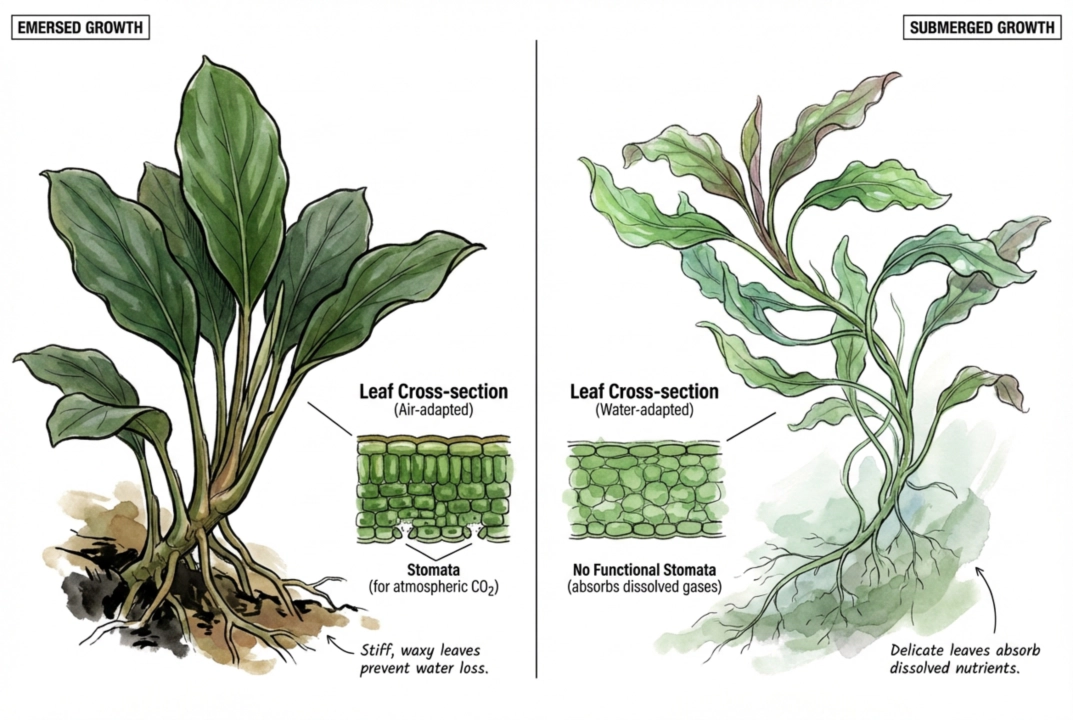
Emersed Bucephalandra leaves often look plainer green, more matte, and firmer than their submerged counterparts, though this varies with cultivar, leaf age, and light.
Nurseries commonly grow them emersed because it is convenient for large-scale production. Growth in air with access to atmospheric CO2 can also be faster, while space, pest control, and propagation play a part too.
In many amphibious plants, air-grown leaves have a thicker cuticle (which limits water loss) and functional stomata for gas exchange in air.
Bucephalandra plausibly follows this general pattern, but published stomatal-density and cuticle measurements specific to this genus are hard to find.
What does submerged Bucephalandra look like?
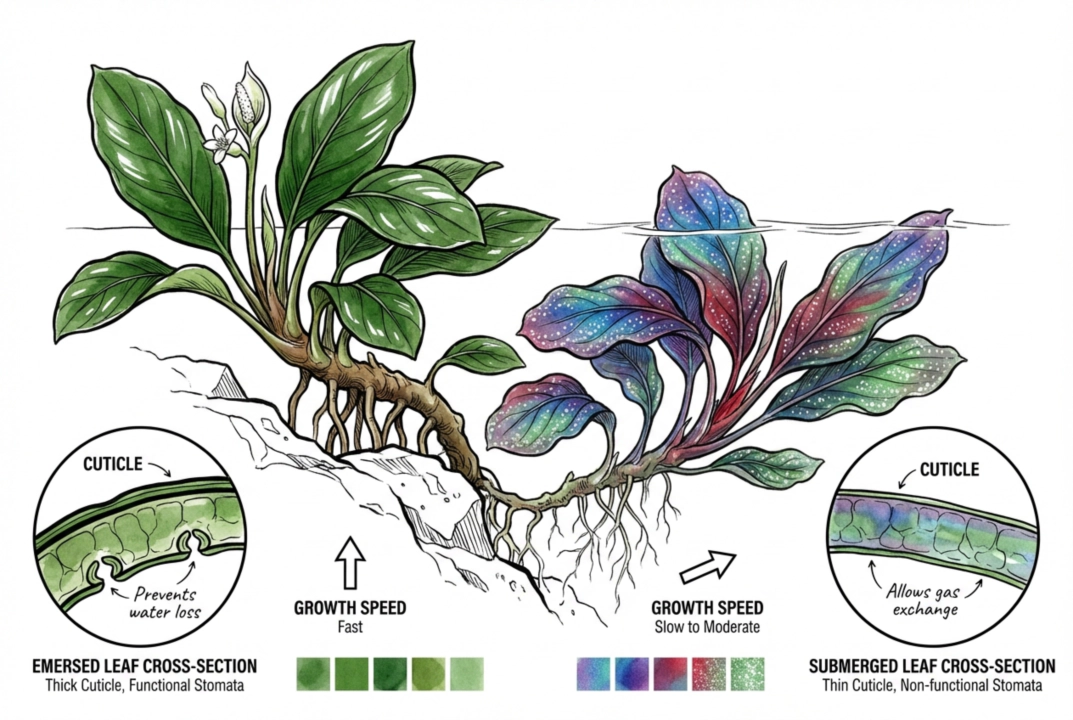
| Feature | Emersed Growth (Land) | Submerged Growth (Water) |
|---|---|---|
| Color | Often plainer green | Often more colorful. Some clones show iridescence |
| Texture | Firmer, more matte | Often softer, more flexible |
| Cuticle | Typically thicker (limits water loss) | Typically thinner (favors gas exchange) |
| Growth Speed | Often faster | Often slower |
Submerged leaves are often more colorful (some clones show iridescent blues, purples, or deep reds) and can have a softer texture, but green, firm submerged leaves are also normal.
In amphibious plants generally, submerged leaves tend to have a thinner cuticle, which is consistent with taking up dissolved gases across the leaf surface.
Roots and other surfaces also contribute to carbon and nutrient uptake.
The tiny reflective spots known as Bucephalandra glitter can look stronger underwater. The cause has not been established for this genus, so do not use glitter alone to judge whether a plant is healthy, fully submerged-grown, or receiving the right light.
Why do Bucephalandra melt when put underwater?
A common reason is that air-adapted leaves do not work as well underwater. Water slows gas diffusion sharply, so a leaf built for air is generally far less efficient at gas exchange once submerged, though exchange does not drop to zero, and some existing leaves can survive.
As those older leaves senesce, the plant can remobilize mobile nutrients (such as nitrogen, phosphorus, and potassium) from them while it grows new leaves suited to underwater conditions.
Whether every old leaf is shed, and how much is recovered, has not been measured specifically in Bucephalandra transitions.
Is melting a disease?
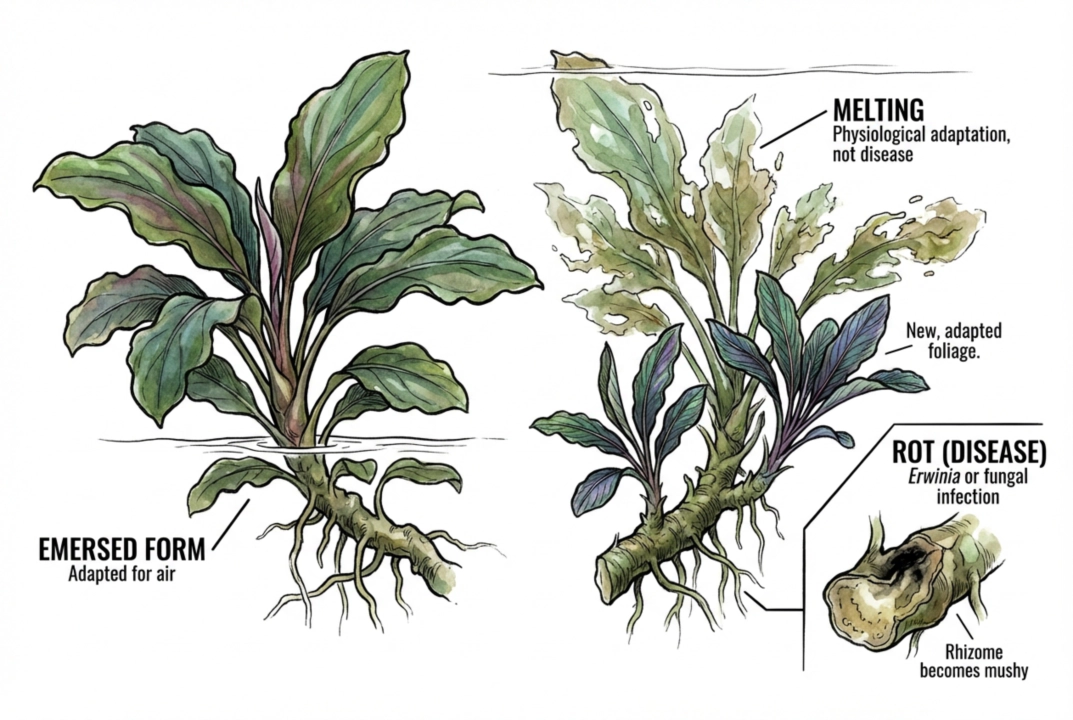
Losing old leaves during the emersed-to-submerged transition is often a normal part of the process rather than a disease. The plant drops leaves that no longer suit its conditions.
But melting is not always benign. Shipping injury, temperature or light shock, water-chemistry problems, toxins, and nutrient or root failure can produce similar-looking decline. The key check is the rhizome.
If the rhizome, the thick stem, becomes mushy, foul-smelling, or soft in a spreading area, that points to rot rather than a normal transition.
Soft rot is associated with low oxygen, wounds, contamination, heat, and prolonged waterlogging, and burying the rhizome in substrate makes it more likely.
The specific pathogen cannot be identified by eye. Several bacteria once grouped under Erwinia have since been reclassified, including Pectobacterium and Dickeya, and fungi or other causes are also possible.
Watch rhizome firmness, odor, spread, and whether new growth appears. If it is worsening, isolate the plant promptly.
How long does the transition take?
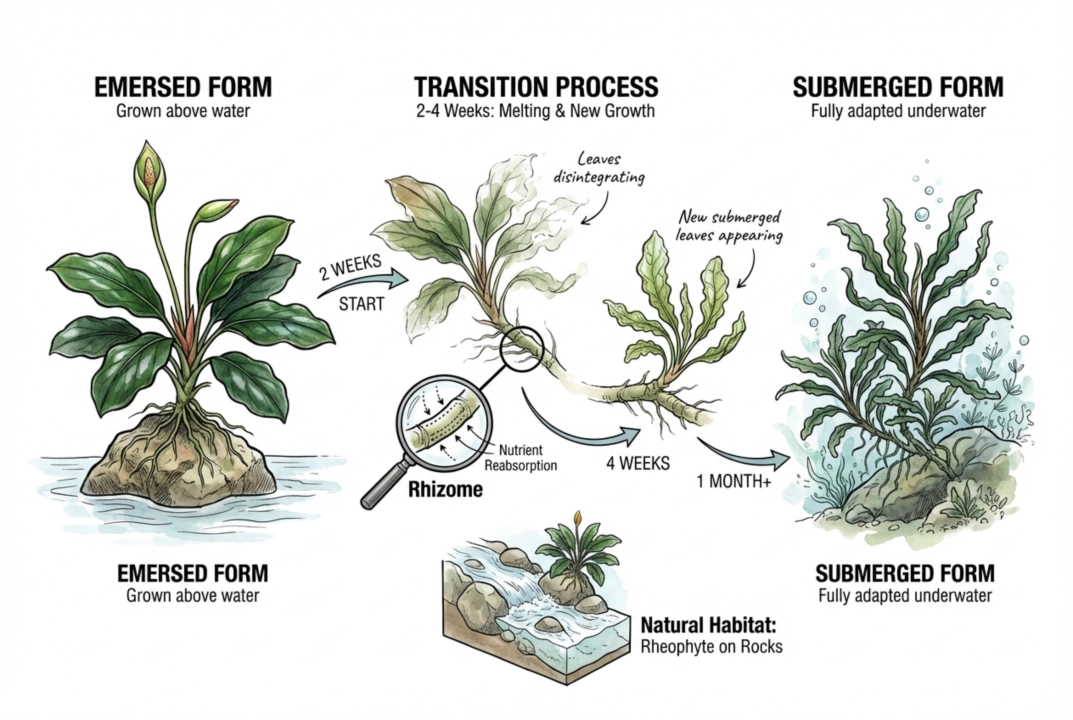
There is no fixed timeline. Hobbyists often see old leaves drop over a few weeks and new submerged leaves push out within the first month or two, but this varies widely with the cultivar, the size and reserves of the rhizome, temperature, light, CO2, and how established the tank is. Treat any specific number as a rough expectation, not a guarantee.
While you wait, keep an eye on the rhizome rather than only counting weeks. Losing leaves is expected. A rhizome that is turning soft or smelly is not, and needs action regardless of how much time has passed.
The underlying trigger for growing different leaf forms is studied in other amphibious species, for example, lake cress (Rorippa aquatica, in the mustard family) switches leaf shape through a hormone-gene module.
The authors note that not all heterophyllous plants use the same mechanism, so this is a comparison from another family, not a demonstration of how Bucephalandra does it.
The genes, hormones, and leaf anatomy behind Bucephalandra’s two forms have not been worked out.
Where do Bucephalandra grow in nature?
Bucephalandra are obligate rheophytes endemic to the island of Borneo. They grow attached to rocks in fast-flowing streams and waterfalls.
Why does their habitat matter?
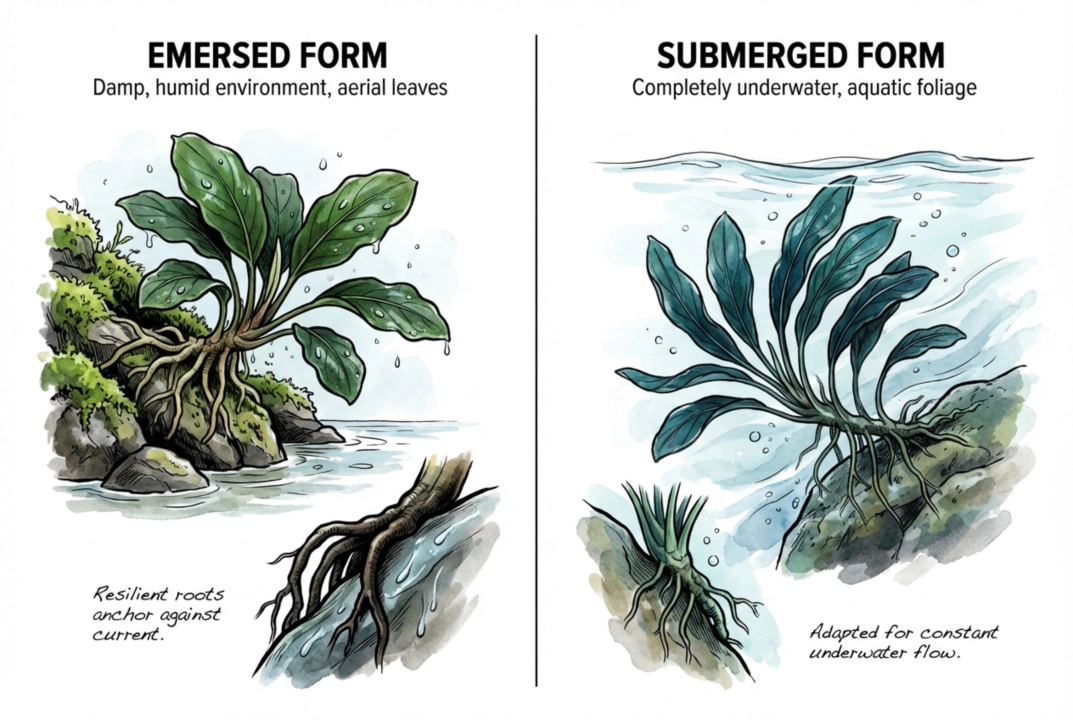
Their natural habitat is a useful starting point for care, though the specifics differ by species and locality.
Many Borneo streams do rise and fall between wet and dry periods, but the exact hydrograph varies from site to site, and some habitats stay wet year-round.
Living in and out of the water like this fits with why the plants can transition between emersed and submerged forms, but that is an inference rather than a directly tested cause.
The practical takeaway is about mounting, not soil chemistry. Keep the rhizome from being buried or packed in wet organic material.
The roots themselves can sit in an inert inorganic medium. Cultivation reports (including from Kew-associated horticulturists) describe Bucephalandra thriving with roots in submerged inorganic media, so the rule is to expose the rhizome, not to keep every root out of any substrate.
How do I care for each form?
What does emersed Bucephalandra need?
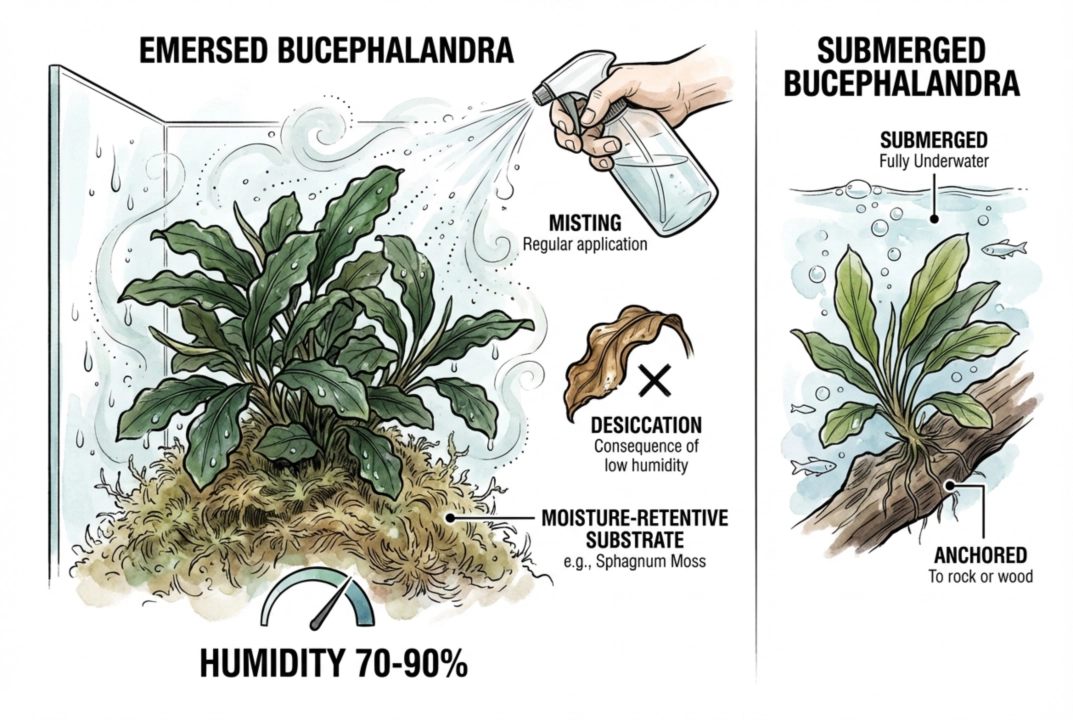
If you are growing them emersed in a terrarium or paludarium, high humidity matters, especially for a plant that is freshly converting.
A commonly used range is roughly 70–90% relative humidity, but humidity alone does not tell the whole story. What the leaves actually experience depends on temperature (through vapor-pressure deficit), on airflow, and on how long the leaves stay wet.
Too little humidity lets leaves desiccate. Too little airflow and constantly wet leaves invite fungal problems, and dense, soggy organic media around the rhizome can cause rot.
Misting and a moisture-retentive medium such as sphagnum can help, but treat them as options to balance against airflow and root oxygen rather than mandatory steps, and keep the rhizome from sitting saturated.
What does submerged Bucephalandra need?
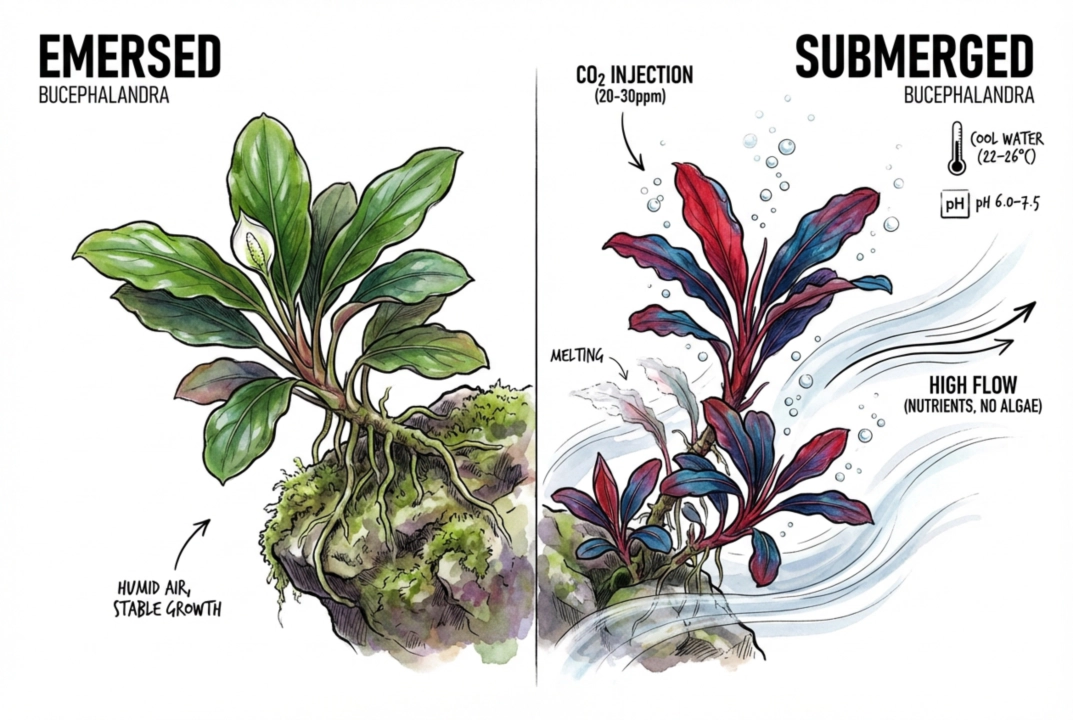
Stabilize the Aquarium
In an aquarium, aim for steady, stable conditions.
Flow
Good water movement helps. It thins the boundary layer at the leaf surface, which can aid nutrient and gas exchange, and it avoids stagnant dead spots. Aim for even circulation rather than the strongest current you can create. Very high velocity can stress some plants, and flow by itself does not remove algae. Their rheophyte origin is the reason movement helps, not a reason to maximize it.
CO2
Injected CO2 can improve growth when other conditions are right, and many hobbyists run 20–30 ppm, but it is not a guaranteed fix for melting or color. If you use it, treat it as advanced, optional care. Measure it against pH/KH, watch livestock for stress, and ensure good distribution rather than dosing to a number blindly.
Water Parameters
A commonly used starting range is around 22–26°C and slightly acidic to neutral pH (6.0–7.5). These are reasonable hobby defaults rather than genus-wide optima. Species and localities differ, and you may need to adjust.
Liquid carbon supplements
Liquid carbon supplements are not the same as dissolved CO2, and there is no controlled evidence that they prevent Bucephalandra melt or algae during a transition.
If you choose one, follow that product’s label exactly. Do not transfer a dose or a spot-treatment method from another brand, and stop if the plant shows damage.
Mounting adhesive
To mount them, many aquascapers use a cyanoacrylate gel. Choose one explicitly labeled for aquarium or reef use, because cure time and continuous-immersion safety vary by formula. Compare aquarium-safe adhesives before committing.
Apply a small amount to the rock rather than the rhizome, then hold the plant for the stated time.
Which one should I buy?
Budget and patience matter, but so do pest tolerance, the size and cultivar you want, whether the seller can trace where the plant came from, and your quarantine and setup.
Is Tissue Culture better?
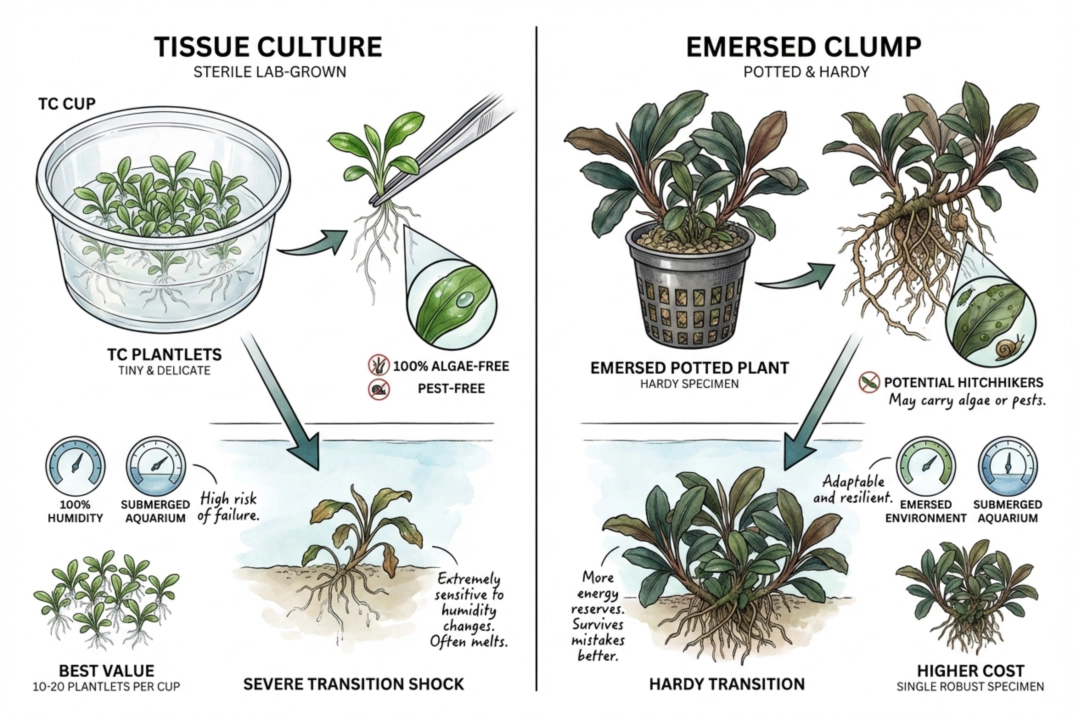
Tissue culture (TC) cups are grown aseptically in a lab. When you buy one, check that the seal is intact and that the supplier stands behind its cleanliness.
Pros
A sealed cup can hold several small plantlets and, with a reputable supplier’s guarantee, be free of snails, algae, and pests. Exact plantlet counts and value vary by supplier and cultivar.
Cons
Plantlets are raised on a sterile medium in a sealed, very humid container, so acclimatizing them to open-water conditions takes care and some are lost in the process. Potted or clump, emersed plants can carry more reserves, but which option transitions better depends on the cultivar, how it was grown and handled, and your tank. Neither is always hardier.
How do I tell whether a plant is grown submerged?
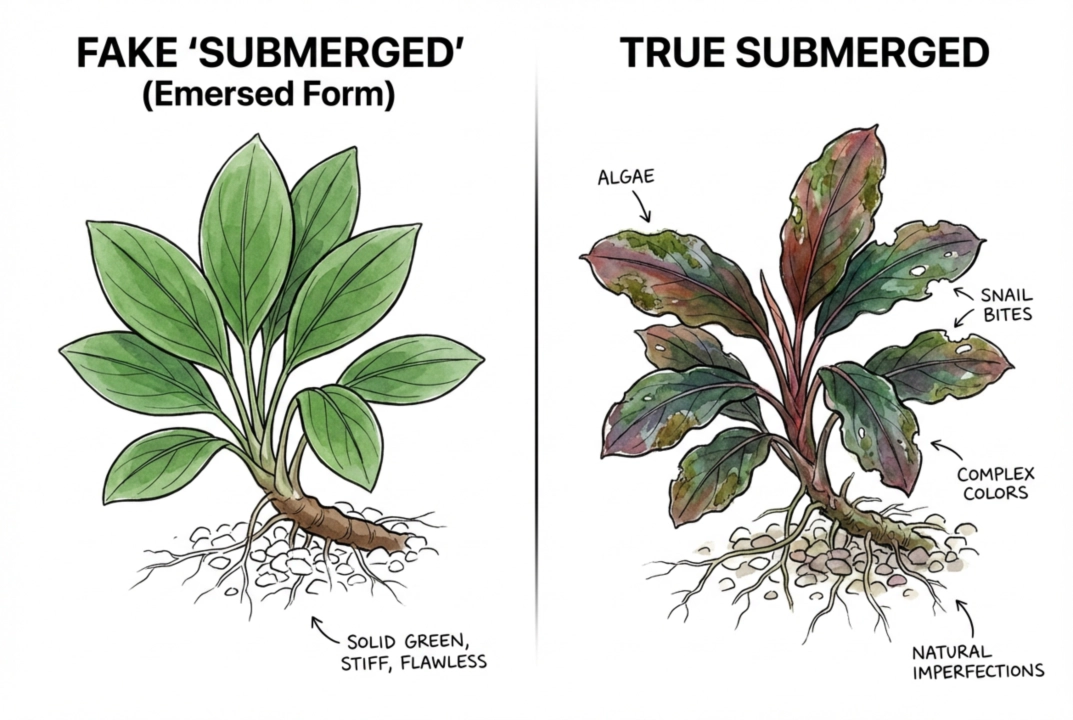
You cannot reliably judge how a plant was grown, or a seller’s honesty, from leaf appearance alone.
Emersed and submerged forms overlap, and appearance shifts with cultivar, leaf age, light, and nutrition, so plain green leaves are not proof of anything on their own.
Instead of reading damage as authenticity, ask the seller for recent, dated growth photos and how the plant has been kept, and watch the newest leaves it produces after you get it.
Algae or snail bites do not prove submerged growth. A healthy, well-kept submerged plant can be clean and green, and that damage is a quarantine and quality downside, not a plus.
Troubleshooting
Why are there holes in my leaves?
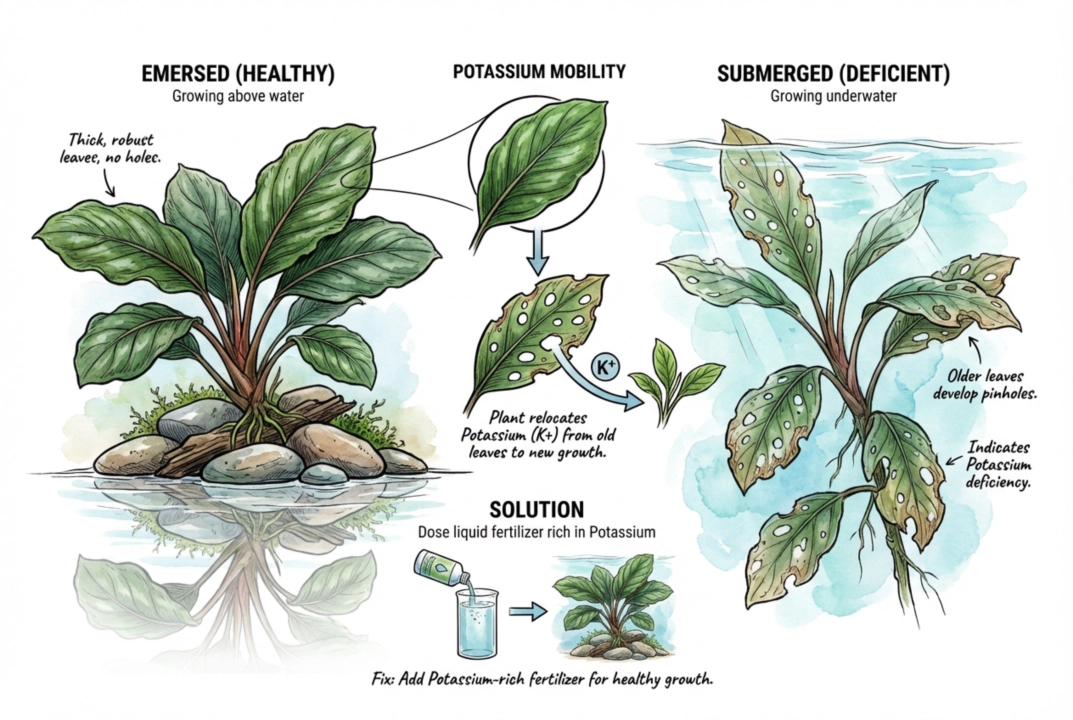
Small pinholes are one sign that can point to a potassium deficiency, but they are not specific.
Herbivory (snails or other grazers), physical handling, ongoing melt, spot necrosis, disease, and light or chemical injury can all produce holes, so holes alone do not confirm a nutrient problem.
How to Check First
Before adding anything, review what you already dose, your water-column potassium, other nutrients, livestock that might graze the leaves, and your water-change schedule.
Ruling those out matters, because dosing on a guess can mask the real cause or create a nutrient imbalance.
If Potassium Is the Likely Culprit
Potassium is mobile in the plant, so a genuine shortage tends to show on older leaves first as the plant moves it to new growth.
In that case a potassium-containing fertilizer, added within a tested plan, is a reasonable step, but confirm the cause rather than assuming it.
Why is the rhizome rotting?
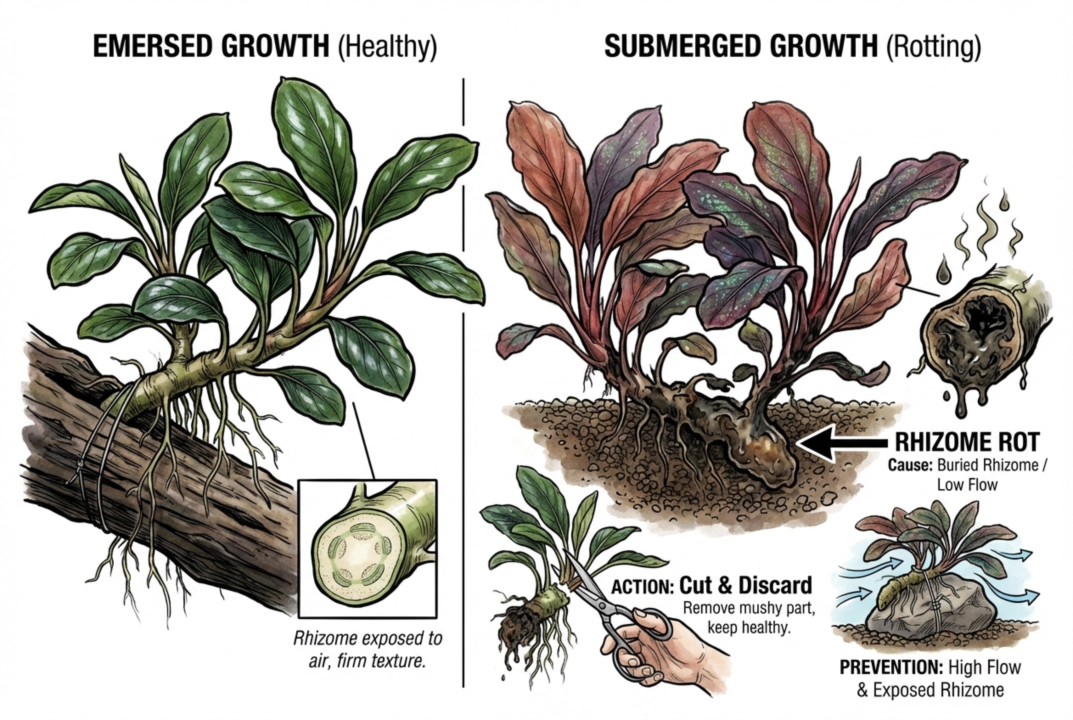
If the rhizome turns mushy and smells bad, treat it as rhizome rot. (Submerged growth on its own is not rot. Judge by firmness, odor, and whether the soft area is spreading.)
How to Fix It
Isolate the plant so any pathogen does not spread. With a blade or scissors disinfected before you start, cut back into firm, healthy tissue and discard all soft, discolored material. Make sure each piece you keep still has a viable node or leaf and, ideally, roots.
Disinfect the blade again between cuts and between plants, and seal the removed tissue and any contaminated water rather than tipping it back in. If the rot keeps advancing despite cutting, it is better to discard the whole plant than to reinfect a tank.
Prevention
Keep the rhizome exposed rather than buried, avoid stagnant dead spots, and keep tools and water clean.
Good circulation helps, but flow alone does not guarantee prevention. Contaminated water and unclean cutting tools can also spread the pathogens involved.