
Terrarium Glass: The Science of Choosing a Vessel
How terrarium glass affects light, viewing, heat and sealing: the small light-transmission edge low-iron glass offers, when curved jars distort or focus sun, why to avoid known leaded vintage vessels on wet acidic substrate, and how gasket seals behave.
Marcus Hale · Published 2025-12-25 · 28 min read
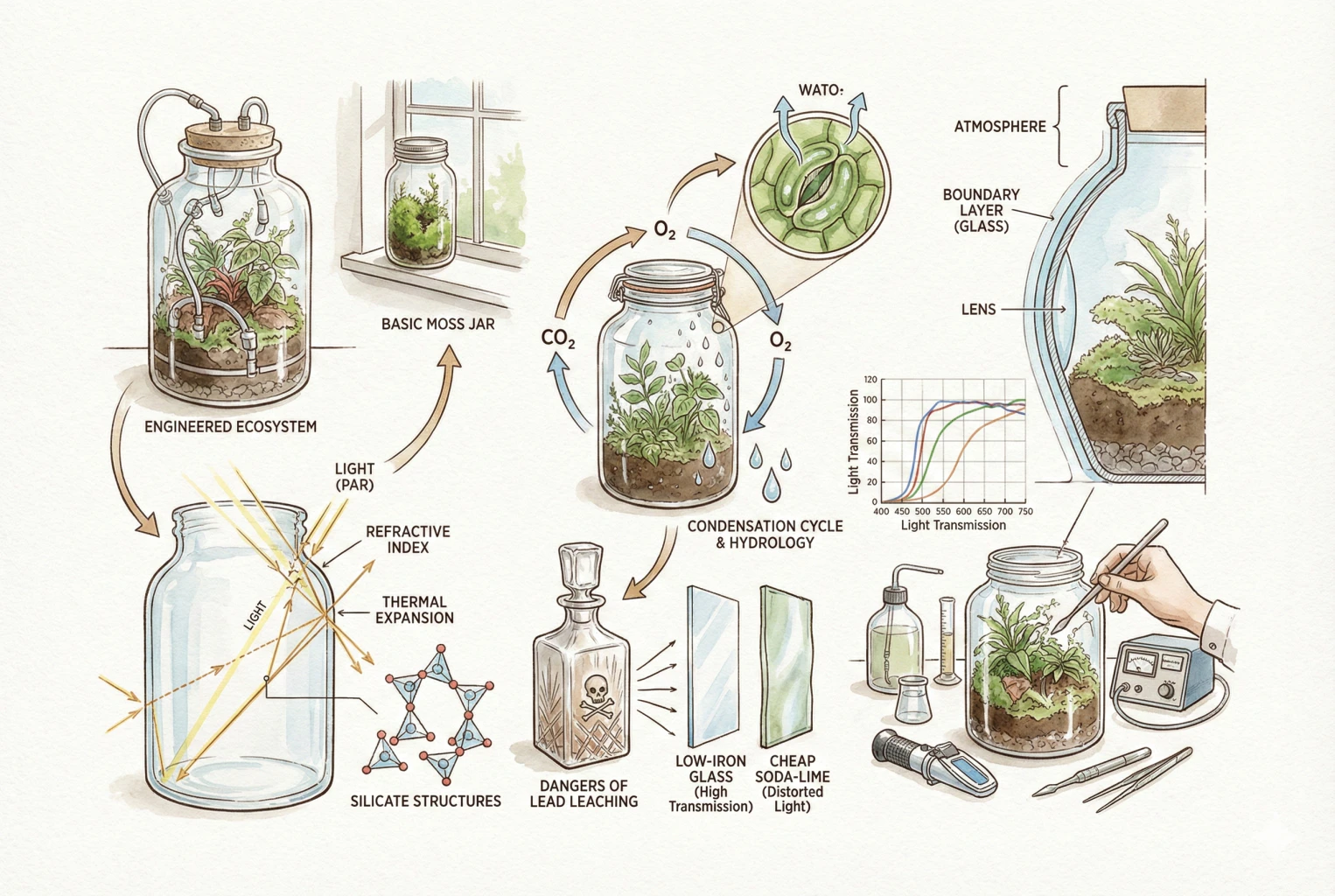
Key Takeaways
- Glass composition and shape influence light, viewing, heat and moisture retention, but placement, lid fit, biology and lighting matter just as much, so glass alone does not decide whether a build succeeds.
- Low-iron glass transmits a little more visible light than standard soda-lime and renders color more faithfully, but the difference is usually only a few percentage points at the same thickness, so judge plant light with a measured PPFD or DLI reading.
- A known or untested leaded vintage vessel should not stay in permanent contact with wet, acidic substrate because lead can leach into acidic liquids, even though the exact terrarium risk has not been directly measured.
- Curved jars distort the view and may focus sunlight under particular conditions, but direct sun can overheat any closed vessel, so keep closed terrariums out of direct sun.
- Gasket or clamp jars lose water vapor more slowly than a loose glass-on-glass lid, but a gasket is not automatically a certified hermetic, vacuum or pressure seal, so test the seal and match plants to the humidity it actually holds.
The Vessel Is Part of the System
A terrarium is closer to a small closed-loop system than to a decorative object. The vessel is not the only thing that matters, lid fit, placement, lighting and the plants and microfauna inside all shape how it behaves, but the glass does influence light transmission, viewing quality, heat build-up and how well moisture is retained.
Glass composition affects light and color, vessel shape affects viewing and sun exposure, leaded vintage glass can be a poor fit for wet acidic builds, and seal design changes moisture retention. Where a number matters for plant health, measure it in your own build rather than trusting a specification on a label.
I fill the empty vessel with cardboard forms at the planned plant height and try to reach the bottom with the actual spoon, forceps, siphon, and cleaning cloth. A wide-looking opening can become unusable once branches and hardscape occupy it.
With the vessel still empty, I rehearse lifting its wet-equivalent weight from the display position. If routine access requires tilting a heavy glass vessel over furniture, I choose a different shape before building inside it.
2. The Material Science of Transparency (Glass Composition)
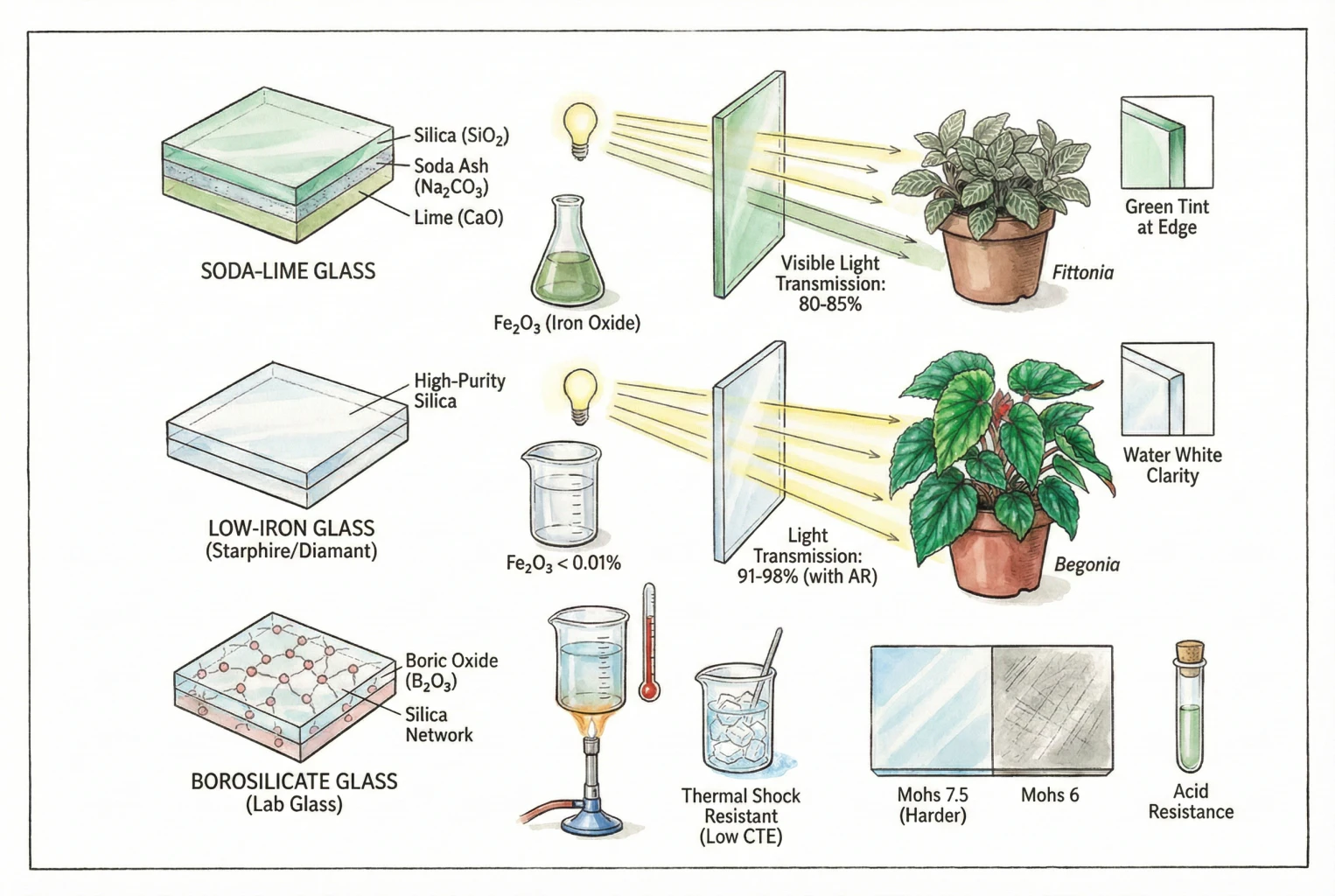
Clear materials differ in how much light they pass, how faithfully they render color, and how they respond to thermal stress. Those differences are real but often small. The ranges below include their sources and caveats rather than presenting them as fixed facts.
2.1 Soda-Lime Glass (The Ubiquitous Standard)
Soda-lime-silica glass makes up the large majority of glass produced, more than 95% of European glass output, per Glass Alliance Europe, and it is the workhorse of the container and flat-glass industries, from jars to window panes.
2.1.1 Chemical Matrix
In the finished glass, three oxides dominate. Exact proportions vary by product and manufacturer. A representative flat-glass example (Vitro clear) is roughly SiO2 73%, Na2O 14%, CaO 9%, with MgO and trace oxides making up the rest.
- Silica (SiO2). Roughly 70–74%. This is the glass former, derived from sand.
- Sodium oxide (Na2O). Typically around 13–15% in the finished glass. It comes from soda ash (sodium carbonate, Na2CO3) added to the batch as a flux, which lowers the melting point of the silica to make it workable. The batch ingredient (Na2CO3) and the final oxide (Na2O) are not the same thing.
- Lime (Calcium Oxide, CaO). Roughly 9–12%, often alongside some MgO. This acts as a stabilizer that improves chemical durability. With little or no stabilizer, glass becomes far more soluble in water.
2.1.2 The Iron Problem
Silica sand usually contains a small amount of iron oxide (Fe2O3). The exact level varies by source and batch. A figure near 0.1% is often cited for ordinary glass, but it is not a fixed value.
Even at low levels, iron oxide acts as a pigment. It is largely responsible for the green tint you see when you look at the cut edge of a glass pane, and the tint deepens with thickness.
2.1.3 Light Transmission
Iron in the glass does absorb some UV and IR and adds a faint green cast to visible light.
The size of that visible effect depends on iron content and thickness, and for ordinary thin containers it is modest.
According to manufacturer data (Vitro clear soda-lime), visible transmittance is about 90% at 3 mm and 89% at 6 mm, dropping to the mid-80s only at much greater thicknesses (about 85% at 12 mm, 83% at 19 mm).
A typical jar or tank wall is in the 3–6 mm range, so standard clear glass transmits roughly 89–90% of visible light, not the 80–85% sometimes quoted, which corresponds to very thick panes.
Terrariums often hold plants that tolerate lower light such as Fittonia, Begonia or mosses, but lower-light tolerance does not mean any amount of light will do. Each species has a light range best checked against a measured PPFD or DLI reading rather than assumed from the glass.
Read Light at the Plant
At a matched thickness, the visible-light difference between standard and low-iron glass is usually only a few percentage points, so the transmission loss through a clear glass wall is much smaller than a 15–20% handicap. Viewing angle, the lid and condensation on the glass can affect delivered light at least as much as the choice between standard and low-iron glass.
2.2 Low-Iron Glass (A Modest Light and Color Edge)
Low-iron glass is sold under manufacturer trademarks (Starphire is a Vitro brand and Diamant a Saint-Gobain brand) and generically as ultra-clear. These are specific products, not a single material grade.
2.2.1 Refining the Chemistry
Low-iron glass is made from high-purity sand with naturally low iron, or from sand processed to remove iron oxide.
Product-specific iron targets are often around 0.01%, roughly an order of magnitude below a typical 0.1% figure. The exact value is a product specification rather than a universal standard.
Compare Like Thicknesses
The lower iron gives a water-white look and a small transmission gain. At about 3 mm, standard clear runs around 90% and low-iron around 91–92% (Vitro Starphire, Pilkington Optiwhite). The gap widens with thickness but stays small for jar- and tank-wall thicknesses.
Figures near 98% belong to a specific anti-reflective (AR) coating system, not to uncoated low-iron glass, and are omitted here because the coating type, both-side treatment, angle, and moisture/cleaning durability needed to justify one in a wet terrarium are not established.
Color Fidelity
The main practical benefit is for the viewer. Less green edge and cast means soil, moss and reds render more faithfully to the eye.
Light and Spectrum
Standard clear glass is not a strong green filter, and there is no spectral evidence that ordinary clear glass selectively strips red and blue. For a terrarium the transmission gain is small, so decide with a measured PPFD or DLI reading rather than the glass grade alone.
Ultum Rimless Tank
High-end aquascaping brands such as UNS Ultum rimless tank favor low-iron glass mainly for clarity and color rendering. The aquarium case is partly about light traveling through water depth, which does not apply the same way to a terrestrial terrarium, so treat the listing as a low-iron example rather than proof of a required light advantage.
Landen 60P
Current third-party listings put this roughly 17.1 gallon rimless low-iron aquarium at about 60×30×36 cm with 6 mm glass and a claimed >91% low-iron clarity. Those figures come from resellers rather than a confirmed manufacturer source, and the 45° mitered-edge and intended-for-terrarium-use claims could not be verified against an official Landen specification, so treat them as unconfirmed. It is an aquarium, and using it as a high-humidity terrarium requires a custom lid plus checks of the seams, support surface, access and intended-use warranty.
2.3 Borosilicate Glass (The Thermal Shield)
Lab borosilicate is the material of beakers, test tubes and some heat-resistant kitchenware. Pyrex is a consumer trademark whose formulation has differed by region over time. Current Corning lab glassware such as PYREX 7740 is a distinct borosilicate and should not be conflated with any given bakeware.
2.3.1 Composition and Structure
Borosilicate is broadly defined by containing at least about 5% boric oxide (B2O3). It is not simply soda-lime with boron swapped in. A representative example, PYREX 7740, is about SiO2 80.6%, B2O3 13%, Na2O 4.1% and Al2O3 2.3%, so it still contains alkali and alumina.
The boron-rich network gives it a lower thermal expansion.
2.3.2 Thermal Expansion and Durability
The key property is the Coefficient of Thermal Expansion (CTE). Borosilicate expands roughly one-third as much as soda-lime when heated (about 3.3×10⁻⁶/K for PYREX 7740 versus about 8.6×10⁻⁶/K for soda-lime).
- Thermal Shock. The low CTE makes borosilicate more tolerant of temperature change than soda-lime, but it is not unbreakable. Thick vessels, scratches and steep temperature gradients can still crack it, and manufacturers warn against extreme swings. Do not treat any glass as safe to move straight from a freezer to an oven, or from a cold windowsill onto a hot heat mat. If you use a heat mat, first confirm the vessel manufacturer permits it, and use a thermostat, an air gap or spacer for heat distribution, and a temperature probe so you are not driving a localized gradient into the glass.
- Hardness. Borosilicate and soda-lime are close in hardness (Knoop values are roughly 480 for PYREX 7740 versus about 470 for clear soda-lime) so claims of a large gap such as Mohs 7.5 versus 6 are not supported. To remove hard-water scale, prefer a vinegar or citric-acid soak and a non-scratch tool, following the manufacturer’s cleaning instructions, rather than aggressive scrubbing on any glass.
- Chemical Resistance. Borosilicate resists acids well. In practice the mild acidity of a terrarium (from peat/sphagnum substrates and dissolved CO2) is rarely enough to corrode ordinary soda-lime glass noticeably within a human lifetime, so for terrarium use this is a minor factor. Clarity over time depends more on water chemistry, abrasion and cleaning than on glass type.
2.4 Comparative Material Data Table
The table below summarizes the four glass types. Transmission is quoted at a comparable thin-wall thickness (about 3 mm) so the values are directly comparable. Figures are approximate and drawn from manufacturer data where noted above.
| Feature | Soda-Lime (standard) | Low-Iron (Starphire/Diamant) | Borosilicate (e.g. PYREX 7740) | Lead Crystal |
|---|---|---|---|---|
| Primary Composition | Silica, soda, lime | Silica, soda, lime (very low iron) | Silica, boron trioxide, some alkali & alumina | Silica, lead oxide |
| Visual Tint | Faint green at edges | Near-colorless | Near-colorless | High sparkle (high refractive index) |
| Visible Transmission (~3 mm) | ~90% | ~91–92% | ~90% | Varies by piece |
| Thermal Expansion (CTE) | ~8.6×10⁻⁶/K | Similar to soda-lime | ~3.3×10⁻⁶/K (more thermal-shock tolerant, not unbreakable) | Similar to soda-lime |
| Hardness (Knoop) | ~470 | ~470 | ~480 (very close) | Softer (lead content) |
| Lead Leaching Risk | None | None | None | Possible in acidic contact. Avoid for wet substrate |
| Notes for Terrarium Use | Fine for most builds | Small clarity/color edge | Handy where deliberate heat is applied, with the cautions above | Display of dry items only |
3. Optical Physics (Refraction, Geometry, and PAR Loss)
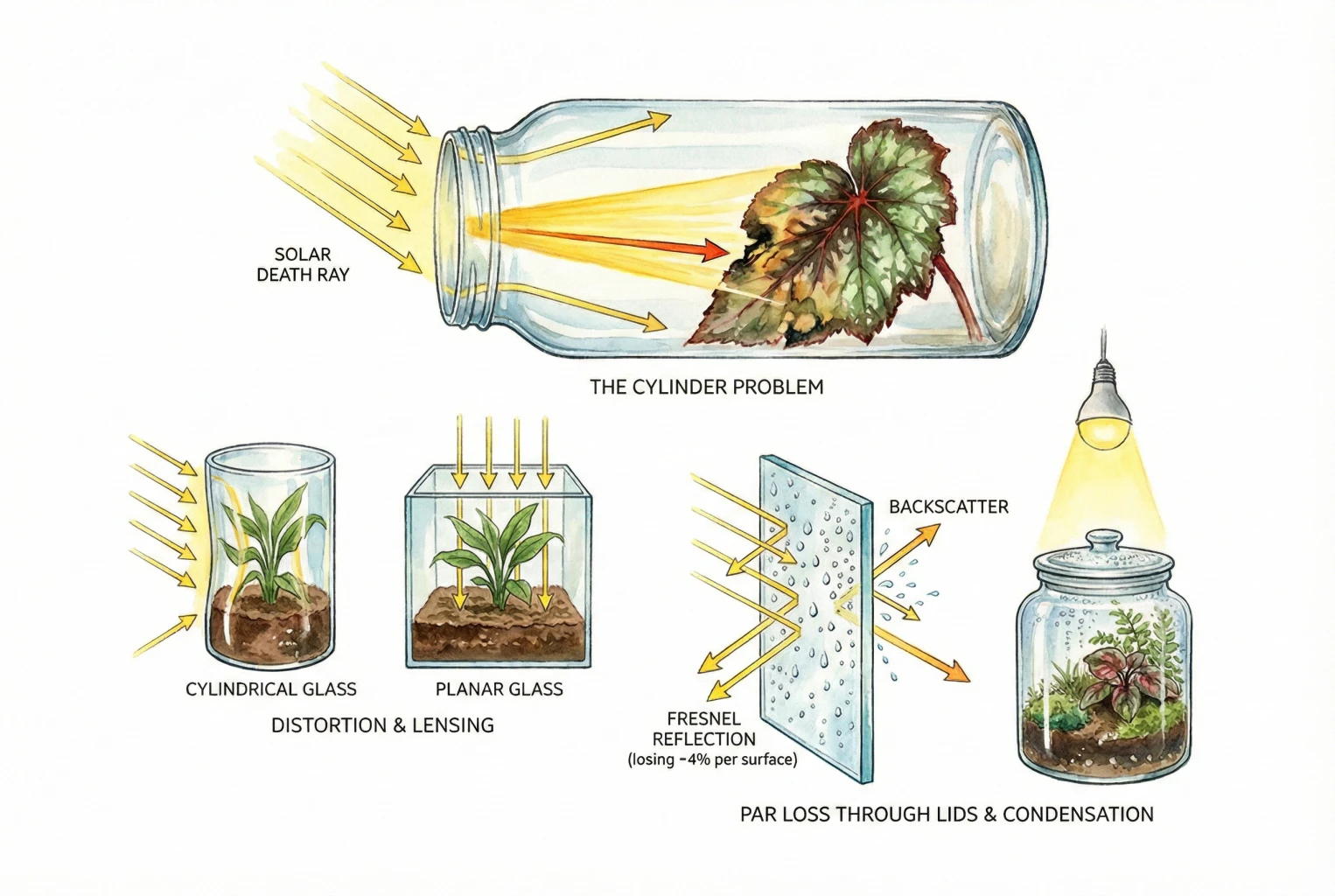
Container shape affects how a build looks and, under some conditions, how sunlight behaves, but shape is not a simple on/off filter, and curved does not automatically mean unsafe.
3.1 The Cylinder Trade-off (Distortion and Conditional Focusing)
Cylindrical jars are common because they are inexpensive and easy to find (cookie jars, apothecary jars).
Their curved walls do introduce viewing distortion, and under direct sun they can, depending on geometry, focus light, but whether that matters depends on the intended look, wall uniformity, what fills the jar, viewing angle and sun exposure.
3.1.1 Refractive Mechanics
Glass has a refractive index of approximately 1.5, while air is close to 1.0. When light passes from air into glass and back into air, it bends at each interface.
- Planar Glass. Through parallel flat walls (as in a square tank) an image is shifted slightly rather than strongly distorted at normal viewing. At oblique angles some refractive and reflective distortion remains.
- Cylindrical Glass. Across a curved wall the angle of incidence changes continuously, producing a lens-like effect that can magnify or warp horizontally. The exact behavior depends on the curvature, wall thickness, viewing position and angle.
3.1.2 Visual Distortion
Fine details, such as springtails moving across the substrate, can look stretched or warped through a cylinder wall depending on your viewing angle.
This makes clean photography harder, though far from impossible. Hobbyists photograph cylindrical jars routinely.
3.1.3 Focusing Under Direct Sun
A curved, water-filled or thick-walled vessel can, under the right sun angle, concentrate sunlight into a brighter spot (the same conditional hazard behind occasional reports of curved glassware starting fires).
This is possible, not inevitable, and the effect depends on curvature, wall thickness, any liquid inside, distance and the sun's angle.
The safer rule is simpler and applies to every shape. Keep closed terrariums out of direct sun, because direct sun can overheat a closed vessel regardless of whether it is flat or curved.
3.2 Reflection and Condensation at the Glass Surface
Make an AWESOME Terrarium for FREE! by SerpaDesign. A general build walkthrough for context, not a measurement of light loss.
Any glass surface reflects a little light, and condensation adds its own optical effect.
- Fresnel Reflection. At each air/glass interface, roughly 4% of light reflects at normal incidence (for a refractive index near 1.5), so two surfaces reflect on the order of 8%. Note that a manufacturer's whole-pane visible-transmission figure already includes these surface reflections, so the ~90% quoted earlier and this ~8% should not be subtracted from each other. That would double-count the same loss. Angle, coatings and additional panes change the figure.
- The Condensation Factor. A closed terrarium often carries water droplets on the glass. These scatter and refract light. They can diffuse it (which may help understory plants by softening shadows) and can also send some back. How much reaches the plants depends on droplet amount and pattern. Clean condensate is not the same optical situation as the salt- and dirt-fouled glass sometimes discussed in reef keeping, and specific loss figures require direct PAR measurements rather than assumption.
- The Takeaway. Surface reflection and condensation do reduce delivered light somewhat. If plants look under-lit, confirm it with a PPFD or DLI reading before raising output because simply increasing light can bring its own problems such as heat, algae and photoinhibition.
4. The Toxicology of Vintage Glass (The Lead Crystal Trap)
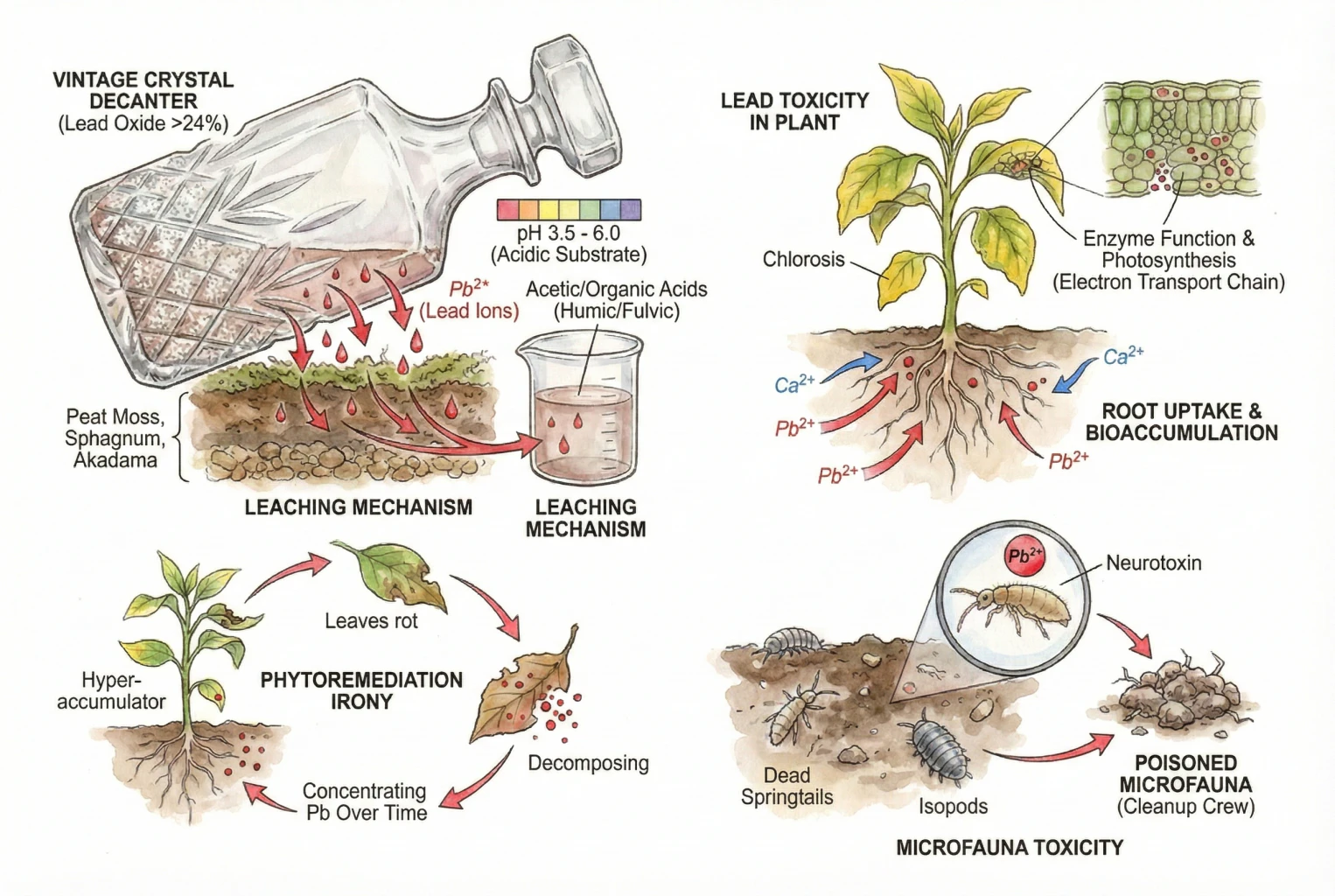
This is a debated topic in the hobby. The evidence supports a precaution rather than a certainty. If you know or suspect a vintage vessel is leaded, it is sensible not to keep it in permanent contact with wet, acidic substrate.
4.1 The Leaching Mechanism
Lead crystal is glass that contains lead oxide, often above about 24% in traditional full-lead crystal, to raise the refractive index and soften the glass for cutting. Not every vintage or antique piece is leaded, and modern crystal is often lead-free, so identify the vessel before assuming its composition.
- Acid Interaction. Lead can leach from leaded glass, particularly on contact with acids. Terrarium substrates (peat, sphagnum, akadama) tend to be acidic, though the exact pH varies with the product, the water and buffering rather than sitting at any single figure. Leaching tests commonly use 4% acetic acid. That is a harsher, simpler extraction than the humic and fulvic acids of decomposing soil, so it is a rough proxy, not an equivalent.
- The Data. The most-cited study stored acidic liquids, 4% acetic acid and alcoholic beverages, in leaded decanters for 1, 2 and 10 days and measured roughly 100–1800 µg/L of lead, rising at lower pH. Those results support a risk from long-term storage of acidic liquid. The study did not test terrarium substrate, and it did not measure release within minutes, so that specific claim is not supported by the source.
Potential lead exposures from lead crystal decanters
4.2 How Lead Can Affect Plants and Microfauna
If lead entered the substrate, plants and the soil food web could take some of it up. The amount and its effects would depend on concentration, chemical form, moisture, competing ions, and species. Those factors have not been measured in a terrarium here.
- Root Uptake. Plants can absorb lead through their roots. Some uptake is associated with calcium-related transport pathways, though the full picture also involves other routes and retention in the root apoplast, so it is not a single pathway. At sufficient exposure, lead can inhibit chlorophyll synthesis, disrupt enzymes and photosynthetic electron transport, and cause chlorosis and stunted growth. Effects that are dose-dependent, and the relevant dose for a jar is not established.
- Phytoremediation. Some plants are used to draw metals such as lead out of soil, and a few are true hyperaccumulators, but use in phytoremediation does not mean every such species hyperaccumulates. If lead were present, tissue that later dies and decomposes could recirculate some of it, though the actual glass→soil→plant flux and any net build-up have not been measured here.
- Microfauna. Lead is a known toxicant, so a springtail-and-isopod cleanup crew is a reasonable thing to protect. But general toxicity does not by itself confirm mortality at whatever (unmeasured) level a leaded jar might reach.
- Recommendation. As a precaution, use lead-free or standard glass rather than a known or untested leaded vessel for a wet build. If you want to reuse a vintage piece, have it tested, and note that surface swab and spot tests have detection limits and can miss lead, so a negative result is not a guarantee.
Lead toxicity in plants. Mechanistic insights into toxicity and physiological responses
5. Prevent Overheating
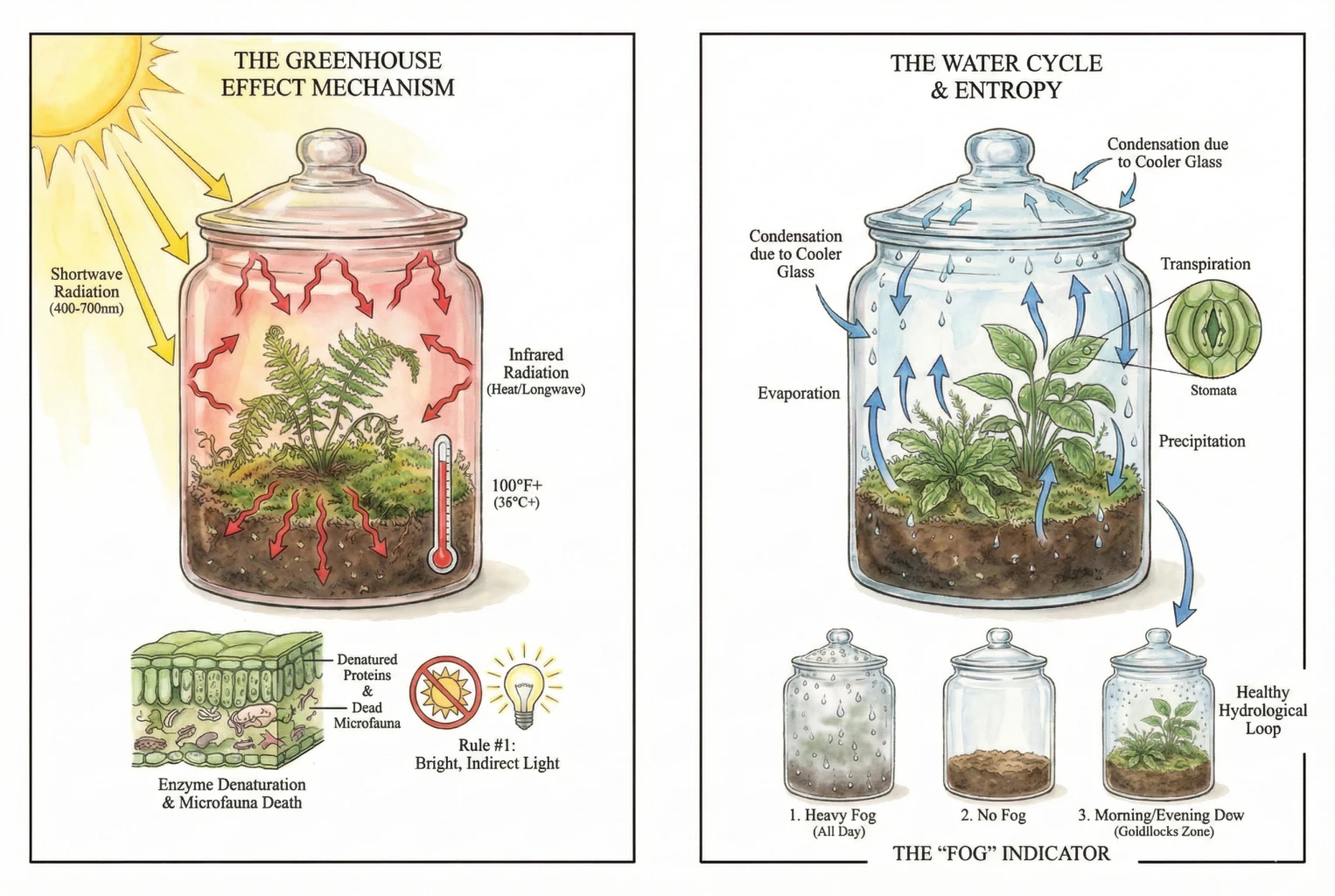
A closed terrarium recycles water internally, but it can also overheat quickly in direct sun. It is not a permanent energy trap. In steady state the energy coming in roughly balances what leaves, and temperature settles. The risk is how high that balance point climbs in strong sun.
5.1 Why a Closed Jar Warms Up
Glass transmits visible light well and is less transparent to longwave (thermal) infrared, but that is only part of the story.
Input. Sunlight enters the jar. Note that solar energy is not only the 400–700 nm (PAR) band (it also includes UV and near-infrared) so treating input as PAR-only understates the heat load.
Conversion. Plants and soil absorb light and re-radiate part of it as longwave infrared (heat).
A closed container warms because heat and humid air cannot mix freely with the room. Direct sun can raise the temperature fast, so keep the vessel out of hot sun and check it after changing the light or lid.
4. Direct Sun Result
A closed jar in direct sun can heat up substantially, and how fast and how far depends on vessel size, sun intensity, ambient temperature and ventilation. There is no single universal 38°C within minutes figure. Sustained heat stresses plants and microfauna in species-specific ways rather than instantly denaturing everything. Keep closed terrariums in bright, indirect light, out of direct sun, and confirm conditions with actual leaf-temperature and light readings if in doubt.
5.2 The Water Cycle Inside the Jar
A closed terrarium recycles water.
Water Cycle Sequence
Evaporation leads to condensation, which returns water to the substrate as precipitation or runoff.
- A fluctuating steady state. Water transpires from leaves and evaporates from the soil, then some of it reaches the glass. Rather than a fixed equilibrium, this is a steady state that shifts as room conditions change over the day.
- Condensation Point. Condensation forms where humid air meets a surface at or below its dew point. Usually the glass, when the glass is cooler than the inside air. The glass is not always the coolest surface, though. A sunlit side, a lamp, or the daily room cycle can reverse it. Read fog against dew point and glass temperature, not as a simple sign of energy loss.
- Reading the fog (with caution). Condensation gives clues but is not a complete diagnosis on its own. Check it alongside glass temperature, substrate moisture and how the plants look.
- Heavy fog all day. May mean it is too warm relative to the room, or there is too much water, but a cool glass surface or poor air mixing can also cause it.
- No fog. May mean the air is dry or the temperature difference is small.
- Light morning/evening dew. Often accompanies a well-balanced jar, but by itself it does not prove the plants are healthy (confirm with the plants themselves).
6. Choose the Lid and Seal
A tightly closed terrarium loses water vapor slowly, so it needs topping up far less often. The David Latimer jar, reportedly sealed for decades, is a popular anecdote but a single story rather than a controlled test of hermeticity. Terms such as hermetic or truly closed require a leak-rate test that hobby jars rarely have. Most household jars leak to some degree, which is usually fine.
6.1 Glass-on-Glass vs. Gaskets
Glass-on-Glass Lids
Many apothecary jars, such as the Anchor Hocking Heritage Hill Jar, have a heavy glass lid resting on the glass rim. This is not tightly sealed. The fit, surface roughness and any gaps let water vapor and gas move over weeks or months, and the system slowly dries. Whether it dries too quickly depends on the specific fit.
Rubber and Silicone Gaskets
A gasket jar loses water vapour more slowly than a bare glass-on-glass lid. The Bormioli Rocco Fido Glass Jar suits a small display that needs a stable, humid environment. Its bail-and-gasket lid does not make it a pressure vessel or guarantee an airtight ecosystem, so open and monitor it when conditions call for it.
6.2 The Silicone Gasket Modification (with caveats)
Test the Gasket Before Relying on It
You can improve a glass-on-glass jar’s seal with a cast silicone gasket, but this is a living enclosure, so test the result rather than treating it as airtight.
- The idea. A large, inexpensive glass-on-glass jar whose lid rattles and loses moisture can be improved by casting a gasket from aquarium-rated silicone.
- Before you rely on it. Silicone products differ. Use one whose label or SDS explicitly states it is aquarium- or food-contact-safe once fully cured, and confirm the full-cure time for your bead depth and conditions. The commonly quoted 24 hours is a minimum at standard conditions, around 23°C and 50% RH, for a thin bead and may be too short for a thick one. After curing, air it out until there is no odor, wash and rinse it, and run a simple leak or water test. It should carry no pressure rating.
A basic method. Apply a bead of aquarium-rated 100% silicone to the rim of the lid.
- Cover the jar rim with plastic wrap so the lid does not bond to the jar (this is a mold-release trick. Check that the wrap does not leave an uncured or discontinuous surface).
- Set the lid on the jar and let the silicone cure fully, not just the nominal 24 hours, but until it is fully cured for your bead and conditions.
- Remove the lid and wrap. You now have a molded gasket on the lid. Do not call the fit perfect until a leak test confirms it, since lid and rim geometry can shift.
Anchor Hocking Heritage Hill Jar
This popular, affordable US-made glass-on-glass jar has decent clarity for soda-lime. The manufacturer does not claim it is airtight, which matches the note above.
The affiliate listing currently points to the 1-gallon, about 3.8 L, Heritage Hill jar rather than a 2-gallon size. Check the volume and current landing page before buying.
A silicone gasket can tighten it, but that alone does not make it a premium vessel. Optical quality, access and durability are unchanged.
7. Manage Plants Inside the Vessel
Your vessel and seal influence which plants do well, though light, size and care matter too.
7.1 Gas Exchange and Plant Physiology
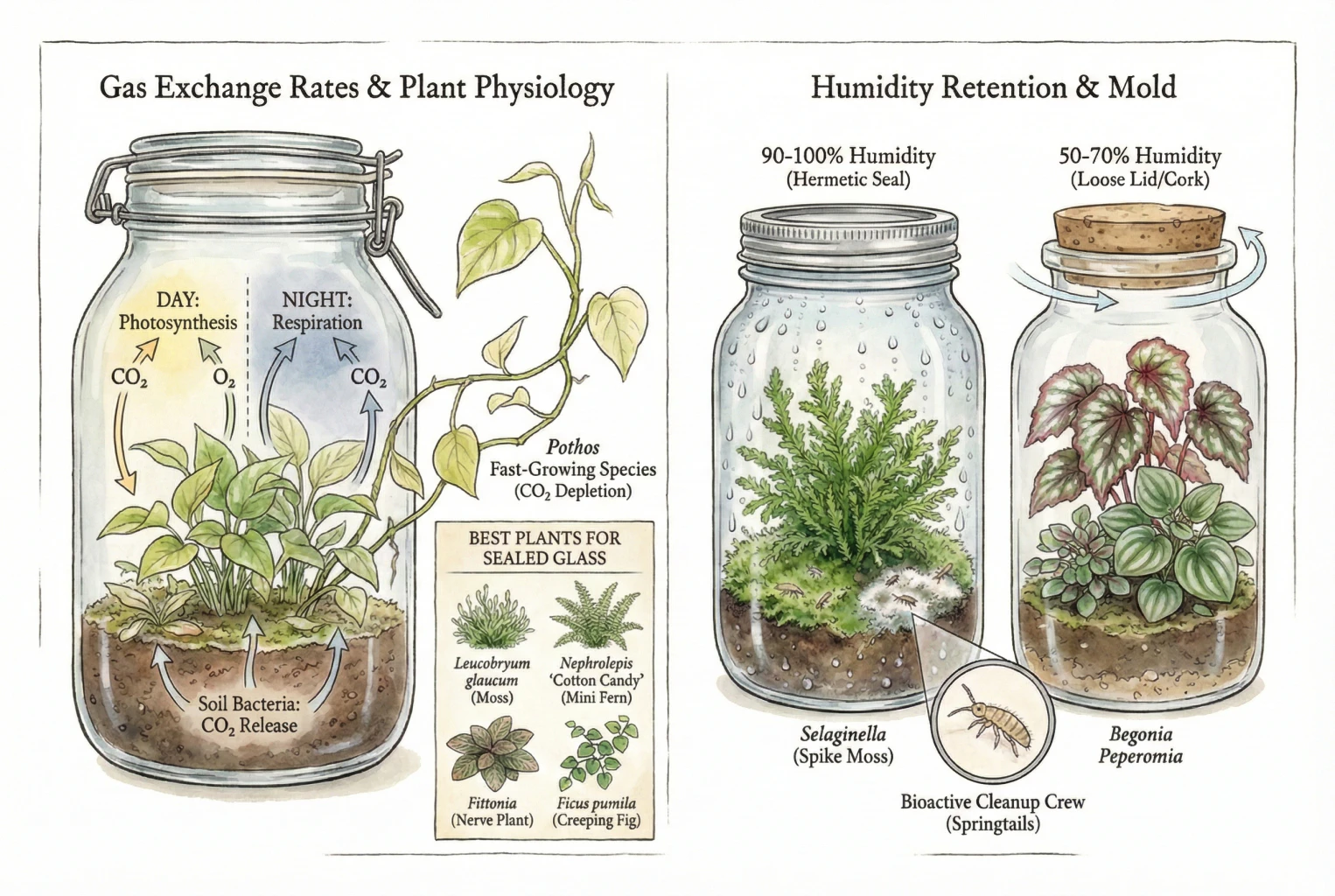
In a tightly sealed jar, carbon dioxide (CO2) can become limiting under some conditions.
- The Cycle. Plants photosynthesize in the light and respire around the clock. They respire during the day too, and during the light period net photosynthesis usually exceeds it. Soil microbes also release CO2 as they break down organic matter, and that organic carbon pool buffers the system.
- The Bottleneck. A tight seal cuts net exchange with the room, so fast growers can draw down daytime CO2. Whether that actually crashes a jar depends on light, biomass and substrate respiration, and it has not been measured here. It is a possibility, not a certainty. Leggy, weak growth is also commonly a sign of too little light, so do not read it as CO2 starvation without checking the lighting first.
- Selection. The main practical reason to favor slower growers in a small sealed jar is to reduce pruning and crowding, not because they must match a bacterial carbon rate.
- Plants that suit sealed glass. Slow-growing mosses (Leucobryum glaucum, Dicranum scoparium) and small ferns such as Nephrolepis Cotton Candy, after checking the vessel scale and confirming the cultivar’s mature size and availability. Fittonia stays compact with occasional trimming. Note that Ficus pumila (creeping fig) is a vigorous, fast grower (it is not a slow creeper and will outgrow a small jar) so choose species by mature size and pruning need, not by reputation.
7.2 Humidity Retention & Mold
A tighter seal tends to hold higher humidity, but the exact level depends on how much water you start with, temperature, plant leaf area, substrate and the leak rate. There is no fixed number per seal type.
Use a hygrometer and match the range to your plants rather than assuming a value.
- Very high humidity (tight seal). Suits plants prone to drying out in open air. Selaginella is often called spike moss, but it is a vascular spikemoss, a lycophyte rather than a true moss, and species differ in their needs. It does like moist, humid conditions, but it does not die within hours in an ordinary room. S. kraussiana, for instance, is grown as a houseplant. High humidity with stagnant air can raise the risk of some molds and bacterial disease, though wet air alone does not confirm disease. A springtail cleanup crew can help graze mold, but springtails are not strictly required and are not a guaranteed control for every mold.
- Moderate humidity (loose lid or cork). Often better for plants like begonias or peperomias, whose leaf-wetness and rot risk depend on species, pathogen, temperature and how long leaves stay wet. A cork lid can allow some gas exchange, but its permeability varies with thickness, fit, coating and saturation, so it does not guarantee fresh airflow.
8. The Breathable Glass Myth and Other Nonsense
A few common claims in online plant communities are worth correcting.
8.1 Breathable Glass
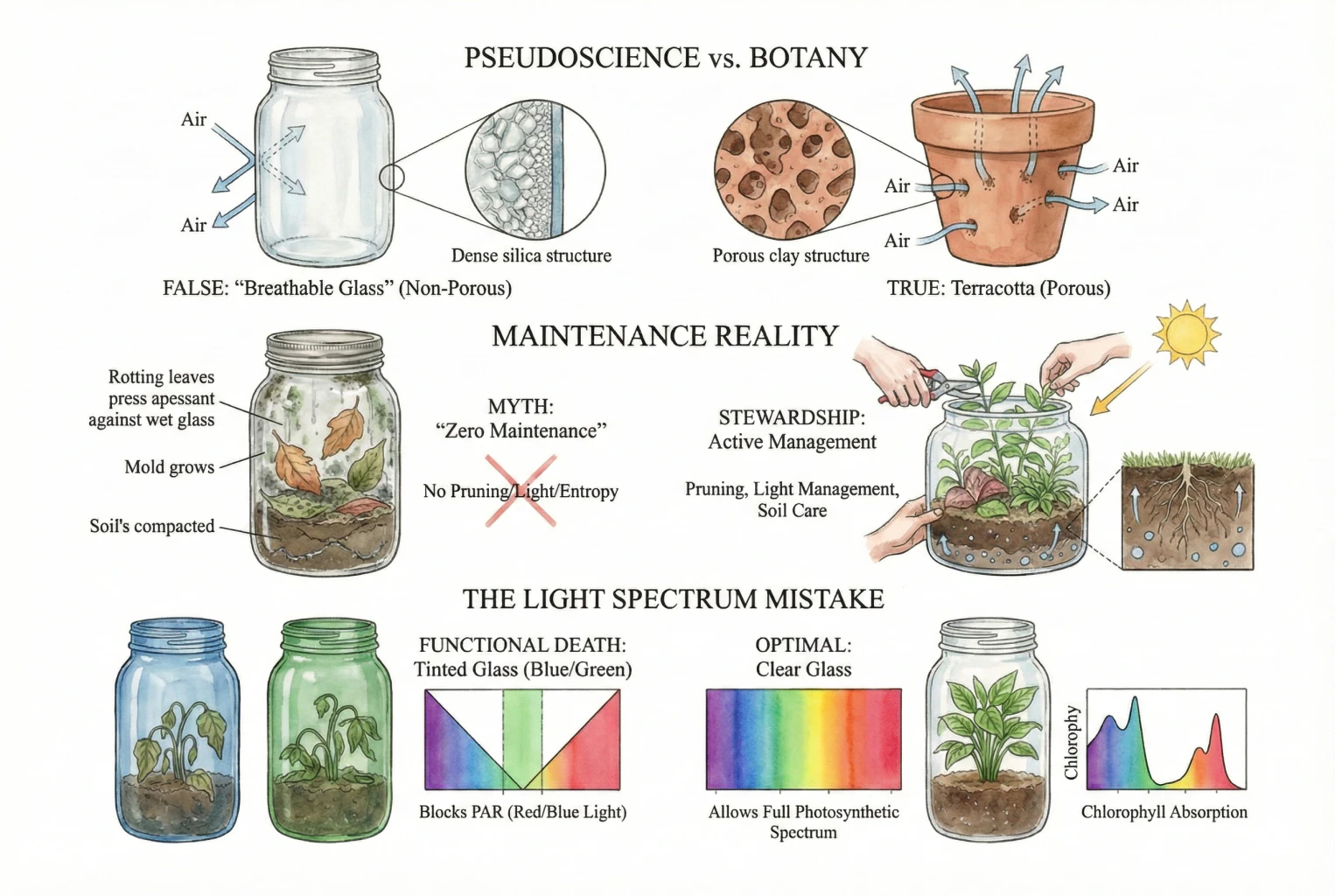
Some listings advertise breathable-glass pots. Ordinary intact glass is effectively non-porous. Unless it is sintered glass, as used in lab filters, or physically drilled, air does not pass through the silicate structure.
Without seeing the actual product it is hard to say what a given breathable-glass listing really is. It may be a permeable ceramic, a glaze or plastic rather than solid glass.
Do not buy one expecting gas exchange through solid glass walls. If you want a wall that exchanges some air and moisture, terracotta does that, but its trade-off is the opposite of a closed terrarium because it lets moisture escape rather than retaining it.
8.2 Low Maintenance Still Needs Checks
No sealed jar is truly maintenance-free, though a well-set-up one can be genuinely low-intervention and long-lived. Plan for the following checks.
- Light management. Repositioning as seasons and sun angle shift.
- Pruning. Plants grow, and in a closed jar leaves eventually reach the glass. A wet leaf pressed to the glass can hold water long enough to invite rot, though that is a risk rather than a certainty. Prune growth back before it crowds the walls.
- Slow changes. Substrate can compact and nutrients redistribute over time. This is ordinary aging, not entropy in the strict thermodynamic sense. You are the steward, not just the observer.
8.3 Tinted (Blue/Green) Glass
Strongly tinted glass changes both the total light and its spectrum, which is why clear glass is the safer default for a planted build.
- Chlorophyll and green light. Chlorophyll absorbs most strongly in the blue, around 430 nm, and red, around 660 nm, but green light is not wasted. Green photons still drive photosynthesis and penetrate deeper into leaves and canopies, so the claim that plants do not use green is a myth. How much red or blue a colored jar actually blocks depends on the dye or oxide, the color and the thickness, which you cannot know without a measured spectral curve.
- Practical point A heavily tinted jar can noticeably cut usable light, but calling it equivalent to darkness overstates it. If you want to use a tinted vessel, verify the light reaching the plants with a PPFD or DLI reading rather than assuming. Clear glass simply removes the guesswork.
9. Choose a Container by Use
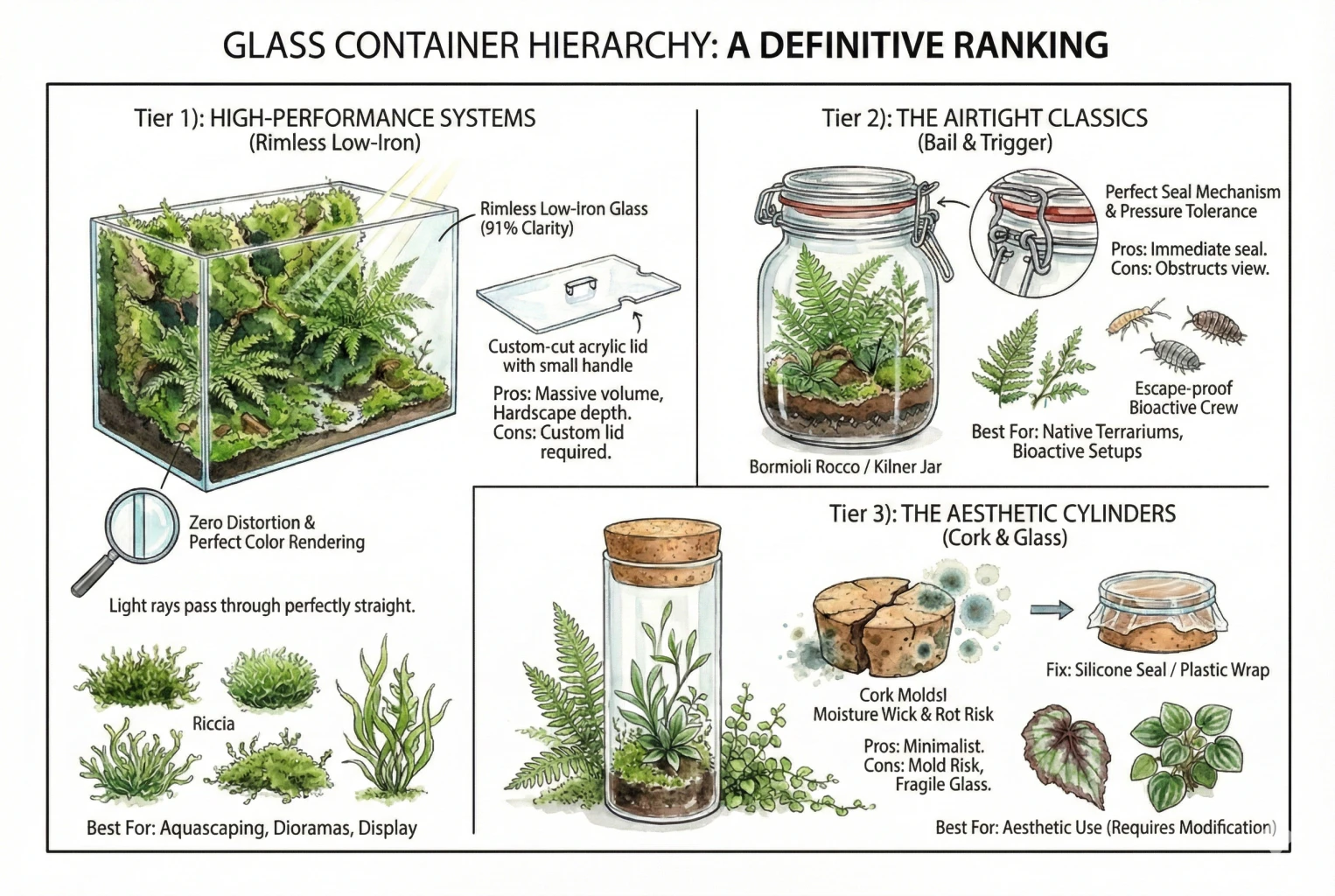
These groups compare glass quality, seal mechanics, and geometry. They are not a benchmarked ranking, and price, availability, dimensions, and your own goal should weigh in too.
Group 1 (Rimless Low-Iron Tanks)
These are aquariums, but their glass clarity and clean geometry also make them capable open or custom-lidded terrariums.
Model. UNS 60U (about 20 gallon, 6 mm, per the manufacturer chart) or Landen 60P (about 17.1 gallon. See the earlier note that its spec comes from resellers, not a confirmed official source).
Material. Low-iron glass. UNS's official page cites 91% Diamant low-iron with 45° mitered edges. Do not assume Landen shares that exact spec.
Pros
Low distortion and faithful color rendering, with generous volume for hardscape depth. No glass achieves literally zero distortion or perfect clarity.
Cons
These tanks are expensive, and a closed setup needs a custom lid that handles condensation, warping, ventilation, access and load support.
Best For
Aquascaping-style moss walls, dioramas and display pieces.
UNS Rimless Nano Cube
A small desktop tank with 45° mitered edges and ultra-clear glass. The linked listing currently maps to the UNS 25C cube (about 4.1 gallon, ~9.84 in), while a UNS 5N is a different model with different shape and dimensions.
Confirm the model and volume on the listing before buying.
Group 2 (Bail-and-Gasket Jars)
A good fit for low-intervention closed jars that you still check on periodically.
Model. Bormioli Rocco Fido Glass Jar or Kilner jars.
Material. Soda-lime glass. Exact material and consistency vary by model.
Mechanism. Metal clamp compressing a rubber/silicone gasket.
Pros
Reduces water-vapor loss well. It is not a perfect or high-pressure seal, and the manufacturers do not rate these jars as pressure vessels.
Cons
The metal clamp partly obstructs the view.
Best For
Bioactive setups with springtails. Whether the jar prevents escapes depends on gasket seating, hinge gaps and how often you open it, so it is not guaranteed.
Bormioli Rocco Fido 5 L Jar
This Italian-made 5 L Fido has a clamp lid and belongs to a replaceable-gasket family, while the manufacturer catalog supports its airtight-lid and pasteurization use.
That does not make it a pressure vessel or a set-and-forget guarantee. Whether 5 L is enough for small ferns and vertical hardscape depends on the species’ mature size and the jar’s dimensions.
Group 3 (Cork-Top Cylinders)
How closed terrariums work and the science behind them by The Urban Nemophilist (general background on closed-terrarium function, not a test of cork jars specifically).
Cork-top cylinders are attractive, but constant moisture creates a few practical caveats.
Model. Cork-top cylinders and apothecary jars.
Material. Glass thickness varies by product. Some are thin.
Pros
A clean, minimalist look many people like.
Cons
Under constant moisture, cork can absorb water and is prone to mold and decay over time, though this varies with the cork’s treatment and how well the jar is ventilated.
Possible Fix
Lining the underside of the cork with silicone or plastic wrap can reduce moisture contact, but check adhesion, food or aquarium safety and whether it traps moisture before relying on it.
Choosing the Right Vessel
The vessel is one lever among several. Glass composition influences light and color, the seal influences humidity and gas exchange, and shape influences viewing and sun exposure, but placement, lighting, plant choice and ongoing care share the work.
Match the Vessel to the Plant
Clear glass avoids the guesswork of a strong tint. A known or untested leaded vintage vessel is best kept out of a wet, acidic build as a precaution, and a closed jar of desert cactus is a poor match because most cacti want dry, airy conditions. Epiphytic jungle cacti such as Schlumbergera are the exception and need their own care.
Low-iron glass gives a small clarity and color edge that may or may not be worth the cost for a given build, since the light difference through a thin wall is minor.
A Bormioli Rocco Fido holds humidity well and needs less topping up, but it is still a low-intervention, monitored system, not a truly set-and-forget one, and it will need occasional pruning.
Washing new glass before building is worthwhile to remove clarity-dulling manufacturing residues. Rinse and dry it afterward so you do not leave detergent behind.
Treat claims that cleaning will ruin your microbiome as caution, not a measured outcome.
Understanding how these factors work lets you build something that both looks good and holds up.
Affiliate Disclosure
This article contains Amazon affiliate links. As an Amazon Associate I earn from qualifying purchases. If you use these links, the site may earn a commission at no extra cost to you. Product availability, price, and specifications can change. Check the current listing before buying.