
Alocasia Frydek: Bias Growth Toward a Front-Facing Display
An aesthetic experiment: use Alocasia Frydek’s phototropism and a consistent, single light direction to bias new leaves toward the viewer, plus honest notes on light measurement, sunburn, and leggy stems.
Marcus Hale · Published 2026-03-03 · 10 min read
Key Takeaways
- A front-facing Frydek display is an aesthetic experiment rather than a guaranteed outcome because leaf age, phyllotaxis and plant health also shape the final arrangement.
- Keep the pot fixed for a one-sided display, but rotate it periodically if you want balanced growth because the trade-off is aesthetic rather than a plant-health rule.
- Place the viewer and the main light on roughly the same side so the light falls on the leaf faces you want to see.
- Start with bright indirect light, measure at leaf level and adjust gradually because there is no verified Frydek-specific foot-candle target and sudden intense sun can scorch unacclimated velvety leaves.
- A fixed light gives more consistent direction than moving sun, but bigger leaves and faster maturation still depend on total light, spectrum, temperature and care, so support existing leggy stems while compact growth develops.
Some Alocasia Frydek plants have leaves pointing in many directions, while others lean more consistently toward one side, showing more of their velvety green faces to the viewer.
Some of that difference is just normal variation. Leaf age, the plant’s natural phyllotaxis (leaf arrangement), and how many growth points it has. But light direction also plays a role.
The main lever here is not pruning. It is how consistently you manage the direction of the light. A front-biased display is an aesthetic experiment, and the evidence does not establish a guaranteed angle or schedule for Frydek.
Why Do Alocasia Leaves Turn Toward Light?
Like many plants, Alocasias tend to grow toward the stronger light source through phototropism.
While each leaf expands, I keep the marked pot front fixed and photograph the blade angle from above. Rotating the pot to correct one leaf changes the light cue for every developing petiole and makes the response hard to read.
Small light adjustments are judged by the next leaf, not a hardened blade. Mature petioles may not fully reorient even when the new setup is better.
My PPFD map covers the expected left edge, center, and right edge of the mature leaf wall. A centered lamp can still create a bright middle that turns outer leaves inward.
How Phototropism Bends Growth
A classic, simplified explanation is that the growth hormone auxin accumulates on the shadier side of the stem. Reviews of phototropism describe a more complex picture, including light-mediated inhibition of growth on the lit side, but auxin redistribution is a useful starting model.
Cells on the shaded side tend to elongate more than those on the lit side, and this uneven growth bends the growing stem.
The effect generally tilts the leaf surface toward the light, though plants also balance this against photoprotection and leaf angle, so the surface does not simply point straight at the sun.
These studies cover general shoot phototropism (largely in model plants such as Arabidopsis), not Alocasia specifically, so treat the mechanism as background rather than a measured Frydek behavior.
Phototropism. Bending Towards Enlightenment
How Fast Can An Alocasia Move?
Separate Growth From Daily Movement
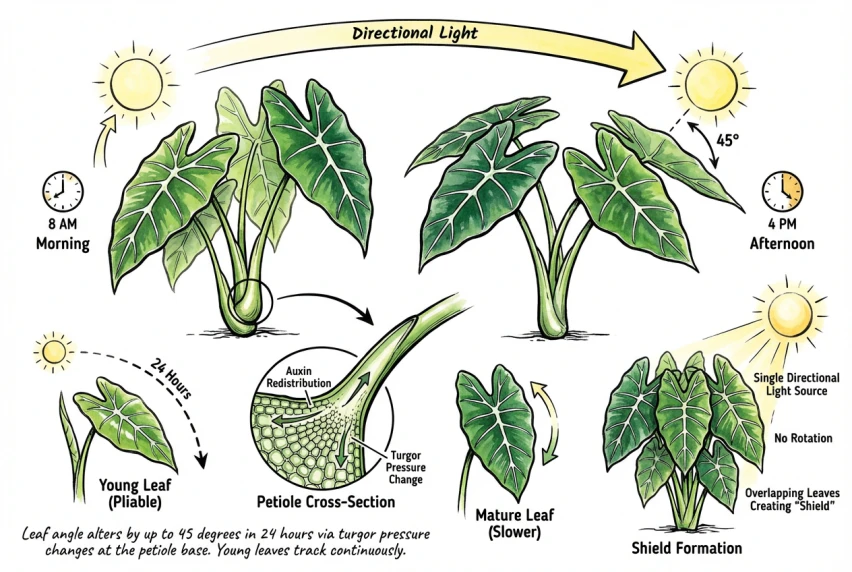
It helps to separate two different things. A new leaf can be oriented toward the light as it expands, and that orientation is largely fixed once the leaf matures. Reversible daily movement of an already-mature leaf is a different mechanism.
Young, emerging leaves are more pliable while they are still expanding, so their final orientation is more influenced by light direction than a mature leaf’s is.
Published time-lapse angle measurements for Frydek are not available, so treat specific daily-tracking claims as unverified rather than as measured facts.
Where the Flexible Joint Sits
In aroids, the flexible joint, or geniculum, sits at the apex of the petiole where it meets the leaf blade, not at the petiole base. Descriptions of aroid morphology note that this nastic movement is a feature of developing leaves and stops once the leaf is mature, so a mature Frydek continuously re-aiming its blades is not well supported.
Mechanism of the Pulvinus-Driven Leaf Movement. An Overview
How do you Get the Shield Look with Alocasia?
The approach is to provide a single, consistent, directional light source and to keep the pot in a fixed orientation.
By placing a grow light or bright window in front of the plant, new leaves tend to be biased toward that direction as they grow, though how strongly and how uniformly this happens will vary between plants and leaves.
Over time the foliage can visually overlap toward the viewer. Keep in mind the trade-offs of a tightly one-sided canopy, such as self-shading of inner leaves and reduced airflow.
Should I Rotate My Alocasia Frydek?
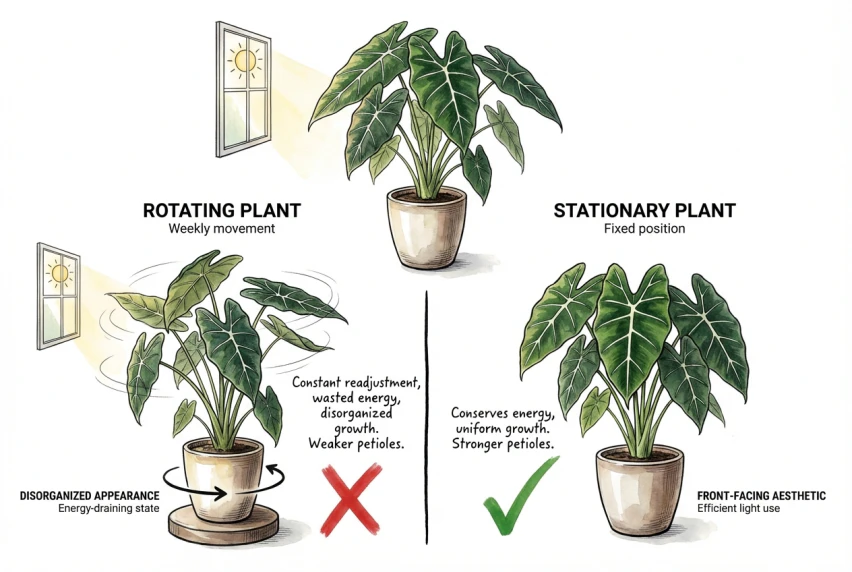
It depends on your goal. For a front-facing display, keeping the pot in a fixed orientation is the logical choice.
Common houseplant advice suggests rotating plants periodically for even, balanced growth, which is a good default if you want a symmetric plant or you want to inspect all sides regularly.
When you rotate, the plant does gradually reorient new growth toward the light again, so the display becomes more all-around than one-sided.
Claims that rotation drains energy or produces weaker petioles have not been measured for Frydek. The practical difference is aesthetic, one-sided versus balanced, rather than a rule about plant vigor.
How to Position Your Plant?
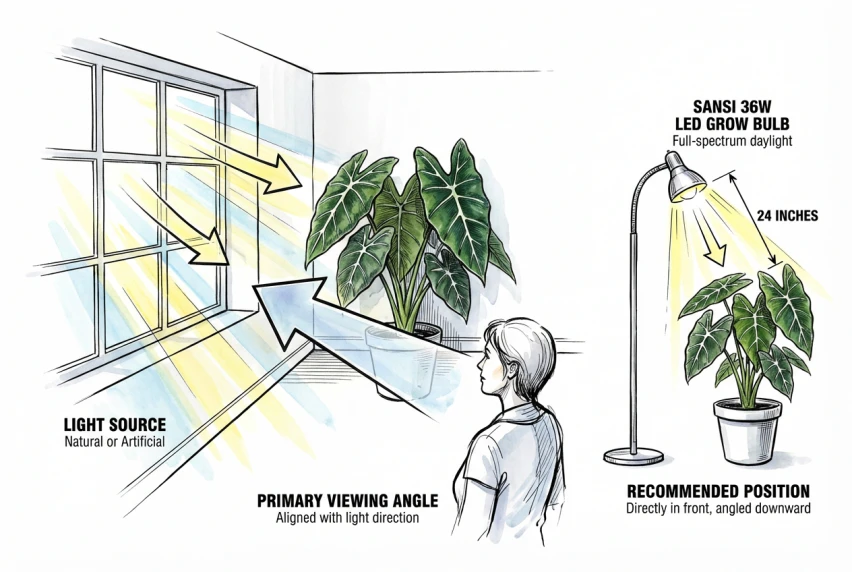
Because leaves tend to face the light, the front of the leaves is the lit side. So to see those fronts, your usual viewpoint and the light should be on roughly the same side of the plant, with the light falling on the faces you are looking at.
With a window, that means viewing the plant from the window side, for example, standing between the window and the plant, or off to the same side, rather than from across the room.
If you stand on the far side of the plant looking back toward the window, you will mostly see the backs of the leaves.
Check the Viewing Side
If your camera or eyes and the main light are on the same side, you are seeing the lit fronts. If the light is behind the plant relative to you, you are seeing the shaded backs.
What Are Alocasia Frydek Light Requirements?
Start With Measured Light
Extension guidance from UF/IFAS recommends bright, indirect light for Alocasia houseplants. No authoritative Frydek-specific foot-candle target has been established, so start with bright indirect light rather than a precise number. A commonly cited range of 400 to 800 foot-candles is general houseplant advice, not a verified optimum for this cultivar.
Balance Duration and Intensity
A useful photoperiod range for foliage houseplants under artificial light is about 12 to 14 hours. This is broad guidance, not a requirement to force natural daylight to that length. What matters is the total daily light the plant receives, its DLI, the combination of intensity and duration, so adjust intensity, duration and distance together.
Use a Light Meter as a Comparison Tool
Rather than guessing by eye, measure at leaf level and adjust gradually while watching the leaves. The Dr.meter Digital Light Meter is useful for comparing similar spots or the same fixture after you change its height. It reads lux or foot-candles, not PAR or PPFD, so do not use it to compare different grow-light spectra or to claim an exact target. Keep the meter dry and use it to compare your own window, season, glass, screen, and shading conditions.
Why Are My Alocasia Leaves Turning Brown and Crispy?
Read the Damage Pattern
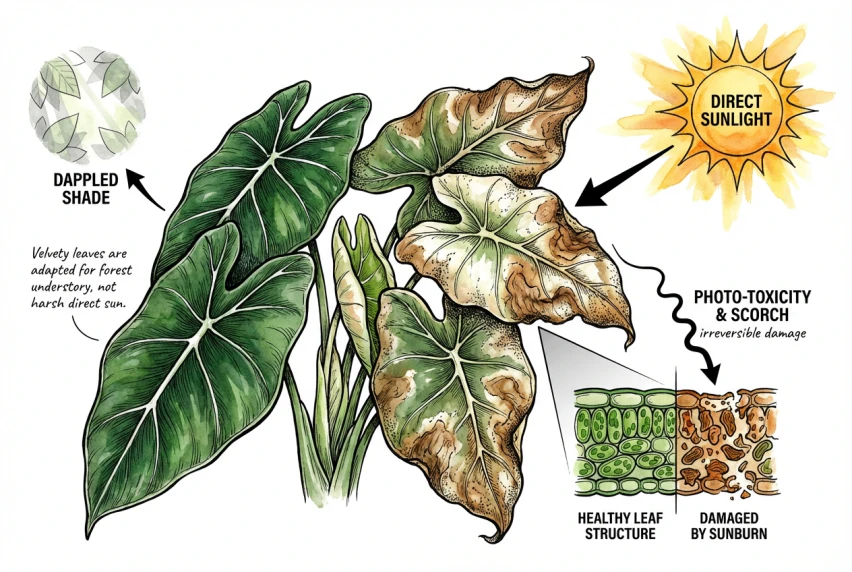
Crispy, bleached or browning leaves can be sunburn, but that is only one possibility. Before assuming excess light, check the timing and pattern of the damage, then soil moisture and root condition, humidity, drafts and temperature, fertilizer or salt buildup, water quality, pests and disease. Phototoxicity is often used for chemical or pesticide-related light injury, so keep that term separate from ordinary light scorch.
The Frydek has a velvety leaf surface, and Alocasia species usually grow in shaded understory conditions, though they are also found in more exposed regrowth.
That makes the leaves prone to scorch if moved suddenly into strong sun, but it does not mean any direct light is automatically harmful.
Sudden, intense afternoon sun can damage unacclimated tissue, harming chloroplasts and causing necrosis.
The severity depends on the dose, the leaf’s acclimation, duration, and airflow, so gradual acclimation matters more than avoiding all direct light.
Tissue that is already scorched will not heal. Confirm the cause first, then decide what to remove. A partly damaged leaf can still contribute useful green photosynthetic area, so you do not always need to cut the whole leaf immediately.
How to Fix Leggy Stems?
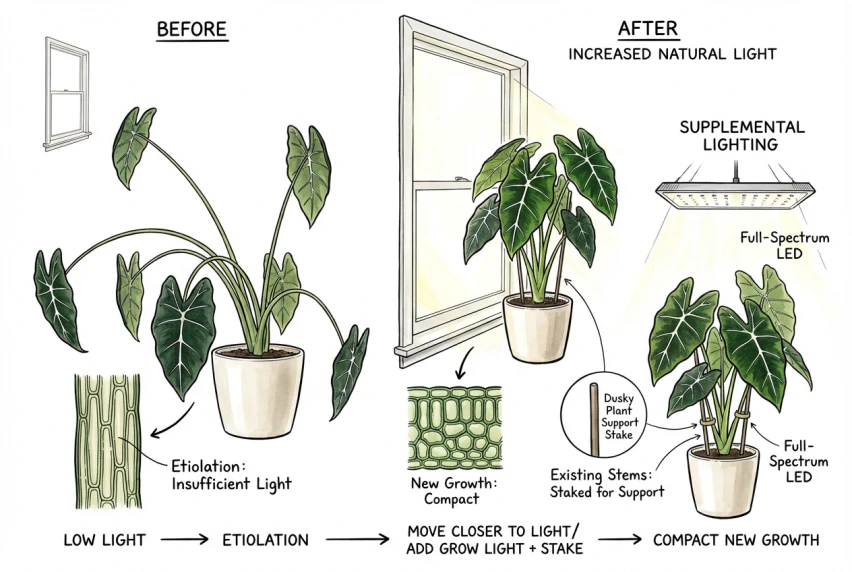
Long, drooping petioles can be etiolation, elongated, weak growth from insufficient light, but that is not the only cause.
Also rule out normal leaf age and architecture, water and turgor status, and root health before concluding the plant simply needs more light.
(With Alocasia, watch petiole length and leaf size and angle rather than the node spacing you would look at on a typical vining stem.)
If you have confirmed low light, increase intensity gradually rather than all at once. A sudden move closer to a window or lamp can scorch leaves or expose them to lamp heat.
Measure at leaf level before and after any change and let the plant acclimate.
Check the Grow-Light Specification
A full-spectrum LED is a reasonable supplement, but a full-spectrum label alone does not confirm adequate PPFD, DLI, coverage or electrical safety. Check the actual specifications and coverage.
Support Existing Stems
Existing elongated stems will not shrink. You can support them temporarily with a stake. VELCRO ONE-WRAP ties suit a loose, temporary attachment between a petiole and a stake. They do not correct the cause of stretched growth. Keep the loop loose, do not bundle petioles, inspect it for rubbing or constriction, and remove it as the old leaf ages out. Plain soft plant ties or clips can serve the same purpose.
How Does an Indoor Plant Lighting Setup Work For Alocasias?
Keep the Light Direction Stable
A dedicated artificial light can give more consistent direction and intensity year-round than window light, which helps maintain a one-sided display when the fixture, timer and measured light level remain stable.
Grow lights hold a fixed position and intensity, so they reduce the seasonal shifts in sun angle that a window introduces.
That steadier direction can limit some reorientation of new growth, but it will not stop the plant’s normal development, gravitropism, or changes in leaf turgor.
Do Grow Lights Work Better Than Natural Light?
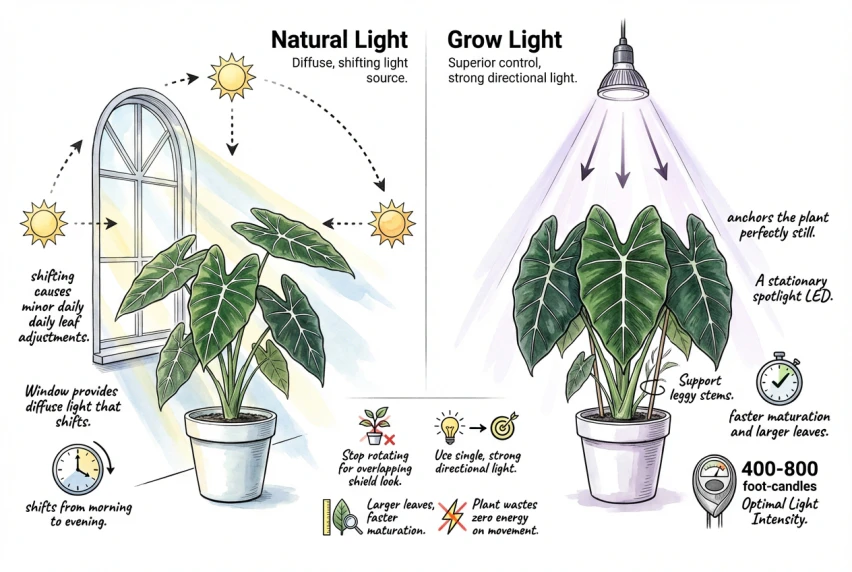
For the specific goal of controlling leaf orientation, a fixed grow light gives more consistent direction than a window does.
Window light changes through the day and across seasons. Depending on the window’s orientation and the weather it is not always diffuse, and those changes can nudge new growth in different directions over time.
A stationary, directional LED provides a steadier direction. The SANSI 36W Grow Light suits one plant in an open, rated E26 fixture when you want a fixed light direction. It cannot by itself guarantee larger leaves or faster maturation, which still depend on the total light, temperature, and overall care.
Map PPFD Across the Canopy
Set the height from the light actually reaching the leaves, not from a center-point product claim. Check several leaf positions after any height change, then raise or dim the lamp if the foliage shows stress. Use a secure, compatible, rated fixture with ventilation and a timer. This bulb is not suited to a tightly enclosed fixture.
Affiliate Disclosure
This article contains Amazon affiliate links. As an Amazon Associate I earn from qualifying purchases. If you use these links, the site may earn a commission at no extra cost to you. Product availability, price, and specifications can change. Check the current listing before buying.