
Alocasia Care Guide: Light, Humidity & Substrate Science
An advanced Alocasia care guide: PPFD light targets, vapor pressure deficit and humidity, semi-hydro substrates (LECA, Pon, Stratum), feeding, dormancy, and biological pest control.
Marcus Hale · Published 2025-11-28 · 20 min read
Key Takeaways
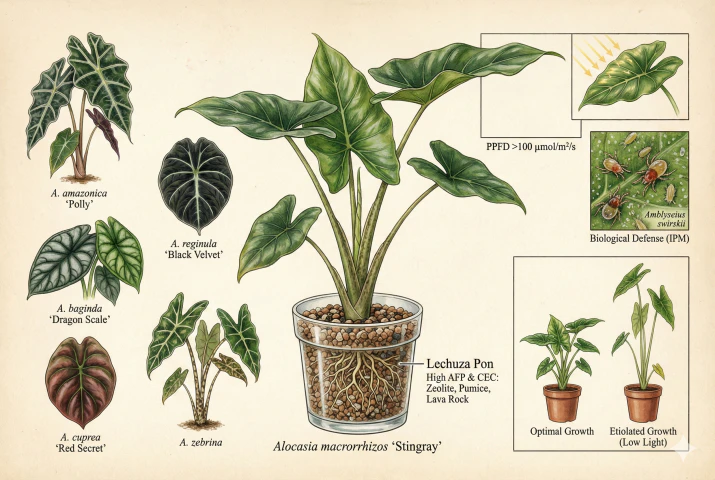
- Alocasia are not low-light plants. They want bright indirect light. A leaf-level PPFD around 100 µmol/m²/s is a reasonable starting point to measure and adjust from. Too little light causes stretched, etiolated petioles. Unshaded, un-acclimated exposure to strong direct sun can bleach leaves.
- Most Alocasia prefer humid air, but keep whole living spaces at or below the ~50% RH health agencies recommend. If a species needs higher humidity, give it its own enclosed cabinet or greenhouse with its own sensor, ventilation, and condensation control rather than raising the humidity of a room you live in. Misting doesn’t change ambient humidity.
- Roots need oxygen, so use an airy aroid mix or a semi-hydro substrate rather than a mix that compacts and stays waterlogged. LECA, zeolite-bearing mineral substrate, and volcanic aquarium substrate can all serve different purposes. A well-structured peat/perlite blend is not the same as compacted peat, and several Alocasia tolerate consistently moist media.
- Feed in the growing season and taper off as growth slows, starting below the label rate and adjusting to measured EC/pH and the plant’s response. Alocasia are not uniformly heavy feeders. Standard Pon includes slow-release fertilizer, while other mineral aggregates may be inert, so check the exact product before adding nutrients.
- For thrips and spider mites, identify the pest first, then choose controls by product label and beneficial-supplier compatibility charts. Biological control can work well, but match each agent to its actual target. A. swirskii is for thrips, whitefly, and broad mite, not spider mites, while S. feltiae targets soil-stage thrips.
Indoor Alocasia care depends on measurable light targets, substrate structure, and integrated pest management.
Alocasia is a large genus with well over 100 species, described by Kew as ranging from seasonally dormant to evergreen, so the numbers here are starting points to measure and adjust rather than fixed rules for every species and cultivar.
The genus is often called finicky, but most of that reputation comes from misreading its very specific needs for light, humidity, and root aeration.
1. Start with the Plant’s Basic Needs
To grow Alocasia well, it helps to understand the plant as it lives in the wild.
After watering, I align the marked front of the pot and photograph each petiole from the same side, then repeat the view before the next watering. Alocasia leaves naturally change angle through the day, so one drooping snapshot can exaggerate a problem.
What matters is a lasting angle change that agrees with pot weight, root-zone moisture, and leaf firmness. That combination keeps me from watering again just because one older leaf lowered itself.
1.1 Structural Adaptations
Read Peltate and Sagittate as Separate Traits
Peltate describes a petiole attaching to the underside of the blade inside the margin rather than at the edge. Sagittate describes an arrow-like blade shape. These are different axes rather than simple alternatives. Kew notes that juvenile Alocasia leaves are often peltate and mature blades are usually sagittate, though some species stay peltate at maturity.
A large leaf area can increase total transpiration, but boundary-layer thickness, stomatal density and conductance, hydraulic supply, and leaf orientation all matter too, so leaf size alone doesn’t make a plant an indoor liability.
In many native habitats ambient humidity is high, which keeps the vapor pressure deficit low.
Indoors, low humidity is one factor that can push water loss ahead of uptake. But sudden petiole collapse has several possible causes, a dry root ball, damaged or rotted roots, cold, mechanical injury, or petiole disease among them, so check root-zone moisture and root condition before assuming the plant simply needs more humidity.
1.2 Toxicology and Defense Mechanisms
It’s important to address the toxicity of the genus. Like many aroids, Alocasia tissues are full of idioblasts containing raphides. Needle-like calcium oxalate crystals.
These are insoluble and act as a mechanical deterrent. When chewed or crushed, the crystals pierce the mucous membranes of a predator, causing immediate, intense pain and swelling.
For the grower this matters beyond pet safety. The sap can cause contact dermatitis, so wear gloves when cutting or dividing.
Raphides are widely regarded as a chewing deterrent, though their protection against particular herbivores has not been well quantified for the genus. In practice, sap-sucking pests such as thrips and spider mites remain the main indoor problem. For related reading, see our spider mites guide.
2. Set Up Light
A common misconception is that Alocasia are low-light plants. Many are understory plants, but light under a tropical rainforest canopy is very different from the shade of a residential hallway. For genuinely low-light aroids, see our low-light care guide.
2.1 Quantifying Light (PPFD and DLI)
Most Alocasia grow best in the bright-indirect range rather than deep shade. A useful metric for usable light is Photosynthetic Photon Flux Density (PPFD), measured in micromoles of photons per square meter per second (µmol/m²/s).
As a rough starting point, a leaf-level reading around 100 µmol/m²/s is a reasonable place to begin measuring and adjust from. This is an example figure rather than a validated genus-wide minimum because responses vary with species, leaf age, temperature, and acclimation. Research on understory A. macrorrhiza found acclimation across roughly 3 to 780 µmol/m²/s. Too little light leads to etiolation, the stretching of petioles as the plant reaches for light.
A more complete measure is the Daily Light Integral (DLI), the total photons received over a photoperiod, which means a lower intensity over a longer photoperiod can deliver the same daily total as a higher intensity over a shorter one.
Judge a plant’s light by its growth and leaf appearance over time, and adjust gradually.
2.2 Spectrum and Species Variance
Growers often sort Alocasia into two informal horticultural groups, but this is a marketing convenience, not a physiological classification, and light needs are better established per species than inferred from leaf color or size.
1. Jewel Types
Species such as A. azlanii and A. reginula have dark, often purple-backed leaves. Pigments may help harvest scattered light, but anthocyanins also serve photoprotection and optical screening, and species-level measurements confirming a light-harvesting role are lacking. For a genuinely low-light forest-floor planting, see our forest-floor mix guide.
2. Giant Species
Species such as A. macrorrhizos and A. odora do not automatically need more light because they are larger. A. macrorrhizos is a rainforest-understory and lightfleck plant, so do not assume that a large Alocasia wants full sun.
2.3 The Dangers of Direct Irradiance
The real risk is moving a shade-acclimated leaf abruptly into strong direct sun, which can cause photoinhibition and thermal injury. This is about acclimation rather than an absolute ceiling. Sun-exposed A. macrorrhiza leaves have been studied above 1,000 µmol/m²/s, so direct noon sun always exceeding Alocasia’s capacity is too strong a rule.
When light exceeds what a leaf can use and dissipate, excess energy can drive photo-oxidative stress that shows as bleached or necrotic patches.
Increasing light gradually, and watching leaf temperature and any bleaching, matters more than a fixed intensity number.
Measure Light Instead of Using Distance Rules
Window direction and a set distance do not guarantee a light level. Latitude, season, window size, glazing, obstructions, and sheer-curtain transmittance can change PPFD several-fold. The reliable approach is a leaf-level light meter plus staged acclimation.
3. Manage Temperature and Humidity
Alocasia metabolism is closely tied to temperature and humidity. As tropical and subtropical plants, most are not adapted to cold, and cold-plus-wet conditions are a common way to lose them.
3.1 Thermal Constraints
Alocasia are warmth-loving plants. Calling them obligate thermophiles borrows a microbiology term and overstates the case. Cold and heat tolerance vary by species and cultivar, so treat the figures below as rough guides rather than genus-wide thresholds.
- Cold temperatures can slow or stop growth. The RHS suggests keeping many indoor Alocasia above about 18 °C (64 °F), and in some tropical species readings near 15 °C (59 °F) may cause chilling injury and impaired root function rather than a clean dormancy. Cold combined with wet soil raises the risk of root rot.
- Heat is easier to tolerate with adequate humidity and airflow. In hot, dry air, stomata may close and heat can build in the leaf, but the outcome depends on leaf temperature, VPD, soil moisture, and light rather than a single air-temperature cutoff.
3.2 Vapor Pressure Deficit (VPD) and Humidity
Humidity matters, and it is best understood together with temperature through vapor pressure deficit (VPD), the gap between how much moisture the air contains and how much it could hold at that temperature.
The same relative humidity gives a different VPD as air and leaf temperature change, so RH alone does not define the moisture stress a leaf feels.
Most Alocasia do better in moderately humid air than in very dry rooms, but a very low VPD is not automatically better. It can reduce transpiration and nutrient transport and favor foliar disease.
A safety note on whole-room humidity
You may see advice to keep a room at 60–80% for Alocasia. Do not do this in spaces where people live.
The U.S. EPA recommends keeping indoor relative humidity at or below 50% when using a home humidifier, because higher humidity encourages mold and dust mites. Adjust the humidifier immediately if condensation appears on windows or walls.
Standing-water humidifiers can grow bacteria and mold, and ultrasonic and impeller units can disperse microbes and minerals into the air, so empty, dry, and refill them daily, clean them about every three days, and use low-mineral water.
If a particular species genuinely needs high humidity, give it a dedicated enclosed cabinet or greenhouse, managed as its own microclimate with a sensor, ventilation, and control of surface condensation and airflow, rather than raising the humidity of a bedroom or living room.
The 60–80% used in a sealed plant case is a very different thing, safety-wise, from 60–80% across a whole room.
Check More Than Humidity
For a plant that wants more humidity, use a humidifier within the safety limits above or cluster plants and enclosures to create a local microclimate. Crispy margins or a leaf that fails to unfurl can also come from root damage, inconsistent watering, salt or nutrient imbalance, mechanical resistance, or pests. Misting does little for ambient humidity and can leave leaves wet, which favors fungal pathogens.
4. Choose a Root-Friendly Substrate
Choose Structure for the Habitat
Many Alocasia grow among leaf litter and humus on the forest floor, but the genus also includes plants from moist-to-ever-wet forest, disturbed sites, stream banks, and swamps. Always keeping Alocasia on the dry side is not a genus-wide rule. Aroid layer is a hobby term rather than a formal soil horizon.
A poorly structured mix that compacts and stays waterlogged can reduce Air-Filled Porosity (AFP) and lead to low root-zone oxygen and rot.
Note that this describes compacted, anaerobic media, not every peat-containing mix. A well-structured peat/perlite blend behaves very differently from dense field soil or old, decomposed potting mix.
4.1 The Physics of Substrates
Build a Starting Mix
Growers use aroid mixes or semi-hydroponic substrates that combine coarse particles for air exchange with finer material for water retention.
Air-filled porosity is not set by an ingredient list alone. Container height, particle-size distribution, packing, decomposition over time, and watering all change it.
Use the following proportions as an adjustable starting point based on how your pots actually drain and dry.
- Use coco coir or quality potting soil as the base at about 30–40%.
- Add perlite or pumice for aeration at about 30%.
- Add orchid bark for structure at about 20%.
- Use the remainder for conditioners such as horticultural charcoal and worm castings.
4.2 Semi-Hydroponics (Mineral Substrates)
Many growers move Alocasia to semi-hydroponic systems. Three commonly discussed options are LECA, Pon or a similar mineral aggregate, and volcanic aquarium soil.
They differ in composition and behavior. Standard Pon is not fully inert because it includes slow-release fertilizer. Do not assume another zeolite-pumice-lava blend has the same charge.
4.2.1 LECA (Lightweight Expanded Clay Aggregate)
LECA is expanded clay fired in a kiln, so the internal gases expand into a honeycomb structure.
Firing temperature and pellet size vary by brand (commonly in the roughly 8–16 mm range), and the larger particles create big air pockets.
Vertical wicking is limited, but exactly how far water rises depends on particle size, pre-soaking, pot geometry, and reservoir level rather than a fixed distance.
LECA is often chosen for large, established plants with robust root systems. Whether it is the most cost-effective option depends on local prices and how you build the system, so compare it for your own situation.
4.2.2 Mineral Aggregate (Zeolite, Pumice, Lava)
Standard Pon combines zeolite, washed pumice, and lava and is sold with slow-release fertilizer. Other mineral aggregates use different ingredients and may be fertilizer-free, so read the product sheet rather than treating Pon’s composition as the definition of the category.
Particle size, container geometry, and packing affect capillary rise. The greater weight of many mineral blends can also steady a top-heavy plant.
Zeolites are aluminosilicate minerals that can adsorb and exchange cations, which is why zeolite-bearing substrates can buffer nutrients. Cation exchange capacity varies by mineral, structure, and solution chemistry, so a single typical number for zeolite, and especially for a mixed aggregate, is not meaningful. The finished substrate would need manufacturer or independent testing for a measured CEC.
A ready-mixed zeolite, pumice, and lava substrate of this type is volume-stable and suited to self-watering setups.
One important caveat applies specifically to pre-fertilized products. Pon’s manufacturer describes its included slow-release charge as lasting about six to eight months. That figure belongs to Pon, not to every mineral aggregate, and actual release depends on temperature, leaching, and plant uptake. Adding a complete hydroponic nutrient to a fresh, pre-charged batch can raise EC enough to injure roots.
Follow the exact product’s feeding guidance and watch measured EC before adding fertilizer. If you want an inert medium, choose a product explicitly sold without fertilizer.
Mineral aggregates also tend to cost more than plain LECA and are heavier to ship.
4.2.3 Volcanic Aquarium Soil
Volcanic aquarium soil is a mineral-rich substrate sold for freshwater tanks. It’s made of soft granules that can break down over time, which may reduce aeration in deep pots.
Some growers use it as a rooting medium for cuttings and corms because of that softness, but this is an off-label use (these products don’t claim superior performance for Alocasia propagation, and there’s no published trial establishing them as better than alternatives).
Ion Exchange in Clays and Other Minerals (USGS)
4.3 Choosing Between Them
Choose the Mineral Substrate by Use
LECA is a common choice for large established plants, while a heavier mineral aggregate can provide more stability. A pre-fertilized product also supplies an initial nutrient charge, but an inert one does not. Volcanic aquarium soil is used by some growers for rooting, though it is not automatically a better long-term medium. Compare particle size, weight, water retention, pH, EC, and how often the medium needs replacing. If you are moving a plant over, it helps to match a semi-hydro conversion kit to LECA, mineral aggregate, and meters.
5. Nutritional Management for Alocasia
Feed to Measured Response
Alocasia are sometimes called heavy feeders, but that label does not hold across the genus. A 2025 HortScience study of Alocasia Bambino grew best at low nutrient concentration, with substrate EC around 0.4 dS/m, and declined at higher EC. Building large leaves takes nitrogen and other nutrients, but the safer default is conservative feeding guided by EC, pH, and plant response.
5.1 Macronutrient Roles
- Nitrogen (N) drives vegetative growth through amino acids and chlorophyll. Deficiency shows as yellowing of older leaves as the plant moves mobile nitrogen to new growth.
- Phosphorus (P) supports root development and the energy molecule ATP.
- Potassium (K) supports stomatal regulation, osmoregulation, and activation of many enzymes. Adequate potassium is associated with better tolerance of cold and drought across crops, but that does not show that extra potassium winterizes an Alocasia. Excess K can unbalance calcium and magnesium uptake and raise EC. Aim for balanced nutrition.
5.2 Fertilizer Regimens
- In soil cultivation, a balanced liquid fertilizer such as 20-20-20 or 10-10-10 diluted per its label during the growing season is a reasonable approach. The right interval depends on the product, your water, substrate charge, and plant size, so watch EC/pH and the plant rather than following a fixed schedule. Slow-release pellets provide a steadier trickle.
- In a genuinely inert substrate such as LECA, the plant depends on the nutrient solution. Use a complete hydroponic nutrient that supplies calcium and magnesium, and check whether your fertilizer and tap water already provide them. Standard Pon is not inert and is pre-fertilized, so do not treat it the same way. Symptoms such as deformed new leaves or interveinal chlorosis can point to calcium or magnesium issues but are not proof on their own. Confirm with EC/pH, a look at the roots, and your fertilizer and water composition before adding more nutrients.
5.3 The Seasonal Shift
Nutritional demand tracks how actively the plant is growing, not the calendar alone. When growth is active, light feeding at low concentration is gentler than occasional heavy doses and reduces the risk of fertilizer burn.
As growth slows with lower light and temperature, cut back or stop, because unused fertilizer lets salts accumulate.
If you keep a plant growing year-round under grow lights, feed to its actual activity rather than to the season.
Potassium. A Vital Regulator of Plant Responses and Tolerance to Abiotic Stresses
6. Integrated Pest Management for Alocasia
Indoor Alocasia commonly get two pests, spider mites (Tetranychidae) and thrips (Thripidae).
Large flat leaves give them room to feed, and dry, warm conditions can favor mites.
Integrated pest management combines identification, sanitation, quarantine of new plants, physical removal, and, chosen by product label, both biological controls and selective pesticides.
Biological control can be very effective, but it is not automatically superior to every spray in every situation. The right choice depends on the pest, its density, temperature, and your setup.
6.1 The Adversaries
Thrips
Thrips are arguably the hardest pest on Alocasia. They seek out crevices and tight spaces, often feeding inside unfurling leaves where sprays can’t reach, puncturing epidermal cells and leaving silvery scarring and black fecal specks.
Spider mites
Spider mites tend to be worse in warm, dry air and on water-stressed plants. They spin fine webs on leaf undersides and cause stippling (tiny yellow dots).
Dry conditions raise the risk, but mites still have to be introduced in the first place, so inspecting and quarantining new plants is the most reliable prevention.
6.2 Biological Control Agents (BCAs)
Predatory mites and nematodes hunt pests directly, but each one has a specific target and a set of conditions it needs, so match the agent to the pest.
- Amblyseius swirskii targets thrips, whiteflies, and broad mites, and it can be released preventatively when pollen or supplemental food is available. Per Cornell, it should not be bought to control spider mites because it can eat a few at low density but does not get through webbing. It typically needs warm conditions (roughly 20–32 °C), adequate prey or alternative food, and a release rate matched to the infestation, sometimes with repeat releases.
- Steinernema feltiae are beneficial nematodes applied as a soil drench that target thrips pupae and fungus-gnat larvae in the growing media. They do not control spider mites, which live and breed on the leaves.
- For spider mites specifically, Phytoseiulus persimilis is a fast hunter for knocking down heavier infestations but dies out once prey runs out. Neoseiulus californicus feeds more slowly and persists longer without food, which suits prevention.
6.3 Combining Chemical and Biological Controls
Check Chemical and Biological Compatibility
Chemicals and beneficials are not simply incompatible. Cornell notes that some selective insecticides and miticides are compatible with A. swirskii, while abamectin, deltamethrin, and spinosad are harmful. Short-residual contact options such as insecticidal soap and horticultural or neem oil can fit a program that conserves beneficials. Check each product against the supplier compatibility chart.
Do not apply pesticides on an arbitrary schedule. Follow the product label for target plant and pest, dilution, re-treatment interval, and protective equipment. Rotate modes of action and rely on thresholds, sanitation, quarantine, and physical removal rather than repeating one product on a fixed cycle. Identify the pest and severity first, then choose controls by label and compatibility chart.
Amblyseius swirskii (predatory mite). Cornell Integrated Pest Management
7. Alocasia Propagation
Propagating Alocasia is different from the stem cuttings used for Philodendrons or Monsteras.
Alocasia propagate mainly by vegetative division (corms) and, for the advanced grower, by seed.
7.1 Vegetative Propagation (The Corm Method)
Alocasia stems are variously rhizomatous or tuberous, and sometimes stoloniferous or bulbiferous, so the terms are not interchangeable. Not every plant produces stolon-tip bulbils, and not every storage organ is strictly a corm. In practice, many growers divide offsets or cormels found on the root system during repotting, which are small hard nodules that can grow into new plants.
You may read that peeling an offset’s hard outer coat, or scarification, speeds rooting. Treat this as optional anecdotal practice rather than a proven step. No controlled Alocasia trial compares peeled and intact offsets, and peeling can damage the bud and basal plate or open an entry point for pathogens. If you try it, keep everything clean.
Volcanic Aquarium Soil for Rooting
A soft volcanic aquarium soil is one rooting option. Place offsets in a shallow container of moist substrate, cover to raise humidity, and keep warm with ventilation to avoid constant surface wetness and rot. Rooting time varies with species, offset maturity, and temperature, so a two-to-four-week estimate is not a reliable standard.
Some growers like this substrate for the rooting stage, but it degrades and compacts over months, so move the young plant into a mineral aggregate or an aroid mix once it’s established rather than leaving it there long-term.
Because this is an off-label use with no manufacturer or trial backing, treat it as one option among several rather than the recommended medium.
7.2 Sexual Reproduction (Hybridization)
Creating hybrids means working with the aroid flowering cycle. Alocasia inflorescences are generally protogynous (dichogamous). The female parts become receptive before the male parts shed pollen, which reduces self-pollination within a single inflorescence (though a plant carrying several inflorescences at different stages can still self).
The female flowers sit at the bottom of the spadix inside the floral chamber, and the male flowers shed pollen afterward.
The exact timing (how long the female phase lasts and how much later pollen sheds) varies with species and temperature, so treat any single figure as species-specific rather than a fixed genus-wide window.
Because the two phases don’t overlap on one inflorescence, hand-pollination usually requires stored pollen and attention to timing.
8. Phenology (Managing Alocasia Dormancy)
New growers are often alarmed when an Alocasia drops leaves in winter. It may be natural dormancy, but Kew describes the genus as ranging from seasonally dormant to evergreen, so many species and cultivars do not have a true winter dormancy. Leaf loss in an evergreen plant can equally mean low light, cold or chilling injury, root or corm rot, drought, salt buildup, or pests.
8.1 Diagnose Before Assuming Dormancy
Before treating leaf drop as dormancy, first check what the species actually does (evergreen or seasonal), then feel the corm or roots for firmness, smell for rot, and review recent temperatures, watering, and any pest signs.
A firm, healthy corm that has shed leaves as a tropical species enters a cool, low-light rest is very different from a soft, rotting root system that needs immediate attention.
Seasonal cues like shorter days and cooler temperatures can prompt rest in seasonally dormant species, but there’s no genus-wide fixed trigger, and readings near 15 °C can mean chilling injury rather than a clean dormancy.
8.2 Keeping a Plant in Growth
For species that would otherwise slow down, you can often keep growth going by maintaining warm, well-lit conditions year-round (grow lights and steady warmth).
Match watering to the plant’s actual activity, and remember that light level (DLI), not photoperiod alone, determines whether you’re truly reproducing growing-season conditions.
8.3 Restarting a Rested Plant
If a genuinely dormant, firm corm is being stored, restart it gently in spring. Provide warmth, resume regular watering only once growth appears, and keep humidity moderate.
Storage conditions matter (letting a corm go bone-dry, or leaving it cold and wet, can both cause damage) so check its actual moisture and firmness rather than following a fixed schedule.
9. Conclusion on Alocasia Care
Growing Alocasia is mostly a matter of matching light, humidity, temperature, and root aeration to the species you actually have, then measuring and adjusting instead of following one-size-fits-all numbers.
A few practical anchors summarize this approach. Give bright indirect light and confirm it with a meter. Keep whole living spaces within safe humidity limits and reserve high humidity for enclosed cabinets. Use a well-aerated substrate, feed conservatively to measured EC and pH, and manage pests by identifying them first and choosing controls by label and compatibility, matching each beneficial to its real target.
Make the Finicky Reputation Actionable
Once you understand why raphides irritate, why vapor pressure deficit shapes watering, and why root oxygen matters, the finicky reputation makes more sense.
These plants have specific needs, but they aren’t mysterious, and they’re among the more rewarding foliage plants to grow indoors.