
Alocasia Corm Dormancy: Why Summer AC Drops Every Leaf
Alocasia corm dormancy, not thirst, is why your Frydek dropped every leaf in summer AC. Learn to spot it, tell it from rot, and recover the corm.
Jordan Cole · Published 2026-07-02 · 23 min read
Key Takeaways
- A cold AC draft is one possible cause of a leafless summer Frydek, but not the only one. Rule out dehydration, root loss, early rot, low light, and pests before you decide.
- Supply-vent air can run well below the thermostat reading, and sustained cold near a leaf is a plausible trigger. Measure the temperature where the plant actually sits.
- A firm, odorless corm is a screening clue, not proof of life. Check the root ball and roots too before concluding.
- If you confirm a healthy resting corm, keep it warm and water by substrate moisture rather than by the calendar. Hold off on fertilizer and needless repotting.
- Reduce cold-draft exposure and keep the plant off the airstream. Watch plant-height temperature and humidity.
Your Alocasia Frydek dropped every leaf in July, and your first instinct was probably panic, then a big glass of water.
Before you reach for either, work through the diagnosis below, because the wrong reaction can finish off a plant that a correct one would save.
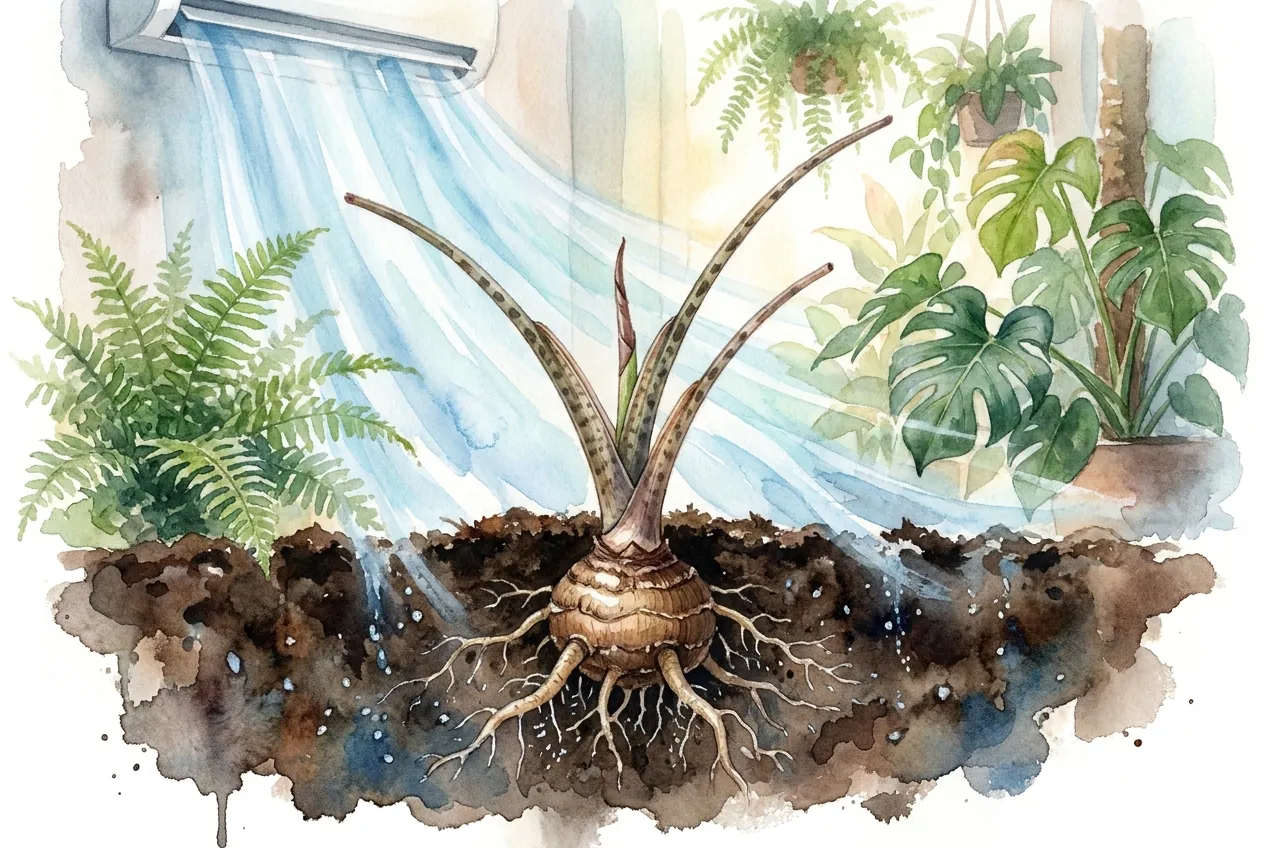
In an air-conditioned home, a cold vent draft is one real way a tropical Frydek can lose its leaves. It may be reading the chilled airstream as a signal to retreat to its corm, the underground storage organ that carries the plant through hard times.
But leaf drop has several possible causes, and cold stress is only one branch to check.
Before assuming dormancy, rule out the more common or more urgent culprits, including a dried-out or hydrophobic root ball, lost roots that can no longer take up water, early rot, prolonged low light, fertilizer or salt injury, a sudden environmental change, and pests such as spider mites.
A cold AC draft belongs on that list, not automatically at the top of it.
Why does an air-conditioned room make a tropical plant go dormant?
An air-conditioned room can chill a plant because the air at the leaf is often colder and drier than the thermostat number suggests.
Alocasia are cold-sensitive tropicals, and sustained cool air near the plant may slow growth and, in some cases, prompt leaf loss.
There is no controlled study fixing a single temperature-and-time trigger for Frydek, so treat any specific number below as an approximate guide rather than a proven threshold.
A useful reference point comes from a New Zealand EPA staff assessment, which cites secondary information that Alocasia micholitziana can slow into dormancy or drop leaves below roughly 16°C (about 61°F).
That supports cold as a plausible cause, but it does not mean every leafless summer plant is in normal seasonal dormancy.
I log the coldest air temperature beside the plant and the substrate temperature inside the pot, not just the daytime room reading. Air conditioning can cool a leaf quickly while a large wet pot remains cold for much longer.
Before changing water or fertilizer, I compare one full cycle near the vent with another at the proposed new position. If the night minimum improves while all other care stays stable, new growth becomes a cleaner test of the placement change.
How cold is the air actually hitting my plant?
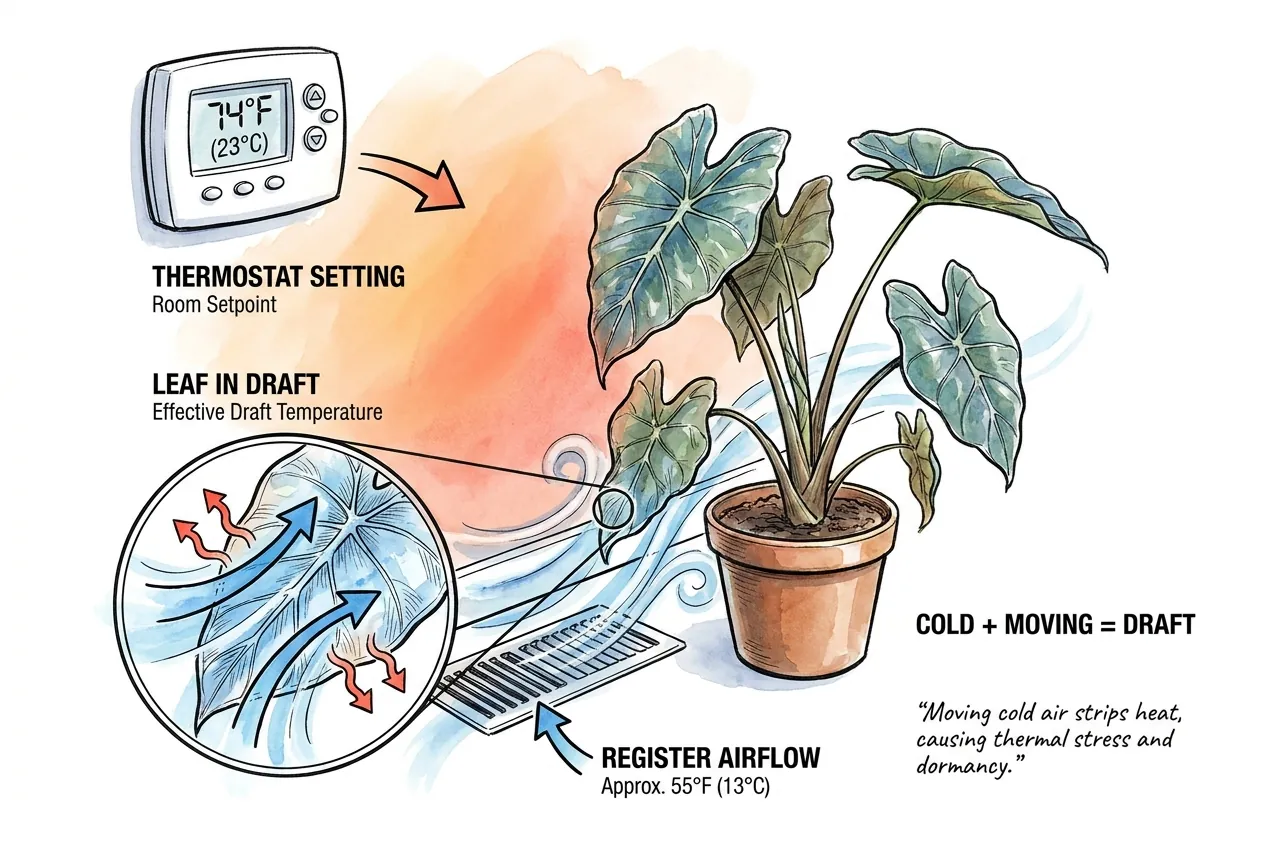
The air blowing out of a supply register can be noticeably colder than your thermostat reads.
Conventional all-air systems are often designed around a supply-air temperature near 13°C (about 55°F), but designers choose supply temperature and airflow based on load, humidity, and system type, so not every register runs at 55°F. Treat 55°F as one possible design example, not a fixed value for your home.
A thermostat set to 74°F does not mean the leaf feels 74°F. A leaf sitting in a register’s airstream may be bathed in air well below the room setpoint.
The only way to know is to measure at plant height, in the airstream, during an active cooling cycle.
Air speed matters too, but for people, not plants. ASHRAE Standard 55 is a human thermal-comfort standard. Its 0.20 m/s (40 fpm) figure limits how many occupants feel a draft at a given temperature, clothing, and activity level.
It is not a validated threshold for leaf heat transfer or plant dormancy, so do not read it as a plant limit.
Actual leaf temperature depends on mixing distance, diffuser throw, radiation, leaf orientation, transpiration, and air speed together.
ASHRAE Handbook. Air-distribution and supply-air design
What temperature range does Alocasia prefer, and where does cold stress begin?
Hobby and care sources generally place the comfortable band for Alocasia around 65 to 85°F (18 to 29°C), with cool exposure below about 60°F (15°C) slowing the plant and colder still raising the risk of cold damage.
These numbers come from gardening guides rather than controlled trials on Frydek, so use them as rough comfort guidance, not exact trigger points.
How long cool air must last, and at what temperature, to cause leaf loss in a specific plant is not established for Frydek.
A brief cool spell is usually survivable. Repeated daily exposure to a cold draft is more concerning.
Rather than trust a fixed one- or two-week rule, watch the plant and measure its actual conditions.
This is why the thermostat can mislead. A wall reading of a pleasant 74°F does not tell you the temperature a few feet under a diffuser, which can be meaningfully colder.
Measure it rather than assume it.
Microclimate Note
Measure temperature where the plant sits, in the airstream, during an active cooling cycle. The wall thermostat does not report the plant’s microclimate.
Alocasia Temperature Tolerance. Hot and Cold Limits
Alocasia Dormancy (Causes, Care and Prevention)
Is it cold damage or a resting response?
Cold can directly injure a leaf, or it can slow growth and lead to leaf loss while the plant waits for better conditions. The appearance alone cannot reliably separate those two responses.
Research on harvested tropical crops shows that sustained chilling can disrupt cells, but it does not provide a temperature threshold for a living Frydek. Use the actual draft, root condition, and the plant’s progress to decide what to do instead of borrowing a number from a different crop.
Membrane lipid metabolism in horticultural products suffering chilling injury
Brief cool exposure is often recoverable, while a sustained or repeated draft is more concerning. If leaves develop water-soaked or black areas, or decline continues after you remove the draft, inspect the roots instead of waiting for a dormant corm to recover.
Cool-Exposure Tip
Brief cool exposure is usually recoverable. A sustained, repeated draft is the more concerning pattern.
When in doubt, reduce the cold exposure and watch the plant rather than assume permanent damage.
Structural membrane alterations in tropical horticultural crops under postharvest chilling stress
What does a firm corm tell you?
A corm is the plant’s underground store of energy and moisture. It can support new growth after conditions improve, which is why a leafless Alocasia is not automatically dead.
That stored reserve does not prove the plant is healthy. A firm, clean corm is one useful clue, but you still need to check for wet soil, failing roots, pests, and ongoing cold stress before choosing a wait-and-see approach.
A first new leaf may be smaller while the plant rebuilds roots and reserves. Give it stable warmth, appropriate light once it emerges, and time rather than trying to force a larger leaf with extra water or fertilizer.
Importance of Underground Storage Organs in Plants
Why does AC air feel dry to my plant even when the humidity reading looks fine?
Air conditioning can make the air drier even at a seemingly acceptable humidity reading, because relative humidity alone is an incomplete measure and AC removes moisture as it cools.
What a leaf actually feels is closer to vapor pressure deficit, the drying pull of the air.
Two distinct effects are at work here. A cold draft changes temperature locally, while dehumidified, mixed room air changes the moisture load.
They do not always push in the same direction.
A room can read a comfortable humidity and still pull water from a thin tropical leaf faster than the roots resupply it, especially if the roots are already compromised.
Low humidity is one plausible stressor on the list, alongside the cold draft, not a separate confirmed dormancy trigger for your specific plant.
Why is relative humidity a misleading number?
Relative humidity is misleading because the same percentage means very different things at different temperatures.
Warm air holds far more water, so a fixed RH gets drier for the plant as the room warms.
Michigan State University Extension puts numbers on it. The water-holding capacity of air roughly doubles for every 20°F rise.
Hold RH at 70% while temperature climbs from 60°F to 90°F, and vapor pressure deficit jumps from 0.55 kPa to 1.45 kPa, a 164% increase in drying pull.
That is why 55% humidity at 75°F is meaningfully drier for a leaf than 55% at 65°F. The gauge reads the same. The plant does not.
Why should greenhouse growers pay attention to vapor-pressure deficit and not relative humidity?
Does the air conditioner itself dry the room out?
Yes. Air conditioners dehumidify as a side effect of cooling, so running the AC lowers the room’s actual moisture content, not just its temperature.
Warm room air passing over the cold cooling coil drops below its dew point and sheds liquid water down the condensate drain.
The supply air that returns is drier than what went in. One nuance is worth keeping straight. Cooling air by itself, while holding moisture constant, actually lowers vapor pressure deficit.
It is the moisture the coil removes, not the drop in temperature, that raises the drying pull, and the two effects partly offset.
How much the room actually dries out varies. A gauge that read 60% before AC season might settle noticeably lower once the compressor runs daily, but the size of that change depends on equipment sizing, runtime, outdoor humidity, infiltration, and latent load, so it is not a fixed or predictable figure.
Frydek care guides generally suggest higher humidity than a dehumidified summer room provides, so during AC season it is reasonable to add moisture back, within the residential limits discussed later.
Vapor Pressure Deficit and HVAC System Design
Alocasia Frydek Care – Vital Growing Tips and Common Problems
Is my corm dormant or is it rotting?
Firmness and smell are useful screening clues, not a full diagnosis. A firm, solid, odorless corm leans toward viable and resting. A soft, mushy, discolored, foul-smelling one leans toward rot.
But a firm, odorless corm does not by itself prove the plant is alive and merely dormant. Dehydration, cold damage, and early internal lesions can all leave a corm that still feels firm, and rot can be odorless in its early stages.
Because this diagnosis carries real consequences, treat the corm squeeze as a first pass and confirm it.
If anything points to a wet or failing root system, ease the plant out of its pot and look at the actual roots, including their color, firmness, and how much healthy tissue remains.
If the picture is unclear or getting worse, a local extension service or diagnostic lab can identify the pathogen more reliably than a squeeze test.
How do I check the corm without wrecking it?
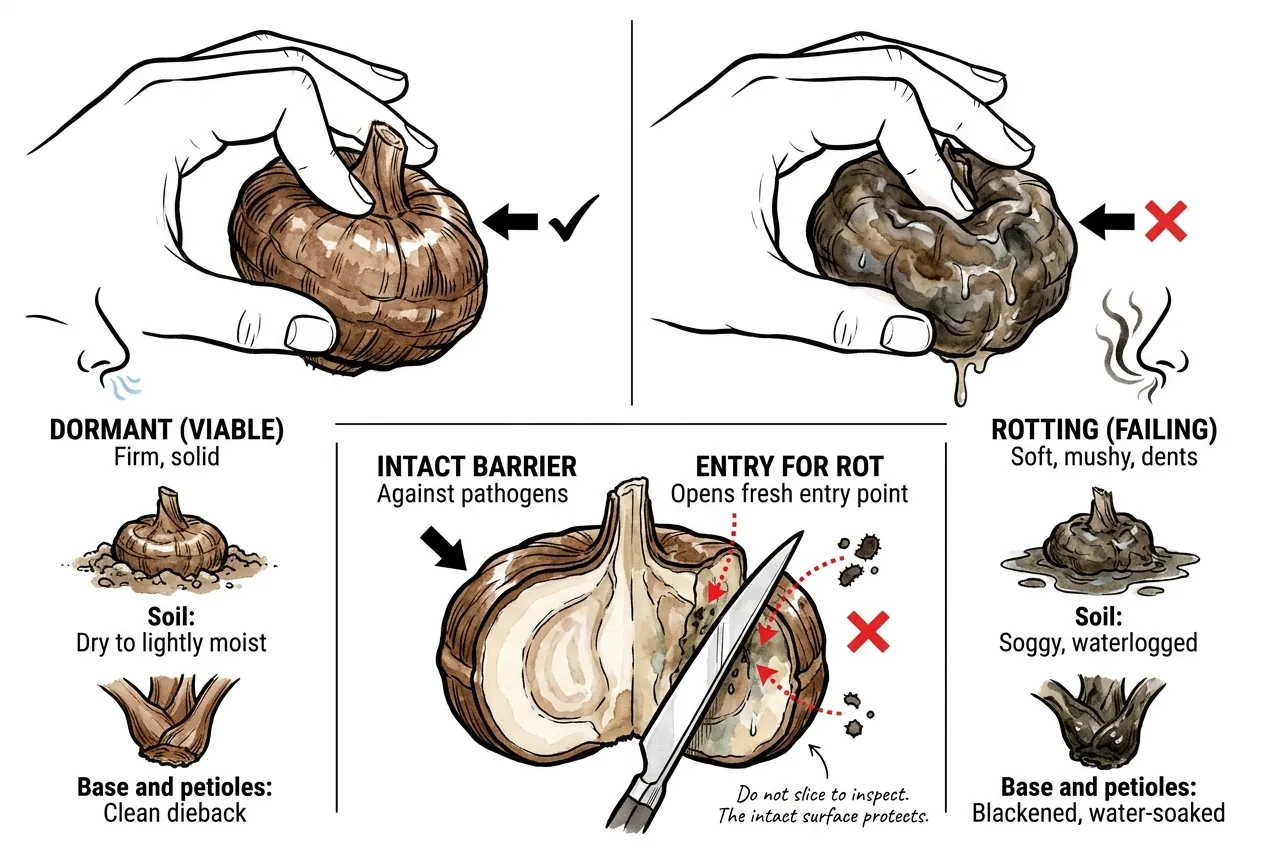
Start with feel and smell rather than cutting. Gently squeeze the corm between finger and thumb and take a sniff. You are checking firmness and odor, not trying to break the skin.
A firm corm resists like a small new potato. A rotting one often dents under light pressure and may weep or smell sour.
Do not slice a healthy-seeming corm just to inspect it. The intact surface is a barrier against pathogens, and cutting it opens a fresh entry point for rot.
Instead, if you suspect trouble, gather more information from the root ball and roots as described above rather than from a cut into the corm.
| Signal | Dormant (viable) | Rotting (failing) |
|---|---|---|
| Firmness | Firm, solid | Soft, mushy, dents |
| Smell | None or earthy | Foul, sour |
| Soil (a weak clue on its own) | Dry to lightly moist | Soggy, waterlogged |
| Base and petioles | Clean dieback | Blackened, water-soaked |
Read the table as a weighting of clues, not a checklist that confirms anything by itself. Dry soil is not proof of dormancy. A healthy plant can be dry, and a pot with dead roots or early rot can be dry at the surface while wet below.
Let the whole picture, including the roots, drive the call.
My Alocasia Lost All Leaves. What to Do Now
What signs tell rot apart from a clean dormancy?
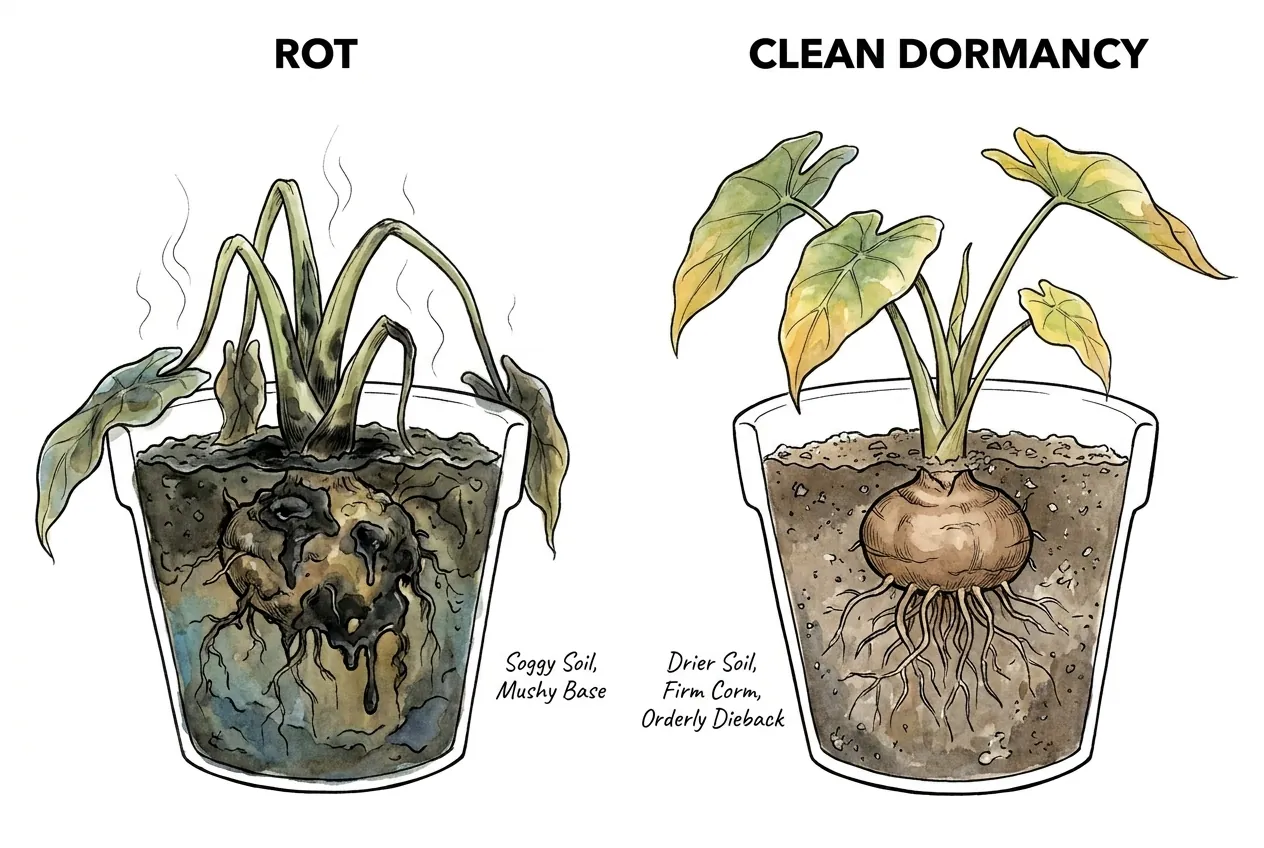
Rot tends to show as soggy soil, mushy blackened bases, and a sour smell, while an orderly dieback leaves a firmer corm and drier soil.
The way the leaves left is a clue before you ever touch the corm. A healthy slowdown tends to yellow and fade from the oldest leaves inward, while rot often collapses the plant from the base with water-soaked, blackening petioles.
These are tendencies, not certainties. If the soil is heavy, wet, and sour, weight the diagnosis toward rot, but confirm by looking at the roots rather than relying on leaf pattern alone.
Extension guidance for suspected overwatering is to unpot carefully and check root color, firmness, and distribution.
Rot Warning
Soggy, sour soil plus a mushy, blackened base points toward rot. Because the fix for rot is nearly the opposite of the care a resting corm needs, confirm with a root check before you act.
Diagnosing houseplants. Diseased or just overwatered? (UF/IFAS)
How do I care for a dormant corm and safely wake it up?
A confirmed resting corm needs warmth, a substrate kept barely moist, and patience.
Rather than watering on a fixed schedule, water by condition, keep the root zone comfortably warm, and hold off on fertilizer and needless repotting until new growth appears.
This advice assumes you have actually confirmed a healthy resting corm with roots intact, not simply a leafless pot.
Warmth, not water, is the more important wake-up cue. A warm spot generally does more to restart a resting aroid than a heavy watering, which mostly risks rot.
How much should I water a leafless corm?
Water by the substrate, not the calendar. How fast a pot dries depends on the mix (peat, coir, bark, mineral), pot size, root mass, drainage, temperature, and humidity, so drying time ranges from days to several weeks.
A fixed every 3 to 4 weeks schedule ignores all of that. Instead, let the deeper substrate approach dry, check by pot weight or a finger or probe well below the surface, and only then water thoroughly enough to wet the whole root ball rather than a small splash that leaves dry pockets and concentrated salts.
With no leaves transpiring, water use drops sharply, though not to nothing. Living roots and corm still respire and hold tissue moisture.
Overwatering is a common way to rot a resting corm, because water the leaves would have used just lingers and starves the roots of oxygen.
At the same time, letting the substrate go bone-dry for long stretches can cause root dieback, which makes rot more likely at the next watering, so aim for barely moist, not extremes.
Never leave the pot standing in water.
A cleaned, stored corm out of soil is a different situation from a potted corm with surviving roots, and each wants its own routine. The guidance above is for a corm resting in its pot. If you intentionally separate healthy offsets during active growth, use the Alocasia corm propagation guide instead of treating them like a stressed, dormant parent plant.
Diagnosing houseplant problems related to poor culture (Iowa State Extension)
Everything You Need To Know About Alocasia Dormancy
What actually wakes the corm back up?
Warmth, rather than more chilling, is what tends to restart a resting corm. In a related genus, Caladium, extension guidance is not to plant tubers until soil reaches about 70°F (21°C), and cold soil simply keeps them dormant.
Warm soil is thought to reactivate the enzymes that remobilize reserves into a new shoot.
That Caladium planting rule is the basis for gently warming a resting Alocasia pot, but it is an extrapolation across genera. There is no trial showing that heating a leafless Alocasia pot to a set temperature improves its recovery or lowers rot.
Treat bottom heat as a reasonable, off-label nudge, not a proven wake protocol, and it offers no benefit if cold is not what stalled the plant.
If you do supply gentle bottom warmth, a thermostat-controlled seedling heat mat is a common tool.
The thermostat matters, because an unregulated mat can overheat the soil, and a mat can run well above ambient or hotter if it fails.
VIVOSUN heat mat is useful only when you have confirmed that a cold root zone is the problem. Its thermostat lets you check the soil temperature, but it will not resolve rot, dehydration, or weak light, and a mat designed for propagation may be more equipment than one small pot needs.
Place the probe at root level rather than on the mat surface, check for hot spots, keep the setup dry, and do not leave it unattended. Use gentle, controlled warmth as a trial after removing the draft, not as a default treatment for every leafless corm.
Caladium fact sheet (Clemson Home and Garden Information Center)
When Should I Plant My Caladium Bulbs?
Should I fertilize or repot to help it along?
In most cases, the answer is no. For a confirmed healthy, resting corm, hold off. A resting corm takes up little, so a normal dose of fertilizer mostly accumulates as salts, raises soil EC, and can burn roots, while routine repotting adds stress with no growth to support.
The exception is when the problem is the pot itself. If you find compacted or airless medium, blocked drainage, active root rot, or a badly oversized pot, then inspecting the roots and repotting into fresh, clean medium is part of the fix, not a mistake. That is the same unpot and clean-up step the rot branch calls for. So decide by condition. Feed based on active growth and soil EC, and repot based on the state of the medium and roots, not on a blanket rule.
For a plant that is genuinely just resting, resume light feeding only after new leaves harden, and repot only when roots fill the pot during active growth.
Dormancy Feeding Note
During dormancy the corm is resting, not eating. Skip fertilizer entirely until you see hardened new leaves.
What summer mistakes turn a recoverable dormancy into a dead plant?
Most avoidable damage comes from treating a resting plant as an emergency. Once you have confirmed it is genuinely resting, overwatering the leafless pot, needless repotting, fertilizing, and moving the plant into harsh direct sun each add stress a recoverable plant does not need.
A confirmed resting plant does not need rescue so much as to be left warm, barely moist, and undisturbed.
The caveat, again, is that this only holds once you have ruled out rot, root loss, and the other causes above, because those do need active intervention.
What is the fastest way to tell dormancy from rot or pests?
Use these checks for screening, not for a final diagnosis. Ask whether the corm is firm or mushy, whether the soil and deeper root ball are soggy or dry, whether there is a draft or vent nearby, and whether any remaining leaves show webbing or stippling.
Then confirm before acting, especially by looking at the roots.
A firm corm with a dry-ish, healthy root ball near a draft leans toward a cold-stress rest. Reduce the draft, warm it gently, and wait.
A mushy corm in soggy soil points toward root rot. Unpot, inspect the roots, let cut surfaces dry, and move any surviving tissue into clean container and fresh, sterile medium, sanitizing tools between cuts and isolating the plant.
If it is unclear or worsening, get an extension or lab opinion.
Fine webbing and stippled leaves in dry air suggest spider mites. Isolate the plant, inspect leaf undersides, physically remove what you can, and use a label-compliant miticide on the recommended repeat interval.
Raising ambient humidity may make conditions less favorable to mites, but it does not by itself clear an infestation, and heavy household humidification carries the tradeoffs covered below.
Each branch leads to a different fix, so confirm the branch before you commit.
Diagram Note
The decision-tree image below is a rough visual summary only. Use it for orientation, not as a substitute for the confirmation steps in the text.
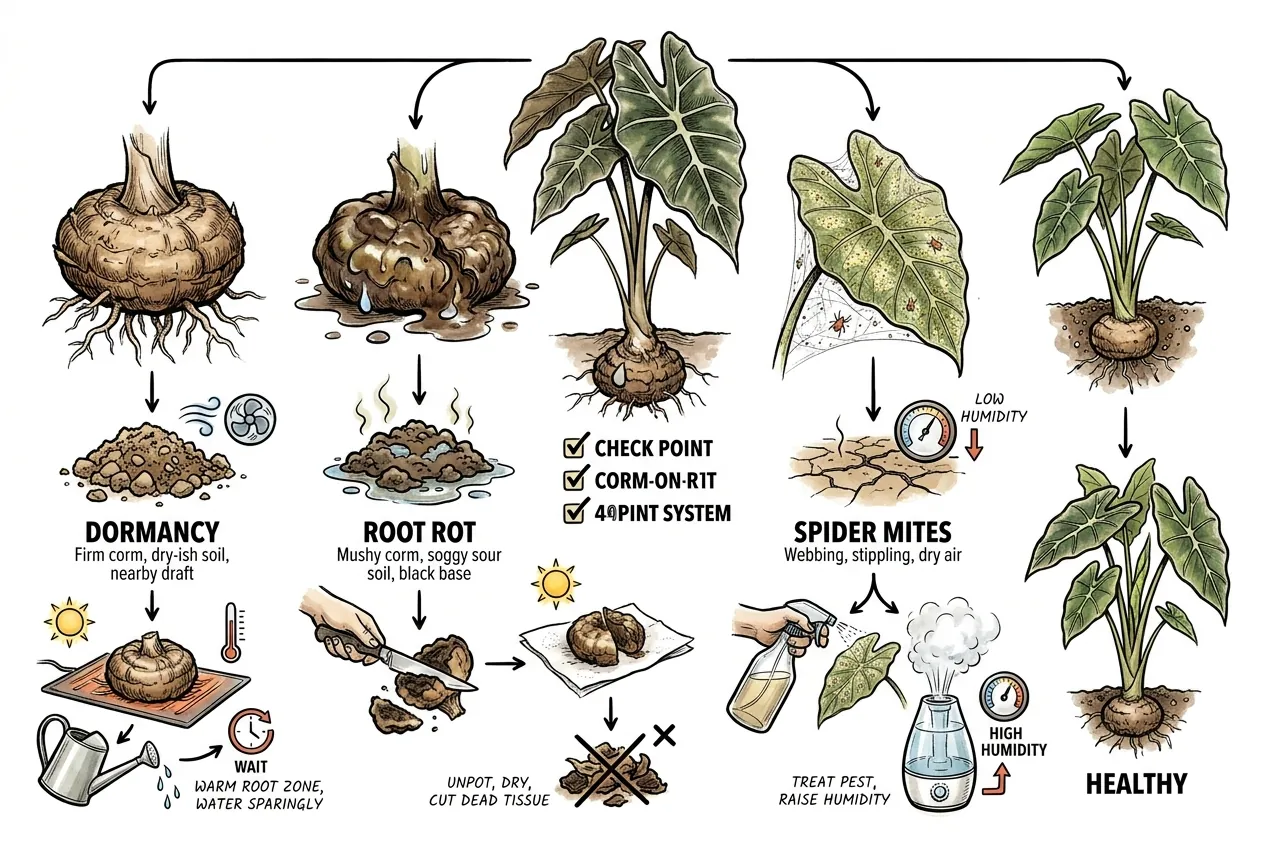
| Diagnosis | Key signs | Correct action |
|---|---|---|
| Dormancy | Firm corm, dry-ish soil, nearby draft | Warm root zone, water sparingly, wait |
| Root rot | Mushy corm, soggy sour soil, black base, dark mushy roots | Unpot, inspect roots, dry cuts, sanitize tools, repot in fresh clean medium, isolate |
| Spider mites | Webbing, stippling, dry air | Isolate, inspect undersides, label-compliant miticide on repeat interval |
The table is a fast reference, not a complete differential. It leaves out root color and texture, drainage, moisture history, direct root-ball inspection, and other non-living causes such as salts, low light, or sudden environmental change, so treat it as a starting point and confirm before acting.
Houseplant problems (UC IPM)
Will more sun and more water help it recover faster?
Generally no, but it depends on the stage. While the plant is a leafless underground storage organ, light has little effect because there is nothing to photosynthesize, so there is no reason to move a bare pot into a hot, direct-sun window where the exposed soil just heats up.
This is about avoiding needless stress, not a claim that sun is always harmful.
Once buds emerge, light matters again. Aim for reasonably bright light with some acclimation as new leaves harden.
The phrase bright indirect is a common shorthand rather than a measured value, and how much direct sun helps or harms depends on intensity, duration, and how developed the leaves are.
Introduce stronger light gradually rather than parking tender new growth in harsh midday sun.
And resist the urge to drench a resting pot. Extra water on a leafless corm mostly raises rot risk without helping, so water by condition as described earlier rather than on impulse.
How do I stop AC-induced dormancy next summer?
Prevention comes down to placement plus monitoring. Keep the plant out of the direct vent airstream, aim to keep the leaf-zone temperature comfortably warm, and manage humidity carefully.
For a lived-in room, keep indoor relative humidity in the roughly 40 to 50% range, which is what the EPA and typical humidifier manuals advise. Humidity much above 50%, plus condensation, encourages mold and dust mites.
If a particular plant genuinely needs higher humidity, create it in an enclosed space such as a plant cabinet rather than raising the whole room.
The single highest-leverage move is reducing cold-draft exposure. When cold moving air is the cause, getting the plant off the draft often does most of the work. When it is not, placement alone will not fix a plant that is actually dehydrated, rotting, or short on light.
Where should I actually put the plant?
Put it several feet from any supply register, out of the direct airstream, and away from window AC units and drafty doors.
Hobby cold-stress guidance for Alocasia specifically calls out air-conditioning vents as a location to avoid.
Do a draft walk during an active cooling cycle. Move your hand around where your plants live and feel for moving cold air, and ideally check with a thermometer at plant height.
Moving a Frydek out of a diffuser’s airstream to a sheltered spot can meaningfully raise its leaf-zone temperature. The exact gain depends on the room and placement, so measure before and after rather than assuming a fixed number.
When cold draft was the cause, this one move can resolve it, but confirm by watching the plant.
Alocasia Temperature Tolerance. Hot and Cold Limits
How do I monitor so I catch it before the leaves drop?
Put a hygrometer at plant height and watch both temperature and humidity during AC season.
Local measurement catches the afternoon humidity crashes and cold cycles the wall thermostat hides.
Aim to keep the plant reasonably warm and, in a lived-in room, hold humidity around 40 to 50% rather than pushing it higher.
Because AC dehumidifies, tropicals often benefit from some added humidity in summer. A room humidifier is one method, with grouping and pebble trays helping modestly.
Two spot readings are a helpful check, not a complete diagnosis. They cannot rule out root problems or catch overnight lows on their own.
TempPro TP49 fits a simple two-point check at plant height and near the vent. It helps confirm a local draft that the wall thermostat misses, but it cannot show overnight lows or brief cooling cycles, so use a data logger if you need a trend rather than a spot check.
Levoit Classic 300S Humidifier suits a lived-in room only when you can keep humidity within the safe range and maintain the unit. It can correct dry room air, but it cannot warm a cold draft or cure a root problem.
Empty and dry a portable humidifier daily, clean it at least every three days, and use distilled or properly demineralized water to limit microbial growth and mineral dust. Aim mist near, not onto, the plant and stop if nearby surfaces collect condensation.
Use and care of home humidifiers (US EPA)
Alocasia Light and Watering Guide
Affiliate Disclosure
This article contains Amazon affiliate links. As an Amazon Associate I earn from qualifying purchases. If you use these links, the site may earn a commission at no extra cost to you. Product availability, price, and specifications can change. Check the current listing before buying.