
Alocasia Frydek Heat-Wave Wilt: VPD Targets & Misting Truth
Why an Alocasia Frydek can wilt in a heat wave with wet soil, how to think about air VPD versus the leaf's own temperature, and why misting is a poor tool for velvet leaves.
Priya Patel · Published 2026-06-04 · 27 min read
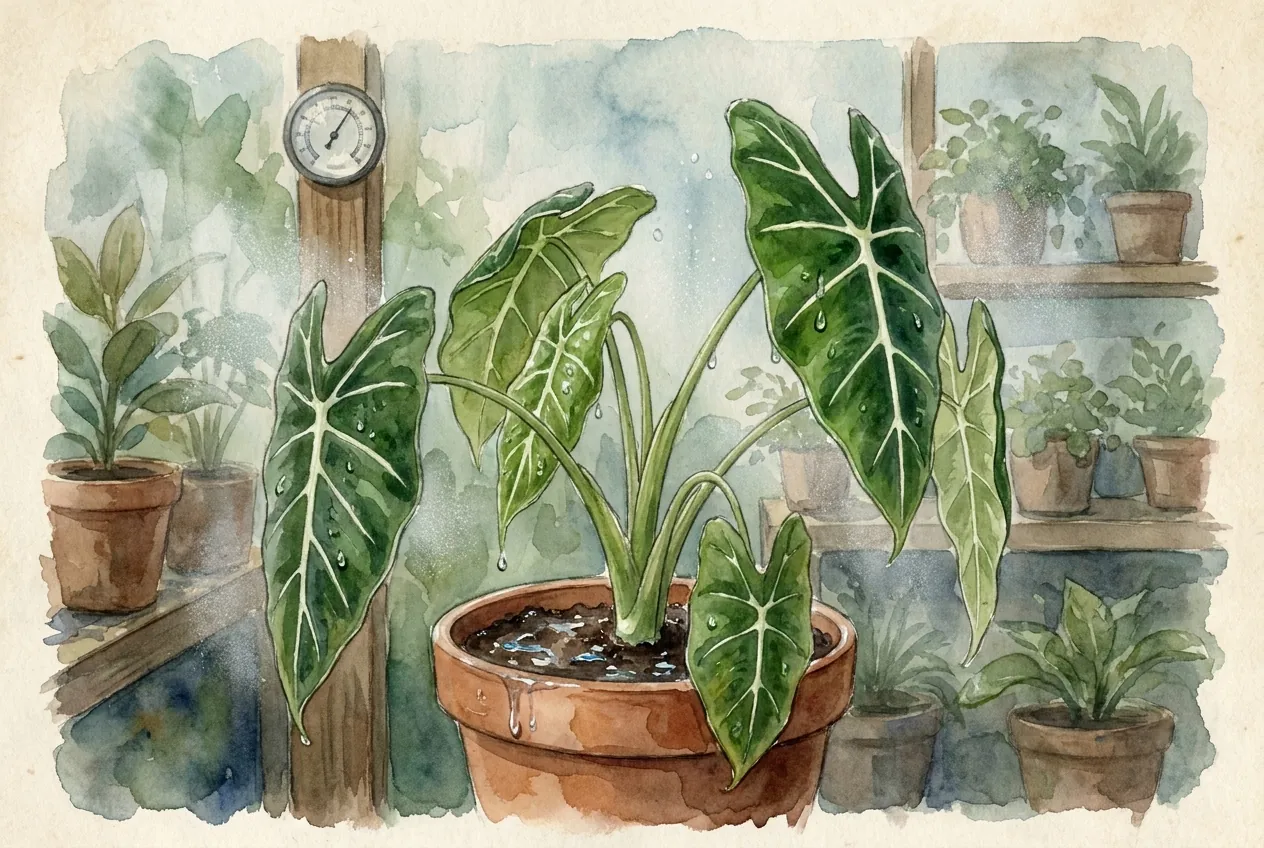
Key Takeaways
- Heat-wave wilt with wet soil can be a temporary hydraulic imbalance, but it can also signal root or pest problems. Check the root zone before assuming a simple transport mismatch.
- There is no Frydek-validated VPD threshold. Use air VPD as a working proxy and pair it with leaf temperature, light, roots, and the plant’s response.
- Hand-misting is a poor heat-wave tool for velvet leaves. It leaves free water and residue on the trichomes without providing reliable cooling.
- Gentle, distributed airflow can help the leaf shed heat. Excess airflow on a water-limited plant can increase demand and worsen wilt.
- Manage the cabinet as a system. Control humidity, airflow, light, watering, sensor placement, and hygiene together rather than chasing one number.
Why does Frydek wilt when the soil is still wet?
In hot, dry air, a leaf can lose water faster than its roots can replace it and wilt even when the substrate is still moist. But midday droop over wet soil can also mean soggy roots, rot, recent repotting, excess light, petiole damage, or pests. Check the root zone before treating it as a simple heat response.
Alocasia micholitziana ‘Frydek’ is native to Luzon in the Philippines (Kew records it in wet tropical primary and secondary forest, at roughly 1,200–1,500 m).
It is grown indoors as a warm, humidity-loving understory aroid. Published cultivation trials that pin down its exact humidity, temperature, or rainfall requirements do not appear to exist, so treat the commonly cited 60–80% RH, warm room ranges as grower experience rather than measured optima.
The velvet look comes from a dense trichome layer. Whatever its evolutionary role, that surface does not help the leaf shed heat, and it holds droplets that a flat, glossy aroid leaf would run off.
When ambient temperature climbs and humidity falls, vapor pressure deficit (VPD) rises and stomata tend to close protectively.
As they close, transpiration and its cooling effect drop (usually reduced, not switched fully off). If cooling falls enough, leaf temperature can rise above air temperature, which encourages further closure.
The plant can look limp by mid-afternoon even though you watered yesterday.
I take matching photographs of the same Frydek at dawn, at the hottest part of the day, and in the evening while recording air temperature, humidity, and pot weight. A plant that recovers by evening is showing a different pattern from one that remains limp overnight.
After changing shade or airflow, I repeat the same three observations before adding more water to wet soil. The sequence helps me compare a brief demand spike with a longer root-zone problem. It does not diagnose the cause by itself.
How much can a Frydek leaf actually heat up?
A field study of a much larger Alocasia species found that the outer leaf ran warmer and had lower water movement than the centre. That may help explain why large Frydek leaves sometimes crisp at the edges first, but it is not a Frydek diagnosis.
Edge scorch also comes from salts, uneven watering, low humidity, root injury, excess light or heat, and disease. Check those before attributing it to a long water path inside the leaf.
The Heterogeneity and Spatial Patterning of Structure and Physiology across the Leaf Surface in Giant Leaves of Alocasia macrorrhiza
Is high VPD the same as drought stress?
Not exactly. Dry soil limits the water available to the roots, while hot, dry air increases the water demand from the leaves. Both can cause wilt, but adding water will not fix a leaf that is already losing water too quickly to the air.
Guard cells tend to close as leaf water tension rises, reinforced by abscisic acid (ABA) signaling. As they close, stomatal conductance and photosynthesis usually fall, though not necessarily to zero, and transpirational cooling slows with them.
Within the same hot afternoon, adding more soil water often will not by itself reopen closed stomata, which is why the surrounding environment matters alongside watering.
Practical Implication for Frydek
VPD, not RH alone, is worth watching. Misting briefly raises near-leaf humidity but does not lower bulk-air VPD long enough to matter.
What VPD range makes sense for Frydek?
No validated VPD target exists for Frydek. Use a temperature-and-humidity reading to notice when the air is becoming more drying, not as a cutoff that overrules the leaf, root zone, or light conditions.
Air VPD Versus Leaf-to-Air VPD
A room sensor reports air conditions, while water loss also depends on how hot the leaf becomes. A canopy sensor is useful for trends, but it cannot diagnose the plant by itself. If you use an infrared thermometer, compare several leaves at the same distance and angle rather than treating one reading as exact.
Read Heat and Humidity Together
The same RH is not the same growing condition at different temperatures. As the cabinet warms, the air dries a leaf more strongly even if the humidity display does not change. Reduce heat and direct light first, add gentle ambient humidification only before condensation begins, and keep watching the leaves.
Why not just borrow a cannabis VPD chart?
Because those charts were built for a different plant and a different job. The 1.2–1.5 kPa flower-stage targets in cannabis VPD content are production heuristics tuned to a fast, short-cycle annual grown under strong light, CO2, and irrigation.
Frydek is a slow-growing, shade-adapted understory aroid, so there is no reason to assume the same setpoints transfer.
General care guidance can suggest a warm room with moderate humidity, but it cannot provide a precise Frydek cutoff.
Honest VPD Takeaway
Do not copy another crop’s VPD chart onto your Frydek. Use it only to notice a rising drying demand, then respond to the actual plant and root zone.
Why misting is a poor heat-wave tool
Hand-misting wets the velvet surface. It nudges near-leaf humidity up briefly while the film evaporates, then leaves the leaf worse off in a couple of ways.
First, it adds a stretch of leaf wetness, free water on the surface, which is what many foliar pathogens need to get established.
Second, on hard water it deposits dissolved-solids residue into the trichome layer.
The contrast with greenhouse cooling is instructive. Flash-evaporative (high-pressure fogging) systems are engineered to not wet leaves. They produce very fine droplets that evaporate before reaching the canopy, and the cooling comes from that evaporation in the air.
Hand-misting does the opposite (larger droplets that land, sit, and persist on the leaf). So misting gives you the leaf-wetness downside without the cooling upside.
What does leaf wetness duration actually do?
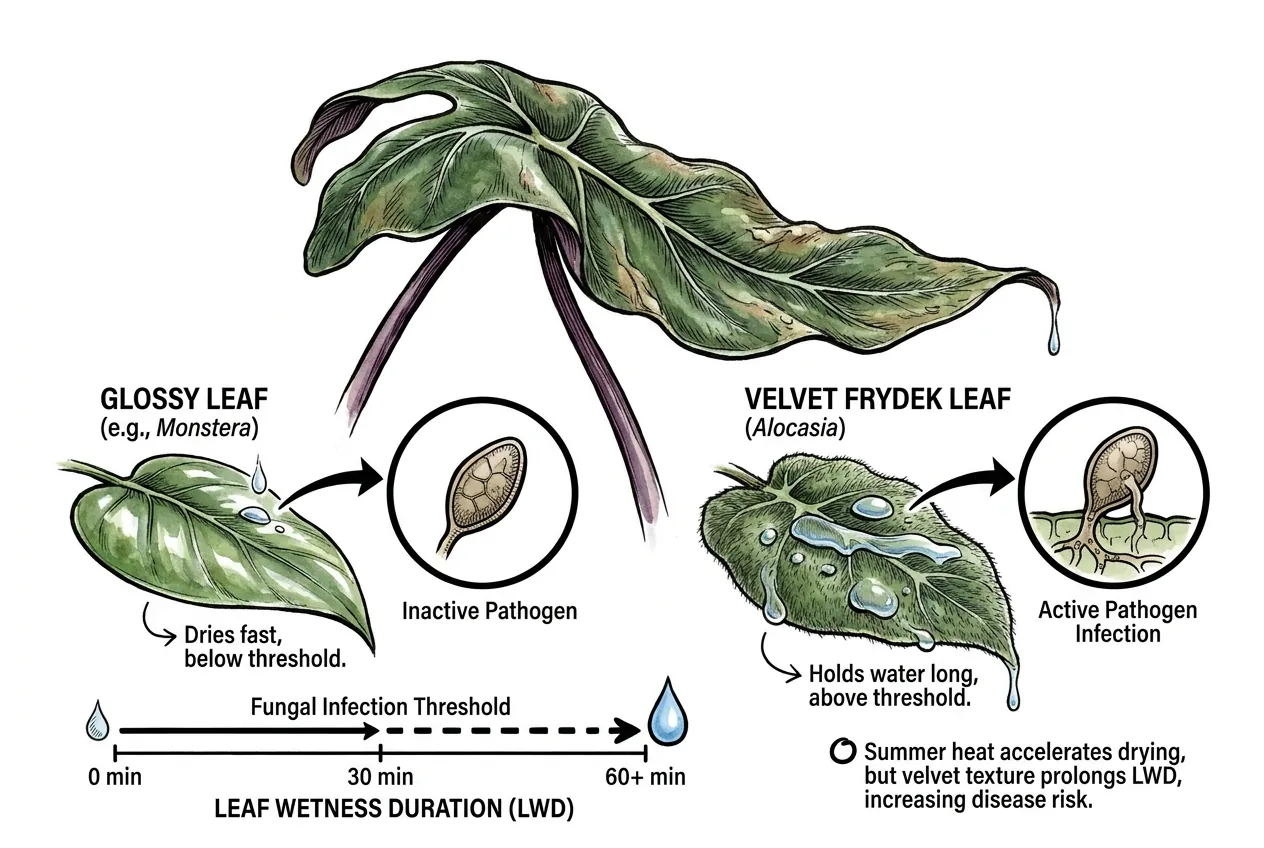
Free water left on a leaf increases disease risk, but no single wet-time threshold applies to every pathogen. The practical goal is to let the foliage dry between wet periods instead of trying to time a supposedly safe number of minutes.
The practical point stands without exact numbers. A matt, hairy velvet surface tends to hold droplets longer than a glossy leaf sheds them, so anything that keeps a Frydek leaf wet works against you.
Keep leaves from staying wet rather than betting on a specific tolerance time.
Which pathogens actually threaten Frydek?
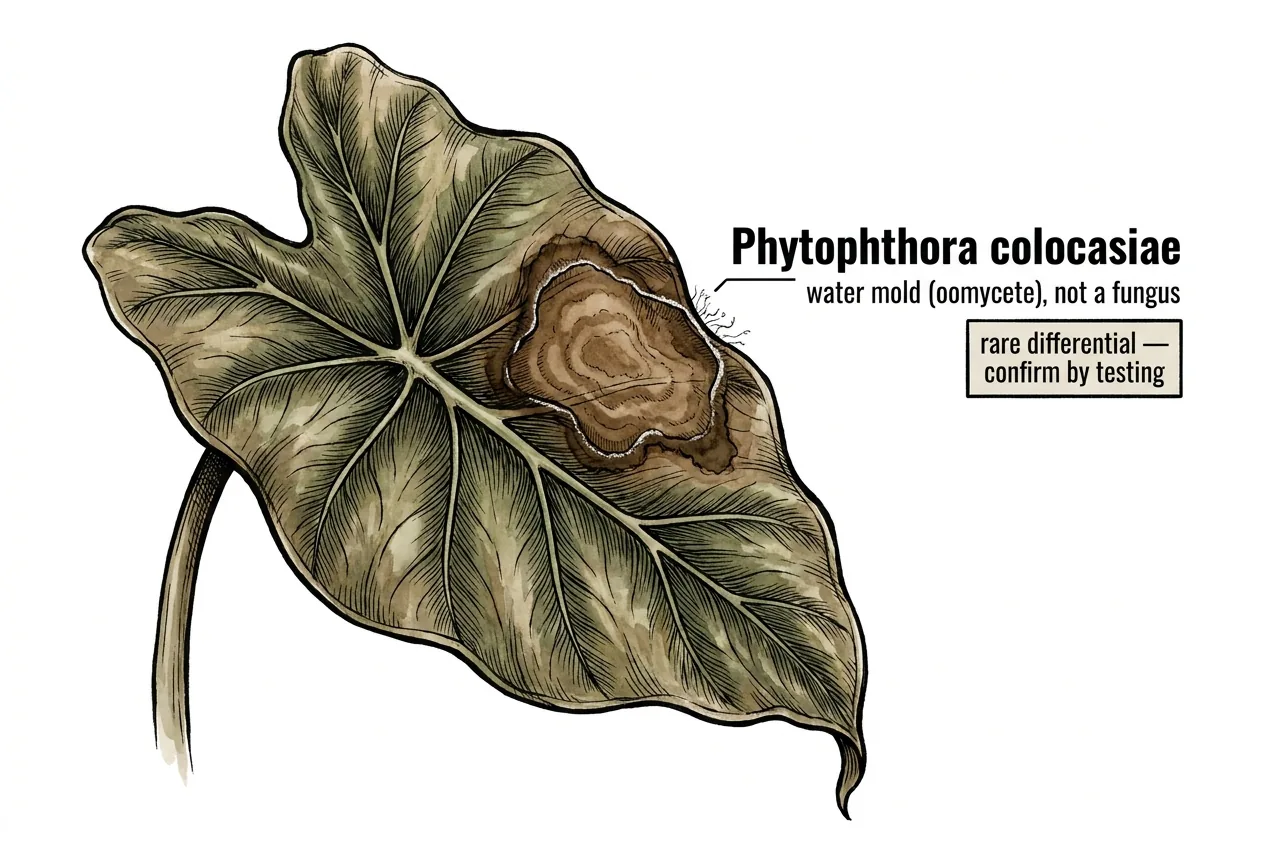
Phytophthora colocasiae, the taro leaf blight pathogen, is worth knowing about, but keep it in proportion.
First, it is a water mold (oomycete), not a true fungus. That matters because oomycetes and fungi differ in biology and in what controls work.
It is documented on taro and on some Alocasia macrorrhiza cultivars, but there is no direct evidence establishing it as a common cabinet infection of A. micholitziana ‘Frydek’.
Treat it as a rare differential, not a default diagnosis.
It does depend on wet foliage, and warm humid conditions favour it, so keeping leaves dry is sensible.
But the temperature story is not a single 28°C means textbook environment cutoff (reported optima differ for sporangia germination versus symptom development).
And the brown-spot-with-yellow-halo look is not specific to this pathogen. Bacterial leaf spot, other fungi and oomycetes, edema, phytotoxicity, and plain sun or heat injury can all resemble it, and a yellow halo can be a cultivar reaction or a dry-stress response.
The more telling signs of taro leaf blight are fast-expanding water-soaked lesions, concentric zonation, a whitish sporangial ring at the lesion edge, and exudate. Check for those, and confirm by testing rather than by appearance alone.
Infected substrate or plant material and splashed water are plausible sources. An ordinary tap-water reservoir is not a documented vector.
What about the white spots on velvet leaves?
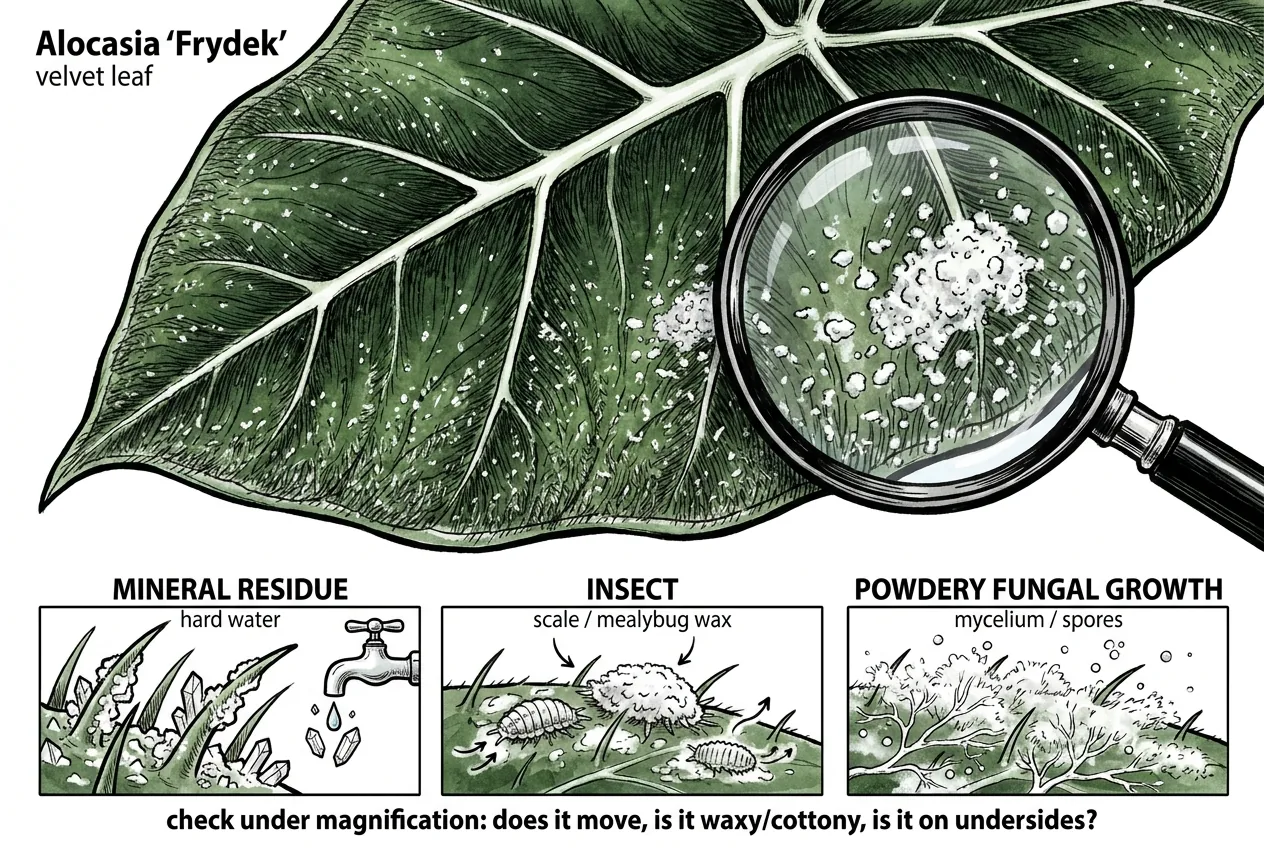
One common, harmless cause is mineral residue, calcium, magnesium, and other dissolved solids, left behind when hard water evaporates.
RTINGS’ lab work on humidifiers documents that any mist source aerosolizes dissolved solids along with water, so the residue tracks water hardness.
On a glossy leaf it usually wipes off. On Frydek’s hairy surface it can lodge between the trichomes and be harder to remove.
Do not assume white spots are mineral deposits. Scale, mealybug wax, mite residue, powdery fungal growth, and dried guttation or fertilizer splash can all look similar. Residue that does not wipe off or move does not rule them out.
Check under magnification. Look for movement, a cottony or waxy texture, and spots on the leaf undersides.
A gentle rinse or wipe test on one small area can help separate loose residue from something living without damaging the trichomes.
If the residue is mineral, use distilled or low-mineral water in the humidifier to prevent more deposits. If you find pests or fungal growth, isolate the plant and treat that problem instead.
Preventing Humidifier White Dust And The Importance Of Distilled Water. RTINGS
What does helpful airflow look like?
Gentle, steady air movement across the canopy is the goal (enough to mix the air and avoid stagnant hot pockets, not a strong stream aimed at one leaf).
A light breeze you can just see in the leaves is a reasonable target. Greenhouse work often cites roughly 0.5–1.0 m/s at the canopy for general crops, but that is not a Frydek-validated number, so start low and watch the plant.
For a small Frydek, a 6-inch clip fan on its lowest setting, set back 30–45 cm and angled to graze across the canopy, is usually plenty.
Gentle airflow keeps hot, humid air from sitting on the leaf and can help it shed heat. It cannot repair damaged roots or refill a dry root zone. Too much airflow can make a water-limited leaf lose water faster, so use only enough for barely visible leaf movement.
How much does airflow actually help?
Research in other crops confirms that moving air changes how leaves exchange heat and water. It does not show that a fan will revive a heat-stressed Frydek on a set timeline. Start at low speed and judge the plant’s response.
Moving from still air to a gentle breeze changes conditions at the leaf. Whether a drooping Frydek regains turgor, and how quickly, depends on the cause. If the roots are compromised, more airflow can raise water demand without helping.
Watch the plant’s response at a low fan speed rather than expecting a fixed recovery time.
Spatial examination of leaf-boundary-layer conductance using artificial leaves
A CFD study on improving air flow uniformity in indoor plant factory system
Does oscillation matter or just velocity?
Oscillation helps mainly by spreading the breeze. A fixed, concentrated stream aimed at one leaf keeps thinning the boundary layer at that spot, which raises water loss there. On a plant that is already water-limited that can dry or damage the leaf.
Oscillating (or simply setting the fan back and low) distributes gentle mixing across the canopy instead of hammering one area.
It does not, on its own, balance hydraulic supply. It just avoids a local hot, dry stream.
The Spider Farmer Grow Tent Clip Fan suits gentle, distributed cabinet circulation because its oscillation avoids holding a hard stream on one leaf. It is a grow-tent fan, not a treatment for a single wilting plant. A small fixed fan can help room-level circulation when set well back and aimed to graze past the cabinet, not directly into it.
Clip Fan Features
Choose a fan with low-speed control, an oscillating head, and a placement that keeps electrical parts clear of moisture. Actual airflow at the leaf changes with distance, angle, and obstructions, so use barely visible leaf flutter as the adjustment point and back off when any leaf flaps or dries rapidly.
Spider Farmer Grow Tent Clip Fan
It costs more than a generic commodity clip fan. If budget is tight, a small fixed fan such as the Honeywell HT-900 used as a room-level helper (set back 60 cm or more and angled to graze across rather than blast into the canopy) is a workable alternative.
Setting up the fan
Clip the fan at canopy height or slightly above, about 30–45 cm from the nearest leaf, angled to graze across the canopy rather than straight down into it.
Use the lowest speed and turn on oscillation if it has it.
Verify by the barely-visible leaf-flutter test. Leaves should just move, not flap. If you own a small anemometer you can also spot-check the air speed at the canopy, but let the leaves’ behaviour be the deciding signal, and back off if any single leaf is being blown hard.
Why ambient humidification beats misting
Ambient humidification beats misting because it raises the humidity of the air the plant sits in without leaving free water on the leaves.
A room or cabinet humidifier can hold ambient RH steadily, which is what people are usually reaching for when they mist (minus the leaf-wetness downside).
The one catch is placement. Keep the mist plume aimed away from leaves so it diffuses to vapor before touching them.
How much output you need depends on the cabinet volume, the target RH, and (this is the part that varies most) how fast the space leaks air.
A rough mass balance for a 200 L cabinet raising RH from about 50% to 70% at 32°C works out to only a couple of grams of water vapor per air change, so the ideal replacement is on the order of a few grams per hour at 2–4 air changes. Real output has to be higher because of humidifier efficiency and leakage.
Rather than commit to a precise millilitre figure, size it by result. Pick a humidifier comfortably larger than the space, set a target RH, and confirm the sensor holds it.
A passive pebble tray adds only a little humidity and generally will not hold a target on a hot, dry day. A powered humidifier will.
How do you place an ultrasonic so it doesn’t wet leaves?
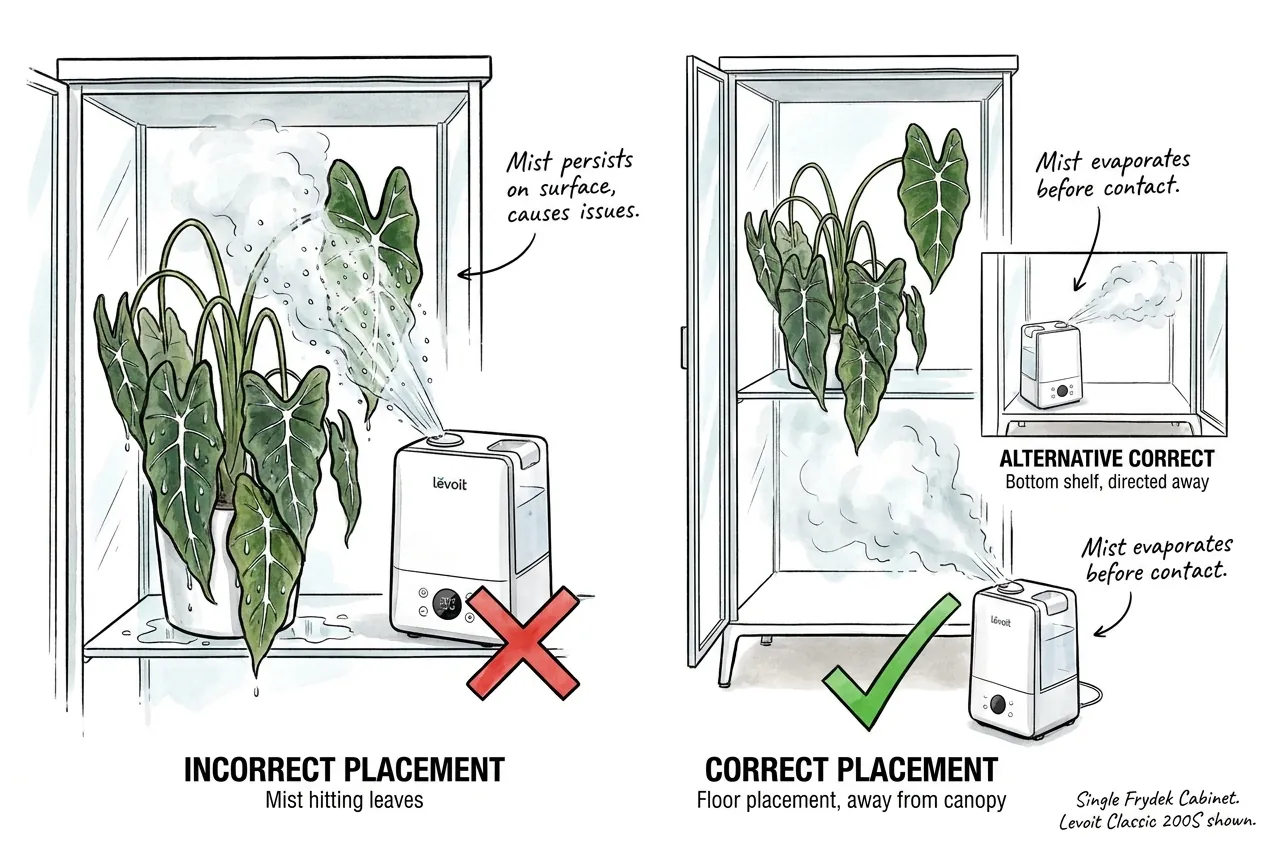
Place the humidifier where its plume travels away from the canopy (on the floor beside the cabinet with the plume parallel to the base is a common choice) and follow the manufacturer’s clearance guidance (keep it off walls and don’t point the mist at surfaces or appliances).
If you set it inside the cabinet, keep the plume pointed away from leaves and off the sensor and any electronics.
If you can see mist landing on leaves, you have the same leaf-wetness problem as misting.
Ultrasonic droplets are very fine and mostly evaporate quickly, but not instantly and not always. How fast they disperse depends on humidity, temperature, dissolved solids, plume concentration, and airflow.
A concentrated plume that hits a cool surface can still condense there. So checking that visible mist does not reach the leaves is necessary but not sufficient (also watch for condensation on cabinet walls, glass, and the plant).
Humidifier Features
Choose a humidifier with enough output to hold the target in your actual cabinet or room, an easy-to-clean tank, and automatic control that you can verify with a separate sensor. The Levoit Classic 300S Humidifier suits a larger room or a leaky cabinet where a small unit cannot maintain humidity. It is not a reason to push a tight cabinet into condensation.
Levoit Classic 300S Humidifier
Use distilled or low-mineral water so an ultrasonic plume does not leave residue on velvet leaves. Place the plume away from the plant and back off if moisture condenses on the walls, glass, electronics, or foliage.
Change the water and clean the tank on the manufacturer’s schedule. A neglected ultrasonic humidifier can disperse minerals and microorganisms from its reservoir.
Should you use a warm-mist humidifier instead?
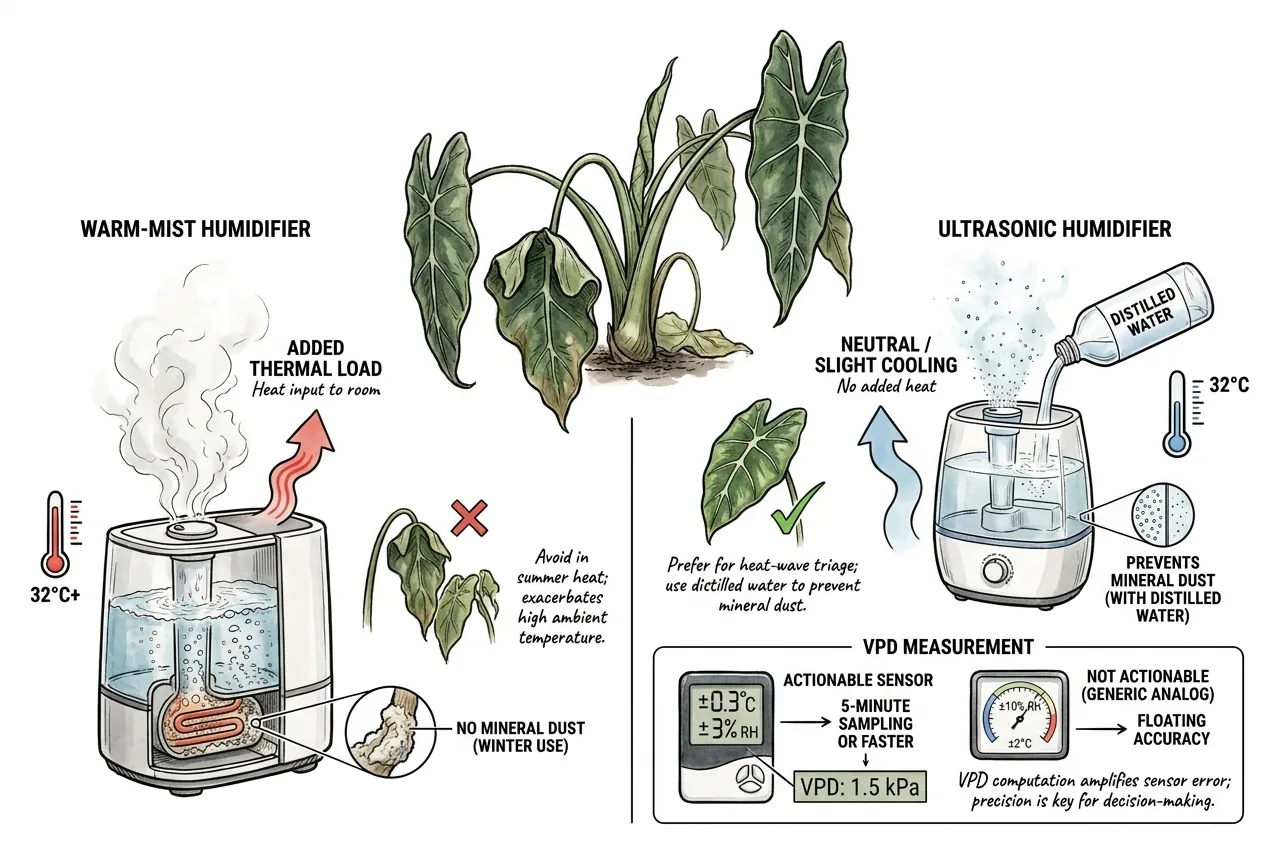
Warm-mist humidifiers boil the water and leave most minerals behind in the heating element, so they release little mineral dust, but they also involve hot water (a burn and scald consideration) and add heat to the room.
During a hot spell that extra warmth works against you, which is the main reason to prefer a cool ultrasonic with distilled water for heat-wave use.
Whichever type you use, keep it clean. Standing water can grow microorganisms, and warm-mist units still need descaling.
For winter dryness, warm-mist is fine. When the ambient temperature is already the problem, the added thermal load usually outweighs the no-mineral-dust benefit.
How to measure air conditions reliably
These sensors measure air temperature and humidity, from which you (or the app) compute air VPD. They do not measure leaf temperature, so they do not give you the leaf-to-air VPD the plant actually experiences. Treat the reading as a useful proxy, not the plant’s true VPD.
A decent thermohygrometer with good accuracy (roughly ±0.3°C / ±3% RH or better), reasonably frequent sampling, and either a VPD readout or data export is worth having. A cheap analog dial that can drift ±10% RH is not much to act on.
Accuracy matters because computing VPD carries the sensor error through. At 32°C, a 3% RH error is about 0.14 kPa of air-VPD uncertainty.
That is a reason to buy a decent sensor, though (since the specific Frydek cutoffs above are unvalidated) it is not a reason to treat any exact kPa boundary as a hard decision line.
Which sensor should you actually buy?
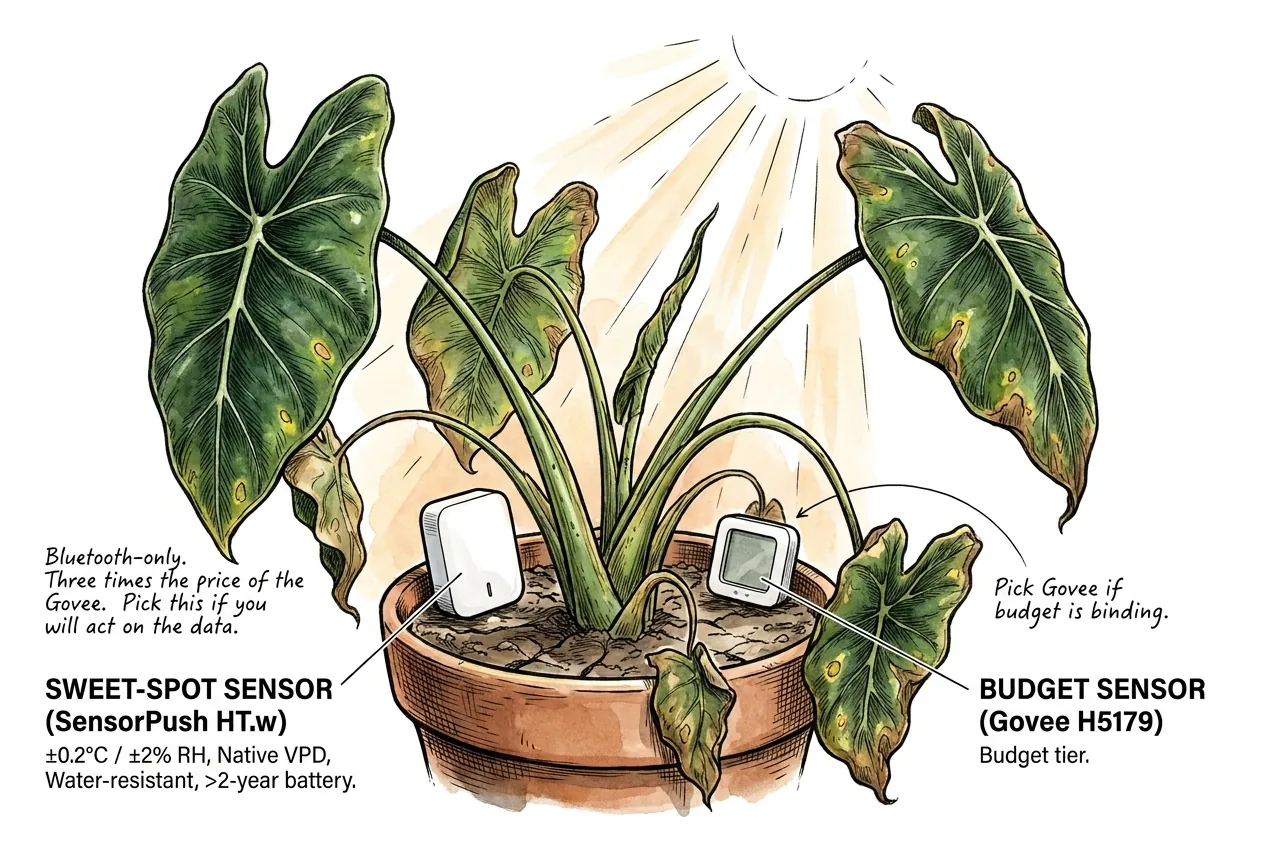
Both options are air temperature-and-humidity loggers, not leaf-temperature meters. The Govee H5179 suits an affordable first log. The SensorPush HT.w suits a setup where closer humidity accuracy and weather-resistant placement matter more.
The more precise option
The SensorPush HT.w climate sensor is the better fit when you need to compare small climate changes and expect occasional splashes. It is not waterproof or submersible, so it still needs a dry canopy position.
High-Humidity Sensor Drift
Prolonged exposure above about 80% RH can add up to roughly +3% RH offset, so high-humidity readings can drift.
It is Bluetooth-only, so remote monitoring needs a nearby phone or the optional SensorPush G1 gateway, and it costs noticeably more than the Govee.
The housing is splash-resistant, so keep it out of standing water and off wet substrate. Pick it if you want the tighter accuracy. The Govee is fine if budget is binding.
The budget option
The Govee H5179 is a practical budget logger for seeing day-and-night temperature and humidity swings. Check the current app and connectivity requirements before buying, and use the readings as trends rather than an exact leaf condition.
Where do you place the sensor?
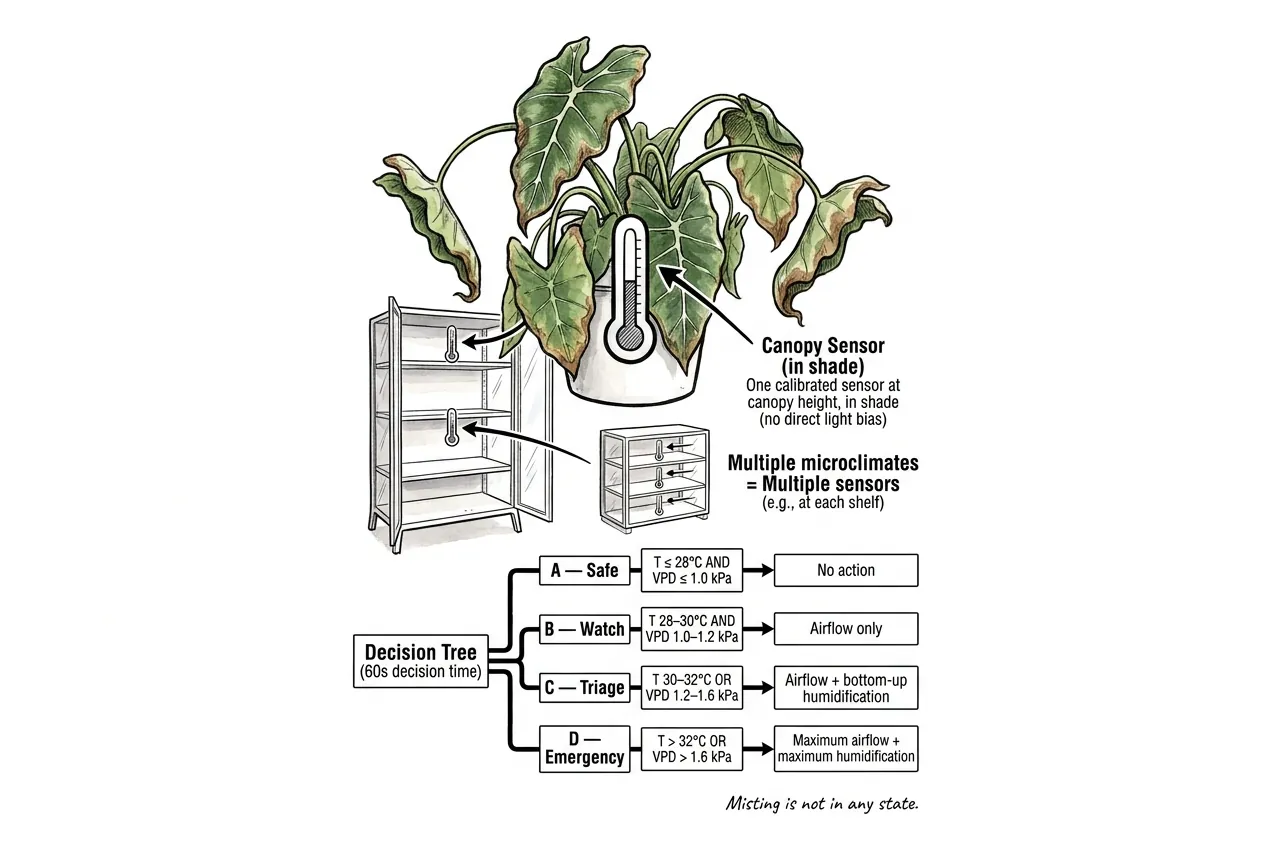
Put it at canopy height, not at the cabinet door or the ceiling. Shade it from direct light so the beam does not bias the temperature reading, and keep it clear of the humidifier plume, the fan’s direct stream, wet walls, and leaf contact, since all of those can skew the reading.
Remember this gives you the air conditions at the canopy (a good proxy, but not the leaf’s own temperature).
Cabinets can vary top to bottom (how much depends on the cabinet, lighting, and ventilation. Measure yours rather than assuming a fixed figure).
If you have stacked shelves or suspect uneven conditions, map a few positions first, then keep a sensor where it best represents the plant. A sensor per shelf helps, ideally cross-checked so the units agree.
A rough guide when conditions get hot
There is no validated Frydek threshold table, so the following is a conservative rule of thumb, not a precise algorithm. Read the plant and the root zone first, then use the numbers as context.
| Situation | What it usually calls for |
|---|---|
| Cool and comfortable air VPD, plant looks fine | No change needed, but still glance at the root zone, light, and pests |
| Getting warm. Air VPD creeping up | Add gentle airflow. Check that the root zone is not waterlogged |
| Hot. High air VPD or the plant is drooping | Gentle airflow plus ambient humidification. Reduce light/heat load and shade if you can |
| Very hot | Prioritise cooling and shade over pushing RH. Humidify only up to a condensation-free level, and keep watching for condensation |
Two cautions. Do not treat a number that looks safe as permission to ignore the plant. Visible wilt, a saturated root zone, pests, or strong light still need attention regardless of the VPD reading.
There is no maximum humidification setting worth chasing. Raising RH past the point where surfaces start to condense creates its own disease and equipment problems, so cap it below that.
Misting is not on the list, on purpose. In the heat it adds leaf wetness without useful cooling. In cool, already-humid conditions it just prolongs leaf wetness.
Reach for airflow and ambient humidification instead.
What does the 24-hour recovery look like?
The leading sign that a heat-stress intervention is helping is returning leaf turgor. Petioles often re-tension within a few hours to most of a day once conditions ease, and a severe wilt can take a full day-night cycle or more. These are rough observation windows, not guarantees.
If turgor has not improved after many hours, the cause may not have been simple heat-and-VPD stress. Look into root rot or a saturated root zone, heat injury, or a pest problem. Photographing the plant at the start and at a few fixed intervals over the first day helps you see the trajectory. Bear in mind you are tracking posture and colour, since new leaves do not appear or grow in a single day.
What about substrate moisture during recovery?
Ease off fertilizer during the heat wave. A stressed plant tends to take up nutrients less effectively, and salts left in the root zone can add to root damage, so a pause is a reasonable precaution rather than a strict rule.
Let the mix dry down before watering again, checking below the surface rather than watering on a schedule.
How deep dry enough is depends on pot size, mix, and root density. A small pot of coarse mix can dry out faster than you expect, so lift the pot to feel its weight and check the root-zone moisture, not just the top layer.
Heat-Wave Watering Tip
In a heat wave, briefly under-watering is usually safer than over-watering. Warm, saturated substrate is one of the conditions that favours water-mold and fungal root pathogens (given inoculum, low oxygen, and susceptible roots), and panic-watering a wilted plant in a hot room is a common way to create it.
If the mix is still soggy days after you eased conditions, that persistent saturation, not a fixed hour count, is the warning sign to act on. Improve drainage and airflow to the root zone, and inspect the roots if it does not resolve.
When can you tell if recovery is complete?
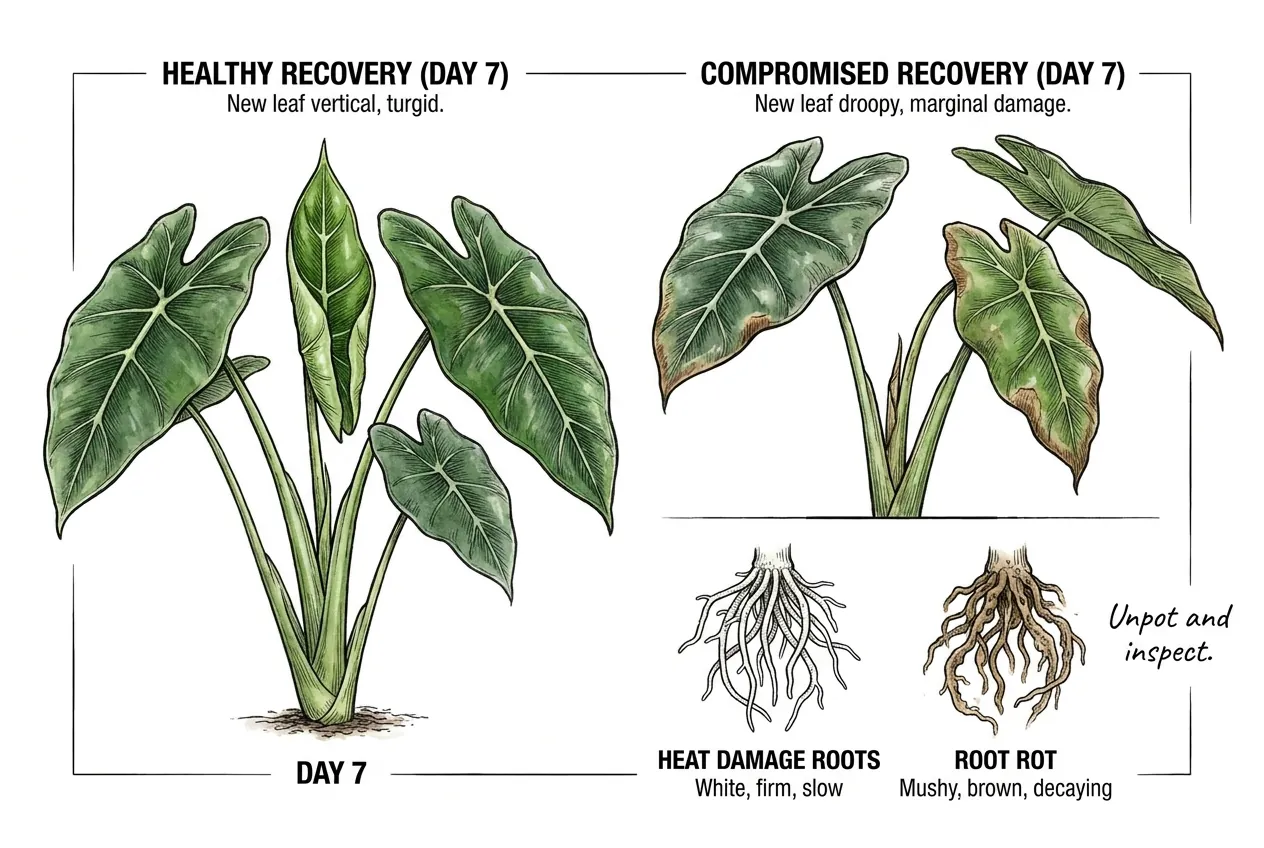
Over the following week or two, new growth is one encouraging sign. A turgid, normal-coloured new leaf suggests the plant is functioning. But treat it as a soft indicator, not a root test.
A slow-growing plant may simply not push a new leaf for a while, older marginal damage can persist even when the roots are fine, and posture alone does not tell you the root state.
If the plant clearly is not recovering, ongoing decline, a soft or discoloured base, a foul smell, or a root zone that stays waterlogged, then it is worth carefully unpotting to inspect the roots.
Firm, pale roots with slow growth point toward heat damage that can rebuild over weeks. Soft, mushy, dark roots with a rotten smell point toward active rot.
If you find rot, the response is not a single magic step. Remove clearly dead tissue, clean up, correct the environment and drainage, repot into fresh clean substrate, and be realistic that a badly rotted plant may not recover.
Avoid unpotting a plant that is already improving. Disturbing recovering roots can set it back.
Preparing before a forecast heat wave
Preparation beats triage, and the most useful moves cost nothing. Before spending anything, work through what you already have. Can you shade the plant or move it out of the hottest, sunniest spot. Can you cool the room (AC, a room fan, opening up during cooler hours). Is the pot draining freely. Do you already own a thermometer or fan?
Sort those first. They matter more than any purchase.
If, after that, you still need equipment, an air thermohygrometer, a gentle fan, and a humidifier are the useful additions.
Order them with enough lead time. There is no need to treat same-day delivery as part of the plan.
A day or two out
Confirm your no-cost prevention (shade, cooling, drainage). Add a sensor, a gentle fan, and a humidifier only if you actually lack them.
Water supply
If you will run a humidifier, keep distilled or low-mineral water on hand. Buy roughly what a few days of intermittent, humidistat-controlled running will use rather than a fixed number of gallons. Actual consumption depends on the space and how often the unit cycles.
Baseline
Place the sensor at canopy height, shaded and clear of the plume and fan, and log a day of current conditions as a before-reference.
Humidifier
Set up the humidifier with distilled water, plume aimed away from leaves. Set a target RH that holds humidity without condensing on surfaces, and confirm it stabilises.
Watch the walls, glass, and plant for condensation and lower the target if any appears.
Fan
Clip the fan at canopy height, set back and on its lowest speed, angled to graze across the canopy. Verify barely-visible leaf flutter and back off if any single leaf is being blown hard.
When the heat arrives
Check that the plant looks stable and conditions are in a comfortable band. Recheck through the hottest part of the day.
At night, temperatures drop and RH and dewpoint shift, so the same humidifier setting can cause condensation. Glance at the plant and surfaces before leaving it overnight rather than assuming the daytime setting is safe.
How do you troubleshoot Frydek heat-wave wilt?
Issue 1. Leaves droopy at 14/00 with wet soil
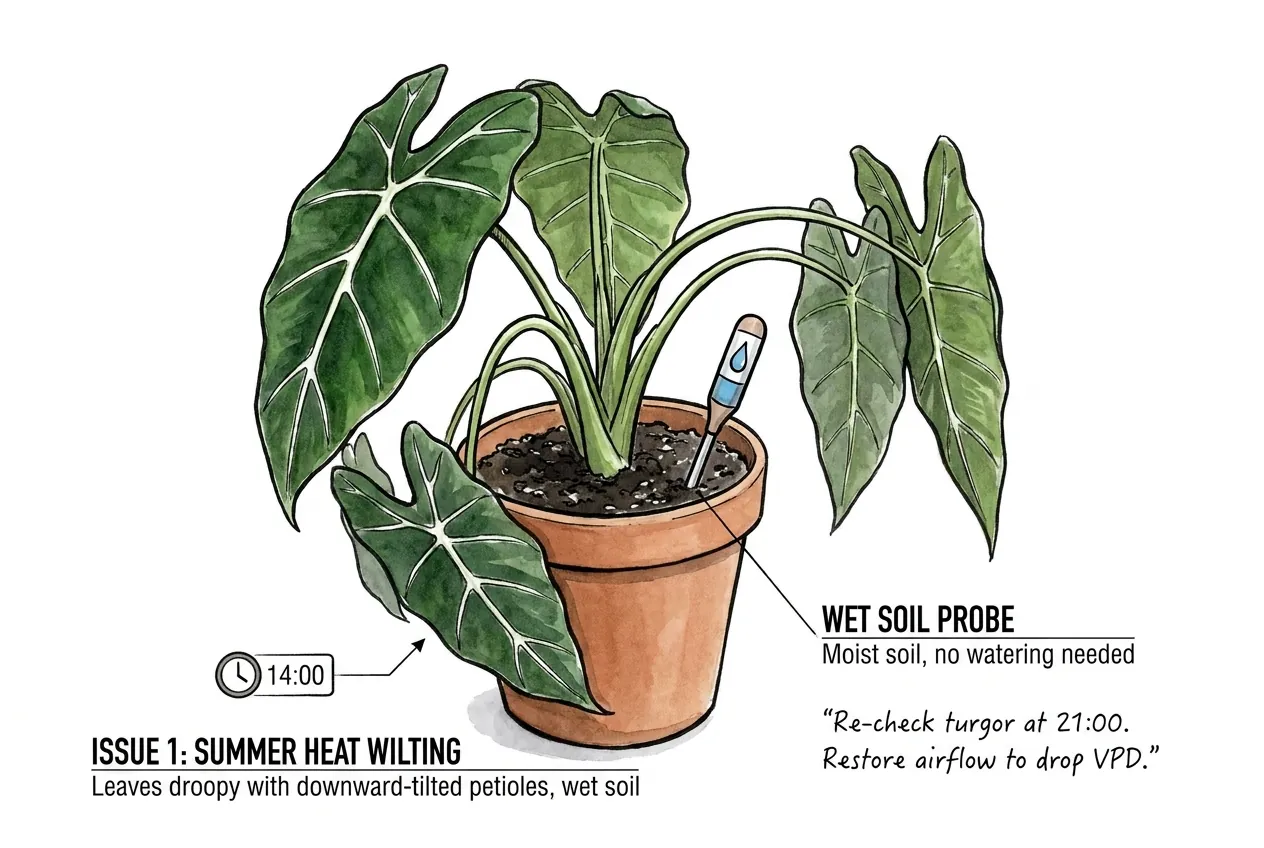
Limp leaves with downward-tilted petioles, no yellowing, crisp tips on the largest leaves first, and soil that reads moist to a finger probe.
Do not add more water first. Instead, ease the afternoon evaporative load, gentle airflow, some ambient humidification, and shade or cooling, and check that the root zone is not waterlogged or rotting.
Adding water rarely fixes a leaf that already has moist soil.
Recheck turgor that evening. A plant with healthy roots often regains firmness within a few hours after conditions ease. If it does not, inspect the roots rather than assuming heat was the only cause.
The goal is to reduce water demand so the existing supply can keep up, not to flood soil that damaged roots cannot use.
Issue 2. Persistent marginal crispiness on largest leaves only
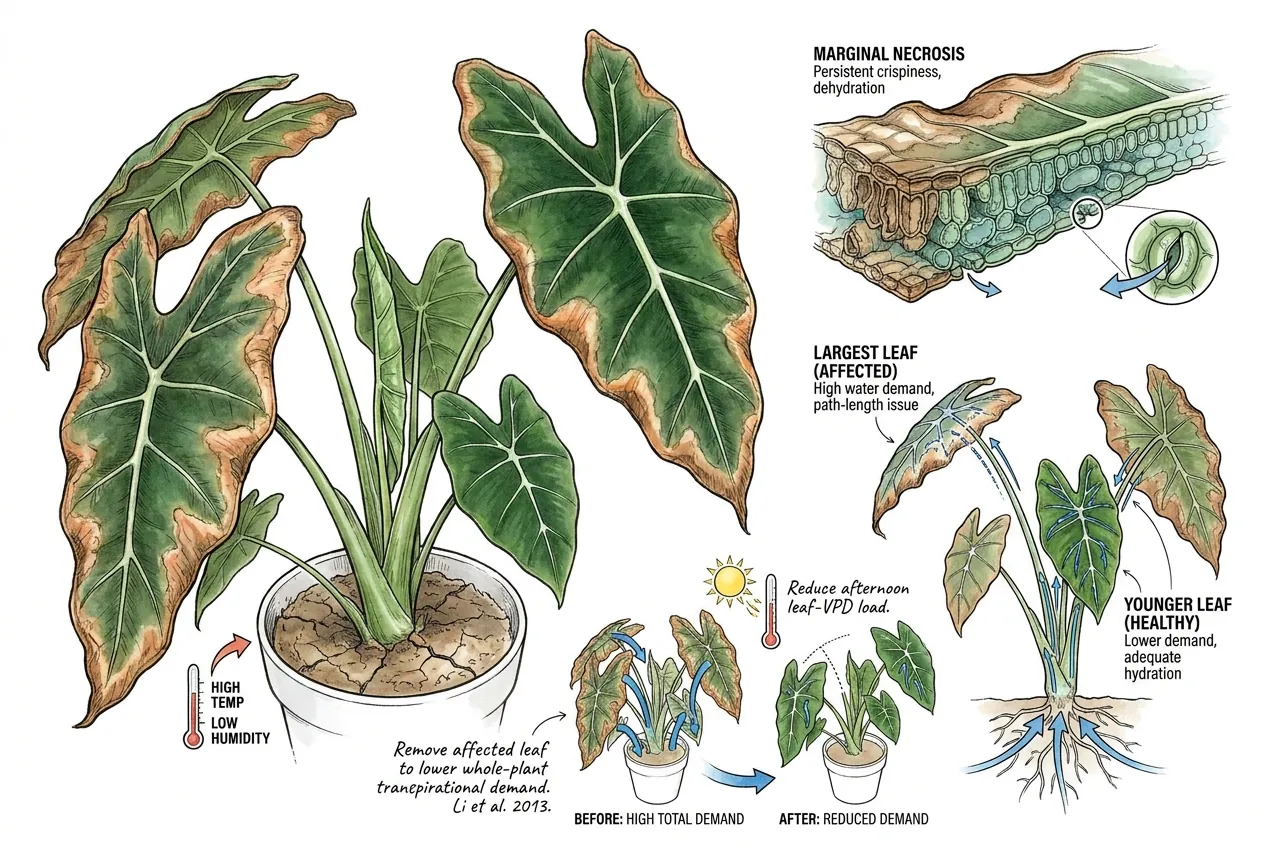
The largest, oldest leaves show outer-edge necrosis while younger interior leaves look healthy.
Large-leaf edge damage can also come from salts, uneven watering, low humidity, root problems, or scorch. Reduce the afternoon heat and drying load with shade, cooling, and gentle airflow. Remove a large leaf only when it is largely dead or clearly diseased, not as a routine response to crisp edges.
Issue 3. White-haze deposits in the trichome layer
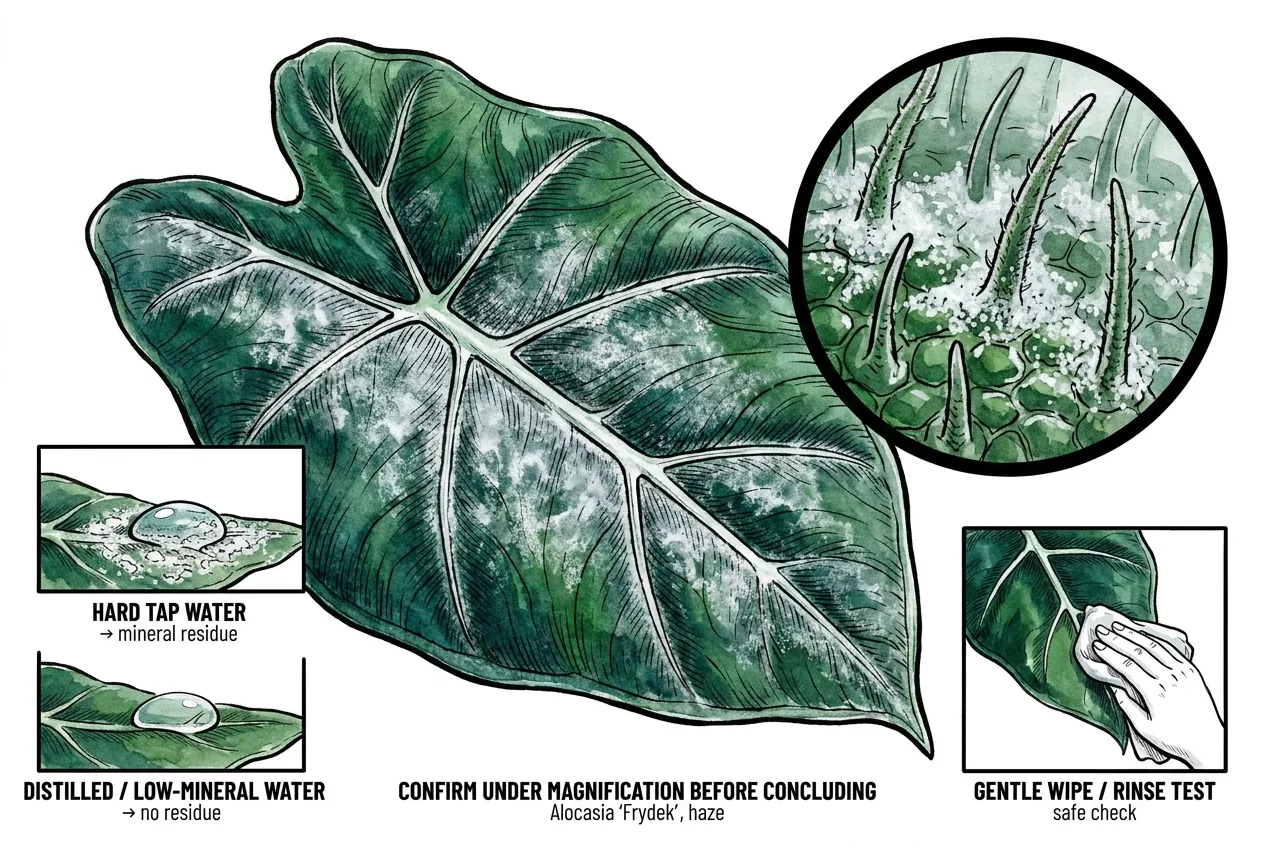
A white haze between the trichomes that does not wipe off easily and does not move like an insect.
Mineral residue from hard-water misting or from an ultrasonic run on tap water is a common, harmless cause, but check before you conclude, since scale, mealybug wax, mite residue, and powdery fungal growth can look similar.
Under a hand lens or magnifier, look for movement, a cottony or waxy texture, or deposits on the undersides.
If it is mineral. Stop misting and switch to distilled-water humidification to prevent more. Aggressive brushing can damage the trichomes, so accept some residue rather than scrubbing, and only remove a leaf if it is largely dead.
If magnification suggests pests or fungus instead, isolate the plant and treat for that.
Issue 4. Brown-spot lesions with yellow halos during a heat wave
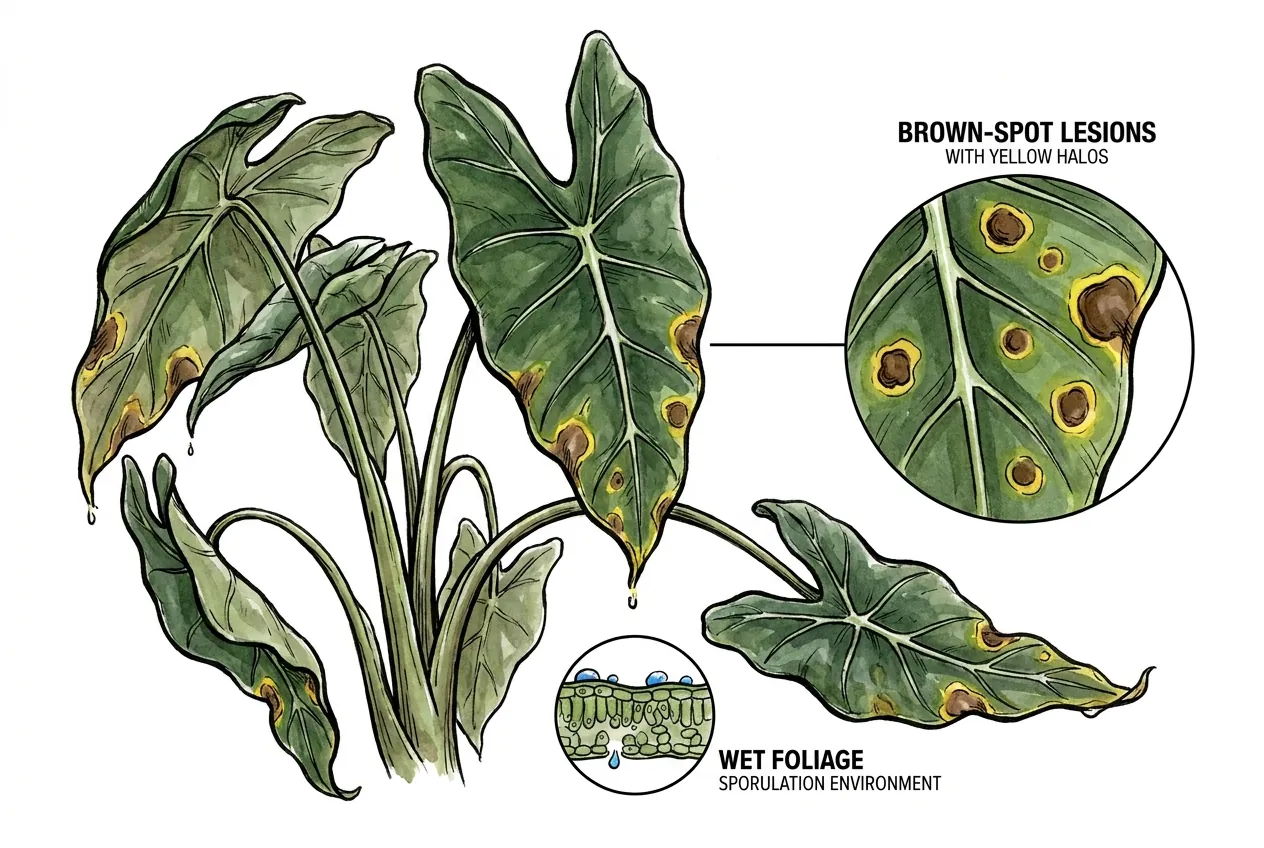
Brown necrotic spots with yellow halos, often where droplets sat on the leaf.
This appearance is not specific. Bacterial leaf spot, various fungi and oomycetes, edema, phytotoxicity, and sun or heat injury can all look like it. A yellow halo alone is not diagnostic.
So the sensible first steps are conservative. Stop misting, keep the leaves dry, improve airflow, and isolate the plant from neighbours while you figure it out.
If spots are actively spreading, remove the worst affected leaves into a sealed bag (do not compost) to reduce spread.
Do not reach for a copper spray on a guess. Copper products are effective against some pathogens but not others, can burn foliage, and must be used according to their label and local rules.
Confirm the diagnosis first (a plant clinic or extension service can help), then treat what you actually have.
Issue 5. Humidity Won’t Rise Despite the Humidifier
Cabinet RH climbs slowly or not at all despite the humidifier running.
Usually the humidifier is undersized for the space or the cabinet leaks air too fast for it to keep up. Output has to exceed the leakage rate. A larger-output humidifier helps.
Reducing air exchange can help too, but be careful during a heat wave. Sealing gaps or hanging a curtain also traps heat, encourages condensation and mold, cuts fresh-air/CO2 exchange, and can wet electrical gear.
Get cooling and ventilation right first, then raise RH only up to a condensation-free level. Check actual temperature, RH, and whether surfaces are near dewpoint rather than sealing the cabinet blindly.
How to Tell Whether Conditions Are Improving
Change one practical factor at a time, such as afternoon shade, fan placement, or ambient humidity. Take a photo at the same time each day and note canopy temperature, humidity, soil moisture, leaf posture, and any new damage.
Use the record to decide whether the plant improves under the new conditions. It cannot prove the exact cause of wilt, so do not use a short-term response to justify more misting or to ignore a saturated root zone, pests, or persistent decline.
Key Takeaways
- Midday droop over wet soil can be a temporary hydraulic imbalance, but check the root zone, light, and pests before assuming it. Several causes look the same.
- Temperature and RH together show when the air is becoming more drying, but they are not the leaf’s true VPD. A hot leaf can experience greater demand, so watch leaf temperature and posture too.
- There is no validated Frydek VPD cutoff. Read the plant, roots, light, and sensor trends together rather than chasing one number.
- In the heat, favour gentle airflow plus ambient humidification over misting, which adds leaf wetness without useful cooling.
- A small clip fan and a humidifier with distilled water are a reasonable stack. Size the humidifier to hold RH without condensation and keep both clean.
- The highest-value preparation is free. Shade, cooling, and good drainage before you buy anything.
Affiliate Disclosure
This article contains Amazon affiliate links. As an Amazon Associate I earn from qualifying purchases. If you use these links, the site may earn a commission at no extra cost to you. Product availability, price, and specifications can change. Check the current listing before buying.