
Alocasia Frydek Spider Mites: The Summer AC Trap
Summer AC can dry indoor air enough to favor spider mites on a thin-leaved Alocasia Frydek. Spot stippling early, rinse safely, and use a hygrometer to keep humidity in a comfortable range.
Priya Patel · Published 2026-07-19 · 25 min read
Key Takeaways
- Summer air conditioning can dry the room enough to favor spider mites, but cooler temperature can slow their development, so measure both temperature and humidity.
- Fine stippling on lower leaf undersides is an earlier clue than webbing, and confirmation with magnification or a paper tap test prevents unnecessary treatment.
- Isolate the plant and knock mites down mechanically before using a labeled product, then repeat on the label interval because one spray will not reach every egg.
- Frydek leaves may be spray-sensitive, so test a small area, avoid heat and water stress, and use the product label rather than an improvised dilution.
- A moderate humidity target, gentle airflow, stable light, and quarantine reduce risk without turning the room into a condensation-prone greenhouse.
Why do spider mites explode on Alocasia Frydek in summer?
Summer air conditioning can dry indoor air enough to favor two-spotted spider mites (Tetranychus urticae) while leaving your Frydek below the humidity it prefers.
The two effects are separate. An AC that runs cooler lowers temperature, which by itself slows mite development, while the drier air it can produce works the other way.
It is worth measuring both rather than assuming.
Air conditioners cool by removing heat, and depending on unit size, run time, and outdoor conditions they can also remove moisture, so some AC-cooled rooms sit near 30-50% relative humidity.
An oversized unit that short-cycles may not dehumidify much at all, so check with a hygrometer instead of assuming a number.
Low humidity suits the mite and sits below the 60-80% RH the Frydek prefers, but the mite’s fastest development happens in warm conditions (roughly 25-30°C), which a well-run AC room is usually cooler than.
I number the leaves on a whole-plant photo and inspect the same underside zones beside the midrib and petiole junction with a light and white card. Randomly checking whichever leaf is easiest can miss the population edge.
Mites, eggs, webbing, and fresh stippling go into separate columns after each treatment. When adults disappear but eggs remain on the same numbered leaf, I keep the follow-up schedule instead of declaring the plant clear.
How fast does the mite life cycle speed up in the heat?
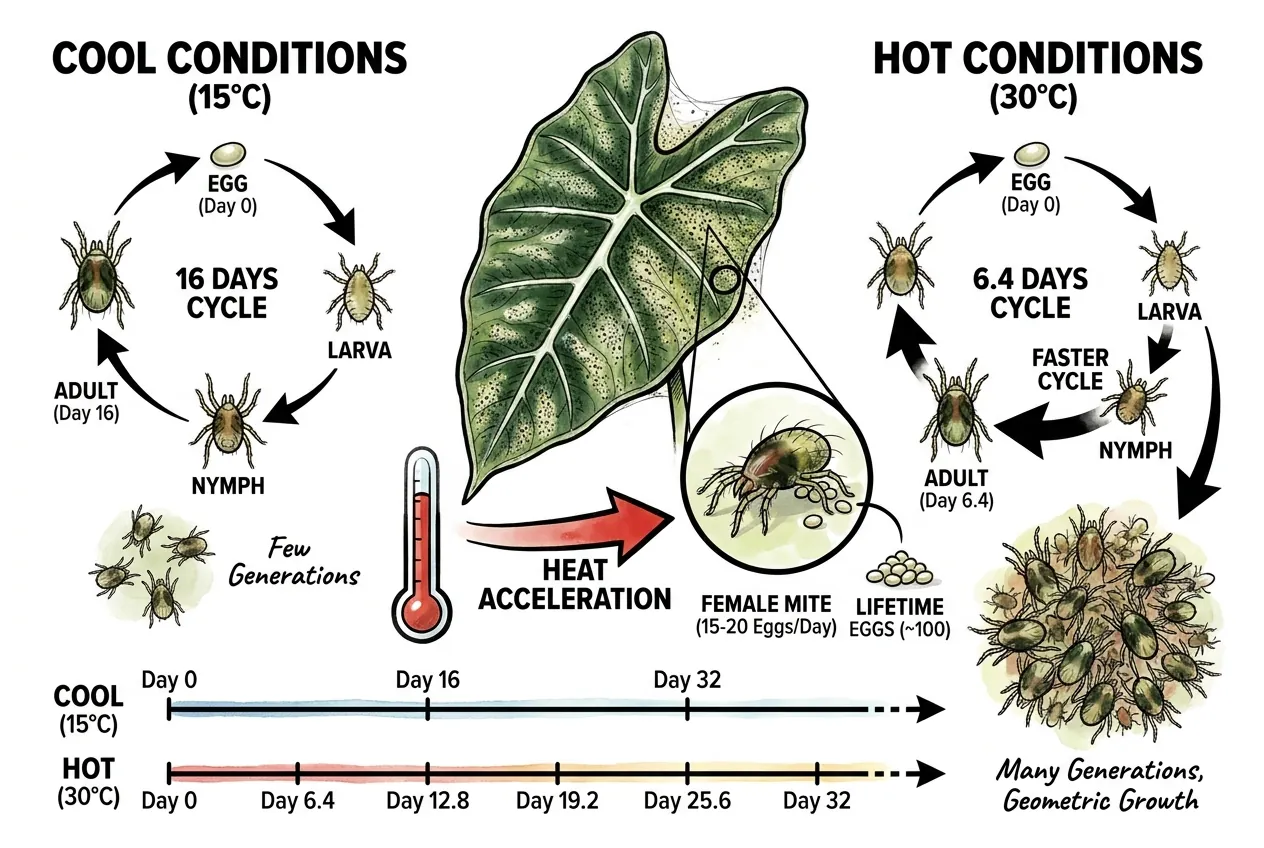
Warmth shortens the mite life cycle, but the exact timing changes with temperature, host plant, and growing conditions. A cooler AC room may slow the outbreak without stopping it.
A small founding population can still become a heavy infestation over several summer weeks. Check undersides regularly and repeat any treatment at the interval on its label, because one spray or rinse usually misses eggs and later hatches.
Tetranychus urticae, Two-spotted Spider Mite
Dry Weather Increases Risk of Twospotted Spidermite
Does dry air also weaken the mite’s natural enemies?
Houseplants rarely have a resident population of predatory mites or a mite-killing fungus. Dry room air does not switch off a natural-control system that is already present in most homes.
Humidity matters when you deliberately introduce predatory mites. Check the supplier’s conditions for that species before buying, because a hot, dry room may keep the predators from establishing even when the Frydek itself looks fine.
Are low humidity levels a limiting factor for spider mite control by phytoseiid predators
Spider Mites, Home and Landscape
Does air conditioning cause spider mites on houseplants?
Air conditioning does not create mites out of nothing. What it can do is contribute to conditions that let a few founding mites build up.
Think of it as one of several risk factors rather than a single cause.
Several summer factors can line up. Warm conditions speed mite development. Dry air favors the mites and stresses a humidity-loving plant, and a water-stressed plant is an easier target.
New plants brought home over summer are a common way founding mites arrive, though the exact introduction routes for any one home are not something these sources measured.
No single factor is decisive, and how much AC matters depends on the actual temperature and humidity it produces in your room, which is why measuring both is more useful than assuming the worst case.
You can reduce risk at several points. Quarantine new plants, keep the Frydek off dry, cold vent drafts, keep it adequately watered, and raise local humidity toward its comfort range.
Spider Mites, Home and Landscape
Success with Houseplants, Humidity
How do you identify early spider mite damage on Alocasia Frydek?
The earliest sign is stippling, not webbing. By the time silk webbing shows up, the population is already large.
Stippling is a scatter of tiny pale dots where mites have emptied individual leaf cells with piercing-sucking mouthparts. Each puncture drains one cell.
On a Frydek’s dark, matte-velvet leaf this reads as the deep green losing saturation, a dusty, sandpapered look rather than crisp holes.
It often shows up first on lower and older leaves, and mites tend to concentrate near the midrib and veins where the surface offers cover.
Hold a suspect leaf up to a window. If the even velvet green is broken by fine peppering, mites are a strong possibility worth confirming under magnification before you treat, since other pests and disorders can look similar.
Twospotted Spider Mites on Landscape Plants
Integrated Pest Management for Spider Mites
How do you confirm mites with a hand lens and tap test?
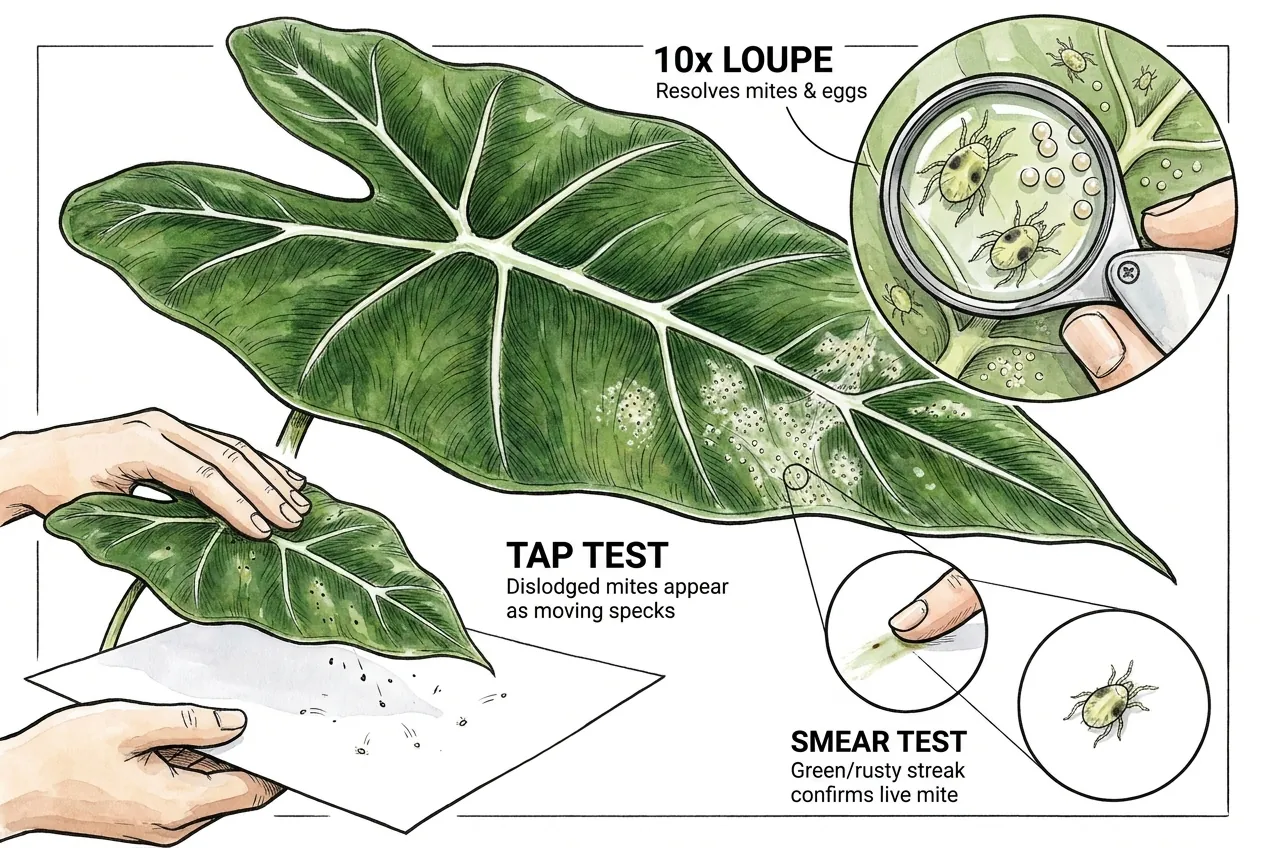
Confirm with two tools together, a 10x hand lens on leaf undersides plus a white-paper tap test.
Adult females are less than 1/20 inch, so the naked eye sees only moving dots.
A 10x loupe resolves the oval, eight-legged mites and their eggs. Two-spotted mites are pale yellow-green with a dark spot on each side.
Their eggs are spherical, translucent, and dewdrop-like, turning cream before hatching.
For the tap test, hold white paper under a suspect leaf and sharply tap it. Dislodged mites appear as specks that start crawling within seconds.
Smearing a moving dot that leaves a greenish or rusty streak suggests a live mite rather than dust, though it does not by itself identify the species.
An empty tap test is not proof there are no mites, since a light population is easy to miss.
Keep a loupe and index card by the plant so a weekly check is quick. A 10x lens is enough for routine screening of the body and lateral spots. Stepping up to 20x helps resolve the tiny translucent eggs.
If you are unsure what you are seeing, a local extension office or diagnostic lab can confirm.
Know the Loupe’s Limits
A standard loupe needs good light, and the field becomes narrow at higher magnification. Inspect near a window or add a phone flashlight, and use the tool for screening rather than trying to identify species or egg viability from the leaf.
Twospotted Spider Mite, Floriculture and Ornamental Nurseries
Mites in Home Gardens
How do you tell spider mites from thrips or a nutrient problem?
Separate Mite Damage Patterns
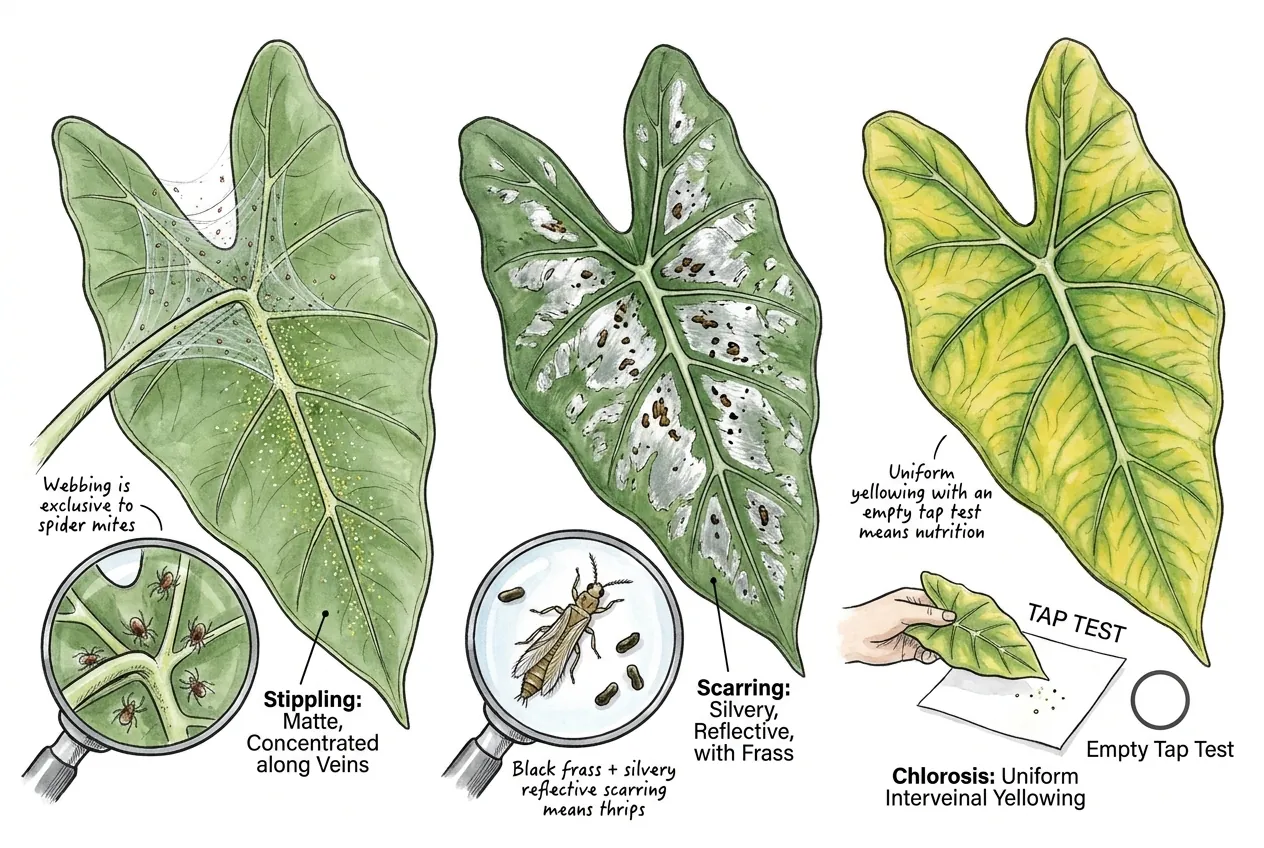
Webbing, frass, and the damage pattern help separate common causes. Treat these signs as a differential to narrow the likely cause, not as a rule that rules anything out for certain.
Among the common houseplant pests it is compared with here, only spider mites spin silk. Aphids, thrips, and mealybugs do not, so fine webbing at leaf axils or along veins points toward mites (and a sign you are past early).
Note that some other organisms, such as spiders and certain other mites, also produce webbing, so webbing alone is suggestive rather than conclusive.
Thrips tend to leave black or brown fecal specks and a silvery, reflective, scarred sheen. Mite stippling is usually matte and non-reflective.
Nutrient chlorosis is more often uniform or follows a pattern, without discrete pinprick dots, but yellowing can also come from root problems, light, or leaf age, so a clear tap test does not confirm it is nutrition.
Use the Pattern Differential
Webbing leans toward mites. Black frass plus silvery reflective scarring leans toward thrips. Uniform interveinal yellowing with no dots and an empty tap test leans toward a nutrition or culture issue.
When the signs are ambiguous, confirm live mites and their morphology under magnification, or ask an extension office or diagnostic lab.
Diagnosing Insect and Mite Damage on Ornamentals
Aphids, Mites and Thrips
Why is Alocasia Frydek especially vulnerable to spider mites?
NC State Extension lists Alocasia as prone to spider mites, so susceptibility at the genus level is a documented observation.
The Frydek’s soft, matte-velvet leaves and its preference for high humidity are consistent with that, though the specific mechanism below is a plausible explanation rather than something measured on this cultivar.
The Frydek’s dark velvet leaves make early dulling, bronzing, and pale stippling easier to notice. That is more useful for home care than trying to predict its susceptibility from leaf anatomy.
Inspect the undersides of its oldest leaves regularly instead of waiting for webbing.
Frydek comfort versus spider mite comfort
| Factor | Frydek wants | Spider mite wants |
|---|---|---|
| Humidity | 60-80% RH | Low, under about 50% RH |
| Temperature | 18-27°C (65-80°F) | 25-30°C (77-86°F) |
| Leaf structure | N/A | Thin, soft cuticle to pierce |
| Air movement | Gentle, off vents | Still, dusty, dry pockets |
Alocasia, Gardener Plant Toolbox
Are spider mites on Alocasia Frydek dangerous to the plant?
A Frydek stores energy in a corm, so leaf loss is often recoverable and a healthy corm can be a reserve for regrowth.
Recovery is not guaranteed, though. A heavy infestation can kill a plant, especially a small or weakened one, and the outcome depends on plant size, remaining roots and leaves, temperature, and season.
Heavy mite feeding adds to the water stress already caused by dry air and weak roots. The exact leaf response varies, so focus on breaking the infestation and restoring stable care rather than predicting which leaf the plant will sacrifice next.
Check the corm at the soil line before you give up. A firm, solid corm is a good sign for recovery, while a soft, mushy, foul-smelling one points to rot, a separate water-management problem rather than the mites.
Firm tissue is reassuring but does not by itself confirm the roots are healthy, so keep watching new growth over the following weeks.
A Frydek reduced to a couple of ragged leaves may regrow from a firm corm once you break the mite cycle and raise humidity, though how long that takes varies.
Twospotted Spider Mite, Virginia Tech
How do you get rid of spider mites on Alocasia Frydek fast?
A sensible first move is mechanical. Isolate the plant, then knock the population down with a forceful lukewarm rinse before any spray.
Repeated rinsing over time does the real work. A single rinse helps but will not clear an infestation on its own.
Isolate first. Move the Frydek to a separate room before you do anything else, then inspect every neighbor it was touching, because mites walk short distances plant to plant.
Then rinse. Mites cling loosely, and a strong targeted jet dislodges them and disrupts the protective webbing.
In a controlled greenhouse trial on impatiens, overhead watering repeated every 2-4 days decreased mite populations as much as 68-fold compared with dry drip irrigation.
That result is from repeated overhead watering of impatiens, not a single houseplant rinse, so use it as support for rinsing regularly rather than proof any one wash will crash a colony.
Rinse the whole plant, especially undersides and axils, under lukewarm room-temperature water.
On a velvet leaf, support each leaf from below with your palm and use moderate pressure, not a hard jet, so the thin lamina does not tear.
Why does rinsing alone fail, and what schedule fixes it?
Rinsing knocks off mobile mites but does not reliably remove attached eggs. The fix is cadence, not a harder spray.
Rinse every few days and continue until repeated underside checks and tap tests come up clean. A calendar is only a guide, because a cooler room can delay a hidden cohort.
A leaf that is heavily webbed and largely dead may be worth removing rather than salvaging, cut at the petiole base with a clean, disinfected blade.
This can take a chunk of the population with it, but keep pruning conservative. A stressed Frydek needs its remaining leaf area, so weigh the eggs removed against the photosynthesis lost rather than stripping leaves you could still recover.
How do you avoid crown rot after rinsing a Frydek?
Reduce rot risk by rinsing early in the day and tipping out any water trapped in the crown, then letting the plant dry with gentle airflow before it returns to its humid spot.
Water pooling in the crown, combined with cool, stagnant air, raises disease risk. Note that root and rhizome rot is driven more by a waterlogged, poorly drained substrate than by wet foliage alone, so manage watering and drainage separately.
Never let the pot sit in standing water. Place a low fan a few feet away to move air past the plant, not blasting the fragile leaves directly.
Misting Is Not a Mite Treatment
A fine-mist sprayer does not have the force to dislodge mites, so it is not a substitute for a real rinse and should not be relied on as a treatment step.
Repeated leaf-wetting can also raise leaf-spot risk on a velvet leaf, so keep any misting minimal and always dry the foliage afterward.
If you already own a continuous mister, its use here is cosmetic leaf-cleaning at most, not mite removal.
BeautifyBeauties Continuous Spray Bottle
BeautifyBeauties sprayer is a fine continuous-mist bottle for general misting. It is too gentle to knock mites off a leaf, so it does not replace a forceful lukewarm rinse and is not a mite-treatment tool.
Overhead and Drip-tube Irrigation Affect Twospotted Spider Mites on Impatiens
Managing Houseplant Pests
Managing Spider Mites on Houseplants
How do predatory mites control spider mites indoors?
Predatory mites hunt two-spotted spider mites and leave no phytotoxic residue on a Frydek’s velvet leaf, which makes them worth considering for an aroid where sprays are risky, provided you can meet their humidity needs.
Match the Predator to the Outbreak
Phytoseiulus persimilis is the fast specialist for an active outbreak.
It is the faster option for an active outbreak, but it performs best in a cooler, humid setting. It is a poor fit for warm, very dry AC air.
Consider a Generalist Predator
Amblyseius andersoni predatory mites fit prevention or low pest pressure better than a dense, webbed outbreak. They are a more flexible generalist than a specialist predator, but they still need conditions the supplier approves, especially adequate humidity.
They may survive briefly when prey is scarce, but a standalone Frydek will not necessarily support a permanent colony. Confirm the exact species, count, sachet format, shipping, and viability on arrival before you rely on a live shipment.
Choosing your predator by climate
| Predator | Diet | Best role | Temperature | Humidity |
|---|---|---|---|---|
| Phytoseiulus persimilis | Specialist, mites only | Active outbreak | 63-82°F sweet spot | Needs above 60% |
| Neoseiulus californicus | Generalist | Low-level or preventive | 50-91°F | 40-80% |
| Amblyseius andersoni | Generalist | Preventive, low pest pressure | 43-104°F survival | Sensitive below ~65% (Koppert) |
For a warm, dry room, a hardier generalist such as californicus or andersoni is a reasonable candidate, provided you can hold humidity in its comfortable range (see the caution above).
A breeding sachet is a self-contained colony that releases mites over a few weeks. Sachets are typically water-resistant rather than fully waterproof, so keep them out of direct spray.
Release rates depend on the plant, canopy, and pest pressure, so follow the supplier’s dosing guidance rather than a fixed one-per-plant number, and re-release on their recommended interval (often around every 4-6 weeks).
Generalist sachets are slower than persimilis, so they suit prevention and low pest pressure more than crashing a heavy outbreak, and predators are a recurring cost.
Treat biocontrol as one part of a program. Because these are live organisms, the buy also depends on shipping temperature, arrival date, and checking viability on arrival, which matter more than reviews. Confirm the exact species, count, and format with the supplier before ordering.
Why can spraying first kill the predators you paid for?
Spraying first can poison the predators, because pesticide residue can stay lethal for days.
Predatory phytoseiids are close relatives of spider mites, so miticides that kill one often kill the other.
Compatibility varies with the predator, product, formulation, and dose. Do not borrow a wait time from another product or study when a supplier’s compatibility chart and the product label can tell you what applies to your situation.
Choose the Control Route First
If you go biological, avoid spraying a harsh miticide first.
If you did spray something, base the wait on that specific product’s label and the predator supplier’s compatibility chart rather than a single number, and err on the longer side.
Better still, rinse mechanically first, then release predators, understanding a rinse reduces but does not guarantee removal of residue.
Phytoseiulus persimilis, Biological Control Agent of the Twospotted Spider Mite
Predatory Mite, Neoseiulus californicus
How do you treat spider mites on a velvet leaf Alocasia safely?
The safest effective chemistry is contact-only and gentle, insecticidal soap and horticultural or neem oil, always test-patched first.
These kill mites physically rather than through a nervous-system poison, so thorough underside coverage matters more than potency.
Insecticidal soap works because fatty-acid salts disrupt the mite’s cell membranes. Horticultural oil suffocates by blocking the breathing pores.
Because neither leaves a lasting residue, you must physically wet the mites where they live, on undersides and in axils.
Turn every leaf over and spray the underside to runoff, then hit the crown, axils, and stems.
Plan on 2-3 rounds spaced roughly 5-7 days apart to catch newly hatched mites, since a single contact spray largely spares the eggs.
Why is the velvet cuticle a phytotoxicity trap?
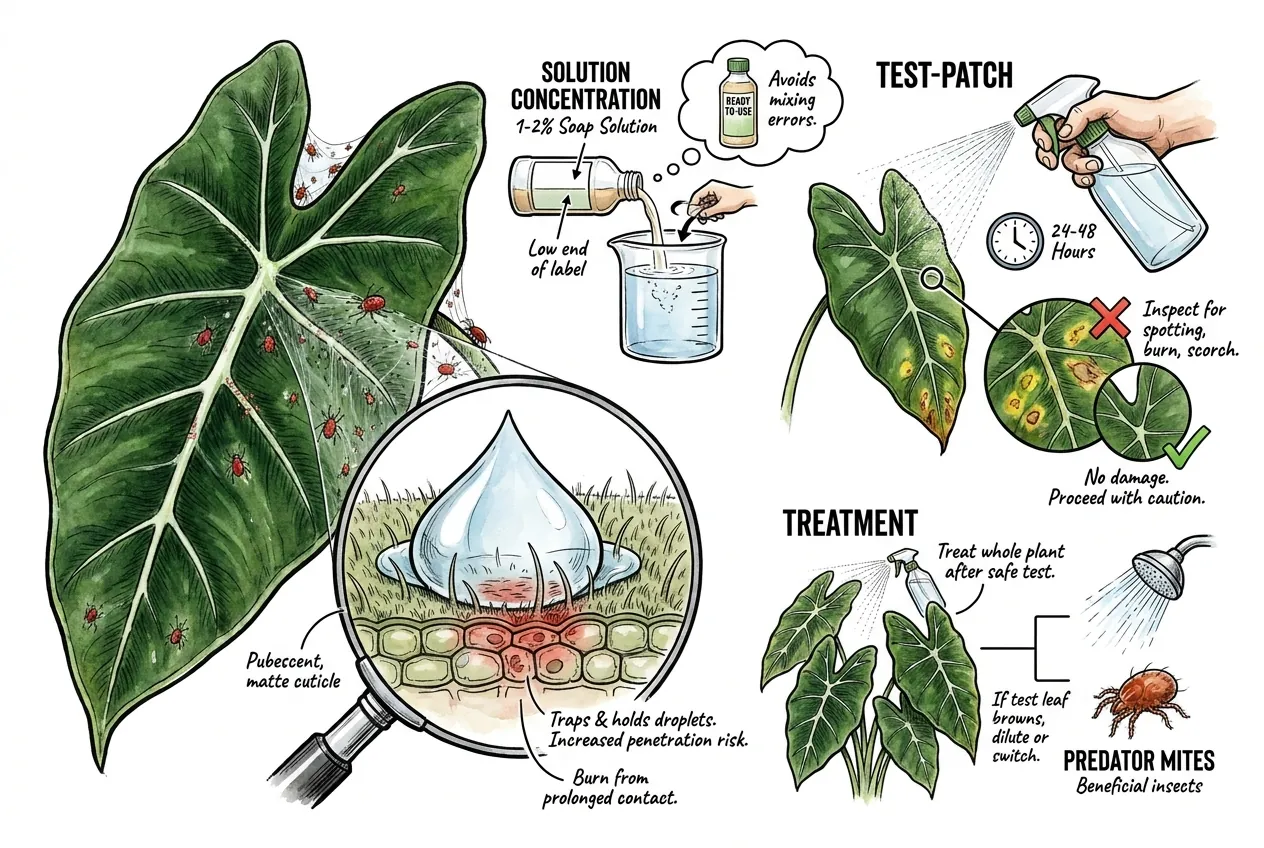
A peer-reviewed arboriculture source notes that highly pubescent (hairy) leaves are more likely to be injured by horticultural oils, because such surfaces can hold droplets against the tissue.
The Frydek’s matte-velvet surface may behave similarly, but droplet retention and burn risk have not been measured on this cultivar specifically, so this is a precaution rather than a documented Frydek result.
Extension sensitivity lists flag the related aroid dieffenbachia, along with some ferns and palms, as soap-sensitive.
That is not direct evidence about Alocasia, but it is reason to be cautious and to treat the Frydek as potentially sensitive.
Either way, the test patch below is the important safety step on a plant whose tolerance is unknown.
Follow the product label
Mix and apply strictly according to the label. A ready-to-use (pre-diluted) product is convenient because it removes mixing errors. Do not dilute a ready-to-use product further, and do not improvise a concentration, since off-label mixtures make both safety and effectiveness a guess.
Oils and soaps differ in concentration and temperature limits, so follow each product’s own directions rather than a single generic ratio.
Always test-patch first
Spray one lower or older leaf, wait 24-48 hours, and inspect for yellow or brown spotting, burned tips, or scorch before treating the whole plant.
If the test leaf shows injury, stop using that product on this plant and switch to a gentler approach such as plain-water leaf showers plus predatory mites, rather than trying to salvage it with an off-label dilution.
Never spray in heat or direct sun
Do not spray soaps or oils on a water-stressed plant or when temperatures exceed 90°F, and keep horticultural oil applications below 85°F, since extension guidance ties higher temperatures and heat stress to greater phytotoxicity risk.
Follow each product’s own temperature limits, as they can differ.
Treat in early morning or evening, out of direct sun, then keep the plant out of bright light for a day after an oil application.
Never spray a Frydek that is already wilting or baking on an AC-dried windowsill.
A ready-to-use potassium-salts-of-fatty-acids soap is a reasonable first-line contact option and matches the active class extension programs recommend.
Use it as sold, without diluting, and apply per its label.
Safer Brand Insect Killing Soap
Safer Brand Insect Killing Soap fits a confirmed light-to-moderate infestation when its current label covers spider mites and your indoor use. Treat it as a contact spray for leaf undersides, not a residual cure. Test one leaf first, use it exactly as labeled in cool shade, and repeat only on the label’s interval because eggs and sheltered mites may survive the first round.
When is a dedicated miticide justified, and what must you never do?
A dedicated neurotoxic miticide like abamectin is a genuine last resort, and for most home growers it is not the right tool at all.
The abamectin products in the extension literature are greenhouse and nursery professional products with restricted-entry intervals and site restrictions, not consumer houseplant sprays.
Use one only when a product is legally registered and labeled for your situation. If a heavy, webbed population survives repeated soap, oil, and biocontrol, consult a professional rather than improvising.
Understand Miticide Risk
Abamectin is an IRAC Group 6 neurotoxin rated highly toxic. Because two-spotted spider mites develop resistance fast, any miticide used more than once should be rotated to a different mode-of-action group, and any product must be used exactly per its label, including required protective equipment, ventilation, re-entry, and disposal, and kept away from people and pets.
Avoid High-Risk Mite Treatments
- No broad-spectrum bug bombs, because they wipe out the natural enemies that suppress mites and frequently cause worse outbreaks.
- No mixing products.
- No spraying stressed or heat-baked plants.
- No midday-sun applications.
- No over-application.
Spider Mites, Home and Landscape
Pesticide Profile, Horticultural Oil
Insecticidal Soaps Fact Sheet
The Use of Horticultural Oils and Insecticidal Soaps for Control of Insect Pests
What humidity do Alocasia Frydek need to prevent spider mites?
For a lived-in room, keep relative humidity in a moderate range around 40 to 50% and stop if windows, walls, or foliage collect condensation. That supports the Frydek better than very dry AC air without creating a household mold risk.
Humidity is a supporting prevention measure, not a point at which mites stop reproducing. Use it alongside weekly inspection, mechanical knockdown, and a suitable treatment or predator when mites are confirmed.
Empty and refill a portable humidifier daily with fresh low-mineral or distilled water, then clean it regularly. Do not try to create the extremely wet conditions used in laboratory fungal studies indoors.
Why does misting fail and what actually raises humidity?
Misting fails because it gives only a momentary spike that evaporates in minutes, so it does not raise ambient humidity meaningfully.
Repeated leaf-wetting also increases leaf-spot risk on a velvet leaf.
Raise Humidity Without Misting
Three approaches are useful, in descending order of impact.
- A room humidifier for constant, measurable humidity.
- Grouping plants so their transpiration raises the shared microclimate.
- A pebble tray under the pot, where evaporation lifts humidity around the foliage.
A humidifier does the most measurable work. Run it near, not blasting directly onto, the plant, ideally in the morning. Cluster the Frydek with other humidity-lovers, and add a pebble tray with the pot sitting above, never in, the water line.
How do you raise humidity without inviting rot and fungus gnats?
Pair the humidity with gentle airflow. A small fan on low across the room, not aimed at the plant, plus spacing so leaves do not touch.
High moisture combined with stagnant air can raise the risk of fungal leaf spot and fungus gnats, so some air movement helps.
Gentle air movement can help dry leaf surfaces and reduce condensation. It does not, however, fix a soggy pot. Root rot and fungus gnat larvae are driven mainly by an over-wet, poorly draining substrate, so manage those through watering and drainage, letting the top of the mix dry between waterings, not through airflow alone.
Keep in mind that moving air also raises transpiration, so a strong draft can stress the plant much like a vent blast.
Move the Frydek out of the direct AC blast. A register can chill and dry the leaf while dispersing any local humidity you have created.
Use a hygrometer at leaf height rather than a far wall, but remember that it reads air rather than leaf temperature or soil moisture. Pair it with direct checks of the foliage and pot.
TempPro TP49 Digital Hygrometer
TempPro TP49 Digital Hygrometer suits a simple leaf-height check of whether AC is drying the plant’s immediate area. It helps you see a trend, not diagnose mites or change humidity on its own. Compare it with another unit or a salt test if the reading seems implausible.
Prediction of Sporulation and Germination by the Spider Mite Pathogenic Fungus Neozygites floridana
Success with Houseplants, Humidity
Integrated Pest Management for Spider Mites
How do you prevent the next AC-season spider mite bloom?
Prevention is the most reliable way to stay ahead of fast summer growth, and it comes down to regular scouting, sensible humidity, and quarantining new plants.
UC IPM figures illustrate why timing matters. Egg-to-adult can take around 28 days at 60°F but only about 8 days at 82°F, so a warm room leaves little margin once mites establish.
Scout weekly. Flip 3-5 lower leaves and scan undersides and axils with a 10x lens, then run one white-paper tap test.
A weekly check is a practical interval in a warm room, aiming to catch a new generation before it seeds the next. Scout more often if the room is warm and dry.
A quick flip-and-scan of the oldest leaves takes only a minute or two, though a fixed few-leaf sample is less sensitive on a large plant or collection.
Quarantine every new plant, since new purchases are a common way infestations arrive. Colorado Extension recommends isolating new houseplants for at least three weeks. Two weeks does not reliably outlast the egg-to-adult cycle in a cooler room.
Loupe-check and tap-test at intake, re-inspect weekly, and use repeated clean inspections, not just the calendar, as your release criterion before integrating.
For a larger aroid collection, preventive predatory-mite sachets can help, but follow the supplier’s dosing and re-release interval (commonly around every 4-6 weeks) rather than a fixed one-per-plant rule, since rates depend on plant spacing and pest pressure.
Keep humidity in the predator’s comfortable range so they stay effective. Sachets work best preventively or at low pest pressure, not for crashing an established outbreak.
Twospotted Spider Mite, Floriculture and Ornamental Nurseries
Two-Spotted Spider Mite, Montana State Urban IPM
Neoseiulus (Amblyseius) californicus, Koppert
Affiliate Disclosure
This article contains Amazon affiliate links. As an Amazon Associate I earn from qualifying purchases. If you use these links, the site may earn a commission at no extra cost to you. Product availability, price, and specifications can change. Check the current listing before buying.