
Terrarium Mushrooms: What They Mean & When to Worry
Terrarium mushrooms explained: why most are harmless decomposers, how to ID the yellow houseplant mushroom, slime molds, and real wood rot, the rotten-egg warning sign, and chemical-free control with airflow and springtails.
Priya Patel · Published 2026-03-24 · 16 min read
Key Takeaways
- A mushroom is often a fruiting body in a moist, organic-rich substrate, not a problem by itself. Still check species identity, plant symptoms, wood condition, and resident safety before deciding what to do.
- The yellow flowerpot mushroom feeds on dead organic matter and does not attack living plant roots. It is not safe to eat, and bright yellow colour is a strong hint rather than a confirmed identification.
- Surface growth and structural rot need different responses, and neither is identified by colour alone. Watch texture over time and consider wood moisture, species, temperature, and how long the material stays wet.
- Rotten-egg odor combined with wilting in wet soil is a high-priority signal. It suggests low-oxygen conditions and possible reduced-sulfur compounds, so check water level, substrate saturation, roots, and resident animals.
- Springtails and isopods can graze fungi but cannot replace airflow and moisture control. Cleanup fauna helps only when the enclosure’s environmental conditions also support it.
What Mushroom Growth Means
Fruiting Body Versus Mycelium
Before jumping to conclusions, it helps to understand the difference between the mushroom and the mycelium.
The Mushroom Is a Fruiting Body
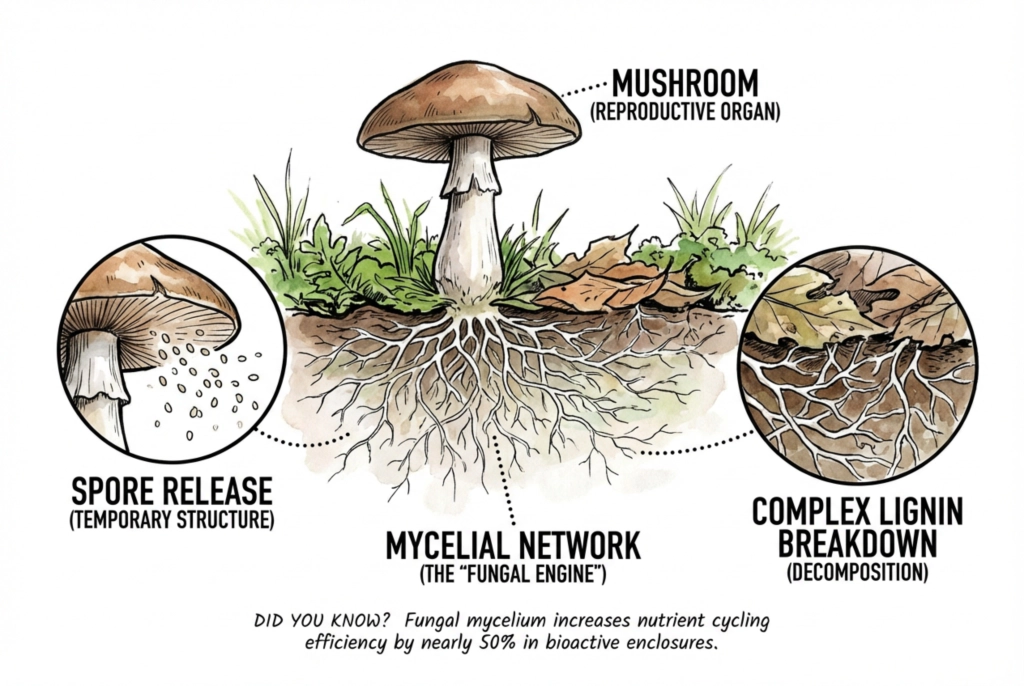
For mushroom-forming fungi, the visible mushroom is the reproductive structure (a short-lived body that releases spores).
Mycelium Is the Larger Network
The larger part of the organism is usually the mycelial network threading through the substrate.
It is often described as fine white filaments, but its color and form vary by species and conditions, and not every white thread you see is fungal mycelium.
Without handling an unknown mushroom, I photograph the cap, stem base, nearby substrate, and surrounding plant tissue. I add the time because a cap can expand and collapse between routine checks.
The log notes whether growth is isolated or repeating from the same buried material, while pets and children stay away. The sequence helps distinguish a brief fruiting event from a persistently wet decay pocket that needs correction.
Decomposition Is Usually Normal
Fungi are among the most important decomposers in a bioactive enclosure.
According to the USDA soil biology literature, fungi are major decomposers of tough materials like lignin, helping break down leaf litter and sphagnum so nutrients become available to plants.
The exact share of decomposition they handle in a given enclosure is not something you can measure from the outside.
So the appearance of a mushroom often just means your substrate is moist and rich in organic matter and that decomposition is active, not that anything is necessarily wrong.
Fungal mycelium secretes extracellular enzymes that contribute to nutrient cycling, though the size of that effect depends on the fungus and the conditions and is not quantified here.
Use a Simple Response Ladder
- If you can identify the growth, it is not toxic to residents, and the plants and hardscape look fine, observe it.
- If the species is uncertain or pets and children can reach it, remove and isolate the fruiting body.
- If plants are wilting, wood is softening, or you smell rot, inspect the roots, substrate saturation, and hardscape.
- If foul odor appears with animal distress, treat it as urgent and contact an exotics veterinarian.
The Classic Yellow Houseplant Mushroom
Leucocoprinus birnbaumii (Friend or Foe?)
Identify by More Than Color
A common sight in indoor horticulture is the sudden appearance of bright, lemon-yellow pins emerging from the soil.
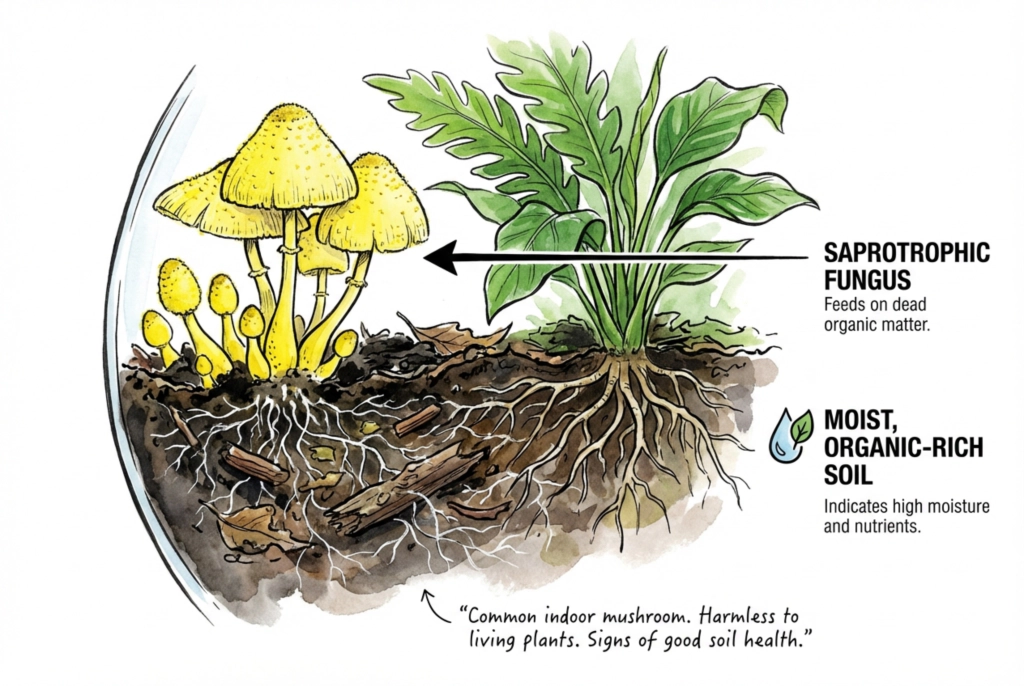
These are consistent with Leucocoprinus birnbaumii, the yellow houseplant mushroom. Color and shape are a good hint, but a confident identification really needs a look at the cap texture, the gills, the ring on the stalk, and ideally a spore print. Several other small mushrooms can look similar, especially when faded or immature.
Why Yellow Mushrooms Appear Indoors
Its spores are commonly carried in commercial potting mixes, which is why it turns up so often indoors.
Its presence usually means the substrate is rich in organic matter and consistently moist, though temperature and the spores already present also play a role.
The Yellow Mushroom Feeds on Dead Matter
Extension sources describe this fungus as saprotrophic. It feeds on dead organic matter. NC State Extension states it does not attack the living roots of your plants.
Leucocoprinus birnbaumii (Yellow Houseplant Mushroom) | NC State Extension
To Pluck or Not to Pluck?
Treat the Mushroom as Inedible
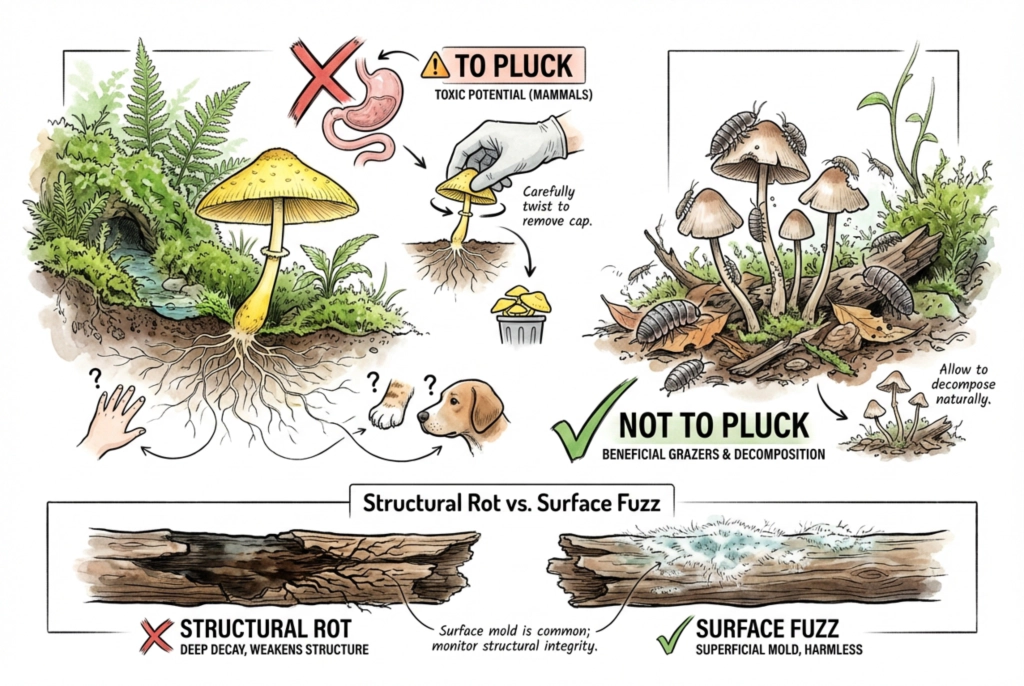
Although L. birnbaumii is not known to harm your plants, NC State rates its ingestion toxicity as medium. The exact toxic principle is unknown and reported symptoms range from mild to severe.
Treat it as not safe to eat for people or pets.
Remove Fruiting Bodies for Resident Safety
Cleanup animals like isopods and springtails may graze on fungi, but whether they take this particular mushroom is not something you can count on. If you have free-roaming dogs or cats, or curious toddlers, remove the caps rather than leaving them.
When you do, wear gloves or wash your hands afterward, and seal the removed pieces in a bag for the trash rather than composting them in the room.
Because the mycelium remains in the substrate, the mushroom will likely fruit again. Repeated plucking, along with the moisture and airflow steps below, is normal.
Structural Rot vs. Surface Fuzz
Decoding Driftwood Decay
Surface Growth Changes Over Time
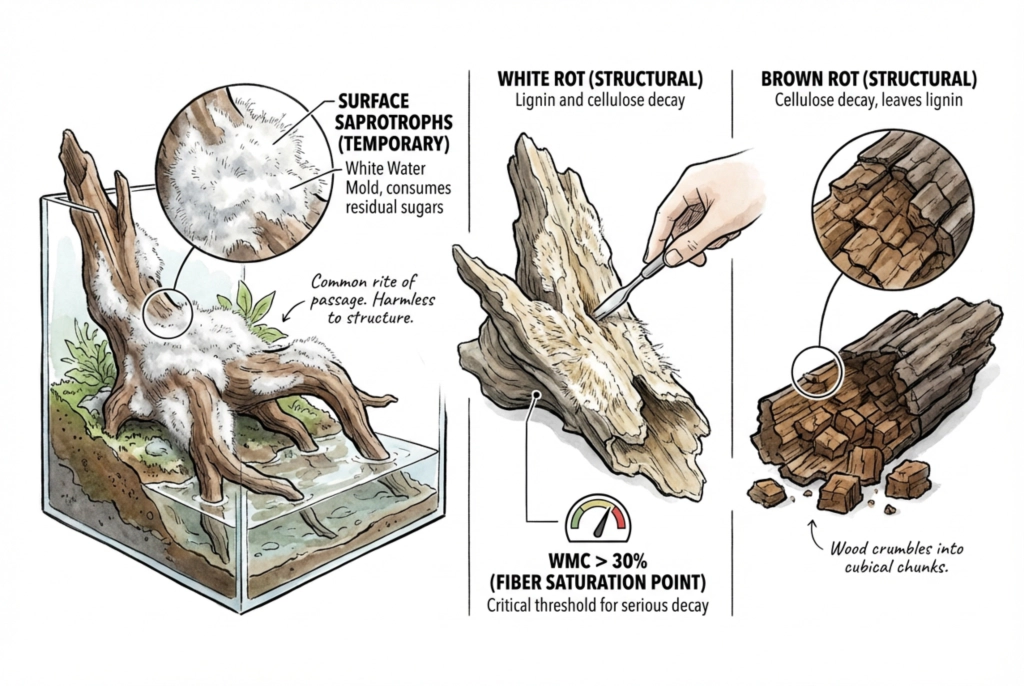
A bloom of white, fluffy growth on a newly introduced piece of spider wood is a common experience for new terrarium owners.
The useful skill is telling a harmless surface film from structural rot, but neither can be identified by eye alone.
That early white growth is often assumed to be a temporary water mold feeding on residual sugars, but by appearance it could just as easily be a bacterial biofilm, a fungus, an oomycete, or a mix.
Rather than diagnosing it from color, watch it over a week or two. A film that fades on its own as the wood cures behaves differently from growth that spreads and softens the wood.
Wood Moisture Sets Decay Risk
True wood-decay fungi (white rot and brown rot) are a separate concern. USDA Forest Products Laboratory work on building woods gives broad bounds. Sustained decay generally occurs above about 30% wood moisture and does not occur below 20%, with 20–30% treated as a grey area.
Those numbers are not a universal on/off switch (the actual threshold depends on the wood species and product, temperature, and how long the wood stays wet).
Press-Test Structural Hardscape
Growth that turns the hardscape white and stringy, or that crumbles it into brown cubical chunks, points toward structural decay.
These textures are useful field clues, but they do not tell you the exact organism or how much load-bearing strength the wood has left. Press-test soft or spongy spots and replace any hardscape that has lost integrity or that an animal could dislodge.
Limiting Conditions for Decay in Wood Systems | USDA Forest Service (Morris & Winandy, 2002)
Preventing Hardscape Collapse
Keep the Wood Base Above the Reservoir
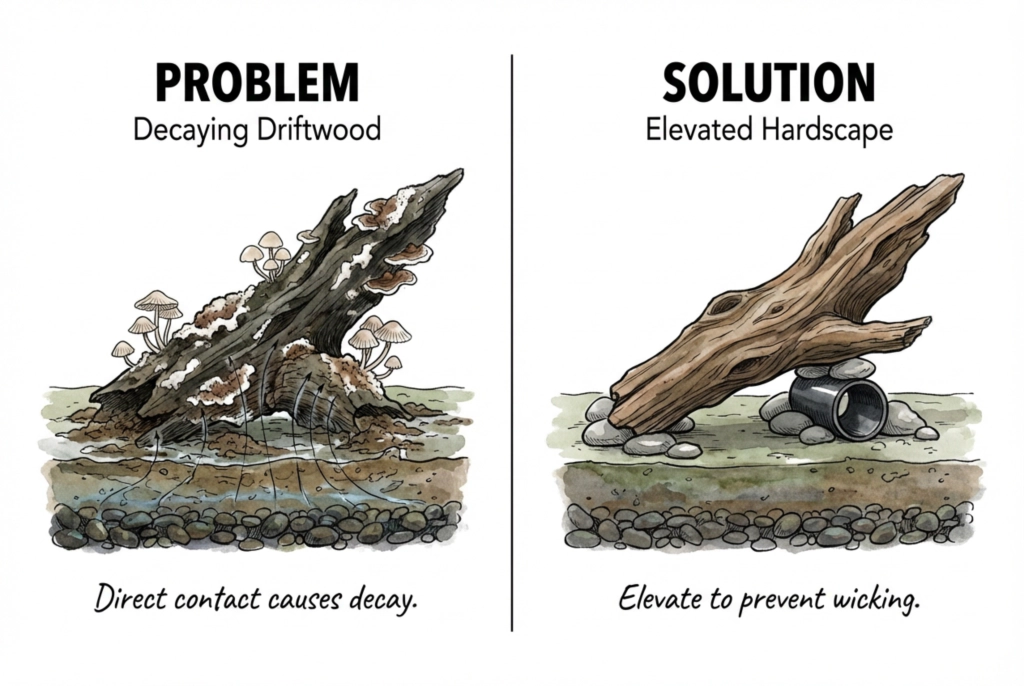
To slow decay, keep the base of your driftwood from sitting directly in the drainage layer where it wicks up water.
Measure Load-Bearing Wood When Needed
Raising the hardscape on rock or PVC reduces that direct wicking, which helps. It does not by itself guarantee the wood stays below any particular moisture level. In a closed, high-humidity enclosure the wood can still take on water from splash, condensation, vapor, and any remaining contact points.
If a large piece is load-bearing, keep clearance above the reservoir line and, if you want to know the actual moisture, check it with a wood moisture meter rather than assuming.
The Not-Quite-Mushrooms (Slime Molds)
Bacterial Grazers on the Move
Movement Is a Slime-Mold Clue
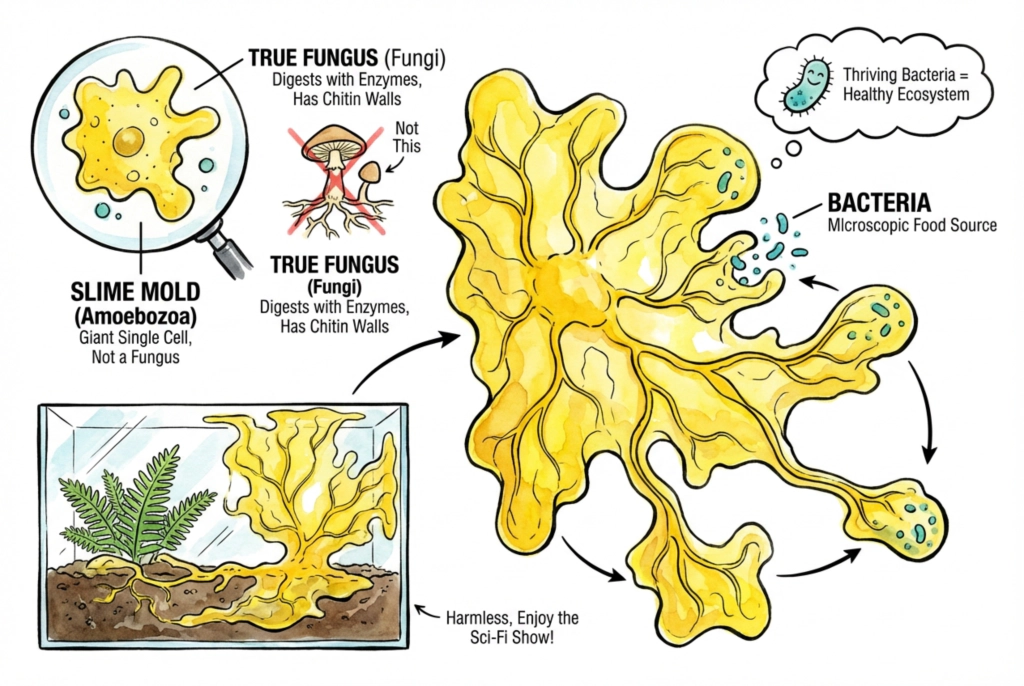
Sometimes a bright yellow or white vein appears on the glass, spreading and changing shape over days.
A network that actually moves is a good clue, though not every colored streak on glass is a slime mold.
Slime Molds Are Not True Fungi
The common ones seen in terrariums are plasmodial slime molds, which are not true fungi. They are amoebozoans, and their plasmodial stage can be a single mass containing many nuclei rather than a single-celled organism.
Slime Molds Engulf Food
Unlike true fungi, which secrete enzymes to digest their food externally, slime molds engulf and consume microorganisms (bacteria, yeasts, fungal spores, and others, not bacteria alone).
What Slime Mold Does Not Prove
Spotting one tells you those microbial food sources are present. It does not, by itself, prove a thriving or healthy ecosystem.
Extension guidance describes common plasmodial slime molds as generally harmless and mostly cosmetic, so there is usually no need to treat them.
That is not the same as being safe for every organism in every situation. Fungicides are generally not recommended here, but the reason is that treatment is unnecessary for a harmless cosmetic growth, not simply that slime molds lack chitin, since fungicides have varied targets.
In most cases you can leave it to run its course and clear on its own.
Red Alerts (Overwatering and Anaerobic Crashes)
Diagnosing the Swamp Smell
Fungi are not all one thing. Many are benign decomposers, but some situations are genuine warning signs.
Rotten-Egg Odor Is a Priority Signal
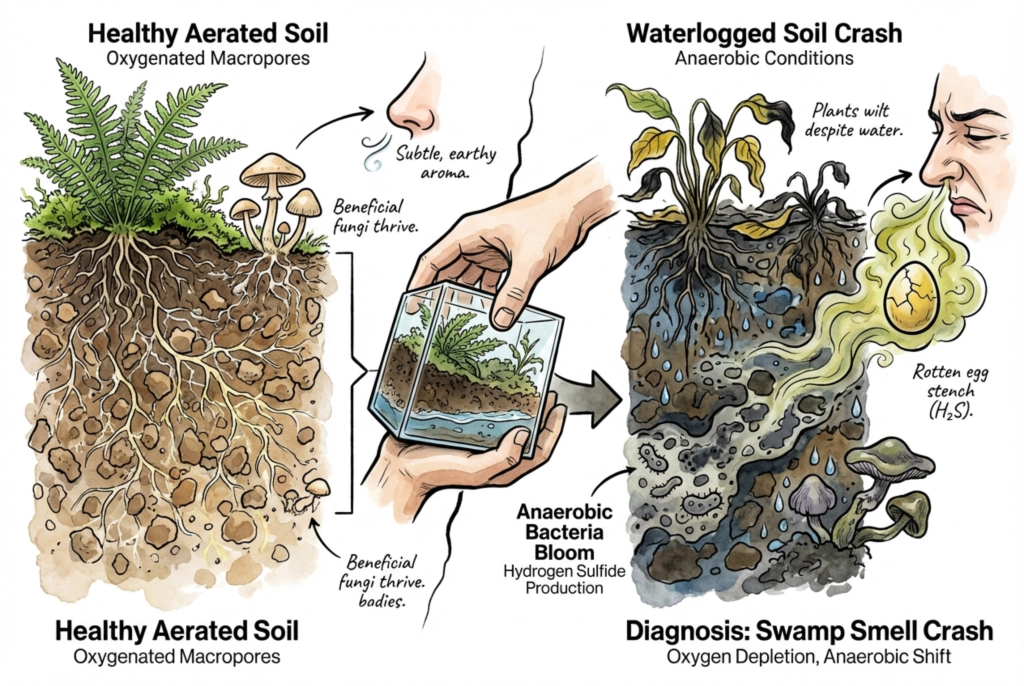
If your substrate suddenly smells like rotten eggs and your plants are wilting even though the soil is wet, treat it as a high-priority problem to investigate rather than a confirmed single diagnosis.
A rotten-egg odor suggests reduced-sulfur compounds, possibly hydrogen sulfide, H₂S, forming under low-oxygen conditions, but the smell alone does not identify the exact cause.
Waterlogging Reduces Oxygen
Waterlogged substrate limits gas diffusion and lowers oxygen availability, and can create hypoxic or anoxic microsites, though it does not uniformly remove all oxygen everywhere.
Separate Root Starvation From Pathogen Infection
Under those reducing conditions, oxygen-dependent (aerobic) fungi are stressed and anaerobic microbes become more active. Some can produce that hydrogen sulfide smell.
Root oxygen starvation, anaerobic decomposition, and any pathogen infection are separate issues that can overlap, so check them individually rather than assuming one has caused all of them.
Combating Water Molds
Why Pythium Can Return
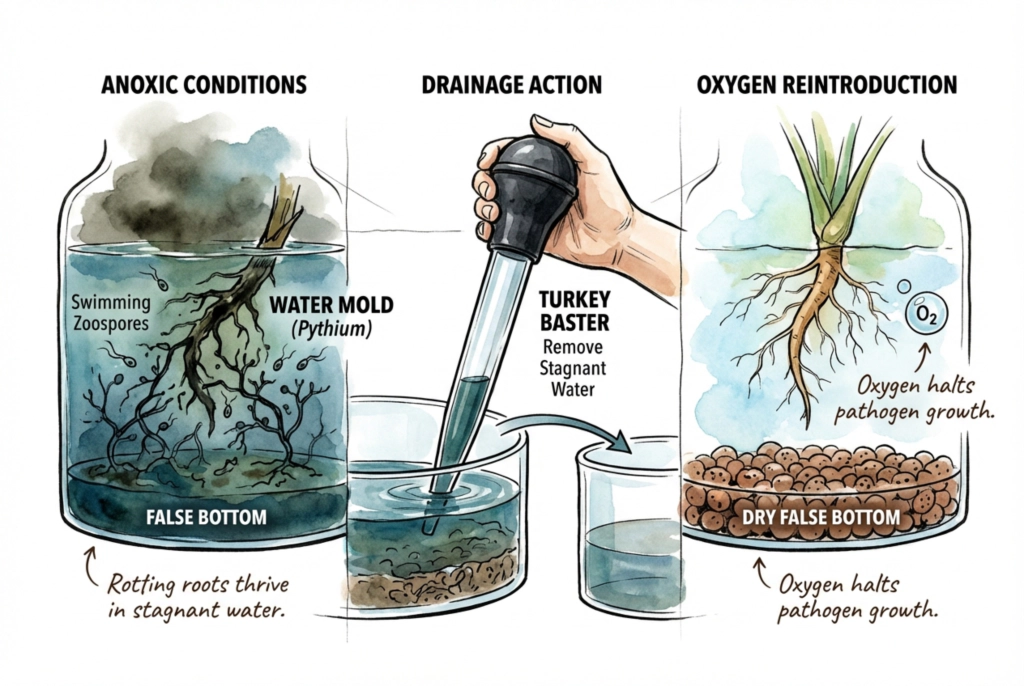
Wet, poorly drained conditions favor water molds such as Pythium, which can infect and rot plant roots. Pythium is an oomycete, not a true fungus. Species differ in their hosts, temperature preferences, and spore types, and some produce motile zoospores in free water.
Several species also form survival structures, such as oospores, that persist through drying and unfavorable conditions, which is why the problem can return.
Drainage Is the First Response
If you find standing water contacting the substrate, draining the false bottom with a turkey baster or siphon is a sensible first response.
Be realistic about what it does. It removes excess water and reduces a key risk factor, but it does not instantly aerate saturated substrate, does not repair roots that are already infected or necrotic, and does not by itself stop an established infection.
UC IPM guidance for Pythium pairs water and drainage management with sanitation, removing diseased plant material, and treating or replacing affected medium.
If plants keep declining, inspect and trim rotten roots, improve drainage and airflow, repot in fresh medium if needed, and escalate rather than relying on draining alone.
The Stagnant Air Factor
Why Do Mushrooms Keep Fruiting?
Moisture and Mycelium Drive Fruiting
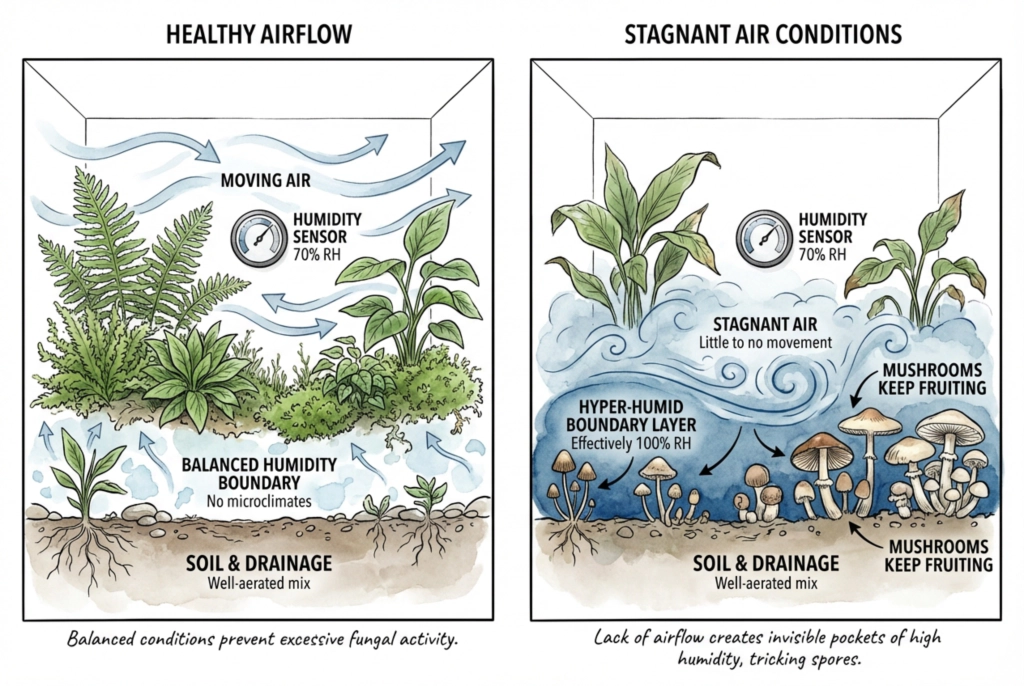
You might have good soil and drainage, yet mushrooms keep appearing. Stagnant air is one plausible contributor, but it is rarely the only factor. Continuing substrate moisture, established mycelium already in the substrate, temperature, CO₂, and the species’ own biology all feed into whether and how often it fruits.
With little air movement, a more humid layer of air can sit directly above the substrate.
The Surface Boundary Layer Is Local
So even if your hygrometer in the open part of the enclosure reads, say, 70%, the thin layer right against a wet surface can be considerably more humid.
How much more depends on temperature, how wet the surface is, and the enclosure’s shape. It is not automatically 100%, so measure the local conditions when that distinction matters.
Spore germination responds to species-specific water activity, temperature, nutrients, and other signals rather than being changed by still air alone.
Airflow and Surface Drying
Use Airflow as a Gentle Adjustment
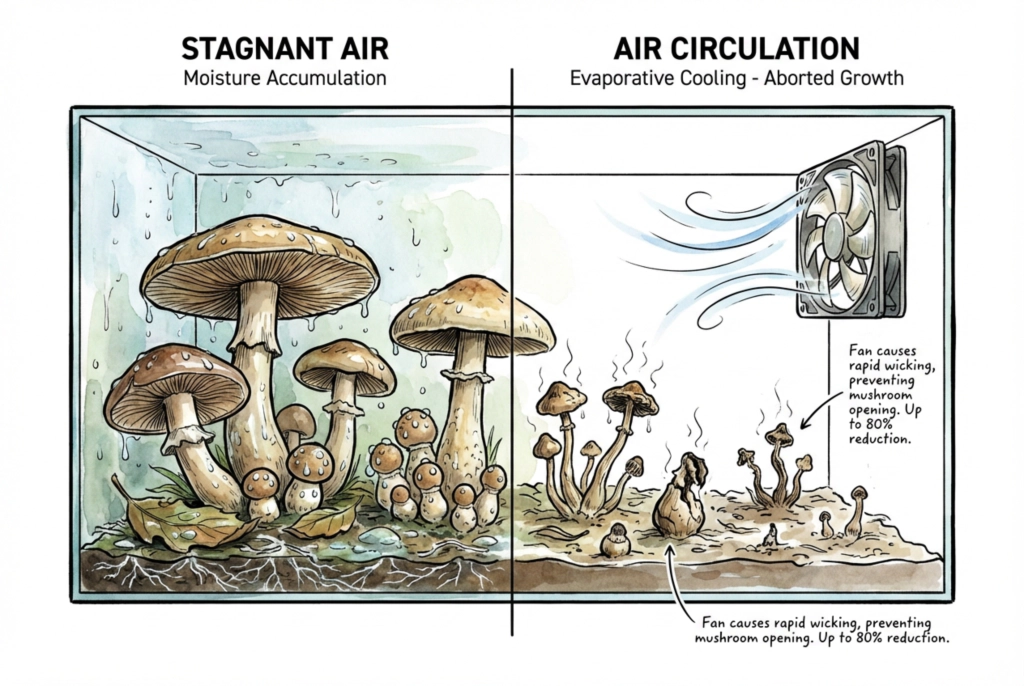
Adding gentle air movement is one non-chemical lever that can make the surface less consistently wet, which some keepers find reduces fruiting.
It is not the only fix. Substrate moisture, fresh-air exchange, temperature, and the species all matter too, and drying too aggressively can harm plants, moss, springtails, and amphibians.
Adjust Airflow Gradually
The idea is that moving air can wick moisture from the surface of young pins, and some keepers report fewer fruiting bodies with better circulation.
The effect depends on air velocity, layout, and the fungus. Many cultivated mushrooms actually need high humidity plus controlled fresh-air exchange rather than a fan blown directly at them.
Whatever you use, adjust gradually and watch your residents. Aim for a mild reduction in surface wetness, not a wind tunnel, and monitor surface and substrate moisture and temperature as you go.
A fan can help only when the enclosure also has a path for air to enter and leave. Direct, aggressive drying can harm plants, moss, springtails, and amphibians.
AC Infinity MULTIFAN S5
AC Infinity MULTIFAN S5 can move air across a vent in a larger enclosure, but it is not wet-rated equipment. Do not place it inside a continuously wet vivarium, where condensation, corrosion, water, and animal contact create avoidable risks.
Use a wet-rated option for in-enclosure movement or mount this type of fan outside the enclosure with a GFCI outlet and drip loop. Adjust airflow by observing drying and temperature rather than by a fixed fan setting.
Your Frontline Defense (The Cleanup Crew)
Springtails to the Rescue
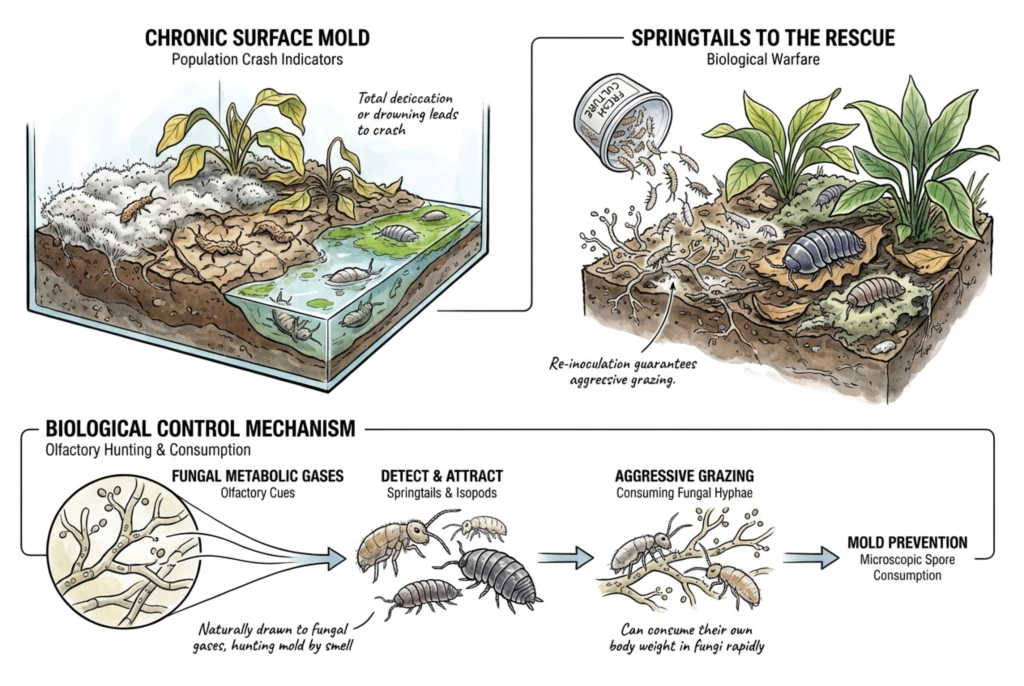
A common non-chemical approach is to keep a healthy cleanup crew.
What Springtails Can and Cannot Do
Texas A&M extension describes springtails (Collembola) as fungivores that also eat bacteria and decaying vegetation, with populations that rise and fall with moisture, temperature, and available food.
Laboratory studies show some collembolans respond to fungal volatiles and even prefer certain fungi, but that is a species- and fungus-specific finding. It does not mean springtails and isopods jointly find and remove every terrarium mold by smell, and the extension source does not make that combined claim.
In a specific laboratory microcosm, one collembolan species consumed more than its own body mass of fungal mycelium per day, but that depends on the species, the fungus, and the density.
Low or moderate grazing can even stimulate fungal growth or spread spores, so grazing is not always net suppression.
Grazing Has Limits
Severe, persistent surface mold has many possible causes, fresh organic input, overfeeding, temperature, wetness, competing microbes, and too little air exchange, so it is not almost always a crashed springtail population.
Desiccation or prolonged flooding can reduce cleanup fauna, but confirm what is actually happening (check moisture, feeding, and whether you can still see springtails) before buying more animals.
Rebuild the Culture After Correction
Once the underlying conditions are corrected, a fresh culture can help re-establish grazers.
Josh’s Frogs Springtails
Josh’s Frogs springtails can seed a cleanup crew in a suitably moist terrarium. They graze some surface growth and recycle fine debris, but they do not make stagnant air or persistent overwatering safe.
Dwarf White Tropical Isopods
Dwarf white tropical isopods add a larger-detritus cleanup role than springtails. Use them only in an enclosure with enough leaf litter and moisture, because a culture cannot compensate for a missing food web.
These cultures can reduce surface fungus over time under suitable conditions, but they do not guarantee that spores are eaten before fruiting, and they will fail if the environmental cause is left unaddressed.
Give a new culture time to acclimate and establish, and keep monitoring.
Soil Allies. Folsomia candida preference for Fusarium over Trichoderma (Santos-Barbosa et al., 2025)
Do Fungi Threaten Vivarium Inhabitants?
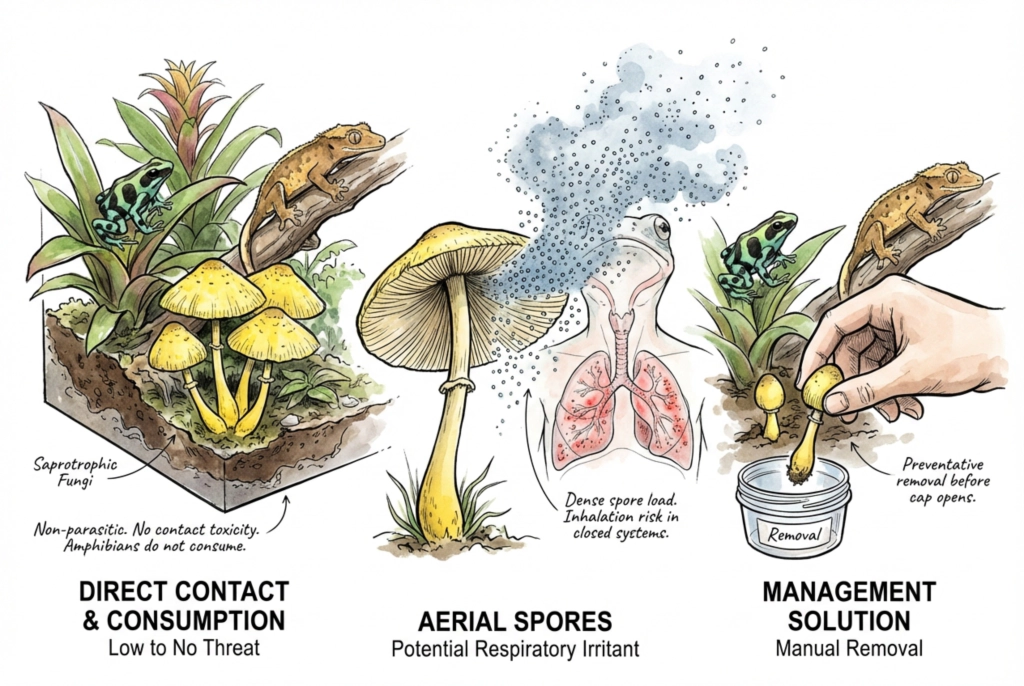
Species and Contact Risk
A saprotroph like L. birnbaumii feeds on dead matter rather than living tissue, so it is not going to attack your animals the way a parasite might.
That is specific to an identified species, though. The phrase most common soil mushrooms is not a defined group, and being a saprotroph does not by itself rule out every contact or ingestion effect for every animal.
Because look-alikes exist, do not treat a visual guess as a confirmed identification.
Real risk depends on which animals you keep and how they behave. There is no species-specific veterinary source here to support blanket claims that amphibians never eat mushrooms or that contact is entirely safe, so do not assume either.
Incidental ingestion (including via prey), skin contact, and disturbance of the animal’s microbiome are all possibilities worth considering, and amphibians vary a lot in how much they rely on lungs, gills, and skin for gas exchange.
Spore Load Is Uncertain
A mature fruit body can release very large numbers of spores (figures in the literature range from millions to billions over its lifetime, depending heavily on the species, size, maturity, and environment, so no single per-hour number applies).
Whether that spore load actually irritates a given amphibian’s respiratory system in a closed vivarium is not something the available sources establish. Treat it as an open question rather than a proven cause.
Remove Before the Cap Opens
A practical response is to remove the fruiting body before the cap opens, which can reduce local spore release.
But it does not remove the mycelium in the substrate, does not undo release that may already have started, and is not a full answer on its own.
Weigh it together with identifying the mushroom, controlling pet and child access, watching residents for any clinical signs, checking the substrate, roots, and hardscape, and expecting recurrence.
If an animal shows distress, or you have a strong foul odor plus a sick animal, treat it as urgent and contact an exotics veterinarian.
Affiliate Disclosure
This article contains Amazon affiliate links. As an Amazon Associate I earn from qualifying purchases. If you use these links, the site may earn a commission at no extra cost to you. Product availability, price, and specifications can change. Check the current listing before buying.