
Fix Transplant Shock in Aroids with Kelp Foliar Feeding
A practical triage approach for bare-root imported aroids: how to assess a stressed plant, manage the root zone and humidity, and use kelp extract as an optional foliar biostimulant, with honest limits on what the evidence supports.
Marcus Hale · Published 2026-03-20 · 11 min read

Key Takeaways
- Bare-rooting for phytosanitary clearance can damage fine roots and root hairs, but how much depends on the species, shipment, and packing. Root hairs matter most for nutrient uptake. Their share of water uptake is still uncertain in the research and varies by species and soil.
- Imported plants often drop older leaves, which reduces the surface area they need to hydrate. Leaf drop is driven mainly by ethylene and shifting auxin levels, with abscisic acid playing an indirect, situational role, not by one hormone alone.
- The core of recovery is root-zone care. Keep the medium evenly moist but well aerated, maintain stable humidity, gentle light and temperature, and inspect for soft tissue, odor, or pests. A foliar spray does not replace root hydration.
- Kelp (Ascophyllum nodosum) extract is an optional biostimulant. It has not been tested for imported-aroid transplant recovery, and its effects vary with the product, extraction method, and dose. Follow the manufacturer’s label rate. The product’s efficacy for this specific use is not established.
- Watch the plant, not the calendar. Improving hydration, ended leaf drop, and eventually new roots are recovery signs, but they can come from acclimation and root-zone care as much as from any spray. Reintroduce watering and feeding gradually as roots return.
Imported Anthuriums and Philodendrons often arrive stressed after a long trip from an overseas nursery, and transplant shock is a common worry.
Overseas shipping can be hard on a plant. Time in a dark box, temperature swings, and bare-root handling for phytosanitary clearance all add up.
How much damage actually occurs depends on the route, packing, species, and how long the plant was in transit.
When a plant arrives, inspect it before doing anything. Check for firm stems, living roots, soft or mushy tissue, odor, lesions, and pests.
This tells you what you are actually dealing with rather than assuming the worst.
A plant with reduced or damaged roots is easy to over-water. Saturated, poorly aerated substrate starves the remaining roots of oxygen and raises the risk of rot, but watering itself is not the problem.
The goal is a substrate that stays evenly moist and well aerated.
Support a compromised root system with an evenly moist, airy medium, stable humidity, gentle light, and close inspection first. Kelp foliar feeding is optional and does not replace root hydration.
What is Transplant Shock in Imported Aroids?
Start With Root-Zone Triage
Transplant shock is a loose umbrella term rather than a single diagnosis. It can involve dehydration, chilling or heat injury, mechanical root damage, rot, and the stress of moving into new light, humidity, and substrate.
It helps to separate these, because they call for different responses.
Common contributing factors for imports include the sudden change in environment, temperature swings during shipping, and removal from the nursery growing medium during bare-rooting.
When an Anthurium or Philodendron is bare-rooted for phytosanitary handling, fine roots and root hairs can be damaged.
How much is lost varies with root condition, shipment length, packing, and species, so it is not accurate to assume every plant’s root hairs are entirely gone.
Root hairs increase the absorbing surface of a root and are especially important for nutrient uptake. Their share of water uptake varies by species and growing medium, so do not assume that a bare-root plant has lost all ability to take up water.
Time in a dark box can draw down stored carbohydrates and leave a plant dehydrated, but the extent depends on how long transit lasted and how the plant was packed.
Check the plant’s actual water and tissue status rather than assuming severe depletion.
A plant with damaged roots still has epidermis, lateral roots, and remaining hydraulic pathways that can take up water from an appropriately moist, aerated medium.
The real risk comes from saturation, low oxygen, injured or dead tissue, pathogens, and temperature, not from watering itself.
Aim for a moist but well-draining substrate and inspect the roots as they recover.
Why do imported plants drop leaves?
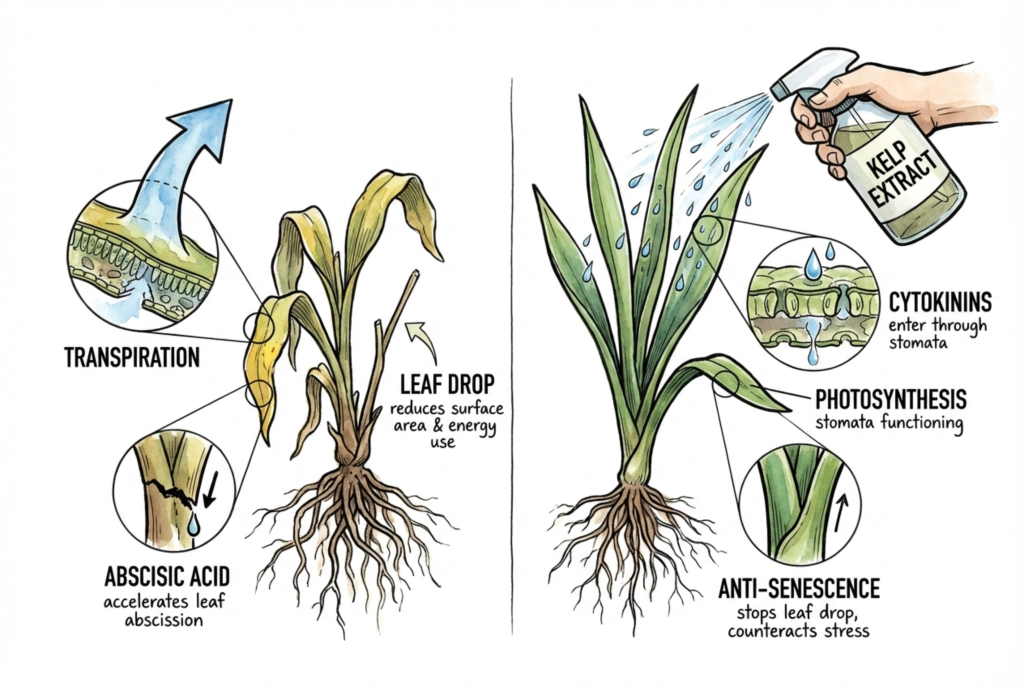
Shedding older leaves reduces the transpiring surface a plant has to hydrate, which can lower its maintenance burden while roots recover.
This can be an adaptive response, but not every dropped leaf is intentional. Mechanical injury, ethylene signaling, and infection can also cause leaf loss.
With fewer functional roots, a plant may not be able to support all of its foliage, and nutrients from senescing leaves can be remobilized to the rest of the plant.
The control of leaf drop is more complex than a single hormone. Current reviews place ethylene and the balance of auxin at the center of abscission, with abscisic acid contributing indirectly and situationally through stress and senescence, rather than acting as the sole driver.
Keep in mind that holding onto leaves is not always the goal. On a plant with a badly reduced root system, some leaf loss can help balance water demand against what the roots can supply.
How does Kelp Extract work on bare-root plants?
What Kelp Extract Can and Cannot Explain
Ascophyllum nodosum extracts can contain nutrients and compounds that influence plant growth, but their composition varies widely by product and extraction method. A foliar spray can leave some dissolved material on and in a leaf, yet that does not show it will stop leaf loss or rebuild roots on an imported aroid.
Some seaweed extracts may affect stress responses, but the direction and size of the effect depend on the formula, dose, plant, and growing conditions. More open stomata, for example, can increase water loss from a plant with weak roots.
Use kelp only as an optional, label-directed biostimulant. Stable temperature, humidity, root-zone moisture, and oxygen are the parts of recovery you can control directly.
Ascophyllum nodosum-Based Biostimulants. Plant Growth and Stress Tolerance
Are all kelp extracts the same?
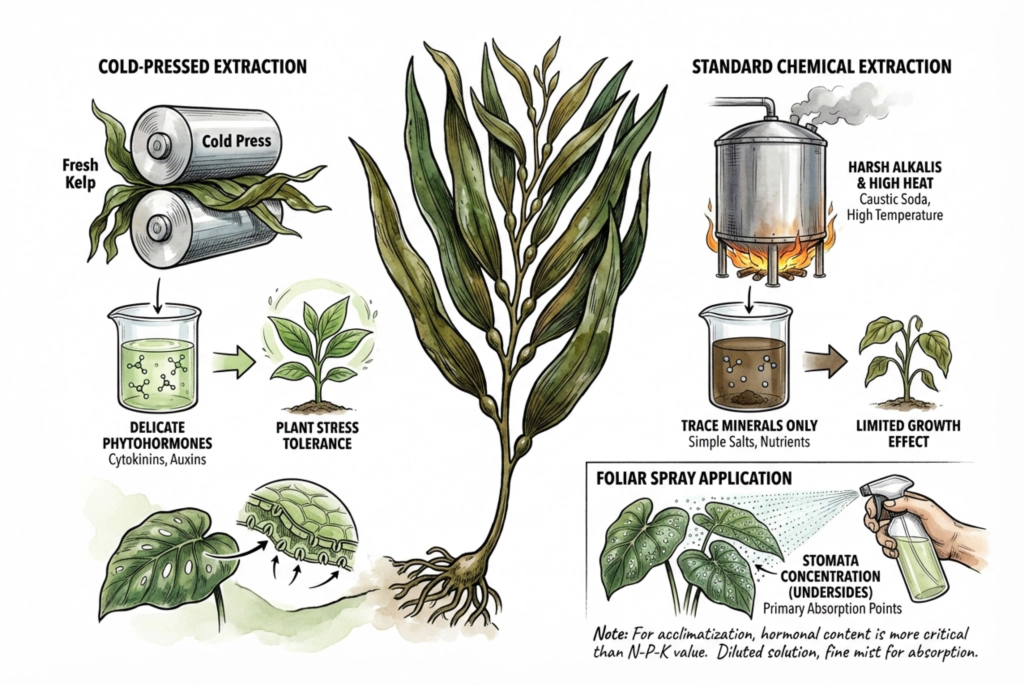
No, kelp extracts are not all the same. They differ by seaweed species, harvest, extraction method, formulation, storage, and dose, and those differences change what ends up in the product.
Processing changes the composition, but labels such as cold-pressed or cold-water-extracted do not guarantee a particular amount of active compound. Do not choose a product from a processing claim alone.
For imported-aroid recovery, no evidence ranks kelp hormone content above root oxygen, moisture, carbohydrate reserves, or the absence of infection. Use the label on the bottle you have rather than relying on retail descriptions or a generic rescue recipe.
If you use a seaweed extract, follow the directions on its current label, not a rescue recipe. Foliar, houseplant, and transplant-drench rates are different uses and may not all appear on the same label. Use the amount, method, crop, and interval printed on the bottle you have rather than carrying a rate over from another formulation.
How do you apply a foliar kelp spray?
Set Up a Light, Even Spray
If you choose to foliar-feed, mix at the product’s labeled rate and use a clean fine-mist sprayer for light, even coverage without runoff. Rinse the sprayer after use so residue does not clog it.
Spraying leaf undersides is a reasonable way to improve coverage, but it is not a rule or proof of better recovery. The dose and label directions matter more than the sprayer itself.
When is the best time to spray?
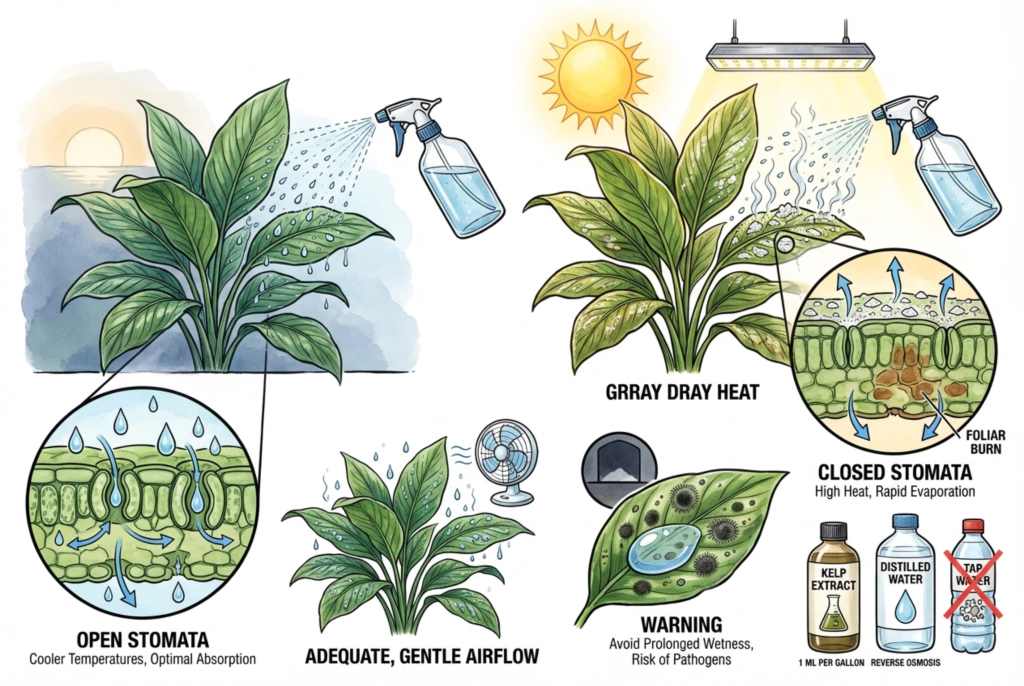
Early morning is a practical time to spray. Cooler temperatures and slower evaporation give droplets more time on the leaf and reduce the chance of injury.
Do not rely on a claim that stomata are fully open at one particular time of day. If you spray in the evening, do it early enough that the foliage dries before nightfall.
In hot, bright conditions, droplets can dry quickly, which reduces contact time and can concentrate any salts left on the leaf.
Whether that actually burns foliage depends on the concentration, droplet chemistry, humidity, and leaf temperature, so it is a risk to manage, not a certainty.
Make sure you have gentle airflow in your grow space, while avoiding cold drafts or drying that stresses the plant. Airflow helps leaves dry and reduces disease risk.
Prolonged leaf wetness does raise the chance of fungal and bacterial disease, but infection also needs the pathogen to be present on susceptible tissue at a favorable temperature.
Avoid leaving foliage dripping wet overnight. This lowers the risk rather than making leaf spot inevitable.
What mixing rate should you use?
Follow the Label and Check Your Water
Use the rate printed on your product’s current label. Do not apply a generic rescue ratio, because houseplant, foliar, and transplant uses can have different directions. If the label does not cover your intended use, do not infer a rate from another formulation.
Water quality depends on where you live. Tap water is generally fine for most houseplants, according to guidance from Virginia Tech and Washington State University, so a blanket ban on tap water is not a reliable rule.
Low-mineral water, whether distilled or reverse osmosis, is an optional choice mainly to reduce cosmetic mineral deposits and mixing variability, and it can matter for sensitive species or for water that is very hard or high in sodium or chloramine.
Judge it from your local water report rather than a blanket ban.
There is no clear evidence that the calcium, chlorine, or chloramine in normal tap water degrades kelp hormones within the short time the spray is in contact with the leaf.
Hard water can leave a visible residue, but that residue can be wiped or rinsed and leaves turn over. It does not permanently block stomata.
A nonionic surfactant can lower surface tension and help a spray spread on waxy leaves, but even coverage does not by itself guarantee absorption or safety.
Only add an adjuvant if both the kelp product’s label and the surfactant’s label allow it at a stated rate. Excess surfactant can injure foliage.
Check first whether the product already contains a wetting agent, patch-test one stressed leaf, and watch for damage before treating the whole plant.
Can you mix kelp with other fertilizers?
Reintroduce Fertilizer Gradually
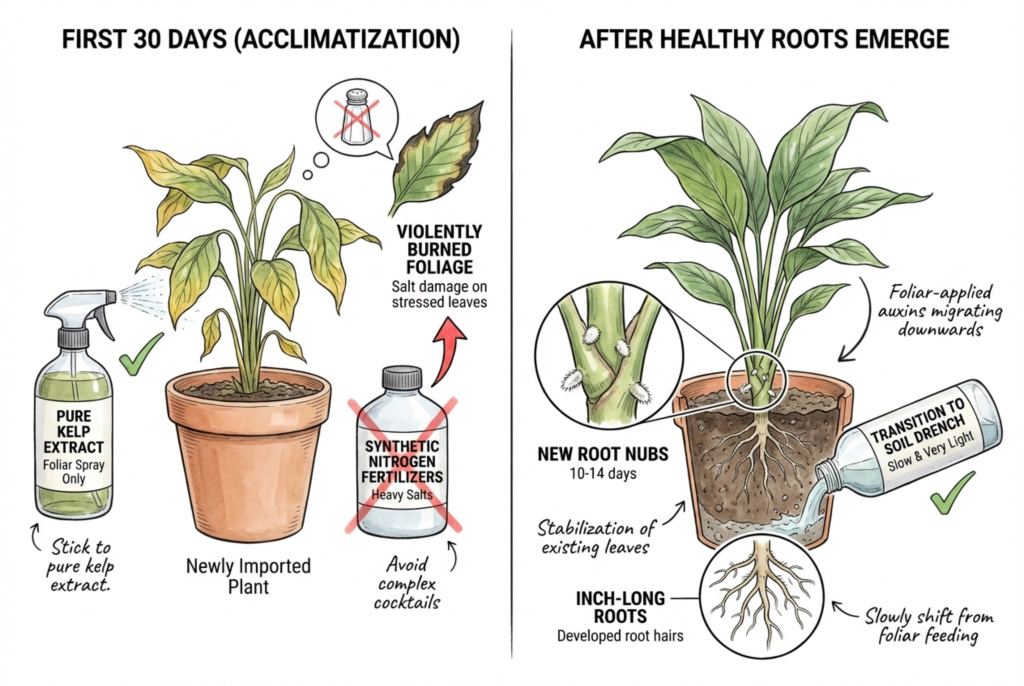
A newly imported plant with a reduced root system can be more sensitive to concentrated feed than an established one, so a conservative approach is reasonable.
That is a matter of solution strength, species, and root condition rather than a rule that established plants can be fed while new plants cannot.
It is sensible to hold off on heavy fertilizer while a plant recovers, but there is nothing special about a fixed 30-day cutoff or a ban on synthetic nitrogen specifically.
Let the plant’s recovery, not the calendar, guide when you reintroduce feeding.
Any foliar input, natural or synthetic, can burn foliage if the concentration is too high. That is a dose problem, not a property of synthetic salts. A carefully diluted soluble fertilizer is normal practice.
Judge each mix by its concentration, the label, leaf sensitivity, and the conditions you apply it in.
While roots are rebuilding, it is fine to keep feeding simple, but do not treat kelp alone as safer or more effective than good hydration and root-zone care, for which there is no comparative evidence.
Monitoring the Recovery Process
An early sign of recovery is that the existing leaves stabilize and yellowing and leaf drop slow down.
This is encouraging, but it is not proof that a kelp spray specifically did the work. Improved hydration, acclimation to temperature and humidity, and normal root-zone recovery can all produce the same change.
Some already-damaged leaves may keep declining even as the plant recovers overall.
Read Recovery as a Trend
New roots may appear over the following weeks, but there is no reliable fixed timeline. How fast they come depends on the species, plant size, season, temperature, and how damaged the roots were, so specific numbers such as 10 to 14 days or one inch are not dependable targets.
Look at fresh, firm root tips. A fuzzy white coating can be new root growth but can also be mold, so inspect closely before assuming.
New roots can result from the plant’s own reserves, acclimation, temperature, humidity, and root-zone conditions as well as any input you used.
Treat new growth as a welcome sign of overall recovery rather than proof that one spray caused it.
As roots return, gradually shift back toward normal root-zone watering, adjusting to the medium’s moisture and the container’s aeration so you avoid sudden saturation.
Note that living tissue needs water and an aerated, moist medium even before visible roots form, so a foliar-only period is not a universal protocol.
Foliar feeding is not a long-term replacement for root nutrition and healthy root-zone management, whether that is a soil mix or a soilless system such as bark, coir and perlite, sphagnum, or semi-hydro.
At most, it is one optional support during the acclimation period, and the outcome for any given plant is uncertain.
Before I apply kelp or change the recovery setup, I make one baseline record under the same light. It includes whole-plant and root-zone photographs, drained container weight, and the leaves already damaged. Repeating that view prevents a leaf that briefly firms after hydration from looking like a treatment response.
I count a recovery trend only when several signs move together, such as stable older leaves, firm new root tips, and a normal drying pattern. If I change humidity, watering, and a spray at once, I record the result as inconclusive rather than assigning the improvement to kelp.