
Terrarium Condensation: Read the Fog & Prevent Rot
How to use terrarium condensation as one observation among several: the dew-point and transpiration basics, why glass temperature confounds the reading, and how to confirm too-wet or too-dry jars before acting.
Elena Vargas · Published 2025-12-13 · 12 min read
Key Takeaways
- Condensation is one observation rather than a diagnosis, so pair a light morning fog or clear glass with substrate moisture, plant condition, and glass temperature.
- Fog forms when humid interior air meets cooler glass, which means the same jar can fog heavily on a cold windowsill and barely fog in a warm room.
- Heavy droplets suggest excess water only when they occur with muddy soil, standing water, wilt, or odor, while dry substrate and drooping leaves make clear glass more concerning.
- Winter condensation can hide dry soil, so measure glass and air temperature and move the jar from a cold surface before changing ventilation.
- A reservoir layer, barrier, charcoal, airy substrate, and optional springtails support maintenance, but a rotten-egg smell is a warning to ventilate rather than a reason to sniff the jar.
Closed terrariums often fail when condensation is treated as a nuisance to wipe away instead of a signal to read in context. It is useful to watch, but it is not a diagnosis on its own.
Foggy glass is not automatically failure. It can be part of a normal water cycle. Persistent heavy droplets running down the sides can point to too much water, but cold glass can fog heavily even when the substrate is fairly dry.
What Condensation Can and Cannot Tell You
Condensation tracks the relationship between humidity inside the jar and the temperature of the glass surface. It cannot tell you about root activity or microbial balance by itself. For those, inspect the plants, substrate, and any odor directly.
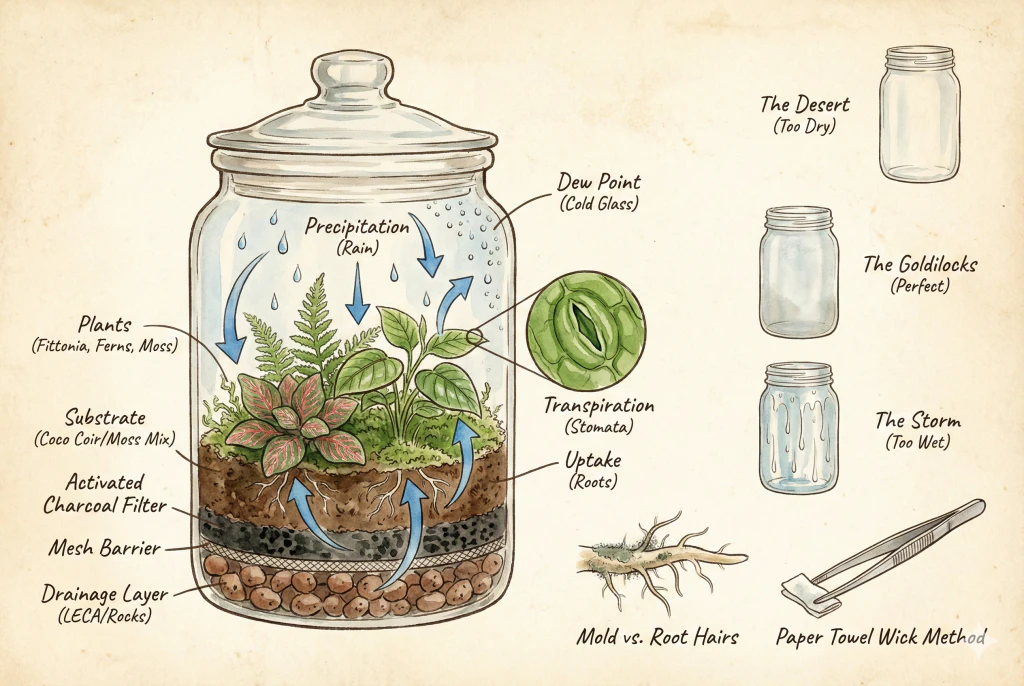
The Science. Why Your Jar Is Sweating (And Why You Want It To)
A sealed terrarium behaves roughly like a closed loop. This is a useful working model, though real lids leak some water vapor and gas, and matter moves in and out whenever you open the jar. Within that approximation, added water recirculates between soil, plants, and glass.
Water Uptake
Water Moves From Substrate to Leaves
The substrate holds water in its pores, and roots draw it into the plant to maintain turgor and carry dissolved nutrients. Nutrient movement is not only a matter of water flow. Diffusion, root contact, and membrane transport contribute, and details vary with species and medium. When the substrate is too dry, turgor drops and the plant wilts. Hydraulic redistribution, in which roots passively move water from wetter to drier soil layers, is a separate process from ordinary uptake.
Transpiration
Transpiration Adds Moisture to the Jar
Plants lose water vapor through leaf pores, or stomata. Stomata open to admit CO₂ for photosynthesis, and some water escapes at the same time. Transpiration is regulated in its own right rather than being only a by-product. A planted jar generally adds more moisture to the air than bare substrate, though the amount depends on leaf area, soil evaporation, temperature, and how well the jar is sealed.
The driving force is vapor pressure deficit, or VPD. It is the difference between saturation vapor pressure at the leaf surface and vapor pressure in the surrounding air, and it depends on leaf temperature as well as humidity. In a closed jar VPD is low, so transpiration slows. Even at 100% air humidity, a leaf slightly warmer than the air can still have a small VPD. Very low VPD reduces transpiration but does not automatically close stomata or stop nutrient uptake, so the idea that plants are starving in water is an oversimplification.
The Dew Point
Dew Point Connects Humidity and Glass Temperature
The jar’s air warms during the day, and warmer air can hold more water vapor before saturating. If part of the glass is cooler than the interior air, the air touching it can cool to its dew point, the temperature at which it becomes saturated and releases liquid onto the glass.
Droplets then coalesce, slide down, and return water to the soil. Their apparent volume reflects both humidity and glass temperature, so appearance alone does not tell you whether the soil is over- or under-watered.
There is often a daily rhythm. Most tropical foliage plants used in closed terrariums open their stomata mainly by day, though night-time water loss varies by species. Plants respire continuously rather than switching photosynthesis and respiration on and off. The time of heaviest fog depends on how the room, window, and lighting warm and cool the vessel, so there is no universal hour. A jar that never fogs and has dry soil may need water, but visible fog alone is not proof of health and a temporarily dry surface is not automatically a dead terrarium.
Plant responses to rising vapor pressure deficit
Engineering the Goldilocks Environment
Build a Reservoir With Realistic Limits
Condensation is easier to manage on a well-built base. In a jar with no drainage hole, a coarse lower layer acts as a reservoir, or false bottom, where excess water can collect below the root zone. Size it to the vessel and root depth. Roughly 1–2 inches is common, but use LECA, gravel, or lava rock according to the build.
A mesh or fabric barrier reduces soil washing into the reservoir, but it does not stop water wicking upward by capillary action. Fine substrate over coarse material can stay saturated at the interface, so check substrate moisture directly rather than trusting the visible reservoir. Activated horticultural charcoal can adsorb some odors and compounds, but its capacity is finite and chemical-specific. Avoid barbecue briquettes, which may contain horticulturally unsuitable binders and additives.
Choose an Airy Substrate
An airy, water-holding mix using coco coir, sphagnum, and perlite drains better than dense garden soil, which can compact. Treat worm castings as an optional fine nutrient amendment rather than something that adds airiness.
Add Water in Measured Steps
Initial watering is worth doing carefully because it is easy to add water and harder to remove it from a sealed jar. Pre-moisten the substrate first. Then add water with a syringe, pipette, measured cup, or fine mister so you can check the substrate before adding more. A large uncontrolled pour is the main thing to avoid. Seal the jar and let it settle before deciding whether it needs more or less water. A wrung-out-sponge feel is a rough guide, not a precise target, and the right amount depends on the plants and medium.
A fine continuous mister distributes water gently and is convenient for coating leaves and settling soil. It is a delivery convenience, not a guarantee against overwatering. Repeated misting can still saturate a closed jar.
Continuous Fine-Mist Bottle
A continuous fine-mist bottle can make it easier to add water in small, even amounts. Capacity, spray orientation, and output vary by model, and the bottle does not prevent waterlogging. An ordinary adjustable spray bottle, pipette, or measured cup can do the same job, so choose by the control you need rather than by the product format.
Reading the Glass (Fog Patterns and What to Check)
Treat each pattern below as a prompt to confirm with other signs rather than a diagnosis. Alongside the fog, note glass and air temperature, room humidity, substrate moisture, reservoir level, and plant condition.
Pattern A (Light Morning Fog That Clears)
A thin mist that clears as internal and room temperatures equalize is compatible with a healthy jar, and often no action is needed. Confirm that the substrate is moist rather than sodden, the reservoir has no standing water, plants show no wilt or soft tissue, and there is no foul odor. If those checks pass, leaving the jar alone is reasonable. Some plants lose a little water at night, so overnight transpiration is one possible source of fog.
Pattern B (Heavy, Persistent Droplets)
Drops on the glass much of the time can simply mean the glass is cooler than the interior air. The pattern points more firmly to too wet when it comes with dark muddy soil, reservoir pooling, wilt, soft tissue, or a sour smell. Sustained near-saturation with poor air movement can favor rot and mold, but droplets alone do not confirm it.
If the added signs point to excess water, ventilate. Prop or open the lid and watch the response rather than fixing a set number of hours. A small jar or dry room can over-dry quickly, while a large or humid one may need longer. Wiping the glass with a clean microfiber cloth improves visibility and removes some water. Recheck the substrate and plants before repeating.
Pattern C (No Visible Condensation)
Clear glass can result from equal glass and air temperatures, a leaky lid, low plant mass, or water sheeting rather than beading. None means the plants are starving. It suggests the jar may be too dry only when it comes with dry, light-gray substrate and dull or drooping leaves.
If those signs agree, add water in a controlled way and wet the actual root zone rather than only misting the surface. Add a modest amount, reseal, and recheck over the following days rather than assuming a fixed dose has solved it.
When a jar suddenly looks too wet, I do not open it immediately. For three days I photograph the same pane after lights-on, near the warmest point, and before lights-off.
I keep the room position and camera angle unchanged and mark the reservoir waterline on the glass. If fog changes while the waterline, substrate, and plant firmness remain stable, I check glass temperature before removing water.
When venting is actually needed, I change only the lid gap and photograph the next full cycle before widening it again. I do not increase the opening and extend the venting time on the same pass. Small vessels can lose water surprisingly quickly, and a single controlled change makes it much easier to stop before a wet jar becomes a dry one.
Advanced (Thermal Lag and Emergency Water Extraction)
Check Glass Temperature Before Venting
Condensation depends heavily on the temperature difference between interior air and glass, not just on how much water is in the jar. A terrarium against a cold window can look stormy even when the substrate is fairly dry. If you react by venting, you can dry out the plants while cold glass continues pulling moisture from the air.
Before diagnosing, measure it. An infrared or contact thermometer can show whether the glass is much colder than the air. If the glass is near freezing, treat that as a temperature-safety problem first because tropical plants can suffer chilling injury. Move the jar off the cold surface and warm it gradually. Once glass and air temperatures are closer, the condensation reading becomes more meaningful, but still confirm it against the substrate and plants.
Extract Pooled Water With Control
If water pools in the reservoir, you do not have to pour it out and disturb the layout. A syringe, pipette, or turkey baster can draw water out directly, and a small access tube sunk into the reservoir makes that easier.
A capillary wick also works. Twist a paper towel or cloth into a tight rope, push one end into the reservoir with long tweezers, and drape the other end over the rim into a lower bowl. Water moves along the wick by capillary action and gravity if the receiving bowl sits lower. This is a wick rather than a true siphon. Speed varies with towel, drop, contact, and evaporation, so check it at short intervals rather than leaving it overnight.
Myths and Disasters
Condensation Is Bad and Means Rot
Not by itself. Foggy glass can be part of a normal cycle, and clear glass does not mean death. Tropical plants like Fittonia and ferns prefer humid conditions, yet high humidity and visible condensation are not the same variable. Clear glass can simply mean the glass and air are at the same temperature. Judge dryness from substrate and plants rather than glass alone.
Wipe the Glass Every Day to Keep It Clean
There is little reason to wipe on a schedule. Each wipe removes some water from the system, so wipe mainly when deliberately reducing excess water or clearing algae that blocks your view. Whether it dries the jar depends on the vessel and how much water you remove, so judge it by moisture and visibility.
White Fuzz Means Mould
Shape alone cannot identify white growth reliably. Root hairs are fine tubular outgrowths on roots, while a uniform fuzz at a stem base could also be trichomes, young adventitious roots, mineral residue, or fungal growth. Use a hand lens or macro photo to inspect where it attaches, how quickly it spreads, its texture, any smell, and how the tissue underneath responds over several days.
Use Springtails as Optional Cleanup
For genuine mold, you do not need to sterilize the tank. Springtails, including Folsomia candida, graze on fungi and decaying matter and can help keep surface mold down. They do not eat every kind of mold or provide permanent control, and establishment varies. The research below is preliminary laboratory work rather than proof of general terrarium mold control.
Live Springtail Culture
A live springtail culture ships as living animals, so confirm the species and inspect its arrival condition. Container volume includes the culture medium and does not reveal a reliable live count or coverage area. Keep the culture under the supplier’s moisture and feeding conditions, then confirm activity and reproduction before relying on it. Springtails help consume some surface fungi and detritus, but they are not a fix for a chronically waterlogged jar or infected tissue. Address excess water and rot first. If you are choosing a cleanup approach, you can compare terrarium mold-control options.
It Smells Like Rotten Eggs
A rotten-egg smell is a clue that soil may be waterlogged and anaerobic, possibly producing hydrogen sulfide, but smell is not a positive gas or pathogen identification. Do not lean in and sniff the jar. Smell fatigue prevents concentration estimates, and OSHA and NIOSH warn against relying on odor to judge hydrogen sulfide. Open the lid in a well-ventilated area, keep people and pets back, and let it air out.
Correct the Cause After a Warning Odor
Remove standing water and decaying material. Poking the root zone with a skewer can damage roots and will not restore porosity in saturated fine media. Extract excess water, replace part of the substrate, or repot into a drier mix. Do not judge roots by color alone because some species have naturally dark roots. Look for soft, mushy, or sloughing tissue together with foul smell and inspect the crown. If cutting is needed, use clean, disinfected tools, cut back to firm living tissue, protect the crown, and isolate the plant while it recovers.
Soil Allies. Exploring the Combined Potential of Folsomia candida and Trichoderma against Fusarium oxysporum
Read the Fog Alongside Every Signal
The Practical Reading Rule
Terrariums are set-and-observe rather than set-and-forget, and condensation is only one signal. Read it with substrate moisture, plant condition, reservoir level, and glass temperature. A light fog that clears is usually fine. Persistent heavy droplets call for checks for excess water, while clear glass calls for checking whether the substrate is actually dry. Avoid overwatering, keep some air moving, and add springtails only if you want a bioactive cleanup crew.
Use the glass as a prompt to check the rest of the jar, and act on those checks rather than on fog alone.