
Cryptocoryne Wendtii Melt After pH Drop: Week-3 Rescue
Cryptocoryne wendtii often melts around week 3 in a new Aquasoil tank. Inside: how to diagnose the likely cause and a measurement-led water-change plan to help it recover.
Samuel Reed · Published 2026-06-07 · 31 min read
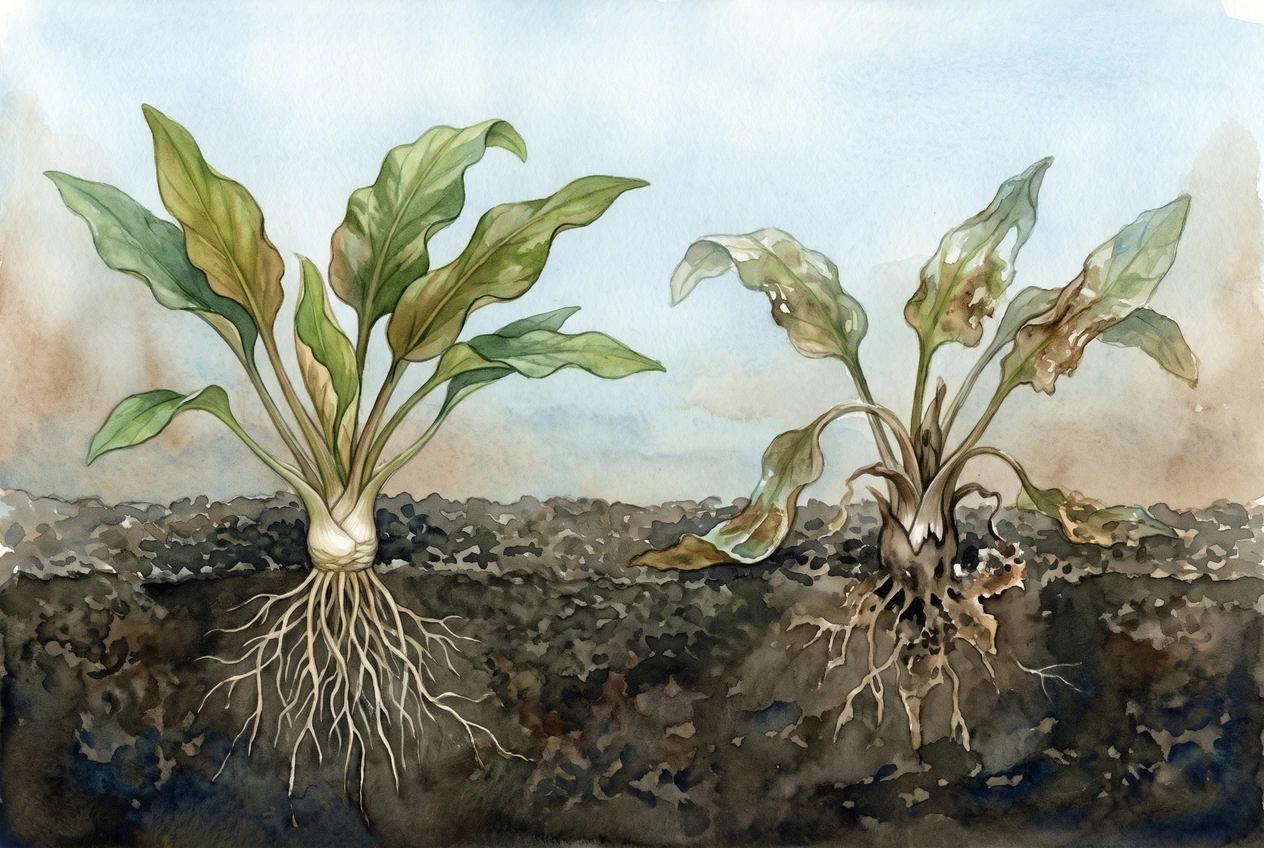
What is crypt melt, actually?
Crypt melt is a description of a symptom with soft, dissolving leaves, not a single diagnosis.
In a new tank it is most often a shedding-and-adaptation response, where the rhizome sheds leaves it can no longer support and can stay alive underground.
But the same appearance can also come from crown or rhizome rot, transplant or root damage, nutrient deficiency, or CO2 and light stress, so the first job is to work out which one you are looking at.
The recovery plan below is aimed at the shedding-and-adaptation case. Give the rhizome a stable window instead of stacking a second shock on top of the first.
I place pH, KH, temperature, water changes, substrate work, and the first translucent leaf on one timeline. A parameter measured after melt begins may be a consequence of maintenance rather than the original trigger.
Without pulling the crown, I photograph it and mark every firm new spear. Continued crown firmness and a growing spear matter more than the number of old leaves that dissolve.
One stable crown stays undisturbed while I correct water conditions elsewhere. Replanting every melting Cryptocoryne removes the cleanest check of whether stability alone was enough.
Is it adaptation, not disease?
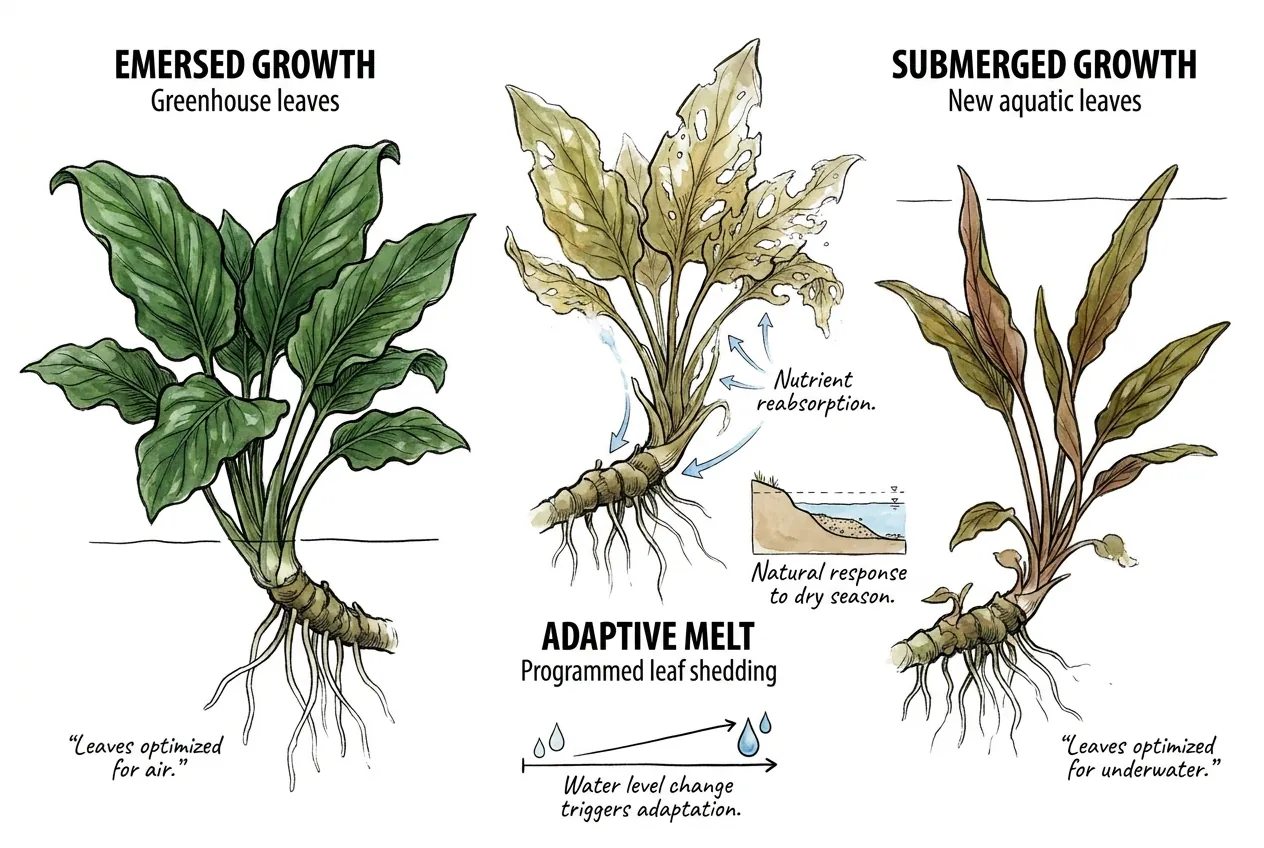
Crypt melt is often an adaptation response after a change in conditions, especially when emersed-grown leaves move underwater. A shedding leaf does not automatically mean the rhizome is dead.
Keep the crown planted, remove only clearly decaying leaves, and give a firm, odor-free rhizome a stable period before disturbing it again.
The practical version
Many of the leaves the plant arrives with are grown above water in a greenhouse, and those leaves often do not survive the switch to submerged life.
As they fade, the plant appears to recover some nitrogen and stored sugar back into the rhizome before dropping them, which is one reason not to strip every marginal leaf on day one.
Why does C. wendtii specifically melt so often?
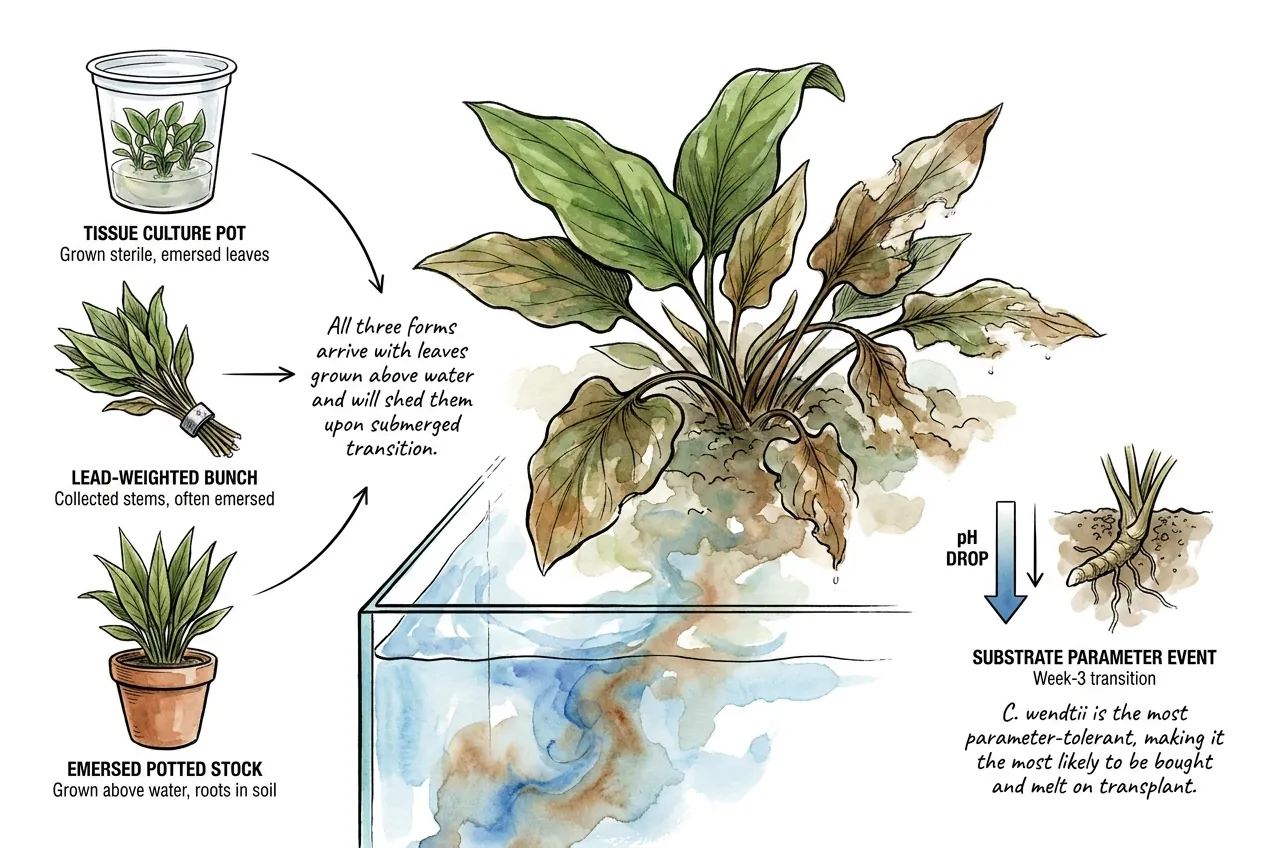
Cryptocoryne wendtii is widely sold and has a reputation as one of the more tolerant, beginner-friendly crypts, which is part of why most retailers carry it.
It ships in several forms. Tissue-culture pots, lead-weighted bunches, and emersed-grown potted stock.
These forms are not identical. Much potted and bunched stock is grown emersed (above water), and those emersed leaves often will not persist once the rhizome moves to submerged life.
Tissue-culture plants are grown sterile in a nutrient gel and are a different case. They are not simply emersed stock. So expect leaf turnover mainly from emersed-grown material, not as a guarantee for every plant you buy.
Because so many beginners buy C. wendtii, you see it melt often, but that is exposure frequency, not evidence that this species melts at a higher rate per plant than others.
The useful takeaway is simpler. A healthy C. wendtii can lose most or all of the leaves it arrived with and still regrow from the rhizome, provided the crown and roots are still sound.
How to avoid Cryptocoryne melting after planting. YouTube (video)
How do you tell parameter-shock melt from rhizome rot?
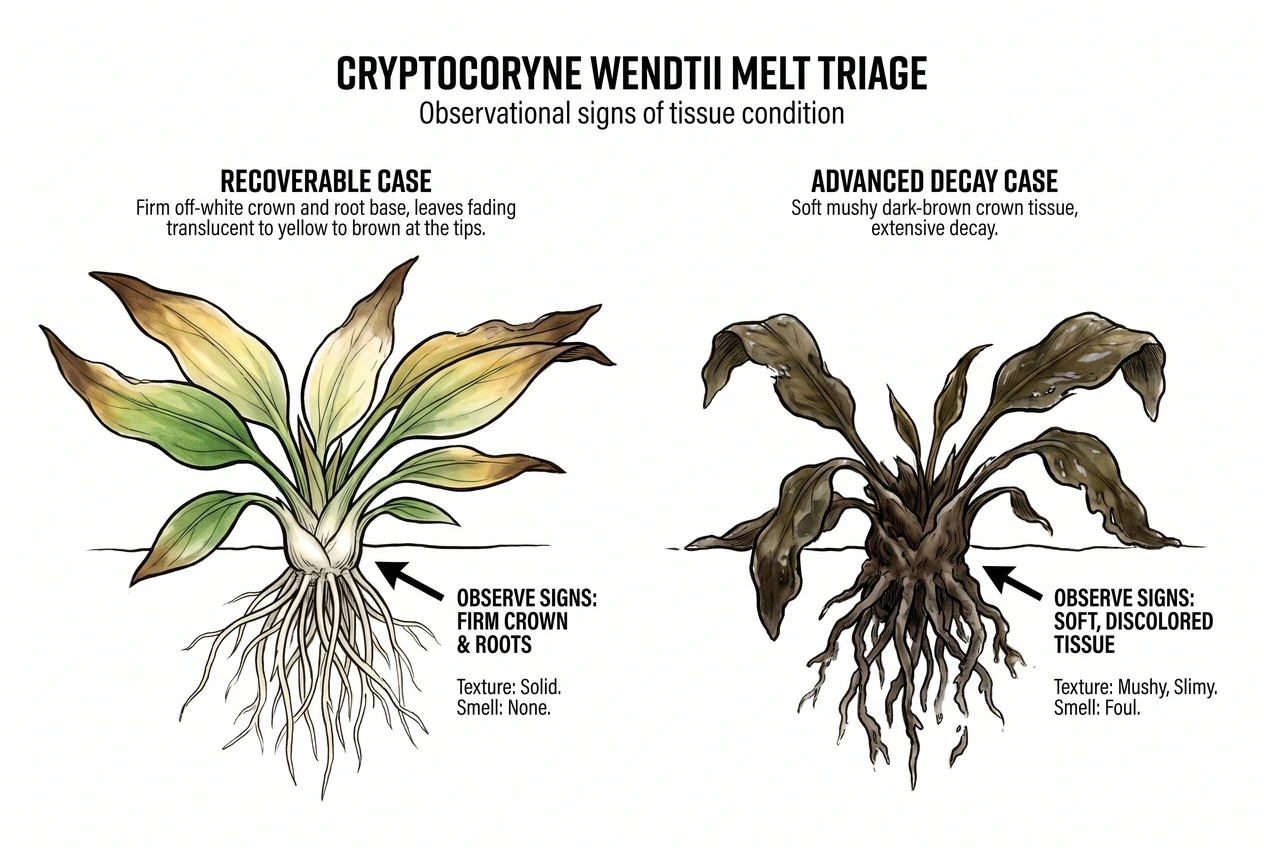
This is the triage call that matters most. Get it right and you give a recoverable rhizome a chance. Get it wrong and you either uproot a plant that would have recovered, or you leave rotting tissue in the tank.
The two patterns below are observational signals, not lab diagnoses. The causes can overlap, so use them to decide whether to wait or to inspect, not as a definitive verdict.
Shock/adaptation melt (usually recoverable)
- Leaves go translucent, then yellow, then brown, then dissolve
- Rhizome remains white or off-white inside, firm to gentle pressure
- No sour or putrid smell at the crown
- Plant has not been physically disturbed in the last 7 days
- A trigger event is identifiable. New substrate, big water change, recent move, lighting change
Rhizome rot signals (may need trimming or discard)
- Rhizome is soft, mushy, dark brown to black inside
- Foul or sour smell when sniffed close to the crown
- Damage or rot often follows physical injury to the rhizome (uprooting, splitting, pulling on the crown)
- Dark, spreading discoloration in soft tissue is a warning sign, though soil staining, oxidation, and dead-but-not-infected tissue can also look dark, so treat it as a prompt to look more closely, not proof of infection
These are signs that decay may be advanced. Whether the underlying cause is bacterial, fungal, or simple anaerobic breakdown of dead tissue is not something you can tell by eye, and there is no good evidence that it reliably spreads to healthy neighbouring plants, so don't panic-treat the whole tank on the strength of one soft rhizome.
The general advice in retailer guides such as Buce Plant and Aquarium Co-Op is conservative. Avoid pulling the plant just to check.
Repeated uprooting disturbs fine roots and the crown and can add stress to an already weak plant.
Inspect when the observational signals point that way (most leaves gone to mush, a sour smell at the crown) rather than on a schedule.
Why do new Aquasoil tanks often wobble around week 3?
Fresh Aquasoil can release ammonia and lower KH and pH during the early cycle. Test ammonia, nitrite, KH, and pH regularly, then respond to the trend instead of expecting a particular “week 3” crash.
What does the day-by-day ammonia and pH curve look like?
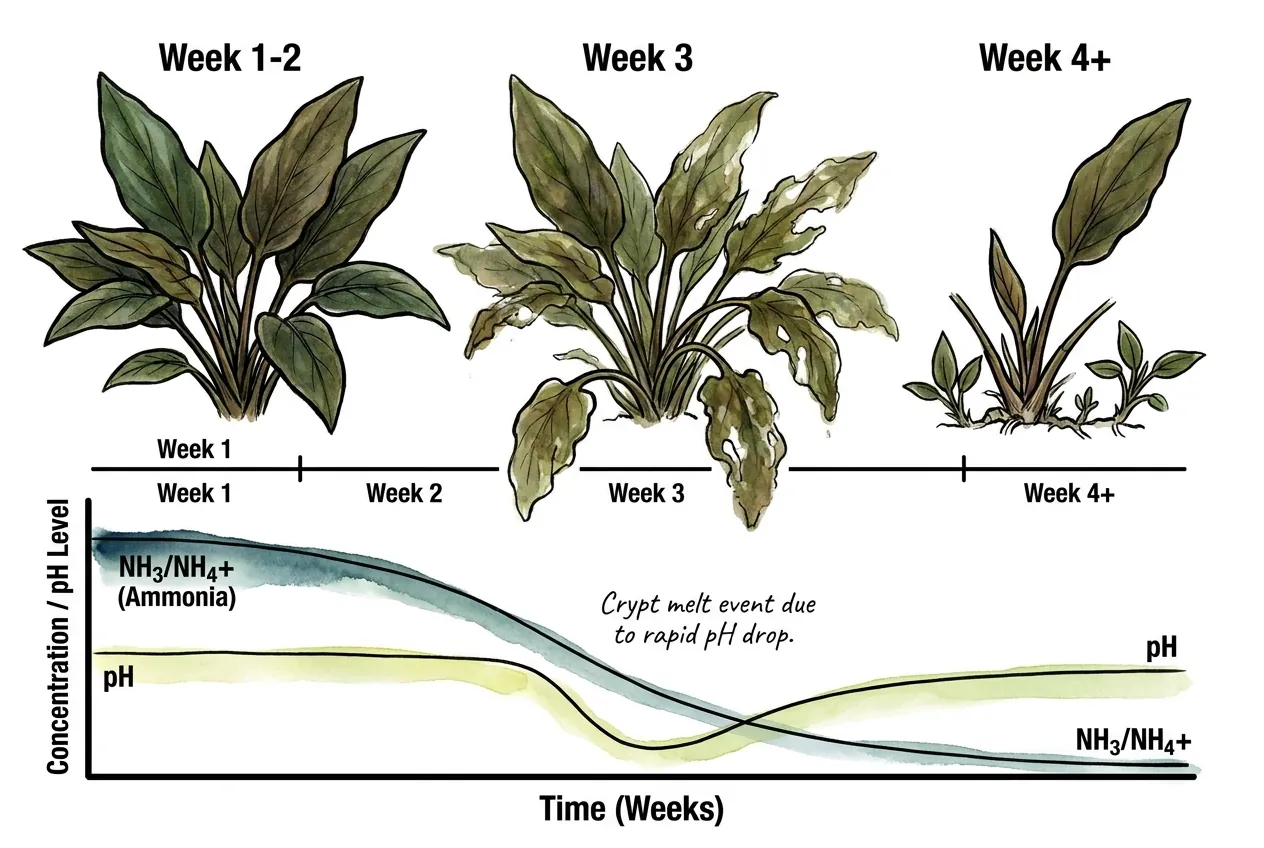
Active substrates such as ADA Aquasoil Amazonia are organic-amended baked soils that can leach ammonia in the first weeks.
ADA's own published Amazonia Ver.2 data shows an early ammonium spike around NH4 5.0 mg/L and pH 5.8 at two weeks, so the early-ammonium concern is real for that product.
Other soils such as Tropica Aquarium Soil, Landen, and Controsoil behave broadly similarly in principle, but each brand and batch has its own release profile, so do not assume an identical curve.
A typical early-cycle sequence
| Week | What is happening | Outcome |
|---|---|---|
| 1–7 | Substrate leaching NH4+/NH3. Heterotrophic bacteria establishing. PH already low (Aquasoil’s H+ release). | Crypts are stressed but functional |
| 8–14 | Ammonia-oxidizing bacteria reach numerical density. NH3 starts dropping, NO2 starts rising. Proton load on the water peaks. | First parameter swings appear |
| 15–21 | Nitrite-oxidizing bacteria catch up. NO2 drops, NO3 climbs. If KH is very low, acid from nitrification is poorly buffered and pH can drop. This is where a crypt under combined stress may start to melt. | The wobble window |
| 22–28 | Substrate leach slowing. Bacterial population mature. System approaching stability. | Recovery window |
The Shrimp Farm's published Aquasoil cycling guide recommends heavy early water changes. Roughly 95–100% on the first day, again 95–100% the next day, then around 50%, with the soil cycling in roughly one-and-a-half to two weeks.
The takeaway is that a fresh active-soil tank benefits from large, frequent early water changes while ammonia is high, which is exactly the window in which a C. wendtii planted on day one is most exposed.
For a look at the same early-cycle ammonia dynamic with bucephalandra, see the aquasoil ammonia leach week 1 walkthrough.
Cycling Aquasoil Amazonia. Complete Guide for Shrimp Tank Setup (retailer guide)
What does the proton math say?
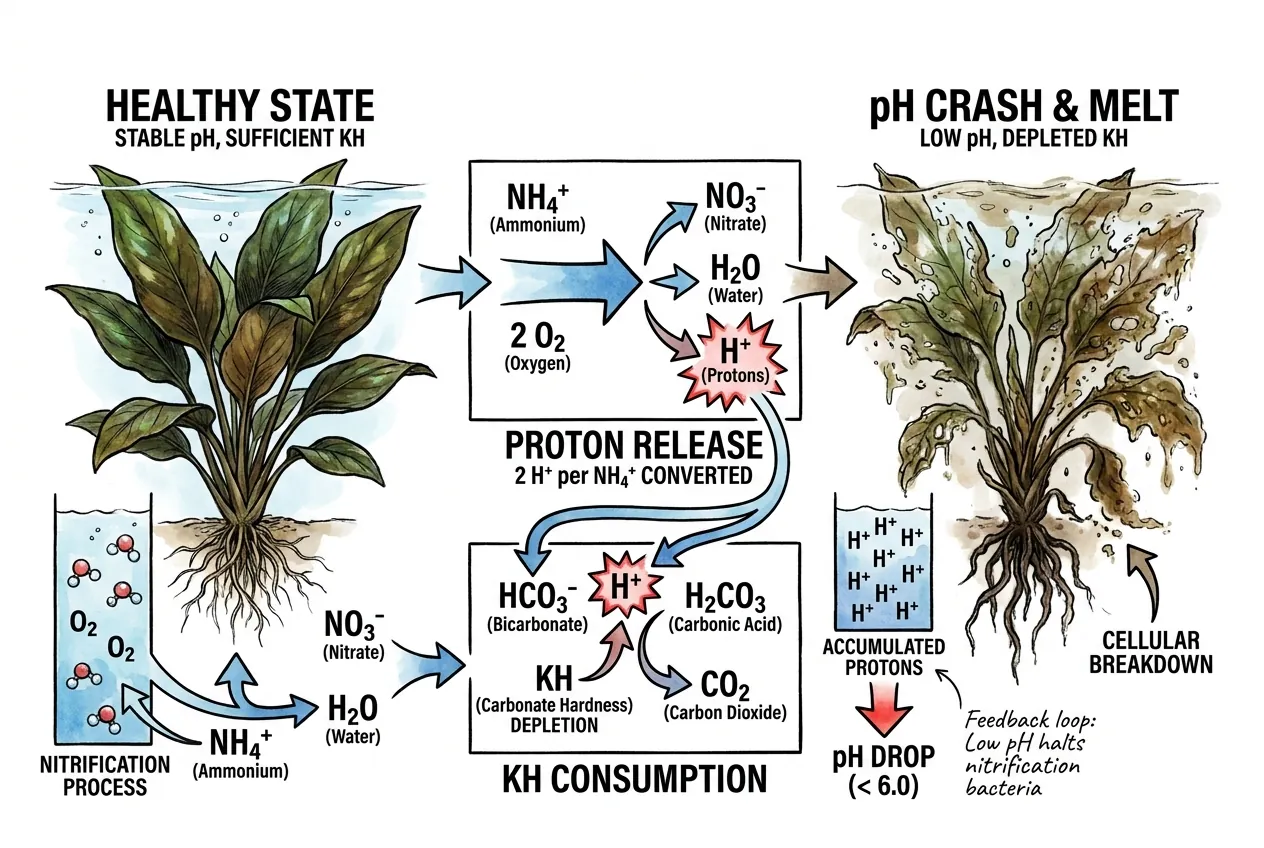
The net nitrification reaction
NH4+ + 2 O2 → NO3- + H2O + 2 H+
As a new tank processes ammonia, KH and pH can fall. Low KH is not automatically a problem, and low pH does not prove that the cycle has stopped. Follow ammonia and nitrite as well as pH.
How does Aquasoil lower KH?
Active soil can reduce the water’s buffering by exchanging minerals with it. How far KH and pH fall depends on the soil, source water, and amount of substrate.
What is the cation-exchange mechanism behind the KH crash?
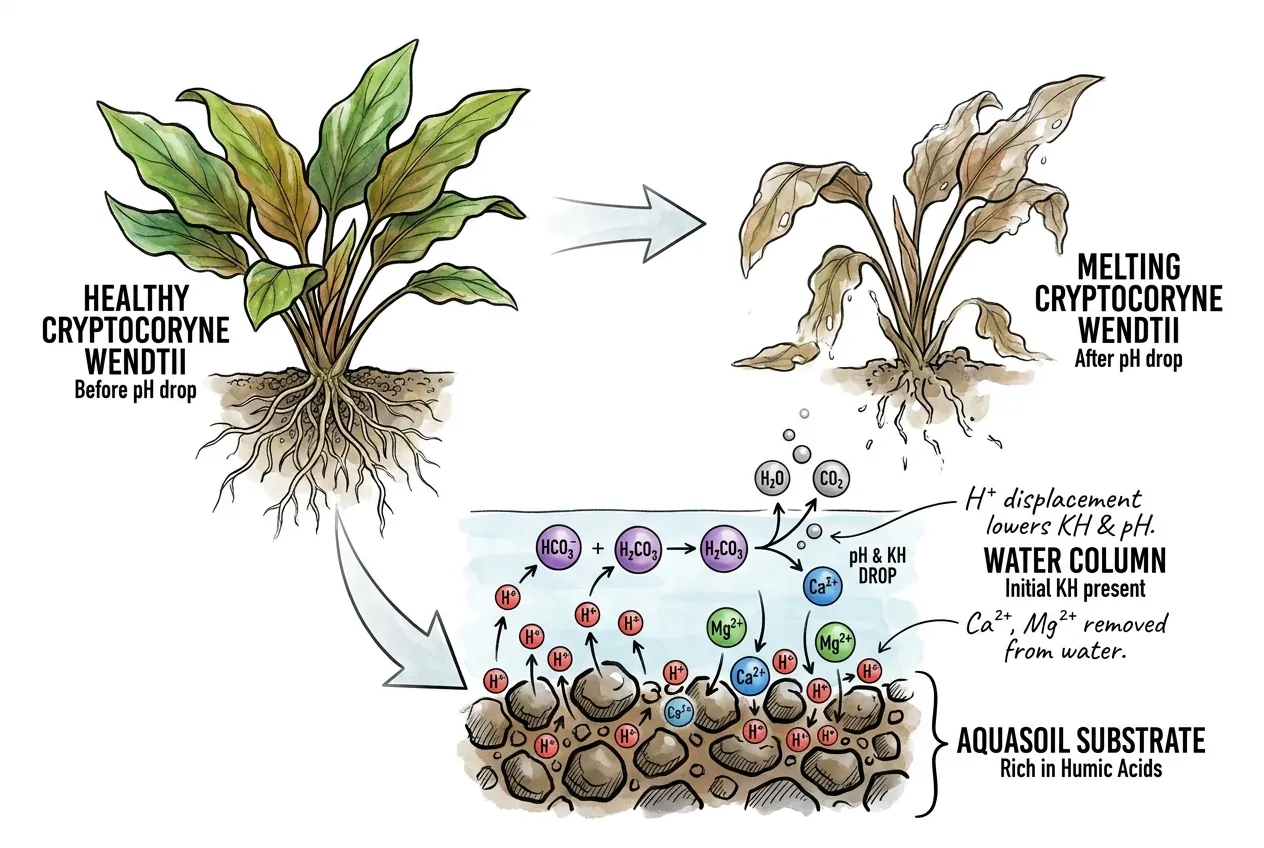
The chemistry is less important than the management decision. Do not assume a low KH needs correcting in every active-soil tank. Test the full water picture, stabilize ammonia and nitrite first, and avoid raising pH while ammonia is still measurable.
Buffer chemistry (Aquasoil). UK Aquatic Plant Society (forum discussion)
HOW TO. Setup ADA Amazonia Soil. YouTube (video)
Why does KH = 0 make everything fragile?
KH is the buffering capacity of the water against acid input.
- At around 4 dKH, pH is relatively stable (CO2 injection, nitrification, and tannins tend to move it in small amounts, though the exact swing depends on how much you inject and on gas exchange).
- At around 1 dKH, the same acid inputs move pH more, so readings are less steady.
- At very low KH, there is little carbonate buffering, so acid inputs can move pH more sharply. How far and how fast depends on the amount of acid, the tank volume, CO2, and gas exchange. A low KH does not mean pH inevitably crashes to a fixed value in hours.
Importantly, low KH is not the same as an unhealthy tank. The 2Hr Aquarist notes that Aquasoil tanks regularly have measurable KH levels of 1 dKH and below, and thousands of tanks are well run this way without additional buffering. The same source measured ammonia oxidation continuing at pH 5.2–5.9 and concluded that in these tanks ammonia oxidation does not stop and that adding buffer to fight the substrate is generally not recommended.
So low KH is usually benign. It only becomes a concern when it coincides with a large ammonia load and an unstable, sensitive plant, and even then the fix is not automatically to buffer.
Are bacteria affected by low pH or KH in aquasoil tanks? The 2Hr Aquarist
A measurement-led two-week plan
Protect livestock first if any are distressed. Use larger, more frequent, temperature-matched and dechlorinated water changes while ammonia is high, then reduce the frequency as readings improve. Let the test kit, not a fixed day count, decide the next step.
What do you do in days 1–3?
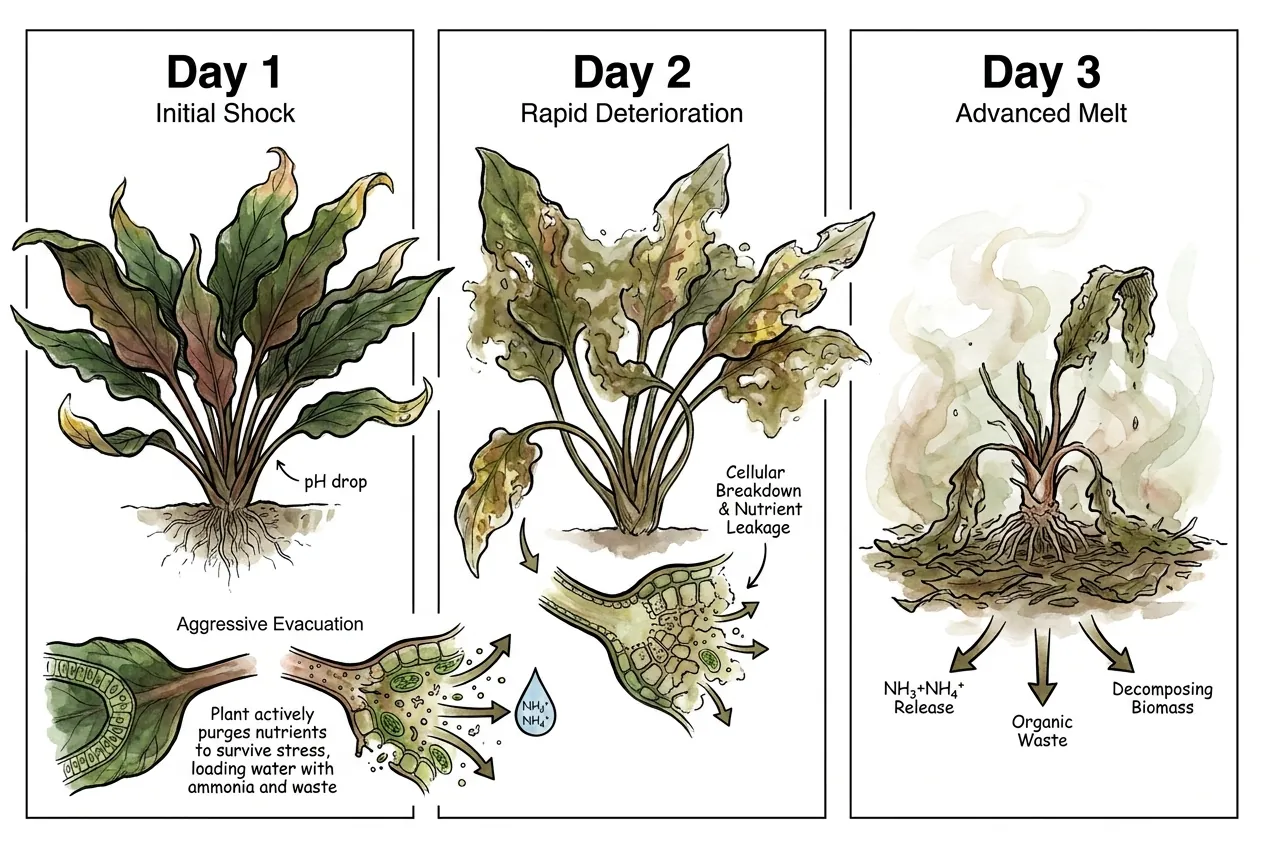
Water change
Around 50% daily, temperature-matched and dechlorinated. Match the replacement water's temperature, pH, and TDS/EC to the tank as closely as you can, because that prevents a second shock more than how slowly you add it.
Add water gently
Pour down a glass or add over a few minutes so you do not stir up the substrate or create a sudden local swing.
CO2
Keep it off while pH is dropping or animals look stressed. CO2 forms carbonic acid, which lowers pH, and running the tank without it removes one variable during the unstable window.
Lights
Use a shorter day of around 4–5 hours at reduced intensity to keep algae down while the plants are not taking up much.
Fertilizer dosing
Pause it. Fresh Aquasoil is already nutrient-rich, so there is little to gain from dosing while the crypt is mostly bare.
Measure daily
Check total ammonia, nitrite, pH, and KH, and note temperature.
Large daily changes during a fresh active-soil cycle are consistent with the heavy early-change advice in the Shrimp Farm guide and common on planted-tank forums, though those sources do not co-publish a single 50% daily rescue figure.
The aim is to keep total ammonia low. How low is safe depends on pH and temperature, because those set how much of it is the toxic NH3 form.
Rotting leaves add to the nitrogen load, so removing clearly decomposed tissue helps.
What changes during days 4–7?
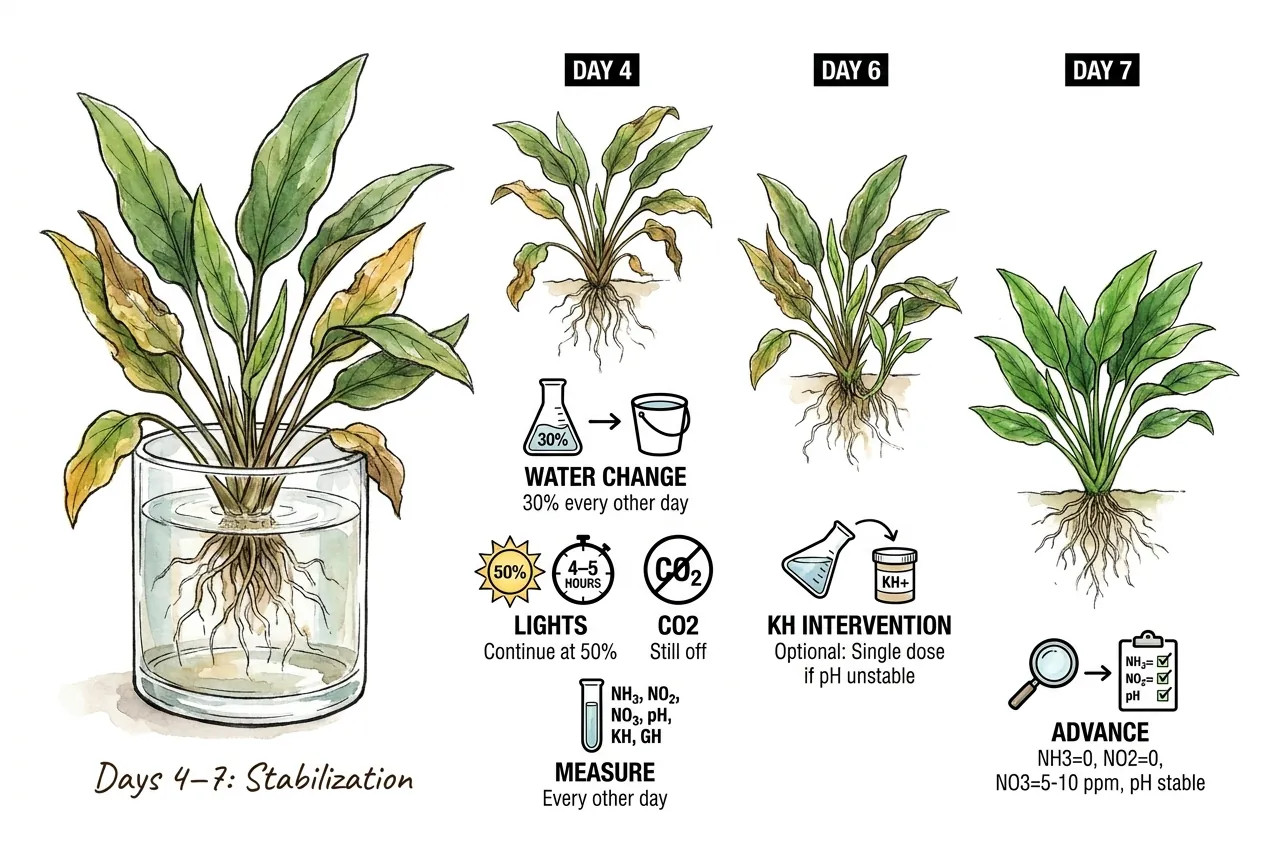
Ease off the daily changes once total ammonia is falling and low (roughly 0.5 ppm or under) and KH has settled. Whether that is at the substrate's natural low floor or somewhere you have chosen to hold it.
There is no single correct number here. The trend matters more than a threshold.
Water change
Make smaller, less frequent changes of around 30% every other day as ammonia falls, adjusting to your readings.
CO2
Keep it off until ammonia reads zero and pH is holding steady.
Lights
Keep the shorter, dimmer window.
KH intervention with caution
If pH is still unstable you can add a small dose of sodium bicarbonate or a KH+ product, but there is an important safety catch. Ammonia toxicity comes from the un-ionized NH3 fraction, and raising pH increases that fraction at the same total ammonia. So if measurable ammonia is still present, raising KH or pH can make the water more toxic to fish and shrimp, not less. Before dosing, check total ammonia and calculate or look up the NH3 fraction for your pH and temperature, and consider whether more water changes are the safer route. Note too that the 2Hr Aquarist source above argues against buffering active-soil tanks at all, so treat buffering as a last resort once ammonia is at or near zero.
Measure every other day
Check total ammonia, which most hobby kits read, nitrite, nitrate, pH, KH, and GH, and note temperature because it changes the toxic NH3 fraction.
Move to the final, low-intervention stage once ammonia and nitrite read zero and pH is holding steady over a couple of days.
(Nitrate may or may not be clearly measurable depending on planting and water changes, so don't treat a specific nitrate number as a required checkpoint.)
How do you handle days 8–14?
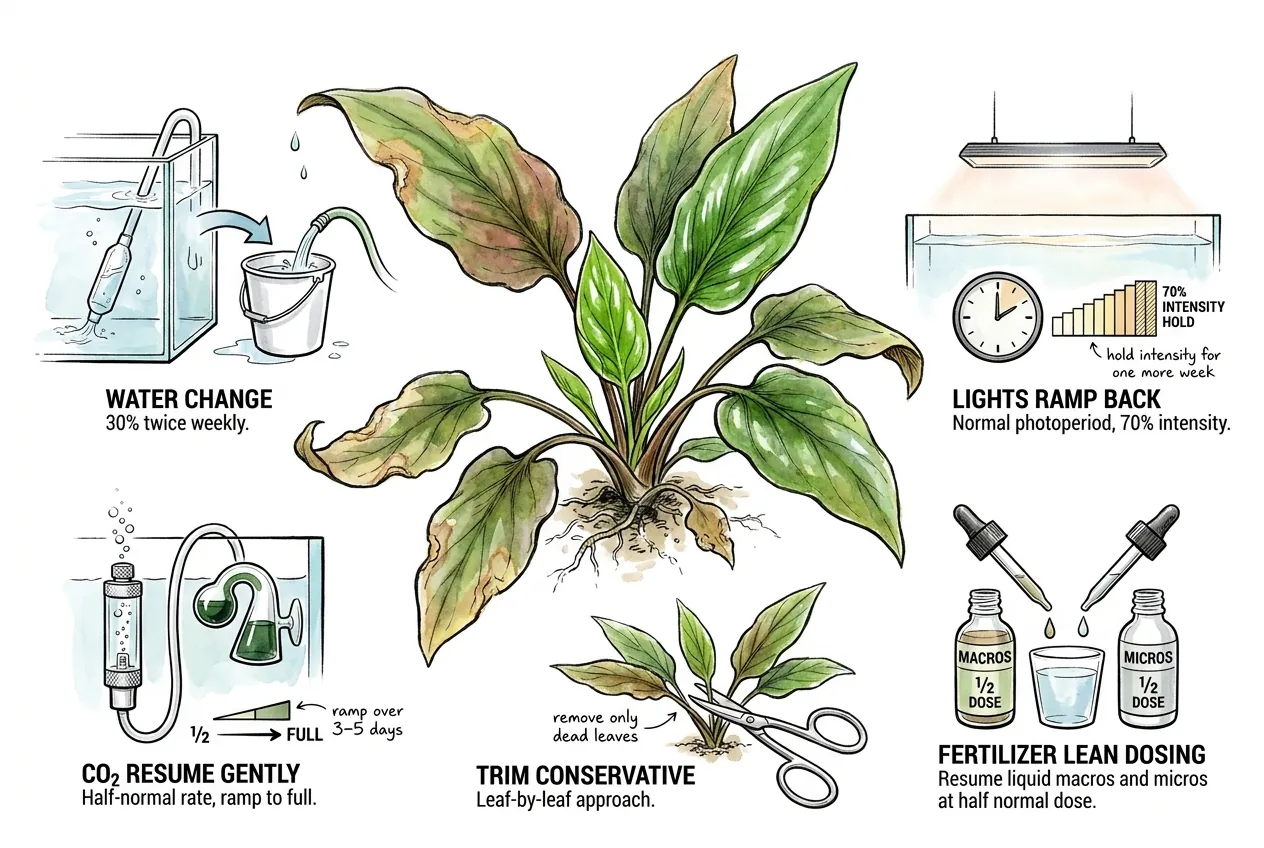
Water change
Make a 30% change twice weekly.
CO2
Resume gently if you inject CO2. Start low, watch the pH, drop checker, and fish behaviour, and ramp up over several days rather than all at once.
Lights
Ramp the photoperiod back up gradually, keeping intensity a little below normal for a while and watching for algae.
Fertilizer
Hold off until you see recovery. With fresh, nutrient-rich Aquasoil there is usually little to gain from dosing while the crypt is still bare. Wait for the first new leaf at the crown before resuming liquids at a lean rate. If other plants show a clear deficiency, dose lightly for them rather than on a schedule.
Trim
Remove only clearly decomposing tissue.
Rough checkpoints to watch
Treat the numbers below as rough orientation, not validated endpoints. The direction that matters is ammonia and nitrite falling toward zero and pH holding steady over 48 hours.
The KH figures are a comfort floor, not a requirement. A healthy Aquasoil tank can run happily at KH 0–1, so do not chase a KH target for its own sake, especially given the ammonia-toxicity catch when you raise pH.
| Checkpoint | NH3+NH4+ | NO2 | KH | pH | Action if missed |
|---|---|---|---|---|---|
| Day 3 | < 1.0 ppm | < 1.0 ppm | ≥ 1 dKH | ≥ 6.0 stable | Continue 50% daily WC |
| Day 7 | < 0.25 ppm | < 0.25 ppm | ≥ 1 dKH | 6.2–6.8 | Extend phase 1 by 3 days |
| Day 14 | 0 | 0 | ≥ 2 dKH (or substrate floor) | 6.5–7.0 stable | Extend protocol to 21 days |
What about temperature?
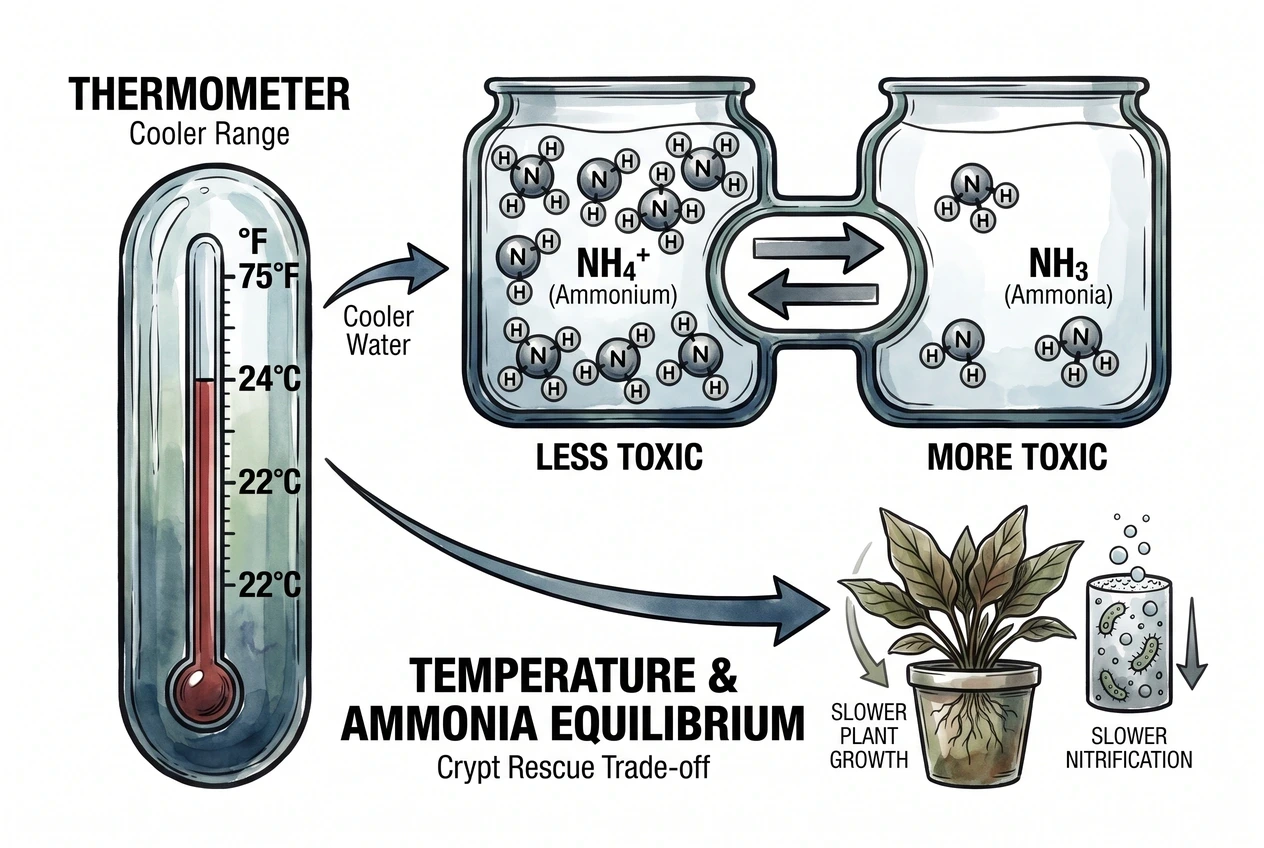
Holding the tank on the cooler side of the crypt's range. 22–24 °C (72–75 °F) is well within C. Wendtii's tolerance. Has one clear benefit. Lower temperature shifts the equilibrium toward the less-toxic NH4+ form, so a given total ammonia is safer.
There is a trade-off, though. Cooler water also slows nitrification and plant growth, so it is not a pure win.
Use it as a way to reduce ammonia toxicity while the load is high, not as a fixed prescription.
Melting Plants In New Tank. From Melt To Majesty (hobby guide)
What should you avoid during the rescue?
- Avoid uprooting just to check the rhizome. Repeated disturbance breaks fine roots and stresses the crown, which can set a weak plant back. Inspect only when the observational signals warrant it.
- Hold off on adding livestock until the cycle reads stable (ammonia and nitrite at zero), rather than by a fixed date.
- Avoid swinging CO2 back to peak rate to boost photosynthesis.
- Don't rely on Prime / Safe / Amquel daily as a substitute for water changes. These products can temporarily reduce ammonia toxicity, but they do not remove the nitrogen load, and their exact chemistry and interaction with test kits vary by product.
- Be cautious with very large single water changes. A sudden swap can cause a temperature/pH/TDS swing if the new water is not matched. Note that the Shrimp Farm guide cited above actually recommends near-100% changes on the first couple of days of cycling a bare tank, so this is about matching parameters and avoiding shock, not a blanket ban on large changes.
Why Do Aquarium Plants Melt? Aquarium Co-Op retailer guide
How deep should you trim (and when do you leave the mush alone?)
You cut only what is fully necrotic and leave the rest, even if it looks ugly. The rhizome is still pulling nitrogen and stored sugar out of every borderline leaf until it fully collapses.
What is the leaf-by-leaf rule?
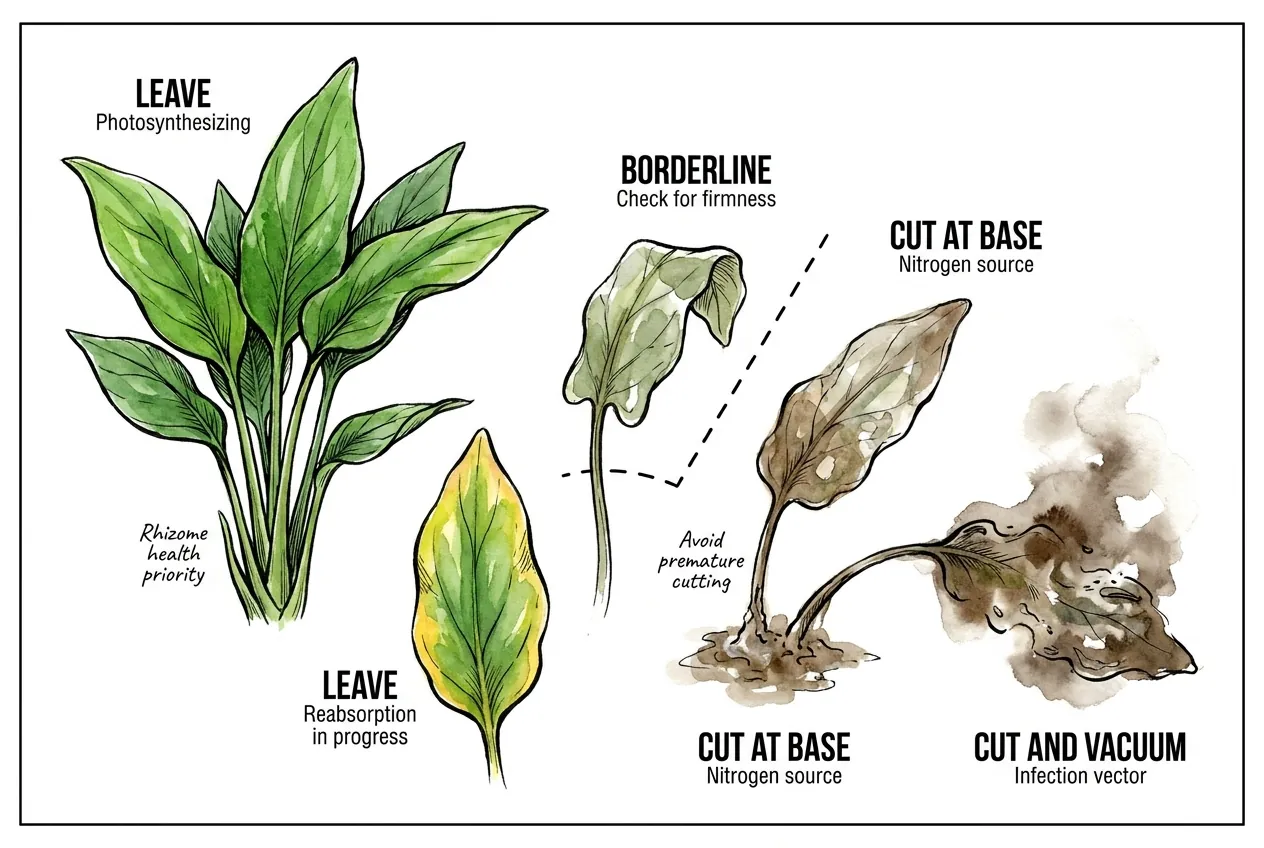
Cut a leaf if and only if it is fully necrotic (translucent, brown, structurally collapsed, or actively rotting).
Leave any leaf that retains green chlorophyll signal, even if it is yellowing at the edges.
The rhizome is still reabsorbing nitrogen and soluble carbohydrate from those marginal leaves until the moment they fully collapse. Cutting early wastes the rhizome’s investment.
| Leaf state | Action | Why |
|---|---|---|
| Green, intact, firm | Leave | Still photosynthesizing, still feeding rhizome |
| Yellowing at margin, otherwise structural | Leave | Reabsorption in progress |
| Translucent, limp, partial collapse | Borderline. Leave if firm, cut if it smears | Distinguishes structural from bacterial |
| Brown, mushy, dissolving | Cut at the base, near the substrate | Decaying tissue adds to the nitrogen/organic load |
| Liquefied / smearing | Cut and vacuum out | Rotting matter is best removed from the tank |
Aquarium Co-Op's guidance for cutting a spent leaf is direct. Cut it off at the base of the stem near the substrate. Buce Plant describes a more aggressive planting-day approach for emersed stock. Cut off all the emersed-grown leaves and any heavily injured leaves, even if that leaves you with no leaves at all. Both are reasonable in the right context. The aggressive cut on planting day for emersed material, the conservative one when you want to keep any leaf that is still feeding the rhizome.
During a melt already underway, leaning conservative, removing clearly decomposed tissue while leaving firm leaves alone, is a defensible default, but it is a judgement call, not a proven winner.
If leaves are rotting rather than cleanly senescing, leaving that biomass in the tank adds to the nutrient load, so weigh removal against retention rather than following one rule blindly.
Why is the do-not-uproot rule so absolute?
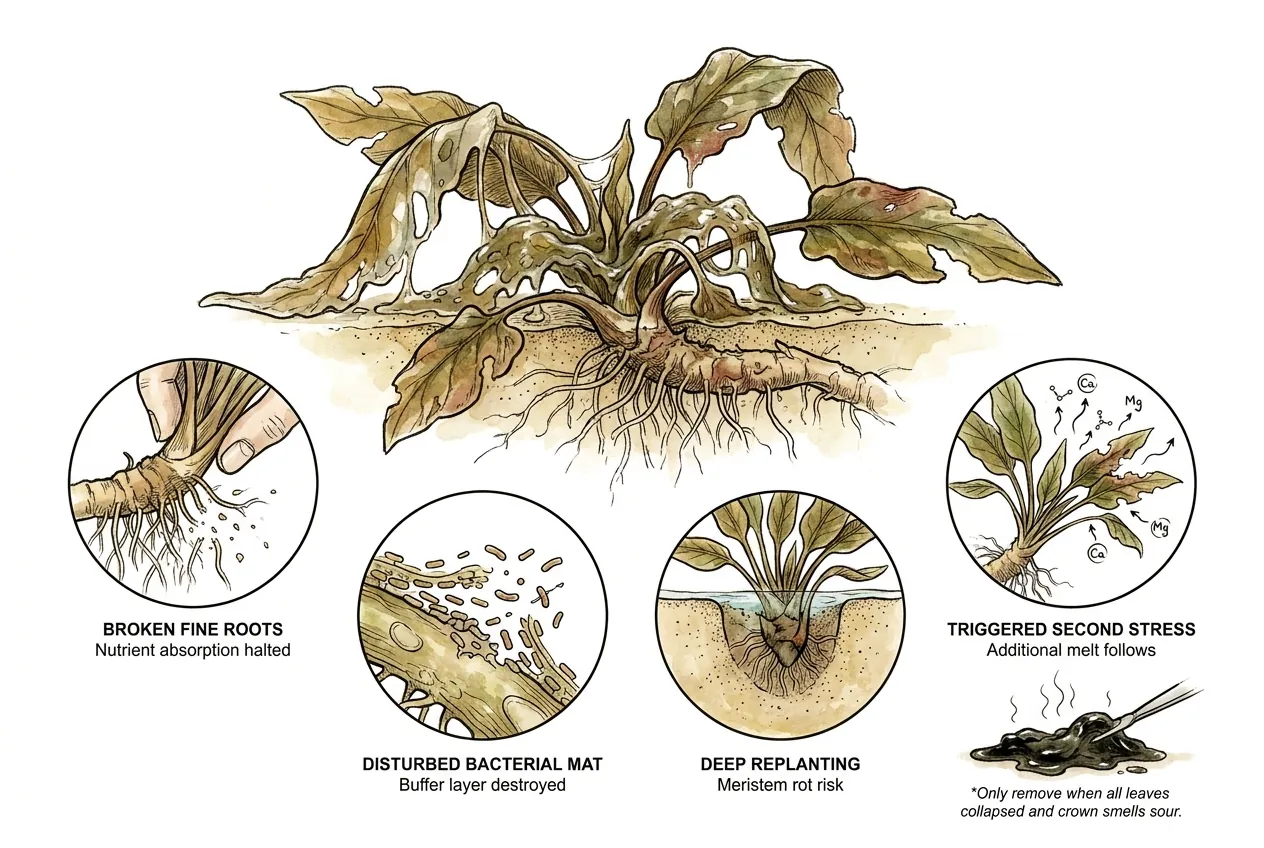
A good default during trimming is to leave the rhizome in place rather than uprooting to check. The reasons are practical and observable.
- Uprooting breaks fine roots that the plant is using to draw nutrients from the substrate. A real setback for a plant that is already weak.
- Handling disturbs the crown and the biofilm around the roots.
- Replanting too deep can bury and damage the crown, which can lead to rot.
- Each disturbance is another stress on a plant that is trying to stabilize.
If you do inspect (when most leaves have collapsed and the crown smells sour) accept that a rotted rhizome may already be a loss. Otherwise, give it time.
Cryptocoryne Aquarium Plants and How to Handle Crypt Melt. Horizon Aquatics (retailer guide)
Cryptocoryne Plants. Complete Care Guide. Canton Aquatics (care reference)
What does the new-leaf signal look like?
New leaves emerge from the center of the rosette, at the crown, often within a few weeks of the melt but with a lot of variation depending on the plant, temperature, light, and substrate.
They will often be smaller, more translucent, narrower, and sometimes a different shade than the originals.
This is the submersed form of the leaf. Usually a good sign that the plant is recovering.
(If new growth looks distorted or discoloured in an unusual way rather than simply small, keep an eye out for deficiency or rot instead.)
Leave these new leaves alone. As they establish over the following weeks they tend to broaden out toward the characteristic C. wendtii shape.
How do you throttle lighting to keep algae off a bare rhizome?
Cut photoperiod to 4–5 hours and intensity to 30–50% the day you notice the first translucent leaf.
Drop CO2 next, and only then add fast-growing nutrient sinks, because the melt itself has turned half of your planted biomass into a passive consumer.
How does the algae triangle play out during melt?
The 2Hr Aquarist's algae framework is a useful heuristic that points at three levers. Light, CO2, and nutrients.
It is not the whole story (algae species, grazers, flow, organic load, and how mature the microbial community is all matter too) but it is a good place to start.
Broadly, when light and nutrients are high and plants are growing well, healthy plants tend to keep algae in check. When plants stop taking up nutrients (because they are melting), the balance can tip toward algae.
A tank in the middle of a crypt melt tends to sit on the wrong side of that balance.
- Ammonia may be high (substrate leach plus decaying leaves). Test to confirm rather than assume
- Nitrate can build from nitrification, though heavy planting or water changes can keep it low
- Iron and micros are present in the substrate
- A chunk of the planted biomass (the melting crypts) is taking up little or nothing for a while
- Lights and CO2 are still running at the scape's normal rate
That combination raises the risk of an algae flare, which is why throttling light (and CO2) during the melt is worth doing.
As 2Hr Aquarist puts it. Low light + CO2 is one of the most stable combinations available, and it is much easier to control algae problems in a low light tank.
What is the throttle protocol?
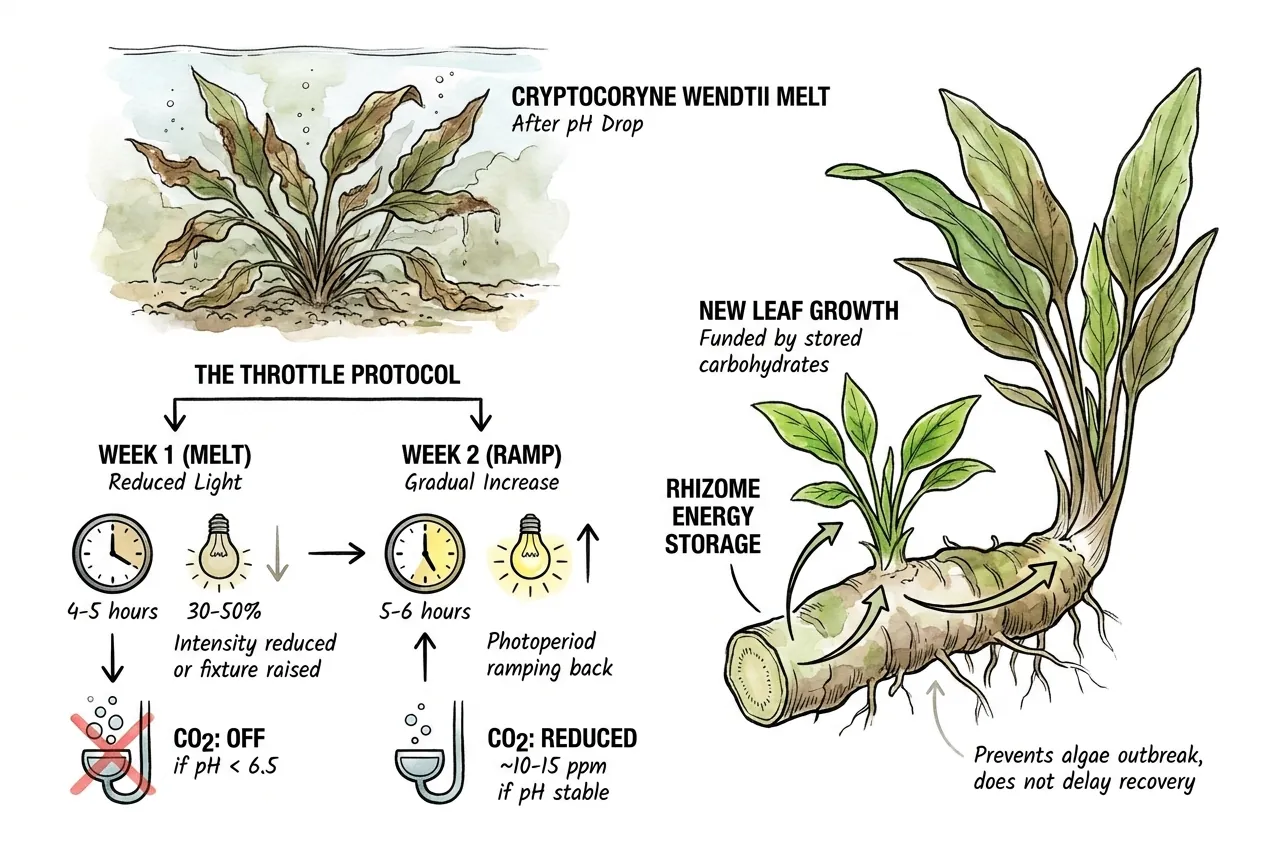
These are starting points to adjust by what you see (algae, the state of the remaining leaves, and how the other plants respond), not fixed values. The right numbers depend on your fixture and planting.
- Photoperiod, early on. A shorter day of around 4–5 hours
- Photoperiod, as things stabilize. Ramp back up gradually
- Intensity. Dim if your fixture allows. Otherwise raise the light or shorten the day (note that dimming and shortening are not equivalent. They affect total daily light differently)
- CO2. Off while pH is dropping or animals look stressed, if you keep it on once pH is steady, keep it modest and watch the drop checker and the fish
Reduced light is unlikely to slow recovery much in the early stage. A lot of the first regrowth is thought to draw on the rhizome's stored reserves rather than fresh photosynthesis, and new leaves start contributing as soon as they appear.
The main point is that lowering light during the melt reduces the algae risk that could otherwise set the recovery back, and it costs little while the plant is mostly bare.
For the lighting fundamentals behind reduced-photoperiod tanks of this kind, the Bucephalandra tissue-culture red/blue LED post covers the spectrum-vs-intensity tradeoff in detail.
Do floaters and stem-plant backup help?
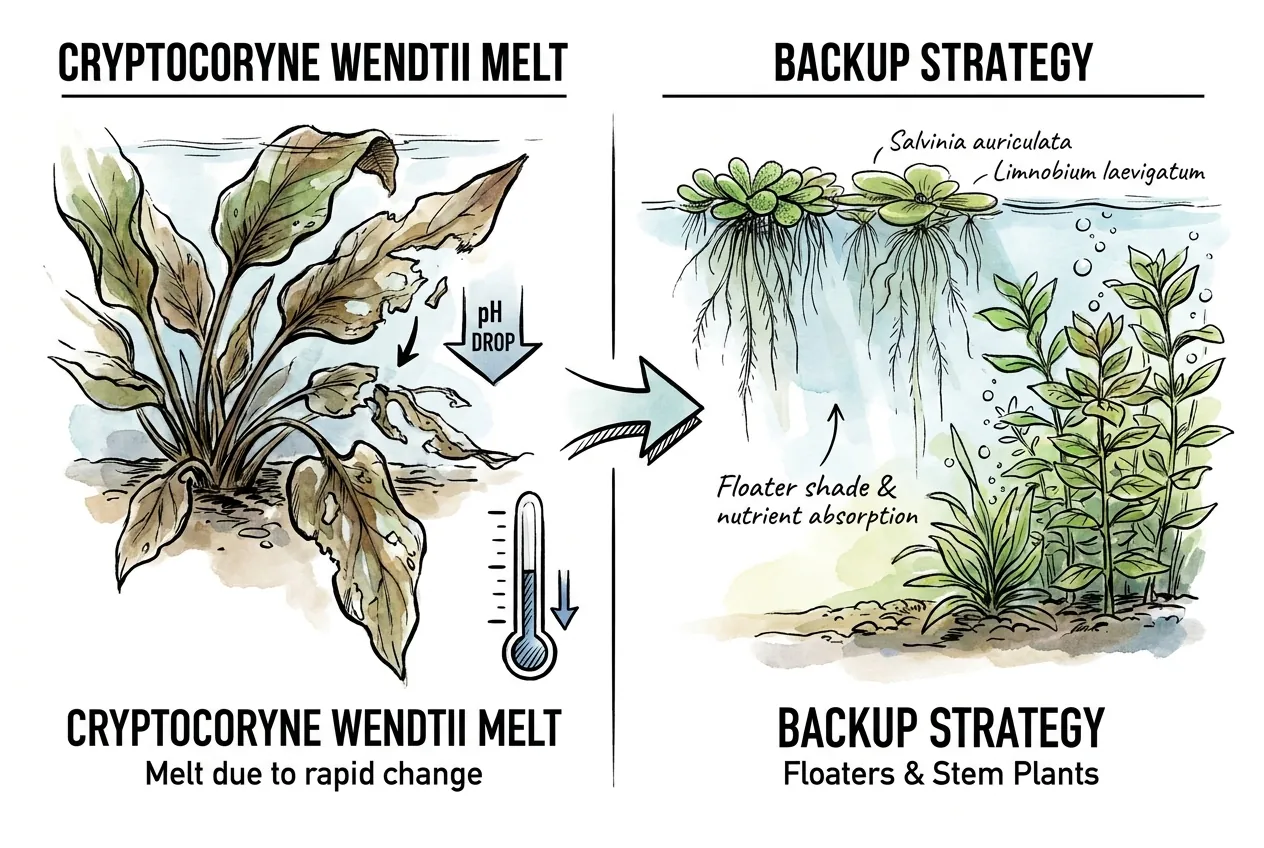
Fast-growing floaters and stem plants can be a useful adjunct during the throttle window. They take up some dissolved nutrients and shade the tank, which can help hold algae back and reduce light pressure on the exposed crown.
Choose species carefully, and check local regulations before you buy. Some commonly suggested plants are restricted or invasive. Hygrophila polysperma is on the USDA Federal Noxious Weed List in the United States, and water lettuce (Pistia stratiotes) is regulated or listed as invasive in a number of regions.
Avoid those where they are restricted and prefer locally legal options, for example many aquarists use frogbit, salvinia, or red root floater as floaters and ludwigia or rotala as stems, but even these should be confirmed against your local rules.
Whatever you add, quarantine new plants, never release aquarium plants into the wild, and dispose of trimmings in the trash rather than in waterways or drains.
Why are my plants melting? Is melting in a new tank normal? The 2Hr Aquarist
Which remineralizers and test kits should you actually use?
The product choices divide cleanly into GH or KH boosters for the water column, crushed coral for a passive KH floor, and a tiered test-kit set for measurement. Each option below connects its intended use to the tradeoff that matters during a melt.
Which GH/KH boosters are worth using?
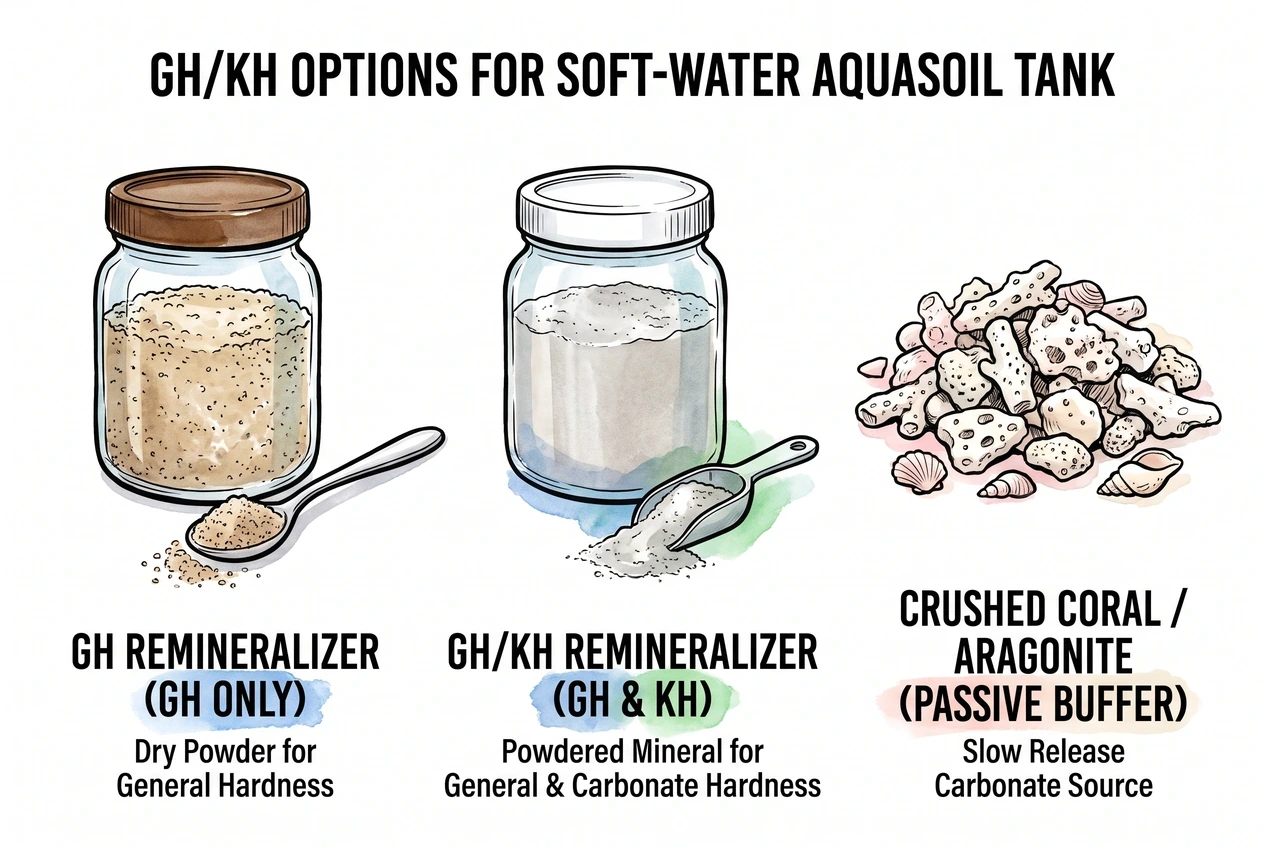
Seachem Equilibrium is a dry remineralizer for planted-tank GH supplementation. Per Seachem it adds GH (Ca, Mg, K) without adding KH, and the label dose is about 16 g per 80 L to raise GH by roughly 3 dGH.
If you mix it in a separate container it can produce a temporary haze. Seachem directs you to Alkaline Buffer, not Equilibrium, when you want to raise KH.
Best for
Adding GH on RO source water while letting the substrate keep KH low.
One thing to note
Because it does not raise KH, it will not lift a low pH on its own. It is a remineralizer, not a buffer.
Salty Shrimp Mineral GH/KH+ is a powdered remineralizer for RO or distilled water. It raises both GH and KH (a roughly 1/0.5 GH. KH relationship), and per the manufacturer dissolves almost completely.
The official use is remineralizing pure water (the label dose is around 2 g per 10 L to reach about 6 dGH and 300 ± 50 µS conductivity) so dose to those targets rather than eyeballing a rescue amount.
Best for
Remineralizing RO/distilled water for shrimp and planted tanks to a defined GH/KH target.
Because it adds both GH and KH
Using it specifically to raise KH during a melt is off-label. Before you do, note two things. Raising pH while ammonia is still present increases the toxic NH3 fraction (see the caution in the water-change section), and the extra KH will slowly be consumed by the substrate's exchange capacity.
If you only need GH and want to leave KH low, the GH-only product above is the better fit.
Anecdotally, some hobbyists prefer a fully-dissolving powder for repeatable mixing. One Aquarium Co-Op forum comment notes Salty Shrimp Shrimp Mineral is in powder form which makes it exactly the same every time, while others report undissolved residue with less-soluble products.
Treat these as user experiences, not manufacturer specs. Seachem's own guidance is that any haze is temporary.
Crushed Coral or Aragonite
These are passive, slow-acting sources of alkalinity. They dissolve faster as pH drops and more slowly as pH rises, so they can add some buffering over time.
How much they add, and how steady they are, depends on the amount of media, particle size, flow through it, your source water, and the acid load, so they are not a guaranteed dKH figure.
They are a long-term option, not something that will lift a low pH the same day.
Best for
Slowly adding some passive buffering over the long run, without active dosing.
One thing to note
It responds slowly, so it will not fix a pH problem happening today, and the amount of buffering it provides varies with the setup rather than being a fixed floor.
Which test kits cover the rescue?
You need to measure to run any of this sensibly. A reasonable test-kit set for an Aquasoil tank during the melt window.
Tier 1 (API Freshwater Master Kit)
Tests pH, ammonia, nitrite, nitrate, and is inexpensive. It reads by matching a colour card, so treat readings as approximate rather than to a certified accuracy.
One thing to keep in mind. Its ammonia test reads total ammonia, which is not the same as the toxic NH3 fraction. You need pH and temperature to work that out.
Its main gap for this job is that it does not include a KH test, so on its own it is fine for routine maintenance but not enough for tracking a low-KH active-soil tank.
Tier 2 (Add a KH test)
An API or Tetra KH/GH test alongside the Master rounds out the useful set. PH, ammonia, KH, GH.
For an active-soil tank where KH is the parameter most likely to move, this is a sensible combination, though many stable low-KH tanks run fine without testing everything daily.
Tier 3 Salifert KH test titration
A titration-style KH/Alkalinity kit gives a finer reading than a colour-card drop test. Per Salifert its resolution is about 0.3 dKH, with an optional 0.15 dKH mode.
Some hobbyists find it more consistent day-to-day than colour-card kits (one forum comment notes where API fluctuated greatly day to day, Salifert was consistent) though that is user experience rather than a certified accuracy figure.
Find it on Amazon as the Salifert KH test.
One thing to note
It uses more tank water and is a bit more involved than a drop-count kit. The finer KH reading is useful for a low-KH Aquasoil tank.
Tier 4. Digital pH probe (optional)
A digital pH probe or meter can help on CO2-injected scapes by giving continuous or repeatable pH readings, but only if you keep it calibrated, store the electrode properly, and account for temperature and drift. Otherwise a cheap probe can be less reliable than a good drop test.
A pocket tester such as the Hanna Checker HI98103 reads to 0.1 pH with about ±0.2 pH accuracy and still needs calibration and storage solution. It is a handheld pen, not a continuous inline controller.
This tool is not necessary for a one-off recovery.
Which test kits should you run during the rescue?
- Basic. API Freshwater Master + an API/Tetra KH/GH test.
- Better KH precision. API Freshwater Master + a Salifert KH/Alkalinity titration kit.
- Optional. Add a calibrated digital pH meter, mainly useful for long-term CO2 scapes.
What test kits should I buy for my aquarium or planted tank? (buyer's guide)
Should you add a KH buffer at all?
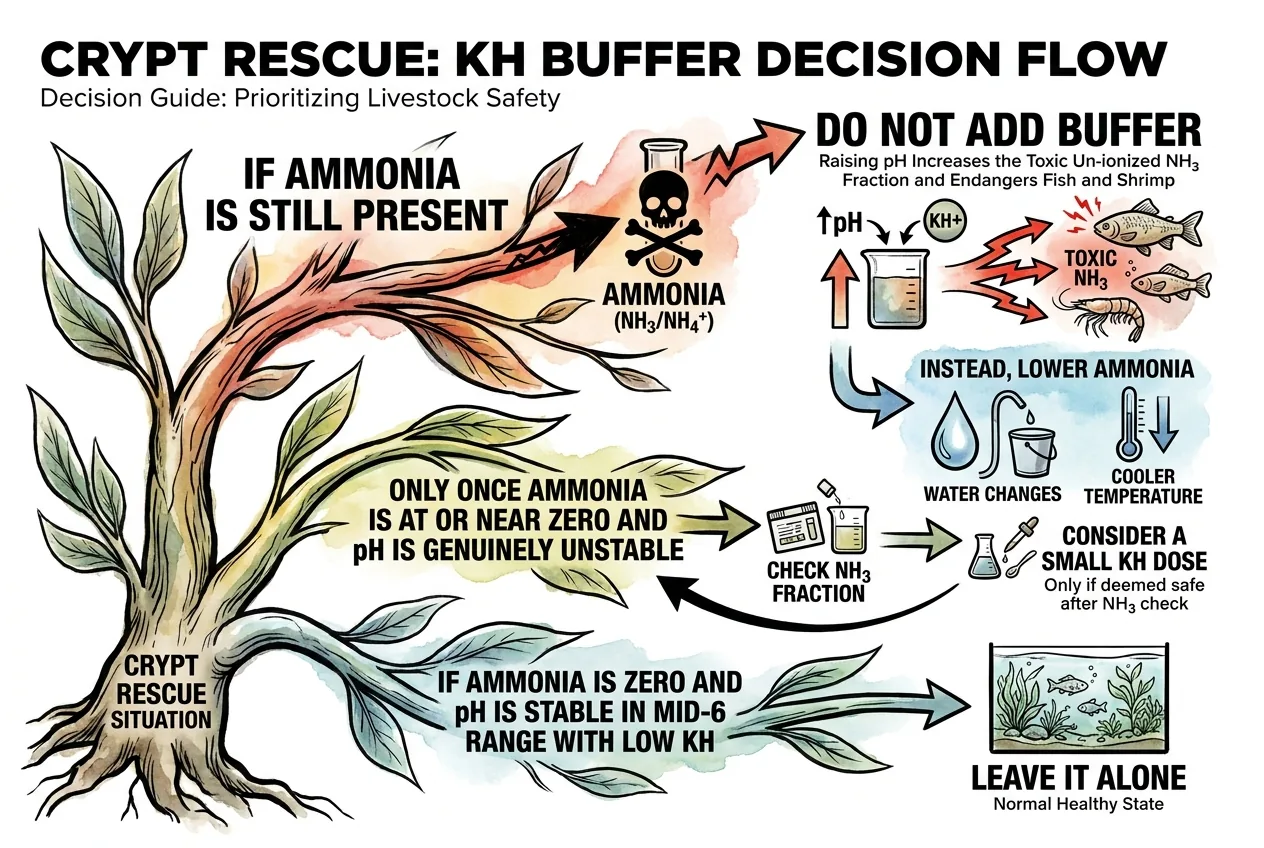
For most Aquasoil tanks, the honest answer is usually not. The 2Hr Aquarist source above argues against buffering active-soil tanks, and a stable low-KH, low-pH Aquasoil tank is a normal, healthy state.
Base the decision on readings, and put the ammonia-safety check first.
- If ammonia is still present. Do not reach for a buffer first. Raising pH increases the toxic NH3 fraction at the same total ammonia, so buffering can make things worse for livestock. Use water changes (and cooler temperature) to bring ammonia down instead.
- Ammonia at or near zero but pH still genuinely unstable. Only then consider a small KH dose, after checking the NH3 fraction for your pH and temperature.
- Ammonia at 0, KH low, pH in the 6.5–6.8 range. Leave it alone. This is the normal long-term state of a healthy Aquasoil tank, not a problem to fix.
What does recovery look like, and when do you resume fertilization?
Recovery usually shows up first as new leaves at the crown, often within a few weeks, then broadening over the following weeks, but the exact timing varies with the plant, temperature, light, and substrate, so treat any week-numbers below as rough expectations rather than a schedule.
Practical rule Hold off on fertilizing until you actually see that first new leaf.
What does the week-by-week recovery curve look like?
| Time | Visible signal | Internal status | Action |
|---|---|---|---|
| Week 0 | Leaves dissolving | Parameter shock, rhizome shed-and-protect | Begin 14-day rescue |
| Week 1 | Most leaves shed | Rhizome dormant, reabsorbing N | Conservative trim, throttled lights, CO2 off |
| Week 2 | Bare rhizome | Cycle stabilizing | Reduce WC cadence, hold lights low |
| Week 3 | First new leaf at crown | Rhizome redirected carbohydrate to growth | Resume normal photoperiod at 70%, gentle CO2 |
| Week 4–5 | 2–4 new leaves, small, translucent | Submersed-form leaves photosynthesizing | Resume liquid fert at half dose, place root tab |
| Week 6–8 | 5–10 leaves, broadening | Recovery established | Full normal fertilization, full photoperiod |
| Week 8–12 | Canopy restored | Stable | Standard maintenance |
Aquarium Co-Op's guidance is in the same spirit. Expect little shoots popping up within a few weeks, and give the plant several weeks before writing it off.
How do you resume fertilization?
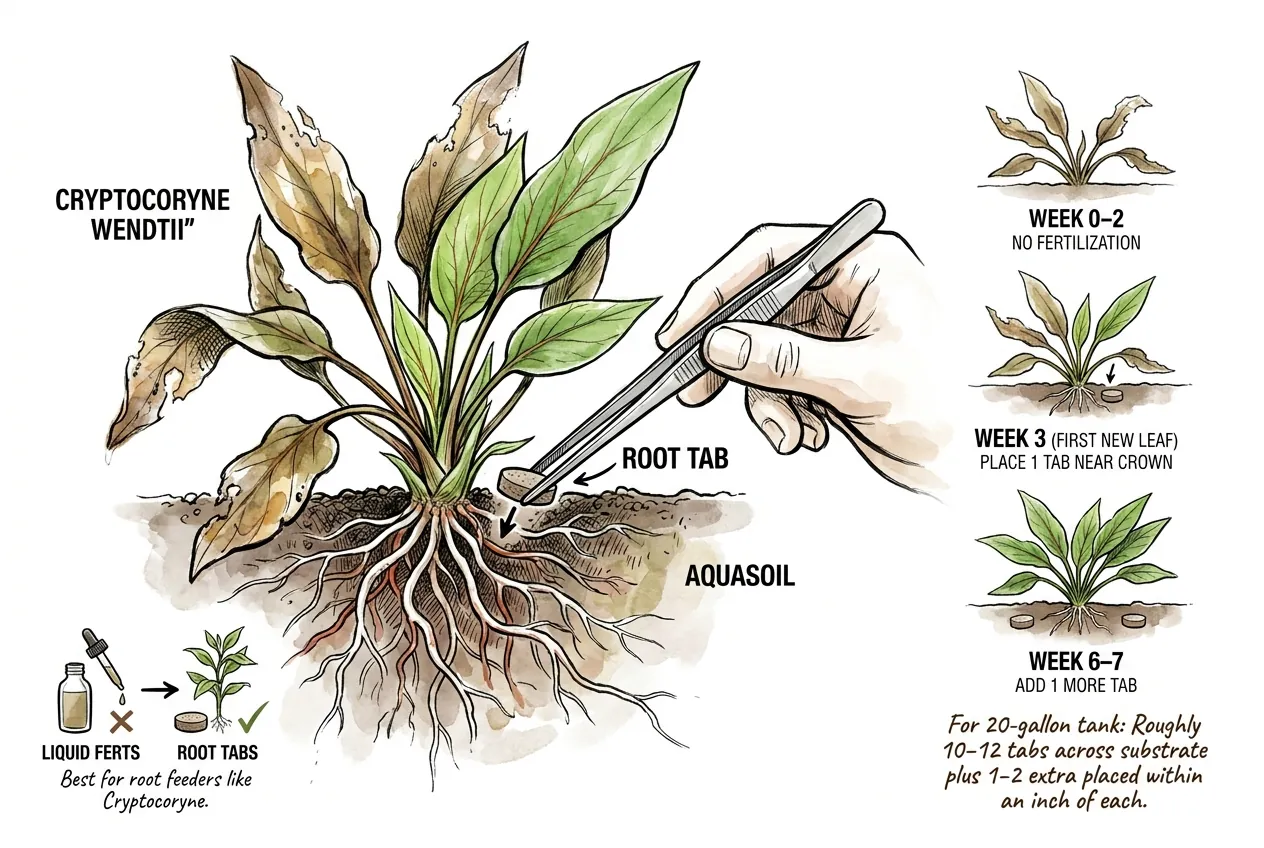
Cryptocorynes make good use of nutrients at the root zone, so root tabs are a sensible way to feed them.
They also take up nutrients through their leaves from the water column, though, so root feeder is a lean rather than an either/or. Root tabs are not automatically more efficient than liquid dosing in every case.
One important caveat. Fresh Aquasoil is already nutrient-rich, so in the first weeks a new tank often does not need extra tabs at all.
Add them if growth is poor once the tank has matured, following the spacing on your specific product's label.
The schedule below is one illustrative example for a mid-sized recovering scape, not a fixed prescription. Amounts depend on the tab brand, its nutrient content, and how densely the tank is planted.
| Week | Liquid macro | Liquid micro | Root tabs |
|---|---|---|---|
| 0–2 | None | None | None |
| 3 (first new leaf) | 50%, 1×/week | 25%, 1×/week | Place 1 tab near crown |
| 4–5 | 50%, 2×/week | 25%, 1×/week | Hold |
| 6–7 | 75%, 2×/week | 50%, 1×/week | Add 1 more tab |
| 8+ | 100% normal cadence | 100% normal cadence | Replace every 2–3 months |
If you do use tabs, spread them out following the spacing your product recommends (many tabs specify something like a 4–6 inch grid) rather than clustering them, so nutrients reach the rosettes between them.
Distribution matters more than piling tabs near one plant.
What is the yo-yo melt and how do you avoid it?
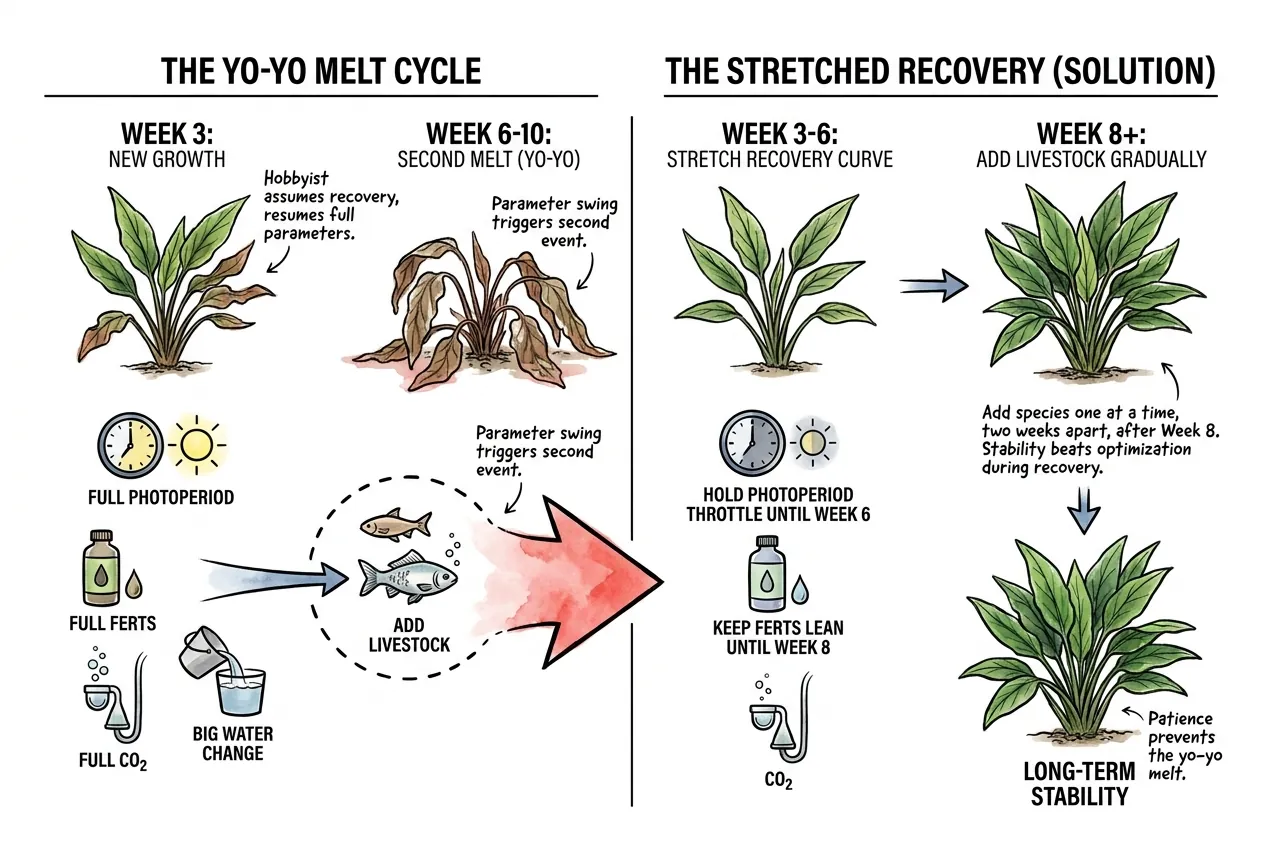
A common late failure is a second melt some weeks after the first. The usual pattern. A hobbyist sees new leaves, decides the tank is done, and swings everything back at once (full ferts, full CO2, full photoperiod, new livestock, and a big water change on the same day).
That much change at once destabilizes the parameters, and the plant can melt again in response.
The practical fix is to change one thing at a time and let the tank settle between changes.
Bring light and ferts back gradually rather than all at once, and watch how the plants respond rather than following a fixed calendar.
Add livestock only once the cycle reads stable (ammonia and nitrite at zero), a little at a time, sized to your filter's capacity, not on a set date.
Slow and steady beats optimizing everything at once during recovery.
Still getting crypt melt. UK Aquatic Plant Society (forum discussion)
What if the rescue fails?
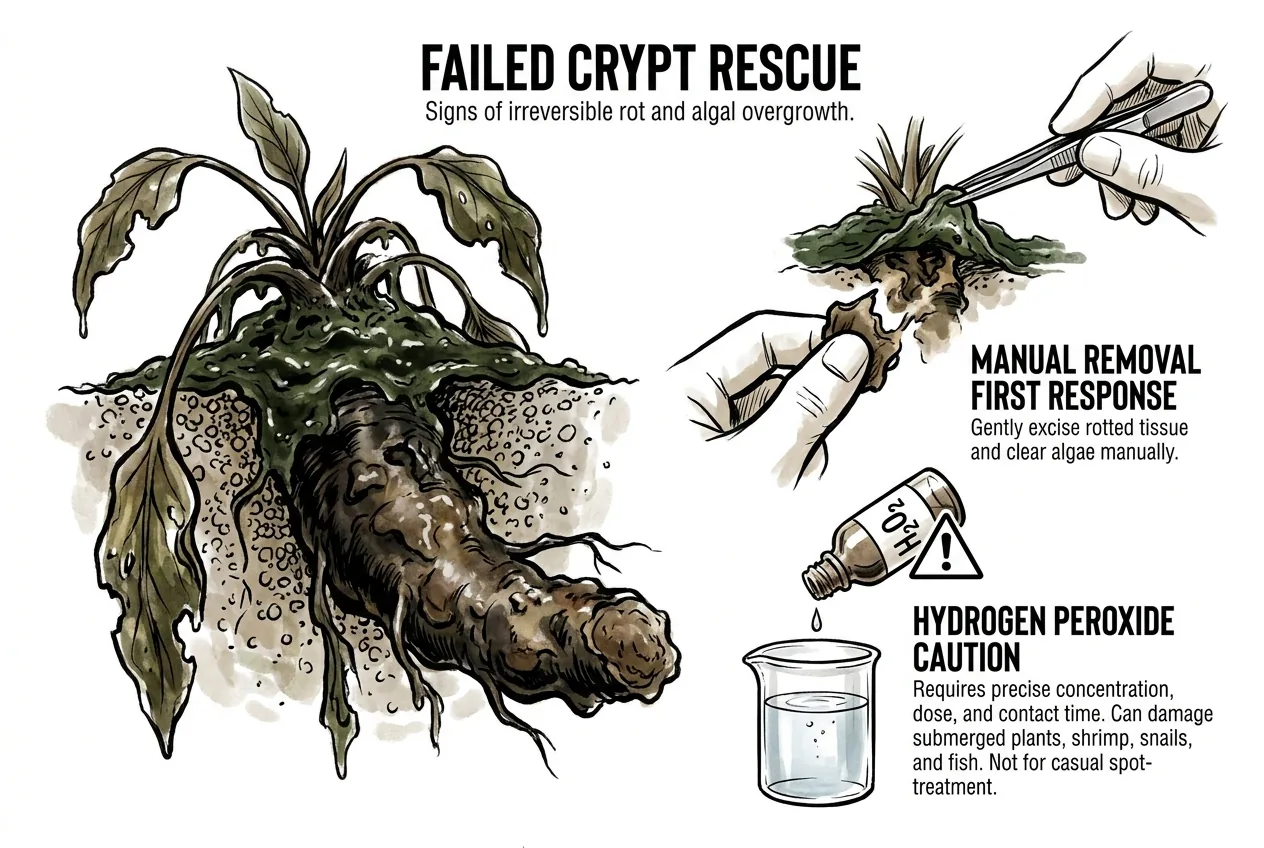
Not every rescue succeeds.
Failure signatures
- Rhizome already rotted A mushy, dark, sour rhizome with no new growth after several weeks points to advanced decay. If little firm tissue remains, the plant is likely a loss. Check carefully and allow slow plants enough observation time before discarding them.
- Algae took over the crown. An algae mat covering the crown. Remove it manually first. Hydrogen peroxide is sometimes used to spot-treat algae, but it can damage submerged plants (the effect is light-dependent) and stress shrimp, snails, and fish, so it needs careful attention to concentration, total dose, contact time, and filtration. It is not a casual step, and correcting the underlying cause matters more.
- A second melt. Re-check parameters and variables rather than assuming it is only a fertilizer issue. Deficiency, rot, or CO2 problems can look similar.
- One plant out of several is lost. If you planted a group and most recover, losing one is not unusual.
C. wendtii is regarded as one of the more forgiving crypts, which is why it is recommended to beginners, and a healthy plant with a sound rhizome has a good chance of coming back.
Some other crypts, such as C. crispatula or C. cordata, have a reputation for being fussier, but these are general impressions, not measured success rates, so treat any specific percentage with caution.
What does recovery look like in your specific tank?
If the shed leaves were a shock/adaptation response and the rhizome is sound, expect new leaves within a few weeks and fuller growth over the weeks after that. Variable by tank, and not something the plan can guarantee.
A safety-first checklist
- Livestock, first. If any fish or shrimp are gasping or distressed, treat that as the emergency it is, a water change now, before worrying about the plants.
- Today's readings. Total ammonia, nitrite, pH, KH, plus temperature. Ammonia and nitrite come first because they affect the animals. Use the trend, not a single day, to decide the next 48 hours.
- The worst-looking crypt. Remove only leaves that are clearly decomposed. Leave firm ones alone.
- The light timer. Throttle it (roughly 4–5 hours at reduced intensity) until you see new growth, adjusting if algae or the other plants tell you to.
- The CO2. Keep it off or low while pH is unstable or animals look stressed, and bring it back gradually.
- The water-change plan. Note your dates, but advance on test-kit readings rather than the calendar.
If you are running several crypts and one melts harder than the others, that is normal. They are not synchronized.
Don't pull the slower ones just to match. Recovery in a planted tank is uneven. (If a lagging plant also shows rot, crowding, or a buried crown, that is worth a closer look.)
The most useful treatment for a firm, sound rhizome is a stable water column. Avoid dramatic changes, remove only decaying tissue, and judge recovery by new growth at the crown.
Affiliate Disclosure
This article contains Amazon affiliate links. As an Amazon Associate I earn from qualifying purchases. If you use these links, the site may earn a commission at no extra cost to you. Product availability, price, and specifications can change. Check the current listing before buying.