
Syngonium Albo Reverting to Green: A Summer Troubleshooting Guide
Syngonium albo reverting to green in warmer months? Chimeral variegation can revert, and here is how to tell reversion from light damage, plus the node-pruning approach growers use.
Marcus Hale · Published 2026-06-14 · 24 min read
Key Takeaways
- Syngonium Albo variegation is generally understood as a chimera in the growing tip. A reverted all-green stem does not turn variegated again on its own.
- Reversion often appears during warm, fast-growing months. Reverting shoots gain ground fastest when the plant is growing vigorously.
- More direct sun is not a reliable fix. Chlorophyll-poor white tissue scorches easily, and brighter light has not been shown to reverse reversion.
- Use daily light integral rather than peak intensity alone. Roughly 70–100 PPFD over 10–12 hours is a starting point to verify, not a proven Albo threshold.
- The main recovery step is pruning back to a node whose bud still carries variegation. Act before an all-green shoot takes over the plant.
Your Syngonium Albo is throwing solid green leaves, and a common piece of advice is to give it more light.
That advice can help a plant that is genuinely under-lit, but pushing an already well-lit plant into harsh direct sun tends to scorch the delicate white tissue rather than restore it.
Variegation in these plants is generally understood as a chimera. Two genetically different cell layers arranged in the growing tip.
When a stem reverts to all green, that arrangement has been lost, and brightness alone does not put it back.
Confirm repeated all-green new growth, then prune back to a visibly variegated node before the green shoot takes over. The seasonal pattern and light ranges below are practical starting points, not controlled Syngonium Albo thresholds.
TL. DR
Variegation in these plants is generally understood as a chimera, and once a stem reverts to all green it does not turn variegated again on its own. Reversion tends to show up during vigorous, warm-season growth.
More direct sun is not a reliable fix and can scorch the white tissue. A common starting point is a steady daily light dose in the roughly 70 to 100 PPFD over 10 to 12 hours range (verify with a reading), and the main recovery is cutting the stem back to a node whose bud still carries variegation before an all-green shoot takes over.
Why is my Syngonium Albo turning green? (the chimera, not a mood)
The variegation on a Syngonium Albo is generally described as a chimera. The white is not a pigment the plant chooses to make. It reflects a mosaic of genetically different cell layers in the growing point, and reversion happens when that mosaic is lost in favor of ordinary green tissue.
The shoot apical meristem is built from layers, conventionally called L1, L2, and L3, numbered from the outside in. When the layers carry different genotypes in a stable arrangement, the result is a periclinal chimera, and this layered structure is one accepted explanation for stable white and cream sectors.
The exact layer arrangement in any given commercial Albo clone has not been characterized here, so treat the L1/L2/L3 picture as the general model rather than a verified map of this plant.
This matters for one practical reason. Because the pattern depends on that structural arrangement rather than on a pigment the plant can switch on, a stem that has reverted to all green does not become variegated again on its own.
Variegation persists only where the layered chimera persists.
For each candidate node, I photograph its full circumference and mark where pale and green sectors cross the bud eye. A front-only stem photo can hide the sector that actually supplies the next shoot.
After pruning, I keep the map and label the activated node. The next stem and several leaves, not the first blade alone, decide whether the new growth is useful.
PPFD and air temperature are recorded at each node height as the vine grows. The upper shoot may reach a different light zone from the lower bud being asked to replace it.
Why does green growth tend to take over?
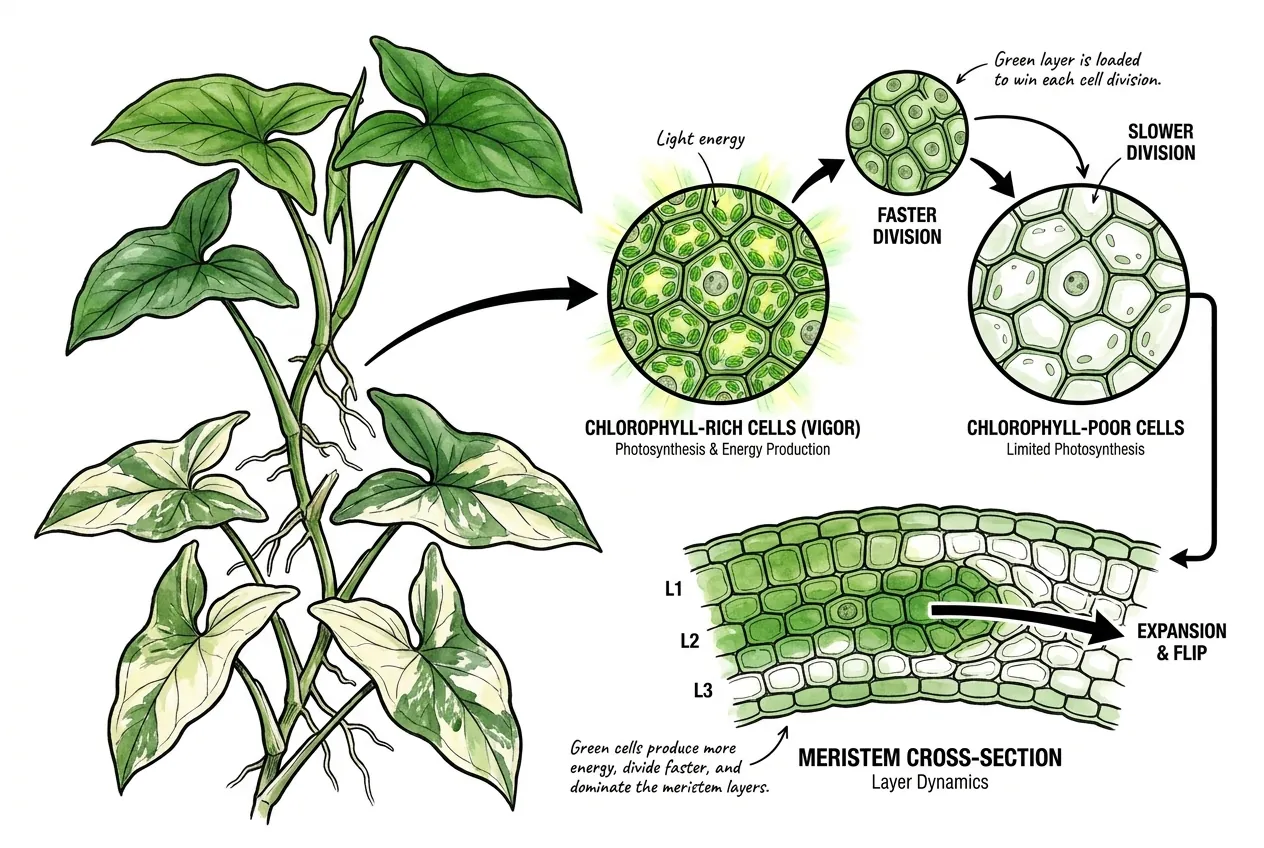
A common explanation is that green tissue, which is full of chlorophyll and photosynthesizes, has more resources and vigor than chlorophyll-poor white tissue.
On a whole-plant level, green tissue clearly carries more of the photosynthetic load. It is worth being clear about the limits of this reasoning, though. The idea that individual green cells in the meristem out-divide their white neighbors cell by cell has not been measured in this plant, so treat it as a plausible model rather than an established fact.
What growers do observe is the outcome. Once a shoot starts producing all-green leaves, that shoot tends to keep going green and can eventually dominate the plant if it is not pruned back.
The general horticultural guidance is to remove reverted, non-chimeral shoots so the plant is pushed back to variegated growth.
Using a periclinal chimera to unravel layer-specific gene expression in plants
Genetic Selection. Chimeral Reversion (UF/IFAS)
Pattern analyses of selected variegated forms (includes Syngonium podophyllum)
Why is reversion more noticeable in the warm season?
Many growers report seeing more all-green growth in the warm, long-day months. A reasonable explanation is that this is simply the season of fastest growth. Longer days and higher temperatures push many plants into rapid flushing, and the general rule is that reverting shoots gain ground fastest when the plant is growing vigorously.
This is an observation-based pattern, not something that has been measured in controlled Syngonium trials.
Keep in mind that an indoor plant does not experience outdoor seasons directly. Rather than assuming a calendar effect, it is more useful to track the plant's actual growth rate, measured light, and temperature, and to watch for repeated all-green new growth.
Is reversion tied more to growth rate or to stress?
The common working view is that reversion tracks growth rate. The faster a plant flushes, the more opportunities a reverted shoot has to run away with the plant.
Whether stress plays a separate role has not been tested for this plant, so this is a reasonable heuristic rather than a settled distinction.
Keep growth steady rather than explosive, and prune confirmed reverted shoots instead of chasing more brightness.
Why Is My Variegated Plant Turning Greener?
Does more sun fix reversion? (no, and here is why it backfires)
There is no good evidence that adding more direct sun restores variegation, and it can make things worse. White sectors have little to no chlorophyll.
Chlorophyll is one part of how green tissue copes with strong light, alongside other pigments and protective mechanisms, so tissue that is short on chlorophyll is generally less equipped to handle intense light.
In practice this means white sectors are usually the first part of a leaf to bleach, brown, or scorch under strong direct sun, though the exact susceptibility depends on the plant, its acclimation, and the exposure.
Extension guidance for Syngonium podophyllum is to avoid full sun for this reason.
So moving a reverting plant abruptly into harsh midday sun has two problems. It is not a reliable way to bring variegation back, and it risks scorching the very tissue you are trying to protect.
Do Not Use Harsh Sun as a Reversion Cure
Do not move a reverting variegated plant into harsh direct sun in an attempt to force variegation back.
Once a plant already has adequate light, adding intensity mainly risks bleaching the chlorophyll-poor white tissue and is not a reliable way to reverse reversion.
Where did the more-light myth come from?
The advice comes from a real but narrow observation. Plants kept in very low light can look less variegated, and adding light can help. It is worth being careful about the mechanism, though.
A genetically white cell does not simply start making chlorophyll and turn green. That would contradict the structural, chimeral picture above.
What can change is the green tissue's chlorophyll and the plant's overall vigor and shoot selection, along with how the pattern reads visually.
Those are different from the cell-lineage loss that defines true reversion, and they should not be lumped together.
The results are also not uniform across Syngonium. In a greenhouse study of the different cultivar S. podophyllum White Butterfly, plants grown at about 200 PPFD were actually whiter than plants at 700 PPFD (though they had fewer leaves and lower quality), which cuts against any blanket lower light always means more green rule.
That study is a different cultivar under production conditions, so it is a caution rather than a prescription for Albo.
The safe practical reading is narrow. Moving a plant out of a genuinely dark corner into decent light can help, but pushing it from decent light into harsh direct sun does not, and past adequacy more intensity mostly risks damaging white tissue.
Effect of Fertilizer, Temperature, and Light Level on Growth of Syngonium podophyllum White Butterfly
What is the difference between PPFD and DLI?
Read the Daily Dose, Not Just the Peak
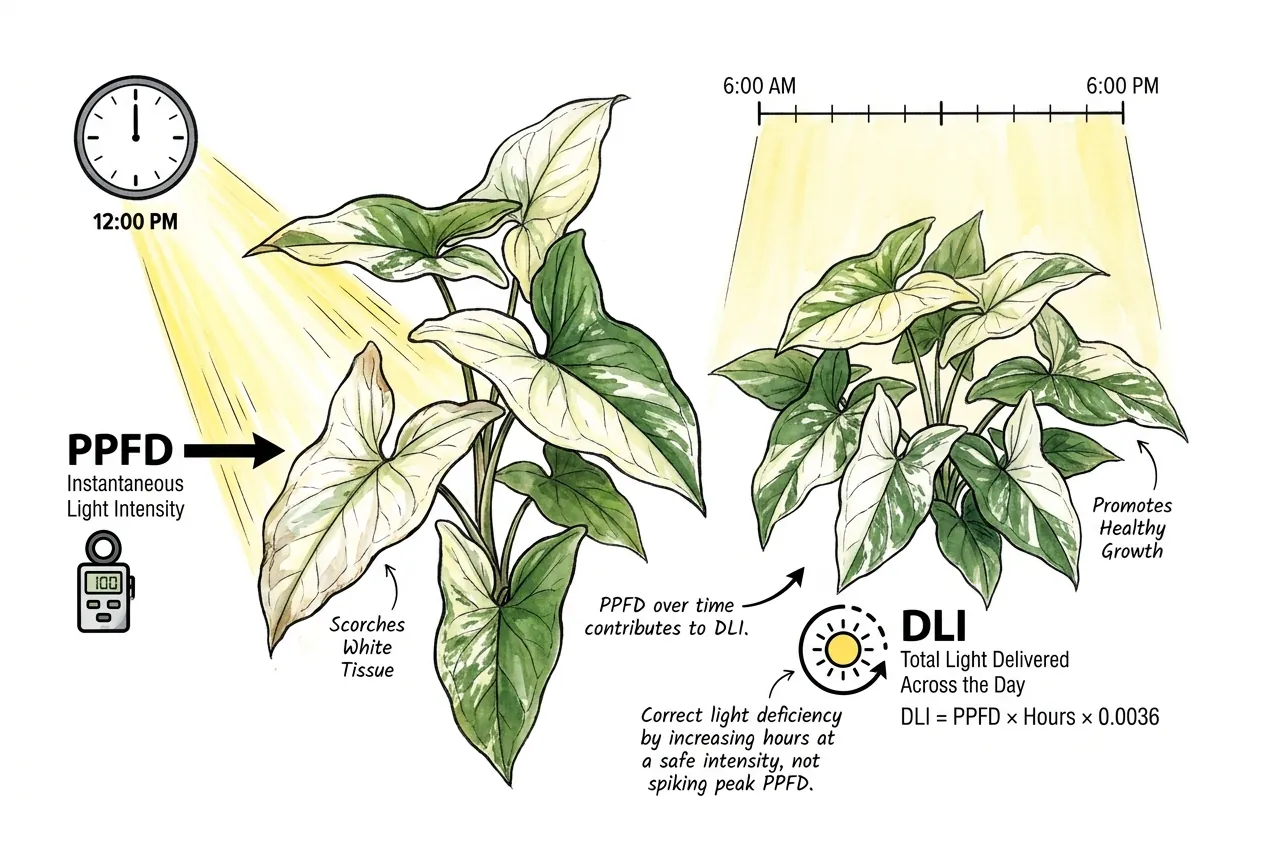
PPFD is the light hitting a leaf at one moment. DLI is the total light that leaf receives over the day. A meter or grow-light calculator can convert your reading and timer schedule if you need a daily total.
If the plant is under-lit, extend a safe, steady light schedule before increasing intensity. Intensity, duration, and spectrum are not fully interchangeable, so make one small change at a time and watch the newest leaves.
Why Do Variegated Houseplants Have White Leaves?
Why Is My Variegated Plant Turning Greener?
What light levels should a variegated Syngonium actually get?
A commonly cited starting range for a variegated Syngonium is roughly 70 to 100 PPFD at the leaf surface over a 10 to 12 hour photoperiod, a little above the 60 to 90 PPFD often suggested for plain green aroids.
The reasoning is that white sectors carry less of the photosynthetic load, so green tissue does more of the work.
These figures come from hobbyist and retailer guides rather than controlled trials on this cultivar, so treat them as starting points to verify with a light reading, not proven reversion thresholds.
Convert that to a daily total and you land in the general foliage band. At 85 PPFD for 12 hours, DLI is about 3.7 mol per square meter per day.
University extension guidance puts low-light foliage houseplants at roughly 3 to 6 mol per square meter per day.
That band is a generic grouping for low-light foliage plants. It is not an Albo-specific optimum, and it has not been shown to prevent reversion.
The practical goal is modest. Give the plant enough integrated daily light that it is not chronically under-lit, while staying well below the intensities that scorch white tissue.
Light target cheat sheet
| Plant | PPFD target | Photoperiod | Approx DLI |
|---|---|---|---|
| Plain foliage aroid | 60–90 | 10–12 h | ~2.2–3.9 |
| Variegated aroid (Albo) | 70–100 | 10–12 h | ~2.5–4.3 |
| Foliage low-light band | Not specified | 12–14 h | 3–6 |
How do I hit those numbers indoors?
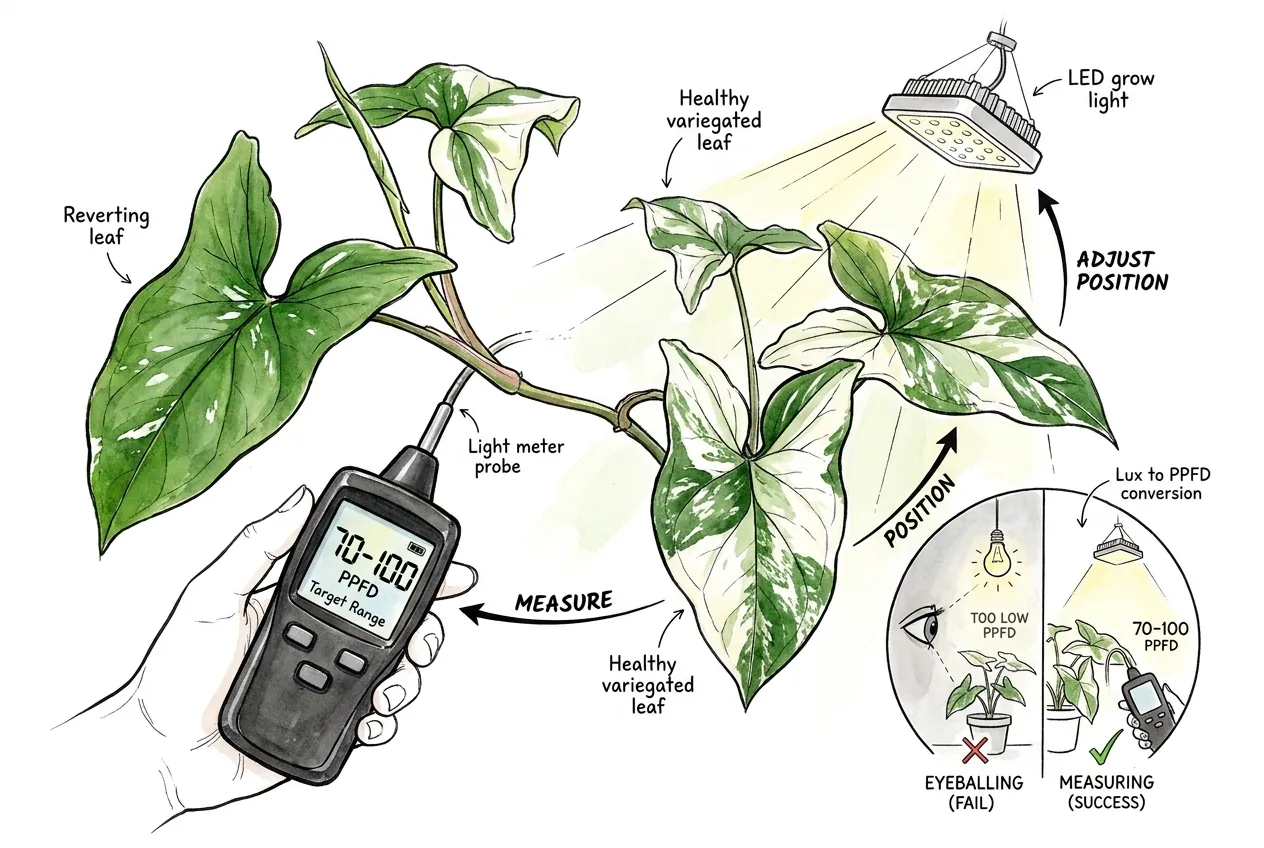
The practical approach is to measure, then place the light to match. Eyeballing brightness is unreliable because the human eye responds logarithmically, so a room that looks bright can be well short of 70 PPFD.
Measure before you move anything
Taking a reading beats guessing, and helps you avoid both under-lighting and over-lighting. Be aware of what your meter actually measures, though.
Most affordable handheld meters, including the one below, read illuminance in lux, which is weighted for the human eye.
You can convert lux to an approximate PPFD for a known light source, but the conversion factor depends on the lamp's spectrum, so the result is an estimate, not a direct PPFD reading.
The Dr.meter Digital Light Meter is useful for comparing the bright and dim spots around a plant. It reads lux rather than true PPFD, so use it to make relative placement decisions rather than to claim an exact plant-light target.
What this is good for, and what it is not
A lux meter is fine for comparing spots in a room and for spotting a room that is far too dark.
For an exact PPFD figure it is only an approximation, and reversion versus bleaching are multifactorial, so no single number diagnoses either on its own.
If you need true PPFD
Because it reports lux, the lux-to-PPFD conversion is approximate and shifts with the light spectrum.
For genuine micromole (PPFD) readings you need a quantum PAR sensor, which typically costs several times more.
Then place the light
As rough starting points to verify with a meter, a slim LED grow bar 20 to 40 cm (8 to 16 in) above the canopy often lands near the 70 to 100 PPFD range, and an east window with a sheer curtain can give in the ballpark of 60 to 90 PPFD at 30 to 60 cm from the glass.
Actual values vary a lot with the fixture, and with window orientation, latitude, glazing, season, weather, and time of day, so record what you actually measure rather than trusting these numbers.
Keeping leaf-surface temperature moderate, roughly at or below 27 to 28 °C (80 to 82 °F), is sensible so you are not stacking heat stress on top of light, though this is a general comfort guideline rather than a proven reversion threshold.
If growth stalls with no signs of stress, raising light in small steps (on the order of +10 PPFD every couple of weeks) is a cautious way to acclimate, rather than one big jump.
Important Considerations for Providing Supplemental Light to Indoor Plants
How to Accurately Measure Light for Plants Using Daily Light Integral
How do I tell reversion apart from light damage?
A useful first step is to look at new growth versus older growth, because these look-alike problems can have opposite responses.
Get it wrong and you can make things worse, for example by adding light to a plant that is actually bleaching.
The signals below are clues to weigh together, not a complete diagnosis on their own.
Reversion shows up in the GROWTH. New leaves emerge fully green, leaf after leaf, where older leaves were variegated.
If that pattern repeats over several leaves, reversion is worth suspecting, and left unpruned a reverted shoot can come to dominate the plant.
Damage to EXISTING white tissue is different. Under too much light, white sectors can go translucent, papery, or crispy.
Bear in mind that similar changes on already-open leaves can also come from water or root stress, low humidity, physical injury, or normal aging, so light is not the only suspect.
Sunburn tends to appear as defined brown or tan dry patches on the most exposed leaves, though pests, disease, and contact or heat damage can look similar.
Separately, a new leaf may simply emerge a different shade and settle into its final pattern as it matures. The exact time this takes varies by plant.
Diagnosis table
| Signal | Reversion | Bleaching | Sunburn | Settling |
|---|---|---|---|---|
| What changes | New leaves all green | Existing white goes translucent | Brown dry patches | New leaf shade shifts then stabilizes |
| Cause | Green meristem layer winning | Light too intense for white tissue | Direct or peak sun scorch | Normal leaf maturation |
| Trend | Progressive, leaf by leaf | On already-open leaves | On exposed leaves | Resolves within days |
| Fix | Prune to a variegated node | Reduce intensity, keep DLI | Move out of direct sun | Do nothing |
Which leaves should I inspect?
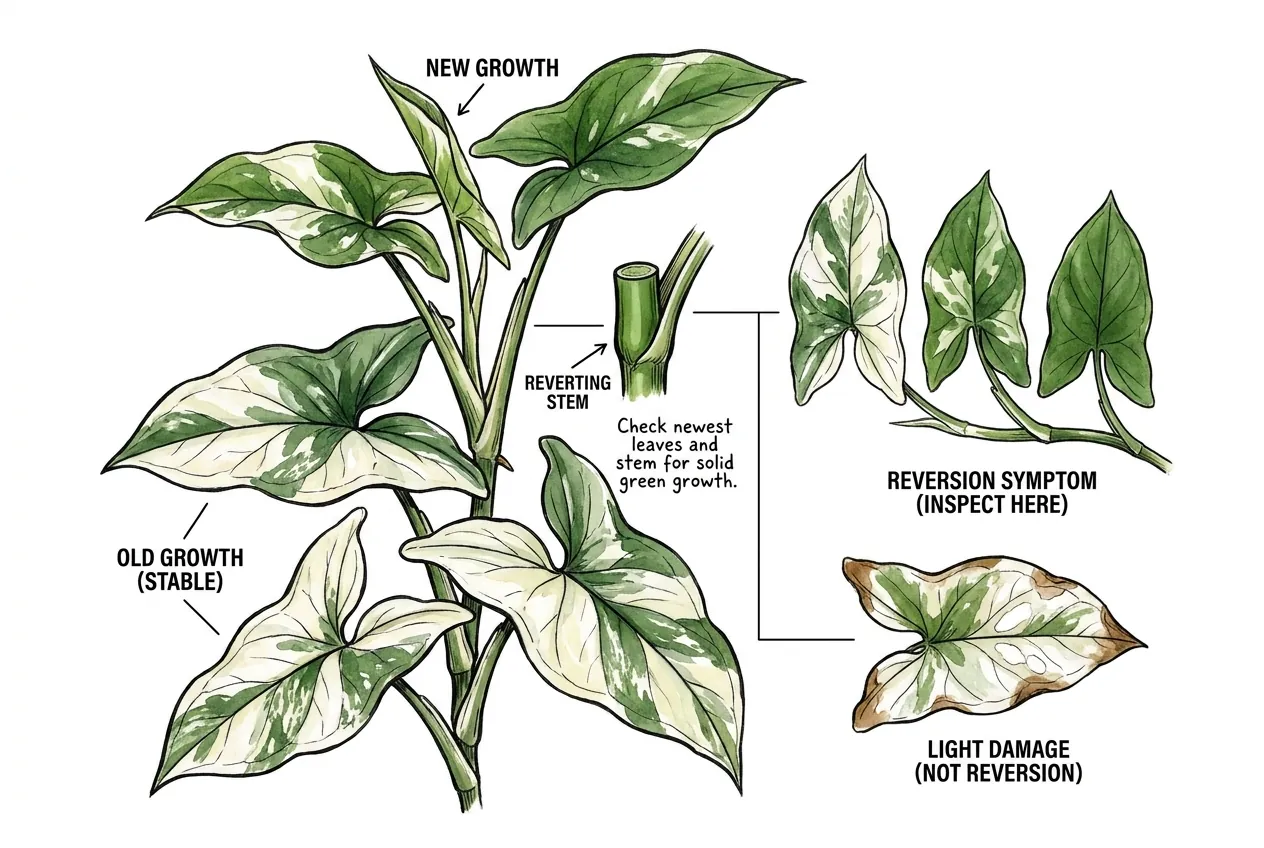
Inspect the newest two or three leaves and the node they came from, rather than the oldest leaves. Reversion tends to be readable at the growing tip.
If each new leaf has less white than the one before, and the stem feeding the tip shows a fully green section, reversion is the likely explanation and the node approach below applies.
A visibly green stem is a strong clue but not proof, since stem color does not fully reveal the genotype of the buds.
If instead the white areas on already-open leaves are turning see-through or crisp, that points more to a light or care problem than to reversion, and adding light could make it worse.
Why Is My Variegated Plant Turning Greener?
Why Do Variegated Houseplants Have White Leaves?
Where exactly do I cut to bring variegation back?
The general recommendation, consistent with university extension guidance on chimeral reversion, is to cut the stem back to the last node that still carries variegation, removing the all-green section above it.
The idea is to remove the reverted, non-chimeral growing point and encourage the plant to push a new shoot from a lower bud that may still carry the variegated structure.
This is often called mechanical chimera selection, but it is a bias in the odds, not a guarantee.
Two things are at work. Cutting off the top reduces apical dominance, the auxin signal from the active tip that keeps lower buds dormant, which encourages a lower bud to break.
And selecting a variegated node aims to favor a shoot that still carries the pattern. What actually grows back is not guaranteed. You may get one shoot, several, or a weak one, and it may or may not return variegated.
A practical heuristic is to look for a node where a stripe of white variegation runs through or beneath the axillary bud, since cutting above an all-green node tends to regrow green.
Treat this as an uncertain visual cue rather than a rule. The visible stripe does not confirm the bud's internal layer arrangement or how the next leaves will look, so keep a propagation backup in case the regrowth is not what you hoped.
What is the exact cut?
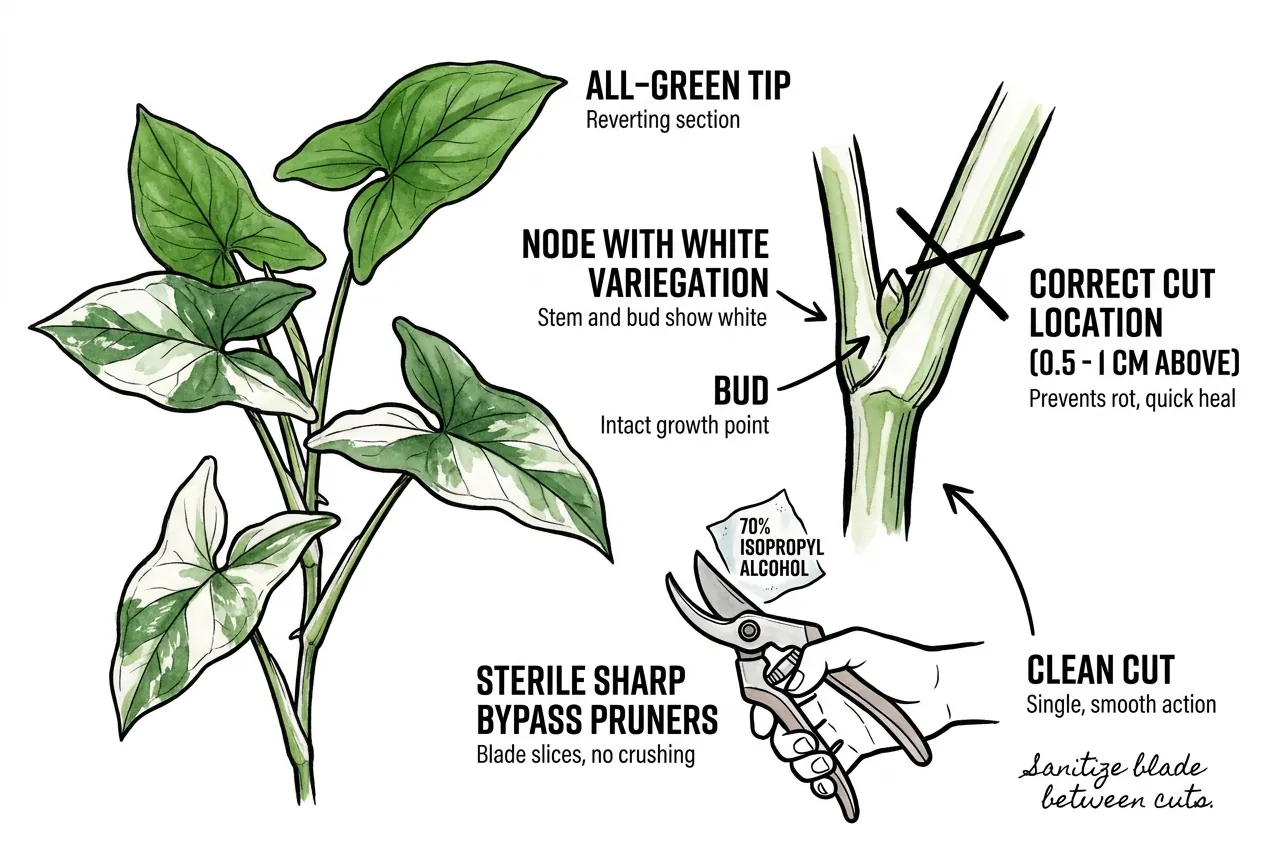
Trace down the stem from the all-green tip until you reach a node where white variegation is clearly present in the stem and at the bud.
Make a clean cut a short distance above that node, roughly 0.5 to 1 cm as a rule of thumb, leaving the bud intact.
Adjust for the stem size so you protect the bud rather than following the number exactly.
Tools and sanitation
Use sharp bypass pruners or a clean blade. Wipe off any sap or debris first, then disinfect the blade before and between cuts with 70% isopropyl alcohol, and dry it afterward.
This reduces the risk of introducing disease, though alcohol is not equally effective against every pathogen, so this is disinfecting rather than true sterilization.
A clean single cut generally heals better than a crushed or ragged one.
Any sharp, disinfected blade works. Small snips or a razor blade are often easier to control on thin Syngonium stems. The gonicc 8-inch Bypass Pruning Shears are an option when you also need a sturdier bypass tool for larger stems. They are not necessary for a small cutting.
Why a bypass blade
A bypass blade slices rather than crushes, which makes for a cleaner cut. It has a sap groove and can be wiped down with alcohol between cuts.
Whether a bud breaks cleanly afterward depends on the plant and conditions, not on the tool.
Size and upkeep
At 8 inches these are oversized for tiny props, and a small snip is often better for delicate work.
Like any carbon-steel tool the blade can spot with rust if stored wet, so dry it after disinfecting.
How soon should I prune?
There is no need to panic-prune, but do not ignore a reverting shoot either. The sensible approach is to base the decision on a few things rather than a strict deadline. Whether you have confirmed repeated all-green new growth, whether the plant is healthy enough to prune, whether there is a viable variegated node below to cut back to, and whether you have a propagation backup in case the regrowth disappoints.
Pruning while the plant is actively growing can help the lower bud break sooner. The general caution is that a reverted shoot left to run tends to keep going green and can dominate the plant, so it is worth acting once you are confident it is truly reversion, without over-cutting a valuable plant on a false alarm.
Safety before you cut
Handle the sap with care
Syngonium podophyllum contains insoluble calcium oxalate crystals, and its sap, stems, and leaves can cause skin irritation (contact dermatitis) in people.
Wear gloves, avoid touching your eyes or mouth, keep the cut sap off your skin, and wash your hands, tools, and work surface afterward.
The plant is also toxic to cats, dogs, and horses. Chewing it can cause oral irritation, drooling, swelling, and difficulty swallowing.
Keep cuttings, trimmings, and any rooting water away from children and pets, and contact poison control or a veterinarian if ingestion or swelling occurs.
Syngonium podophyllum (NC State Extension)
Arrow-Head Vine (ASPCA)
How do I propagate the cutting I just removed?
Keep the goal separate from viability here. An all-green cutting can usually root and grow fine, it just will not be variegated, so it does not preserve what you were trying to save.
An all-white or nearly all-white cutting is the opposite problem. With little or no functional chlorophyll it may survive for a while on stored resources but has no lasting engine for growth, so it tends to fade or rot over time.
A cutting that keeps both green and white tissue is the practical target.
Select a healthy piece with at least one node and a leaf. More nodes give you more buds to work with. Beyond that, the specific ratios and node counts you see quoted are rules of thumb without controlled data behind them for this plant, so do not treat them as guarantees.
What rooting setup works best?
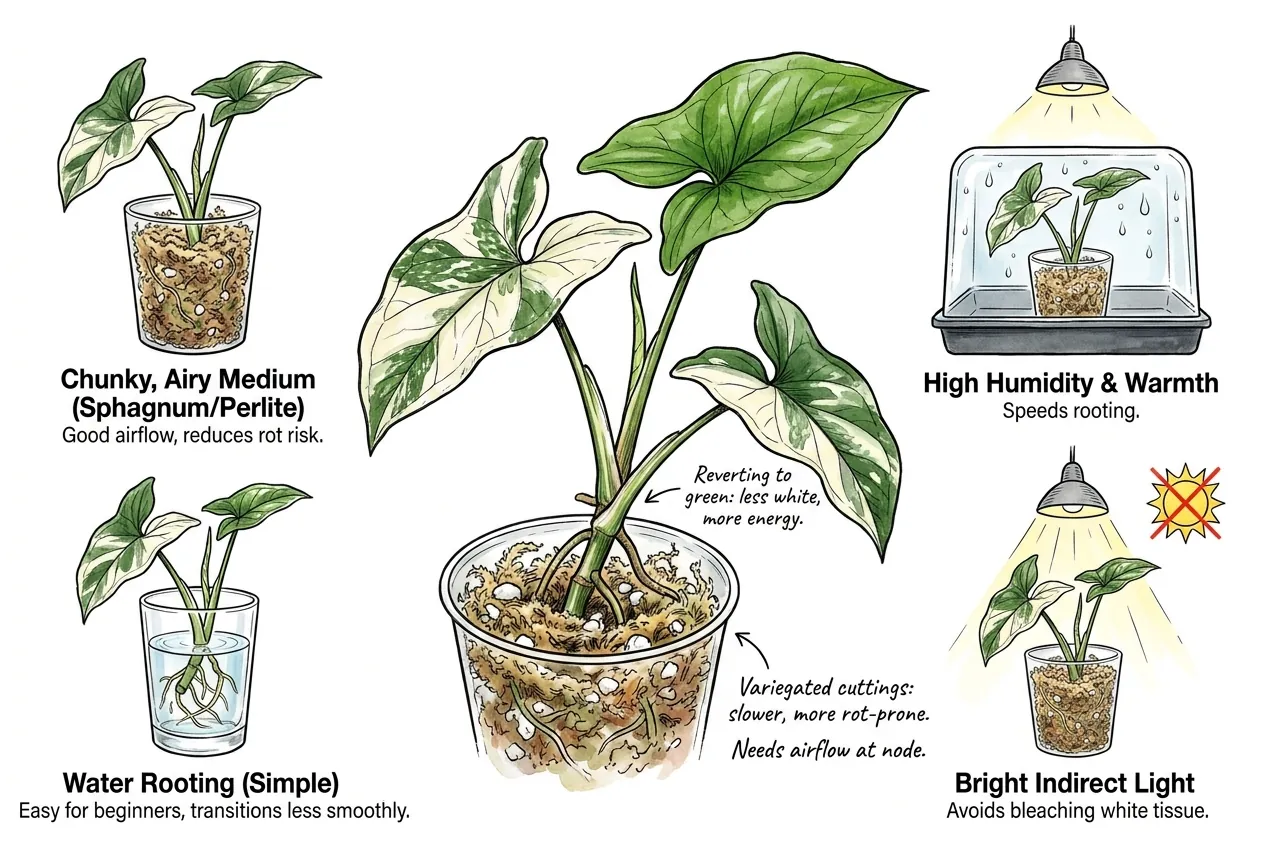
Sphagnum moss, perlite, and plain water can all root Syngonium cuttings. Water is the easiest to set up, but water-rooted cuttings can be a little fussier to transition into soil.
Whichever you choose, the fundamentals matter more than the medium. Keep the medium or water clean, moist but not waterlogged, and warm, and change or refresh water regularly.
A cutting with less green tissue has less energy to spare, so give it good hygiene and stable conditions.
If you use a covered propagation box for humidity, vent it periodically, watch for condensation, keep the medium from staying soggy, and check the cutting daily, since a sealed, over-wet box raises the risk of rot.
Use bright indirect light only, as for the parent, since white tissue on the cutting scorches under strong light just as it does on the parent.
Why Do Variegated Houseplants Have White Leaves?
How do I keep variegation balanced over future seasons?
The most reliable approach is consistency. Keep the plant adequately but not harshly lit, keep growth steady rather than explosive, and prune reverted shoots promptly.
You cannot make a chimera permanently stable, and there is no single guaranteed intervention, but steady care biases the odds toward balanced growth.
How do I hold the daily light steady?
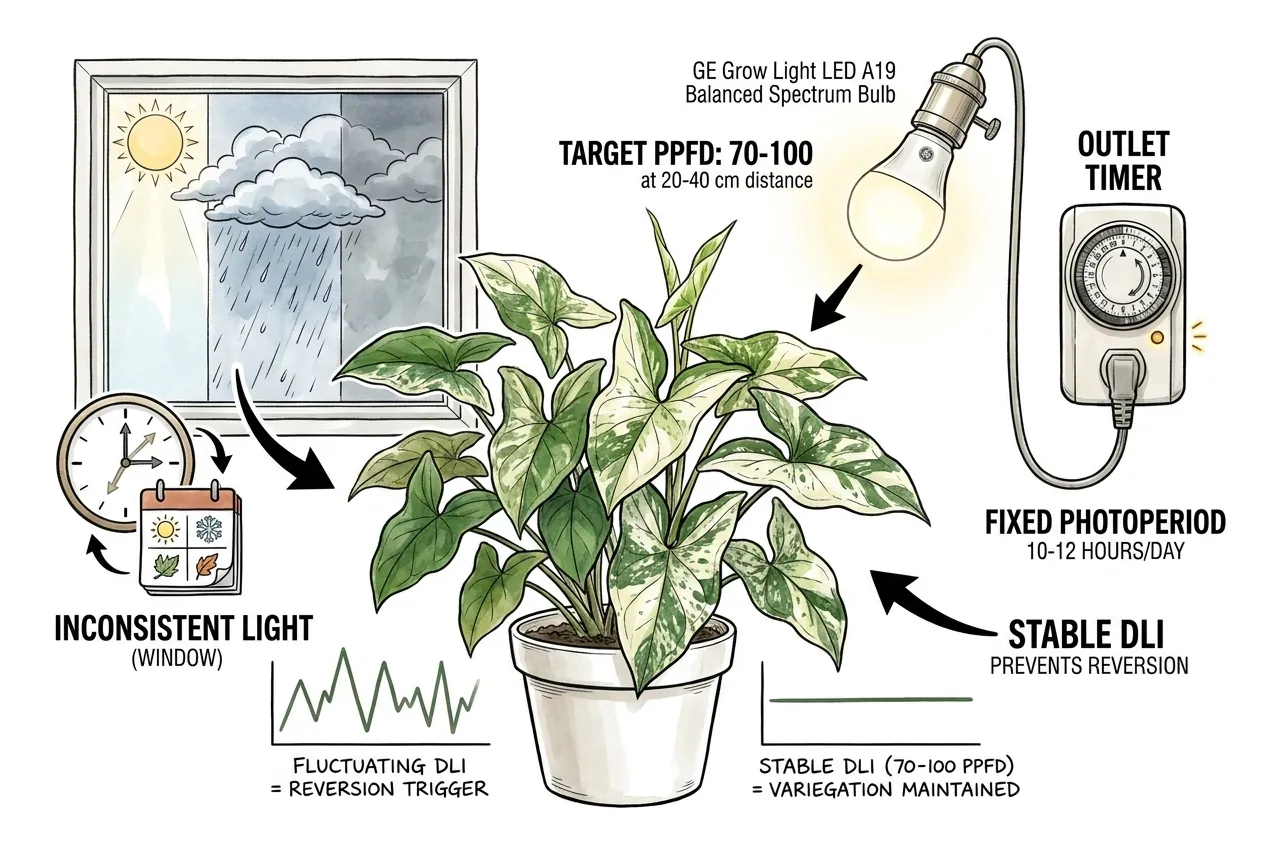
Aim to keep the daily light dose in the general low-light-foliage band, roughly 3 to 6 mol per square meter per day, which for these plants tends to mean something like 70 to 100 PPFD over 10 to 12 hours.
A grow light on a timer is convenient here because it repeats the same schedule day to day, whereas a window varies with weather and season.
Note that keeping light steady is about convenience and consistency. It has not been shown to prevent reversion, and window variability should not be treated as a proven reversion trigger.
A consistent photoperiod is one thing a timer provides that a window does not. Even so, the actual DLI at the plant still depends on lamp output, distance, and canopy changes, so verify it with a reading rather than assuming.
Pick a grow light and timer
Choose a light that reaches a useful level at the leaf, provides balanced white light, and can run on a fixed schedule. The GE Grow LED Plant Light Bulb A19 suits one small plant near a standard lamp socket and timer. It is not a practical single-light solution for a shelf of plants.
What a timer does
A fixed daily photoperiod on a timer keeps the schedule repeatable through cloudy weeks and into winter.
That is a convenience and consistency benefit. Do not read it as a guaranteed cure for seasonal reversion.
Coverage limits
A single A19 bulb realistically covers one small plant at close range. For a shelf you would step up to a bar or tube fixture.
Total PPF (16 µmol/s here) is not the same as PPFD at the leaf, which depends on distance and coverage, so verify placement with a meter and keep the leaf from overheating.
How do I avoid explosive green growth?
Very heavy nitrogen feeding can drive fast, soft flushes, so steady, moderate feeding is a reasonable general practice.
Be cautious about the stronger claim, though. There is no direct evidence that a particular feeding rate or temperature determines whether the green layer wins, so treat moderate feeding gives better-patterned growth as a plausible rule of thumb rather than a proven mechanism.
Keeping temperatures moderate, around or below 27 to 28 °C at the leaf, is sensible general care and avoids stacking heat stress on top of light, but it is a comfort guideline, not a validated reversion threshold.
And whenever you do see confirmed, repeated all-green growth, cutting it back to a variegated node before that shoot takes over remains the core response.
Key Takeaways
The white on a Syngonium Albo is generally understood as a chimera in the growing tip, not a pigment the plant can will back, so a stem that has reverted to all green does not become variegated again on its own.
Reversion is more often noticed during vigorous, warm-season growth. That fits the general rule that reverted shoots gain ground fastest when a plant grows fast, though it has not been measured in controlled Syngonium trials.
More direct sun is not a reliable fix. It risks scorching chlorophyll-poor white tissue and is not a dependable way to reverse reversion.
For light, think in terms of daily dose (DLI), which already combines intensity and hours.
Roughly 70 to 100 PPFD over 10 to 12 hours is a common starting point to verify with a reading, not a proven Albo threshold.
The main recovery is pruning. Cut back to a node whose bud still carries variegation before an all-green shoot takes over, base the timing on confirmed repeated reversion and plant health, and keep light and growth steady afterward.
Affiliate Disclosure
This article contains Amazon affiliate links. As an Amazon Associate I earn from qualifying purchases. If you use these links, the site may earn a commission at no extra cost to you. Product availability, price, and specifications can change. Check the current listing before buying.