
How to Stabilize Variegation & Stop Reversion
A practical guide to managing reversion in chimeral variegated plants: how to tell stable from unstable patterns, why all-green shoots can outgrow variegated ones, how to read light, and how to prune a confirmed reverted shoot back to variegated tissue.
Elena Vargas · Published 2026-02-02 · 13 min read

Key Takeaways
- Reversion usually means an all-green shoot has out-competed variegated growth. Green tissue photosynthesizes more than white or pale tissue, and care can favour variegated growth without permanently changing the underlying chimera.
- Read the stem and axillary bud, not a single leaf. On sectorial cultivars, a white stripe through or under the bud is a useful heuristic for a variegated shoot, but surface colour does not guarantee the outcome.
- Give the plant bright, indirect light and adjust from its response. Measured light helps compare spots, but no published foot-candle threshold switches reversion on or off.
- Use complete, balanced nutrition rather than a special low-nitrogen formula. There is no evidence that a specific ratio stabilizes a chimera, and cutting nitrogen too far can cause deficiency.
- Prune a clearly reverted shoot back to variegated tissue below it. Match the cut to the stem and bud rather than an arbitrary leaf count, and use normal indoor-humidity guidance.
Variegation covers several different situations. Some patterns are chimeral, with two genetically distinct cell lineages growing side by side, while others come from inherited genetics, transposons, epigenetics, pigment masking, structural air-space effects, viruses, deficiency, or damage.
These types respond very differently to care, and the advice below is aimed mainly at chimeral cultivars such as Monstera Albo and Thai Constellation.
For a chimeral plant, care cannot rewrite the genetics of the cells. What you can do is favour the variegated tissue, notice a reverted shoot early, and prune it back before an all-green shoot takes over the plant.
Reversion in a chimera is best managed by favouring healthy variegated growth, checking the stem and bud, and pruning only when an all-green shoot is clearly taking over.
Why does variegation disappear?
Why Green Shoots Win
In a chimeral plant, an all-green shoot has a real advantage. Green tissue photosynthesises, while white or pale tissue assimilates little or no carbon of its own.
In several variegated species, white tissue has been measured to fix very little CO2 and to depend on sugars supplied by the green tissue, acting as a heterotrophic sink rather than a source (Abadie et al., 2020).
Chimeral variegation involves two genetically distinct cell lineages growing together in the same shoot.
The green lineage contains functional chloroplasts. The white or pale lineage has few or none.
Calling the white tissue parasitic overstates the case. It is normal tissue of the same plant and can still contribute to structure, transport, and nitrogen storage, but it does draw on the plant’s sugar budget.
Because an all-green shoot is more photosynthetically productive, it can grow more vigorously and, over time, out-compete the variegated growth at the top of the plant.
That change in the visible pattern is what growers call reversion. It reflects which shoots and cell layers end up dominating the growing point, not a plant decision to turn green.
The white sectors of variegated leaves are not photosynthetically active
Is my plant stable or unstable?
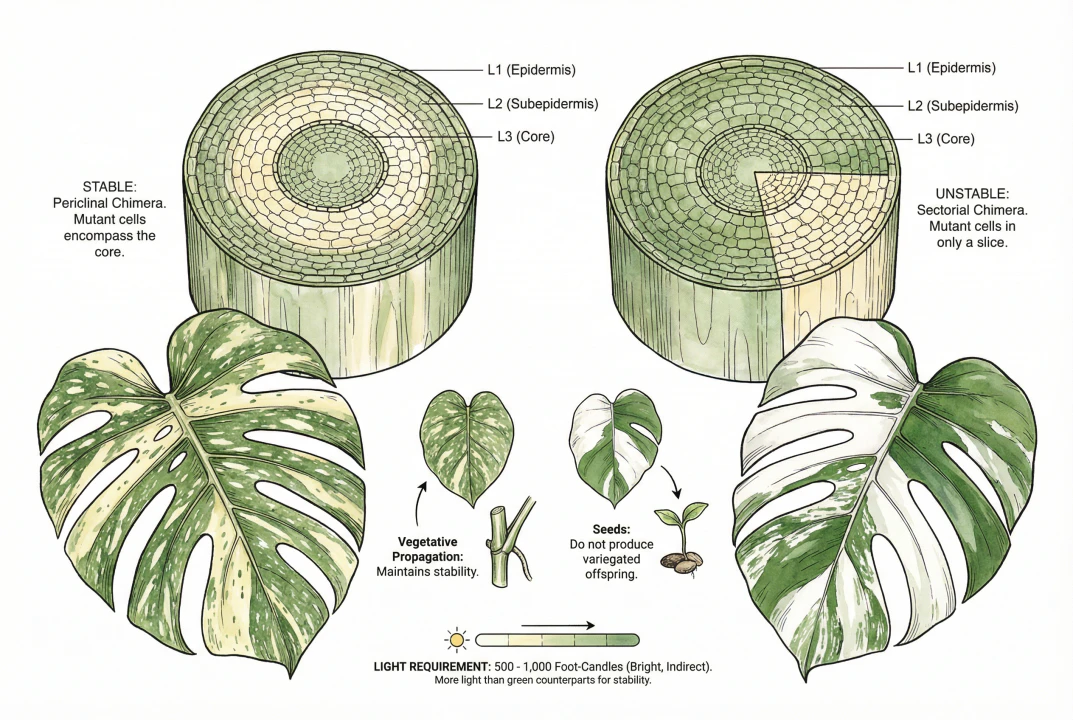
For chimeral plants, how stable the pattern is depends on how the two cell lineages are arranged in the shoot apical meristem. The layer of cells (often described as L1, L2 and L3) that generates new growth.
In a periclinal chimera a genetically distinct lineage occupies one or more complete meristem layers.
This arrangement is often relatively stable, and Monstera Thai Constellation is generally described as relatively genetically stable in propagation. The qualification matters because complete-layer chimeras can still break down depending on how the layers rearrange and on the propagation method.
In a sectorial chimera the two lineages sit side by side in a sector that can run through several layers, and such arrangements tend to be less stable.
Monstera Albo is commonly treated by growers as behaving this way. These cultivar labels are horticultural observations. Confirming the exact chimera type of a given plant needs cytological or genetic testing, not surface appearance alone.
Using a periclinal chimera to unravel layer-specific gene expression in plants
How much light does a variegated plant need?
Set a Bright, Adjustable Baseline
A variegated plant generally does well in bright, indirect light. There is no published foot-candle number that has been shown to keep a chimera stable, so treat light as something to provide generously and then adjust by watching the plant, not as a switch that turns reversion on or off.
Because a leaf with a lot of white or pale area photosynthesises less per unit of leaf than an all-green leaf, a heavily variegated plant may need a brighter spot, or more green leaf area, to gain the same total energy.
How much depends on the cultivar, how much of the leaf is green, and how the plant has been acclimated, so read this as a tendency rather than a fixed requirement.
Both extremes cause problems. Too little light leads to weak, leggy growth, and too much direct sun can scorch leaves. White or pale tissue, which lacks the pigments that protect green tissue, is often the first to burn.
But whether a given spot is too dim or too bright depends on leaf temperature, how long direct sun hits the plant, acclimation and the cultivar, not on a single foot-candle cutoff.
How to measure light accurately
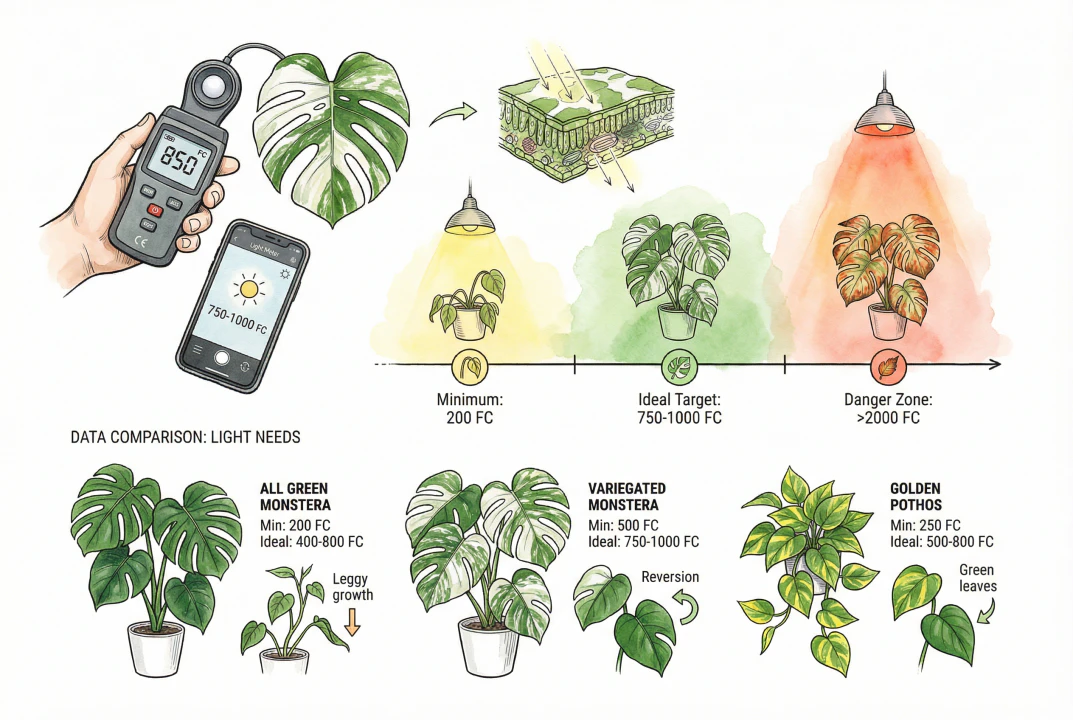
General houseplant references group plants into low-, medium- and high-light categories. For context, Missouri Extension describes medium-light houseplants as doing well around 250–1,000 foot-candles, with 500–1,000 foot-candles from artificial light.
Those are broad indoor-light ranges, not variegation-specific targets, and none of these sources give a foot-candle number for keeping variegation stable or preventing reversion.
A meter is still useful for comparing spots, because our eyes adapt to dim rooms and are poor judges of intensity.
An inexpensive lux/foot-candle meter lets you compare, say, a north window with a spot two metres back.
Dr.meter Digital Light Meter
Dr.meter Digital Light Meter measures illuminance weighted for human vision, not the PAR/PPFD that plants actually use, so it is best for comparing natural or white-lamp locations rather than judging grow lights.
Take several readings at leaf level across the canopy and at a few times of day rather than one number at noon, since a single midday reading does not tell you the daily total (the DLI) or the light reaching leaves that face away from the window.
For grow lights, a PPFD reading and DLI are more informative than foot-candles, and phone-app readings vary with the device and its calibration.
Lighting Indoor Houseplants | MU Extension
Can fertilizer cause reversion?
What Fertilizer Can and Cannot Change
Nitrogen is needed to build chlorophyll and photosynthetic proteins, so it is easy to assume that more nitrogen pushes a variegated plant green. The evidence is narrower than that.
In one study of Hosta Gold Standard, excess nitrogen turned the golden centre of the leaf green while the green margin did not obviously change.
That is a cultivar-specific effect on pigment expression, not proof that feeding a well-fed chimeral Monstera more nitrogen rewrites its cell genetics or forces the white lineage out.
Use Complete Nutrition
Avoid over-fertilising and give the plant complete, balanced nutrition.
There is no controlled trial showing that a deliberately low-nitrogen diet stabilises variegation, and restricting nitrogen too far risks deficiency, chlorosis, and weaker growth, the opposite of what you want.
Supply the other nutrients a plant normally needs, correcting potassium or magnesium if a deficiency shows, rather than dosing extras on the assumption they will hold the pattern.
Nitrogen affects leaf variegation in Hosta ‘Gold Standard’
The ideal NPK ratio
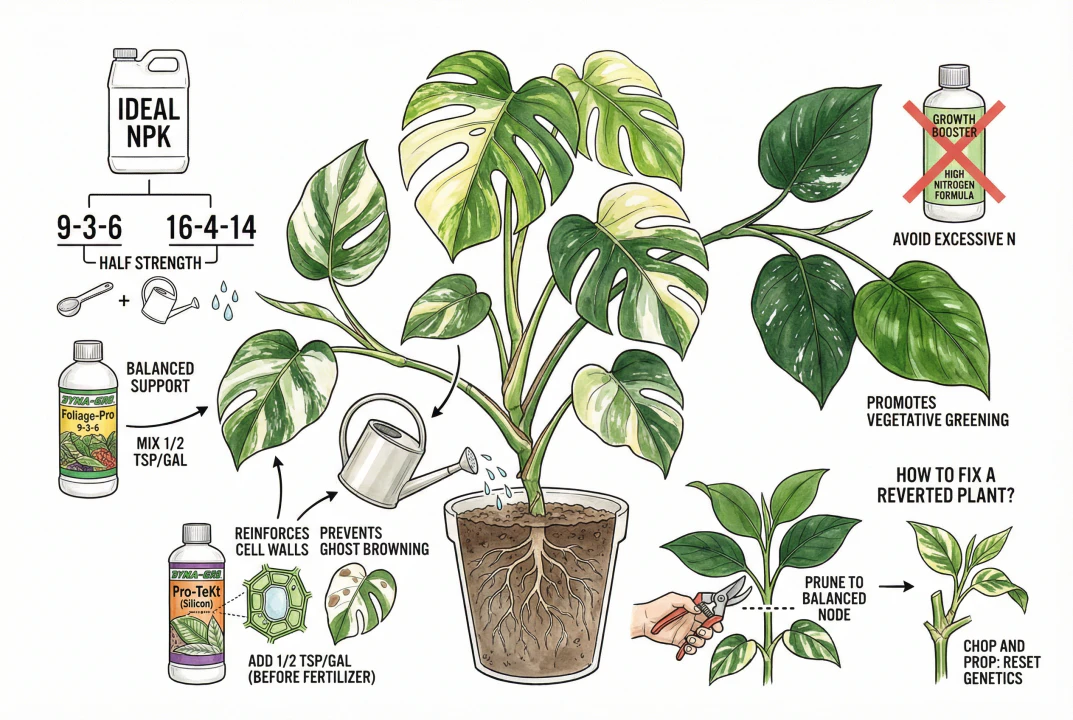
The three NPK numbers on a label are percentages of nitrogen, phosphorus, and potassium by weight.
Diluting to half strength lowers the concentration you deliver, but it does not change the nitrogen-to-potassium ratio. A formula does not become lower in nitrogen than potassium by being diluted.
In a product like 9-3-6 the nitrogen value is higher than the potassium value, and in 16-4-14 nitrogen is also higher than potassium.
Both are complete fertilisers, but neither is an example of nitrogen at or below potassium. Rather than chasing a specific ratio for variegation, for which there is no controlled evidence, pick a complete fertiliser and pay attention to the actual dose, which depends on the medium, your source water, and the label rate.
A complete, urea-free foliage fertiliser is a credible general choice when it supplies the main macro- and micronutrients in one bottle.
SUPERthrive Foliage-Pro 9-3-6
SUPERthrive Foliage-Pro 9-3-6 (formerly sold under the Dyna-Gro name) provides that complete profile.
Treat it as ordinary balanced nutrition, not a reversion treatment. There is no evidence that it, or any low-nitrogen formula, stabilises variegation.
Follow the label rate and adjust for your substrate, water, and the season rather than fixing on one dose.
Silicon is a beneficial element that can help cell-wall and stress physiology in some crops, but for most plants it is not essential, and how much a plant takes up and where it deposits it varies a lot by species, tissue and dose.
There is no controlled study showing that silicon, or a specific product, prevents browning of the white sectors on a Monstera.
SUPERthrive Pro-Tekt
SUPERthrive Pro-Tekt (0-0-3), formerly sold under the Dyna-Gro name, is at most an optional silica trial. It is not a treatment for reversion, so use it only when the label fits your existing nutrition plan.
If you do try it, stir it into the water before adding the fertiliser to reduce the risk of precipitation.
Bear in mind it is a 0-0-3 product, so it also adds potassium and alkalinity. Check the final pH and EC before stacking it with a complete fertiliser, since browning has many causes (sun and heat, watering and root problems, salts, mechanical injury, pests and normal ageing) that a silicon supplement will not address.
How do I fix a reverted plant?
Prune Back to Variegated Tissue
Once a shoot has clearly reverted to all-green, the standard advice from horticultural sources such as the RHS and UF/IFAS is to trace that shoot back and prune to variegated tissue below it.
Cut back to a point on the stem that still carries the variegated pattern.
Pruning does not reset the genetics or bring back the cell lineage you removed. What it does is remove the dominant all-green shoot so that other buds, which may still carry variegated tissue, get a chance to grow.
A solid-green leaf is a warning sign that an all-green shoot may be taking over at that point, though a single leaf can be transitory. Watch the next leaf or two and the stem and bud pattern before deciding.
Removing the growing tip relaxes apical dominance and can prompt a lower bud to activate. It does not force a particular bud, and it does not guarantee the new shoot will be variegated, which bud responds depends on the plant, its root vigour and the season.
Reversion in variegated plants | RHS
Genetic chimeral reversion | UF/IFAS
The Stem Stripe Rule
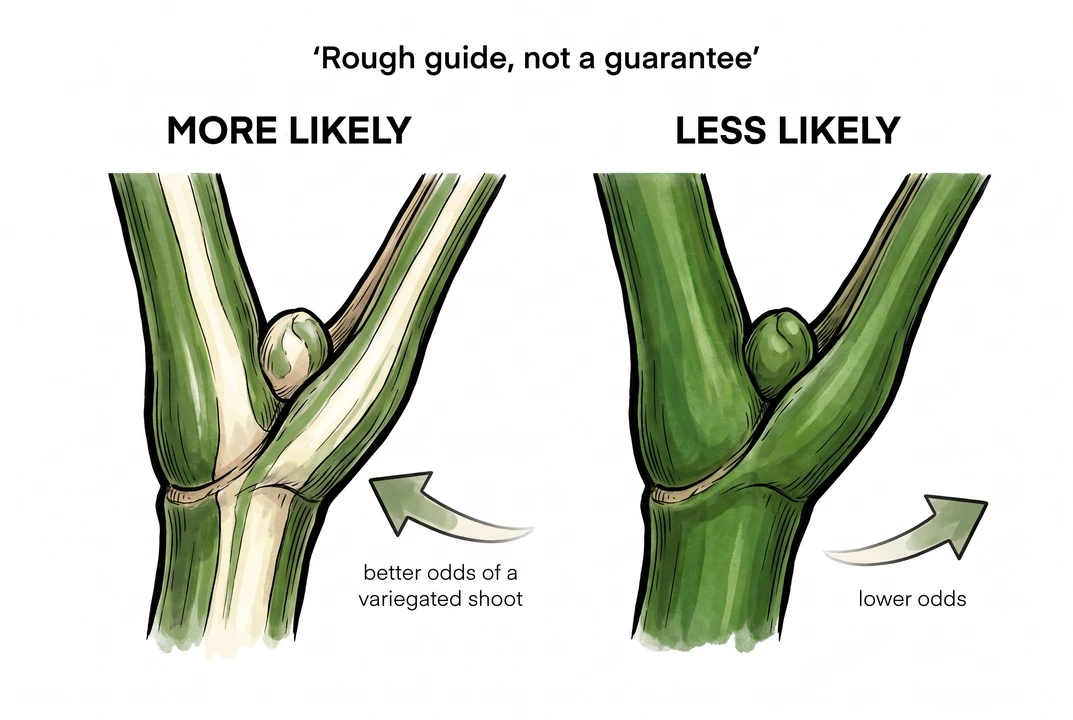
Don’t rely on a single leaf. Read the stem and the axillary bud together with the recent leaf sequence.
On sectorial cultivars like Monstera Albo, look for a node where a stripe of white variegation runs through or underneath the axillary bud.
This is a practical heuristic used by growers, not a measurement of what the internal cells will produce.
- Stripe through the eye. Better odds of a variegated shoot, but not certain. Surface colour does not fully reveal the founder cells inside the bud.
- Entirely green stem and bud. Lower odds of a variegated shoot, though rarely truly zero.
I number candidate nodes with loose removable tags and photograph the full circumference of each stem before choosing a cut. One front-facing photo can hide the exact point where a pale sector misses the bud eye. I rotate the stem or camera until both sides of the node are documented.
After pruning, I keep the node number with the plant and judge the new shoot by its stem, bud, and leaf sequence rather than its first leaf alone. This turns an uncertain pruning decision into a record I can compare when the next node must be chosen.
Step-by-Step Pruning Guide
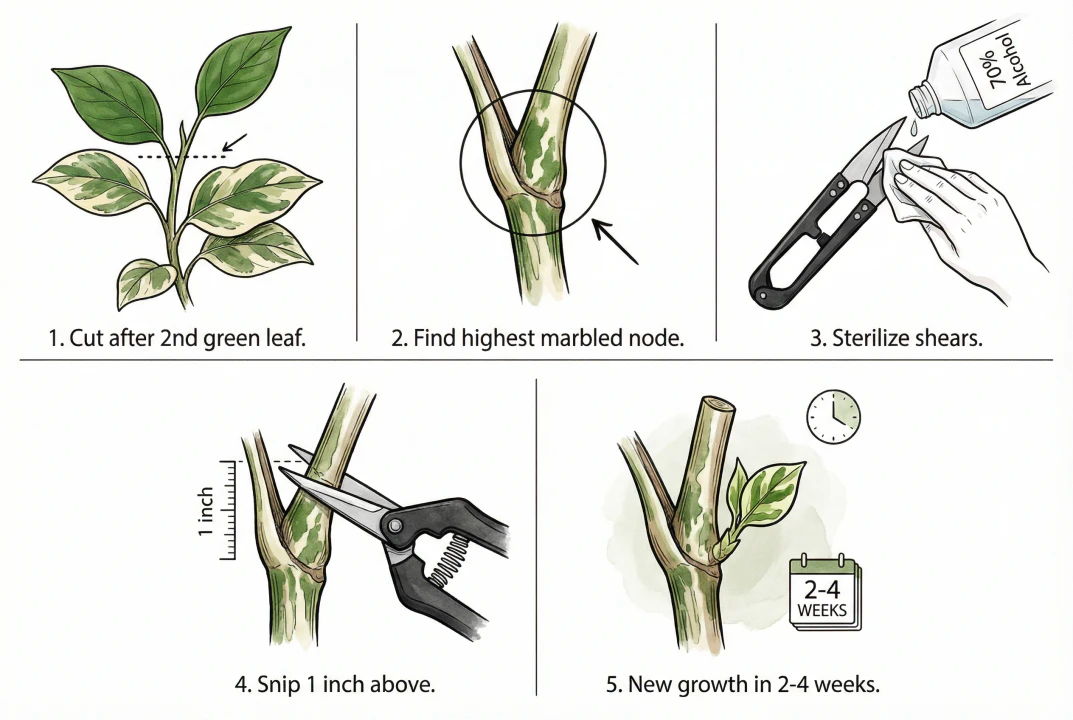
- Confirm the reversion. Make sure a shoot has genuinely gone all-green. Watch the leaf sequence and the stem, rather than reacting to a single leaf.
- Choose the target node. Find a node below the reverted growth that still shows variegated tissue and a healthy bud. Surface marbling alone does not guarantee the bud will produce variegation.
- Clean and disinfect the tool. Wipe off debris first, then disinfect the blade with 70% isopropyl alcohol (dip, wipe or spray) and let it air-dry. This disinfects rather than fully sterilises, and alcohol is flammable.
- Make the cut. Cut cleanly just above the node without crushing the bud. Close enough to avoid a long stub that can die back, but not so close that you damage the bud. The right distance depends on the stem’s thickness.
- Wait and observe. A new shoot may emerge over the following weeks, but timing varies with temperature, light, root health, season, node maturity and species.
A clean, sharp cut just above the bud matters more than any particular brand of tool. For tender, narrow stems and tight internodes, a fine snip works well. For a thick, mature Monstera stem it may lack the blade capacity, so use a sharp bypass pruner or knife sized to the stem.
Fiskars Micro-Tip Pruning Snip
Fiskars Micro-Tip snips suit tender, narrow stems and tight internodes. Whatever the tool, keep it sharp and disinfect the blades with 70% alcohol between cuts, especially between plants or after cutting diseased tissue.
Dealing with all-white leaves
How White Tissue Uses Carbon
An all-white leaf sector, sometimes called a ghost leaf by collectors, has little or no functional chlorophyll, so it fixes very little carbon of its own.
Not every pale or white-looking area is chlorophyll-free. Some is pigment masking or structural, but a truly achlorophyllous leaf mostly draws on sugars made elsewhere in the plant.
That makes such a leaf a heterotrophic sink rather than a parasite. It is still normal tissue and can play a part in the plant’s structure and metabolism, but it does not pay its own way in sugar.
A single all-white leaf is not a problem, and many growers simply enjoy it. Repeated all-white growth, however, can gradually weaken a plant’s overall carbon balance, so it is worth considering pruning.
Base that decision on the plant’s total green leaf area, its reserves and whether viable variegated buds remain lower down, not on a fixed leaf count.
Affiliate Disclosure
This article contains Amazon affiliate links. As an Amazon Associate I earn from qualifying purchases. If you use these links, the site may earn a commission at no extra cost to you. Product availability, price, and specifications can change. Check the current listing before buying.