
Hoya Carnosa Sunscald: Preventing Summer Sun Damage
Hoya carnosa compacta and summer sunscald: why strong sun can scorch a Hindu rope, how to harden off gradually, and how to help a burned plant recover.
Elena Vargas · Published 2026-06-13 · 28 min read

Key Takeaways
- On a Hindu rope, strong sun can cause sunscald. Living cells oxidize and die, and clearly dead tissue does not turn green again.
- A Hoya grown in low light tolerates far less than one grown bright. Judge by the plant’s recent conditions, not the species name.
- Window glass blocks most UV-B, and outdoor light is usually much brighter than a windowsill. An abrupt move outside is therefore a large, unpracticed change.
- Harden off gradually over about two weeks. Start in shade, then add short spells of gentler sun, and pull back at the first sign of scorching.
- Keep burned leaves that still show healthy green. Remove only leaves that are mostly dead or clearly diseased.
A Hindu rope plant that was thriving on your windowsill can show pale, papery patches within a few days of a move into strong summer sun.
When the pattern lines up with the sun, this is most likely sunscald, the everyday term for high-light injury.
It is a common collision between a shade-grown leaf and much brighter light than it grew under.
Confirm that the marks follow the light exposure, then reduce the light and increase it again only in small steps. The listed numbers are scale references, not a validated Hoya-specific prescription. Check for pests, spray residue, and root or watering problems when the pattern does not match the light.
What is sunscald on a Hoya, and how is it different from a passing color change?
Separate Permanent Scald From Color Change
Sunscald is photooxidative injury. Excess light drives cell death in the leaf tissue, and the clearly dead tissue never turns green again.
That permanence is the key difference from a temporary color shift. The leaf’s surface wax and cuticle can help screen light, but there is no direct evidence that wax loss must come first for a Hoya to scorch, so treat the surface layer as one possible protective factor rather than the trigger.
On a Hindu rope, the matte sheen on the leaves is worth preserving. Surface wax and the epidermis can reflect and filter some light before it reaches the chloroplasts, though the exact reflectance of this cultivar has not been measured.
I photograph the sun patch when direct light first reaches the plant, halfway through the exposure, and 15 minutes before the leaves return to shade. These three points follow the moving beam rather than arbitrary clock times. Compacta folds create small hot pockets, so one exposed outer curl may burn while the rest of the vine stays unchanged.
When acclimating the plant, I add 15 minutes of direct exposure every three days and pause at the first new pale or crisp patch. Three days gives exposed tissue time to show a response before the next increase. Existing scars will not heal, so a fully expanded new leaf without fresh damage is the useful endpoint.
For this check, I set an infrared thermometer to 0.95 emissivity and work close enough to keep its measurement spot inside one leaf curl. I take three readings from sunlit outer curls and shaded leaves, then compare their medians with a shaded air sensor beside the plant. The fixed emissivity, spot size, and median keep background surfaces or one unstable reading from deciding the result.
What does sunscald look like on a Hindu rope?
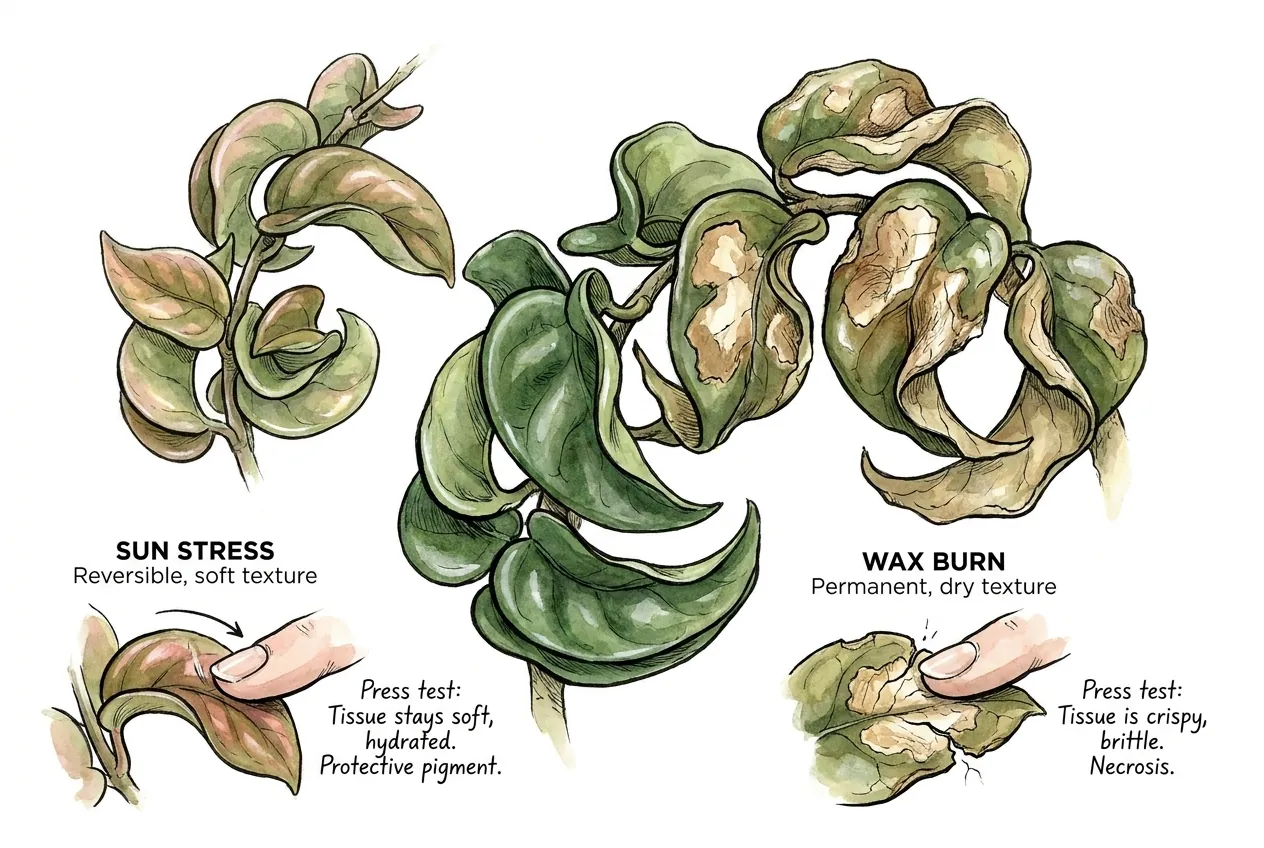
It often looks like bleached, tan, or brown patches with a dry, papery, or crispy texture, usually concentrated on the side of the leaf that faced the light.
Where the damage is worst, the sheen may be dulled, though a dull patch on its own can also come from abrasion, residue, or age.
Compare that to mild sun stress, which tends to show pink, bronze, red, or purple tones on tissue that stays soft, flexible, and hydrated. That coloring is often living cells making protective pigment.
Dry, bleached, dead tissue is necrosis.
Feel the Tissue
Texture is a useful clue, not a validated test. Tissue that is still soft with a gradual color shift is more likely living and may recover. Tissue that is bleached, tan, dry, or crispy is usually dead.
Soft lesions can also come from edema, rot, or chilling, and dry lesions from salt, drought, heat, or chemical injury, so weigh the whole picture rather than one squeeze.
| Signal | Mild sun stress (often reversible) | Sunscald / dead tissue (permanent) |
|---|---|---|
| Color | Pink, bronze, red, purple | White, tan, beige, brown |
| Texture | Soft, flexible, hydrated | Dry, papery, brittle, crispy |
| Waxy sheen | Intact | Dulled or gone in the patch |
| Tissue state | Living cells, protective pigment | Dead cells, necrosis |
| Outcome | Colour can fade back over weeks | Dead patch does not regreen |
Houseplant Sunburn vs Sun Stress
Why can the damage appear a day or two after a sunny afternoon?
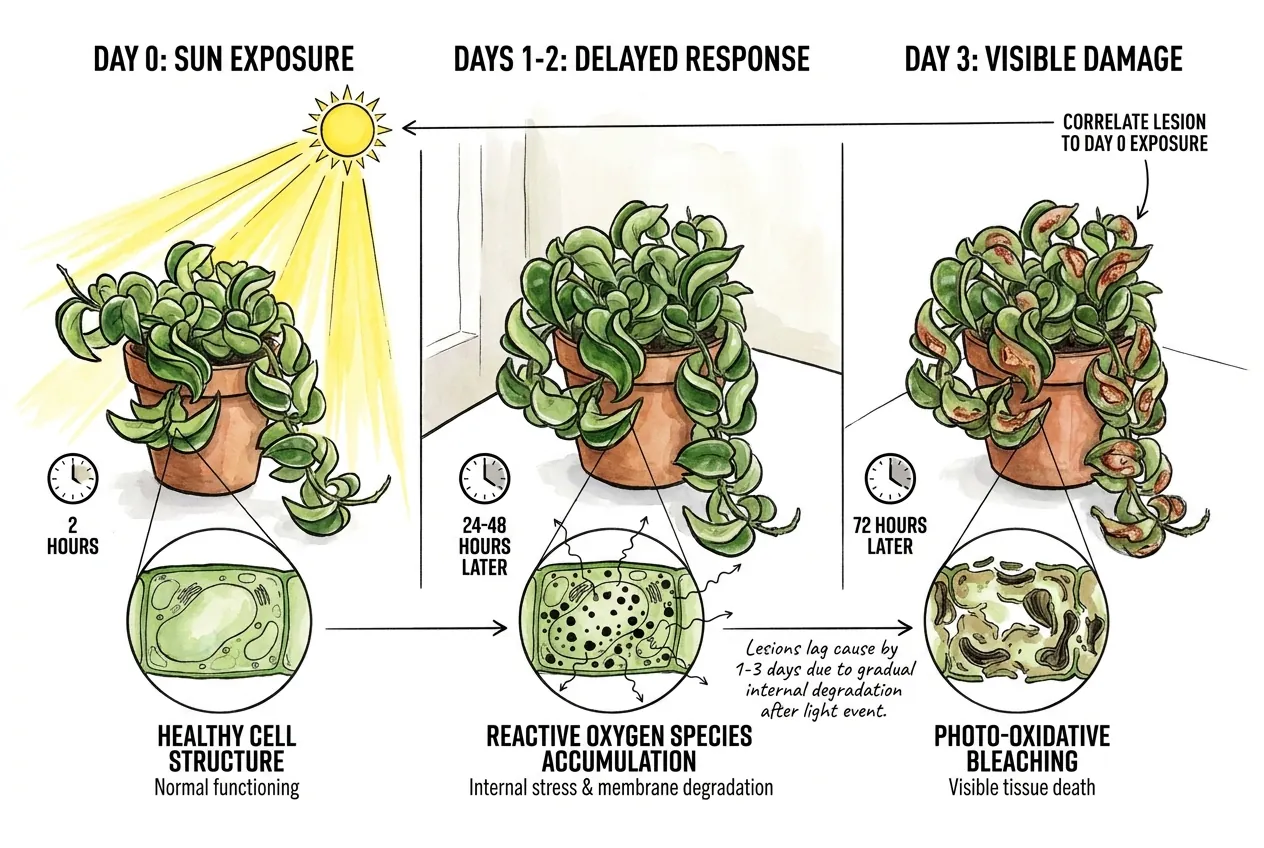
A visible lesion can lag the light event because photooxidative bleaching develops as reactive oxygen species accumulate and membranes degrade.
Onset is not fixed, though. Sunscald can show during the exposure, within hours, or over the following days, and repeated exposures can add up.
This delay is one reason owners misdiagnose the problem. It is easy to blame yesterday’s watering rather than a strong sun exposure a day or two earlier.
When a new lesion appears, note the date and look back over recent light changes, but also weigh watering, root health, temperature, and any sprays, since those can cause similar marks.
How do I rule out edema, thrips, or other look-alikes?
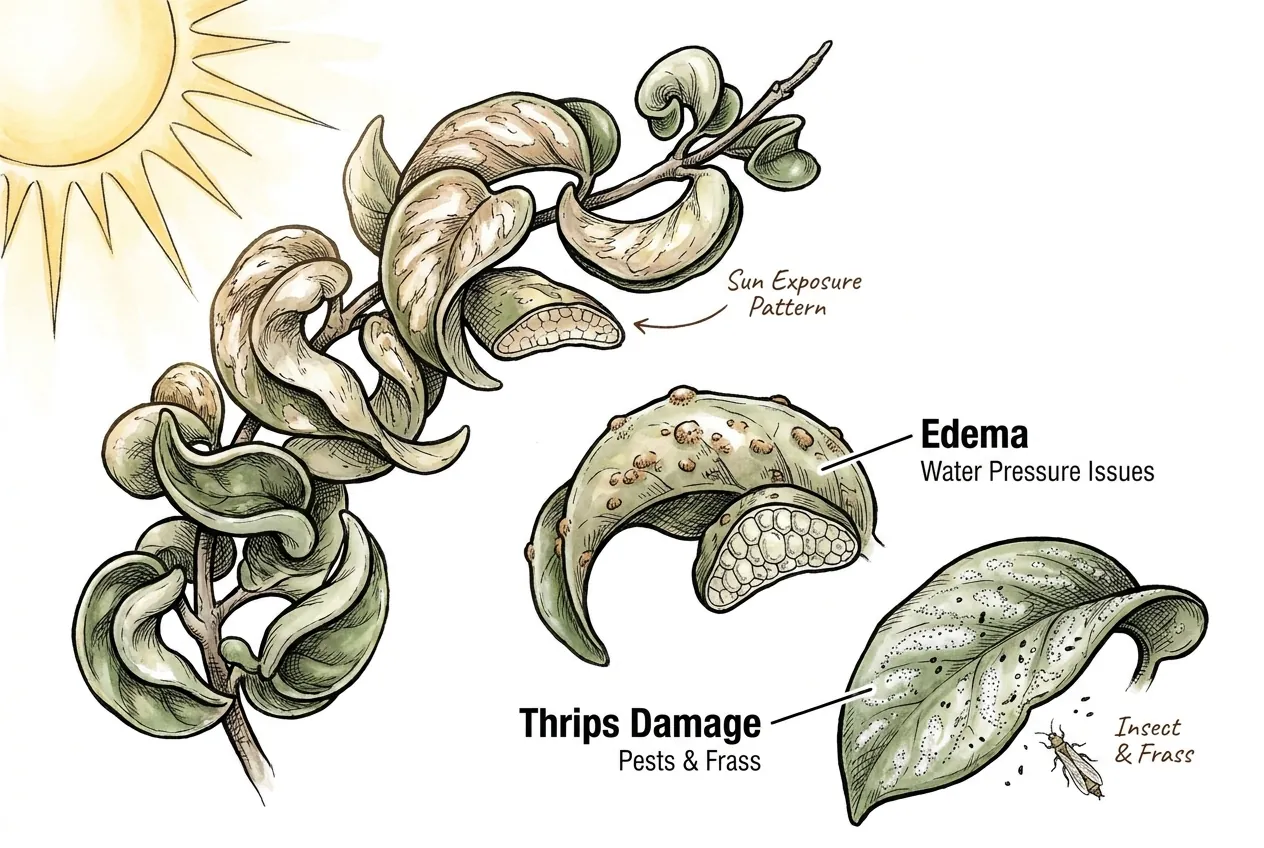
Check the geometry and the leaf undersides first. Light damage tends to follow the exposure, clustering where the sun actually hit, usually one side or the top of the plant.
Edema and pests often ignore that pattern, though heat from glass or spray residue can also be uneven.
Edema shows as corky bumps on leaf undersides from water-pressure issues, not bleaching, though it can start as translucent blisters.
Thrips leave silvery stippling with tiny black frass specks, and you can sometimes find the insects, though they are not always in view.
If the discoloration tracks the sunniest face of the plant and the texture is dry, sun or heat injury moves up the list, but rule out chemical residue and pests before settling on it.
Why is Hoya carnosa compacta so easy to scorch?
Judge Light by Recent Acclimation
Hoya carnosa is a CAM epiphyte that grows well in shaded, filtered light, and a 1987 study found it showed apparent photoinhibition under full glasshouse light it had not grown under.
Photoinhibition means reduced photosynthetic performance, which is not the same as visible burning, but it points the same way. A plant grown dim has less protective capacity in reserve.
A specimen kept in low indoor light is usually toward the low end of that range, though its exact tolerance depends on its own history, not the cultivar name.
The practical takeaway is that the safe-light limit is set mostly by the light the plant has been living in recently, alongside temperature and how long the exposure lasts, not by the species name on the tag.
What light is the Hindu rope actually built for?
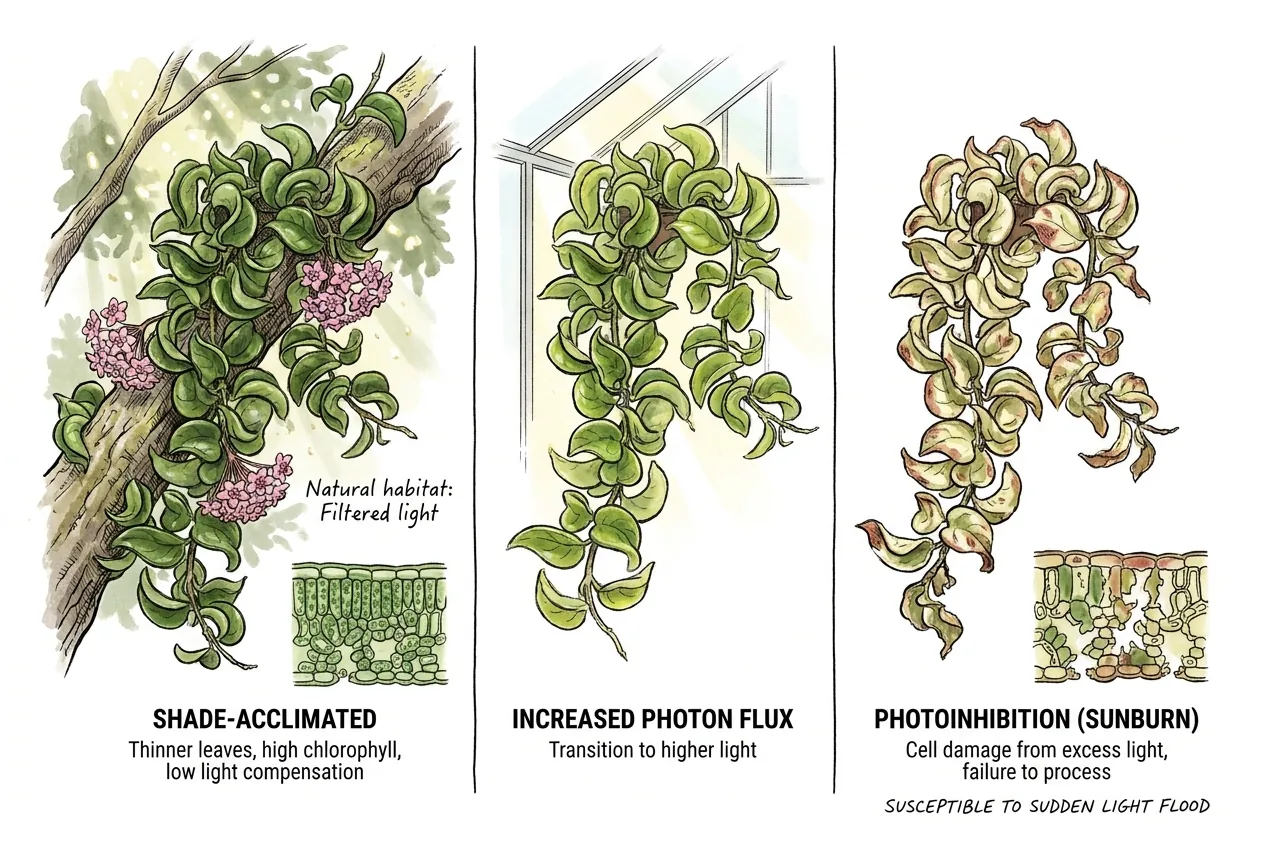
The wild species, Hoya carnosa, grows as an epiphytic climbing vine in subtropical and tropical Asian forest, on trunks and branches under a canopy, where it receives filtered light and sunflecks rather than unobstructed midday sun.
The compact cultivar is a nursery selection of that species, so its habitat is a useful backdrop rather than a description of the cultivar itself.
The 1987 study reported that Hoya carnosa grown under full glasshouse photon flux density apparently experienced photoinhibition.
Read narrowly, that means a shade-acclimated plant can be susceptible to photoinhibition when moved to much higher light than it grew under. The study did not observe visible burning or wax damage.
In general, shade-acclimated leaves tend toward thinner tissue, a lower light compensation point, and more chlorophyll.
That configuration is good at harvesting dim light and less able to cope with a large, sudden increase, though these specific traits were not all measured in this cultivar.
Responses of Two CAM Species to Different Irradiances and Susceptibility to Photoinhibition by High Light
Why does being an indoor compact cultivar make it worse?
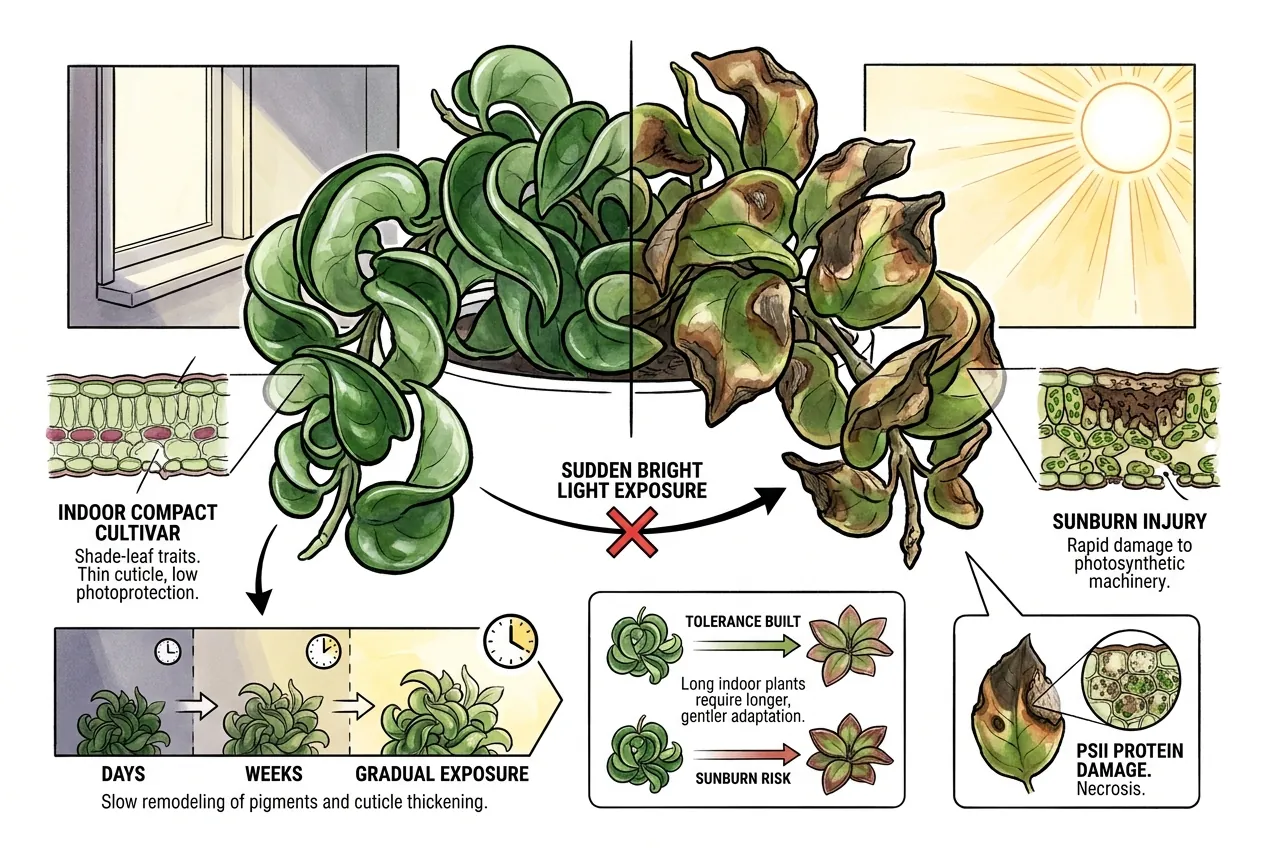
A compacta that has been in low, glass-filtered light for a long time is likely carrying shade-leaf traits with limited photoprotective reserves, so it usually has more adjusting to do before it can take strong sun.
How far it has to go depends on the individual plant’s history, which you often cannot know precisely.
Building tolerance generally involves adjusting pigments, raising photoprotective capacity, and, in newly formed leaves, changes to the cuticle.
None of that is instant. It takes days to weeks of graded exposure, and already-mature leaves may change less than new growth does.
Give a long-indoor plant a longer, gentler ramp than a nursery plant that was already grown bright, and adjust by watching how the leaves respond.
Plant responses to UV-B radiation. Signaling, acclimation and stress tolerance
Does the same exposure burn one plant but not another?
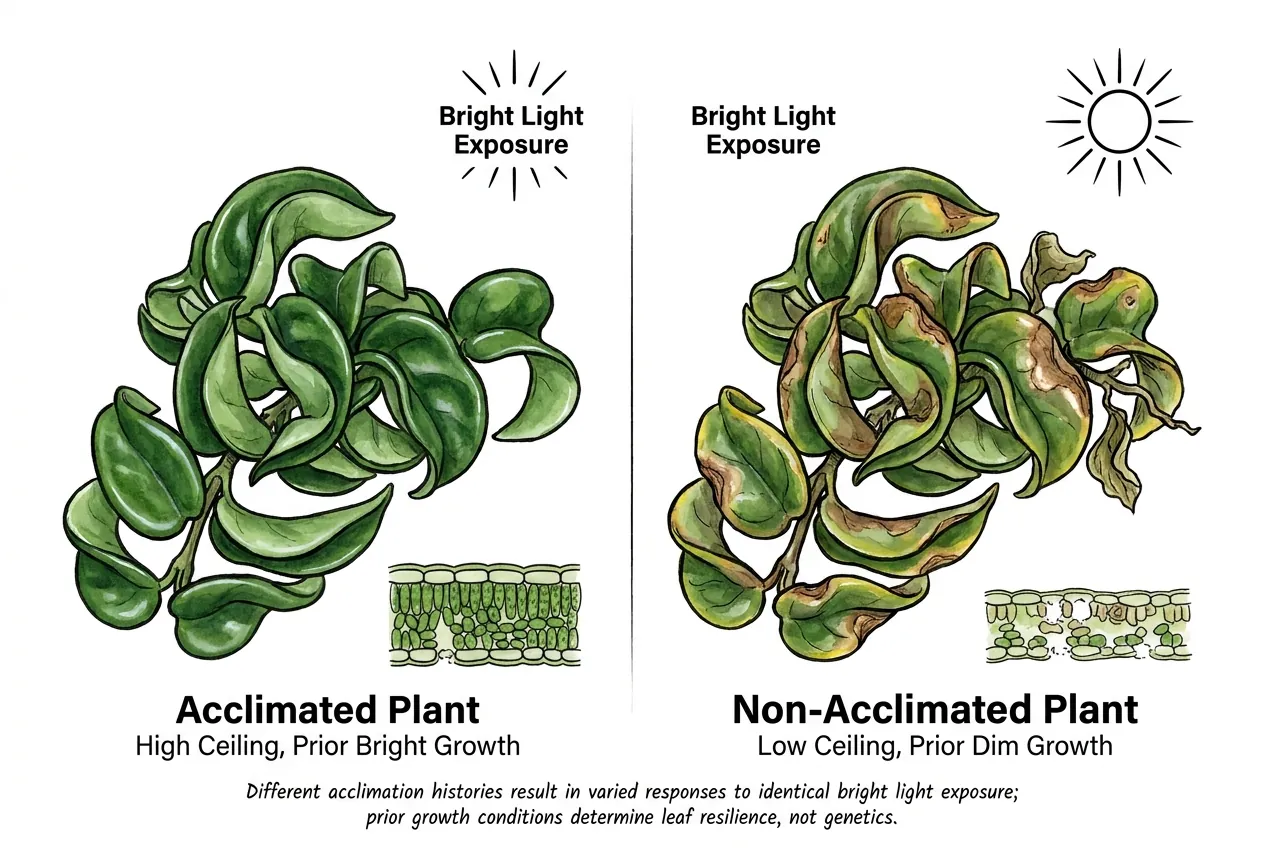
Often, yes. Acclimation history is a big part of it. A plant grown brighter usually tolerates more. But it is not the only factor.
Root health, water status, leaf age, nutrition, pests, and microclimate all shift how a given plant responds, so two similar cuttings can differ for several reasons.
A plant that has been at a north window is likely tuned to low light. Moved to a south window in July, it can scorch in light that a brighter-grown sibling would tolerate.
Ramp each plant from wherever it has actually been living, and track that history so you are not caught off guard.
How does the spectrum outdoors differ from a bright window?
Treat Outdoor Light as a New Exposure
Outdoors, both the spectrum and the brightness change. Clear window glass blocks most UV-B and reduces UV-A, though the exact transmittance depends on the glass type, thickness, and any coating.
So a plant grown behind glass is used to little UV-B and, usually, lower light.
Move it outside and it can meet more UV-A, added UV-B, and several times more photosynthetically active radiation at once, with less acclimation to any of it.
UV is only one part of the risk, though. How bright the light is, how long it lasts, and how hot the leaf gets all matter too.
How much UV does my window actually block?
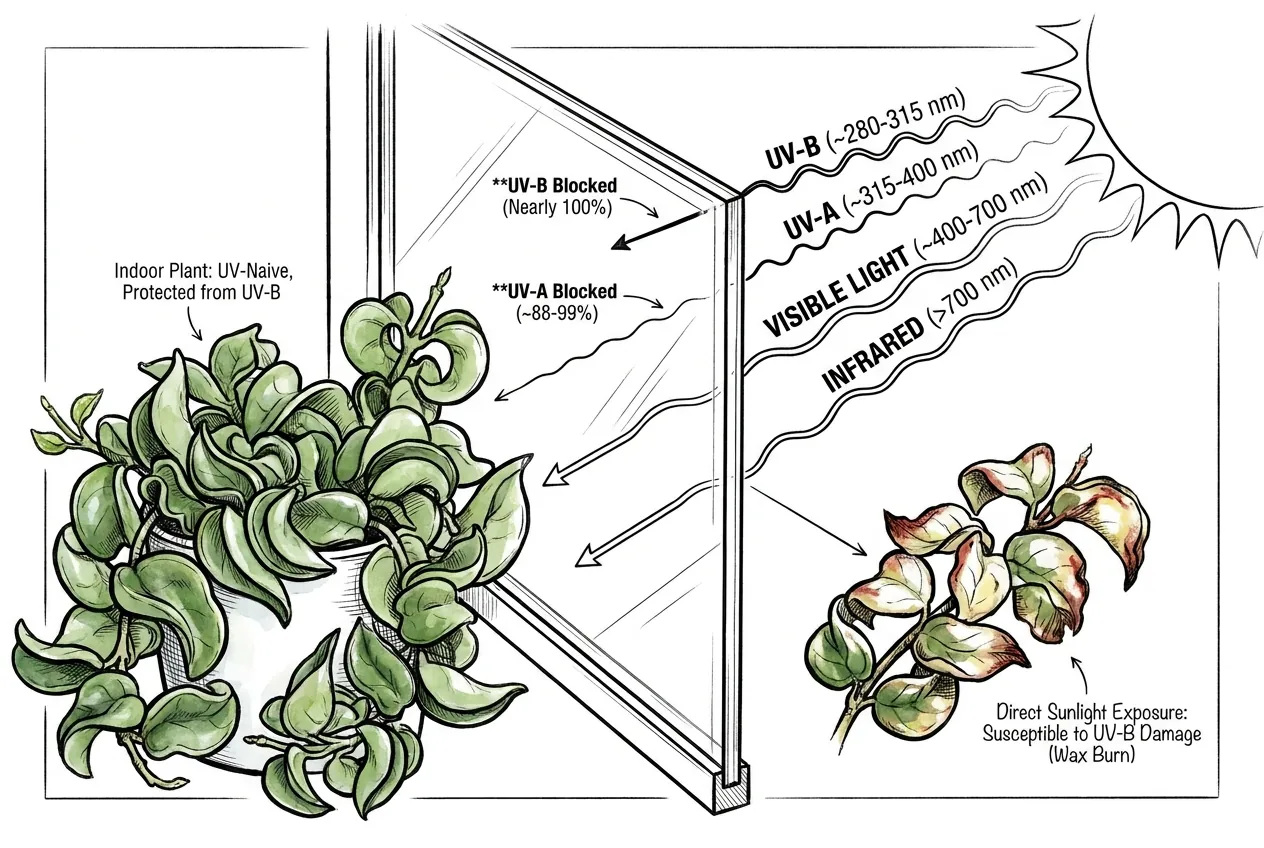
Window glass changes the UV that reaches a plant, but it does not make direct sun harmless. A Hoya that has only lived behind glass can still be poorly prepared for outdoor light, heat, and longer direct exposure.
How big is the brightness jump from windowsill to summer sun?
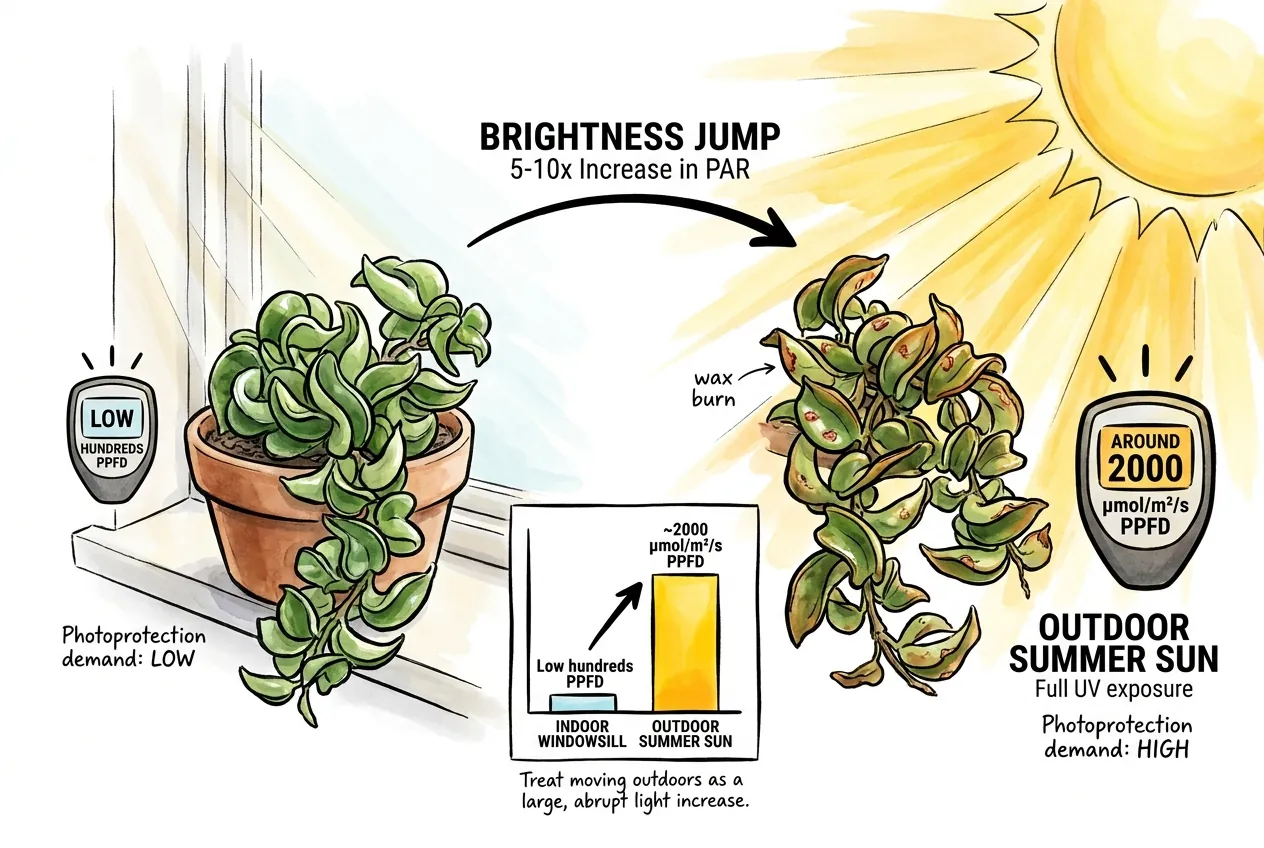
It is often a large jump, on the rough order of several-fold, but the exact multiple depends on the window, its orientation, distance from the glass, weather, latitude, and time of day.
As a scale reference, clear-sky midday summer sun can reach around 2000 µmol per square meter per second of PPFD, while a bright indoor spot is frequently a small fraction of that.
Measure if you want a real number for your setup.
Photosynthesis in a shade plant saturates at a modest PPFD. Light beyond that point has to be dissipated safely. When the plant’s protective systems are overwhelmed, that surplus energy feeds the damage cascade.
| Factor | Indoor, behind glass | Outdoor summer sun |
|---|---|---|
| UV-B present | Mostly blocked by glass | Yes |
| UV-A | Reduced | Full |
| PPFD (PAR) | Usually far lower (measure it) | Up to ~2000 µmol/m2/s at clear midday |
| Photoprotection demand | Low | High |
Treat moving a plant outdoors as a large, abrupt light increase and plan the ramp around that multiple.
Is it the change itself that burns, not a fixed brightness?
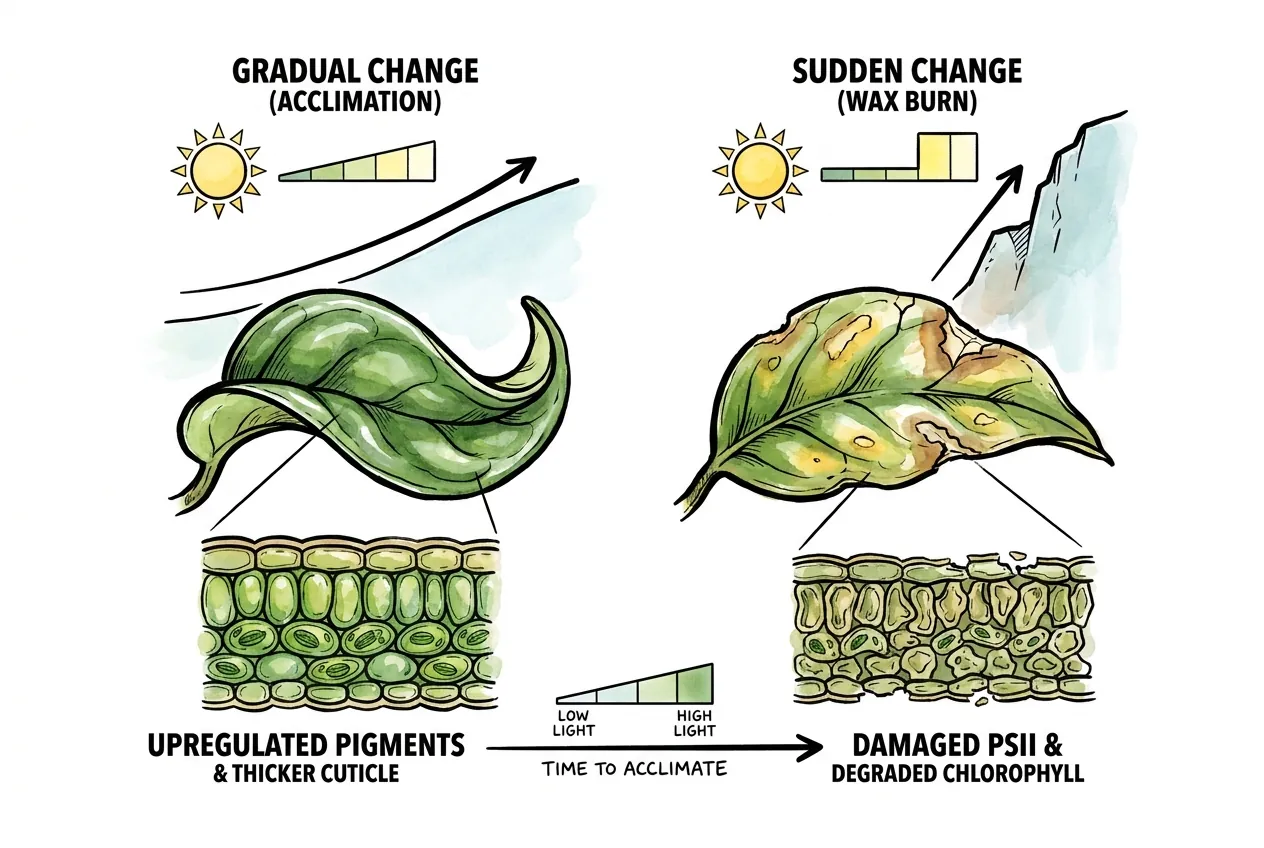
The rate of change matters a lot, though not alone. Photoprotective pigments, D1 repair capacity, and, over time, cuticle traits all need time to build, and an abrupt shift can outrun them.
But absolute intensity, how long the exposure lasts, leaf temperature, and water status all combine to decide whether a leaf scorches.
This is why even a spot that is not blindingly bright can scorch a plant if the jump from its previous home is large and sudden.
A cloudy-feeling day can still carry meaningful UV and diffuse PAR.
Watch the Change, Not Just the Glare
Do not judge the load only by how bright the light feels to your eyes. Weigh how big a change it is from where the plant just came from, and confirm with a meter if you can.
Plant responses to UV-B radiation. Signaling, acclimation and stress tolerance
Why Strong Sun Leaves Permanent Damage
Keep Damage From Outrunning Repair
A leaf can safely use or release only so much incoming light. When exposure exceeds that capacity, the leaf’s light-harvesting system is damaged faster than it can repair itself. Outdoor UV can add to that stress.
Prevent sunscald by keeping the light increase small enough for the plant to adapt before the next increase. Once a patch is truly dry, bleached, and dead, the goal is to protect the remaining green tissue.
Why Shading Works
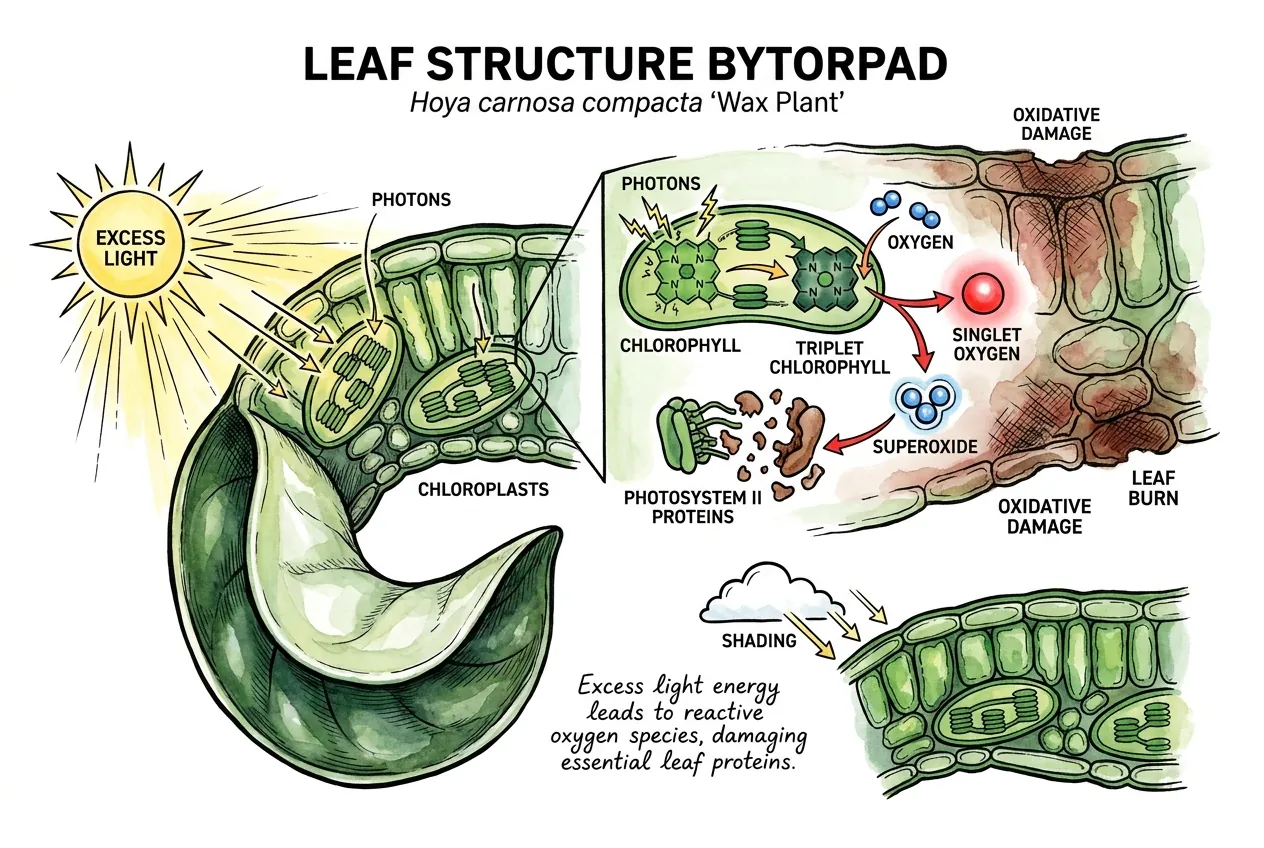
When a leaf absorbs more light than it can use, unstable oxygen compounds can damage its light-harvesting tissues. Shading lowers that excess at the source, which is why it protects a recently moved plant.
Production of Reactive Oxygen Species by Photosystem II as a Response to Light and Temperature Stress
Why a Sudden Change Is Harder
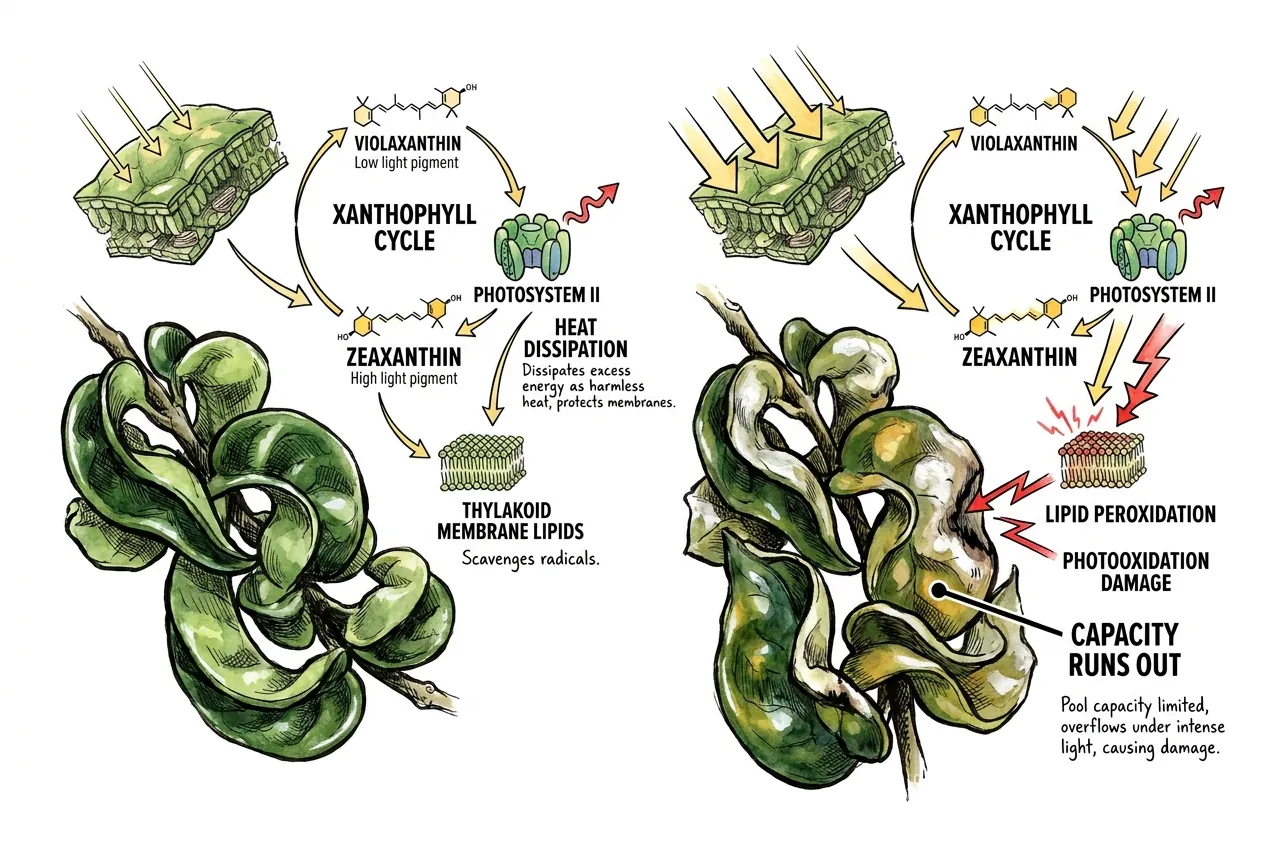
Plants have ways to release excess light as heat, but that protection has limits. A shade-grown leaf reaches those limits sooner than a leaf already accustomed to bright light, which is why gradual acclimation matters.
The violaxanthin cycle protects plants from photooxidative damage by more than one mechanism
Why Outdoor Light Adds Risk
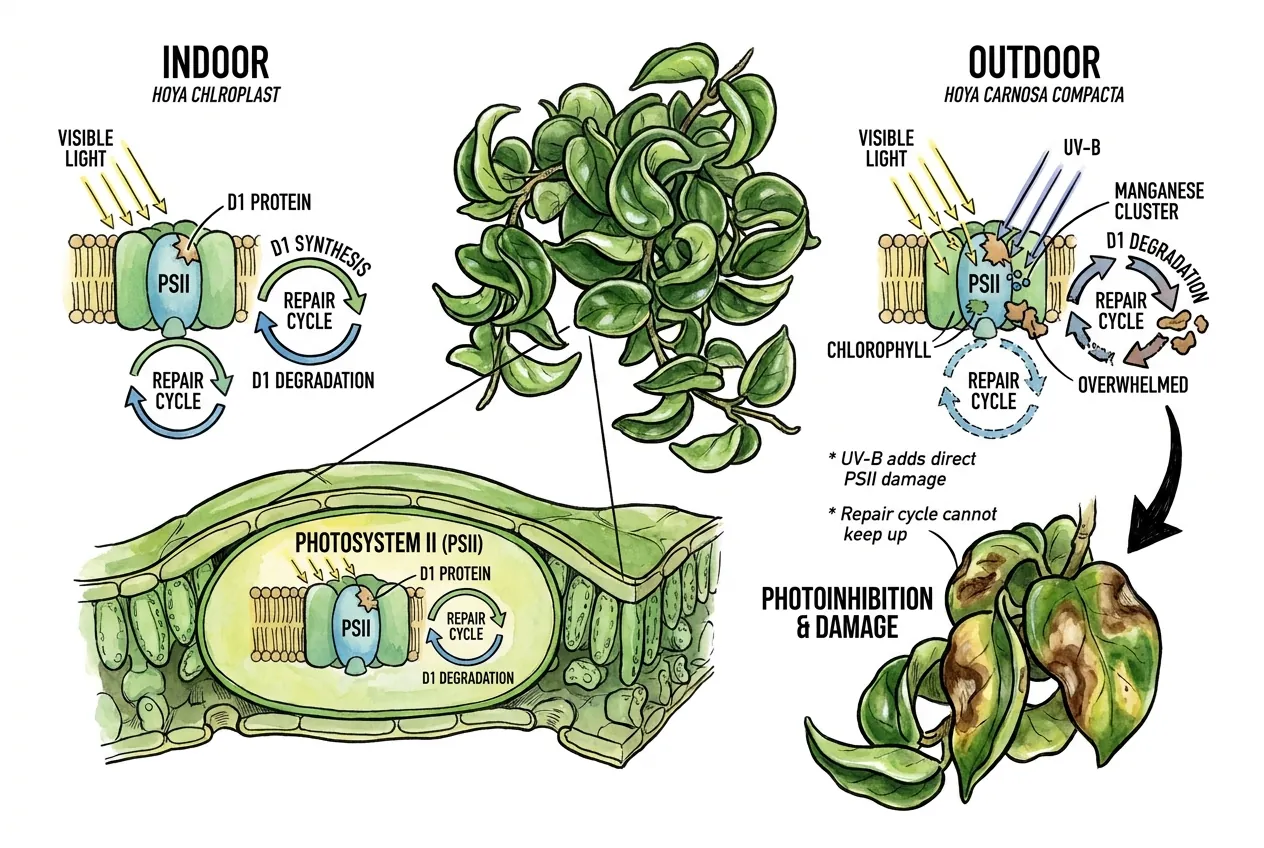
Outdoor exposure can add UV-B that ordinary window glass filters, as well as much more visible light and heat. That is why outdoor sun can be harsher than indoor light that appears similarly bright.
Plant responses to UV-B radiation. Signaling, acclimation and stress tolerance
Why is the bleached patch permanent?
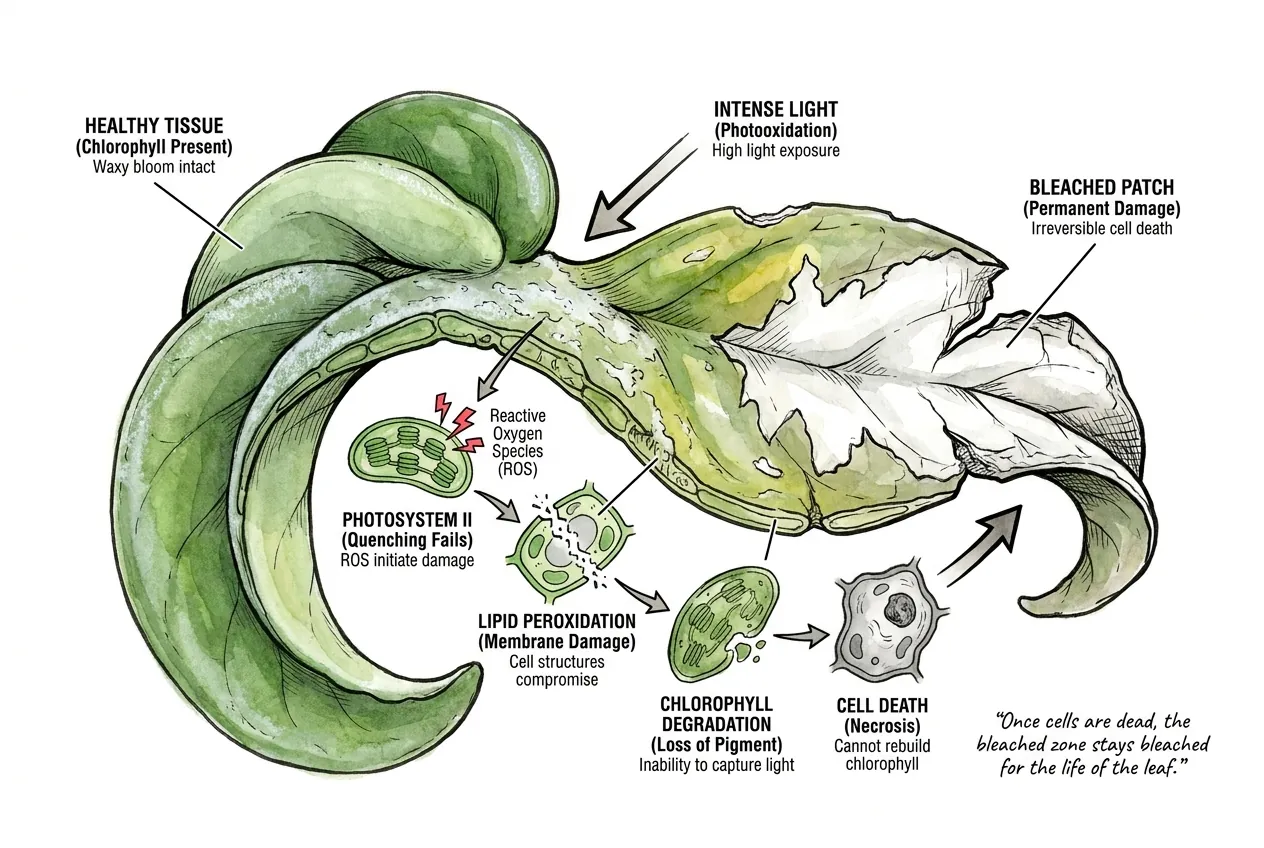
Once a patch is genuinely dead, it stays that way. A truly bleached, necrotic patch is the end stage of photooxidation. Lipid peroxidation, chlorophyll degradation, and cell death, in which oxygen plays a role, and dead cells cannot rebuild chlorophyll.
Not every pale mark is dead tissue, though, so judge by texture and whether it changes over time.
Where cells are truly dead, that patch does not recover. A leaf can still grow new healthy tissue elsewhere, but the dead zone stays that way for the life of that leaf.
Once you see bleaching, the job shifts from saving that tissue to protecting everything still green.
Production of Reactive Oxygen Species by Photosystem II as a Response to Light and Temperature Stress
How can the wax layer help protect the leaf?
Preserve the Surface Barrier
Surface wax and the epidermis can screen some light before it reaches the leaf interior. Handle the foliage gently and harden the plant gradually instead of assuming its semi-glossy surface protects it from a sudden change in sun.
How much light can a waxy surface reflect?
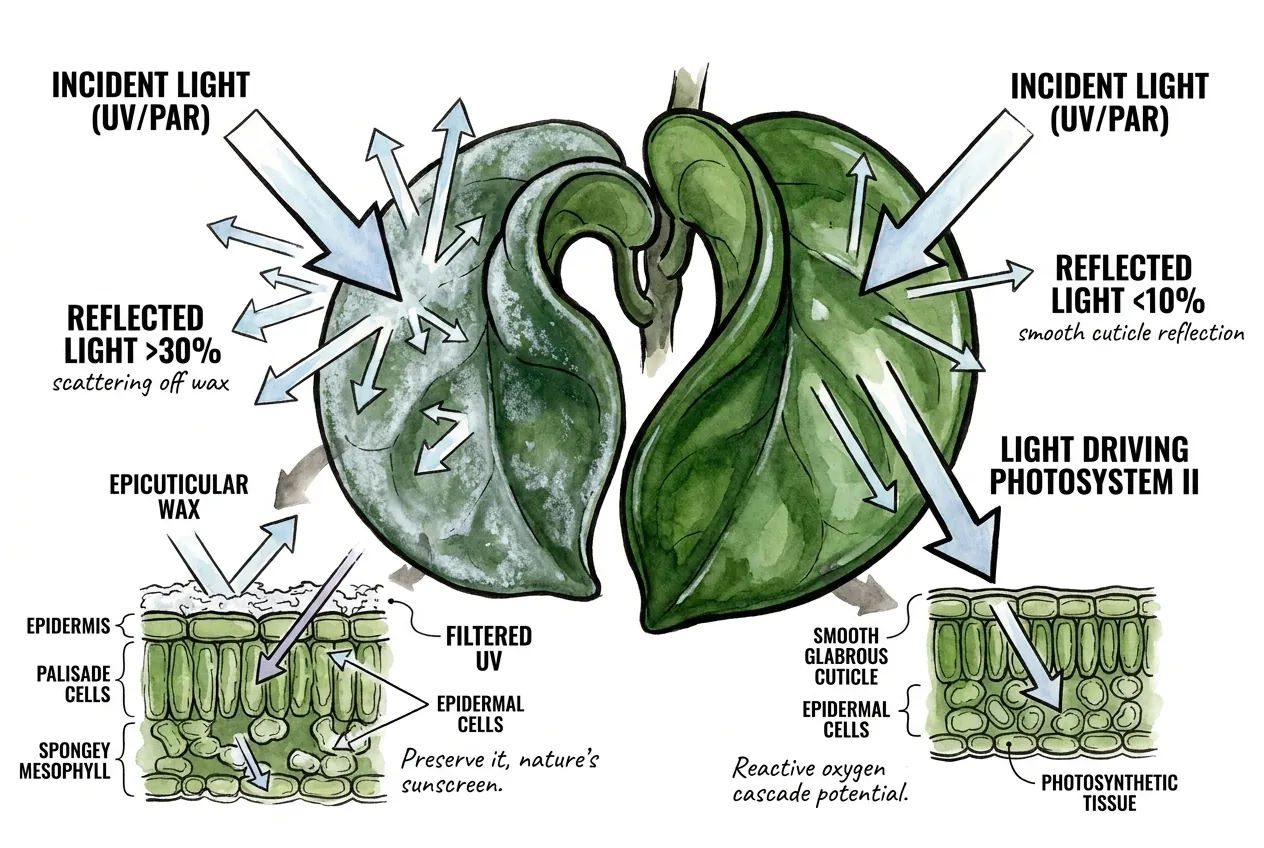
In leaf-optics reviews, a strongly glaucous, wax-crystal surface can reflect 30% or more of incident UV and PAR by scattering, while a smooth cuticle reflects under 10%.
Any light that is reflected does not reach photosystem II, so it cannot drive the reactive oxygen cascade.
The same review notes that a wax layer’s reflecting capacity protects the epidermal cells, while the epidermis filters some UV away from the tissue underneath.
How much a given Hoya surface reflects has not been measured, so treat this as the general mechanism rather than a number for the Hindu rope.
Either way, the sheen is worth keeping intact. Handle the leaves gently rather than polishing them.
The Optical Properties of Leaf Structural Elements and Their Contribution to Photoprotection
Why does a weak cuticle overload the inside defenses too?
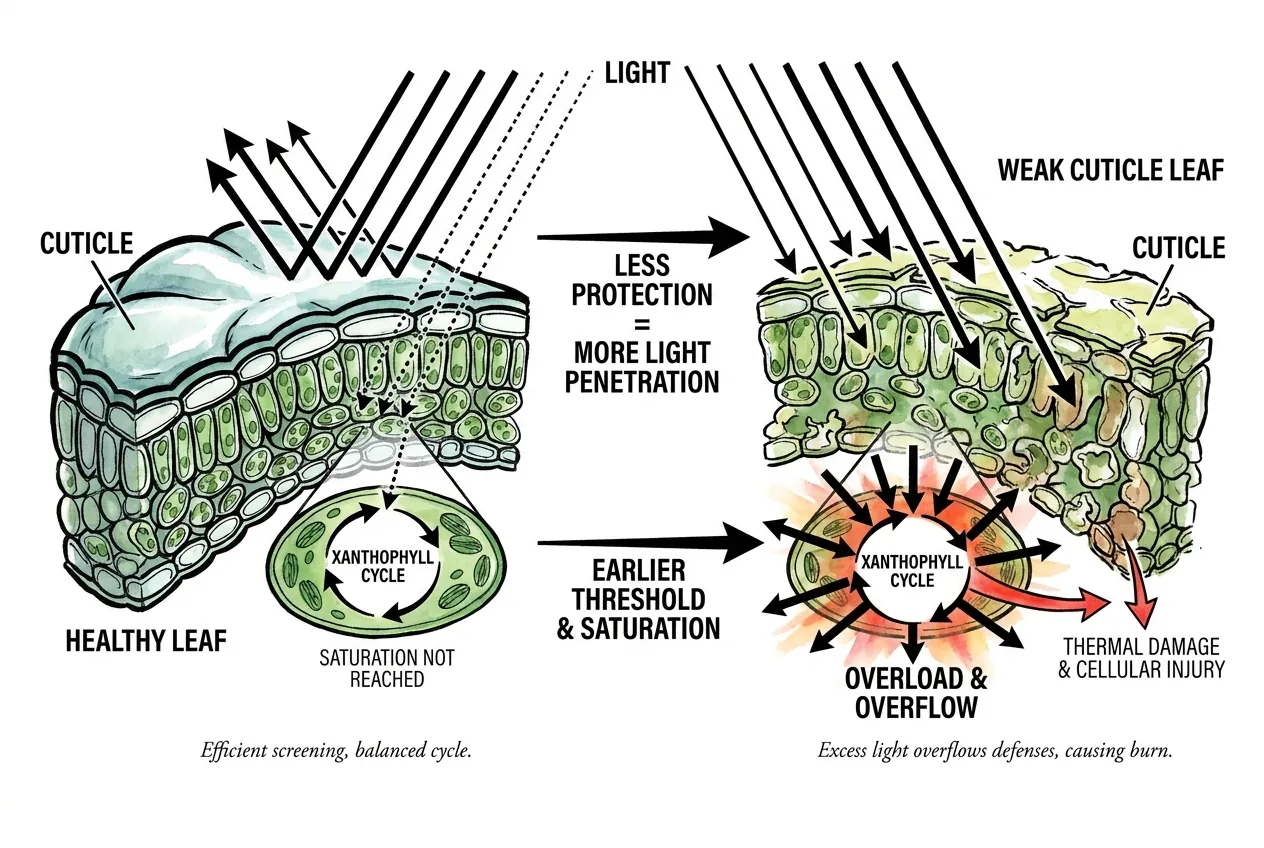
Surface screening and internal photoprotection tend to work together. When less light reaches the chloroplast, the xanthophyll cycle has less to handle.
In principle, a weaker surface screen lets more light through, so the internal capacity is reached sooner, though this coupling has not been measured directly in Hoya.
Different leaf surfaces can change how much excess light reaches sensitive tissue, but there is no measured Hoya threshold to apply. Use the plant’s recent light history and visible response instead.
The Photoprotective Role of Epidermal Anthocyanins and Surface Pubescence in Young Grapevine Leaves
Does hardening off really thicken the cuticle?
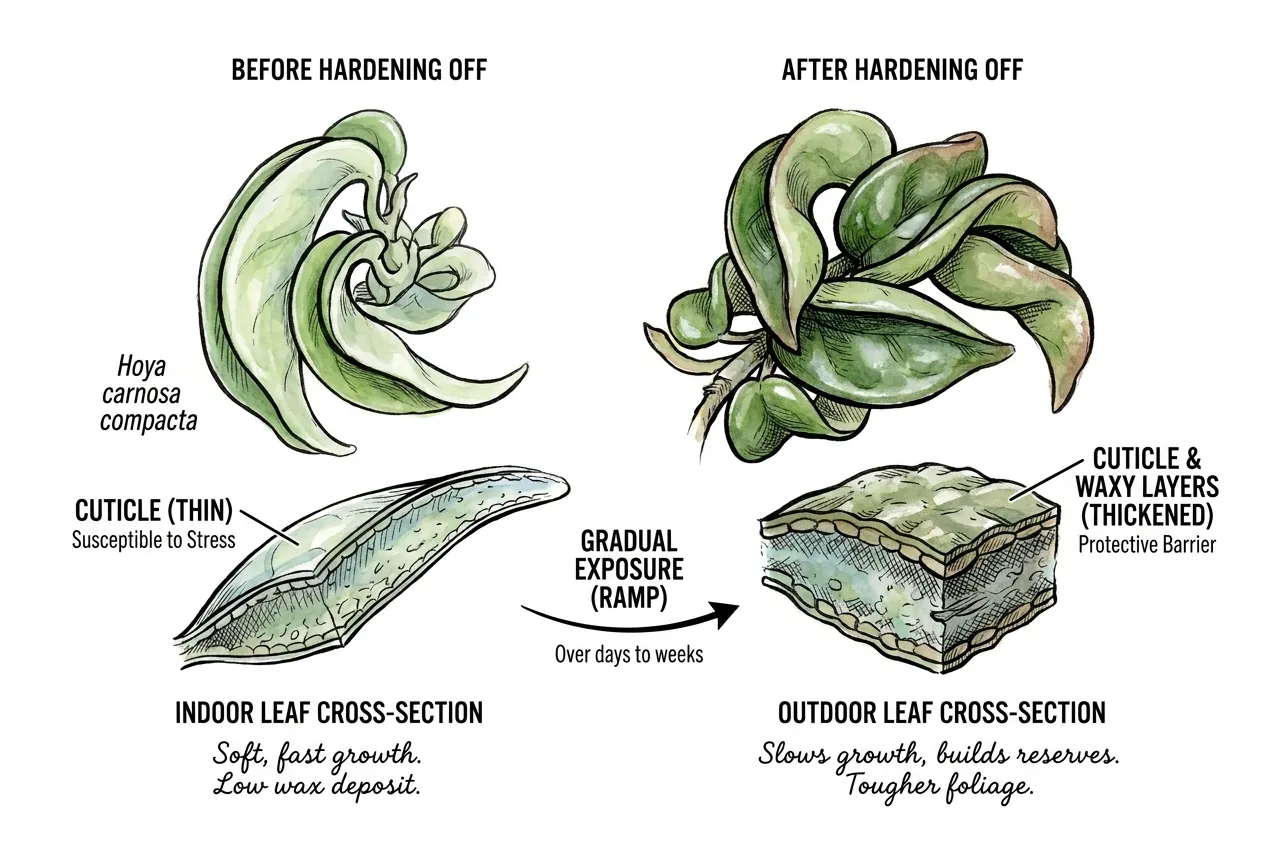
It can, though most of the evidence is from vegetable and flower seedlings. University extension guidance describes hardening off slowing growth and thickening the cuticle and waxy layers, while building carbohydrate reserves and cell-wall lignin.
Gradual stress can signal a plant to lay down more wax and adjust protective pigments over days to weeks, mainly in newly forming leaves.
Whether an already-mature Hoya leaf remodels the same way over a similar span is not established, so expect the biggest changes in new growth.
This is why you cannot rush it. You are waiting on the plant to build protective structure over time, not just to get used to a feeling.
Starting a Garden. Hardening Off Indoor Seedlings (University of Illinois Extension)
What happens when I rub the waxy bloom off?
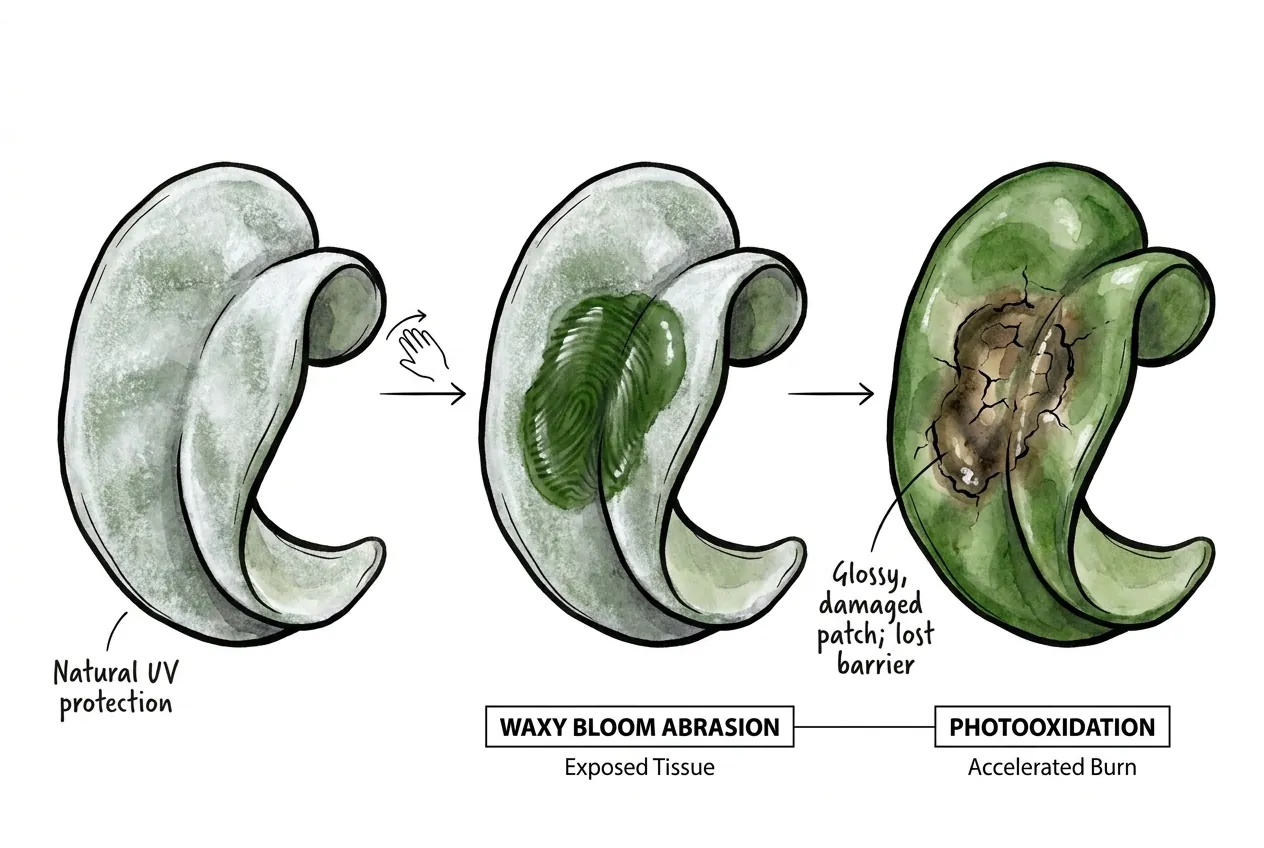
You can disturb the wax where you touch it. Epicuticular wax contributes to a leaf’s defenses against UV, water loss, pathogens, and insects, so abrading or melting it can locally weaken that protection.
Leaf-shine products, repeated handling, and heat-softening can strip or smear the surface.
In principle the exposed tissue then has less surface screening, though how much this changes burn risk on a Hoya has not been measured.
Since the downside is small, the conservative move is to handle Hoya leaves minimally and skip leaf-shine products.
How do I harden off a Hindu rope correctly?
Ramp Light Gradually
Take it slow, over roughly two weeks or more if the plant needs it. Start in bright outdoor shade, then add short spells of gentler sun in small increments while avoiding the harsh midday hours at first.
Watch the plant and pull back a step at the first sign of bleaching, crisping, wilting, or leaf heating.
Using a labeled shade cloth to cap the light helps, but confirm the actual light and leaf temperature rather than trusting the percentage alone.
The idea behind the ramp is to give protective pigments and capacity time to build, and new leaves time to form, before the plant meets stronger sun.
Treat the schedule as adaptive, adjusting to the plant, not as a fixed Hoya-tested recipe.
What does a cautious ramp look like?
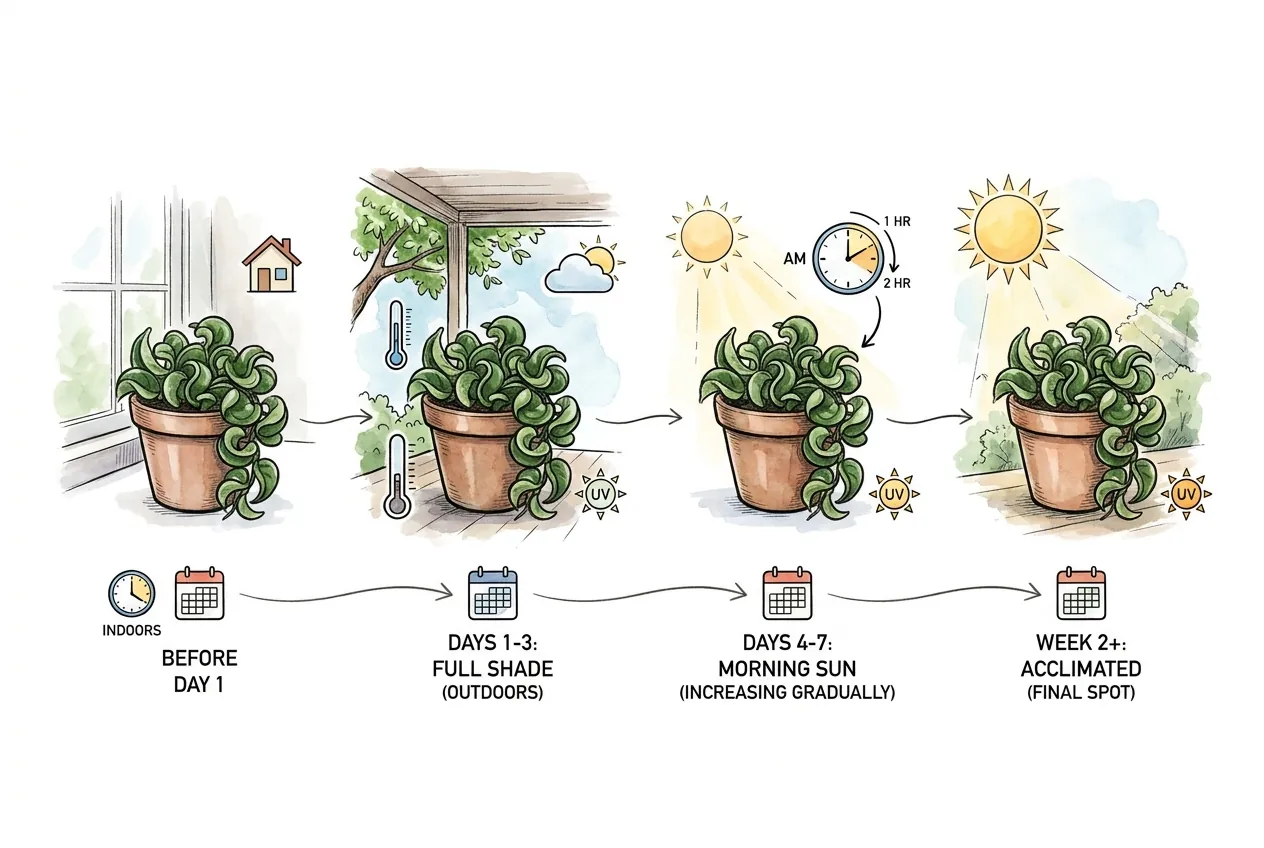
Begin with a few days in bright outdoor shade, which is usually already brighter than indoors and, importantly, now includes some UV.
Then add short spells of direct sun, starting small, and lengthen them only as the plant tolerates each step.
The specific hour-by-hour numbers you see online are examples, not values validated for Hoya, so let the plant’s response set the pace.
University extension guidance for seedlings frames the broad timeline. Let the plant adjust over roughly one to two weeks before moving it to its final spot, starting in a sheltered site.
Note that the same guidance introduces the first outdoor exposure during the warmer midday hours, not the morning, so the schedule below is adapted, not a direct quote of that source.
The point either way is to add UV and higher light gradually rather than all at once.
Do not jump straight to a few hours of direct sun. That oversized step is an easy way to burn a plant you were trying to acclimate.
Why morning sun and not afternoon?
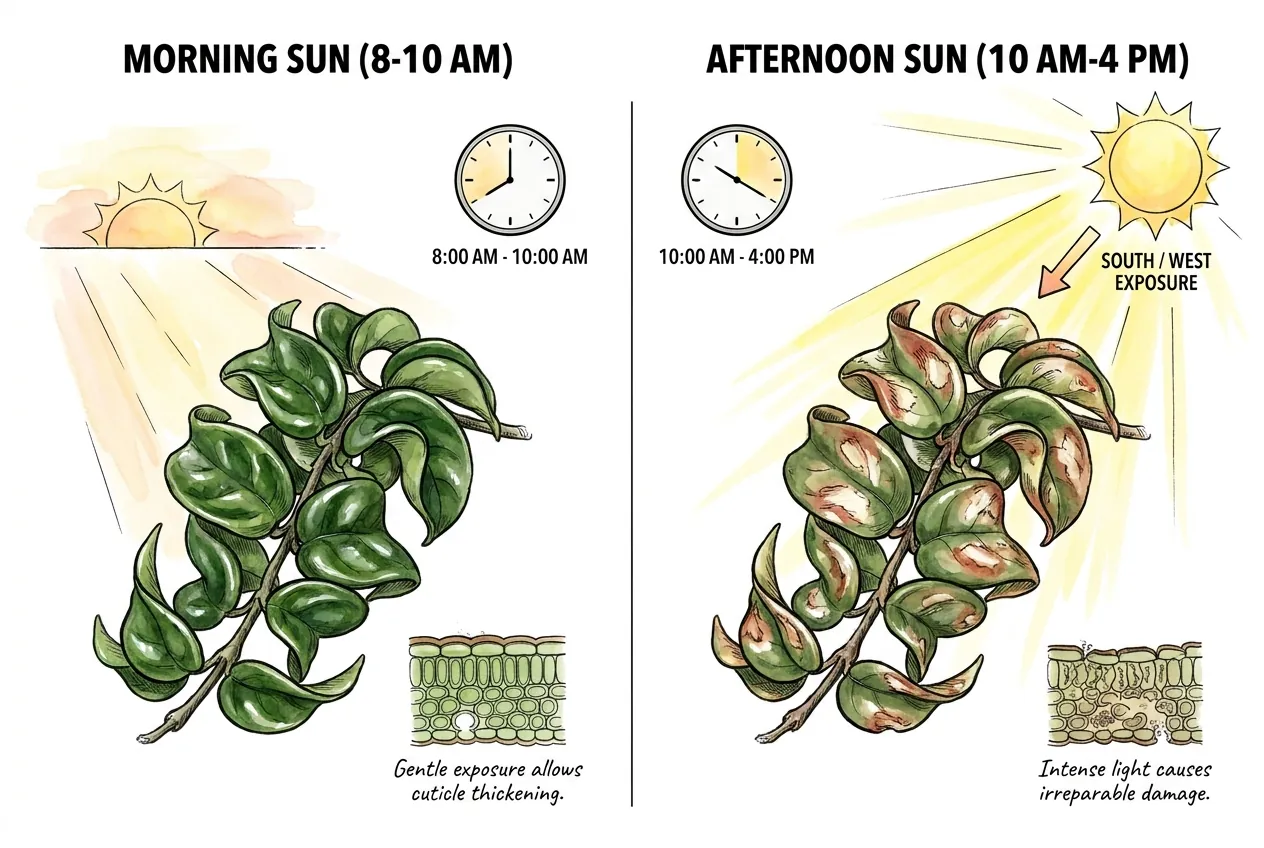
Midday sun, very roughly the hours around 10am to 4pm in many temperate locations, tends to carry the highest combined PAR and heat load, which is what overruns an unacclimated leaf.
In the northern hemisphere, south and west exposures are often the strongest, and an intense exposure can cause damage that takes a long time to grow out.
Adjust these directions for your own hemisphere and season.
Morning sun is usually cooler and less intense, so it tends to be lower in total irradiance, even though the spectrum is broadly the same sunlight.
That makes it a gentler place for a plant to practice with direct light.
As a practical default, favor morning sessions early in the ramp and add any midday exposure last and briefly, watching the plant.
Starting a Garden. Hardening Off Indoor Seedlings (University of Illinois Extension)
What shade-cloth percentage should I use, and what does it mean?
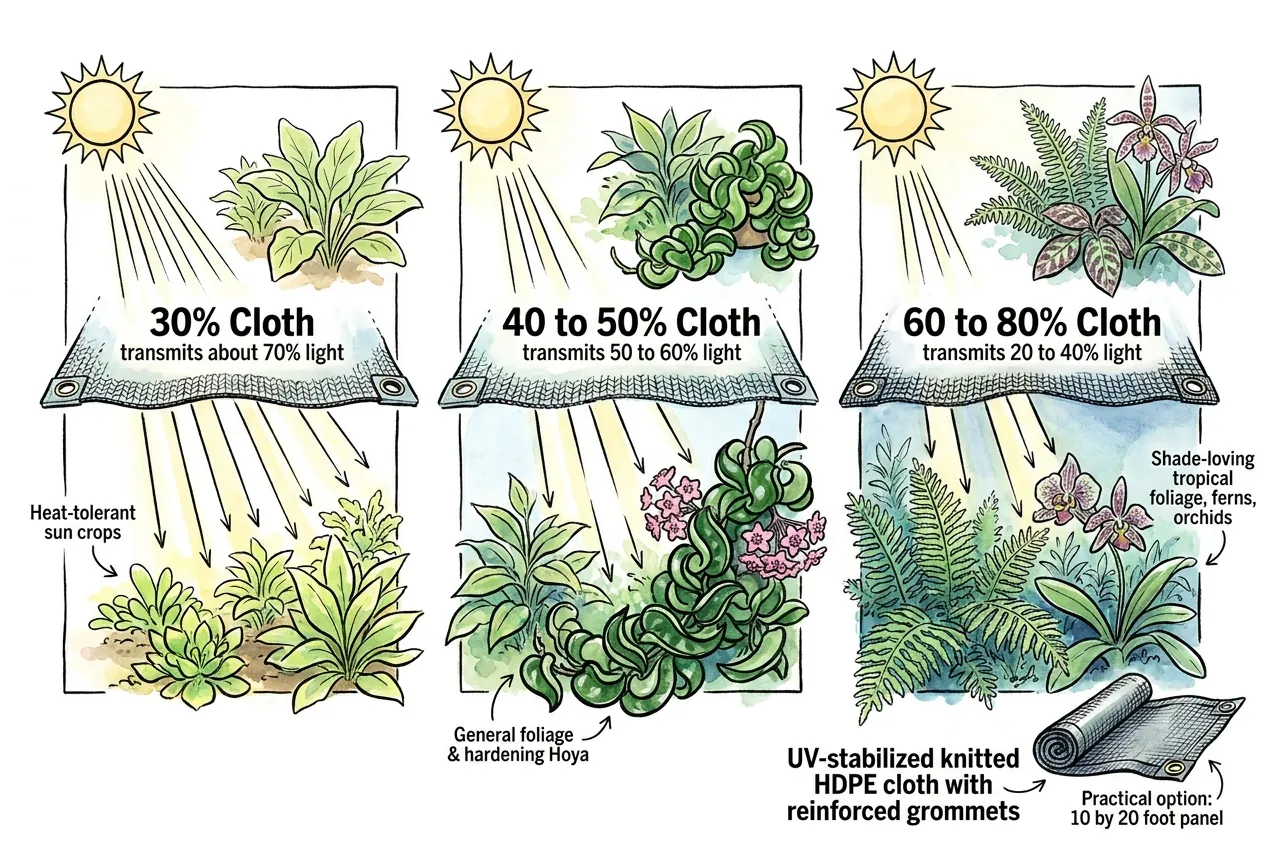
A shade-cloth percentage is roughly how much sunlight the cloth is rated to block. A 50% cloth is rated to block about half and transmit the rest. A 30% cloth transmits about 70% of PAR.
These are nominal figures, and the real light and heat that reach the plant depend on the weave, colour, installation angle, and whether the light is direct or diffuse.
Shade-loving tropical foliage such as many ferns and orchids is often grown at 60 to 80%.
For a shade-adapted Hindu rope entering summer sun, 40 to 50% cloth is a reasonable cautious starting point, but there is no validated Hoya PPFD ceiling to guarantee it is low enough.
A 40% cloth over full sun still passes a lot of light, so measure the light and leaf temperature under the cloth and adjust from there.
| Shade cloth | Light transmitted | Best use |
|---|---|---|
| 30% | About 70% | Heat-tolerant sun crops |
| 40 to 50% | 50 to 60% | General foliage. A cautious start for hardening (measure and adjust) |
| 60 to 80% | 20 to 40% | Shade-loving tropical foliage, ferns, orchids |
Choose shade cloth by the reduction you need and how you will secure it. A large panel is useful only when you are shading a patio, greenhouse, or several plants. It is usually excessive for one Hoya.
winemana Garden Shade Cloth can provide a cautious starting reduction for an outdoor hardening area. It is not a permanent prescription, and a labeled percentage does not prove the light or leaf temperature at your plant. Measure if possible and use more shade if the plant shows stress.
What Shade Cloth Percentage Is Best for a Greenhouse?
How do I ramp an indoor plant before it ever sees real sun?
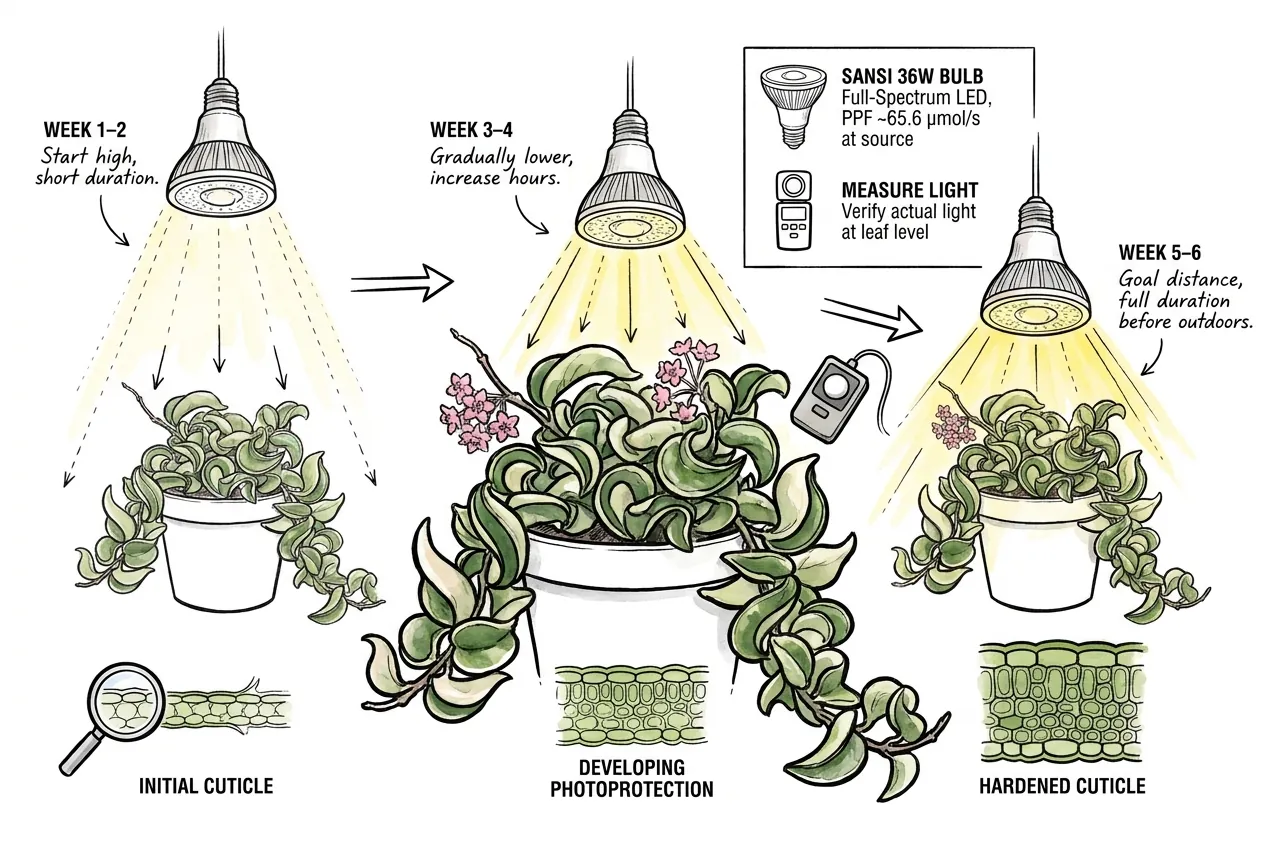
Stepping up a full-spectrum grow light over several weeks can shrink the eventual outdoor jump.
Raising indoor PPFD gradually builds photoprotective capacity on your schedule and out of the weather.
It is not a full substitute for outdoor hardening, though. Indoor light usually lacks UV-B and the temperature and airflow swings of real sun, so plan for a further outdoor ramp anyway.
SANSI 36W Grow Light can suit a single Hoya or small cluster when you want to make a gradual indoor light increase before moving outdoors. Set it at a measured distance, increase the daily duration slowly, and keep it in an open fixture that can safely support the bulb.
It is not a whole-shelf solution or a substitute for outdoor hardening, and there is no universal Hoya target to chase.
What should I avoid doing during the ramp?
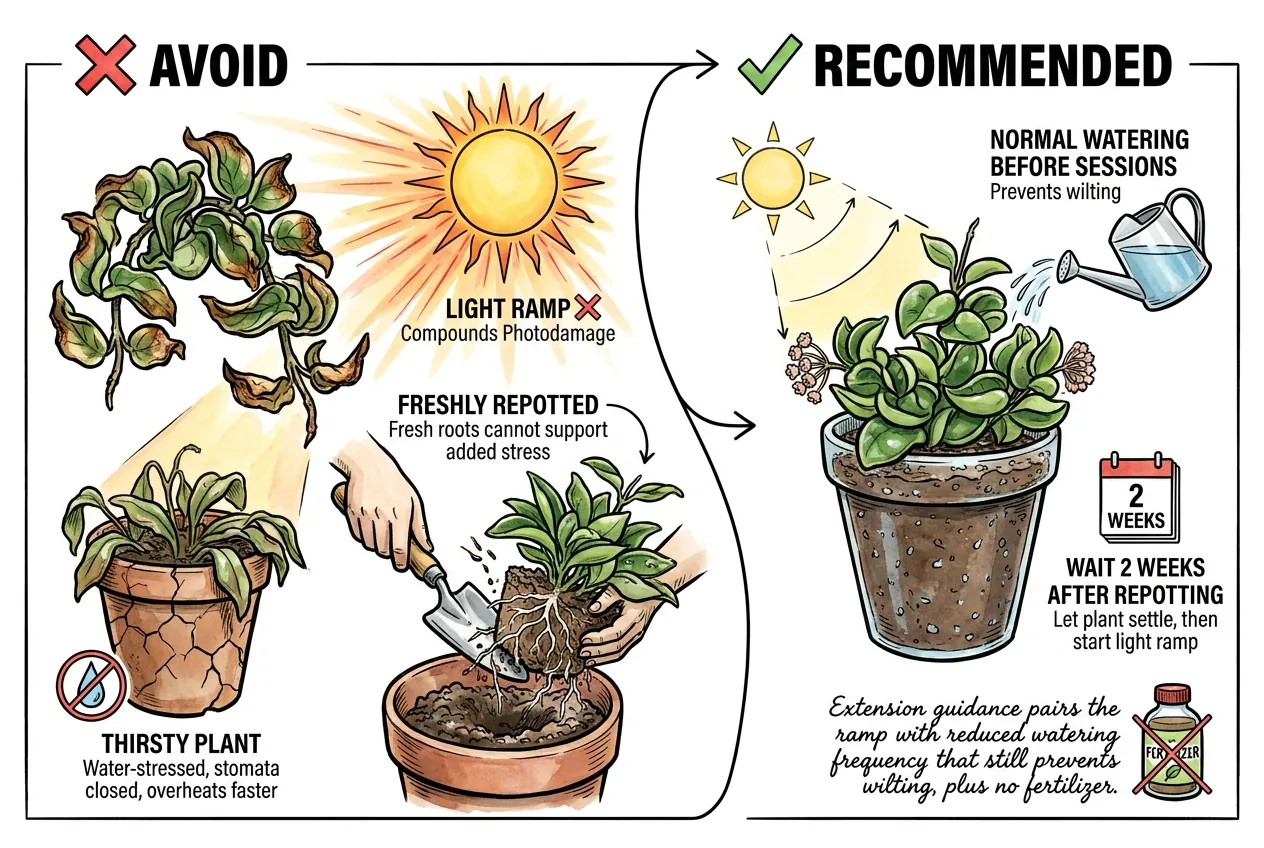
Avoid hardening off a thirsty or freshly repotted plant. A water-stressed plant handles a light transition poorly and can overheat, and fresh roots are still re-establishing.
Hoya is a CAM plant, so its stomata are mainly open at night rather than in the day, which is a reason not to lean on the usual daytime-stomata explanation used for typical C3 houseplants.
In practice, water normally before sessions, hold off on fertilizer through the ramp, and let the plant settle after repotting before adding a light change.
Extension guidance for seedlings pairs hardening with reduced watering frequency that still prevents wilting and no fertilizer. That is seedling advice, so treat it as a general steer, not a Hoya rule.
Keep the two stressors separate. Repot, let the plant recover, then start the light ramp, judging readiness by new root and shoot activity rather than a fixed number of days.
My Hoya is already burned. What do I do now?
Protect What Remains
Triage by tissue type. Bleached, tan, dry tissue is dead and will not regreen, while soft reddish discoloration on living tissue may fade as conditions improve.
Do not strip every marked leaf, because a leaf with healthy green tissue is still photosynthesizing for the plant.
If a leaf is soft, mushy, or spreading, that may be rot or infection rather than simple sunscald, and that needs its own diagnosis.
Move the plant to bright indirect light, keep watering appropriate to how fast the pot dries, hold fertilizer and repotting, and let new growth carry the recovery.
Which burned leaves will recover?
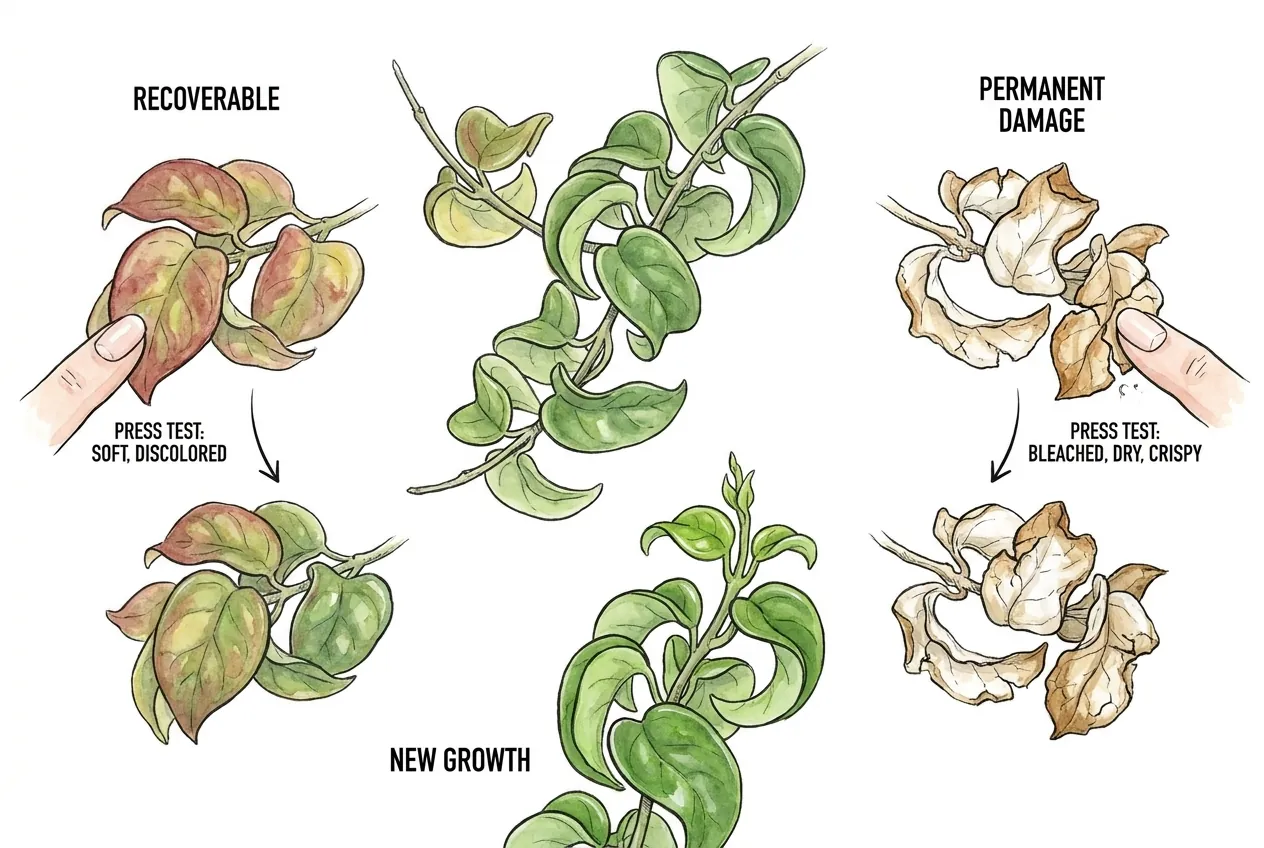
The living tissue can. Mild sun-stress coloring on soft, hydrated tissue may improve once conditions are corrected, while bleached, necrotic tissue is dead and cannot turn green again.
Feel and look at each lesion, but do not rely on that alone. Also check whether it is spreading, whether there is any odor, and the leaf underside for pests.
Soft and gradually discolored leans toward living tissue. Bleached, tan, dry, or crispy leans toward dead tissue.
Overall, the plant tends to recover by producing new healthy leaves once the underlying light, heat, or water problem is fixed, even when individual damaged leaves do not.
Houseplant Sunburn vs Sun Stress
Should I cut the burned leaves off right away?
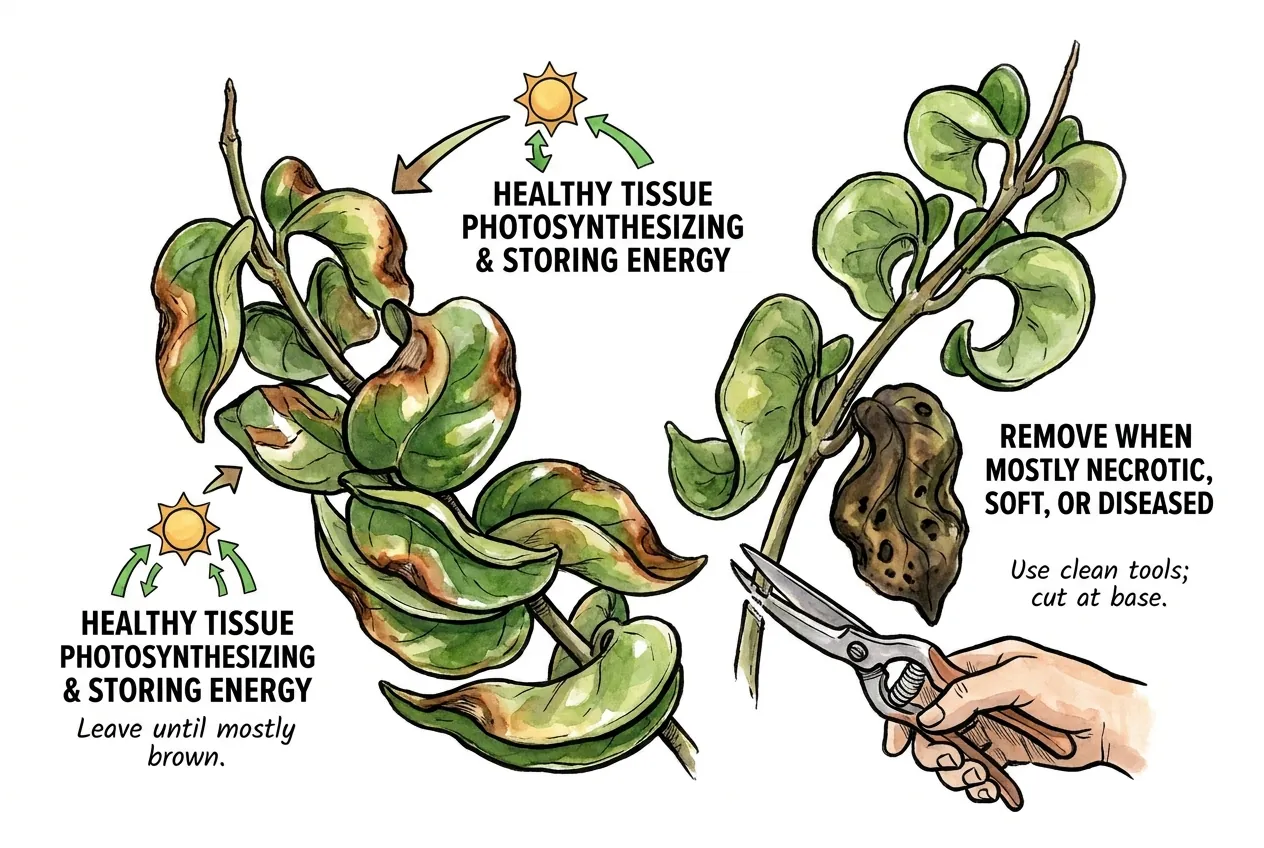
Usually not right away. A burned leaf that still has meaningful healthy green is generally worth keeping, because that tissue keeps photosynthesizing while the plant recovers.
Use judgment rather than a strict rule, though. A leaf that is mostly dead, collapsing, or a disease risk can be worth removing even with some green.
Lean toward removing a leaf when it is mostly necrotic, going soft or mushy, or showing possible disease signs such as dark spots or a powdery coating.
If you suspect disease, isolate the plant and identify the problem before removing lots of tissue, rather than assuming every marked leaf must go.
When You Do Cut
Use clean tools, cut at the base, and avoid dragging across the surface of neighboring leaves.
Are Your Plants Sunburned? How to Heal Them
What aftercare actually helps, and how long does recovery take?
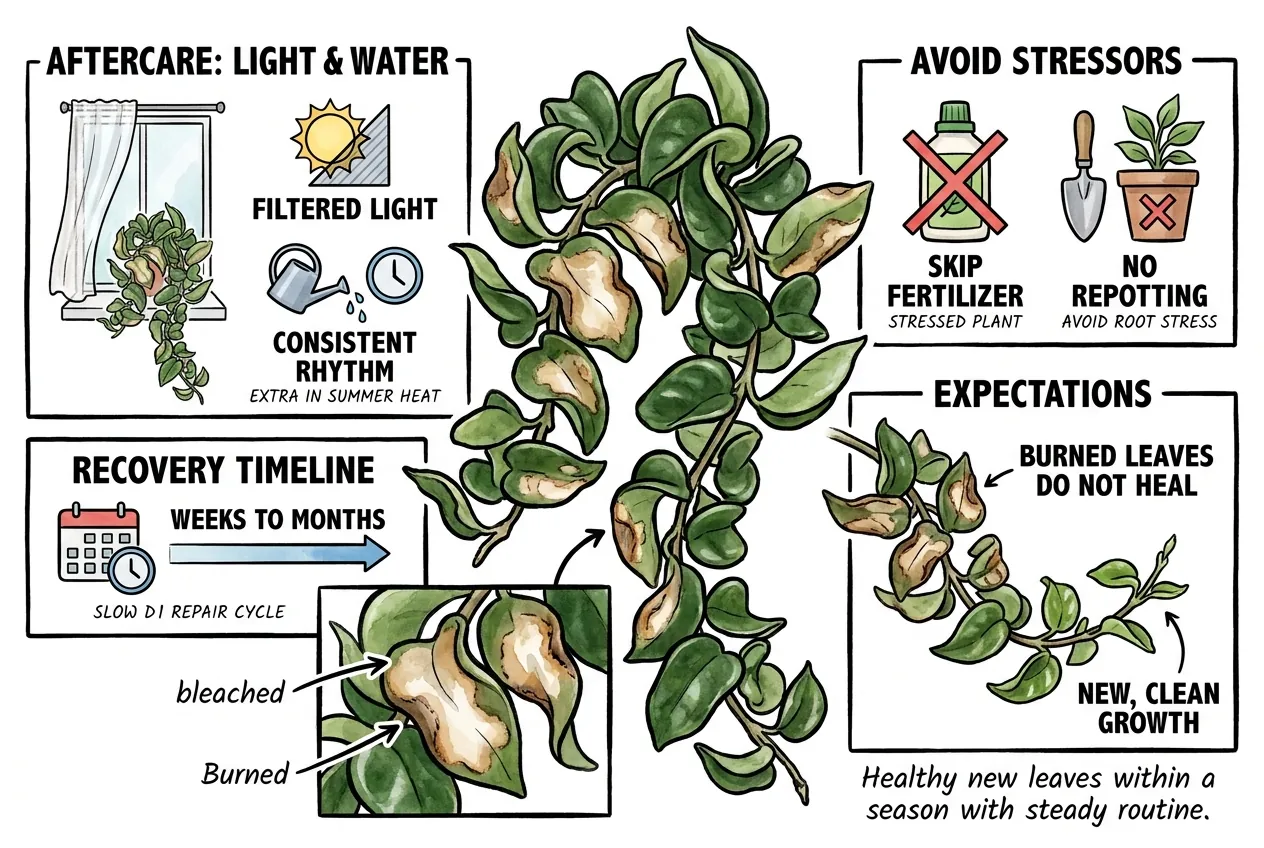
Stable conditions help. Move the plant to bright indirect or filtered light to stop further photooxidation.
Water by how quickly the pot actually dries rather than adding water on a schedule. Heat can dry the mix faster, but blanket extra water on a stressed Hoya risks root rot, so check the substrate first.
Skip fertilizer while the plant is clearly stressed.
A stressed plant does not benefit from heavy feeding, and the priority is letting fresh, healthy leaves take over, if you suspect a nutrient problem, address it cautiously rather than force-feeding.
Avoid repotting during recovery, since that stacks root stress on top of light stress.
Expect new, clean growth over weeks to months rather than days, though the exact pace depends on plant health, season, and temperature.
The burned leaves will not heal, but a Hindu rope moved off the hot glass and kept on a steady routine will usually push healthy new leaves over the following weeks to months.
How do I stop sunscald from happening again?
Measure Before You Move
Stop guessing at light. Measure PPFD with a meter, use a labeled shade cloth to reduce outdoor light (and check the result), and ramp indoor plants with a full-spectrum light before they ever see real sun.
Each tool addresses a different part of the same problem.
The throughline is simple. Keep the light the plant receives under whatever level it currently tolerates, and change it gradually.
Since there is no published Hoya PPFD ceiling, treat that limit as something you find by observation and measurement, not a fixed number.
How do I measure the light my Hoya is getting?
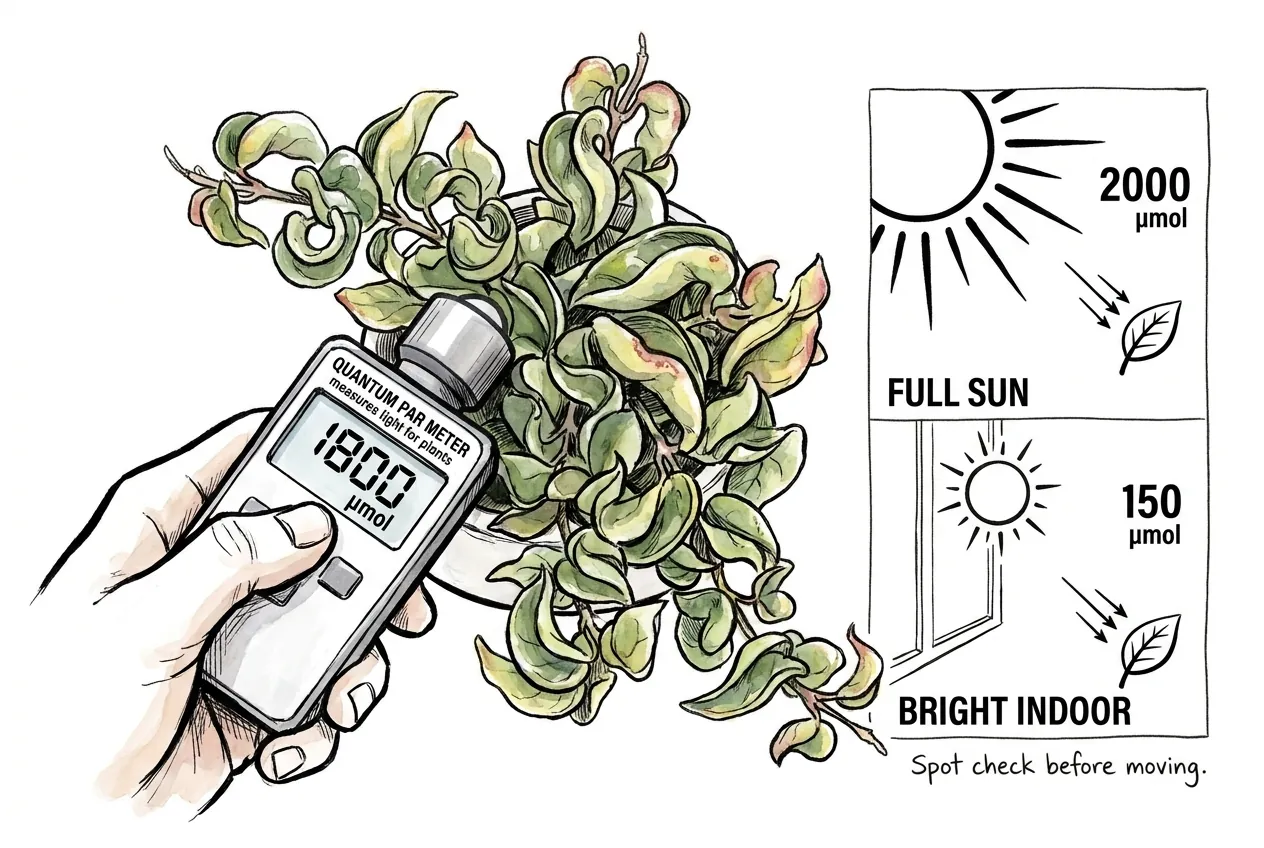
Read it in PPFD with a quantum meter so light becomes a number instead of a guess. Clear-sky summer sun can run near 2000 µmol per square meter per second, while a bright indoor shelf is often a small fraction of that.
A single reading is only a start, though. Duration, daily light integral, leaf temperature, and recent history all matter too.
Apogee MQ-500 Quantum Meter is useful when you regularly compare plant locations or tune a larger collection, because it lets you measure the leaf-level change before and after a move. It is expensive for one or two plants, so a simpler meter or a carefully calibrated phone app may be enough for a rough comparison.
For a few plants, a budget quantum sensor, a calibrated lux meter, or a carefully chosen phone PAR app can get you a rough figure for far less.
Note their limits. Lux is weighted for human vision, so converting lux to PPFD depends on the light’s spectrum, and a phone app’s accuracy varies with the device, its sensor, calibration, and any diffuser.
What Shade Cloth Percentage Is Best for a Greenhouse?
What is the right placement and monitoring routine?
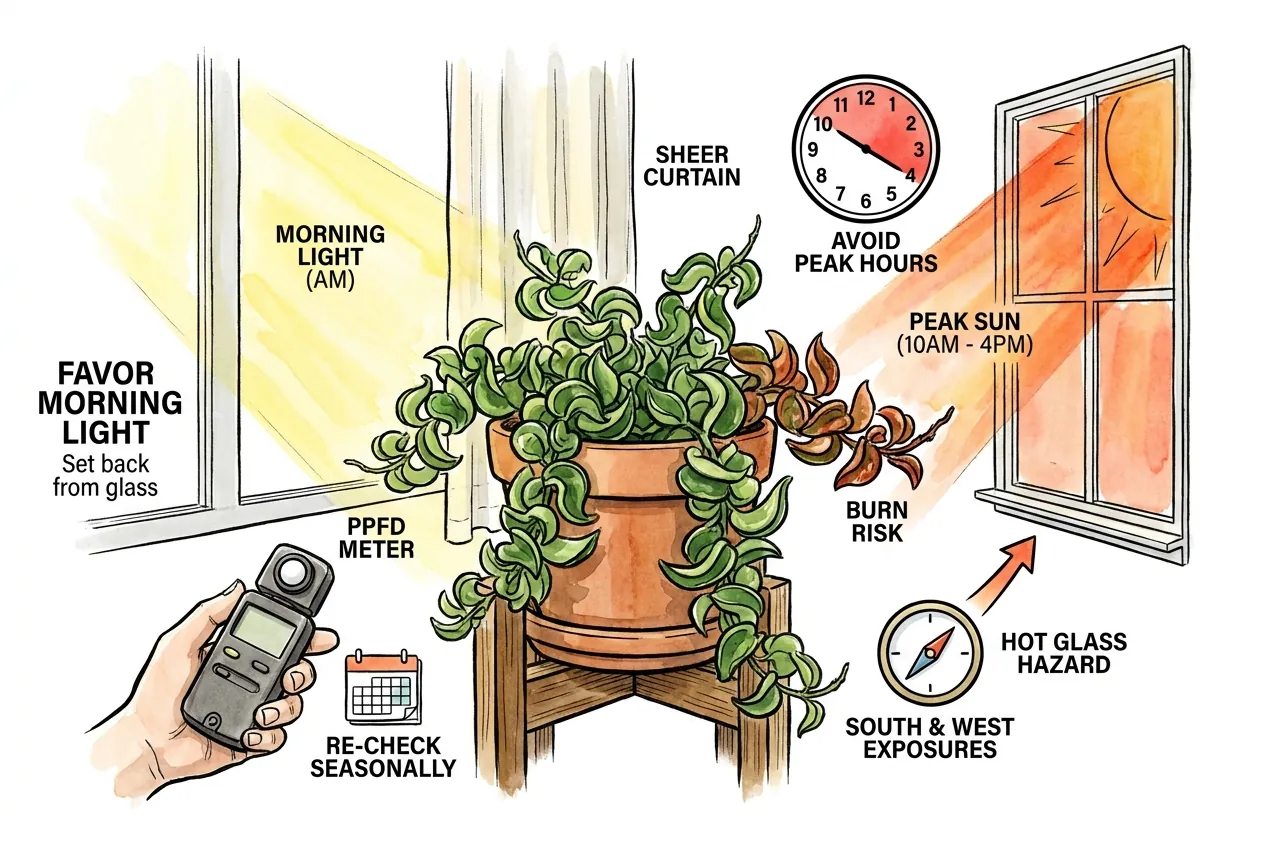
Keep the plant out of the strongest direct sun and re-check the light as the seasons change.
In many temperate locations the peak falls around 10am to 4pm, with south and west exposures often the strongest in the northern hemisphere, so set the plant back from hot glass and favor gentler light.
Adjust for your own hemisphere.
Moving a plant two to three feet off a hot window, or adding a sheer curtain, often drops the peak load noticeably, though whether it is enough depends on the window, glass, latitude, and time, so confirm with a reading.
Sun angle shifts through the year, so a safe winter spot can become a summer hazard.
Re-check PPFD as the seasons change rather than assuming a location is permanently safe. During the high-sun months, an occasional reading catches problems before the leaves do. How often is worth it depends on your risk and season.
How do these pieces fit into one prevention system?
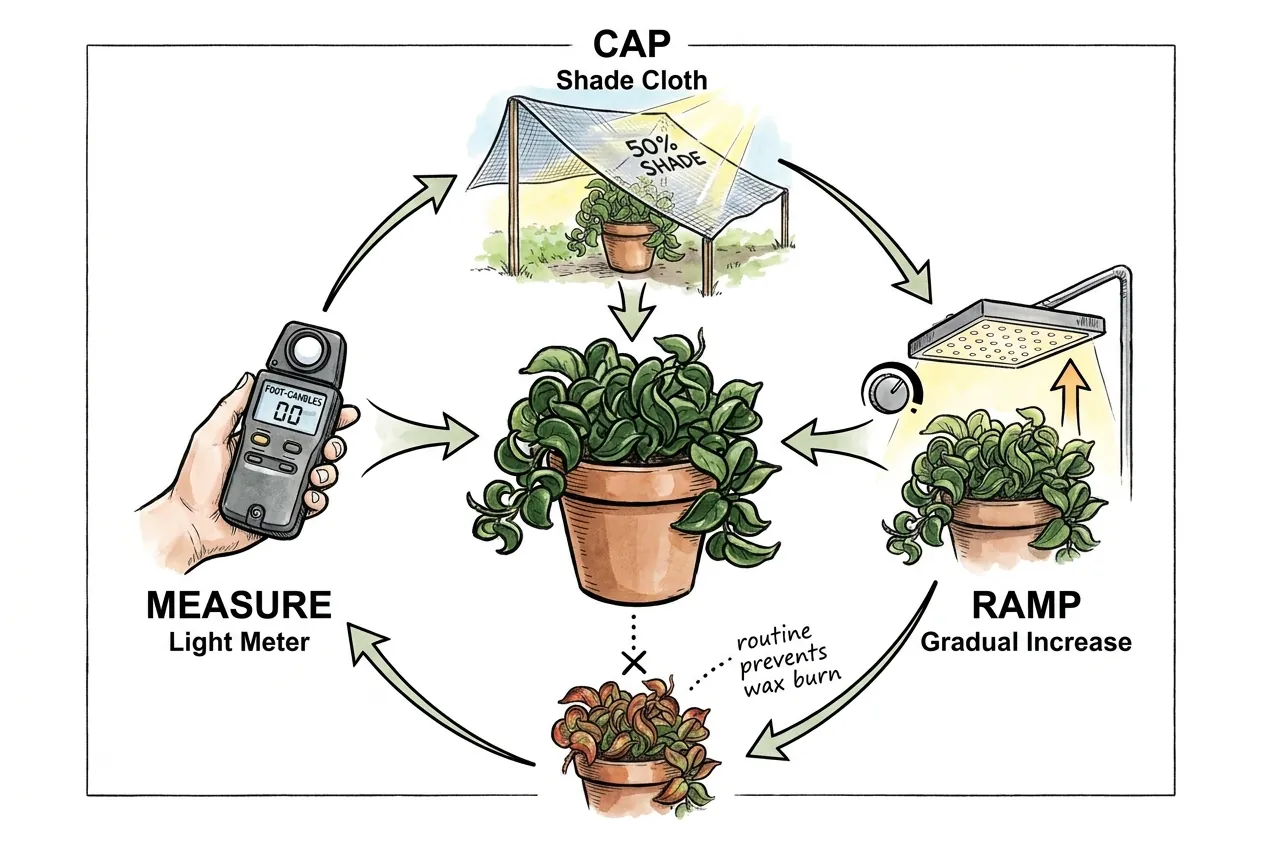
They form a measure, reduce, and ramp loop. You measure the light with a meter, reduce outdoor exposure with a labeled shade cloth (checking the actual light it passes), then ramp both indoor and outdoor light gradually so the plant is not handed a sudden jump.
The same gear serves recovery and prevention. Shade cloth that protects a hardening plant also shields a recovering one, and the meter that guides your ramp also flags when a seasonal change has pushed the light past what the plant has been handling.
Build the routine once and sunscald becomes far less of a recurring surprise. Instead of reacting to scorched leaves after the fact, you are keeping the light the plant receives within a range it can handle, and adjusting as conditions change.
Affiliate Disclosure
This article contains Amazon affiliate links. As an Amazon Associate I earn from qualifying purchases. If you use these links, the site may earn a commission at no extra cost to you. Product availability, price, and specifications can change. Check the current listing before buying.