
Monstera Albo Sunburn: Why White Sectors Cook First
Monstera albo sunburn hits the white sectors first in July. Learn why variegated tissue cooks, how to prevent it, and if it recovers.
Samuel Reed · Published 2026-07-05 · 31 min read
Key Takeaways
- White Monstera Albo sectors tend to burn first. They lack the chlorophyll-based machinery that lets green tissue use and safely spend strong light.
- As a conservative rule, judge safe light by the whitest leaf, not the green. Treat it as your most sun-sensitive tissue.
- Aim for bright indirect light (a generic medium band is roughly 500-1000 fc). Diffuse harsh windows with a white sheer curtain and measure the result.
- Avoid abrupt light changes. Ramp up over a week or two and harden off outdoor moves gradually over one to two weeks.
- Scorched white tissue does not heal. Do not panic-cut or fertilize a stressed plant, and protect the growth point.
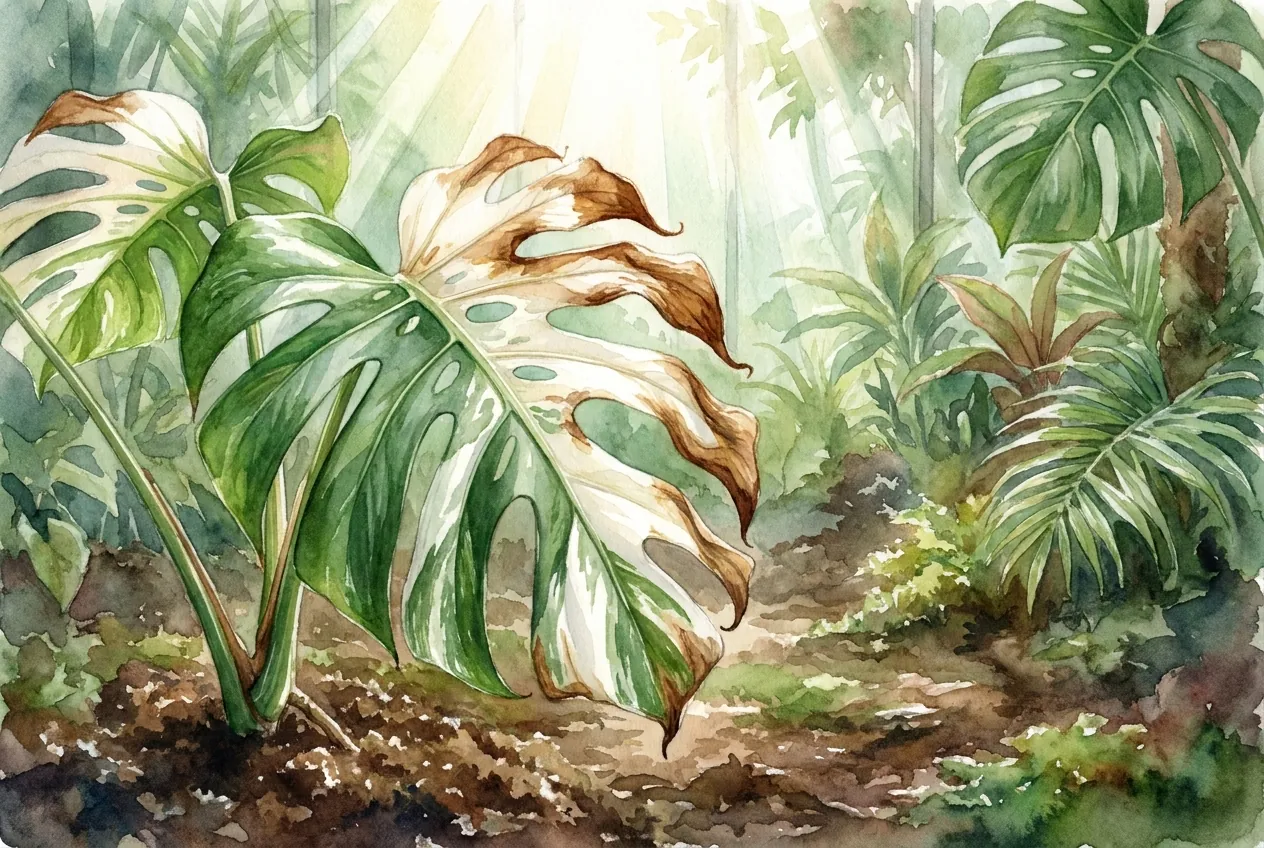
Hold a Monstera Albo leaf up to a bright window and you see the pattern in one glance. The green half is dense and opaque.
The white half is thin and translucent, almost like frosted glass, because it scatters, reflects, and transmits more of the light instead of absorbing it into working pigment.
That white tissue is not paint and it is not a color trick. It is living plant tissue with very little chlorophyll and much less of the carotenoid pigment that helps green leaves cope with strong light.
So in high summer, when many mid-latitude homes get their strongest window light, white sectors are often the first to show damage.
They can bleach, crisp, and die back while the green tissue an inch away stays fine.
Place the plant by the tolerance of its whitest leaf, soften harsh direct light, and change exposure gradually. White-sector injury can resemble other problems, so check the pattern, tissue texture, watering history, and pests before acting.
Why do the white parts of a variegated Monstera burn first?
White sectors have little of the chlorophyll and protective pigments that green tissue uses to turn light into energy and cope with excess light. The exact injury pathway has not been measured in Monstera, so no specific chemical explanation should be treated as settled.
What matters for care is simple. Treat the whitest leaf as the most sun-sensitive part of the plant, diffuse harsh direct light, and avoid sudden exposure changes.
I set the infrared thermometer to 0.95 emissivity and work close enough to keep its measurement spot fully inside each white or green sector of the same sun-facing leaf. I take three readings per sector and compare the medians with an air sensor beside the leaf. Fixed emissivity, spot size, and median keep background surfaces or one unstable reading from deciding the result.
The log pairs the sun window and leaf angle with those readings. A moving afternoon beam can explain a sharply bounded burn better than a daily room average.
A traced damage edge lets me judge protection by whether new tissue crosses that boundary. Existing white necrosis will not recover, so color improvement is not the endpoint.
What is Albo tissue physically, and why is it so fragile?
Monstera Albo is a chimera. A single plant built from more than one genetically different cell population, where some tissue cannot build working chloroplasts and so reads white.
The white pattern is genetics expressed through cell arrangement, not disease and not paint.
Exactly which chimeric arrangement produces it is not settled in the published literature.
Plant meristems are often described in three histogenic layers (LI, LII, LIII), and a stable one-layer periclinal chimera is one way variegation can be maintained.
But for variegated Monstera deliciosa the pattern has also been described as an irregular, transposon-linked sectorial mosaic, which behaves differently.
Treat the tidy single-layer model as one possibility, not a confirmed fact for this cultivar.
Either way, one practical point holds. You generally cannot force a reverted stem back to variegation or grow out white on demand, because the pattern is set by the genetics of the growing point rather than by anything you do to an existing leaf, and it can shift when the plant branches or you cut it.
It also explains a care fact that is well supported. Because the white areas lack normal chloroplasts, they are genuinely more fragile than green tissue.
How is a white sector different under the microscope?
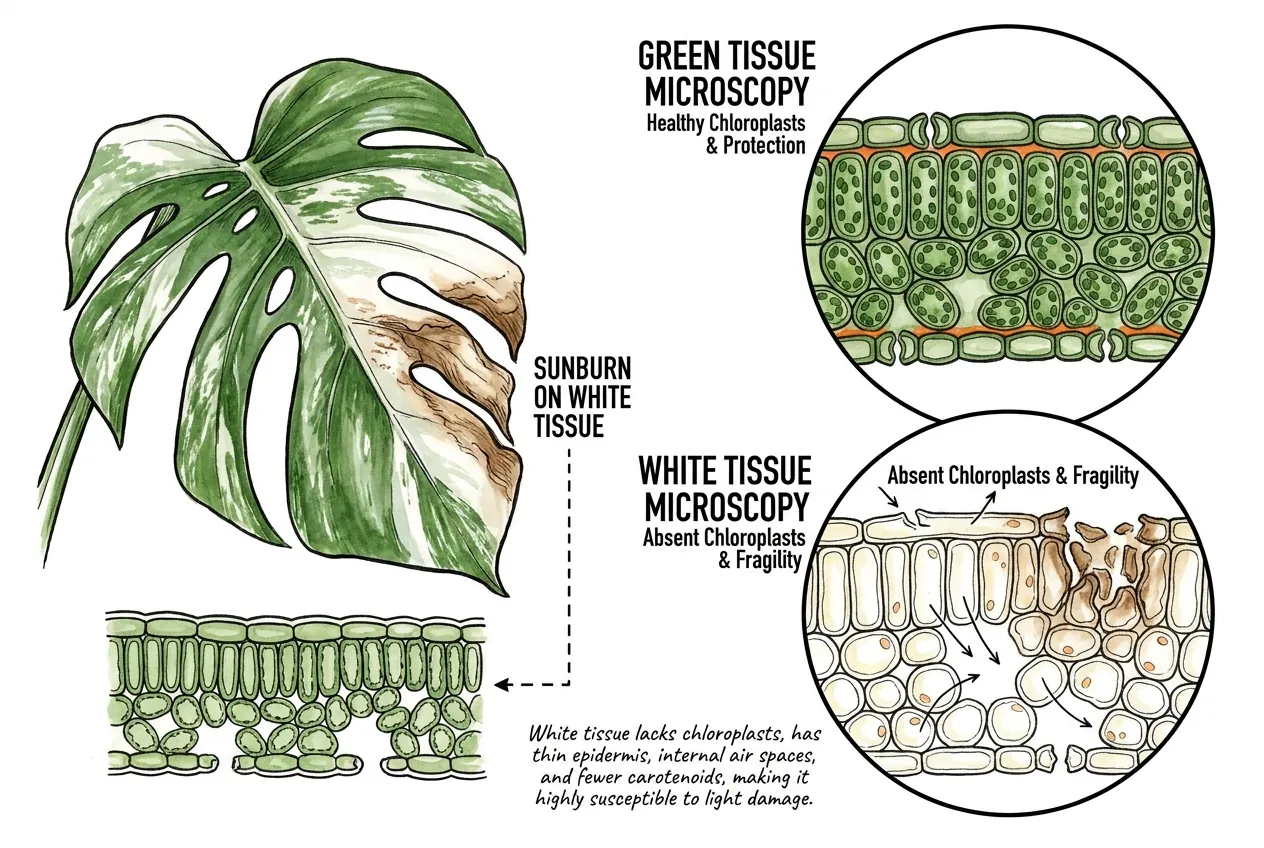
The best-supported statement is that white-sector cells are alive but hold very little chlorophyll and much less protective pigment than green cells, because their plastids never fully developed.
The specific numbers below come from other species and systems, so read them as illustrations of the pattern rather than measurements of a Monstera leaf.
In a study of complete white versus complete green leaves in a chimeric pineapple, chlorophyll in the white leaves fell below reliable detection and green-leaf carotenoid ran roughly thirty times higher.
That is real data for that pineapple system. It is not a measurement of a green-versus-white sector on the same Monstera leaf, and it should not be restated as an exact Monstera figure.
Anatomy varies by the type of variegation. One detailed study of foliar variegation (mostly in Blastus) found white areas with thinner epidermis, internal air spaces, and fewer stomata, but it also reported that those white areas still contained functional chloroplasts and similar total chlorophyll.
That is a structural kind of white, different from Monstera’s largely chlorophyll-free sectors, so the two should not be merged into one picture.
The one anatomical detail worth carrying forward, cautiously, is stomata. If white sectors have fewer or less responsive stomata, that could mean less transpirational cooling, but stomatal density alone does not settle how much a sector cools, so hold it as a plausible contributor rather than a proven cause.
Green sector versus white sector (the general pattern)
This table summarizes the broad direction reported across several variegated species (Arabidopsis, pineapple, Blastus, Pelargonium) plus reasonable inference.
It is a composite, not a single Monstera dataset, and the figures are indicative rather than exact.
| Feature | Green sector | White sector |
|---|---|---|
| Chloroplasts | Full, mature, layered thylakoids | Undifferentiated, empty plastids |
| Chlorophyll | Normal | Essentially zero |
| Carotenoid pigment | Present | Much lower (about 30x lower in one pineapple study) |
| Stomata | Normal density and response | Fewer, slower to open |
| Energy source | Self-feeding via photosynthesis | Fed by borrowed sugar from green tissue |
| Photoprotection | Xanthophyll cycle, NPQ, antioxidants | Weak to absent |
Because white cells cannot photosynthesize, they live on sugar imported from green tissue.
Some variegated systems also upregulate antioxidant defenses in white tissue, which fits the idea that it is under stress. The evidence does not establish an exact multiplier or failure threshold for Monstera.
The practical consequence is straightforward. A nearly all-white leaf contributes little energy and leans heavily on the rest of the plant, so it tends not to be a good long-term bet.
Protect and prioritize the green-containing leaves that actually power the plant.
Chimeras. University of Florida IFAS Plant Propagation
Physiological Characterization and Comparative Transcriptome Analysis of White and Green Leaves of Ananas comosus var. Bracteatus
Leaf structure affects a plant’s appearance. Combined multiple mechanisms intensify remarkable foliar variegation
Does a white sector run hotter than the green tissue next to it?
This is often assumed, but it is not directly measured on Monstera, and the honest answer is possibly, under some conditions. A leaf sheds heat mainly by transpiration, the evaporation of water through open stomata, plus radiation and convection.
If white sectors have fewer or less responsive stomata, they may cool a little less. But because white tissue also absorbs less visible light, it may take on less heat in the first place.
Those two effects push in opposite directions, so a blanket claim that white runs hotter is not established.
What is well supported is that hydration dominates leaf temperature. Under bright light with dry soil and still air, a leaf can climb well above air temperature.
In an energy-balance study modeling several crops, water-stressed leaves ran about 6°C above air under sunlight and up to roughly 12°C hotter under some artificial light sources, while well-watered leaves stayed within about 2°C of air.
These are modeled scenarios for those crops, not a hot-window Monstera measurement, but the direction is clear. Water status and evaporative cooling matter more than the light source itself.
Evaporative cooling can be substantial. In poplar, transpiration dropped leaf temperature by up to about 9°C under high heat, but a drought-stressed tree managed only about 1.1°C because closed stomata stop the evaporation.
Those are chamber-specific numbers for poplar, not fixed values for a Monstera white sector, yet they show why keeping the root zone watered is your most reliable cooling lever.
At what temperature does leaf tissue get damaged?
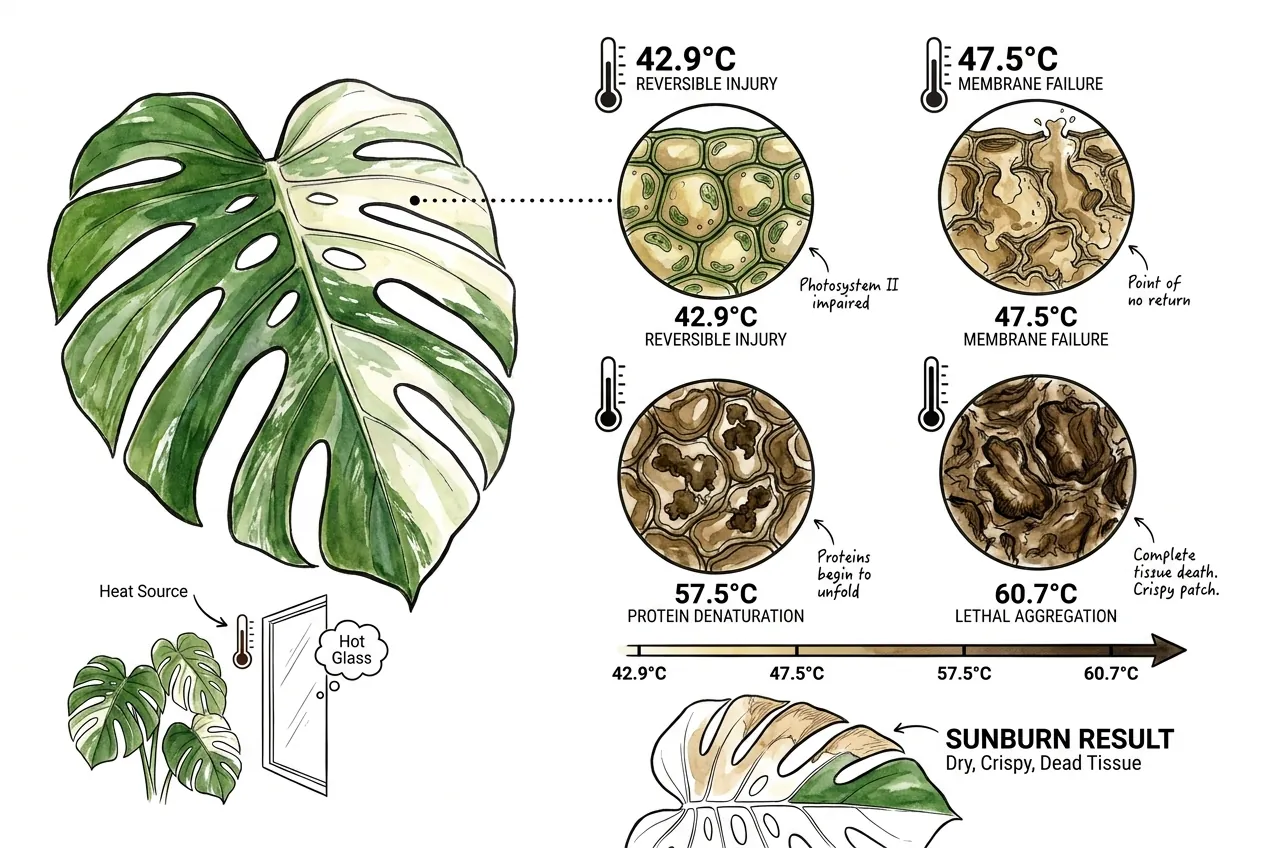
Heat injury tends to progress through stages as temperature and exposure rise, and a local hot spot only needs to cross a threshold locally to kill those cells.
A 2025 study measured a sequence in cut leaves of six mountain plant species, and the between-species variation was large, so read the following as an order of events with representative averages, not fixed limits for a houseplant.
In that study, reversible photosystem II impairment began around 42.9°C on average, a membrane-damage transition sat near 47.5°C, and protein denaturation ran from roughly 52.3°C to 57.5°C. Membranes generally failed before proteins did, but the exact numbers are species-dependent and were not measured on Monstera or on white sectors.
The July worry is real without pretending to precise arithmetic. If room air is a warm 32°C and a stressed leaf runs perhaps 10°C hotter near hot glass, that puts it near 42°C, brushing the reversible-injury range. It does not by itself reach 47.5°C. Whether a white sector runs hotter still, and by how much, is not established, so the takeaway is directional. Hot glass plus a heat wave stacks conditions that can push exposed tissue toward damaging temperatures.
This fits why sunburn typically shows as a dry, tan, crispy dead patch rather than a soft yellow. The cells were heat- and light-injured rather than slowly starved, and that tissue does not recover.
The three practical levers that help cool tissue are consistent soil moisture, distance from hot glass, and gentle airflow.
Each supports the evaporative and convective cooling that under-defended white sectors benefit from most.
Analysis of Environmental Effects on Leaf Temperature under Sunlight, HPS and LEDs
A novel method for measuring heat injury in leaves reveals the sequence of heat injury development
Functional Stomata in a Variegated Leaf Chimera of Pelargonium zonale without Guard Cell Chloroplasts
Increase in leaf temperature opens stomata and decouples net photosynthesis from stomatal conductance in Pinus taeda and Populus deltoides x nigra
Why is midsummer often the danger month?
In the Northern Hemisphere at mid-latitudes, summer tends to stack several light-and-heat factors. The noon sun sits near its highest, daily light totals peak, and thermal lag can push the hottest air a few weeks past the June solstice.
None of this is a universal rule, though. Timing, intensity, and even which window is worst depend on your hemisphere, latitude, climate, and the building itself.
The solar-angle numbers are approximate but reasonable. Around the solstice a plant near 40°N sees the noon sun roughly 73° above the horizon, versus about 50° near the late-March equinox.
A higher, steeper sun can strike a horizontal leaf more directly, though it may actually reach less deeply through a vertical south-facing window and is more easily blocked by an overhang.
Seasonal daily light contrast outdoors is large. A clear summer day can reach a daily light integral near 60 mol/m²/day versus under 5 in northern winter.
Those are outdoor figures, not what a plant receives at an indoor window, so treat them as context rather than an indoor target.
The practical trap is real regardless of exact numbers. A plant that spent winter and spring in weak, low-angle light has leaves built for that environment and has not re-acclimated, so the same windowsill that was gentle in April may deliver much stronger, more direct light by midsummer, depending on your orientation, glazing, and any shade.
How do windows amplify the light and heat?
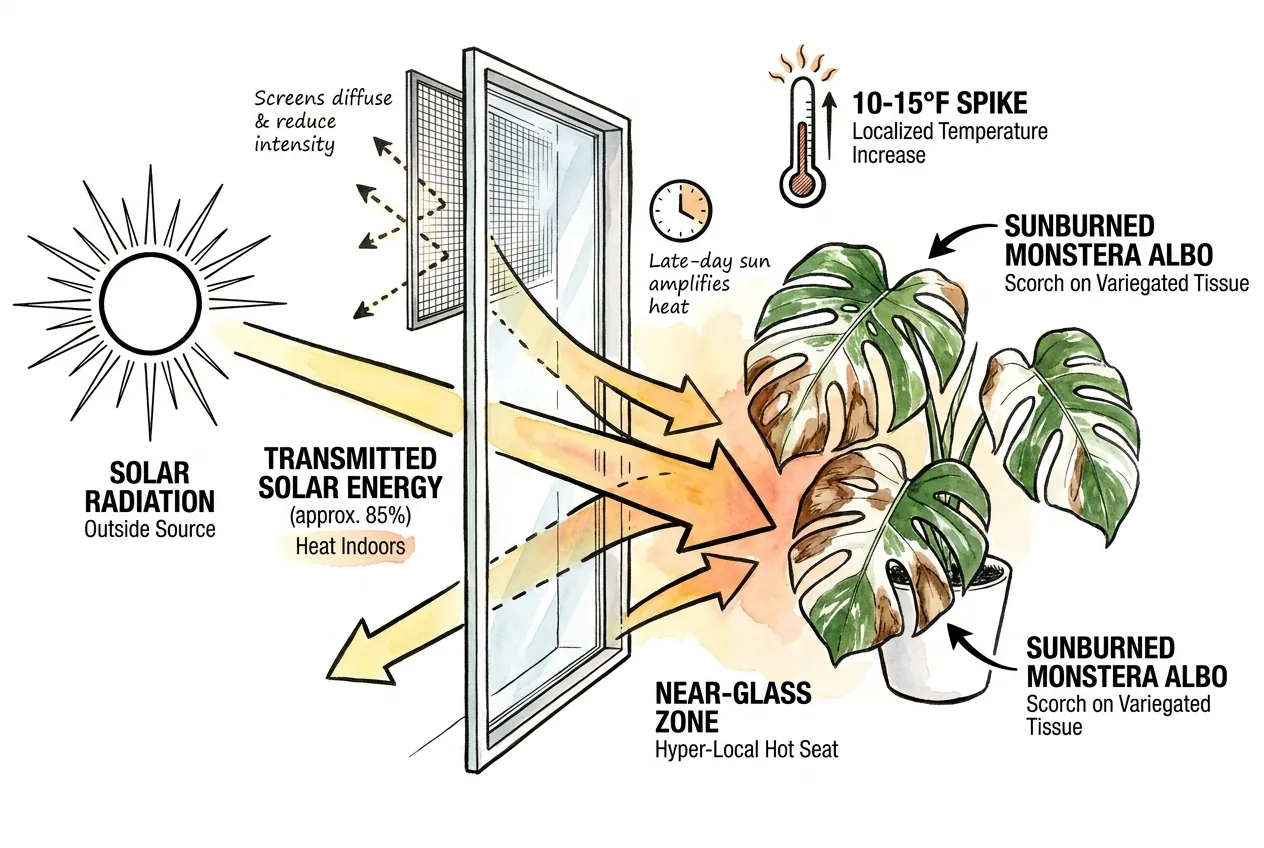
Clear glass passes a lot of light, and the zone right by the glass can become a local hot spot exactly where people love to place a prized plant.
How much passes, though, is not a single number. A glazing product’s visible transmittance and its solar heat gain are different properties, and low-E, double-pane, coated, or screened windows vary widely.
There is no universal 85% of solar energy figure to apply to your window.
Air near a sun-drenched window can feel warmer than the rest of the room, and removing insect screens for summer can let more light through.
But the exact temperature rise depends on your glazing, orientation, and room, so check yours rather than assuming a fixed spike.
In the Northern Hemisphere, west-facing windows are often the harshest in practice, taking the late-day sun when the room and walls have already been warming for hours, though nearby buildings, trees, and your climate can change that.
Why is a heat wave plus high light worse than either alone?
In green photosynthetic tissue, combined high light and high heat can cause more damage than either alone. Heat speeds light damage to photosystem II and slows the plant’s repair of it, so net injury builds.
Excess photons damage the D1 protein at the heart of photosystem II, which the plant normally repairs continuously. Moderate heat raises the damage rate and slows the repair cycle.
That mechanism applies to photosystem-containing green tissue.
White sectors have little photosystem to damage in this way, so it explains stress in the plant’s green tissue more than it explains why a white sector browns.
It is a reason to protect the whole plant on hot, bright days, not a stand-alone account of white-first injury.
The practical lesson is to watch the forecast, not just the calendar. A clear-sky day in the mid-90s°F stacks conditions that raise risk even if your plant handled bright light on a cooler week, though what matters is the actual leaf temperature, exposure duration, and the plant’s acclimation, not the air temperature alone.
Pre-shade and cool before the heat wave rather than reacting after tissue crisps.
Window orientation (a Northern-Hemisphere starting point)
This is a rough heuristic for the Northern Hemisphere. Reverse it south of the equator, and adjust for your latitude, season, setback from the glass, glazing, and any outdoor shade.
Extension sources note that a south window a few feet back can read medium or low from spring through fall, and a north window can be medium in summer, so measure rather than assume.
| Window | July character | Albo verdict |
|---|---|---|
| East | Gentle morning sun, coolest | Safest, easiest win |
| South | Can bring direct sun. Varies with setback and shade | Usually needs setback or a sheer |
| West | Intense afternoon heat on an already-hot room | Harshest, avoid or heavily diffuse |
| North | Weakest, but can be medium in summer | Often dim. May be workable in peak summer |
Daily Light Integral Defined. Michigan State University Extension
Mechanisms Regulating the Dynamics of Photosynthesis Under Abiotic Stresses. Frontiers in Plant Science
How do I tell sunburn apart from overwatering, edema, and nutrient burn?
Sunburn usually leaves a recognizable pattern. Dry, tan-to-bleached, crispy patches on the most sun-exposed, uppermost leaves, on the sun-facing side, while shaded lower leaves stay clean.
The most useful clue is spatial, because damage often lands where the light lands. Treat it as a likelihood, not a diagnosis.
Disease and pests do not always track the sun the way sunburn tends to, so location is a helpful filter.
But leaf wetness, microclimate, and injury can also concentrate on one side, so a matching pattern raises the odds of sunburn without ruling other things out.
If damage sits on the sun-facing side of the topmost, most-exposed leaves and is absent on shaded lower leaves, sunburn is likely.
Confirm it with the recent exposure history (a move, a heat wave, screens removed) and a quick check of roots and undersides for pests before you settle on it.
Sunburn can develop within hours, first appearing as bleached, washed-out patches on the white sectors.
What is a quick texture-and-soil check?
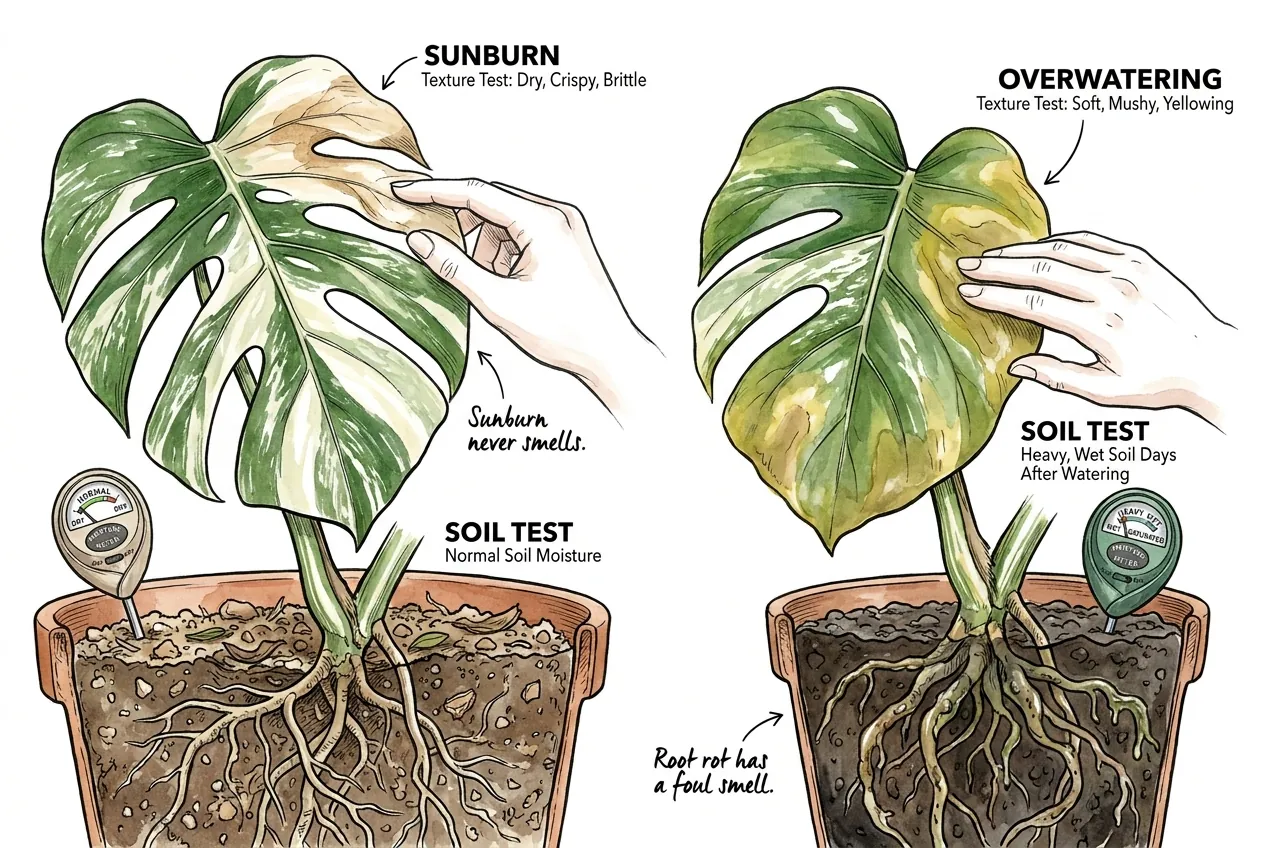
Texture and soil are useful clues rather than a definitive test. Sunburned tissue is often dry, brittle, and crispy. Classic overwatering damage is soft, mushy, and yellowing, usually lower on the plant with heavy wet soil days after watering.
But root problems and root rot can also produce crispy, dry margins by starving leaves of water, so crispy does not always mean sun.
A crispy patch on a light-facing leaf with normal soil moisture leans toward sunburn. Soft, yellow, lower-leaf damage with soggy soil leans toward a watering or root problem.
Smell can help but is not decisive. A foul, sour smell points to decay, yet root rot does not always smell, and sunburned tissue can develop secondary soft rot if organisms move in, so do not clear root rot on the absence of odor alone.
Two more look-alikes are worth checking directly rather than ruling out by season. Edema makes small translucent blisters or corky bumps, typically on leaf undersides, and is common in cool, humid, dim, wet conditions, though it can coexist with other stress.
Fertilizer or salt injury often browns tips and margins and may leave a salt crust, but it is not always even across the whole plant, so also weigh your feeding history and the plant’s roots.
Sunburn versus its four look-alikes
Use this to organize the history, not as a confirmatory diagnostic. Real cases overlap, several causes can occur together, and none of these rows is exclusive.
If damage is spreading or you are unsure, inspect the roots, check undersides under magnification for pests, and consider a local plant clinic.
| Disorder | Texture | Location | Environment | Soil |
|---|---|---|---|---|
| Sunburn | Dry, crispy, bleached-tan | Top, sun-facing leaves | Hot, bright, recent spike | Normal |
| Overwatering | Soft, mushy, yellow | Lower, older leaves | Any | Wet, heavy, sour |
| Edema | Raised blisters, corky bumps | Undersides, margins | Cool, humid, dim | Recently overwatered |
| Fertilizer burn | Dry tips and margins, yellow halo | Even across whole plant | Any, after heavy feeding | Salt crust on surface |
| Pest stippling | Fine silvery dots, webbing | New growth, undersides | Any | Normal |
When is white browning just natural die-off?
Some white browning is not a care mistake at all. Pure-white sectors cannot photosynthesize and lean on the rest of the plant, so a very-high-white leaf often browns over time even with careful conditions.
The practitioner Darryl Cheng describes such browning as largely inevitable, though that is an experienced observation rather than a strict biological law, and not every white patch is destined to brown.
The distinction is in the timing and pattern. Sun-side, sudden, crispy browning that follows a heat or light spike is sunburn, a fixable environment problem.
Gradual browning of a very-high-white leaf, happening even in gentle light, is natural die-off of tissue that was never sustainable.
For over-white shoots, that browning is expected. Prune the shoot back to a node with a better green-and-white balance to protect the plant’s energy budget.
Leaf Scorch. Common Mid-Summer Problem. University of Missouri IPM
Monstera Albo browning on white part. House Plant Journal
Edema. University of Wisconsin–Madison Horticulture Extension
How much light can a Monstera Albo actually handle?
Because its white sectors contribute little photosynthesis, a Monstera Albo leans on its remaining green tissue, so it does benefit from generous light overall.
The practical goal is bright indirect light rather than harsh midday beams. This is a care judgment rather than a precise light prescription. No species-specific safe or optimal number has been established for Albo.
A useful starting reference is the generic interior-plant scale. Extension sources place high light above about 1000 foot-candles, medium at 500 to 1000, and low at 50 to 500. That is a general classification, not an Albo safe range or a scorch threshold.
Direct sun at a south or west window often reads well above 1000 foot-candles, and sudden strong direct sun is the main risk to protect against, especially for white tissue.
On conversions, be careful. Lux and foot-candles measure light as the human eye sees it, while PPFD measures photosynthetic photons, and the two do not convert by a fixed factor without knowing the light’s spectrum.
So rough guides that pair, say, 100 to 300 µmol/m²/s with bright indirect light, or an aroid daily light integral around 6 to 12 mol/m²/day, are context, not exact equivalences for your setup (see this light-science guide for houseplants for how PPFD and DLI relate).
A meter is optional at home. The simple version is to place the plant in a bright spot where the leaf does not catch a hot, direct midday beam.
What is a safe way to increase light without shock burn?
Increase light gradually over a week or two, because a leaf that grew in lower light is built for lower light and cannot flip to sun-leaf mode overnight.
Sudden jumps in exposure are a common way people damage an Albo in summer.
There is supporting evidence for the direction. When shade-grown avocado leaves were suddenly exposed to strong light, their protective xanthophyll response was overwhelmed within about an hour while photosystem II efficiency declined. Sun-grown leaves generally carry a larger xanthophyll pool, and building that capacity takes days for the biochemistry and longer for leaf structure.
That is avocado, not Monstera, so read it as a reason to ramp up slowly rather than an exact timeline.
White sectors cannot fully make the chloroplast-based part of this adjustment, so avoid moving an Albo from indirect to direct, or indoor to outdoor, in a single jump.
Note this is about avoiding sudden change, not a claim that any direct sun is forbidden. A well-acclimated plant can tolerate limited direct sun, and practitioners report an hour or two being fine.
If you take it outside for summer, harden it off gradually over one to two weeks, starting with a couple of hours in shade and adding a little sun each day.
This adapts a garden-transplant schedule, so watch the plant and adjust to your weather rather than following fixed days.
Keep it in dappled bright shade rather than unfiltered midday sun.
What products actually solve the light problem?
A cheap, reversible fix is a plain white sheer curtain, which diffuses a harsh beam without robbing the plant of light hours.
How much any given sheer actually cuts depends on its weave, color, pleating, the number of layers, and the sun angle, so there is no single reliable percentage to quote.
The only way to know your reduction is to measure the light at the leaf, at the same time of day, with and without the curtain.
The category is what matters more than a specific product. If a south or west window is still too bright after one panel, layer a second or choose a denser weave, since each adds diffusion, but the effect is not a fixed linear amount.
A very dense sheer can over-dim a north or east window, so match the weave to how harsh your exposure actually is and confirm with a quick reading.
HLC.ME sheer curtains can suit a south- or west-facing window that delivers a harsh beam to the leaf. They are less useful for an already dim north or east window. Check that the panels fit your window and compare the light before and after hanging them, because the reduction is not certified.
How to use it
Hang it on south or west glass through the bright months to soften direct beams into bright indirect light.
You do not need a meter. The practical test is a spot where the leaf does not catch a hot, direct midday beam.
Limitations
The reduction depends on the fabric and setup, not a fixed percentage, so a very bright west window may need two layers or a denser weave.
Measure the light at the leaf with and without the curtain to see what you are actually getting.
If you want to reduce guesswork, a simple light meter helps you compare spots consistently rather than judging by how bright a window looks. A meter is still optional at home.
Dr.meter Digital Light Meter is useful when you want to compare the same leaf position before and after moving the plant or adding a curtain. It reads human-weighted light rather than plant PPFD, so use it for consistent relative comparisons, not as a precise Monstera light prescription.
How to use it
Measure the light at the leaf at the same time of day to compare placements consistently, rather than guessing from how bright a window looks.
Limitations
Because it reads lux and foot-candles rather than PAR in µmol, and because that conversion is spectrum-dependent, use it for relative comparisons, not lab-grade PPFD or DLI.
Enthusiasts who need true PAR pay several times more for a quantum sensor, which most hobbyists do not require.
Decreased Photochemical Efficiency of Photosystem II following Sunlight Exposure of Shade-Grown Avocado Leaves
Interior Plants and Light. PlantTalk Colorado (Colorado State University Extension)
Hardening Transplants. Nebraska Extension
How do humidity, water, and airflow lower the sunburn risk?
Keeping the plant cool and hydrated helps it tolerate more light. Transpiration is a major way a leaf sheds heat, and it needs soil water to run.
Moderate humidity and steady soil moisture support that indirectly, though, importantly, raising humidity is not the power supply of evaporative cooling. Higher humidity lowers the vapor-pressure gradient, which usually reduces the evaporative flux itself.
Its real benefit is slowing dehydration so stomata stay open, not adding cooling directly.
Transpiration needs open, responsive stomata and enough soil water to replace what evaporates.
When soil water runs low, many plants close stomata, evaporative cooling drops, and leaf temperature can climb.
How strongly a given species does this varies, so treat it as a tendency rather than a fixed rule.
That is why a dry pot in a heat wave is risky. Heat and drought can compound. At high leaf temperature with closed stomata, damage can develop quickly, though how fast depends on the leaf temperature, species, and duration, so the within minutes framing is a worst case, not a norm.
The practical rule is to check the pot rather than water on a rigid calendar. Feel the soil, or lift the pot to judge weight, every few days in a heat wave and water before it goes bone-dry.
Avoid keeping it permanently saturated. How often to water depends on your mix, pot size, and root health, so a fixed 2-to-3-day evenly moist target can overwater some setups.
Does raising humidity and airflow really help?
They help, mostly indirectly, and both are safe, low-effort levers. Moderate humidity keeps the vapor-pressure deficit in a comfortable band so the plant transpires steadily instead of slamming stomata shut in very dry air. It is about avoiding dehydration stress rather than a proven cooling optimum.
Monstera generally does well in medium-to-high humidity, but there is no evidence that a precise 50 to 60% is a cooling sweet spot, so treat that as a comfortable range and also watch for condensation and mold in your home.
Every leaf sits inside a thin, still film of air called the boundary layer. In stagnant air that film can trap heat against the leaf, and in greenhouse settings gentle air movement (on the order of 50 to 100 feet per minute) is used to keep leaf temperature closer to air temperature.
That is a greenhouse design figure for circulating a whole space, so a small home fan will not necessarily hit an exact leaf-level speed. The takeaway is directional. A little air movement helps.
The key word is gentle. Aim a small fan across the room, not straight at the plant, because a hard, direct blast on an already water-stressed plant increases water loss and can make things worse.
One clear caveat on method. Do not rely on misting for humidity. Extension testing shows the humidity bump from misting is very short-lived, so it would need repeating many times a day, and wet foliage can invite disease.
A clean humidifier, or simply grouping plants, sustains ambient humidity far better.
What climate-control gear is worth it?
Two device classes can help in a dry room, though neither is required for every Albo. Look for enough humidifier output to hold a comfortable ambient humidity and enough gentle airflow to move air without blasting the leaves.
A room-sized humidifier is a more sustainable way to lift humidity than misting. The Levoit Classic 300S Humidifier can suit a dry room where you will monitor humidity and maintain the unit. It is unnecessary if the room is already comfortable, and it is a poor choice if you will not clean it or manage the water quality.
How to use it
Run it a few feet from the plant during dry heat to keep ambient humidity in a comfortable range, which helps stomata stay open.
Use a separate hygrometer to see what your room actually reaches.
Limitations
Ultrasonic units can spread fine mineral dust from hard water, so use distilled or demineralized water and clean and dry the tank regularly, or they can seed mineral film and microbial growth.
Its built-in sensor reads humidity near the mist, watch for condensation nearby, and skip it if you will not maintain it.
Grouping plants gives a smaller, free humidity bump if you prefer no device.
For airflow, a small clip or oscillating fan on a low setting can help break up still air. The SkyGenius USB Clip-On Mini Fan suits a shelf or small plant area, not a whole room. Place it far enough away that leaves move gently. Direct wind on a dry plant increases water loss.
How to use it
Point it across the room near a hot south or west window to break up stagnant air, and watch the foliage for gentle movement rather than whipping.
Limitations
Even on low it can be too strong up close, so keep it a few feet away and off the foliage. Direct wind on a dry plant increases water loss.
Extreme heat increases stomatal conductance and drought-induced mortality risk in vulnerable plant species
Horizontal Air Flow Systems. University of Connecticut IPM
The air in our home is extremely dry in winter. Should I mist the houseplants? Iowa State University Extension
Swiss-Cheese Plant, Monstera deliciosa. University of Wisconsin–Madison Horticulture
Can scorched white variegation on a Monstera come back?
No, a scorched white sector is biologically dead and will never green up or heal on that leaf.
Sunburn kills cells outright, and plants have no mechanism to regenerate necrotic leaf tissue.
Recovery means one thing only. New, healthy variegated leaves produced by the growth point, not repair of the damaged blade.
Extension guidance is blunt. Once leaf tissue is scorched, the damaged areas will not recover. The brown stays brown forever on that leaf.
The mechanism is photo-oxidative necrosis. Reactive oxygen species rupture the cell membranes, the cell contents spill out, and that is an irreversible injury with no biological path back.
So reframe the goal. You are not healing the burned leaf. You are preventing the next burn and keeping the plant strong enough to push out a healthy new leaf.
Take a photo of the damage so you can later tell whether the brown is spreading, which signals an ongoing problem, or static, which is just cosmetic scar tissue.
Should I cut off the damaged leaves?
Usually no, because a partly-burned leaf still has functional green tissue that photosynthesizes and shades tender new growth, and stripping foliage is its own stressor.
Extension horticulturists specifically warn against the panic-snip.
Trim only what is clearly, fully dead and crispy, and treat it as cosmetic. If a leaf still has substantial green, leaving it or snipping just the crispy edge along the natural dead line is usually fine. A fresh cut edge may brown a little.
Leaving a dead margin does the plant no harm, so cutting is optional.
Remove a whole leaf only when it is almost entirely dead. If a lesion is mushy or spreading, treat that as a signal to re-diagnose (it may be rot or a pest), not as routine sunburn trimming.
Avoid removing a large share of the canopy at once. Take off only what is clearly gone rather than stripping the plant.
When you do cut, technique matters, because every cut is an open wound and warm, humid conditions favor rot organisms.
Use sharp shears, wipe the blades with 70% isopropyl alcohol before and after, wetting the blade and letting it air-dry, and make one clean pass rather than tearing.
Clean visible debris off the blade first, since sterilizer works poorly over grime.
Two safety notes. Monstera sap contains calcium oxalate that can irritate skin and eyes, so wear gloves and avoid rubbing your eyes. Wash exposed skin afterward.
And 70% isopropyl alcohol is flammable, so keep it away from flames and let treated tools dry.
How do I protect the variegation going forward?
Protect the growth point above all, because the variegation of future leaves is set by the chimeric meristem, not by any damaged blade. Check the newest emerging spear at the top of the vine.
If it still shows white or cream mottling, the next leaf can emerge variegated too. Mottling on one spear is a clue to that leaf, not a guarantee about every future leaf, so shield the growth point from harsh sun and avoid chopping the plant back reactively.
A single burned mature leaf does not erase variegation from the meristem, so one bad afternoon does not ruin the plant.
One conservative care rule closes the loop. Hold off on fertilizing a freshly burned or badly heat-stressed plant.
Heavy feeding during acute stress adds little and can add salt stress, so wait until strong, healthy new growth appears, then reassess whether the plant actually needs feeding.
This is about avoiding heavy feeding under stress rather than a claim that any fertilizer automatically forces vulnerable growth. Triage is simply shade, correct watering, and stable placement.
Leaf Scorch and Sunscald in the Garden. South Dakota State University Extension
Reactive Oxygen Species in Plant Cell Death. Van Breusegem & Dat, Plant Physiology
Sunburn. Home and Landscape. UC Statewide IPM Program
Affiliate Disclosure
This article contains Amazon affiliate links. As an Amazon Associate I earn from qualifying purchases. If you use these links, the site may earn a commission at no extra cost to you. Product availability, price, and specifications can change. Check the current listing before buying.