
Anubias Rhizome Rot: What to Do About the Soft Dark Line in Warm Tanks
Warm summer water holds less oxygen, and a soft, dark, foul-smelling rhizome usually means decay has set in. Here is how to spot it, cut it out, and lower the risk.
Jordan Cole · Published 2026-06-14 · 22 min read
Key Takeaways
- A soft, dark, foul-smelling rhizome means decay has set in. The exact cause of Anubias rot is still unconfirmed, with bacterial and fungal soft rot both proposed.
- Warm water holds less oxygen. At saturation, fresh water drops from about 9.08 mg/L at 20 °C to 7.54 mg/L at 30 °C, and warmth can also speed microbial growth in general.
- Rhizomes buried in substrate are the most-cited setting for rot. The local oxygen level around a buried rhizome has not been measured in aquarium studies.
- Cutting decayed tissue back into firm, healthy rhizome is the best available salvage attempt. It is not a guaranteed cure, so sterilize the blade and re-mount in open water.
- Lower the risk by keeping the rhizome above substrate. Keep the tank within your livestock’s safe range and inspect and quarantine new plants.
A healthy Anubias rhizome is firm and generally pale, and the plant is famously forgiving of low light, skipped water changes, and beginner mistakes.
That toughness is a big part of why it is such a popular starter plant.
Then summer arrives, the tank warms up, and one morning there is a soft, dark, foul-smelling patch spreading across the rhizome. In a warm tank, decay like this can advance quickly.
Confirm decay from the rhizome’s texture and odor, cut back to firm tissue promptly, and keep the rhizome exposed afterward.
The exact cause of Anubias rot is not settled in the hobby literature, so focus on what you can observe and do rather than trying to name a pathogen from appearance alone.
What is the soft, dark line on my Anubias rhizome?
Recognize Decay Before Naming the Cause
That soft, discolored tissue is decay, sometimes called soft rot. A wet breakdown in which the rhizome turns mushy, the cells lose their grip on each other, and the structure collapses.
What you can see and smell tells you decay is happening, but it does not by itself identify the organism responsible.
Soft rot can involve bacteria that break down plant tissue, while fungal or secondary infections are also proposed for Anubias. Appearance alone cannot distinguish those causes.
Identifying the organism would need laboratory testing, so a hobbyist should treat the visible decay rather than treating a suspected pathogen as confirmed.
Before cutting anything, I photograph the entire rhizome and mark firm, questionable, and soft sections on the image. Each point is handled gently with clean tools or gloves, and I disinfect between plants so the inspection does not become a spread route.
Only after the map shows where firm tissue resumes do I cut and photograph the cut surface. If softening advances past the original boundary, I can see that progression instead of repeatedly trimming by memory.
Rhizome Firmness Check
A firm, pale rhizome is a good sign. A soft, dark, smelly rhizome means active decay and needs attention today.
A gentle firmness check is a useful triage cue, but treat it as one signal among several, not a diagnosis of the exact pathogen or a guarantee the plant is dead or alive.
Pectobacterium carotovorum
Bacterial soft rot
How do I tell rhizome rot apart from normal Anubias melt?
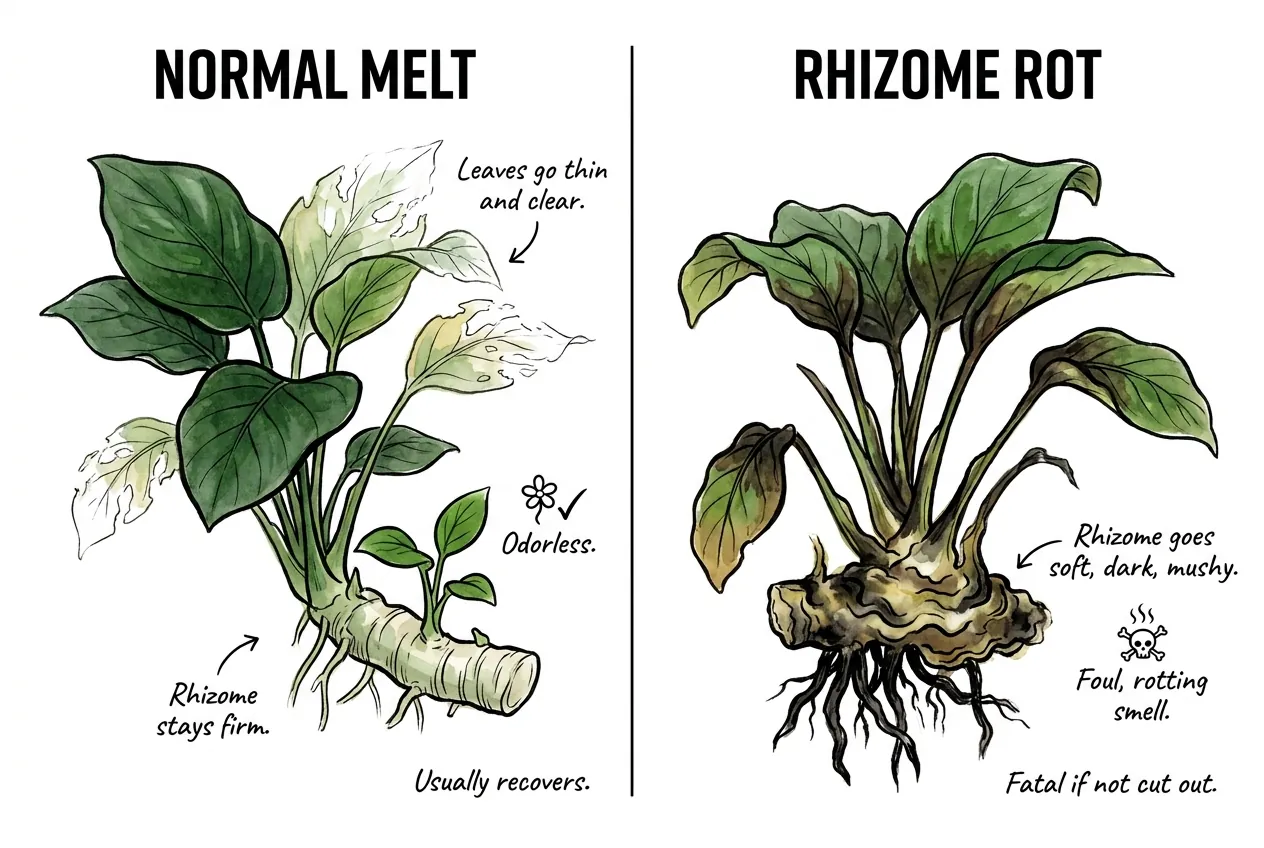
The most useful first distinction is where the problem is. Leaf melt is usually a leaf issue, while rot is a rhizome issue.
In melt, individual leaves turn soft, translucent, and disintegrate, often after the plant transitions from being grown out of water to living submerged. The rhizome typically stays firm and the plant frequently pushes new leaves.
This is not an absolute rule, and plant age, remaining growth points, and the environment all affect recovery.
Rot is more serious. The thick horizontal rhizome itself becomes mushy, brown, and foul-smelling, and the discoloration can look like clear-ish jelly, white, yellow, brown, or black.
Leaves may detach at the base and roots may blacken. Keep in mind that these symptoms tell you decay is present but do not distinguish bacterial from fungal causes, or from secondary decay following mechanical injury, nutrient or temperature stress, or ordinary senescence.
Here is a quick field guide. Treat it as a triage aid rather than a two-box diagnosis.
| Signal | Normal melt | Rhizome rot |
|---|---|---|
| Where | Leaves only | The rhizome itself |
| Texture | Leaf goes thin and clear | Rhizome goes soft and smears |
| Smell | None | Foul, rotting |
| Rhizome firmness | Usually firm and pale | Soft, dark, mushy |
| Outlook | Often recovers on its own | Can spread and kill the plant if the decay is not removed |
Remember that other problems can look similar. Melting leaf tissue can develop secondary decay and odor, and mechanical damage, root or water-quality stress, or a fungal issue can all discolor a rhizome.
If the rhizome is still firm and odorless, melt is the more likely explanation and it is usually best to leave the plant alone to recover.
If the rhizome squishes and smells foul, treat it as active decay and act today.
Why Anubias Melt, Rot and How to Prevent It
Anubias Rot. Symptoms, Causes, and Solutions
Why You Should Not Guess the Pathogen
Some soft-rot bacteria affect other aroids, but no source cited here confirms one as the cause of Anubias rot. Being in the same plant family is not enough to diagnose an affected rhizome.
That uncertainty does not change the immediate response. Remove decayed tissue, keep tools clean, and mount the remaining rhizome in open water instead of applying a crop-disease treatment by guesswork.
Pectobacterium aroidearum sp. Nov., a soft rot pathogen with preference for monocotyledonous plants
Pectobacterium carotovorum
Why does warm summer water raise the risk of Anubias rhizome rot?
Read Temperature and Oxygen Together
Warm water holds less oxygen and can speed microbial activity. That makes surface agitation, stable temperature, and an exposed rhizome especially important during a heat spell.
No study sets a temperature at which Anubias rot begins. Keep the tank within your livestock’s safe range, increase gas exchange as it warms, and treat a soft, dark rhizome as decay regardless of the exact number on the thermometer.
Why does the rhizome tend to rot, and not the leaves?
Keep the Rhizome Exposed
The common explanation is that a buried or smothered rhizome is the easiest place in the tank to create a warm, wet, low-oxygen pocket.
Bacterial soft rot is generally described as needing free water, low oxygen, and a way in through a wound. A buried rhizome plausibly provides all three.
This is a mechanism borrowed from general soft rot biology, not something measured on Anubias in an aquarium.
In hobby sources, the most-cited setting for Anubias rot is a buried rhizome, the idea being that a buried stem cannot get enough oxygen and begins to decay.
In the wild, Anubias grows with that thick stem in open, moving water, clinging to rock and wood, with the rhizome exposed rather than sitting down in the substrate.
Keeping the rhizome out of the substrate is sound husbandry regardless of which organism is involved.
Why does burying or gluing the rhizome cause rot?
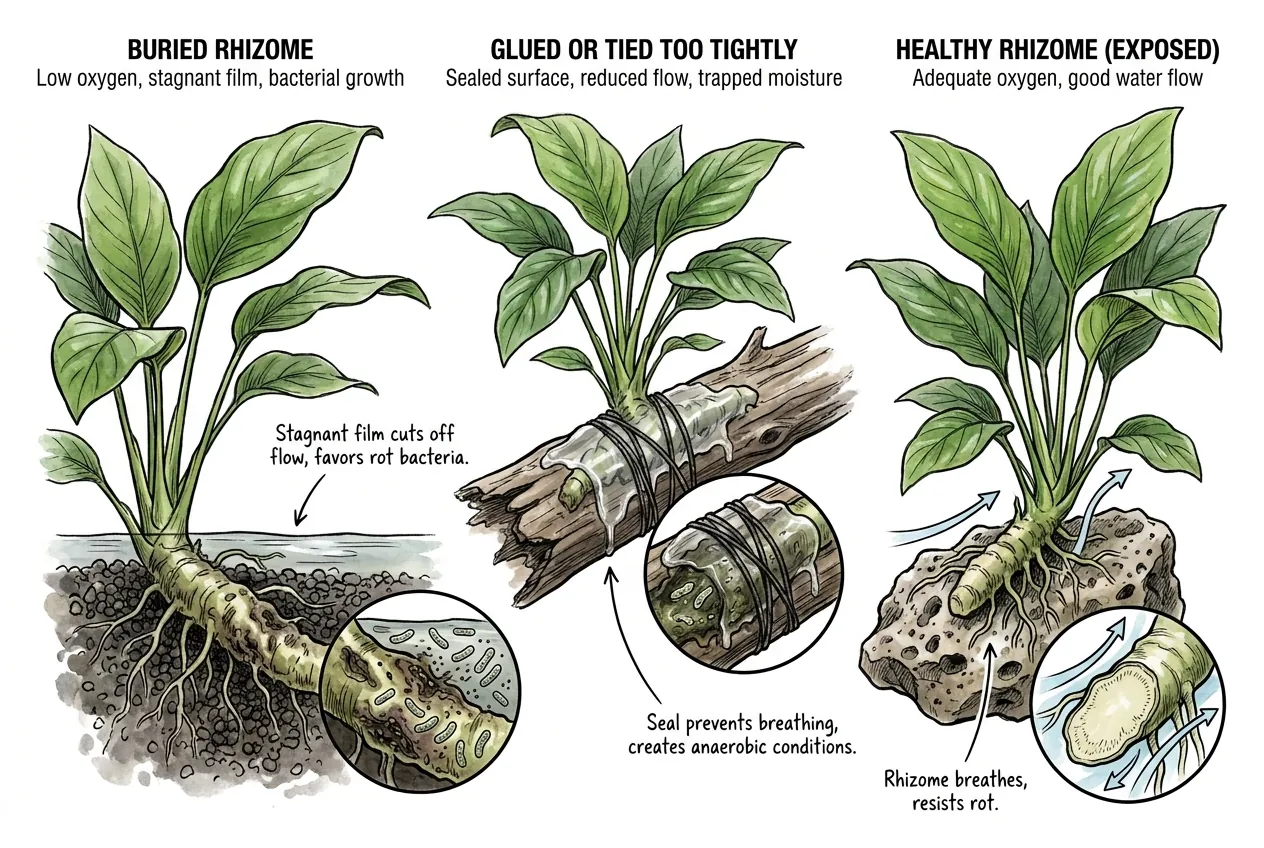
The likely reason burying the rhizome causes trouble is that substrate packs around the stem and slows flow, so the local oxygen level around it plausibly falls below the open-water value.
How far it falls has not been measured with a probe in aquarium substrate, so treat the low-oxygen pocket as a reasonable explanation rather than a documented fact.
Bacterial soft rot organisms are generally facultative anaerobes, meaning they can multiply with or without oxygen, and low-oxygen, waterlogged conditions are described as favoring them in stored crops.
A buried rhizome plausibly recreates similar conditions. Keep in mind that this comes from crop-storage pathology. An aquarium rhizome is not identical to a stored tuber, and the causal organism here is not confirmed.
Wrapping the rhizome very tightly with thread or smearing it under a thick layer of glue is best avoided too.
A tight wrap can crush and wound the tissue, and excess glue covers more surface than needed.
The practical fix is to mount the plant loosely so the rhizome stays exposed in open water, which the prevention section covers in detail.
Why Anubias Melt, Rot and How to Prevent It
How does the infection actually get inside the rhizome?
For bacterial soft rot, the usual route is a wound. These bacteria most commonly enter through cuts and damaged tissue, or through natural openings in the plant surface.
In an aquarium, plausible wound sources include ordinary handling. Trimming the rhizome, a piece snapped off at the store, snails and fish grazing, or crushing the stem under a rock.
These are likely entry points rather than a documented list for Anubias specifically.
Once inside, bacterial soft rot organisms release pectolytic enzymes, cell walls break down, and tissue turns to mush from the inside out.
Because microbial growth and enzyme activity generally rise with temperature, decay can advance fast in a warm tank. A small patch can become a badly damaged rhizome within days.
The exact speed depends on conditions and on the organism involved, which for Anubias has not been confirmed.
Bacterial soft rot
How do I try to save an Anubias once the rhizome is rotting?
Cut Back to Firm Tissue
The best available approach is to cut the decayed tissue back into clean, firm rhizome, and to do it promptly.
Surface chemical dips are not reported to cure an established soft rot, so cutting is the main salvage attempt, not a guaranteed cure.
If most of the rhizome is already mush, discarding the whole plant may be the safer choice to avoid spreading the problem.
Cutting off the soggy or discolored rhizome with a sharp blade is the remedy hobby sources point to. Done early, it can leave a healthy remainder that regrows, though success is not guaranteed and depends on how much clean tissue and how many growth points are left.
The cited source itself frames this as something that may save part of the plant, not a certain fix.
Step 1. Remove and inspect
Take the plant out of the tank and work over a separate container, not your display. Rinse it in dechlorinated water so you can see and smell the rhizome clearly, and use fresh rinse water you can discard afterward rather than pouring it back into the tank.
Inspect gently along the length. Firm and pale is a good sign, soft and dark and smelly is decay.
Handle it as little as possible and keep it away from your other plants.
Step 2. Sterilize the blade
Wipe visible debris off a sharp craft knife or scissors, then disinfect the blade with 70% or stronger isopropyl alcohol, giving it enough wet contact time and letting it air-dry before you cut.
The fresh cut you are about to make is an open wound, and a dirty blade can push contamination into clean tissue.
If you prefer to flame-sterilize instead, do it well away from the alcohol and let the blade cool fully first, since alcohol is flammable. Do not combine the two.
Step 3. Cut into clean, healthy tissue
Cut into firm, pale, odorless tissue rather than flush with the visible edge, since decay can extend a little beyond what you can see.
Take your cut somewhat past the last sign of softness, then check the cut face. If the cross-section still looks translucent, stringy, or discolored, or smells, keep cutting until it looks and smells clean.
There is no validated exact margin for Anubias, so let the appearance of the tissue guide you rather than a fixed number.
Re-disinfect the blade between cuts, and collect and discard the removed tissue in the trash rather than the tank.
Step 4. Re-mount with the rhizome exposed
Attach the remaining healthy rhizome to rock or driftwood with cotton thread or a small dab of cyanoacrylate gel.
Only the roots should touch the substrate, and the rhizome should sit in open water rather than in a stagnant pocket.
Where practical, keep the freshly cut plant in a clean separate container for a few days so you can watch the cut before returning it to the display.
Placing it where there is gentle water movement is reasonable so oxygenated water reaches the cut, though there is no trial showing a specific flow rate improves healing.
Avoid a direct jet, debris, and constant grazing by livestock.
Tip
Act promptly once you see active decay. Because decay can advance quickly in warm water, it is better not to wait. There is no exact rescue deadline established for Anubias, so treat sooner as better rather than relying on a fixed window.
Anubias Rot. Symptoms, Causes, and Solutions
Bacterial soft rot
Do hydrogen peroxide, bleach, or potassium permanganate cure it?
Reported experience says no. Hobbyists have tried potassium permanganate, hydrogen peroxide, and bleach on Anubias rot, and the cited write-up reports that the problem resisted almost all of them.
The likely reason is that once decay is inside the tissue, a surface dip cannot reach it. This is hobby experience rather than a controlled study of every dose and stage, so read it as strong practical guidance, not a proof.
Hydrogen peroxide is mainly used in the hobby as a surface and algae treatment, for example rinsing the outside of a new plant before it goes in. It is not a systemic antibacterial cure, and applying it to freshly cut tissue is not a validated treatment. Oxidizers can injure exposed tissue, and there is no Anubias-specific protocol showing it helps a wound.
If in doubt, skip the peroxide on a fresh cut.
A note on peroxide dips
You will see hobby dip recipes such as diluted hydrogen peroxide for a few minutes, always followed by a thorough rinse in dechlorinated water before the plant goes back in. Reported concentrations and times vary widely and there is no single validated protocol, so keep any dip short, start dilute, and watch the plant.
Delicate species like mosses and liverworts are easily damaged. Anubias is comparatively tough, but longer or stronger is not better, and residual peroxide near livestock is a concern.
Caution
A dip is a surface cleanup step, not a substitute for cutting out decayed tissue. If the rhizome is mushy, a dip will not fix it.
Cutting into clean tissue is what addresses the decay, and even that is a salvage attempt rather than a guaranteed rescue.
Anubias Rot. Symptoms, Causes, and Solutions
How do I cool a tank that keeps overheating in summer?
Lower Heat Without Shock
Pull the water temperature back into your livestock’s safe range and keep the surface agitated.
For Anubias, common care ranges top out in the upper 20s C, so keeping the tank out of the high 20s and away from the low 30s is a sensible target. Treat that as a comfort ceiling rather than a proven rot threshold, since no study fixes a specific rot temperature for Anubias.
Keeping oxygen exchange high while you cool matters just as much.
Two common approaches are an inexpensive evaporative fan and a more expensive chiller, and most hobbyists reasonably start with the fan.
Will a clip-on fan actually lower the water temperature?
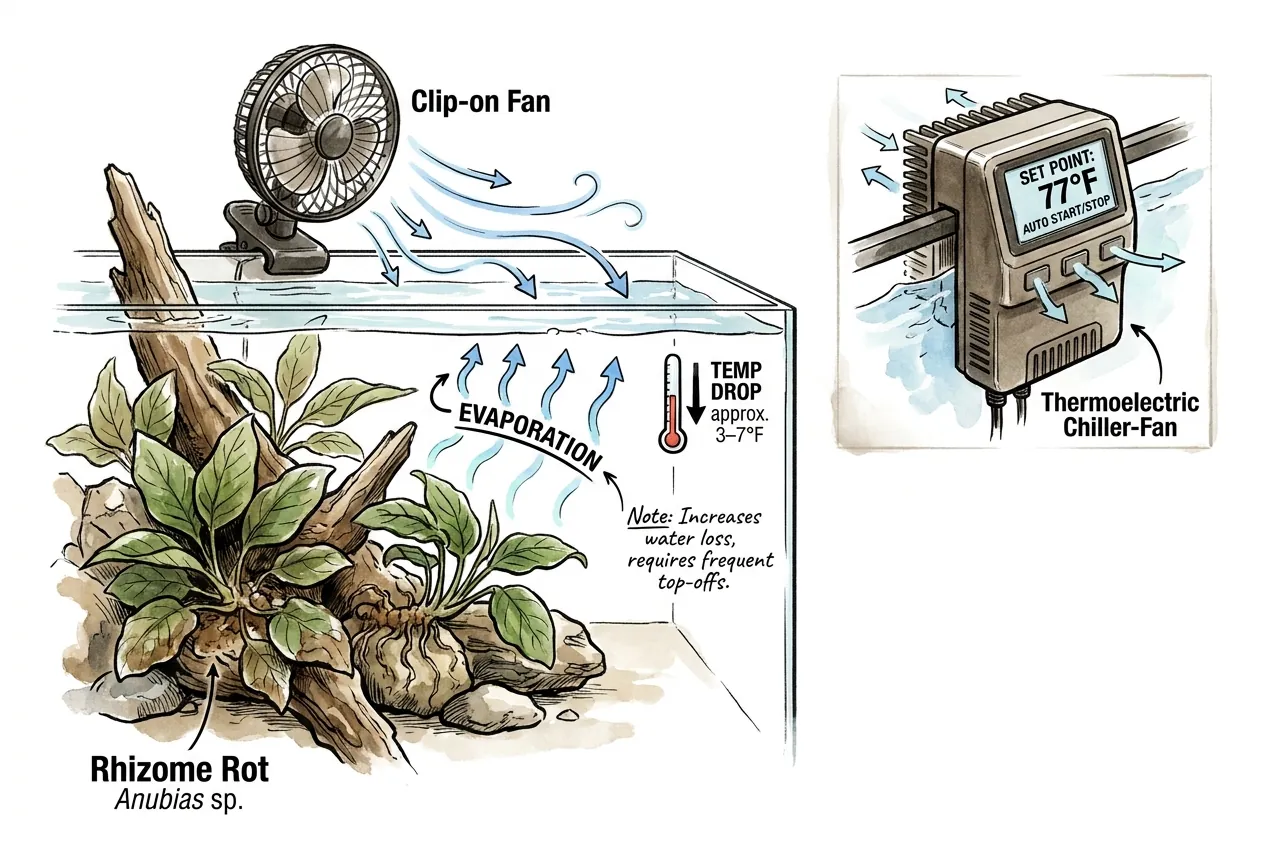
Yes, usually by a few degrees, through evaporation. A small fan blowing across the surface boosts evaporation, which pulls heat from the water.
Fans sold for this job commonly advertise a drop of roughly 3 to 7 °F, but that is a seller claim and the real drop depends on room humidity and dew point, airflow, tank surface area, whether the tank has a lid, and the heat load. Expect less in a humid room.
That is often enough to bring a tank in the low 30s C back into a safer range during a normal heat spell.
The tradeoff is faster evaporation, so you top off more often, and the effect shrinks in humidity.
What Matters in an Evaporative Fan
Look for a surface-directed fan with a temperature set point and auto start-stop, so it cools without overshooting.
AQUASMITH Aquarium Chiller Fan fits a small tank that needs more surface airflow and automatic fan control during short heat spells. It is not a substitute for a compressor chiller in a persistently hot room or a humid, covered setup where evaporation has little effect. Expect more top-offs and make sure the lower water level cannot expose equipment or let fish escape.
Because an evaporative fan only lowers the water a handful of degrees and raises evaporation, you refill more often.
If your room stays very hot for weeks, or you run a large tank, a true compressor chiller may be the only thing that holds the line. Sizing it depends on tank volume, ambient conditions, and heat load, and it costs several times as much and uses far more power.
How fast can I lower the temperature without shocking my fish?
Slowly. A common rule of thumb is to drop the temperature no faster than about 1 °C per hour to avoid shocking livestock.
That is cautious general guidance from pet-care sources rather than a species-tested threshold, so also consider the specific tolerance of your fish and invertebrates, and prioritize emergency oxygenation if the tank is dangerously warm.
Frozen water-bottle spot cooling can help in a pinch, but float the bottle and monitor with a thermometer rather than crashing the temperature.
Watch for a local cold spot, keep the bottle clean, and mind displacement or overflow. A sudden swing stresses fish and plants, which is the opposite of what you want when the tank is already stressed.
Note that evaporative cooling leaves minerals behind as water evaporates, so repeated top-offs can raise dissolved solids over time. Use a suitable top-off water source and watch that heaters and filters do not end up exposed as the level drops.
An open top for a fan can also let jumping fish out, so consider a mesh cover.
Surface agitation matters as much as the raw number, because warm water holds less oxygen.
A fan that ripples the surface and a circulation pump that keeps water turning over both improve gas exchange, so they help on temperature and oxygen at once.
Helping Your Fish Keep Cool in Summer
What equipment helps you catch rhizome rot early?
Measure Heat and Flow
Two inexpensive tools help. An accurate thermometer so you can see when the tank is warming, and good water movement to reduce the stagnant pockets that plausibly favor decay.
Neither prevents rot on its own, but both make the conditions less friendly to it.
Why do I need an accurate thermometer for this?
Because a couple of degrees can matter for both plant comfort and decay risk, and a cheap thermometer that reads several degrees off will not warn you in time.
The concern here is accuracy (how close the reading is to the true temperature), not resolution (how many decimal places it shows). A strip that displays a precise-looking number can still be wrong.
Aim to keep the tank out of the high 20s C for Anubias comfort.
Choose a Readable, Checkable Thermometer
Look for a digital thermometer with a clear display and a fast refresh, and check the accuracy spec rather than trusting the number of digits.
PAIZOO thermometer is useful for watching temperature trends from outside the glass when you want a display that does not sit in the water. It is a poor choice if you need an in-water probe reading or cannot compare it with a known reference. Treat it as a convenient monitor, not proof of the exact water temperature.
Compare any thermometer against a known reference across your working temperature range before relying on it. An outside-glass sensor can be influenced by room air and contact with the glass, so a precise-looking display is not proof that the reading is accurate.
How does water movement help?
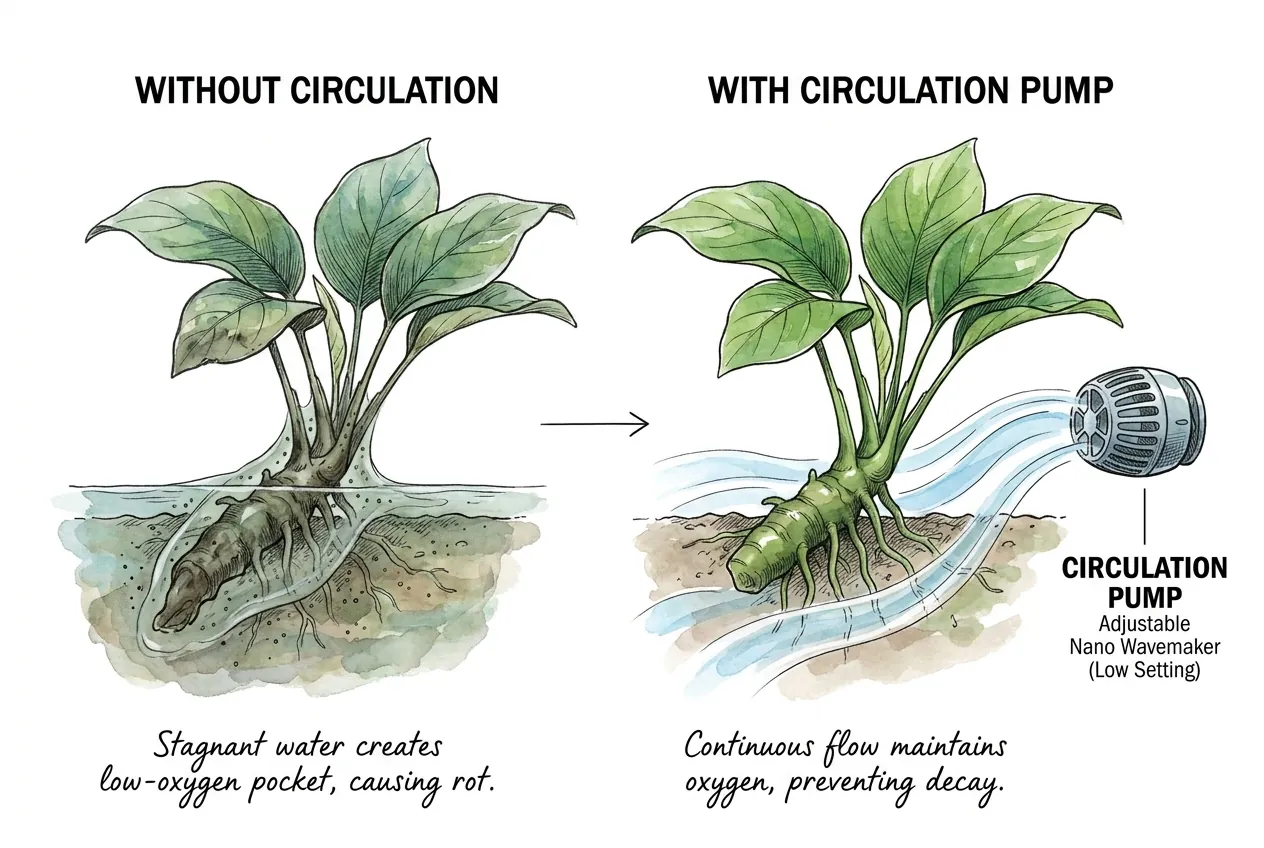
The idea is that moving water keeps oxygenated water sweeping across the rhizome, so a low-oxygen film is less likely to settle against the stem.
Bacterial soft rot is described as favoring stagnant, waterlogged pockets. Mixing plausibly reduces those local gradients, but there is no Anubias experiment showing that a pump prevents rot, so treat this as a helpful general practice rather than a guarantee.
Before adding a dedicated pump, check whether your existing filter already turns the tank over well and reaches the area around the rhizome.
Warm water benefits from good surface agitation and circulation to hold oxygen, and that may be enough without extra equipment.
Match Flow to the Tank
If you do add one, match the flow to your tank, your existing filter output, and the flow tolerance of your fish and shrimp, rather than to a fixed rating.
High numbers can be far too much for a small tank. 1600 GPH is an enormous turnover in a nano setup.
hygger Mini Wave Maker Powerhead can help where the filter leaves a genuinely stagnant area and the livestock tolerates added flow. It is not a default choice for a calm nano or betta tank, where even its low setting may be excessive. Use the controller, aim flow along the glass, and protect the intake from shrimp and small fish.
The main caution is that too much flow can uproot Anubias and stress calm-water fish like bettas.
If you use a pump here, choose one with a controller, run it low, add an intake guard for shrimp and small fish, and aim it along the glass so the rhizome gets a gentle current rather than a jet.
Best and Most Accurate Aquarium Thermometers
How do I lower the risk of Anubias rhizome rot?
Build a Low-Risk Routine
Mount the rhizome in open water, keep conditions stable and within your livestock’s safe range, trim dead leaves carefully, and inspect and quarantine new plants.
Because the exact cause is not confirmed, think of this as reducing risk rather than guaranteeing rot never happens. The aim is to avoid the warm, wet, low-oxygen, wounded conditions that decay tends to exploit.
What is the correct way to mount an Anubias?
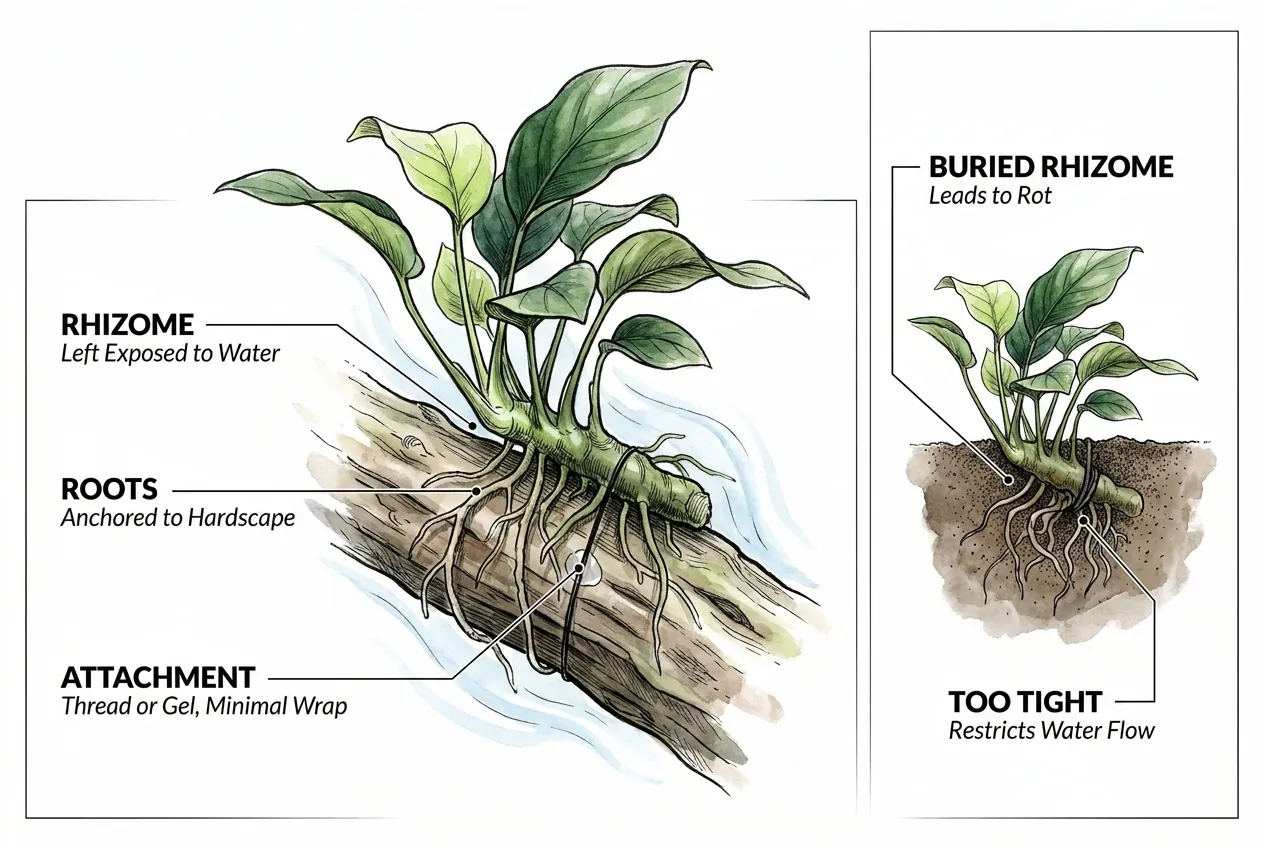
Attach it to hardscape with only the roots touching substrate, and do not bury the rhizome.
Use cotton thread or a small dab of cyanoacrylate gel to fix the plant to rock or driftwood, leaving the rhizome in open water.
Watch the plant’s form and avoid crushing the rhizome as you tie it.
Avoid a thick smear of glue over the rhizome or a very tight wrap of thread. A tight wrap can crush and wound the tissue, and excess glue covers more of the surface than needed. Both are worth avoiding, and keeping the rhizome exposed in open water is the goal.
What water parameters keep Anubias out of the danger zone?
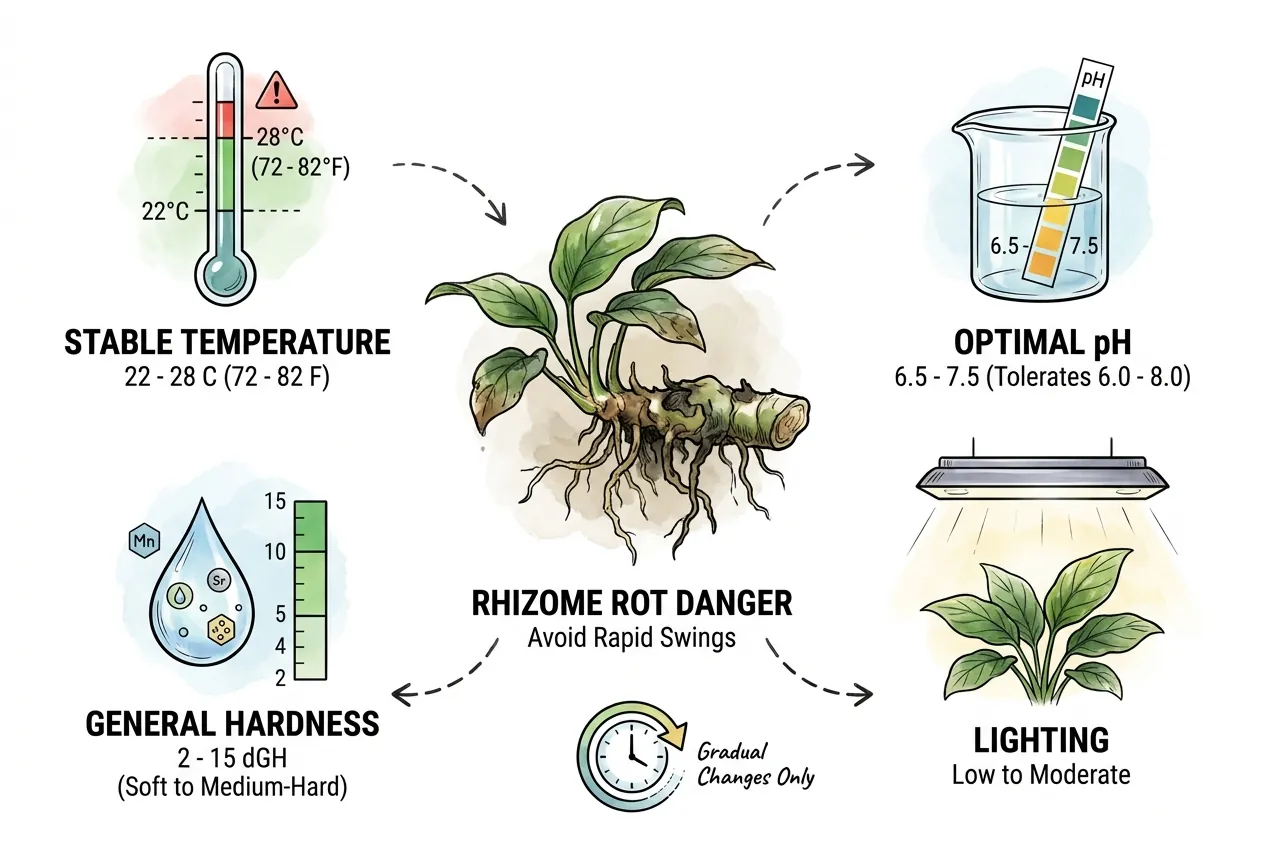
Aim for stable, moderate conditions. Comfortable temperature ranges cited for Anubias barteri vary by source. One commonly cited range is about 72 to 82 °F (22 to 28 °C), while another care reference gives 20 to 30 °C. These are comfort ranges, not a measured rot threshold, so use them alongside the needs of your fish and invertebrates.
Cited references put pH around 6.0 to 7.5 and general hardness from soft to medium-hard.
| Parameter | Target for Anubias barteri |
|---|---|
| Temperature (comfort) | about 22 to 28 °C (72 to 82 °F). One source cites 20 to 30 °C |
| Warm-season caution | watch the tank in the high 20s C and above, alongside livestock limits (not a proven rot threshold) |
| pH | 6.0 to 7.5 |
| General hardness | 4 to 18 dGH |
| Light | low to moderate |
Stability is generally worth aiming for. Rapid swings in temperature, pH, or hardness stress the plant, so make changes gradually.
There is no direct data tying a specific parameter swing to rot incidence, so treat stability as good general husbandry rather than a proven rot control.
Why should I quarantine new plants?
Because a new plant can carry in problems, including decay organisms and algae, on its tissue, and a wound from shipping or handling can give them an entry point once the plant is in warm water.
How often that actually happens is not well quantified, so quarantine is a sensible precaution rather than a guarantee.
Inspect every new Anubias before it goes in. The rhizome should be firm and pale with no soft or dark spots.
Keeping the plant in a separate container for a while, with a longer observation period than just a few days, lets slow-developing problems show themselves before the plant reaches your display.
Use separate tools and water for quarantine work. A short surface rinse can reduce algae and surface debris, but bear in mind it will not remove an infection already inside the tissue, and a symptom-free spell does not rule out a slow decline.
A simple summer routine
Glance at the thermometer daily during a heat spell and inspect the rhizomes regularly. Use visual checks before squeezing them, because repeated pressure can bruise healthy tissue and move material between plants. If you check firmness, touch lightly and clean your hands or tools between plants. Trim clearly dead or badly damaged leaves with a clean tool rather than tearing them off. Keep the surface moving, and add fan cooling when the tank stays warmer than the species can tolerate.
Catching a soft, dark spot early is what matters most. A small lesion found on day one may be a quick trim, while the same lesion found much later can mean losing the plant.
Early detection is the goal. The exact size and timing vary and other causes should not be ruled out.
Why Anubias Melt, Rot and How to Prevent It
Comprehensive Care Guide for Anubias barteri
Affiliate Disclosure
This article contains Amazon affiliate links. As an Amazon Associate I earn from qualifying purchases. If you use these links, the site may earn a commission at no extra cost to you. Product availability, price, and specifications can change. Check the current listing before buying.