
Paludarium Houseplants: Roots in Water, Crowns Above
Grow pothos, philodendron, and peace lily in a paludarium with roots in water, crowns above it, rinsed LECA support, livestock-safe sourcing, and water tests.
Priya Patel · Published 2026-07-14 · 23 min read

Key Takeaways
- For pothos, philodendron, and peace-lily-type plants, keep absorbing roots wet while the crown, stem base, and leaf bases stay above the waterline. Anubias and Java fern are different because their rhizomes can stay submerged when unburied.
- Support cuttings in rinsed LECA or an open holder, never submerged potting mix. Rinsing alone does not prove an unknown nursery plant is livestock-safe.
- In a stocked tank, protect livestock first. Test the water and keep houseplant fertilizer out. A label that says aquarium-safe does not automatically cover shrimp, snails, or amphibians.
- New firm root tips are encouraging, but judge the whole plant by trend, texture, smell, and water tests rather than root color alone.
- A sour smell, soft crown, or wilt while roots are wet is a reason to inspect and isolate now, not a finished diagnosis.
Paludarium houseplants work when the plant is set up as a bridge between air and water. Put the roots in the wet zone, keep the crown in air, and give the root zone oxygen, flow, and a clean support instead of sour potting mix. The simple rule is roots in, crown out. A pothos can send new water-adapted roots through aquarium water, though clean roots are not guaranteed for every cutting, source water, or tank. A peace lily can rot at the base when its crown sits continuously wet. This rule is for pothos, philodendron, and peace-lily-type plants. Aquatic rhizome plants such as Anubias and Java fern need a different placement rule, so keep the rhizome exposed instead of applying the crown-out rule.
What does roots in, crowns out actually mean?
Why the Crown Boundary Matters
For pothos, philodendron, and peace-lily-type houseplants, roots in, crown out means the absorbing roots can sit in water or wet inert media while the stem base and leaf bases stay above the waterline.
The crown is the junction where stems, leaves, or shoots emerge from the root system. Note that this is not a universal law. Crown, stem base, node, rhizome, and leaf base are different tissues, and their safe boundary varies by species.
That junction is not just another root. It is living stem tissue with buds, leaf bases, and tight crevices that can trap water.
When it sits in stagnant, wet organic media, decay is more likely to start where the plant can least afford structural failure.
Temperature, pathogens, and how much wetness the tissue tolerates all affect whether it actually rots.
For these plants, roots in water are usually fine, but a crown held under water for long stretches is at risk. That analogy does not hold for aquatic rhizome plants, whose crown and rhizome are adapted to stay submerged.
Before securing the plant, I mark the crown position and the highest normal water line on the front glass. The two lines make splash, capillary rise, and later water-level creep visible instead of relying on memory.
Only after checking where new roots have grown do I reset the water line. A plant can tolerate roots entering water while the same rise against the crown creates a completely different risk.
Which plant parts can touch water safely?
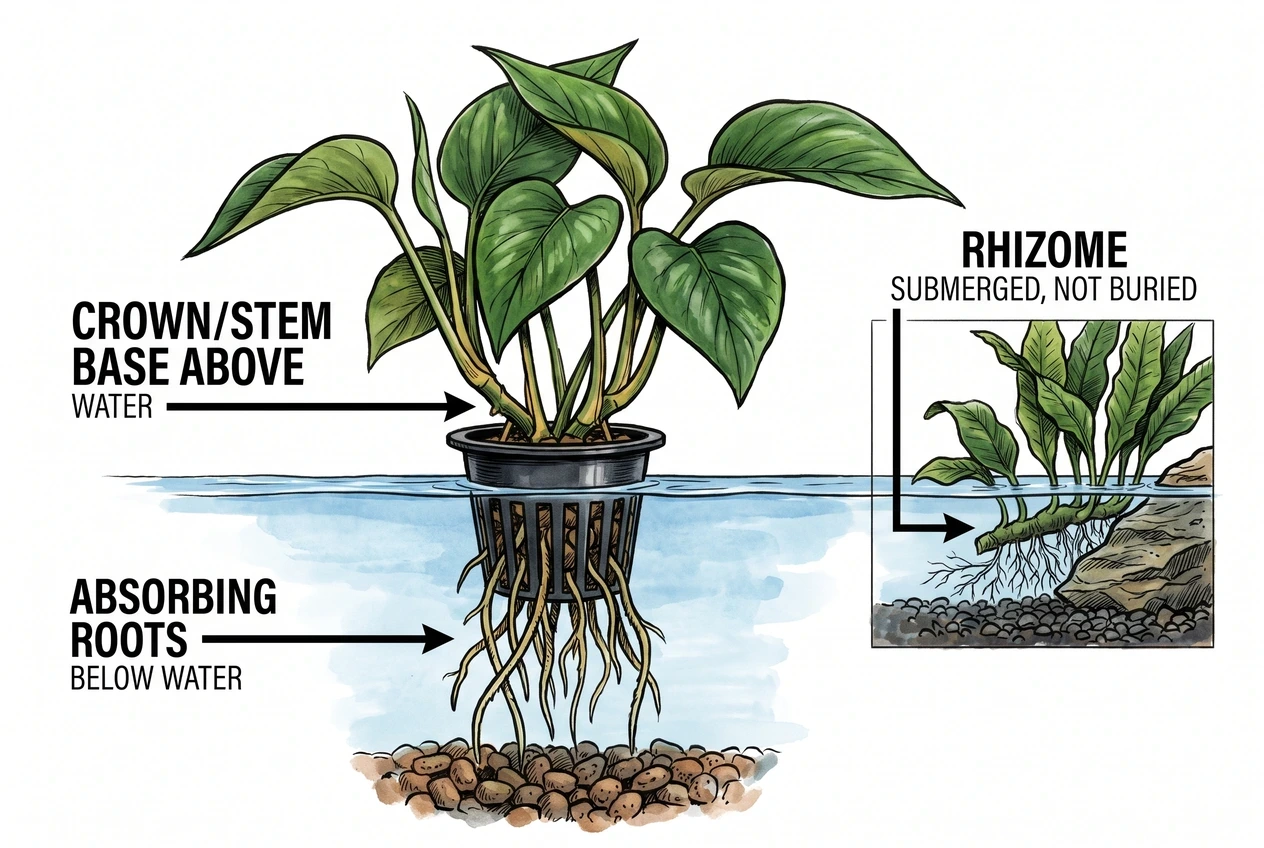
For pothos, philodendron, and peace-lily-type plants, roots and fresh water-adapted roots are the safest parts to put in the wet zone.
A node can also sit near high humidity or just at the waterline when you are rooting a cutting, though the right position varies by species and cutting condition.
Keep the Crown in Air
For those same plants, the crown, leaf bases, and thick stem collars are usually best kept in air. They can tolerate splashes and humidity, but they should not be packed in soaked moss, peat, or mud.
Aquatic rhizome plants such as Anubias and Java fern are the exception, not an example of this rule. Their rhizome can grow fully submerged in a tank. The rule is to leave the rhizome exposed on top of hardscape or gravel rather than burying it in substrate, while the roots grow downward.
Burying an Anubias or Java fern rhizome in substrate can cause it to rot, so keep it visible and unburied.
How do I plant my anubias, java fern, or other rhizome plant?
Overwatered Indoor Plants
Why can some roots live in water without rotting?
Oxygen Is the Real Constraint
Some roots survive wet conditions because the plant maintains enough oxygen movement and grows new roots suited to that environment.
Water itself is not automatically lethal. Oxygen shortage is the more common problem, alongside temperature, pathogens, chemical injury, and how flood-tolerant the species is.
In ordinary potting mix, air sits in pore spaces. When those pores fill with water, oxygen diffusion slows, roots lose energy, old tissue can die, and opportunistic rot organisms get an easier opening.
Water-adapted paludarium roots can do better because a well-run tank may be cleaner and better oxygenated than a drowned pot.
Moving water, open clay pebbles, and exposed nodes can help, but none of them guarantees enough oxygen on their own (dissolved oxygen depends on water temperature, actual flow past the roots, and whether detritus and biofilm build up in the media).
Wet peat packed around a buried crown works against all of this. When the wet zone stays warm or stagnant, correct the enclosure’s airflow and misting balance instead of assuming a porous medium will solve it.
What are aerenchyma and adventitious roots?
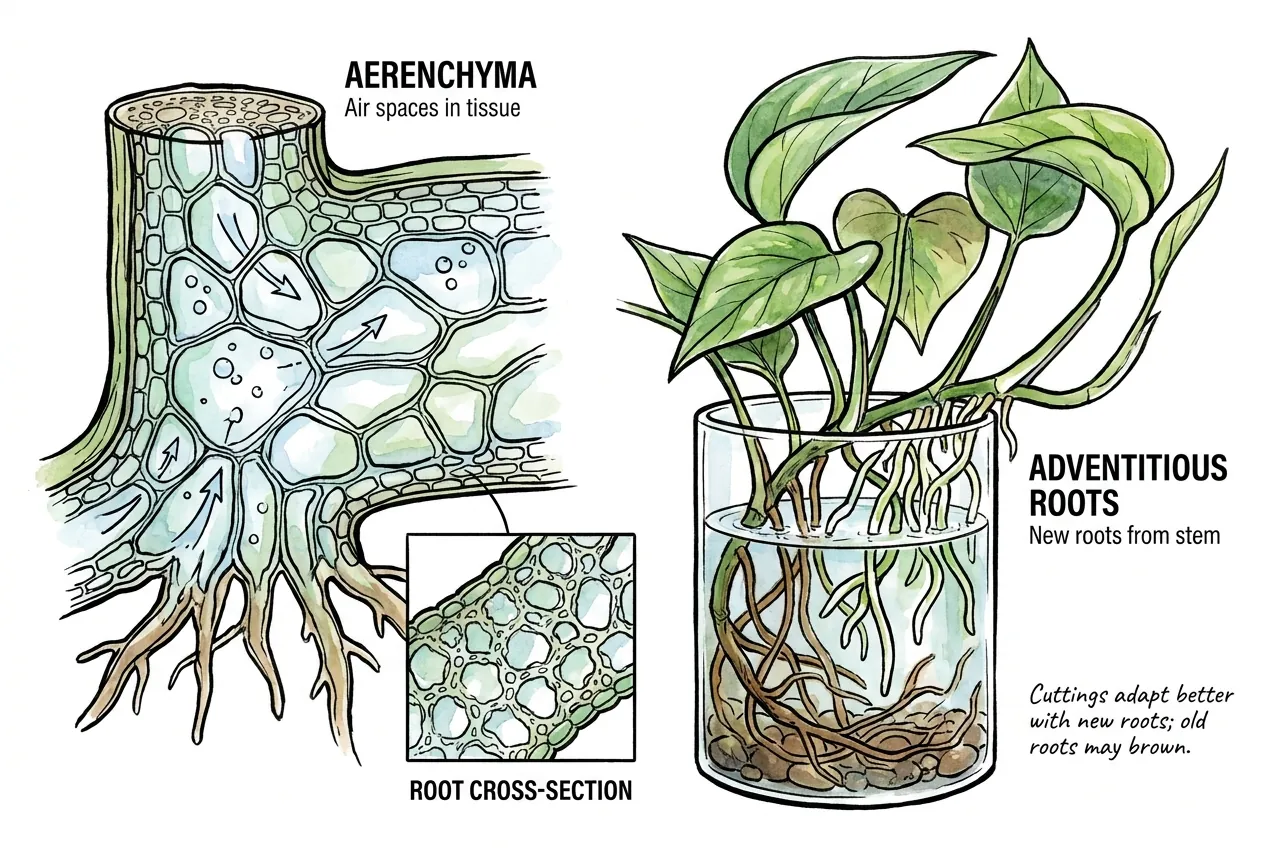
Two Root Responses to Wet Conditions
Aerenchyma are air spaces inside plant tissue that help move oxygen toward wet or flooded roots. Adventitious roots are new roots that form from stems or nodes, and they can be positioned closer to oxygen, though they are not always better adapted to a given wet environment.
These are general flooding responses studied across many plants, not proof about pothos specifically.
In practice, many growers find a fresh cutting easier to convert than a large soil-rooted plant, because the cutting carries less old media and can grow roots suited to the new spot.
This is a common experience rather than a controlled result, and it varies with species, cutting maturity, and how clean the start is.
Read the Root Response as a Clue
For home growers, the practical takeaway is simple. Some old soil roots browning after conversion is often normal. Treat a softening crown, sour-smelling water, or no new firm roots as a reason to inspect and, if needed, isolate the plant.
Genome-wide association study reveals quantitative trait loci for waterlogging-triggered adventitious roots and aerenchyma formation in common wheat
Which paludarium houseplants are good starters?
Choose a Clean Conversion Start
Common starter paludarium houseplants are tropical plants that root readily from nodes and tolerate constant moisture around their roots.
Pothos, heartleaf philodendron, syngonium, and careful peace lily setups are a practical starting point, though the right choice also depends on the exact cultivar, mature size, light and warmth, and how the plant was grown.
Treat Nursery History as a Safety Gate
Commercial ornamental plants may be treated with systemic or contact insecticides, fungicides, plant-growth regulators, and slow-release fertilizer. Systemic residues can stay in plant tissue even after you rinse the soil off, so a clean rinse, normal appearance, and no smell do not prove the plant is safe for livestock. At least one study found that leachate from insecticide-treated nursery pots was toxic to the aquatic invertebrate Hyalella azteca. If you keep shrimp, snails, aquatic insects, or amphibians, prefer plants grown without pesticides or with documented untreated propagation, quarantine and observe new plants, rinse them outside the system, and manage the rinse water. If you cannot confirm the history, keep the plant out of stocked animal water. Build that separation into the wider bioactive terrarium layout before plants or animals go in.
Use cuttings when possible. A cutting usually carries less old soil root to lose and less trapped media to foul the water, which can make the early conversion window cleaner.
The tradeoff is that a cutting also has smaller carbohydrate reserves, so it is not automatically better in every case.
Pothos is a common choice because it roots easily, grows in bright indirect light, and trails from a rim holder.
Philodendron and syngonium are broadly similar, though behavior and humidity needs vary by cultivar.
Peace lily is useful but conditional. It likes even moisture and sub-irrigation, but its crown should not sit underwater.
Treat it as a raised wet-foot plant, not a plant to submerge, and keep in mind it still needs aeration and stable water.
Which plants should stay out of the water-root experiment?
Avoid cacti, succulents, caudiciforms, dry-season bulbs, and anything with a buried storage base that hates constant wetness. They are adapted to storing water, not standing in it.
Also be careful with toxic aroids in open displays. Pothos and many related plants contain insoluble calcium oxalates.
That makes them poor choices where cats, dogs, or toddlers can chew trailing leaves. When you cut these plants, their sap can also enter the water, so do trimming outside the tank rather than over livestock.
If the paludarium is accessible to pets, choose safer placement before choosing a prettier vine. A good plant in the wrong household is still a bad setup.
Epipremnum aureum – NC State Extension Gardener Plant Toolbox
How do you physically keep roots wet and crowns dry?
Mark the Waterline Before Planting
Use a holder that keeps the crown above the waterline while letting roots hang into moving water or coarse wet media. The best designs make the wet-dry boundary visible at a glance.
A simple setup is a tank-rim cup or net pot filled with rinsed clay pebbles. The pebbles hold the cutting upright, keep the crown from sinking, and leave air gaps around roots.
Those gaps help, but they do not guarantee an oxygen-rich, rot-free root zone on their own. Do not use ordinary potting mix below the waterline.
For a banked paludarium, plant into a raised pocket above the water and let roots grow down toward the wet zone.
For a riparium look, use a clip or raft at the rim and let roots trail behind hardscape. Either way, the crown line stays inspectable.
Before planting, mark the normal waterline on the glass with removable tape. Then set the cup so the crown sits comfortably above that mark, with enough clearance for your top-off routine, splash, and any wicking.
This keeps top-offs and surges from quietly reaching the stem base. Evaporation lowers the level, so the real risk is overfilling when you top the tank back up.
Do not hide the holder so deeply that inspection becomes a teardown. A visible cup, clip, or pocket may look less natural on day one.
It usually looks better after the plant grows, and it keeps failures small.
How high should the cup sit?
The cup should sit high enough that only roots and lower media stay wet. If the node or crown disappears below the rim, the plant is too low for a beginner setup.
For cuttings, let the lowest node touch humidity or the top of the wet zone. Let roots chase water downward.
This is safer than burying the whole cutting and hoping the crown adapts.
For rooted plants, trim the holder instead of raising the waterline. A taller cup, shallower media layer, or side clip gives you control without changing conditions for fish.
What support media should go in the cup?
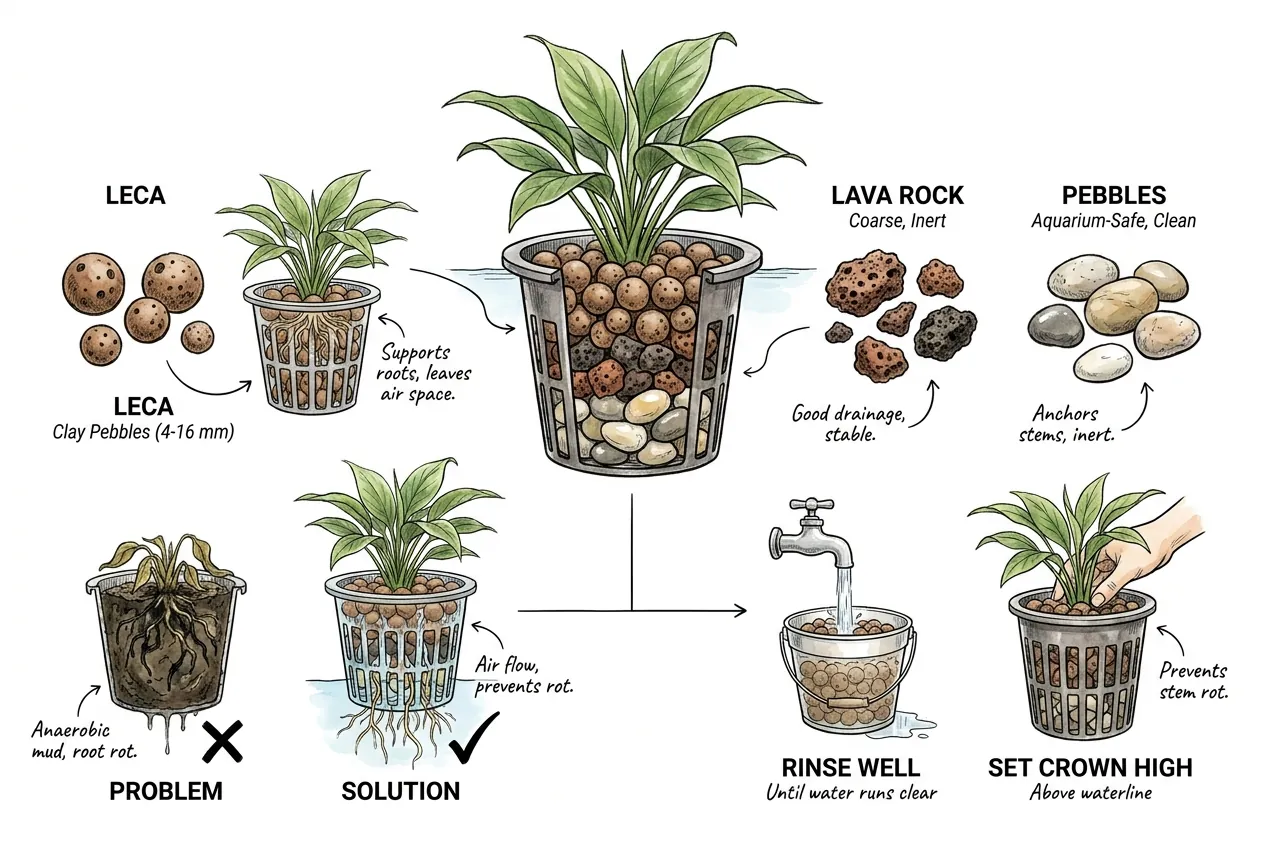
Coarse inert media is a reasonable choice for the cup because it supports roots without packing into anaerobic mud as readily as soil. LECA, coarse lava rock, and clean aquarium-safe pebbles can all work, but inert is not a guarantee. Source, batch, sharpness, soluble residue, and initial pH or EC vary, so check each medium against your own water rather than assuming.
For small cups, a small bag of LECA is enough to test the method before buying in bulk. Choose coarse clay balls that leave open space for water and air movement.
Rinse the pebbles until the water runs mostly clear, then soak them and compare their pH and EC against a sample of your source water before use. Fill a net cup loosely and set the crown above the waterline.
A small bag is convenient for testing the method first.
Coarse clay pebbles can reduce the submerged-potting-mix problem because they hold stems upright without wrapping the crown in wet organic material.
Preventing rot still depends on oxygen, flow, hygiene, and plant condition, not the media alone. If roots are already soft or sour, stop the conversion and use the semi-hydro root-rot diagnostic before adding fresh media.
A 2-lb bag makes sense for one or two small-to-medium rim cups, especially when a resealable bag is easier to store than bulk media.
Skip it for one tiny cup if a local shop sells a smaller amount, and skip 4–16 mm pebbles if the holder’s mesh lets the smallest pieces escape into the tank.
Keep every pebble captive in the cup. Do not use loose LECA as aquarium substrate.
Expanded clay pebbles
Expanded clay pebbles are often marketed as natural media for hydroponic and aquaponic use. That description is not livestock-safety certification.
Rinse and soak the pebbles before use, compare pH and EC against source water, and discard rinse water outside the tank because dust and initial chemistry vary by batch.
Light dry pebbles can float until they waterlog, so secure the cutting before the cup reaches animal water.
If you are still deciding what medium to convert to, you can choose a semi-hydro medium (LECA, Pon, meters) by setup.
Root Rots of Houseplants
What water quality rules change when fish are involved?
Protect Livestock First
Livestock safety comes before plant optimization in any stocked paludarium, and that means fish, shrimp, snails, amphibians, and the tank’s microbes.
A plant cup is not a reason to dose houseplant fertilizer into aquarium water.
In a stocked tank, monitor ammonia, nitrite, nitrate, and pH. Many hobbyists treat detectable ammonia or nitrite as a warning sign.
Note that a standard test reads total ammonia. How much of that is the toxic free form depends on pH and temperature, and safe thresholds vary by species.
Nitrate trend matters, but a pothos cutting does not replace water changes. Confirm how much a plant actually removes by watching its growth and total loading, not by assuming.
Aquaponic guidance treats pH as a compromise among fish, plants, and nitrifying bacteria. NMSU gives 6.4 to 7.4 as a tolerable system range, with 6.8 to 7.0 as a tighter compromise.
That is a specific aquaponic compromise, not a target for every paludarium.
Plant-only hydroponic reservoirs often run lower, roughly 5.5 to 6.5 as a rule of thumb, though crop, source water, alkalinity, EC, and temperature all matter. If tap-water minerals or RO replacement water are driving the instability, set the baseline with a paludarium RO and remineralization plan before adjusting the plant cup.
Set a Water Baseline
Write down the baseline before the plant goes in. A single nitrate reading after the plant roots is not proof that the display is filtering better.
The useful signal is the trend after feeding, pruning, and water changes.
If livestock are present, treat every plant adjustment as a water-quality event. Rinsing roots, cutting old tissue, and disturbing media can release organic material.
Test after the messy work, not only when the leaves look wrong.
Fishless and stocked systems should not use the same rulebook. A fishless cup can be managed like a small hydroponic planter, with weak nutrients and plant response as the main feedback. A stocked tank must protect animals first, so plant growth is secondary to stable water.
Separate Stocked and Fishless Water
If water returns to fish, shrimp, snails, or amphibians, use aquarium-safe inputs only and check that the product specifically names your animals, since shrimp and amphibians are more sensitive than many fish.
If the cup drains to a truly separate reservoir, you have more plant-nutrition options. Confirm the isolation is real by checking for splash, overflow, wicking, and shared tools, not just plumbing.
If you are not sure where runoff goes, treat it as stocked water. That branch also helps with product choices. LECA and test kits do not add fertilizer, but that does not make their dust, leachate, or reagents harmless around livestock.
Hydroponic nutrients belong only where the solution cannot reach animals.
When should you use nutrients?
Use hydroponic nutrients only in fishless reservoirs or isolated semi-hydro cups. In stocked tanks, use aquarium-safe routines and let fish waste supply part of the nitrogen load.
For isolated reservoirs, use a complete hydroponic nutrient only when the water cannot return to livestock.
It belongs in a fishless paludarium reservoir or planter cup where runoff does not enter animal water.
A hydroponic nutrient makes sense only when inert media have no fish waste or soil fertility to draw from. Follow the product label for foliage plants rather than guessing a dose, start on the dilute end, and watch new growth for deficiency or excess rather than chasing fast results.
The limit is livestock safety. Do not dose it into an aquarium with fish, shrimp, snails, amphibians, or other livestock.
What should you test?
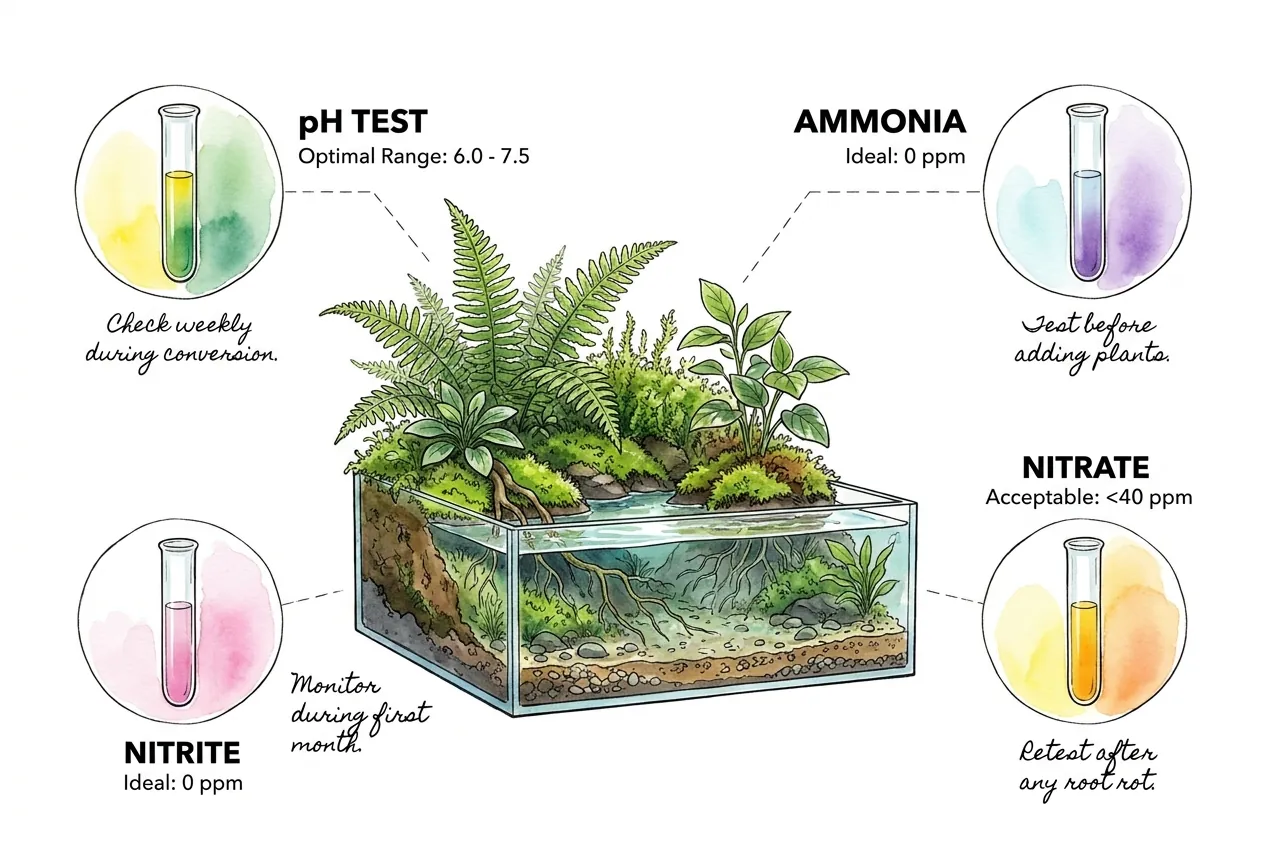
Test pH, ammonia, nitrite, and nitrate before adding plants, through the early conversion window, and after any suspected root rot event.
Rotting roots add organic load and can stress the biofilter before the plant looks awful, so it also helps to watch temperature and, where you can, dissolved oxygen.
There is no single correct pH or nitrate number for all paludariums. Aquaponic systems, plant-only hydroponic reservoirs, and stocked aquariums each have different targets, and within a stocked tank the right range depends on the species you keep.
Set targets from your own livestock, not from a generic chart.
For stocked tanks, a freshwater liquid test kit that checks pH, ammonia, nitrite, and nitrate covers the core parameters.
Liquid kits are slower than strips and are not automatically more accurate. Their useful advantage here is a repeatable color baseline for those analytes.
Test weekly during conversion, then test when livestock behavior, smell, or plant symptoms change, adjusting the interval to your stocking and observed trends rather than a fixed calendar.
Handle Test-Kit Reagents Safely
Take the water sample outside the tank, and never pour a tested sample or reagent back into the tank. Follow the label and safety data sheet. Some liquid test kits include a corrosive acidic reagent, so wear the protective gloves and eye protection the label calls for, avoid inhaling or ingesting them, keep them locked away from children, and dispose of samples and reagents as the label directs. Keep them away from tanks and food-prep surfaces.
Buy a liquid kit when water returns to a stocked freshwater tank and you need repeat checks of pH, ammonia, nitrite, and nitrate.
Skip it for saltwater, when GH/KH or conductivity is the main unknown, or when color vision and strict timing make colorimetric readings unreliable. The aquarium water-test-kit chooser separates those cases before you spend.
Freshwater liquid master test kit
For a stocked freshwater paludarium, choose a liquid kit that covers the parameters you actually need. Ammonia, nitrite, nitrate, and pH are the core checks during conversion, but kits differ on high-range pH, GH, KH, conductivity, chlorine, and dissolved oxygen. Confirm the analyte list on the box rather than assuming the words master kit guarantee a fixed set.
Take a baseline before the plant goes in and follow the kit’s exact shaking, timing, lighting, storage, expiry, and safety instructions.
Important Water Quality Parameters in Aquaponics Systems
Electrical Conductivity and pH Guide for Hydroponics
Hydroponic Nutrient Solutions
How do you convert a soil plant without making soup?
Start With a Clean Plant
Convert soil plants by removing old potting mix, trimming only dead roots, and setting the waterline below the crown. A clean start matters more than trying to save every old root.
Do this work outside the tank, on a separate surface, with sanitized tools, so old media and rinse water do not enter livestock water.
Start with a healthy plant or cutting. Do not use a paludarium to rescue a plant already collapsing from rot, since that usually moves the problem into the tank.
Rinsing removes dirt, not systemic pesticide residues or pathogens. If the treatment history is unknown, keep the plant out of livestock water even when the roots look clean.
Rinse and Grade the Roots
Rinse roots in room-temperature water until peat clumps are gone. Keep firm tan or pale roots, and remove black, hollow, mushy, or sour-smelling roots with clean scissors, treating root color and smell as clues rather than a certain verdict on which tissue is alive.
Place the plant in a net cup or holder. Roots can reach the water. The crown should sit in air.
If you cannot see the crown line, the setup is too hidden. After placement, give the plant a short settling period before judging wilt. Freshly rinsed roots often droop because they lost fine root hairs and support media.
If the crown is firm, the water stays clean, and your tests and livestock look normal, patience is usually safer than another adjustment.
Adjust the Waterline Slowly
The first top-off is the most common beginner mistake. Refill to the old mark, not to the bottom of the lowest leaf.
If the plant needs more moisture, lower the cup gradually instead of drowning the crown. Keep the waterline below the crown as conditions change.
What should happen in the first few weeks?
The first few weeks should show stable stems, a few old-root losses, and new firm root tips. One older yellow leaf is not a crisis. A soft crown is.
Keep light bright but indirect, avoid fertilizer in livestock water, and do not keep raising the waterline to chase wilt.
If the plant wilts while roots are wet, inspect the roots and check the water. Wet-root wilt can have several causes, not only root rot.
Use a simple note while the plant adapts. Record plant signs such as new root tips, yellow leaves, and crown firmness.
Record water signs such as smell, ammonia and nitrite, nitrate trend, temperature, and livestock behavior, along with the dates of any changes you make.
A written log makes troubleshooting more objective. A yellow leaf with firm roots and normal tests is usually just transition stress. A glossy leaf above sour water and soft roots is not a success.
Root Rots on Houseplants
How do you diagnose problems before the plant collapses?
Use Multiple Signals
Diagnose paludarium houseplants by checking location, smell, texture, and water tests together, along with the plant’s source history and how symptoms progress.
Leaf color alone is too vague, and no single sign is a certain diagnosis.
Yellow leaves can mean transition stress, old leaf turnover, low nitrogen, weak light, or root failure.
A sour smell, a black crown, soft brown roots, or wilt while the root zone is wet are stronger warning signs, but they point you toward inspection and water tests rather than confirming one exact cause.
Use these symptom combinations for triage, not as a lab diagnosis.
| Symptom | Likely meaning | First move |
|---|---|---|
| One old yellow leaf | Often normal transition | Remove when loose. Watch the trend |
| Wet roots plus wilt | Possible root or crown failure | Inspect before adding water |
| Sour smell | Suggests low-oxygen decay | Isolate holder, remove rot and trapped media, test water |
| New firm root tips | Encouraging sign of adaptation | Keep conditions steady. Confirm with whole-plant trend |
| Algae on roots | Usually light plus nutrients | Shade roots and test nitrate |
When is it root rot and when is it crown rot?
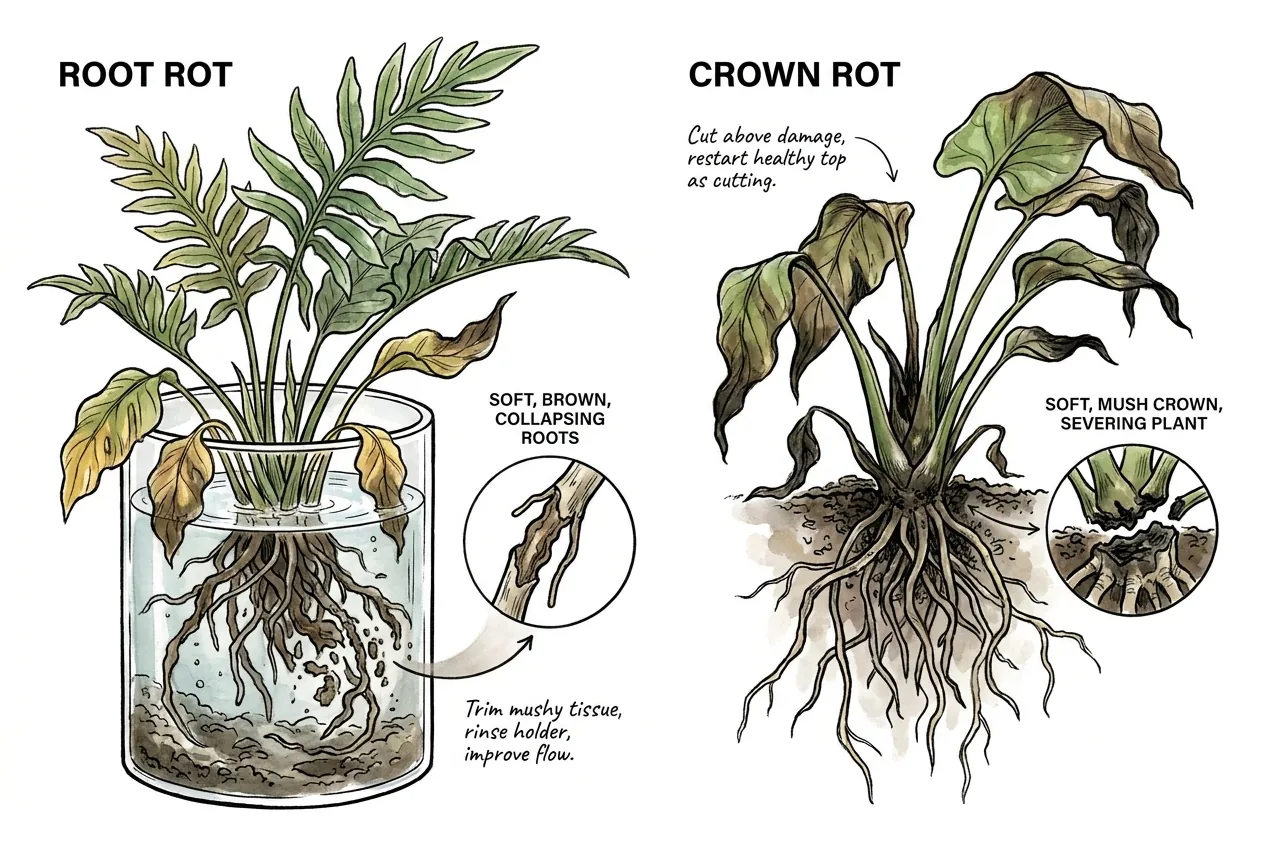
Compare Root and Crown Rot
Root rot generally starts below the plant and shows as soft, discolored, collapsing roots. Crown rot starts at the base where stems or leaves emerge, and it tends to be more urgent because it can sever the whole plant. Exact appearance varies with the species and the organism involved.
Before treating, isolate the affected plant outside the tank, use sanitized tools, and keep contaminated water and debris out of livestock water.
If only roots are affected, you can trim mushy tissue, rinse the holder, and improve flow.
If the crown is soft and the plant has a viable node above the damage, cutting above it and restarting the healthy top as a cutting is one option, not a guaranteed fix.
How do you keep a mature roots-in display tidy?
Prune Without Polluting the Tank
Maintain a mature roots-in display by pruning leaves above the tank and thinning roots below it. The goal is active growth, not a permanent root curtain.
Fast vines export more nutrients when they are actually growing, and that nitrogen only leaves the system when you harvest the biomass.
Old tangled roots can trap debris, block filter intakes, and hide livestock. When you trim roots, lift the holder out and cut on a separate surface with sanitized tools, then return it, rather than trimming over the tank.
Remove dead leaves before they fall into water. Lift holders periodically and smell the root zone as one inspection cue.
A clean smell and firm roots are reassuring, but they do not rule out early problems, so pair the smell check with your water tests.
If it smells sour, isolate the holder, test the water, and clean the affected part rather than waiting for the smell to spread, disposing of debris and rinse water outside the tank.
Root pruning should be uneventful. Remove the brown, hollow, or obstructive roots first, and keep the firm roots that are doing the actual adaptation work.
Healthy roots can be white, cream, or tan and may pick up media stains, so judge by texture, not color alone.
After a root trim, skip plant fertilizer and watch the tank. Fresh cuts and stirred media can change the organic load.
A small water change is usually more useful than adding anything new.
What maintenance rhythm works?
Treat these intervals as a starting rhythm, not a fixed law, and tighten or loosen them based on your stocking, plant biomass, filter load, and measured water trends.
As a baseline, check the waterline against the crown and remove dead leaves about weekly, then test water while plants are new, after pruning, or whenever livestock behavior changes.
Every few weeks, lift cups and inspect roots. Rinsing clay pebbles in removed tank water helps but does not remove pesticides or pathogens.
Periodically rebuild crowded holders and take fresh cuttings from old vines.
Once the wet-dry boundary is stable, maintenance becomes small and regular.
What is the safest beginner recipe?
A good beginner recipe is a pothos or philodendron cutting in a rinsed LECA net cup. Keep the node near moisture and the roots entering water, with every leaf base above the waterline.
For it to be a safe recipe in a stocked tank, start from a plant with a known, pesticide-free or documented-untreated source, quarantine it, place it where pets and people cannot chew it, and keep test reagents away from the display.
Beginner Conversion Sequence
- Choose a cutting from a plant whose source and treatment history you can confirm. Inspect it for pests and disease.
- Take a cutting with at least one node and one healthy leaf.
- Rinse the cutting and remove damaged tissue, working outside the tank and disposing of trimmings and rinse water away from livestock.
- Fill a net cup loosely with rinsed, soaked clay pebbles.
- Set the node just above or at the wet zone.
- Keep the crown and leaf bases in air.
- Test aquarium water before adding the plant and regularly during early conversion, taking samples outside the tank.
- Keep the plant if the whole plant looks stable, new roots are firm, and the crown stays clean. Watch water tests and livestock too.
Paludarium houseplants do not need mystery additives. They need the right tissue in the right place, from a source you can trust.
Seller availability and prices change. Treat claims such as natural or pH-neutral as starting information, then verify the exact medium against your source water before it reaches livestock. A locally stocked alternative may fit a small holder and reduce waste, but run the same ingredient, rinse-water pH and EC, dust, and livestock-safety checks rather than assuming equivalence.