
Monstera Biostimulants: What Chlorella and Azolla Research Can Tell You
Chlorella extracts and cyanobacteria affect some other crops, but neither a food-grade Chlorella powder nor an Azolla-derived slurry has a validated foliar use for Monstera. Learn the evidence boundary and indoor safety limits.
Jordan Cole · Published 2026-05-27 · 20 min read
Start With the Evidence Boundary
No study shows that a food-grade Chlorella powder or an Azolla-derived cyanobacteria spray improves Monstera growth, color, roots, or fenestration. Studies of cultured extracts and other crops cannot supply a dose, interval, or expected result for an indoor Monstera. Do not substitute an untested spray for adequate light, watering, nutrition, root care, or pest treatment.
What exactly are Chlorella vulgaris and Anabaena variabilis?
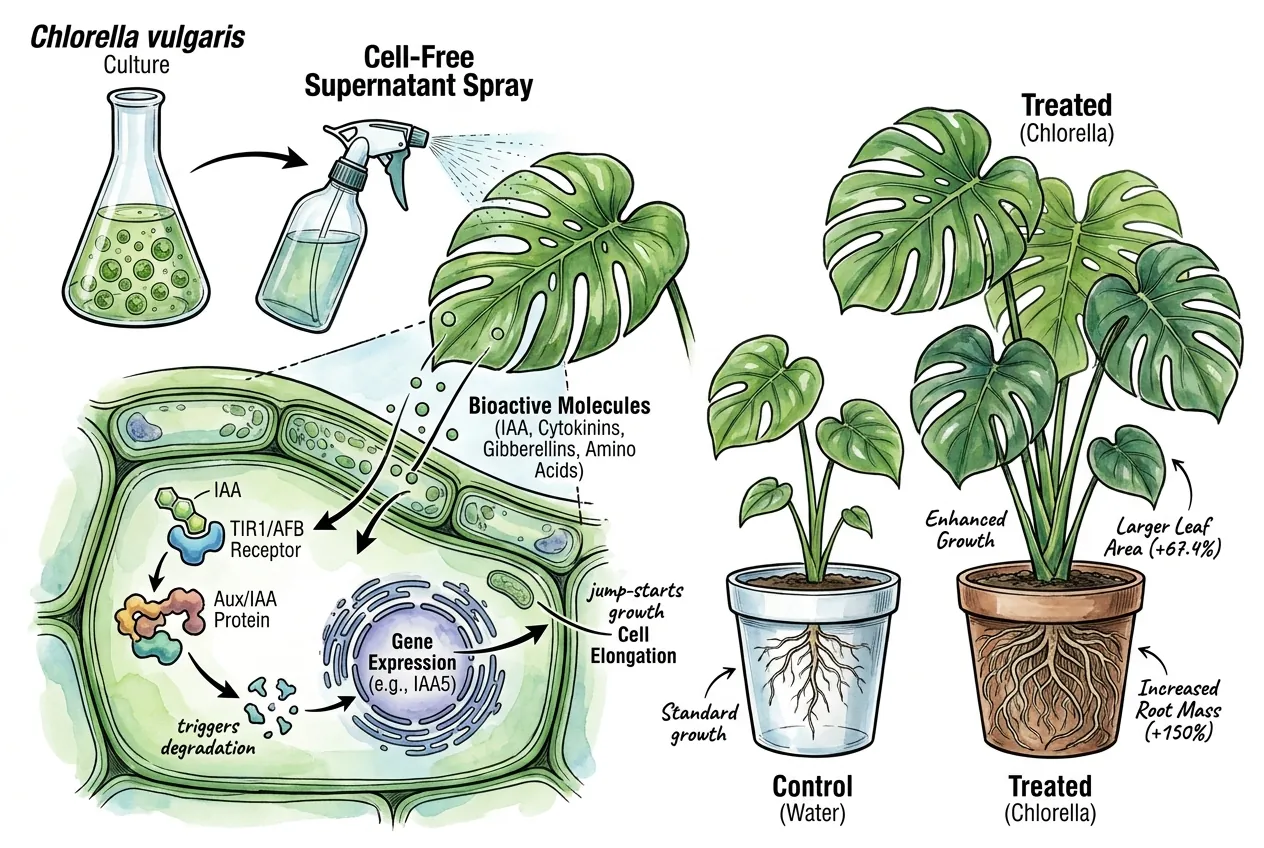
Chlorella vulgaris is a single-celled green microalga. In laboratory studies, its cell-free culture supernatant contains phytohormones, and cell-free extracts have shown growth effects on other plants. That is not the same as a food-grade powder releasing a full hormone mixture on a leaf.
Anabaena variabilis is a free-living filamentous cyanobacterium whose heterocysts fix atmospheric N2.
The live cyanobacteria hobbyists can actually buy come inside Azolla, whose resident cyanobiont is now identified as Trichormus azollae, an obligate host-adapted symbiont rather than free-living A. variabilis ATCC 29413. Whether either organism qualifies as a biostimulant is jurisdiction-dependent.
I write the treatment groups, dose source, watering rules, measurement days, and failure criteria before the first application. Deciding what counts only after seeing the plants makes an ordinary growth difference look like a discovery.
A normal-care group remains in the trial, and plant positions are randomized. Light and temperature gradients across one shelf can easily exceed the subtle effect I am trying to measure.
Before comparing leaf area and color, I rename progress photos with neutral codes. Hiding the treatment name reduces the temptation to choose a flattering frame for the product I expect to win.
How does Chlorella vulgaris boost plant growth?
In laboratory work, Chlorella vulgaris cell-free supernatant has been shown to contain indole-3-acetic acid (IAA), cytokinins, gibberellins, ethylene precursors, abscisic acid, and free amino acids.
In an Arabidopsis study the supernatant up-regulated the auxin-signaling gene IAA5 and shifted the transcriptome toward drought-tolerance pathways.
Auxin generally acts by binding TIR1/AFB receptors and triggering Aux/IAA degradation, which is one plausible route by which applied IAA could act.
Separate extract evidence from retail powder
Those results come from defined culture supernatant and extracts, not from a food powder. A food-powder listing does not identify a plant-active strain, live-cell count, or hormone content.
Extract studies in lettuce and other crops are useful background, but they do not establish a foliar effect or an expected result for Monstera.
What makes Anabaena variabilis different from Chlorella?
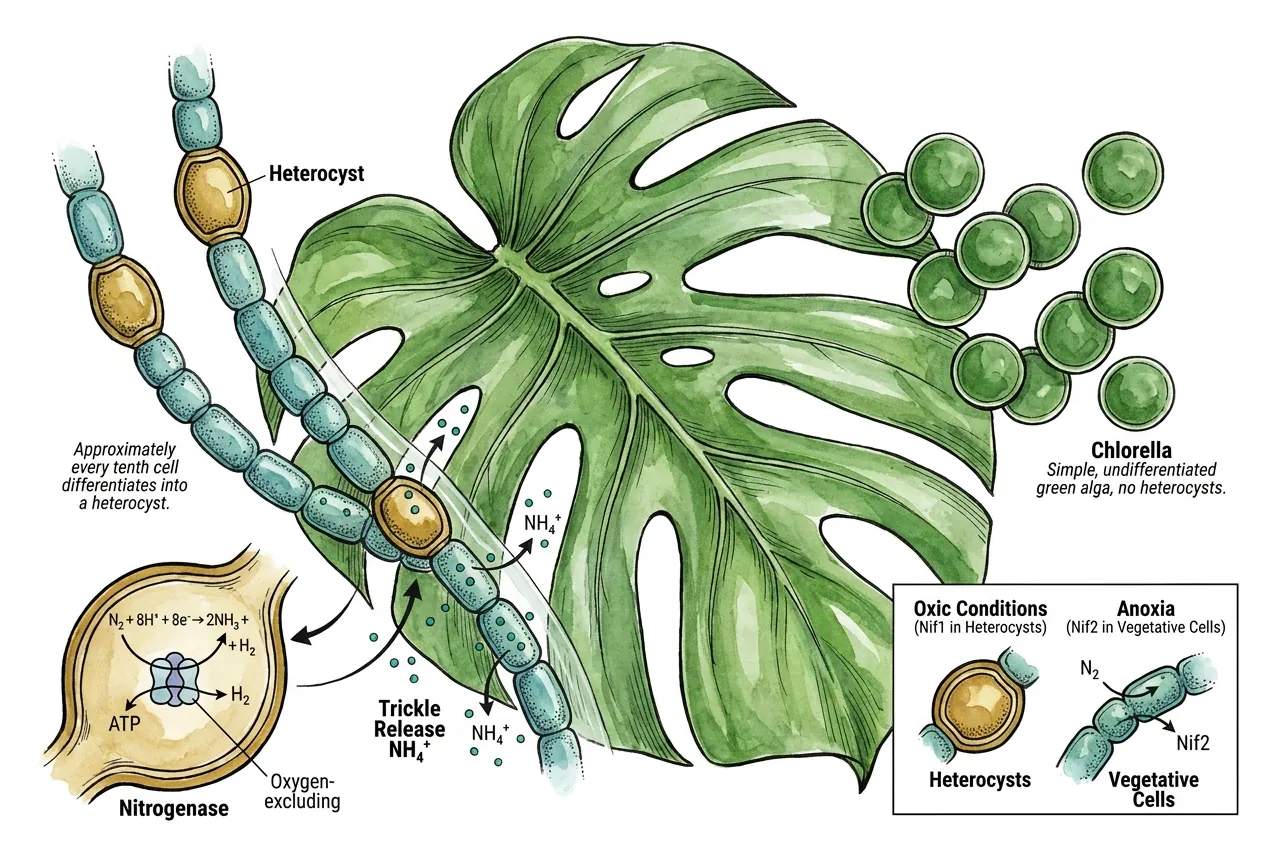
In a filament of Anabaena, roughly every tenth cell can differentiate into a heterocyst, a thick-walled oxygen-excluding cell that houses nitrogenase.
A. variabilis ATCC 29413 carries more than one nitrogenase system, expressed under different environmental conditions. Nif1 operates inside heterocysts under oxic conditions, Nif2 in vegetative cells under anoxia, and an alternative V-nitrogenase under molybdenum limitation.
Heterocysts are the main oxygen-tolerant fixation site, though under anoxia vegetative cells can also fix nitrogen, so describing them as exclusive overstates it.
Heterocysts down-regulate photosystem II to keep their interior anoxic, and nitrogenase reduces N2 to ammonia at a high ATP cost.
Whether intact filaments would keep releasing ammonium across a Monstera cuticle for days after being sprayed on a dry leaf has not been measured. Nitrogen fixation inside a culture is a separate step from delivering plant-available nitrogen through a leaf surface, so any gradual-feeding benefit remains unproven for this application.
Do both organisms count as biostimulants?
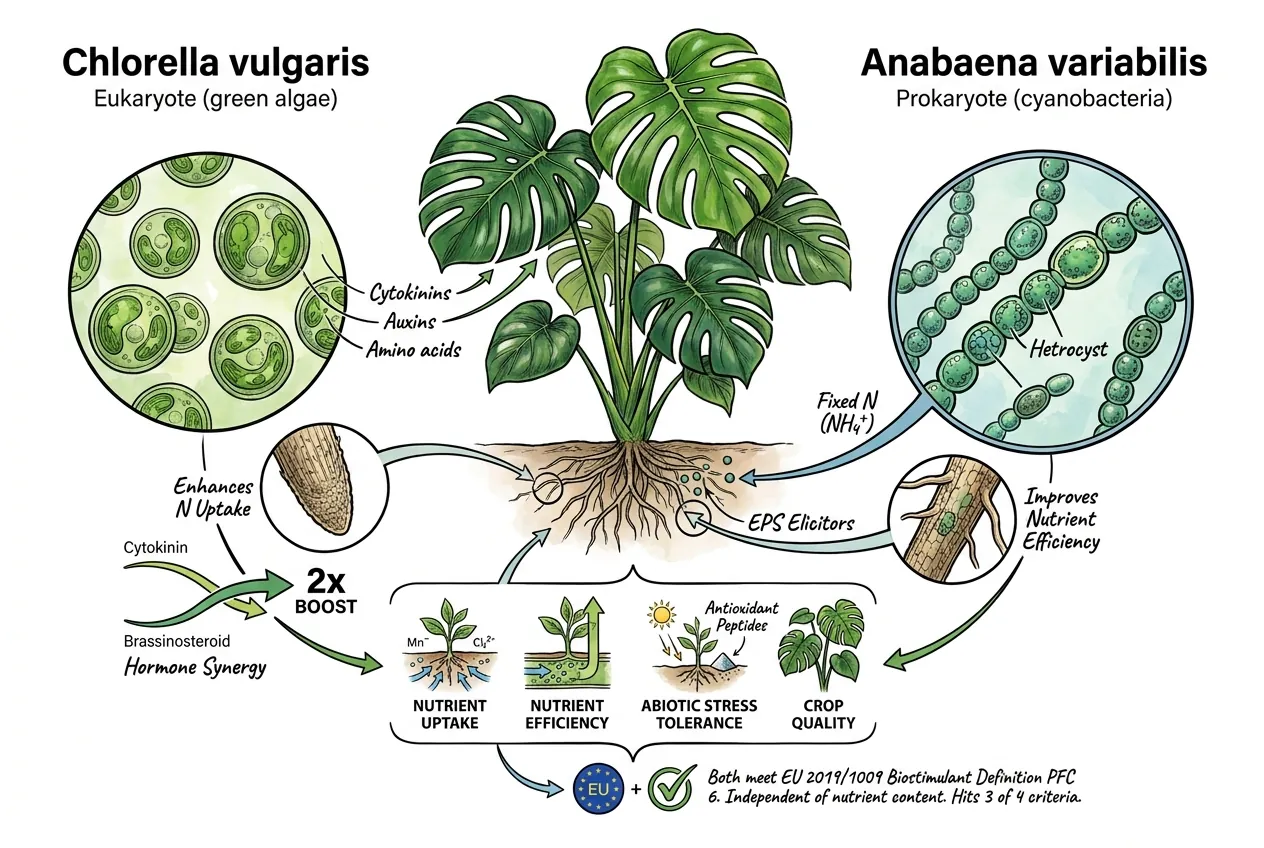
Not automatically. The EU 2019/1009 functional definition of a plant biostimulant covers products that stimulate nutrient uptake, nutrient-use efficiency, abiotic-stress tolerance, or crop quality independent of nutrient content.
Being a microbial biostimulant under PFC 6(A) also requires inclusion on the CMC 7 microorganism list, which currently covers Azotobacter, mycorrhizal fungi, Rhizobium, and Azospirillum, not Chlorella or Anabaena.
It is therefore inaccurate to call these two organisms explicitly approved under PFC 6.
Any claim that the organisms enhance nitrogen uptake or stress tolerance in Monstera is likewise unverified here.
Legally, do not assume the term biostimulant exempts a product from regulation. In the US, the EPA has stated that products making plant-growth-regulator claims or pest-prevention and resistance claims can fall under FIFRA.
Check current rules for your jurisdiction and intended use rather than relying on the label alone.
What the Comparison Can Tell You
Chlorella is a green microalga, while the cyanobacterium associated with Azolla is a different organism from the free-living A. variabilis used in laboratory research. Neither distinction identifies a safe or effective Monstera spray. A food powder is not a characterized plant extract, and a retail Azolla plant is not a strain-identified, toxin-tested foliar product.
Physiological effects and mechanisms of Chlorella vulgaris as a biostimulant on the growth and drought tolerance of Arabidopsis thaliana
Nitrogen fixation in vegetative cells of the cyanobacterium Anabaena variabilis ATCC 29413
Foliar spray application of Chlorella vulgaris extract. Effect on the growth of lettuce seedlings
How does Monstera physiology affect foliar uptake?
Foliar sprays can enter leaves through stomata and through the cuticle, and in many plants the lower (stomata-bearing) surface takes up more than the waxy upper surface, but the relative contribution depends on the species, leaf side, the solute, any adjuvants, and humidity, and has not been measured specifically for Monstera.
Fenestration involves programmed cell death, and Monstera is generally considered a comparatively nitrogen-demanding aroid. Aerial roots that grow into the substrate take up water and solutes. Whether an exposed aerial root absorbs a foliar spray as readily is less certain.
Where on the leaf does the spray actually absorb?
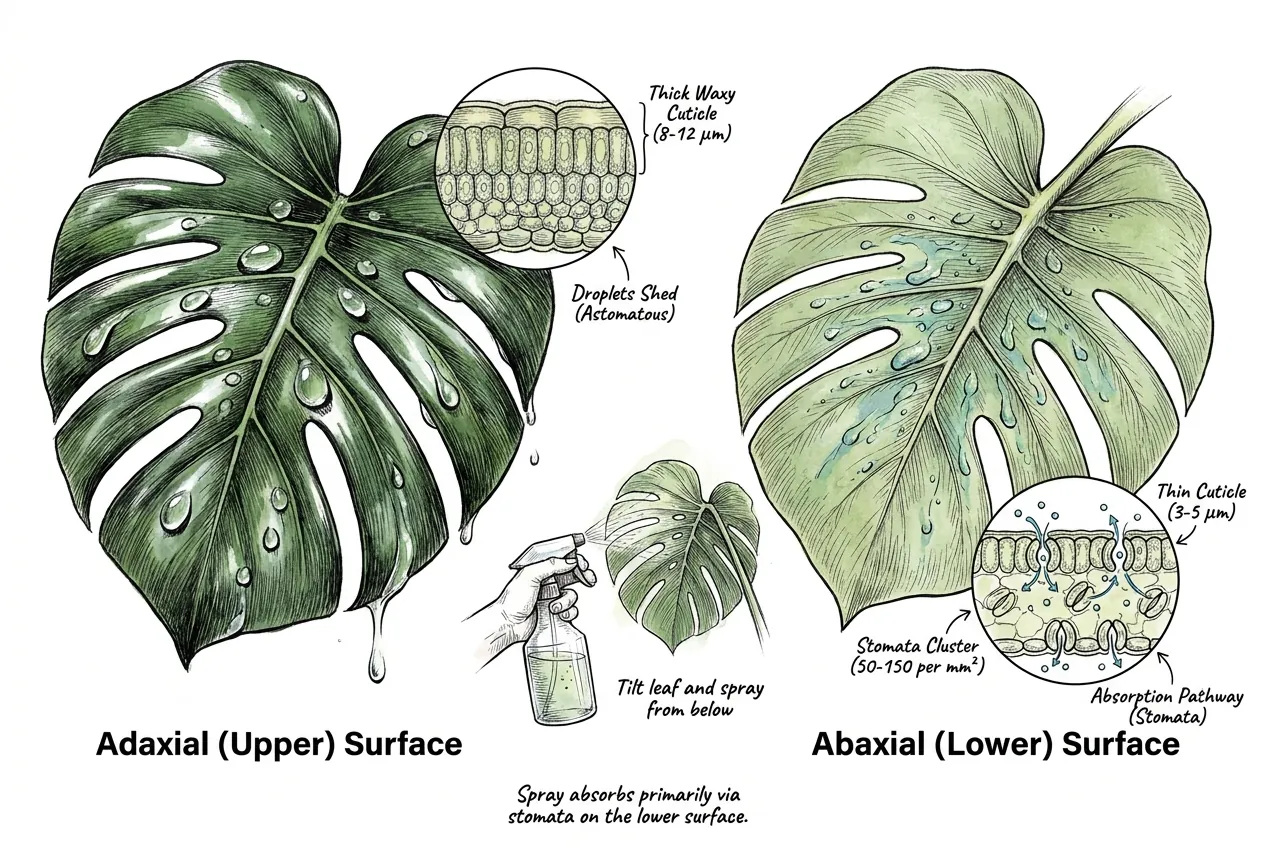
Uptake is generally thought to be higher on the abaxial (lower) leaf surface, where the stomata sit, than on the waxier, largely astomatous upper surface, which tends to shed aqueous spray.
The specific stomatal densities, cuticle thicknesses, and any molecular-size cutoff for Monstera are not established here. Treat the general direction (stomatal side matters) as the takeaway, not exact numbers.
Foliar-nutrient work on other crops, such as manganese and phosphorus on barley, has shown substantially higher uptake through the stomatal surface than the cuticle for those nutrients.
A reasonable, testable practice for Monstera is therefore to tilt the leaf and spray the underside, but verify whether it makes a difference for your plant rather than assuming a fixed multiple.
What drives Monstera fenestration?
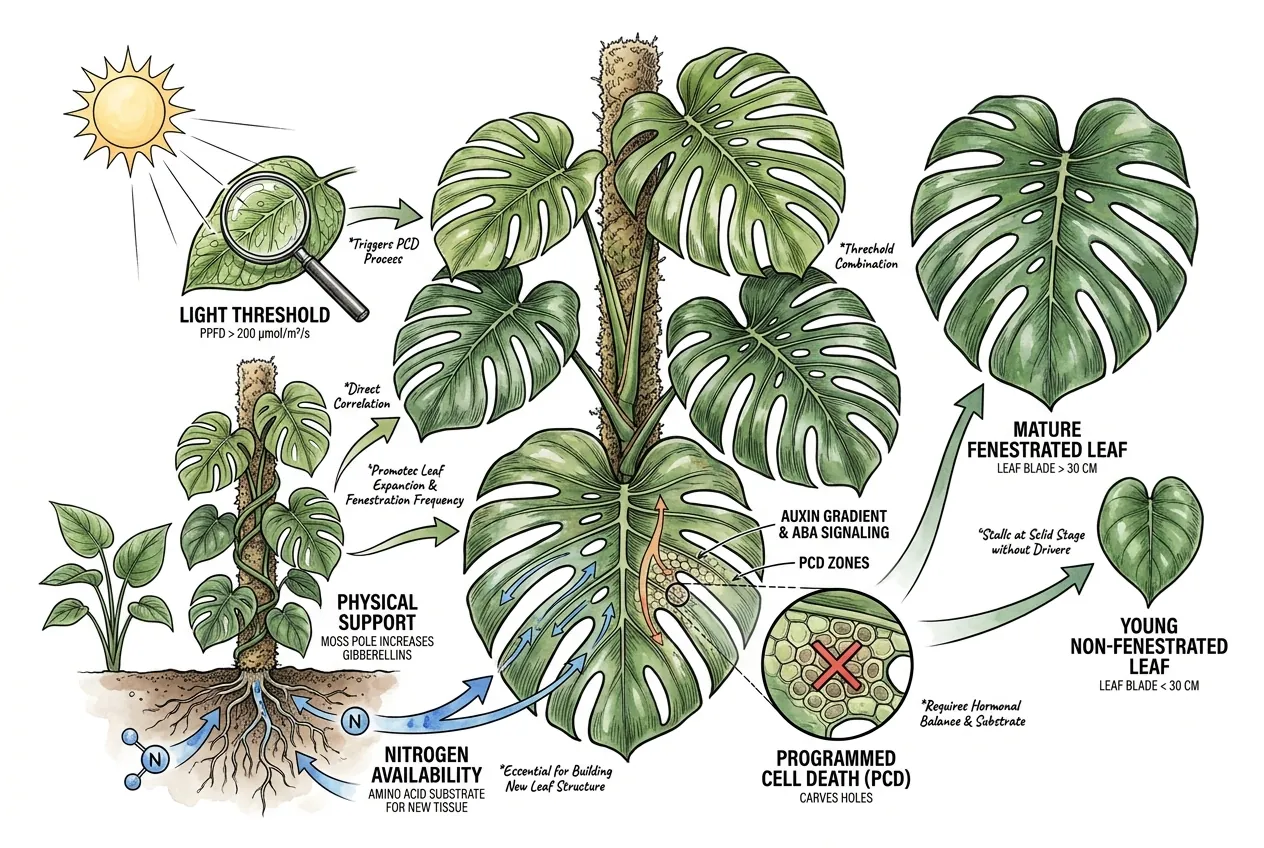
What is established is that the holes (fenestrations) form through programmed cell death in defined zones of the developing leaf.
Beyond that, the specific numeric thresholds sometimes quoted, a set light level in PPFD, a minimum leaf-blade length, or a fixed multiple more gibberellin on a moss pole, are not supported by a Monstera source and are omitted here.
In broad terms, mature fenestrated leaves tend to appear as plants get enough light, grow larger leaves, and have adequate nutrition and support, but the exact drivers and any role for a foliar spray are not quantified.
In practice, plants that are short on light, support, or nutrients often keep producing smaller, less-fenestrated leaves, but this is a general tendency with many contributing factors, not a single hard rule.
How nitrogen-hungry is a healthy Monstera?
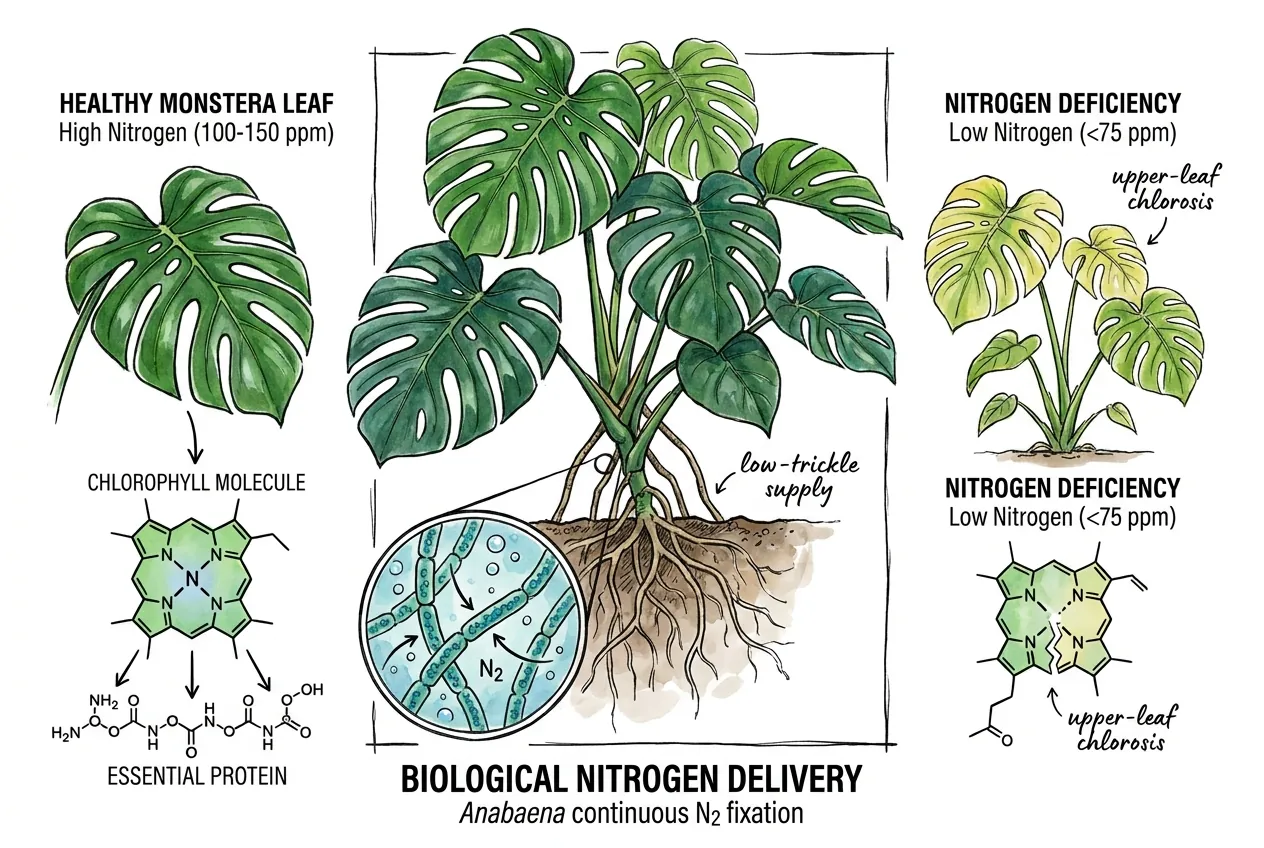
Monstera generally does well on a feeding ratio that favors nitrogen during active growth, and growers commonly use balanced houseplant fertilizers accordingly. Specific numbers such as an exact NPK ratio or a ppm threshold are not established for this species and are best treated as rules of thumb.
One correction worth making. The central atom of chlorophyll is magnesium, not nitrogen. Nitrogen is part of the porphyrin (tetrapyrrole) ring and of every amino acid, which is why nitrogen is so important to leafy growth.
Because nitrogen is a mobile nutrient, deficiency usually shows first as yellowing of the older, lower leaves, not the newest upper ones.
The rationale for trying a cyanobacterial source is that it could supply nitrogen gradually. Whether it actually delivers plant-available nitrogen to a Monstera through the leaf, and whether that offers any advantage over conventional feeding, is exactly what a real trial would need to show.
Do aerial roots absorb foliar spray?
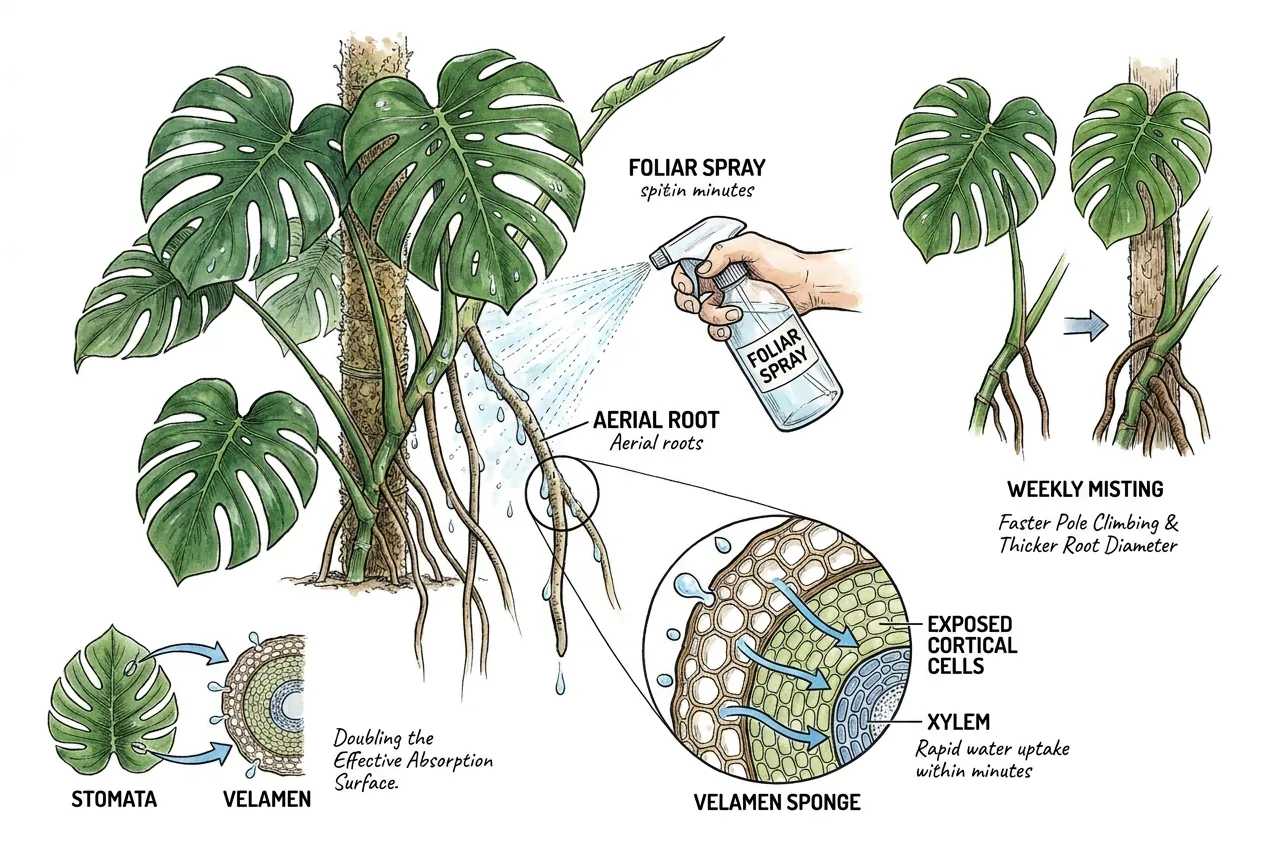
Aerial roots are not purely structural. Roots that grow into a substrate or pole take up water and dissolved solutes.
Whether an exposed aerial root absorbs a foliar slurry within minutes, at rates comparable to soil roots, is not established, so treat that as unverified rather than a given.
Including the aerial roots when you spray is a reasonable thing to try, but claims that it doubles the absorption surface or reliably thickens roots within six weeks are not supported by cited measurements.
If you test it, record it as one more variable rather than assuming the benefit.
From plant surface to plant metabolism. The uncertain fate of foliar-applied nutrients (Fernandez et al., Frontiers in Plant Science 2013)
Foliar-applied manganese and phosphorus in deficient barley. Linking absorption pathways and leaf nutrient status
What Can a Home Comparison Tell You?
A home before-and-after cannot establish that an untested spray caused a change. Light, season, node order, root health, watering, and normal variation can all change leaf size, color, and fenestration at the same time. Use observations to improve ordinary care, not to infer a safe dose or a reliable biostimulant effect.
How do you match plants at baseline?
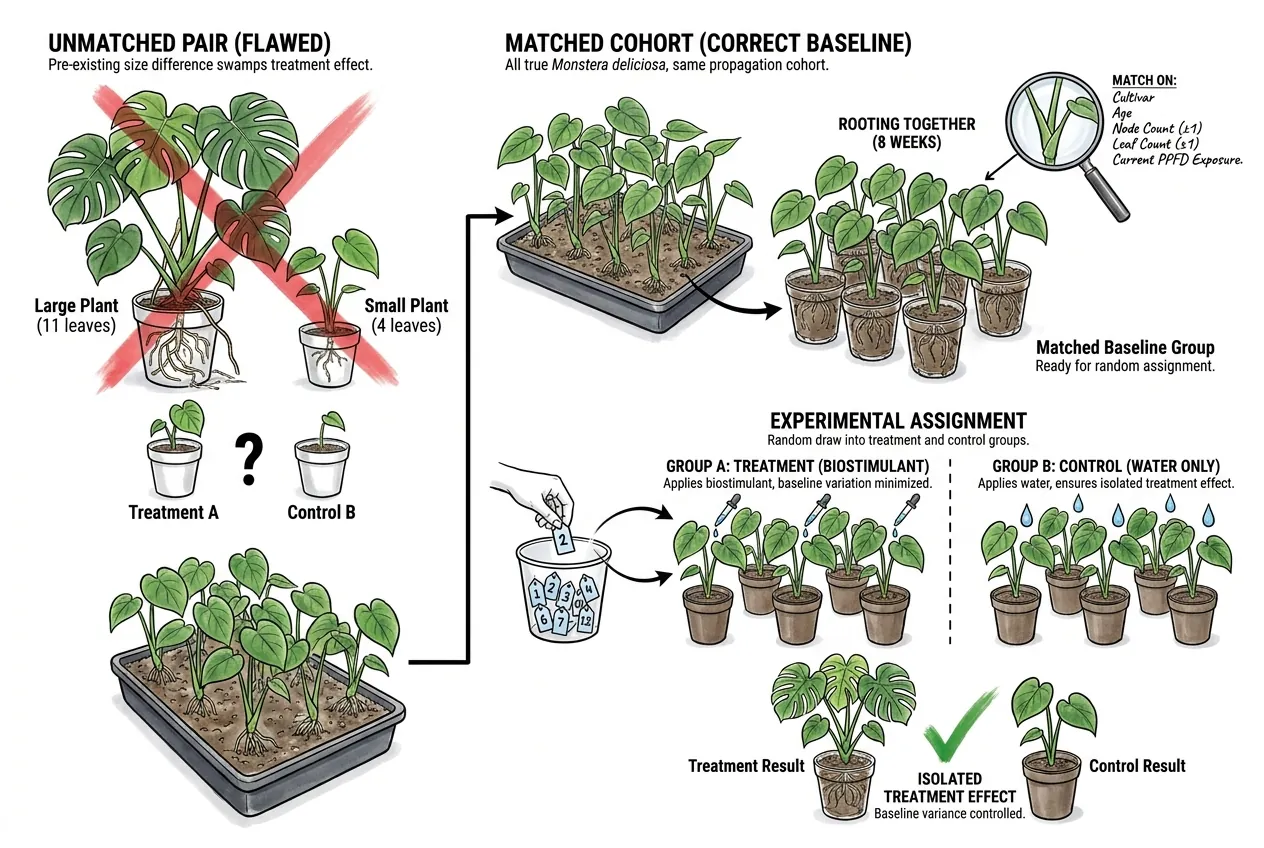
Two plants that look alike can still differ in genetics, maturity, and root condition. A larger plant may continue making larger leaves without any treatment effect, so do not use an informal comparison to make product claims or to justify increasing the dose.
Is There a Validated Dose or Schedule?
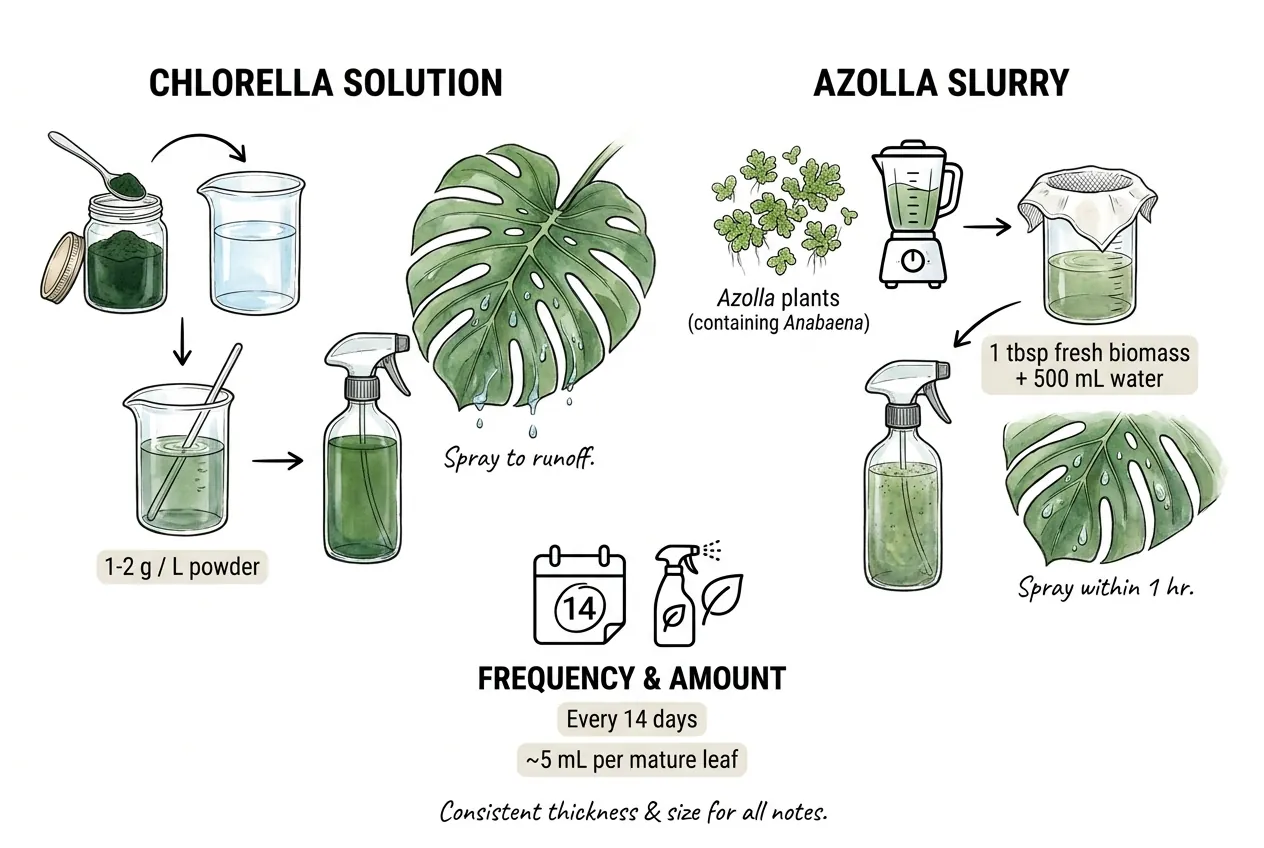
No validated Chlorella or Azolla-derived foliar dose, mixing method, or application interval exists for Monstera. Do not turn doses from other crops, food-powder instructions, or a convenient calendar interval into a houseplant prescription.
Why a Water-Only Control Is Not Enough
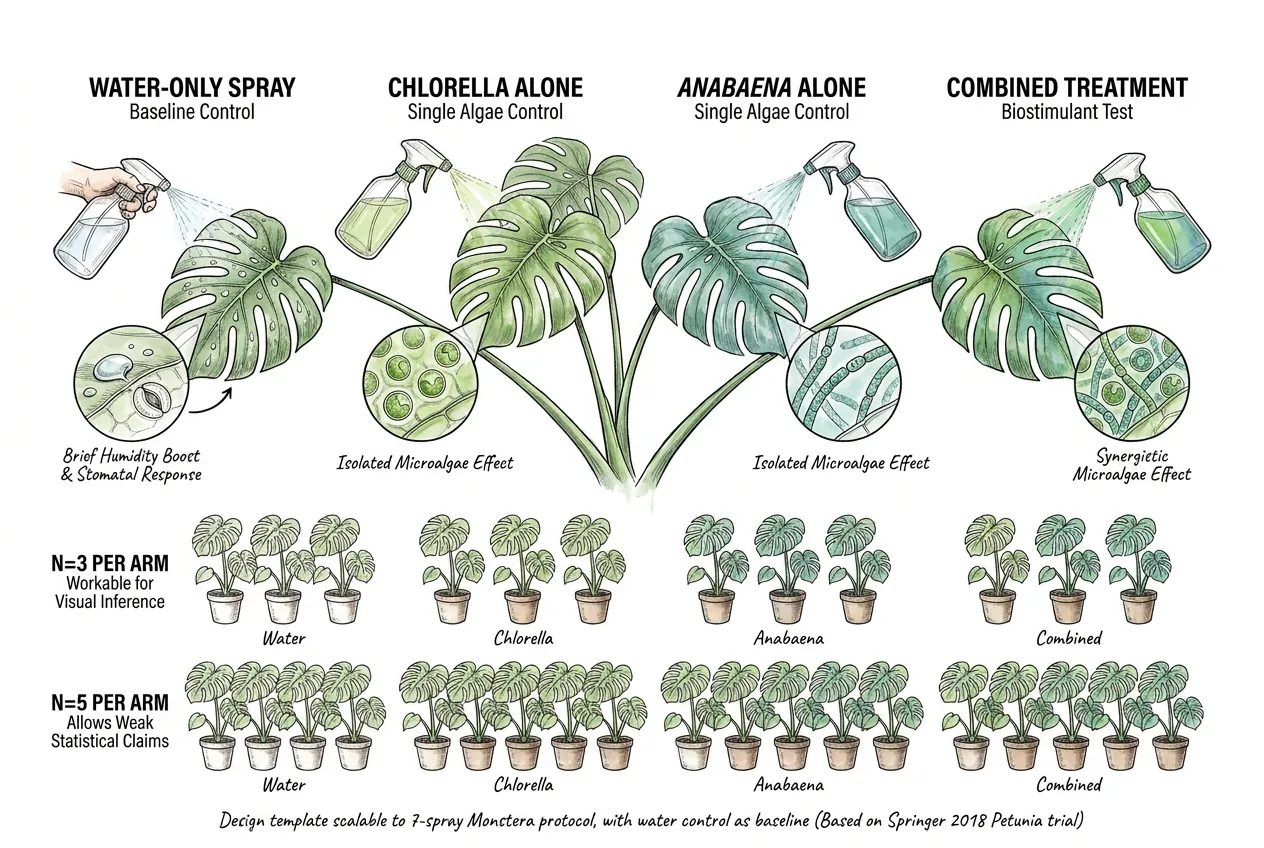
Spraying plain water cannot account for the ingredients of a food powder, the condition of a live culture, or the plant-to-plant differences that affect growth. It may help you notice changes, but it cannot validate the treatment.
Keep Normal Care Stable Instead
If you are watching how a Monstera responds to a change in normal care, keep light, watering, fertilizer, and pest control as stable as you can. This makes the plant easier to assess, but it does not convert an untested slurry into a validated treatment.
Record Normal Growth Simply
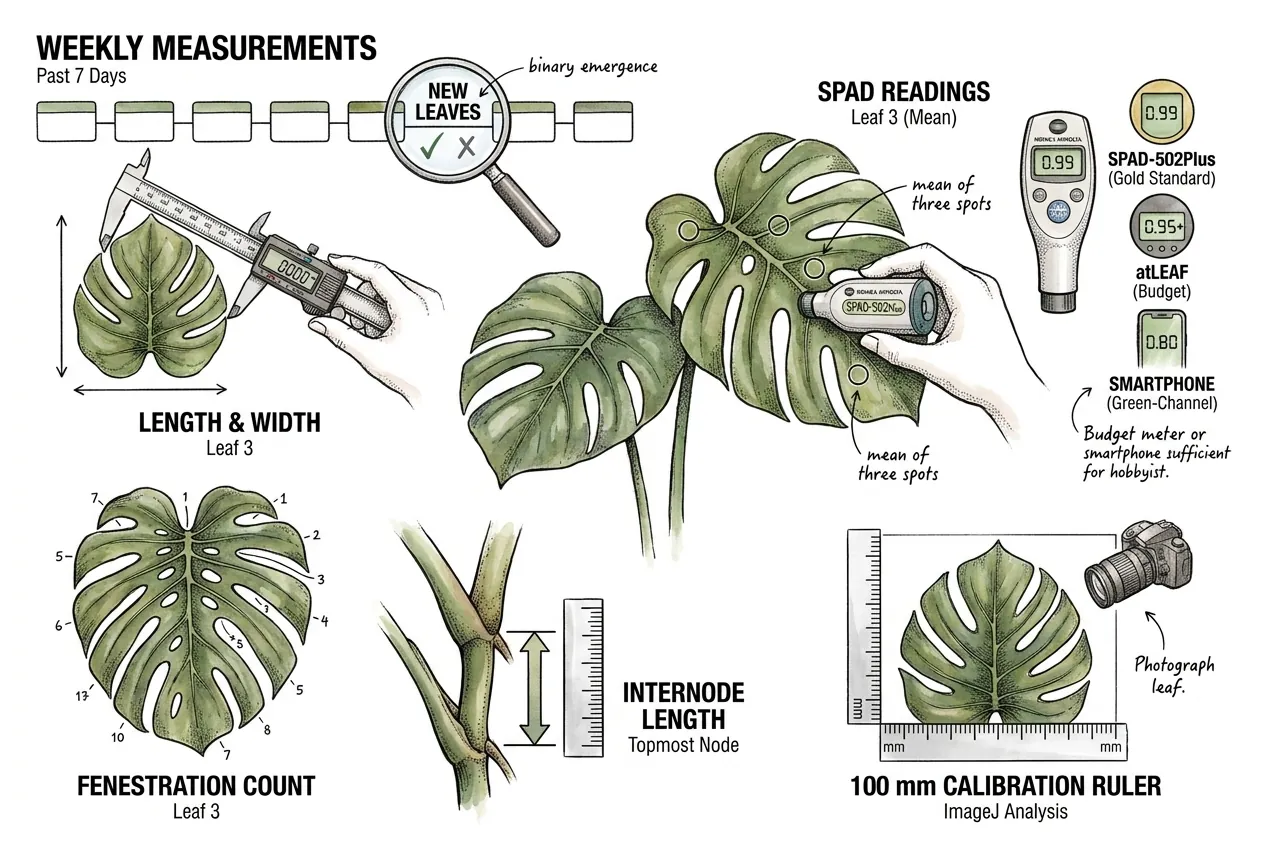
For ordinary care, take photographs from the same distance and light, and record the date each new leaf opens. A ruler in the photo is usually more useful than chasing fine differences with a caliper. Relative-chlorophyll meters can compare readings within the same plant and device, but they do not diagnose a cause or predict a response to an untested spray.
Effect of microalgae hydrolysate foliar application (Arthrospira platensis and Scenedesmus sp.) on Petunia x hybrida growth
What Results Can You Expect?
No Monstera Outcome Has Been Measured
There is no evidence-based way to predict leaf size, leaf color, root growth, or fenestration after a Chlorella or Azolla-derived spray on Monstera. Crop studies use different species, products, and application routes, so their percentages and timelines do not transfer.
Which organism grows the bigger leaves?
Chlorella extracts have affected leaf growth in other crops, but that does not show that a retail food powder will enlarge Monstera leaves. Treat leaf-size benefit as unknown.
Which organism produces darker, greener leaves?
Cyanobacterial products have changed chlorophyll readings in some crop studies, but that does not establish greener Monstera leaves or a safe way to apply a live Azolla-associated culture.
Does the combined treatment beat both single treatments?
No Monstera study shows that combining these materials improves either growth or fenestration. Mixing them increases uncertainty and makes it harder to identify the cause of any leaf problem.
What does the week-by-week pattern look like?
Do not use a week-by-week chart from another crop as a timetable for Monstera. New leaves reflect many weeks of earlier conditions, and normal growth is uneven.
Effectiveness of green microalgae as biostimulants and biofertilizer through foliar spray and soil drench for tomato cultivation
Invigorating soil-plant productivity to improve fruit quality in cherry tomato through multi-modal application of cyanobacteria
Biofertilizing effect of soil cyanobacterium Anabaena cylindrica-based formulations on wheat growth, physiology, and soil fertility
Why DIY Spray Recipes Are Not a Recommendation
Do not make a foliar recipe from a Chlorella food supplement or live Azolla for an indoor Monstera. Neither product has a validated houseplant label, dose, application method, or safety assessment for aerosolizing it around people and pets. If you use a registered foliar product for a separate purpose, follow that product’s label instead of adapting a food or aquarium product.
Food Powder Is Not a Foliar Product
A broken-cell-wall Chlorella supplement is designed for food use. Its food-grade label does not establish a plant-active composition, foliar efficacy, or indoor aerosol safety. Do not infer those from the preparation methods used for research cultures.
Azolla Is Not a Cyanobacteria Spray Ingredient
Azolla is a live aquatic plant with an associated cyanobiont, not a strain-characterized, toxin-tested foliar product. It can be invasive in many regions. Check local possession and shipping rules, keep any legal culture contained, and never release the plant or its water into drains, gardens, ponds, or natural waterways.
Products Discussed
Anthony's chlorella
Anthony’s chlorella is a food supplement, not a registered or validated Monstera foliar product. Do not use its food-grade label, organic status, or extract research to infer a plant dose, plant benefit, or aerosol safety.
Azolla filiculoides Live Plant
Azolla is an aquatic plant, not a strain-characterized or toxin-tested Monstera spray ingredient. Do not blend or aerosolize it for indoor foliar use. If it is legal where you live, keep it contained and never release the plant or its water.
From plant surface to plant metabolism. The uncertain fate of foliar-applied nutrients
Are these biostimulants safe to use indoors?
Separate plant toxicity from spray risk
Do not assume food-grade or aquatic means safe to aerosolize indoors. Monstera itself is toxic to cats and dogs because of insoluble calcium oxalate. Separately, an unidentified live-cyanobacteria slurry has not been tested for the strain, toxins, or contaminants in a household batch. A Chlorella supplement’s food-grade status applies to its intended food use, not to spraying it around people or animals.
What about pets and children?
Two hazards deserve a straight answer. First, Monstera deliciosa is toxic to cats and dogs.
The ASPCA lists it as toxic due to insoluble calcium oxalate crystals, which can cause oral burning and irritation, intense drooling, vomiting, and difficulty swallowing.
This is a real risk if a pet chews the leaves, it has nothing to do with any spray, and it should not be minimized. If a pet ingests Monstera, contact your veterinarian or a poison-control line.
Do not spray unidentified live cyanobacteria indoors. Their potential exposure routes include inhaled droplets and skin or eye contact, and a retail Azolla plant is not a strain-identified, toxin-tested spray product.
Cyanobacteria collection caution
Never wild-collect cyanobacteria from ponds, lakes, or aquarium runoff. Some wild Anabaena and Dolichospermum strains produce microcystin hepatotoxins.
Sourcing from a commercial aquatic-plant supplier or a culture collection is preferable to wild collection, but note that a retail Azolla plant is still not a strain-characterized, toxin-tested product, so it does not remove the need for the safety precautions above.
Will the spray cause algal blooms on pots or fungus gnats?
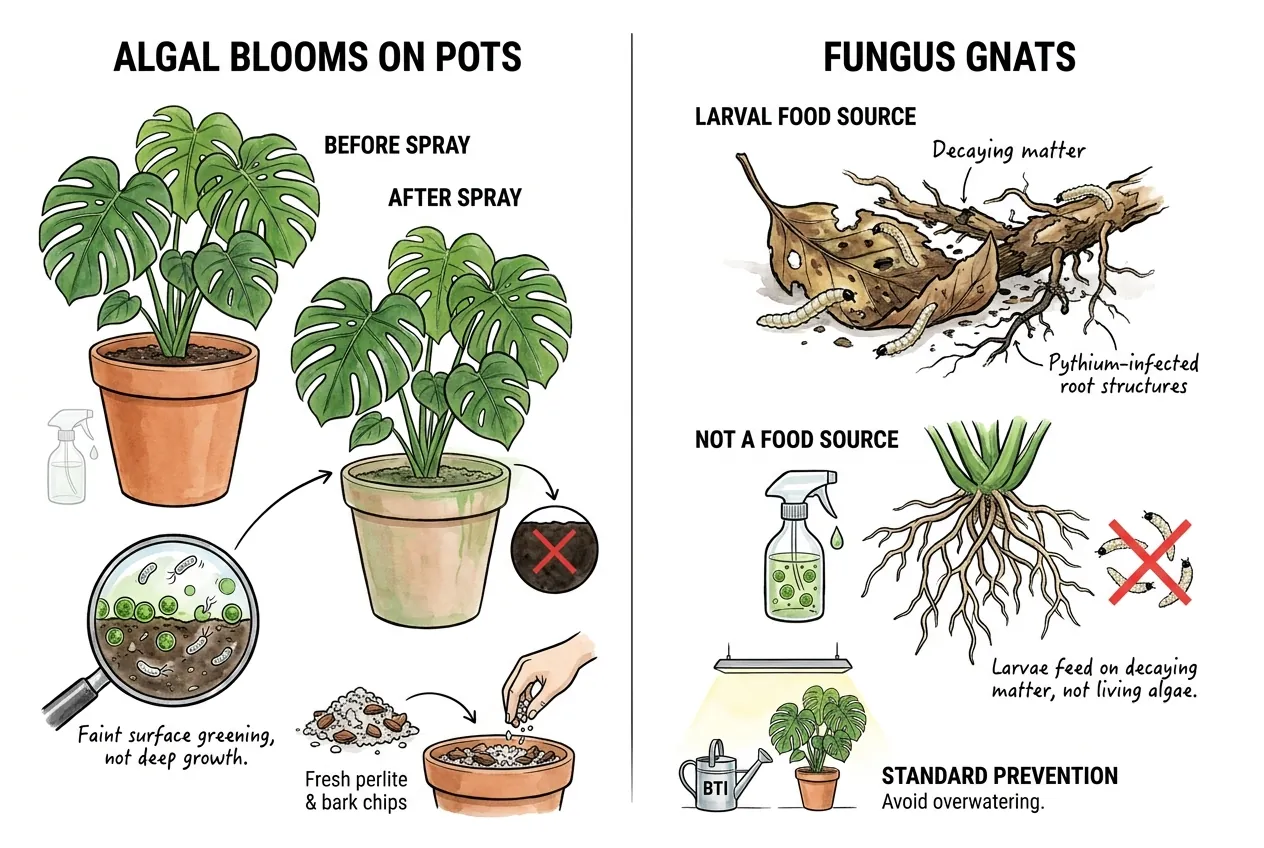
Large algal blooms or gnat outbreaks from occasional foliar overspray are unlikely, but the reassurance is often overstated.
Chlorella runoff can leave a faint green tint on the substrate surface. It needs light to grow well, although some strains can grow mixotrophically or heterotrophically and therefore are not limited to darkness in the same way.
Fungus-gnat larvae feed on fungi, algae, and decaying organic matter, so adding organic residue is not automatically harmless. It is usually a minor factor next to overwatering.
Standard fungus-gnat management still applies. Avoid keeping the surface constantly wet, let the top layer dry, and use a registered control such as BTI if needed.
If surface greening bothers you, address the moisture and residue rather than only covering it up cosmetically.
What goes wrong when you over-apply?
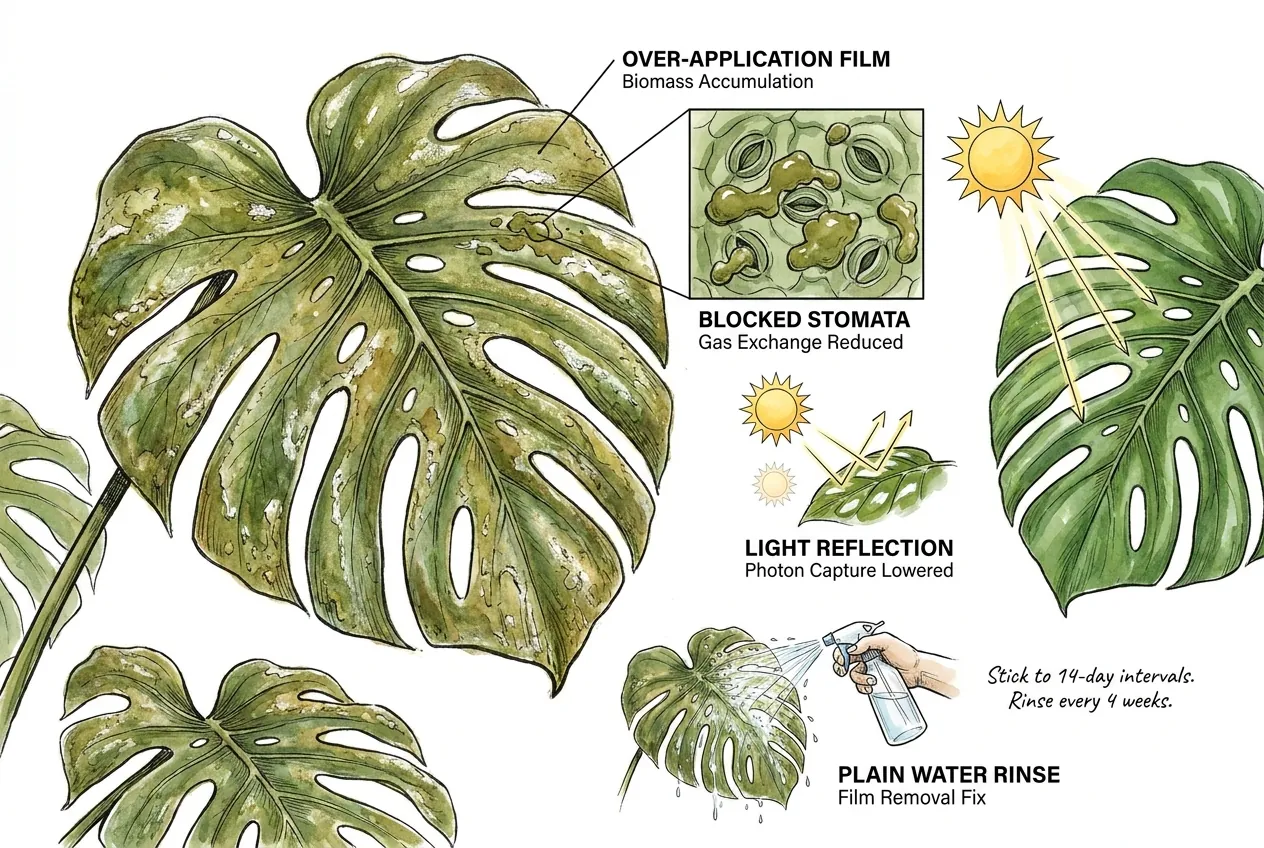
The plausible failure mode of over-applying is a residual biomass film on the leaf that could block stomata and reduce photosynthesis, plus a film that dulls the leaf surface.
The specific numbers sometimes quoted for a concentration threshold, a percentage photosynthesis loss, or a fixed recovery time are not from measured data and are omitted here.
The sensible principle stands. Heavier or more frequent application is more likely to leave residue, not less.
If a plant already has a visible residue, rinse the foliage gently with plain water and correct the underlying cause instead of adding another untested spray.
Cultivation of Anabaena sp. At different phosphorus-excess concentrations. Growth parameters, value-added metabolites, and microcystin-LR production
Effect of storage on plant biostimulant and bioactive properties of freeze-dried Chlorella vulgaris biomass
What Should You Choose Instead?
Neither Chlorella food powder nor an Azolla-derived slurry is an evidence-based Monstera treatment. When growth or color is poor, check delivered light, watering, roots, nutrition, and pests first. Use a product only when its label matches the actual problem and its intended use.
Which is more beginner-friendly?
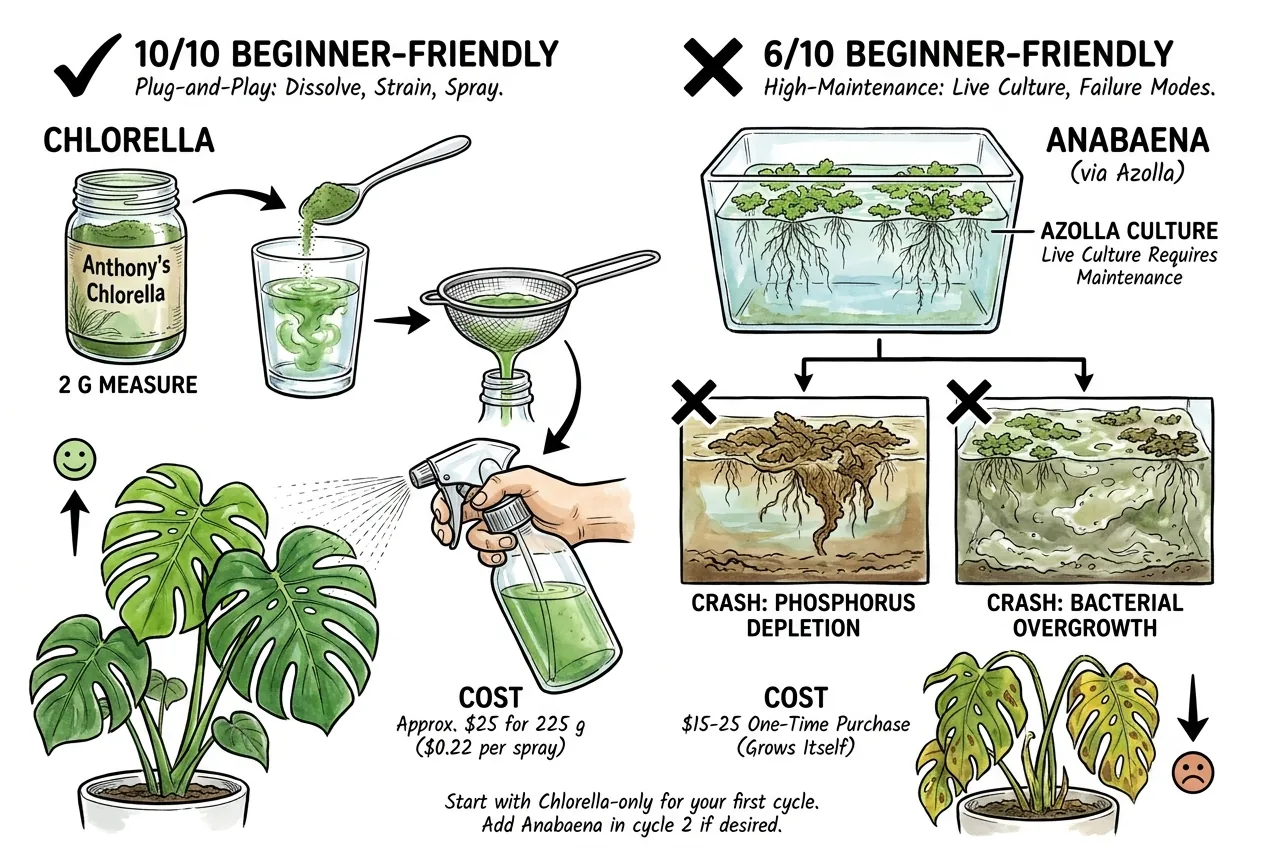
Neither is a beginner-friendly answer to a Monstera problem because neither has a validated indoor foliar use. Chlorella has fewer handling and biosecurity concerns than Azolla, but that does not make it an effective treatment.
What about pest resistance?
Do not rely on these sprays for pest control. There is no evidence that Chlorella or an Azolla-derived cyanobacterial spray protects Monstera against spider mites or thrips.
General ideas about cyanobacterial EPS acting as a defense elicitor, or yield gains from soil cyanobacterial inoculants in field crops like pea, are not pest-control evidence for a houseplant, and treating an active infestation with an unproven microbial spray can delay effective action.
If your Monstera has spider mites or thrips, prioritize accurate pest identification, isolate the plant from others, remove pests physically (for example by rinsing and wiping), and use an appropriate, registered control per its label.
Any biostimulant experiment should wait until the infestation is under control, and note that spraying weekly would contradict the residue caution above about frequent application.
Should you rotate them or pick one and stay?
Do not alternate or combine them. There is no evidence that rotation improves Monstera growth, and adding materials makes any residue or adverse response harder to trace.
Effects of Chlorella extracts on growth of Capsicum annuum L. Seedlings
Invigorating soil-plant productivity to improve fruit quality in cherry tomato through multi-modal application of cyanobacteria
What Simple Records Are Useful?
You do not need a biostimulant kit to assess a Monstera. A consistent photo, the date each leaf opens, and a ruler in the frame are enough to show whether normal care changes are helping.
Start With Photos and a Ruler
Photograph the same leaf from the same distance and light. For soft leaves, this is often more repeatable than trying to measure tiny changes with a digital caliper. Record leaf length and maximum width the same way each time.
What Meters Can and Cannot Tell You
A relative-chlorophyll meter can compare readings within the same plant and device, but it cannot diagnose a nutrient problem or prove that an untested treatment worked. A phone record and a stable care routine are more useful than extra equipment when the underlying cause is still unknown.
Read the Research at Its Actual Scope
The cited research covers Chlorella extracts, cyanobacteria, and foliar uptake in other species and application routes. It provides background on possible mechanisms, not a validated Monstera protocol or a prediction of results.
Equipment for Label-Approved Sprays
VIVOSUN 1L Pump Sprayer
- Suitable use. The VIVOSUN 1L Pump Sprayer is useful for water or a product whose label permits foliar use. It is not a precision dosing tool and does not make an unidentified microbial slurry safe to aerosolize.
- Care point. Dedicate and clearly label the bottle for its intended product, then rinse it according to that product’s instructions so residues do not reach another plant or household use.
For measuring, a plain ruler with a standardized photo (same distance, same lighting) is often more reproducible on soft Monstera leaves than a digital caliper, whose fine display resolution far exceeds what you can reliably repeat by hand.
Define your reference leaf up front and record length and maximum width the same way each week in a simple spreadsheet.
Konica Minolta SPAD-502Plus catalog
Key Takeaways
- No evidence-based dose, interval, or result exists for a Chlorella or Azolla-derived foliar spray on Monstera.
- Use standard light, watering, nutrition, root, and pest care before adding an untested material.
- Do not blend or aerosolize a food supplement or live Azolla for indoor foliar use.
- Keep Monstera away from pets because the plant itself is toxic if chewed.
- Keep any legal Azolla culture contained and never release its water or plant material.
References & Research Background
The cited studies cover Chlorella extracts, cyanobacteria, and foliar uptake in other species, including Petunia, lettuce, tomato, wheat, and pepper. Their products and application routes differ from a food powder or live Azolla on Monstera, so they do not establish a Monstera foliar method or expected outcome.
Affiliate Disclosure
This article contains Amazon affiliate links. As an Amazon Associate I earn from qualifying purchases. If you use these links, the site may earn a commission at no extra cost to you. Product availability, price, and specifications can change. Check the current listing before buying.