
Aroid Potting Mix Product Chooser: Bark, Perlite, Pumice
An aroid potting mix product chooser: pick bark, perlite vs pumice, coir, and charcoal by air-filled porosity, plus a starting ratio to blend them and how to measure the result.
Elena Vargas · Published 2026-07-20 · 32 min read
Key Takeaways
- Aim for air-filled porosity in the published container range of roughly 10–25%. Aroid roots do a lot of open-air gas exchange, so bias toward the airier end and confirm the finished mix in your pot.
- Most chunky aroid mixes use four component roles. Structural bark, an aeration aggregate, a moisture buffer, and one optional amendment are enough. Buy only what your current mix lacks.
- A practical starting ratio is roughly 2 parts bark, 2 parts aggregate, and 1 part buffer. Substitute any amendment into that total rather than adding it on top.
- Pumice and perlite behave similarly for aeration in blended mixes. Pumice is more durable and heavier, while perlite is lighter and cheaper. Grade and dose still change the result.
- Rinse coir and check runoff EC with a method-matched meter. Treat charcoal as optional filler rather than a rot cure.
Low air-filled porosity is a major reason chunky mixes fail, but it is not the only one. Watering frequency, drainage holes, a cachepot holding standing water, pot size, light, temperature, and pathogen load all matter too.
Build an airy mix first, then manage those conditions alongside it.
Start with the component roles and a simple ratio, then check the finished mix in the pot you actually use rather than assuming every bagged ingredient behaves the same way.
What are the 4 things to buy, and in what ratio?
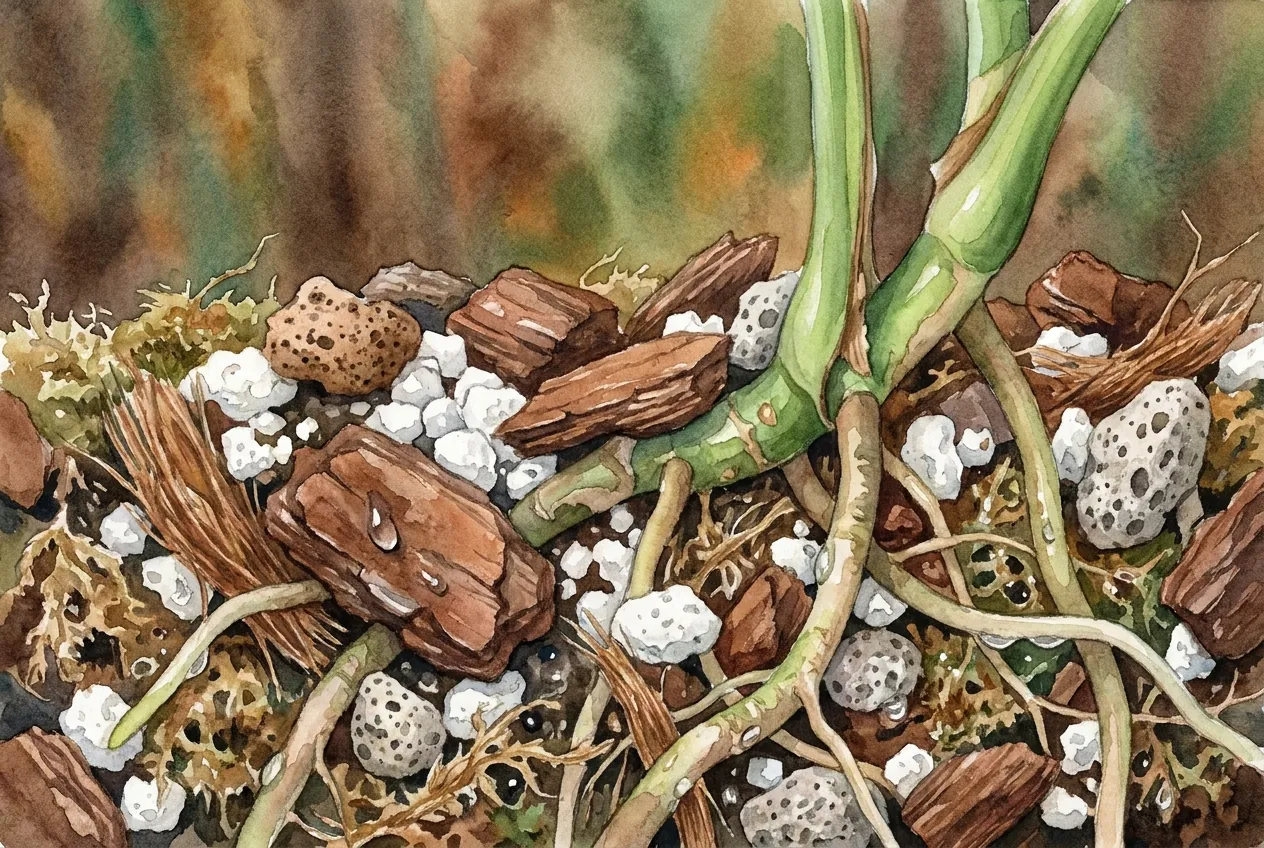
Most chunky aroid mixes combine bark for structure, an aggregate for air space, and a material that holds some moisture. Start with more bark and aggregate than moisture buffer, then adjust for how quickly your pot dries. Particle size, packing, and pot shape matter more than treating one ratio as universal.
Air-filled porosity, or AFP, is one of the most useful properties to target for aroid root health.
It is the fraction of pore space still holding air after the pot finishes draining. It is not the only thing that matters, though. Drainage, watering habits, pot size, temperature, light, and pathogen load all act independently.
Bark builds the big drainage channels. The aggregate keeps them open without soaking up water.
The buffer stops the mix from drying to bone in a day, and the amendment is a small optional touch.
I fill the intended one-liter pot with measured component volumes, level the mix without pressing, and record its dry weight. After slow saturation, I drain it for 30 minutes and record its weight at 24, 48, and 72 hours. The fixed pot and checkpoints reveal how bark grade and container shape alter a ratio that merely sounds chunky.
In the next liter, I adjust one component and keep both labels. Only after the small batch produces the wet and dry rhythm I need do I scale the recipe to the whole collection.
The starting ratio
Use roughly 2 parts bark, 2 parts aggregate, and 1 part moisture buffer, which is about 40% structure, 40% aeration, and 20% buffer.
If you want an amendment, take its share out of the buffer or aggregate rather than adding it on top, so the whole batch still totals 100%.
Do not chase exact percentages. Aim the finished blend into the AFP window, bias toward the airy end for aroids, and confirm it in your actual pot rather than trusting the ratio alone.
Extension guidance puts a common target for containerized crops at roughly 10-25% AFP, with at least 40% of volume holding water at container capacity and total porosity of about 50% or more.
Sources vary, and these are general container figures, not an aroid-specific optimum.
The number worth targeting first
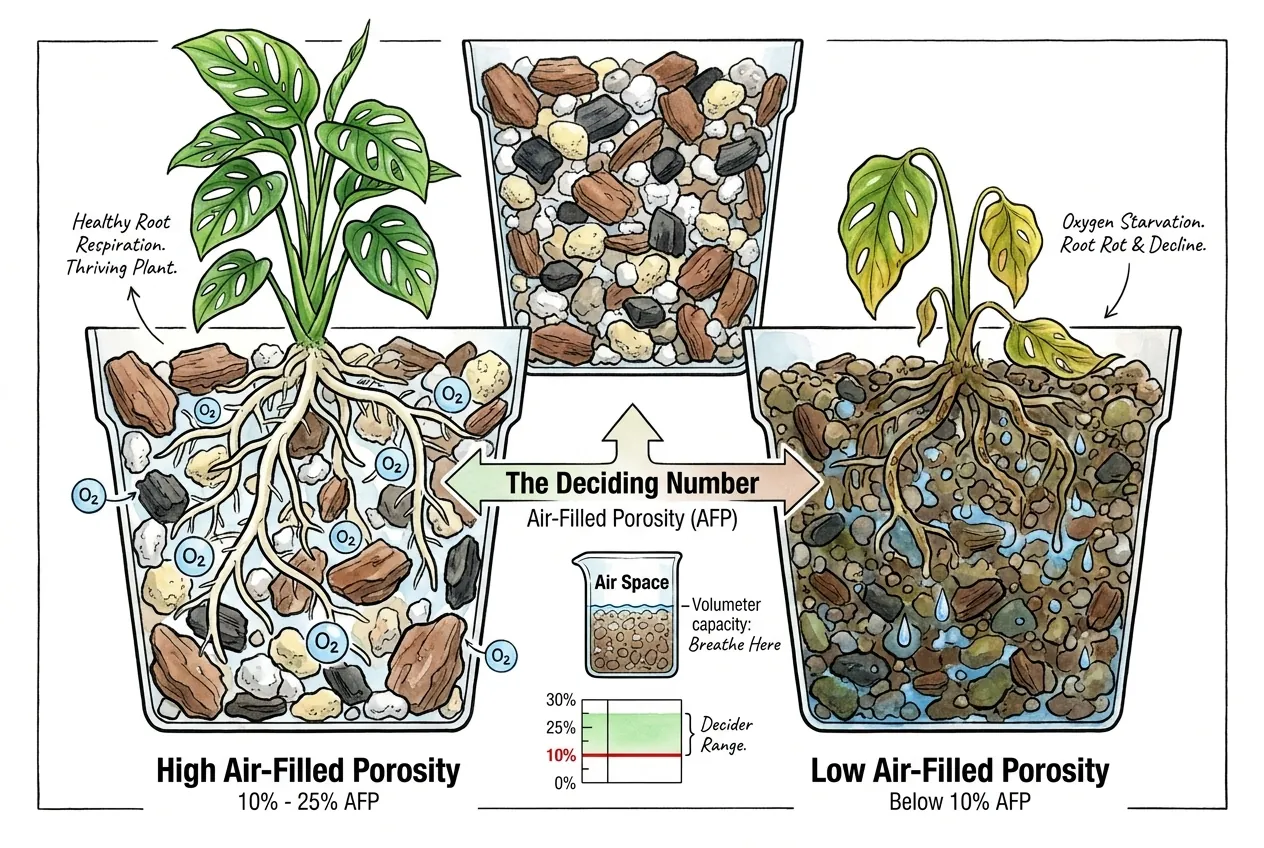
Air-filled porosity is a good first thing to get right. Below roughly 10% AFP the drained pore space can be too small for roots to breathe, and low-oxygen conditions push roots toward decline.
How fast that happens still depends on oxygen demand, temperature, and root volume.
Soil Mixes Part 3. How much air and water?
Understanding Substrate Physical Properties. Air-Filled Porosity, Water-Holding Capacity, Bulk Density
Why does air-filled porosity matter so much for roots?
When water occupies the larger pores for too long, roots receive less oxygen and are more likely to decline. Many popular climbing aroids are especially sensitive to long saturation, although the speed of decline varies by species, temperature, and any pathogen already present.
Large pores matter because they drain and refill with air. That is why a chunky mix and a pot that can drain freely are more useful than simply adding more ingredients.
What happens when the oxygen runs out
Growing root tips need the most oxygen, so they are often the first part to fail in a persistently wet mix. General studies on tree roots support that direction but do not establish a precise aroid threshold.
How rot can follow hypoxia
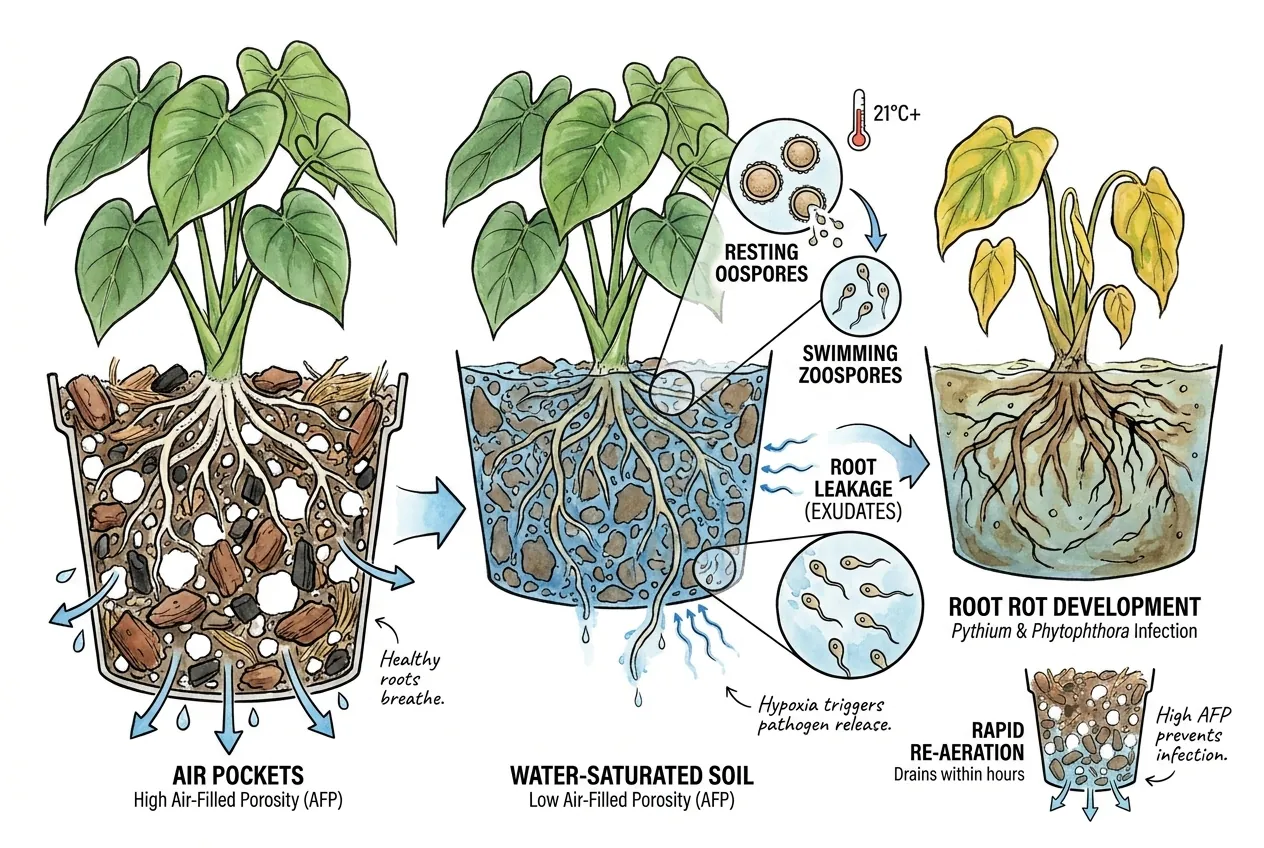
Where Pythium and Phytophthora are already present, leaked exudates and warm, saturated conditions favor them.
Many Phytophthora species produce swimming zoospores in warm, wet soil, with preferred temperatures that vary by species, so treat a single figure like 21°C as illustrative rather than a fixed switch.
Infection also needs free water, a susceptible host, and pathogen inoculum. High AFP alone does not prevent it.
Speed can be striking. UC IPM reports that in landscape hosts, Phytophthora disease can develop in as little as 4 to 8 hours of soil saturation when the pathogen is present, so drainage that re-aerates the pores quickly is a sensible defense.
Drainage management is important, but it is not a substitute for diagnosis, sanitation, and, where warranted, labelled controls.
Keeping AFP high enough that pores re-aerate within hours of watering reduces risk. It does not replace integrated management.
If your collection has ever gone down this road, the diagnostic walk-through in our guide to hemiepiphytic watering is worth a read.
Why many aroids favor an airy mix
Many Monstera, Philodendron, and Epipremnum grow aerial roots that normally cling to bark and open air, so they usually benefit from a fast-draining mix. Terrestrial and corm-type aroids can use more moisture buffer, but their root zone still needs to re-aerate after watering.
Pot shape changes the math
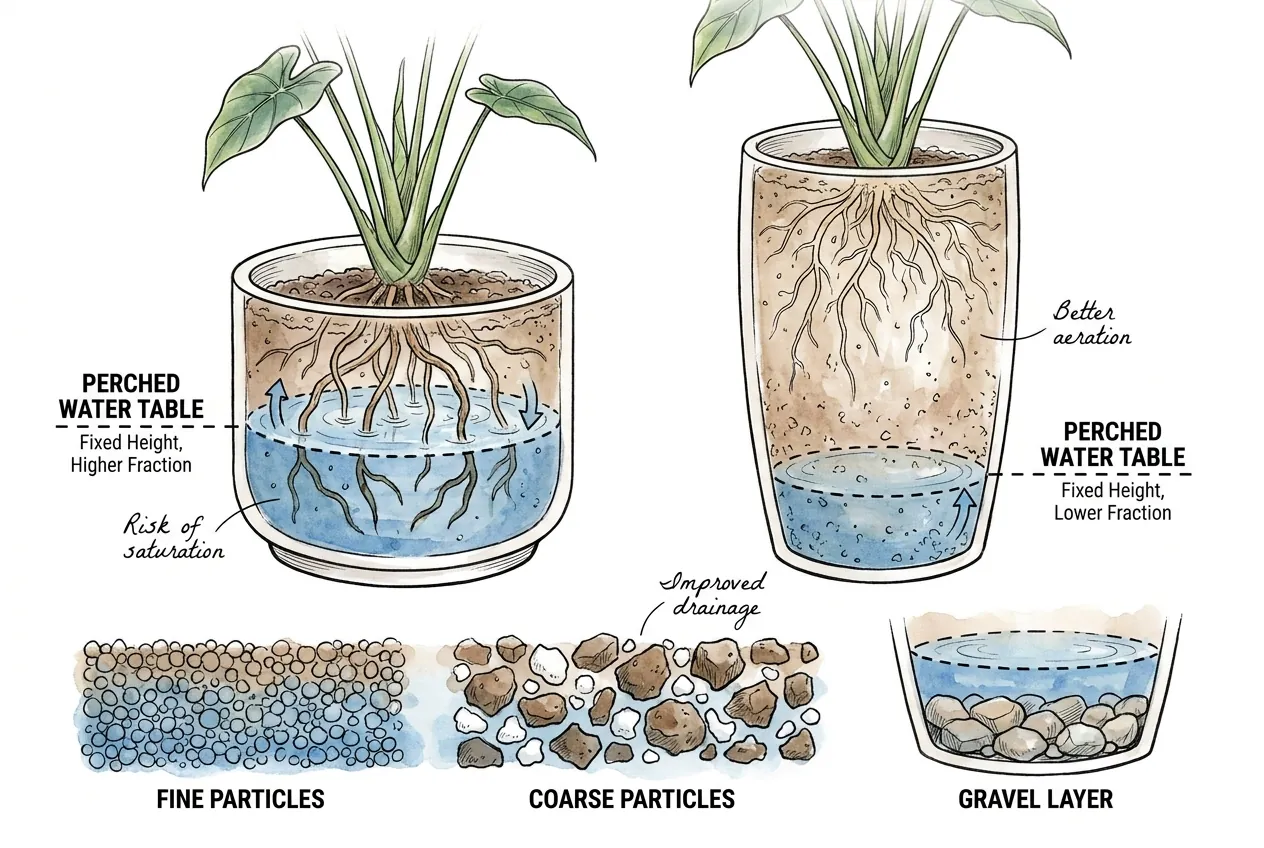
A short, wide pot holds a taller share of saturated mix than a tall pot with the same blend.
The saturated zone at the bottom is roughly a fixed height for a given substrate and packing, so in a short pot it takes up a bigger fraction of the root zone.
Use taller pots or coarser particles for moisture-sensitive aroids. Never add a bottom gravel layer, which raises the perched water table instead of lowering it.
Soil Aeration, Flooding, and Tree Growth
Phytophthora Root and Crown Rot. UC IPM Pest Notes
Root morphophysiology changes during the habitat transition from soil to canopy of the aroid vine Rhodospatha oblongata
Which measurable properties separate a good component from a bad one?
Six measurable properties rank any component. Particle size, air-filled porosity contribution, water-holding capacity, cation exchange capacity, pH, and durability.
Particle size is the master lever, because pore size follows particle size, and pore size decides whether a pore holds air or water.
Coarse particles, roughly above 2-3 mm, build the macropores that drain by gravity and stay air-filled.
Fine particles create micropores that hold water by capillary tension. The University of Arkansas classifies macropores as those wide enough to drain freely, which is exactly the air space aroids need.
Cation exchange capacity, or CEC, is the mix’s nutrient battery. It holds positively charged nutrients like potassium, calcium, and magnesium on particle surfaces and releases them to roots.
Low-CEC minerals hold little fertilizer, so more of it can wash through with watering, while higher-CEC organics store more and smooth out the feed curve.
The table below is a rough scorecard. The figures come from university extension property tables, but an important caveat applies. Those tables measure specific material forms.
The coir figures below are for ground/screened coir pith, and the sphagnum CEC and pH figures are for sphagnum peat, not the coir chips and long-fiber moss sold as products.
Read the table to compare roles, not to set exact doses for a specific bagged product.
| Component | Structural? | AFP at container capacity | Water-holding (% vol) | CEC (meq/100g) | pH | Durability |
|---|---|---|---|---|---|---|
| Medium bark (9-19 mm) | Yes, the backbone | ~20% | ~60% | Low | ~3.5-5.0 | Slow decay, breaks to fines over months to years |
| Coarse perlite (#3/#4) | Yes if above 3 mm | ~25% | ~38% | Negligible | 7.0-7.5 | Inert, but floats, dusts, crumbles over years |
| Pumice (1/4 inch) | Yes | High | Low to moderate | Low | Near-neutral | Inert, stays put, resists crushing |
| Coir (pith figures) | Chips only as chunks | 9.5-12.5% (pith) | 73-80% (pith) | 39-60 (pith) | 5.8-6.9 (pith) | Slow breakdown, high lignin, high raw EC. Chips hold less water and more air than pith |
| Sphagnum (peat figures) | Long fibers as strands | Low to moderate | Very high | 90-140 (peat) | 3.0-4.5 (peat) | Faster breakdown, acidic. Long-fiber moss differs from milled peat |
Read each row loosely as either an air chip or a sponge. Perlite, pumice, and coarse bark act mostly as air chips, while coir and sphagnum act mostly as sponges, though pumice and bark still hold some water and the sponges still admit some air.
You blend a sponge into the air chips so the mix holds water without dropping AFP too low.
One practical warning. An all-coir mix leans wet. Published pith figures put coir AFP near 10-12%, close to the floor.
Chips run airier than pith, but coir still works better as a buffer than as the whole base.
Substrates (Component Properties). University of Arkansas Greenhouse Management Online
How Substrate Structure Influences Air Porosity
What structural bark should I buy, and why medium grade?
Buy medium-grade orchid or fir bark, roughly 9-19 mm or 1/4 to 3/4 inch, as the skeleton of the mix.
Its large, rigid, irregular chips cannot nest tightly, so they leave the big drainage channels that drive air-filled porosity. Fine bark does the opposite and holds water like peat.
The physics is clear even if exact numbers vary by product. In one study, a pine-bark material measured around 49% air-filled porosity at a low bulk density near 0.2 g per cubic centimeter, far airier than peat-heavy potting soil. Treat that as one measured example, not a spec every bark meets.
More generally, extension data show coarse bark near 10 mm raises AFP while fine bark near 4 mm holds about as much water as peat.
Bark is impermanent, and that is a real tradeoff. It is a large, low-nitrogen carbon source, so microbes pull some nitrogen out of the pot to digest it. Measured bark nitrogen in that study ran about 0.2-0.76%.
Bark also breaks down toward fines with age. A comparison of fresh versus aged commercial bark sources found container capacity higher and air space lower in the aged material, on the order of 20% either way.
Exact rates depend on source, particle size, and conditions, which is why bark mixes need refreshing and a little extra nitrogen feeding.
What to buy
Better-Gro for an Affordable Bark Base
Better-Gro Orchid Bark suits an affordable structural base when you will add aggregate and a moisture buffer. It is not complete nutrition. Check each lot for particle size and fines, screen out excess fine material for more air, and pre-soak dry bark so it wets evenly.
rePotme for a Measured Medium Grade
rePotme Monterey Orchid Bark suits a measured mix when you want a more predictable single component. Confirm the actual particle range rather than assuming every bag is identical. It makes more sense for a small collection or top-ups than for potting many plants economically.
Using Recycled Construction Waste Amended with Pine Bark as a Substrate for Urban Plantings
Soilless Substrate Management for Nursery Crops. University of Kentucky Nursery Crop Extension
Perlite or pumice for the aeration aggregate?
Both coarse perlite and 1/4-inch pumice can raise air-filled porosity into the target band, so for most aroid mixes this is largely a tradeoff decision rather than a big performance gap.
A University of Illinois study found the two share similar physiochemical properties and behave alike in blended mixes, though exact grade, blend, and packing still shift the numbers.
The main forks are weight, floating, durability, and cost.
The aggregate adds durable air pockets to the mix without soaking up much water. A rough starting point is 20-30% of a chunky mix, then measure to confirm the finished AFP lands in range.
Perlite sheds water off its surfaces, while pumice holds a little water inside its internal pores and releases it slowly.
Weight is a big part of the difference. Perlite is very light, so it tends to float to the surface on top-watering and can form a white layer, which reduces aeration where it accumulates.
Pumice is a denser rock that resists that hydraulic lift, stays distributed, and adds ballast that helps anchor tall or top-heavy aroids.
Durability is the second divide. Perlite is generally reported to be less durable than pumice, breaking down with handling and wet-dry cycling over time, though the pace in a given mix is not well quantified.
Dry perlite can also raise dust. Older sampling associated with a since-remanded exposure rulemaking reported small crystalline-silica fractions, so a practical precaution is to wet perlite before mixing and wear a mask, following the product SDS.
Pumice is a solid rock that holds its shape well and can be reused. If it came from a diseased pot, rinsing is not enough. Proper steam or chemical sanitation is needed before reuse.
| Property | Coarse perlite (#3/#4) | Pumice (1/4 inch) |
|---|---|---|
| Weight | Very light | Notably heavier solid rock |
| Floating | Floats and migrates to surface | Resists hydraulic lift, stays put |
| Water retention | Sheds water, surface only | Holds a little inside internal pores |
| Durability | Less durable, breaks down over time | More durable, reusable with sanitation |
| Dust and safety | Silica-bearing dust, wet and mask up | Minimal dust |
| Cost and supply | Cheap and everywhere | Pricier, regionally harder to find |
What to buy
GARDENWISE Perlite for Low Weight and Cost
GARDENWISE Grade 4 Perlite suits a mix that needs more air space without much added weight. Finished porosity still depends on the whole mix and pot. Wet it before mixing to reduce dust, and skip it if you top-water and dislike floating particles.
Bonsai Jack Pumice for Stable Air Space
Bonsai Jack Horticultural Pumice suits top-watered or top-heavy pots that need a durable, heavier aggregate. Its extra weight and price make it less attractive for a large collection. Confirm the finished mix by measuring, and sanitize it properly before reuse after disease exposure.
If you would rather run a fully inorganic medium, our soil-to-Pon transition walkthrough covers a pumice-based route. Its air-to-water ratio still shifts somewhat with container, particle distribution, and root growth.
NIOSH PEL Project. Perlite (Crystalline Silica Content and Exposure Limit)
Coir chips or sphagnum for the moisture buffer?
Both hold plant-available water and cation exchange capacity so a chunky mix does not dry to bone in a day, and they trade off differently.
Coir chips are near-neutral, sustainable, cheap, and forgiving on rewetting, but they can ship with a salt load you should rinse.
Chopped long-fiber sphagnum holds more water per gram and is naturally acidic and antimicrobial, but it is not sterile and tends to acidify the root zone and compact over time.
Sphagnum holds a large amount of water thanks to its hollow, dead hyaline cells. Figures around 20 times dry weight are often cited for the material.
Comparisons of water held by volume come from pith and peat data, 73-80% for coir pith versus 60-68% for sphagnum peat, which are not the exact chip and long-fiber products sold here.
The practical difference is rewetting. Coir re-absorbs water reliably even after going bone-dry, while dried sphagnum can turn hydrophobic and shed water.
On nutrients, sphagnum peat’s cited CEC of 90-140 meq/100g roughly doubles coir pith’s 39-60, so peat buffers fertilizer harder.
Those figures are for peat and pith, not the moss and chips you buy, but the general direction, that both organics hold nutrients better than inert aggregates, still applies.
The coir salt problem
Depending on source and processing, some coir arrives with sodium, potassium, and chloride on its exchange sites.
Trade references report raw coir EC varying widely, roughly 0.3 to 2.9 mS/cm in one dataset, with chloride sometimes 400-700 ppm. High loads usually trace to supply-chain issues like saline-water processing rather than being inevitable for all coconut coir.
Excess soluble salt raises osmotic pressure at the root surface, which can mimic drought.
Buy washed or buffered coir, or hydrate and rinse your own bricks, then check runoff EC. Note that washing and buffering are different. Fresh-water leaching lowers soluble salts, while Ca/Mg buffering displaces potassium and sodium from exchange sites.
If you have no meter, rinsing until the runoff is no longer tea-colored is a rough visual cue only, since color reflects tannins, not dissolved-salt concentration.
Leaching lowers EC, and hydrating first helps, because salt ions free up once the fibers are saturated.
How much a given rinse removes depends on the starting salt load, water volume, and extraction method.
For a real-world look at how coir EC drifts over time on a climbing support, see our sphagnum vs coir vs LECA pole substrate test, keeping in mind it may use a different material form and EC method than a potting mix.
| Property | Coir chips | Long-fiber sphagnum |
|---|---|---|
| Water by weight | ~8-9x dry weight | ~20x dry weight |
| Water by volume | 73-80% | 60-68% (peat) |
| CEC (meq/100g) | 39-60 | 90-140 (peat) |
| pH | 5.8-6.9, near-neutral | 3.0-4.5, acidic |
| Raw salt / EC | High, needs rinsing | Naturally low |
| Rewetting | Rewets easily | Can go hydrophobic when dry |
| Longevity | Slow, high lignin | Compacts within months |
What to buy
Envelor Coir for a Rewettable Buffer
Envelor Coco Coir Chips suit pots that sometimes dry too hard and need a near-neutral moisture buffer. The listing’s washed or low-EC status is not verified, so test the first runoff and use less when you tend to overwater.
Besgrow Sphagnum for High Moisture Retention
Besgrow New Zealand Sphagnum suits moisture-loving, high-humidity aroids or rooting cuttings. Chop it into the moisture-buffer portion and watch for compaction. It is acidic and not sterile, so skip it when you want a low-maintenance, pH-neutral buffer.
University of Arkansas Greenhouse Management Online. Substrates (Unit 7, Section 5)
Core Facts About Coir. Nursery Management
Are charcoal and worm castings worth adding?
Both are optional finishing amendments with different evidence behind them. Worm castings are a reasonable gentle slow-release feed plus a microbial input, usually kept to a small fraction such as 10-20% of volume.
Horticultural charcoal has mixed, dose-dependent evidence, so treat it as a low-dose aeration and adsorption filler, not a rot cure.
Note that most of the research is on biochar generally, whose properties vary widely with feedstock and processing, so it does not directly certify a specific bagged charcoal.
Is horticultural charcoal worth it?
Charcoal is optional. Container studies report both gains and losses depending on the dose, feedstock, and crop, so do not add it to solve a root-rot problem.
Its porous surface can bind some dissolved compounds, but it can also temporarily tie up nitrogen. That tradeoff varies by product, so use only a small share when the mix actually needs another coarse filler.
Keep it to 10% or less of mix volume and buy horticultural, not BBQ, charcoal. Many BBQ briquettes carry binders and additives that are not plant-safe.
Anyone whose mix already hits target AFP and who fertilizes on a schedule can skip charcoal with no real loss.
Horticultural Charcoal as Optional Filler
Bonsai Jack Horticultural Charcoal is optional filler when the mix needs a little more structure. Its growth benefit is not verified for this specific product, and fresh charcoal can briefly bind nitrogen. Skip it when the mix already drains and breathes well.
What dose of worm castings?
Worm castings are a reasonable slow-release and microbial amendment, usually kept to a small fraction such as 10-20% of volume.
They add gentle nutrients, a living microbial community, and some water retention. Extension sources describe castings as a mild amendment with NPK that varies by feed and storage. They do not establish a single universal optimum or plateau for aroids, so treat the 10-20% range as a practical starting point rather than a proven ideal.
The reason to keep the dose modest is physical. Castings are fine and dense, so bulk density rises and air space falls as the casting fraction climbs.
Overdo them and you can collapse the aeration a chunky aroid mix is built for.
Worm Castings for a Small Nutrient Boost
Wiggle Worm castings can add gentle nutrition in a small share of a chunky mix. They are fine and dense, so using too much can close air spaces in a chronically wet, low-light setup. Skip them if you already fertilize on a schedule.
Effects of Biochar on Container Substrate Properties and Growth of Plants. A Review
Alleviate environmental concerns with biochar as a container substrate. A review
Composting Series. Worm Castings. LSU AgCenter Extension
How do I mix the ratio by genus, and how often do I repot?
Start from the base ratio of roughly 2 bark to 2 aggregate to 1 buffer, substituting any amendment into that total.
Shift the Mix by Root Habit
Then shift the blend along one rough axis based on how epiphytic the roots tend to be.
The more epiphytic the roots, the chunkier and airier the blend. The columns below are rough ranges, so read each row as a direction to nudge, not an exact recipe, and confirm the finished mix by measuring.
Root habit varies within each genus, so this axis is a simplification. Epiphytic aroid roots generally do more gas exchange and hold up better in airier mixes, while terrestrial and corm-type roots tolerate more plant-available water, as long as the core still re-oxygenates.
Even epiphytes still take up water and nutrients, so this is a matter of degree.
| Genus (root habit) | Structural bark | Aeration aggregate | Moisture buffer | Direction and why |
|---|---|---|---|---|
| Anthurium (most epiphytic) | ~40-50% | ~20-30% | ~10-20% | Chunkiest, highest AFP, roots grip bark and re-aerate fast |
| Monstera (hemi-epiphytic climber) | ~35-40% | ~25-30% | ~20% | Airy, texture for aerial roots, tolerates drying |
| Philodendron (climbers to creepers) | ~35-40% climbers | ~20-30% | ~20-30% | Climbers airy, creeping types want a touch more moisture |
| Alocasia (corm geophyte) | ~20-30% | ~20-30% | ~25-30% | More moisture buffer, but a never-stagnant core |
Treat these as evidence-informed rules of thumb, not lab-validated recipes, and note that the ranges above are directional and do not always add to a single fixed total.
Do not chase exact percentages. Move some volume between aggregate/bark and buffer, keep the whole batch summing to 100%, then confirm the result.
Feeling airy is a weak proxy. To actually check AFP, saturate the finished mix in the pot you will use, let it drain, and measure the water it releases, or send a sample for testing.
The wetting sequence
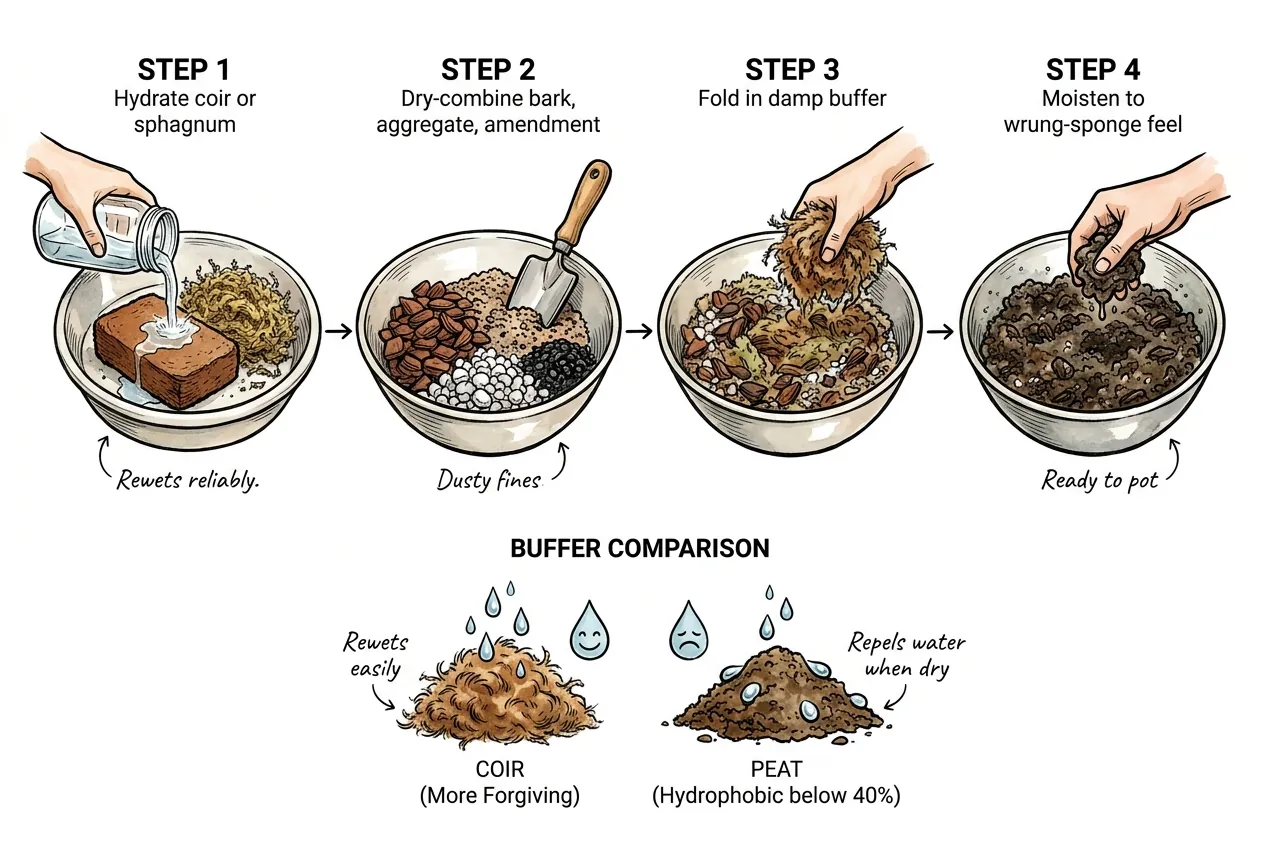
Pre-wet before potting. Dumping dry, dusty components in and watering afterward can let fines wash down and pack the base, and can let a bone-dry coir fraction repel the first watering.
The sequence is simple. First hydrate the coir brick or sphagnum.
Then combine the bark, aggregate, and any amendment. Dampen dusty components such as perlite first and wear a mask, rather than mixing them fully dry.
Fold in the damp buffer, then moisten the whole batch to a wrung-sponge feel and pot.
Coir is the more forgiving buffer here because it rewets reliably. Peat, by contrast, can turn hydrophobic when dry. Long-fiber sphagnum behaves somewhat differently, so watch how your specific buffer rewets.
How often to repot
Let the mix, not the calendar, set the timing. Bark and coir decompose into fines, AFP falls, and the mix compacts, and that is the signal to refresh.
Watch for fast dry-down, a top-heavy plant, stalled growth, or a salt crust.
Chunkier grades and 1/4-inch pumice buy longer intervals. For context, extension guidance says most houseplants need repotting only every 3-5 years and rarely more than once a year, so a shorter refresh interval for a fast-breaking chunky mix is a judgment call, not a fixed rule. There is no direct aroid-specific 12-15 month figure.
Do not wait for the plant to be severely root-bound before acting, though a slightly root-bound plant can be one way to manage size. Our root-bound myth piece has more on this.
When you refresh the mix, you often do not need to bare-root a healthy plant, and bare-rooting adds stress.
If you do, the recovery steps in our transplant shock guide help roots bounce back.
Soil Mixes Part 3. How much air and water?
Nitrogen Immobilization in Plant Growth Substrates. Boyer et al., 2012
Who should NOT buy each class of product?
Every component has an off-ramp, and buying the wrong one for your habits wastes money and hurts the plant.
If your genus, pot, and watering already work, you may not need to buy anything at all.
Skip coarse perlite if you top-water hard
Perlite tends to float to the surface and skim off when you top-water, which reduces aeration where it accumulates.
Substitute 1/4-inch pumice, which is heavier, stays put, and resists crushing.
Skip pumice if weight and cost dominate
If you never move big pots and budget matters, coarse #3-#4 perlite is lighter and cheaper. You accept the floating tradeoff in exchange.
Go easy on the buffer if you chronically overwater
Coir adds water retention, so a heavy dose can punish an overwaterer. Sphagnum is not the fix here, since it holds even more water per gram and compacts faster. Instead lean on a smaller buffer fraction and more coarse aggregate.
Check the Other Causes of Overwatering
Before changing the mix, check for a missing drainage hole, standing water in a cachepot, an oversized pot, or watering too often. If you use coir, leach it because an unrinsed salt load can bite.
Skip sphagnum if you want low maintenance
Sphagnum is acidic and tends to break down and compact faster than coir, which can mean earlier refreshes and some pH attention.
Coir chips are lower-maintenance as a buffer, though no organic buffer is fully hands-off, since pH, salt, and biology all still drift over time.
Skip charcoal and castings freely
Charcoal’s benefit is modest and debated, so it is optional filler, not a rot cure. Substitute more pumice for aeration.
Skip worm castings if you fertilize on a schedule or the plant is rot-prone, and cap them at 10-20% of volume if you do use them.
Skip buying entirely if nothing is wrong
A hardy Pothos or Philodendron in a well-draining nursery mix with no fast dry-down, no salt crust, and no rot is doing its job.
Check the roots and drainage hole, and if all looks well, leave it alone until the next natural repot window.
Bulk Density. University of Arkansas Greenhouse Management Online
Repotting Houseplants. University of Arkansas Cooperative Extension
What are the common failure modes, and how do I prevent them?
Three common failure modes for a chunky mix are compaction as AFP declines, a hydrophobic dried-out buffer, and salt buildup.
They are not the only ones. No drainage hole, a cachepot holding standing water, an oversized pot, watering frequency, light and temperature, root damage, and pathogen load all cause trouble too.
Each of the three below has a diagnostic and a fix, and periodic leaching helps with salt specifically.
Why does my mix stay soggy after about a year?
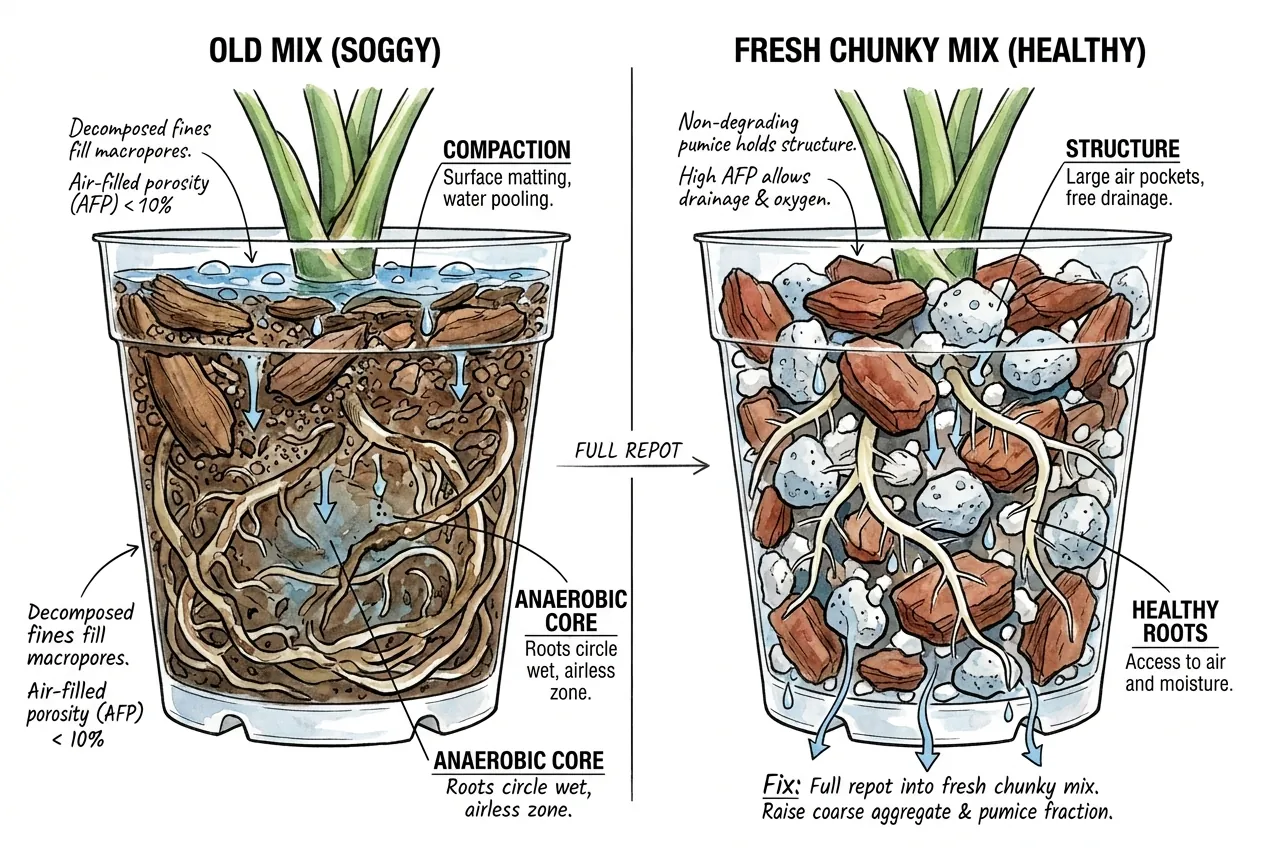
A likely cause is that the bark and coir have decomposed into fines that fill the macropores, lowering AFP so water pools on top and roots sit in a wet, poorly aerated core.
Confirm by feeling the mix and checking how fast it drains rather than assuming a specific AFP number.
If it is genuinely compacted and staying wet, refresh into a fresh chunky mix rather than just topping it up, and check the roots as you go.
If a pot chronically compacts, raise the coarse-aggregate and bark fraction and lean on durable pumice, which holds its structure well.
Why does water run straight through without wetting the rootball?
The buffer has dried below roughly 40-50% moisture and gone hydrophobic, so water sheets down the pot wall and out the drain hole in seconds while the rootball stays dry.
Peat does this readily. Coir resists it because it lacks the waxy repellent layer.
Bottom-soak the whole pot for 20-30 minutes to rehydrate, or repot. Next time keep more of the buffer as hydrophilic coir and never let it fully desiccate.
Why do I see a white crust and crispy leaf tips?
A white crust with crispy tips often means fertilizer salts have concentrated as water evaporated, raising EC so it pulls water back out of root tips, which looks like drought damage.
Unrinsed coir can add its own sodium, potassium, and chloride. Confirm with a method-matched EC reading and by checking your source water, rather than diagnosing from tip symptoms alone.
If EC is high, leach the pot by flushing several pot-volumes of plain water through it, and repeat as needed.
Watering with some extra so it drains through helps carry salt out. A routine of roughly 20% leachate every watering, or a flush every few months, is an option when your water or feed is salty, not a universal rule, since over-leaching wastes nutrients and keeps the mix wetter.
EC bands are also crop- and method-specific. The roughly 1.5 dS/m high band is for woody ornamentals under a saturated-media-extract method, and potted herbaceous aroids differ, so match the interpretation to your test.
Soluble Salts Damaging to Houseplants. Oregon State University Extension
Soil and Container Media Electrical Conductivity Interpretations. UF/IFAS Extension
Looking through the pores of a soilless substrate. Purdue University
Frequently asked questions
Perlite vs pumice for aroids, which is better?
Both can hit a similar air-filled porosity target, so the choice leans more on durability than drainage.
Pumice generally keeps its shape longer, while perlite is more prone to crushing and floating over time. The exact rate in a given mix is not well quantified.
Total porosity is broadly comparable, so on air they are fairly close, though grade and dose still matter.
Choose pumice when you top-water, keep a mix for a long time, or dislike perlite dust and float.
Choose perlite when weight or budget dominates, as with hanging or large pots. The tradeoff is that pumice costs more and is heavier, while perlite is cheaper and lighter but less durable.
Soil Mixes Part 3. How much air and water?
Is horticultural charcoal worth it?
It is a modest, optional amendment whose benefits swing with feedstock and dose. Treat it as a nice-to-have aeration and adsorption filler, not magic.
A 2025 trial blended four biochars at 5-20% into aged bark and peat and grew three native shrubs for three months. All the mixes had acceptable physical properties, a commercial biochar at 10% improved some growth, and some sources harmed at least one species.
So the honest summary is mixed results, not a blanket failure.
Keep charcoal to single-digit percentages up to roughly 10% of volume, and buy horticultural grade rather than BBQ briquettes.
Its most defensible role is low-dose aeration and adsorption bulk. It is not perfectly inert, and its adsorption chemistry varies.
Does coco coir need rinsing, and what EC is a problem?
Often, yes. Raw coir can ship salty, with reported EC varying widely by source and processing, and it is worth checking before it goes near roots.
Two different steps help. A fresh-water rinse lowers soluble salts, while Ca/Mg buffering displaces potassium and sodium held on exchange sites.
Confirm the result with a method-matched EC reading rather than assuming a fixed cutoff, since EC bands depend on the extraction method and your source water.
Buy pre-buffered or pre-washed coir chips if you can. Otherwise hydrate first, then leach to runoff, and check EC with a meter, correcting for your source-water EC.
With no meter, rinsing until the runoff is no longer tea-colored is only a rough visual cue, because color comes from tannins rather than dissolved salts.
A meter and a consistent method are the way to actually confirm it.
Core Facts About Coir. Nursery Management
DIY components or a pre-bagged mix, and what does it cost?
DIY tends to cost less once you buy components in bulk. A pre-bagged mix costs more per quart but offers convenience and less measuring.
Compare local bag prices, yield, and shipping before deciding because the cheaper route depends on your collection size.
The clearer DIY advantage is control over the ratio, not always the price.
DIY lets you adjust the blend toward a genus and swap perlite for pumice or coir for sphagnum.
A single multi-component DIY batch has a higher upfront outlay because you buy several bags, but the per-quart cost can drop because each bag makes several mixes.
As a rough heuristic, DIY suits anyone with several plants or a specific genus target, while a quality pre-bag suits a first-time buyer with one or two plants.
Even with DIY, confirm AFP by measuring the finished mix rather than assuming it from the ratio.
Substrates (Component Properties). University of Arkansas Greenhouse Management Online
How often do I repot or refresh the mix?
Let the mix and the plant set the timing rather than a fixed schedule. Extension guidance says most houseplants need repotting only every 3-5 years and rarely more than once a year. A fast-breaking chunky mix may warrant refreshing sooner, but that is a judgment call, not a fixed 12-18 month rule.
Refresh when you see a salty crust, much faster dry-down than before, a top-heavy plant, or stalled growth, and check EC and your source water before blaming salt.
The clock is driven mainly by breakdown and salt. Pumice and charcoal resist decomposition, so timing tracks bark and coir decay, though root volume, salt, and pot fit matter too.
University of Arkansas extension lists a salty surface crust as a trigger to repot and replace as much soil as practical.
Repotting Houseplants. University of Arkansas Cooperative Extension
Affiliate Disclosure
This article contains Amazon affiliate links. As an Amazon Associate I earn from qualifying purchases. If you use these links, the site may earn a commission at no extra cost to you. Product availability, price, and specifications can change. Check the current listing before buying.