
Philodendron Melanochrysum Pole: Sphagnum vs Coir vs LECA
How sphagnum, coco coir, and LECA differ as Philodendron melanochrysum climbing-pole substrates: cation-exchange behavior, salt drift, watering demands, and how to monitor them with a proper extraction method.
Samuel Reed · Published 2026-06-01 · 26 min read

Key Takeaways
- Sphagnum has the highest cation-exchange capacity of the three. It buffers feed salts strongly at first but can accumulate them fastest if it is never flushed.
- Buffered coco coir is a lower-CEC organic option that is generally more tolerant of irregular watering. Source-water sodium matters more for it than for sphagnum.
- LECA is close to chemically inert, so what you feed is close to what the roots see. Its passive capillary rise is short, so a tall LECA pole needs regular top-watering or an internal wick.
- A single EC number is not diagnostic. Compare substrates with a defined liquid-extraction method, not by pushing a pen into damp moss, and interpret each method against its own reference ranges.
- Match the substrate to the failure mode you are best equipped to notice. Test for salt build-up, measure tap-water sodium, or use touch to catch top-of-pole dry-out.
Three substrates are common in Philodendron melanochrysum pole work. New Zealand sphagnum moss, buffered coco coir, and LECA each handle fertilizer salts differently over a feeding cycle. The best fit is the one whose failure mode you can catch in time.
Watch salt drift because a climbing pole behaves like a vertical wick. Roots near the top may not meet the same concentration you fed at the base. Your readings depend on water, feed, pole size, and room conditions, so compare each pole with its own baseline instead of following a generic time curve.
During normal irrigation, I route pole runoff away from the pot and collect the first 30 milliliters from each drainage path in separate clean cups. The fixed volume keeps a large flush from diluting one sample more than the other.
I read both samples at room temperature within 15 minutes and repeat the test during the same scheduled watering each week. Fixed volume and timing make trends comparable without treating runoff as an exact root-zone inventory. Diverging values tell me where to flush or adjust delivery first.
Each node gets a date when it roots into the pole, and leaf size is compared only among nodes that actually attached. A larger leaf after attachment is more informative than comparing it with a free-hanging section grown under different support.
Why does climbing-pole substrate matter so much for Philodendron melanochrysum?
The climbing pole shapes the aerial-root microclimate, and that microclimate is one of several things that influence whether melanochrysum settles into the large velvet leaves it is known for. Philodendron melanochrysum is a climbing aroid native to Colombia that grows in the wet tropical biome according to Kew Plants of the World Online.
Climbing aroids generally ascend tree trunks and root into bark, moss, and trapped leaf litter. Use that as a general aroid model rather than a measured description of every P. melanochrysum trunk surface.
Those natural surfaces tend to be damp, somewhat acidic, and organically rich, and rainwater is low in dissolved salts.
A home pole is an attempt to approximate that kind of surface. How closely it matches depends on the substrate, your water, and how you feed.
What changes when an aerial root grabs a damp pole?
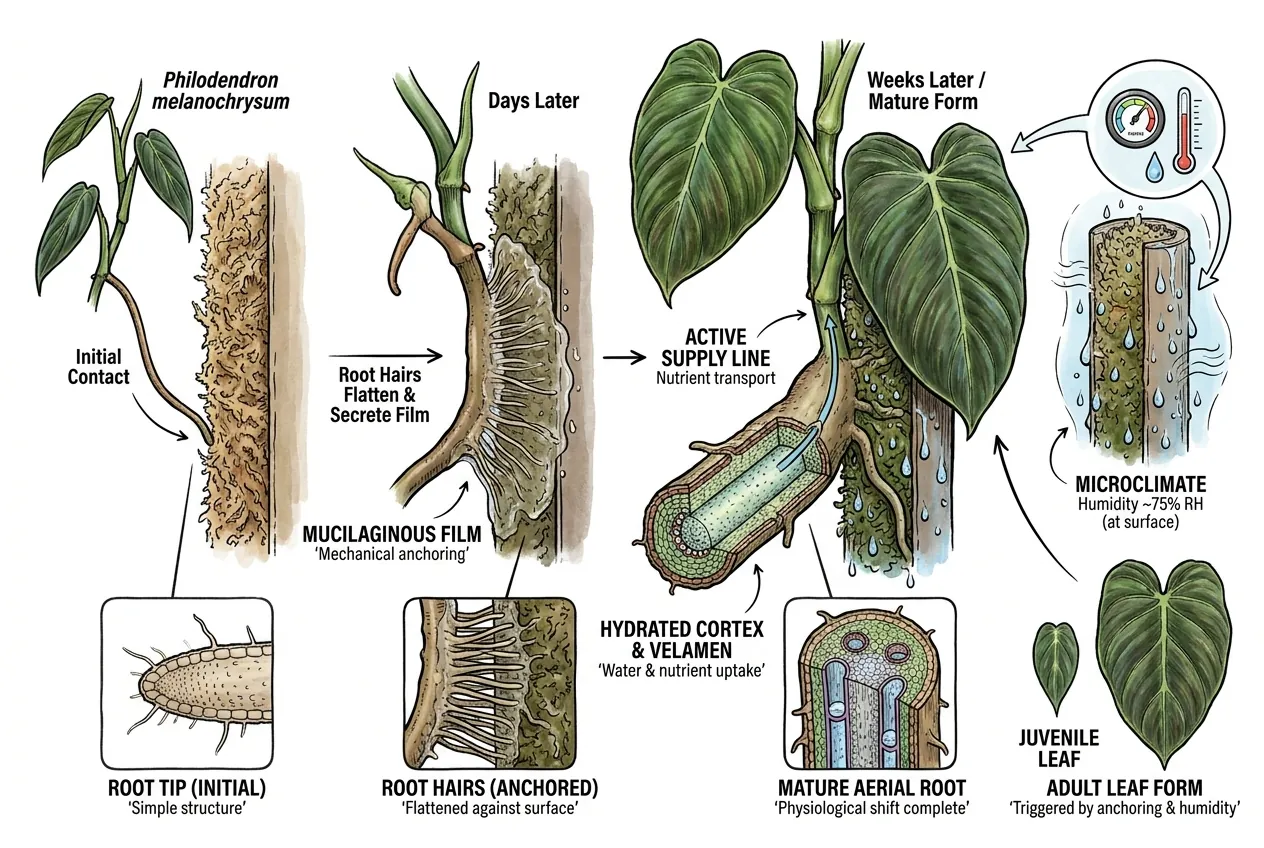
In climbing aroids generally, an aerial root that reaches a moist surface tends to adhere and then take up water.
The attachment literature describes root hairs pressing against the surface and a mucilaginous secretion helping to anchor the root, after which the cortex hydrates and the root can take up water and dissolved nutrients.
How quickly that happens, and the exact anatomy in melanochrysum specifically, are not things the general aroid review pins down for this species, so the sequence above is a mechanism sketch rather than a documented melanochrysum timeline.
A damp pole can raise humidity right at its surface relative to the room. The effect depends on pole size, wetness, and airflow, so do not expect a fixed humidity increase or duration.
Leaf development in climbing aroids is influenced by several factors together, support and anchoring, humidity near the pole, light, and mechanical contact, rather than by any single trigger.
Under good conditions melanochrysum tends to shift from smaller juvenile leaves toward the larger velvet-dark adult leaves with copper-gold veining, but no one of these conditions on its own is a guaranteed switch.
Philodendron melanochrysum Linden & André. Plants of the World Online (Kew Science)
Diverse climbing strategies in aroid vines. Frontiers in Plant Science, 2025
What is EC, and why is drift the right metric for a climbing pole?
Electrical conductivity (EC) reflects how many dissolved ions are in a water sample. More dissolved salts, higher conductivity.
It is a proxy for total salt concentration, not a measure of any specific nutrient, toxic ion, pH, or alkalinity.
Conductivity also changes with temperature, so meters and standards assume a reference temperature.
Watching the trend over time is usually more useful than any single reading, because a climbing pole concentrates salts unevenly along its length.
EC is reported in millisiemens per centimeter (mS/cm). One mS/cm equals 1,000 microsiemens per centimeter (µS/cm).
A meter's TDS or ppm mode is not a direct measurement. It just multiplies EC by a conversion factor the instrument picked.
The true ratio between dissolved solids and conductivity depends on which ions are present. USGS notes that for natural waters it commonly falls around 0.55–0.75 and ranges more widely still, so a ppm reading from a generic factor can be off.
When you compare readings, compare EC in the same units rather than trusting a ppm conversion.
For tropical foliage on a maintenance feed, general commercial guidance treats media soluble-salt levels around 1–2 dS/m as normal, suggests withholding fertilizer around 2 and above, and considers leaching above about 3. Those ranges require a defined extraction method, not a pen pushed into damp moss. Sustained high salinity can brown aerial-root tips, burn leaf tips, and slow growth, but no species-specific pole threshold is established for P. melanochrysum.
Why does EC drift inside a pole even with the same feed?
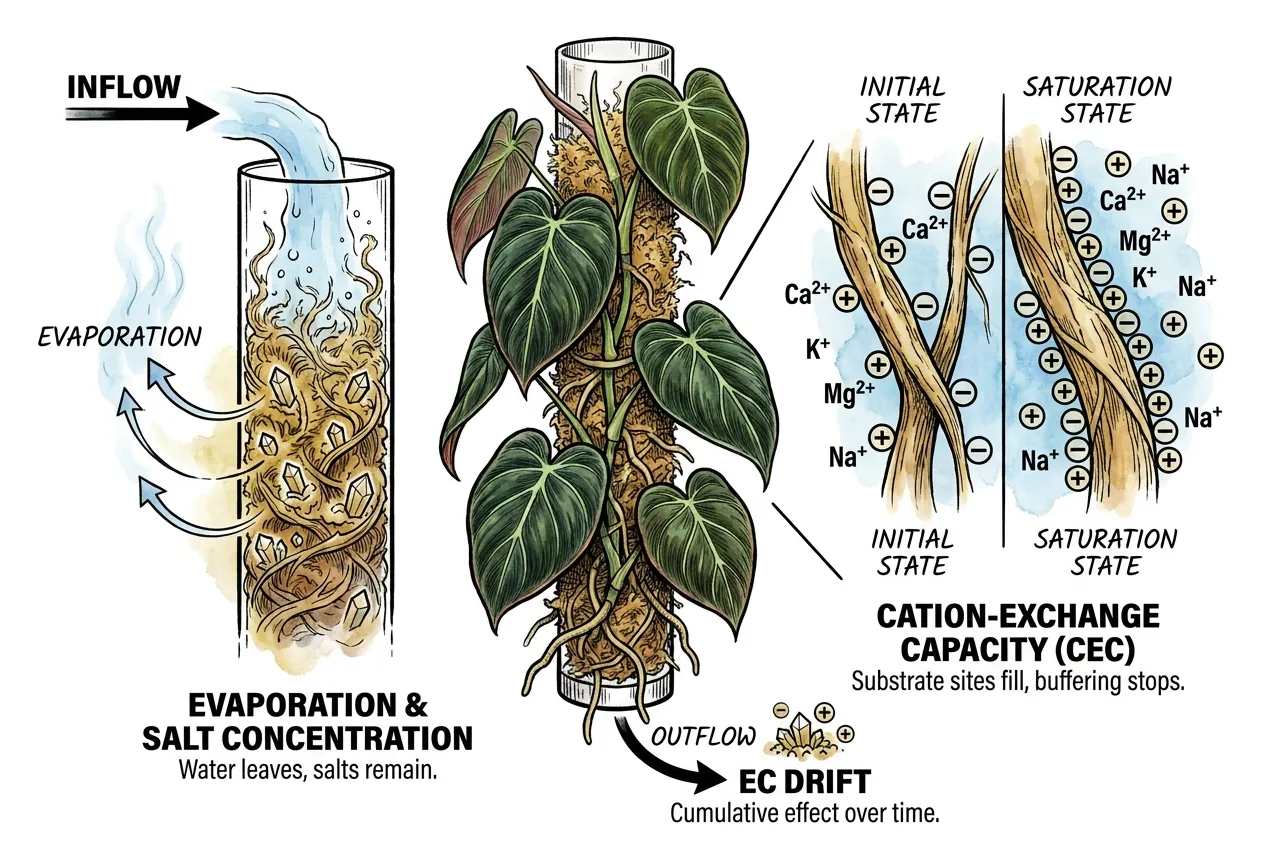
One force is evaporation. Water leaves the pole surface, and the dissolved salts it carried stay behind.
This is the same mechanism that crusts a terracotta rim with white scale. Each irrigation-and-evaporation cycle leaves behind the salts that did not drain out the bottom.
Where and how much accumulates depends on the irrigation path, drainage, and where the pole dries fastest, so it is not evenly distributed.
The second factor is the substrate's own chemistry. Organic substrates like sphagnum and coco coir have cation-exchange capacity (CEC). Fixed negative-charge sites on the cell walls that hold and trade positively charged ions, Ca²⁺, Mg²⁺, K⁺, Na⁺, with the surrounding water.
Those sites are in equilibrium with the pore water, not a one-way tank. They exchange cations rather than trapping whole fertilizer salts, and the common fertilizer anions (nitrate, sulfate, phosphate) are not held the same way.
As more of the exchange sites become occupied by the cations you are feeding, the substrate has less capacity left to soak up further additions, so more of what you feed stays in solution and conductivity tends to rise.
It is a shift in equilibrium, not an on/off switch, and a plain-water flush can lower the soluble salts and move that equilibrium back.
How should you actually measure pole EC?
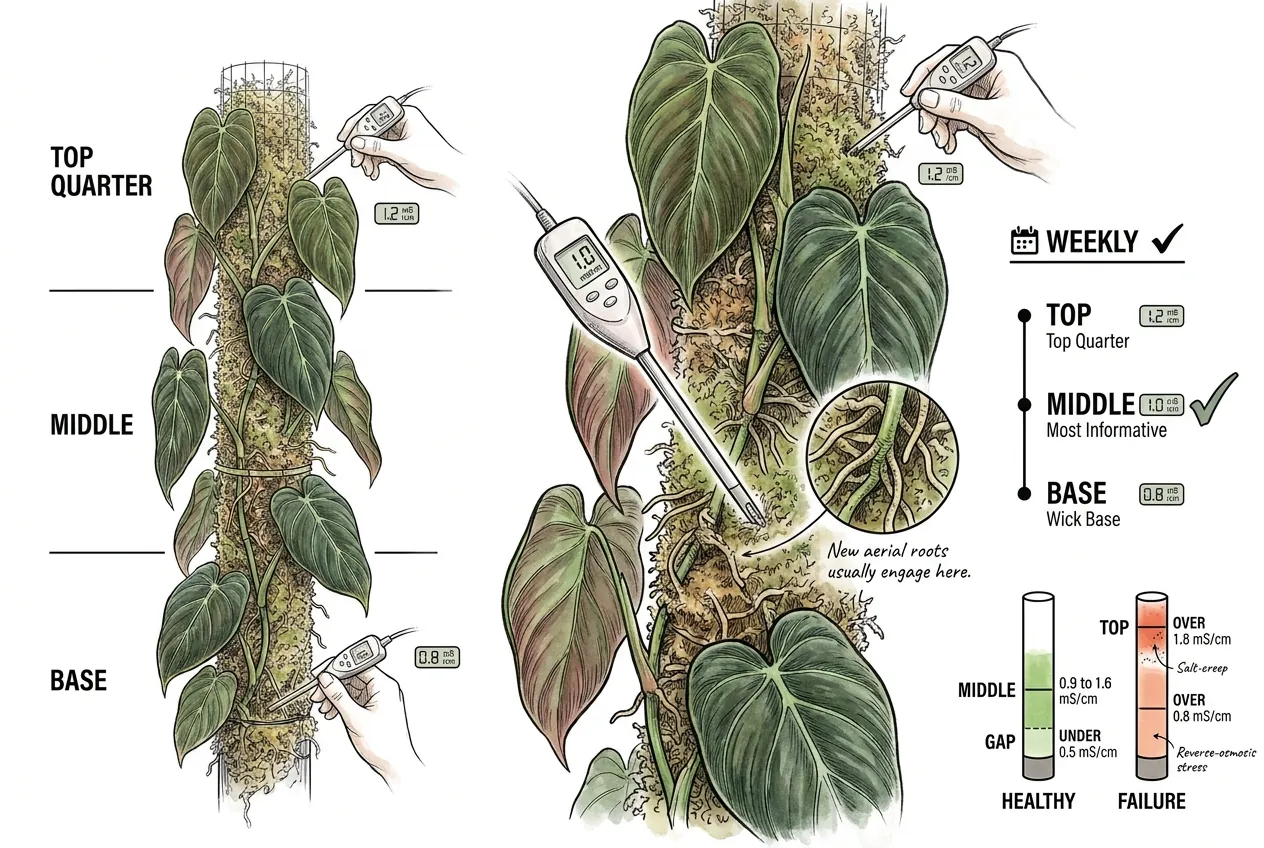
This is the part most hobbyist write-ups get wrong, and it matters. A handheld EC pen measures the conductivity of a liquid.
Pushing it into damp moss or coir does not give a meaningful, repeatable substrate EC, because the reading depends on how wet the material is, how well the electrode contacts water, temperature, and sample volume. None of which are controlled.
With dry LECA there is effectively no solution to read at all, so near zero is not a valid measurement.
To get comparable numbers, extract the pore water with a defined method and read that liquid.
Common approaches are the pour-through (pass a measured volume of water through the root zone and test the leachate) and fixed-dilution extracts such as 1/1 or 1/2 or a saturated-media extract.
These are described in nursery extension guides (for example NC State's pour-through procedure and University of Maryland's comparison of methods).
Each method reads on a different scale, so pick one, keep it consistent, and interpret it against that method's own reference ranges rather than mixing methods or comparing against numbers taken a different way.
Sample at the same time after watering and compare the pole’s top with its base. No validated pole-specific EC cutoff exists for P. melanochrysum. A rising trend or widening top-to-base gap is a prompt to flush and inspect roots, not a diagnosis on its own.
How Does Sphagnum Behave on a Climbing Pole?
Of the three, sphagnum has the highest cation-exchange capacity. That means it soaks up feed cations strongly at first, and (because it holds so much) it can also carry the most accumulated salt if it is fed for a long time without a flush.
The chemistry behind both behaviors is the same. The cell walls carry uronic-acid groups, concentrated in an anionic polymer (sphagnan) in the hyaline cells.
These deprotonated weak-acid groups give sphagnum its exchange capacity. In a bog, this lets the moss take up cations from rainwater and acidify its surroundings.
On a pole receiving regular fertilizer, sphagnum exchanges cations with the feed and can lower base saturation of some ions while raising others. It does not simply trap every weekly dose of salt whole and then release it, because it exchanges cations and does not hold the fertilizer anions the same way.
What Salt Build-Up Looks Like on Sphagnum
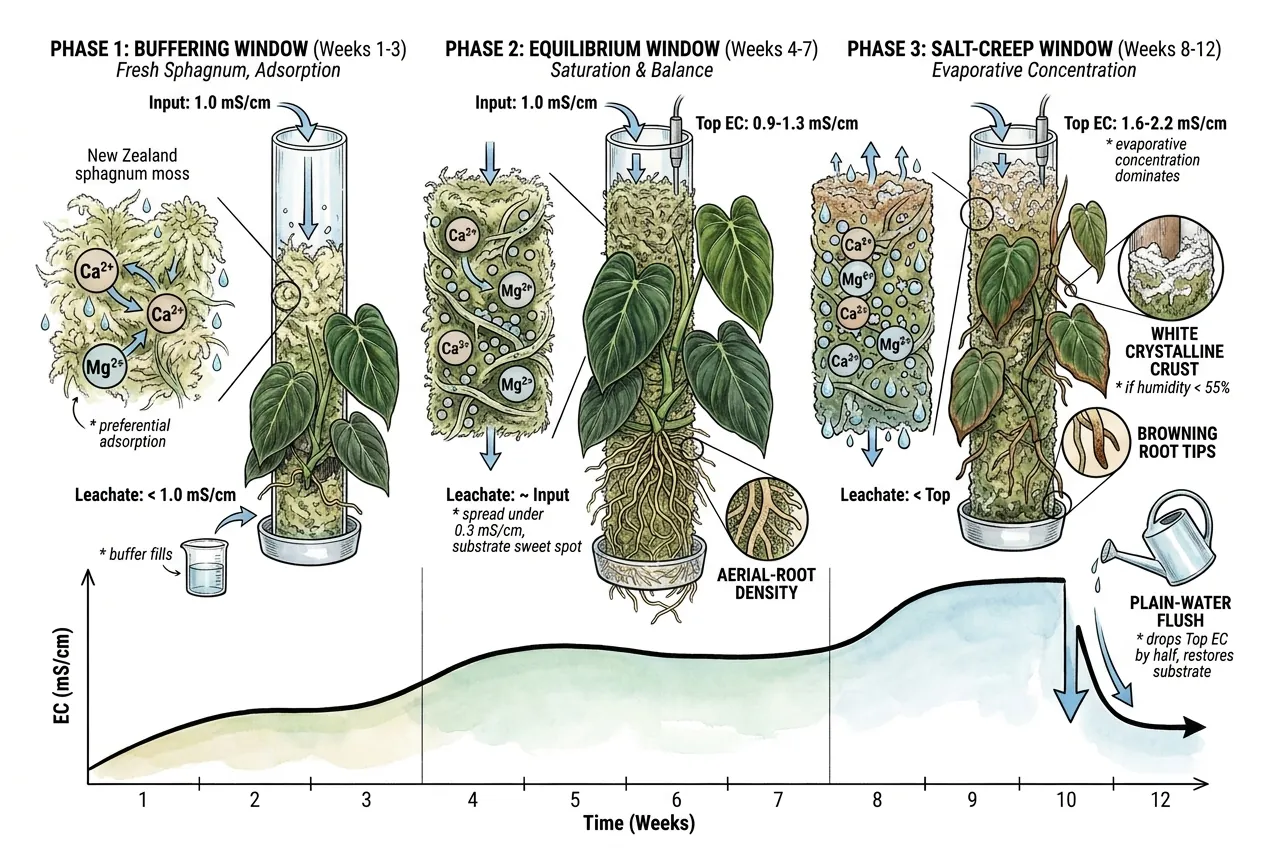
Sphagnum can hold and exchange nutrient salts at first, then concentrate them near the top if it is repeatedly fed and never flushed. The rate depends on water and fertilizer, so follow the pole’s actual trend rather than a calendar curve.
Early (cation uptake)
Fresh, clean sphagnum rehydrated in low-EC water starts low. Under the first feeds, the moss takes up cations such as Ca²⁺ and Mg²⁺, so leachate at the base can read below the input while the exchange sites are being loaded.
Middle (closer to equilibrium)
As the exchange sites fill, readings through the pole track the feed more closely and the top-to-base difference tends to be smaller. This is usually the most stable period.
Later (build-up if unflushed)
Later, evaporative concentration can raise EC at the top of an unflushed pole. Brown aerial-root tips or a faint crystalline crust are prompts to test and flush, not proof of a specific EC value.
A plain-water flush at this point rinses soluble salts out of the top of the pole and lowers the reading.
It moves the equilibrium back toward the start of a cycle rather than fully resetting the substrate. How much it helps depends on how much you flush and how well it drains.
NZ AAA vs Chilean (does the grade matter?)
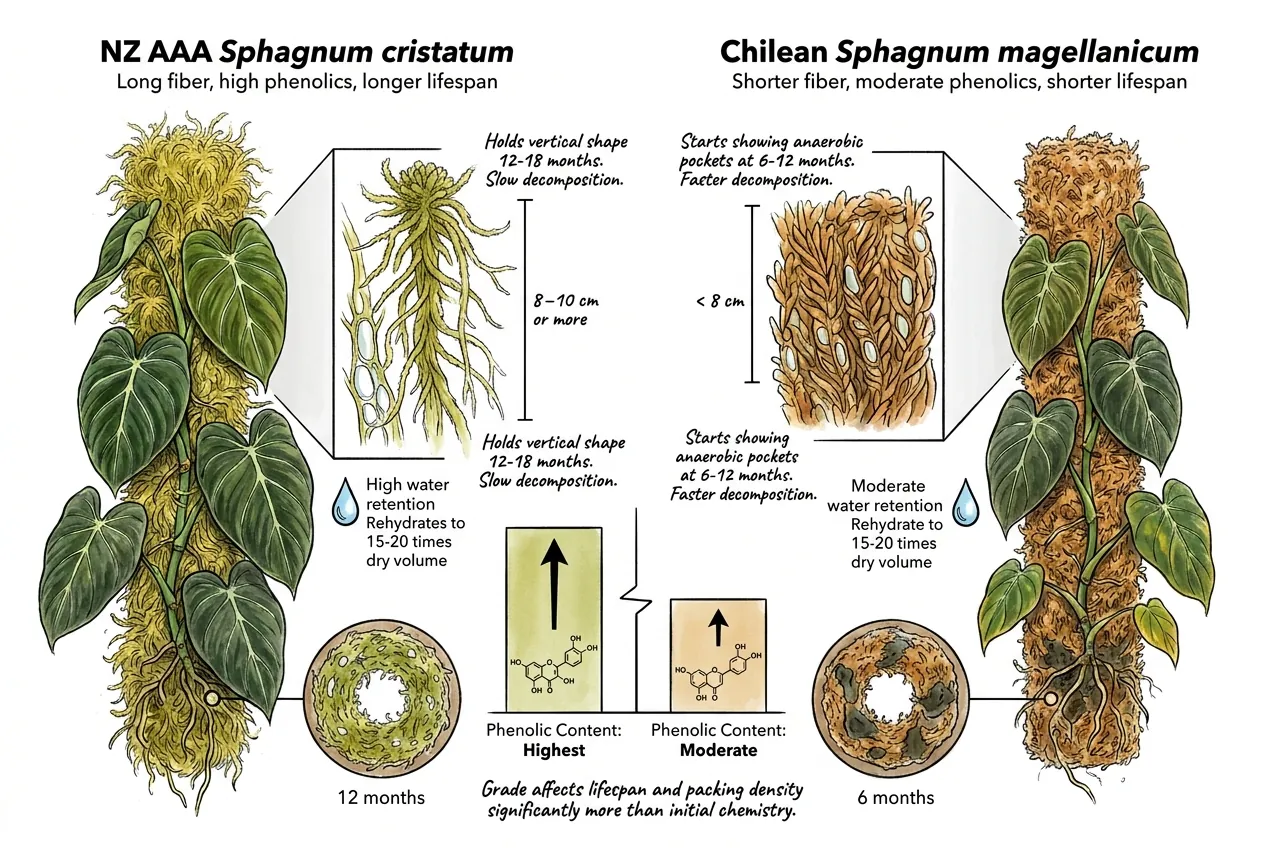
Grade mainly affects structure and packing. Per Besgrow's own comparison, New Zealand sphagnum comes in longer, more robust strands, while Chilean sphagnum is shorter-fiber and denser.
Both rehydrate to several times their dry volume.
Longer strands tend to hold a vertical pole’s shape better, while denser grades can compact sooner. Judge refresh by structure, smell, and drainage rather than a fixed number of months.
What sphagnum do experienced growers actually buy?
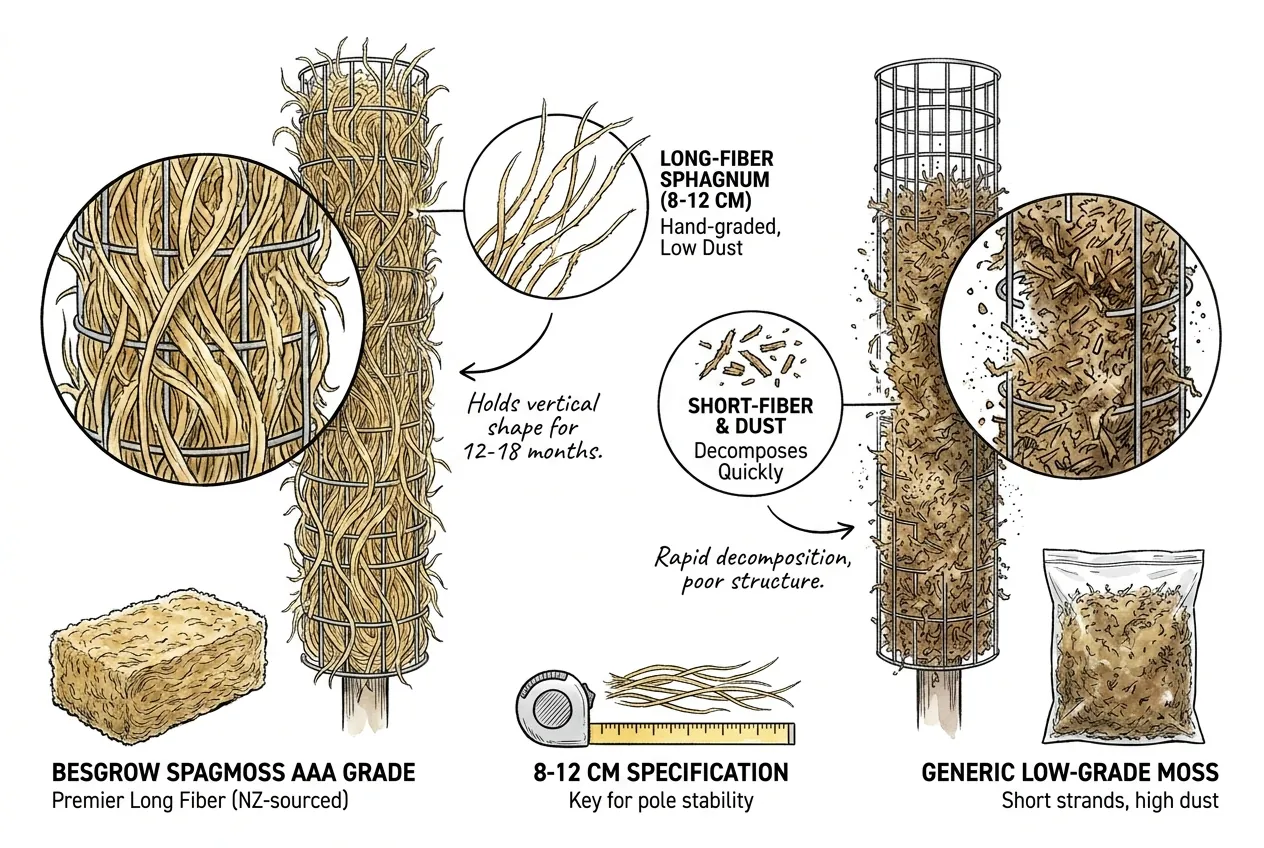
For packing a pole, the specs that matter most are fiber length and freedom from dust. A practical screen is long strands, a low-dust grade, a pale-straw to gold color, and no musty or sulfurous smell.
Strand length and smell are useful buying cues, not a full guarantee of quality or cleanliness on their own.
A genuine long-strand, hand-graded New Zealand moss is a reasonable candidate for pole packing. The Besgrow comparison cited below supports the relative strand difference between its New Zealand and Chilean grades, but it does not establish one universal strand length or dry-to-expanded-volume conversion for every pack. Size a purchase from the exact grade and expanded yield on its package.
Independent tests also do not establish how many months it will keep its structure on a pole or support antimicrobial-longevity claims. If you are weighing options, you can choose a moss pole by fiber and substrate type.
Use case
Rehydrate in low-EC water, squeeze-drain, and pack into the mesh sleeve at fingertip-firm density (not compressed flat).
Flush with plain water when your readings and the plant tell you to, and refresh the top third when the moss starts to compact or smell rather than on a fixed date.
Honest tradeoff
Compare moss by delivered price per measured expanded volume, strand quality, contaminants, and how long it retains useful structure in your own pole. A premium label does not establish better value or a longer service interval.
Mystery of Sphagnum Moss. St. Augustine Orchid Society (Sue Bottom)
Difference between New Zealand, Chinese, and Sphagnum moss. Besgrow
The Perfect DIY Moss Pole in Minutes – No Experience Needed!
How Does Buffered Coco Coir Behave on a Pole?
Coco coir is often the more forgiving organic option of the three for an irregular schedule.
Its cation-exchange capacity is generally lower than sphagnum's, so it tends to drift more gently, though reported CEC ranges for the two overlap depending on the material and how it is measured, so treat this as a tendency rather than a hard rule.
The important caveat is source-water and processing chemistry. Unwashed, unbuffered coir can carry high sodium, potassium, and chloride, and a peer-reviewed review documents that washing and calcium buffering reduce exchangeable Na and K. That does not mean every raw bag is unusable, batch, washing, feed, and the plant's sensitivity all matter, but for a long-lived pole it is worth buying pre-buffered coir or buffering it yourself.
Vendor figures put coir CEC in roughly the 10 to 30 meq per 100 g range. Other extension and review values vary with the material and method.
Coconut husk is often processed near coasts, so raw coir can be loaded with Na⁺ and K⁺ at the exchange sites, which is why washing and calcium buffering are standard steps before horticultural use.
Buffering works by competitive ion exchange (calcium displaces some of the sodium and potassium) and how the coir behaves afterward still depends on your feed and water.
Why buffer coir before pole use?
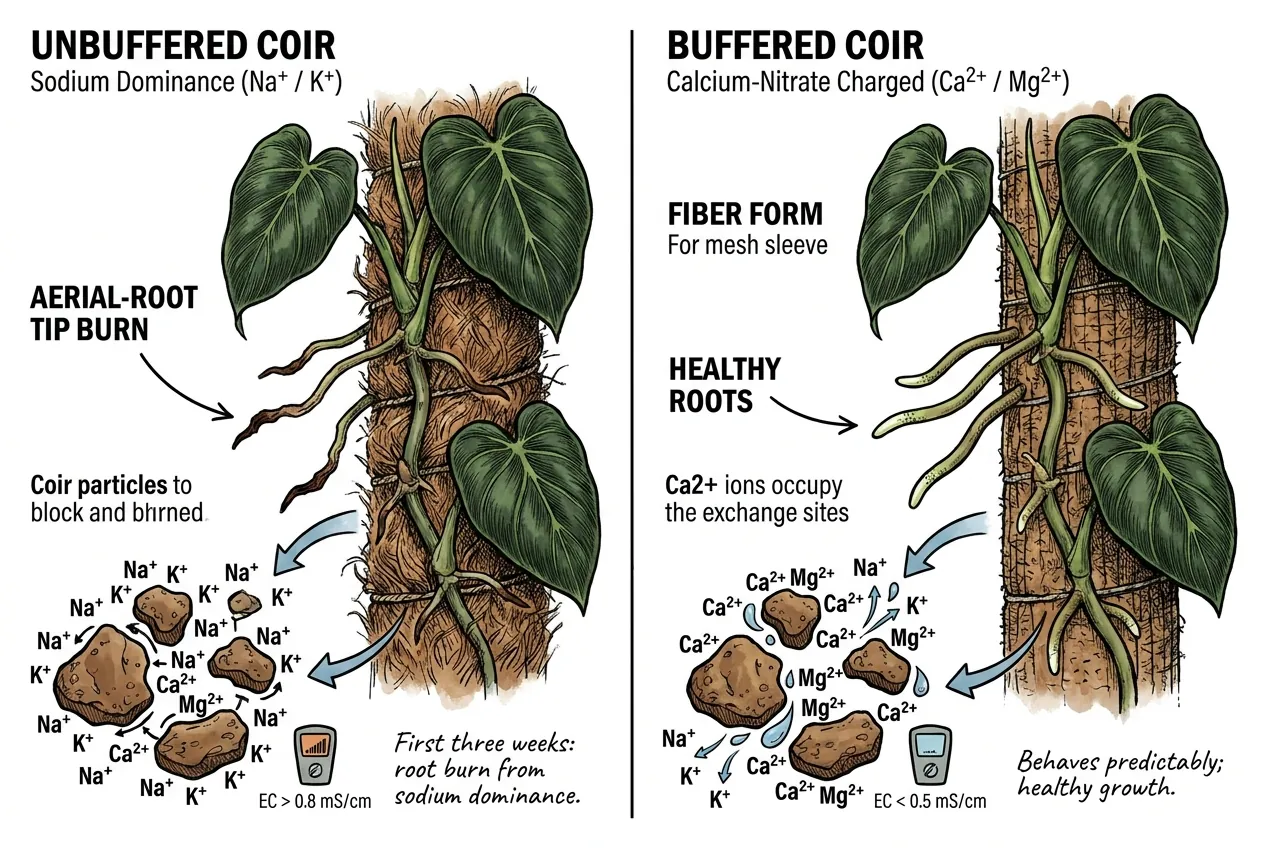
Reputable suppliers wash coir in fresh water, then buffer it with a calcium solution that displaces much of the residual sodium and potassium from exchange sites. A well-buffered product starts lower in EC and behaves more predictably. Unbuffered coir can contribute to aerial-root and leaf-tip symptoms, but timing depends on the batch, water, and feed.
When buying, look for coir explicitly labeled buffered or Ca/Mg charged, and check the stated EC on the label or a posted analysis.
Note that pre-rinsed is not the same as buffered. Rinsing lowers soluble salts but does not do the calcium exchange.
Fiber form (rather than fine pith or chips) generally packs a mesh sleeve better.
What Salt Drift Looks Like on Coir
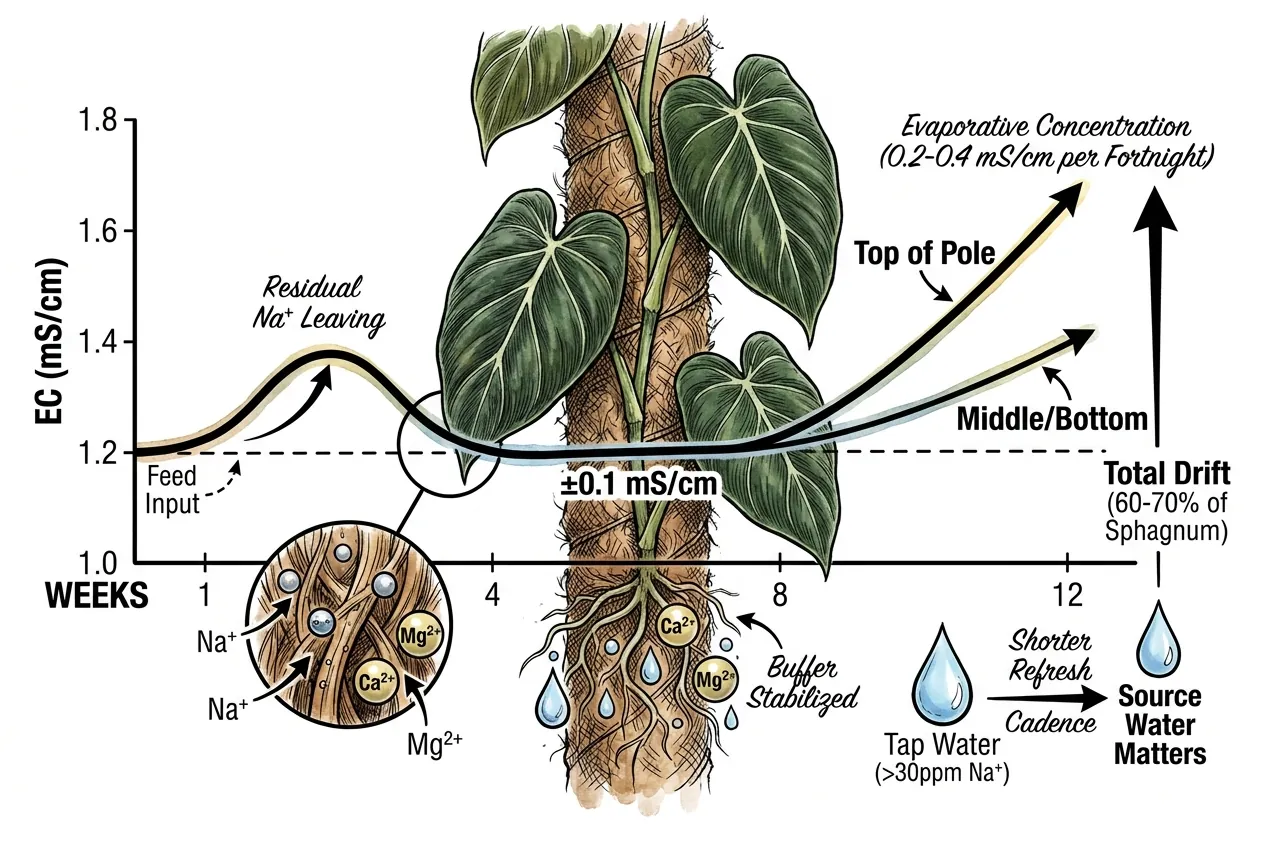
Qualitatively, buffered coir tends to drift more gently than sphagnum on the same feed. Early on, the buffer keeps exchanging residual Na⁺ for incoming Ca²⁺ and Mg²⁺, so leachate can briefly run a little above the feed input as displaced sodium leaves.
As the pole is fed, readings may track the feed more closely. Without a flush, evaporation can still raise the top-of-pole reading over time. Use your own extracted samples to decide when to flush rather than a per-week expectation.
Source water matters more for coir than sphagnum. If your tap water carries elevated sodium, buffered coir has less capacity to keep masking it, so it can accumulate and shorten how often you need to refresh.
Sodium held on the exchange sites is not permanently locked in (it can be displaced again by calcium buffering or leached by flushing) but relying on that is less reliable than starting with clean water and buffered coir.
If in doubt, get a lab analysis of your water.
Which coir product should you buy?
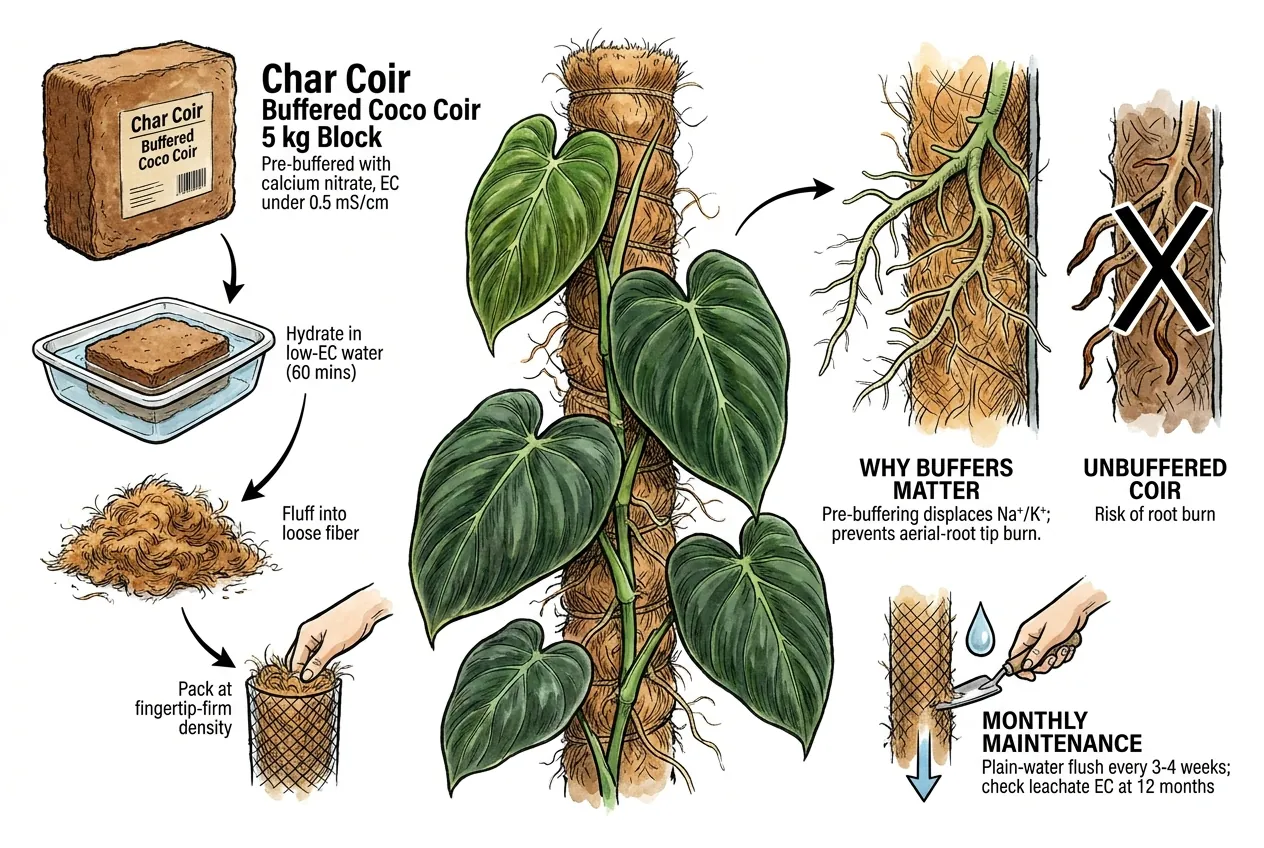
Look for coir that is buffered or Ca/Mg charged and has a low, documented starting EC. Coir is sold both as compressed blocks and as ready-to-use loose fill. Blocks are usually cheaper per liter but need hydrating, while loose fill is more convenient.
Exactly how much you get from a given package depends on its form, so check the volume on the listing.
Buffered, RHP-certified loose-fill coir
Look for a loose-fill coir with documented processing and quality controls appropriate to your use, such as buffering, washing, pH stabilization, and an independent substrate standard.
Compare the exact batch or product EC and pH using the stated extraction method. Figures produced by different media-to-water ratios and test methods are not directly interchangeable, so do not treat one supplier’s low result as the ceiling for every bag.
Use case
Loose-fill coir does not need the expansion soak required by a compressed block, though it may still need moistening before packing. Hydrate as needed in low-EC water, fluff, and pack it into the mesh sleeve at fingertip-firm density.
Flush with plain water when your readings and the plant call for it, and check leachate EC periodically. A steady climb above your input feed is a sign the coir is loading up and the pole may need repacking.
RHP certification is a quality signal for consistency. It does not by itself prove wicking or attachment performance on a tall pole.
Honest tradeoff
Coir is generally cheaper than premium sphagnum per liter of expanded volume, but its buffered capacity is finite.
If your tap water is very hard or high in sodium, or you are not willing to measure EC at all, coir's advantage shrinks and sphagnum on a more frequent refresh may suit you better.
Coco Coir as a Medium-CEC Substrate. HortGrow Solutions
Buffering Coco Coir with Calcium Nitrate
How Does LECA Behave on a Pole?
LECA's appeal is a relatively flat salt profile, because it has very low cation-exchange capacity. What you feed is close to what the roots see.
It is fired clay, expanded at roughly 1,200 °C until each pellet becomes a porous sphere with a dense outer shell. Close to inert is not the same as perfectly inert, though. Properties vary between products, and studies show expanded clay can sorb some phosphate and metal ions, so it is not a guarantee of zero chemistry.
Compared with organic substrates, LECA has less buffering and salt build-up. Its main challenge is hydrology. A coarse aggregate column may stay dry near the top. Wicking distance depends on pellet size, packing, and wetting, so a tall pole often needs top-watering or an internal wick.
Why is the wicking limit such a big deal?
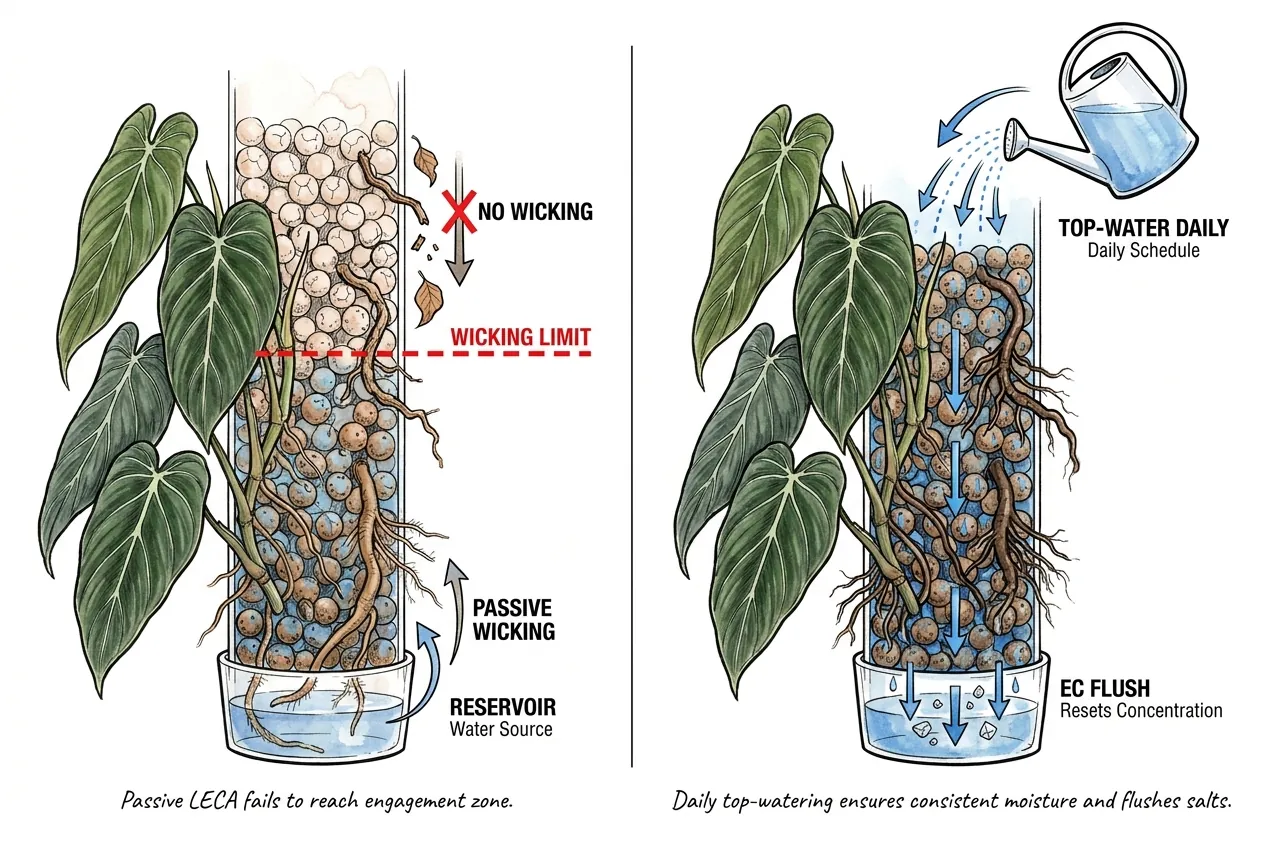
Because passive rise is limited, a LECA pole usually needs help getting water to the aerial-root zone near the top. Either a top-watering routine, or a wick insert running from the reservoir up the inside of the pole.
How often you need to water depends on the water volume, drainage, room humidity, and the plant's demand, so treat water frequently as the principle rather than a fixed daily prescription.
Top-watering also tends to help the salt profile. When water drains through, each irrigation acts as a partial flush of whatever concentrated near the top.
How much it flushes depends on how much you apply and how much drains, so it evens out drift rather than magically holding EC perfectly flat.
Keep the Upper LECA Zone Wet
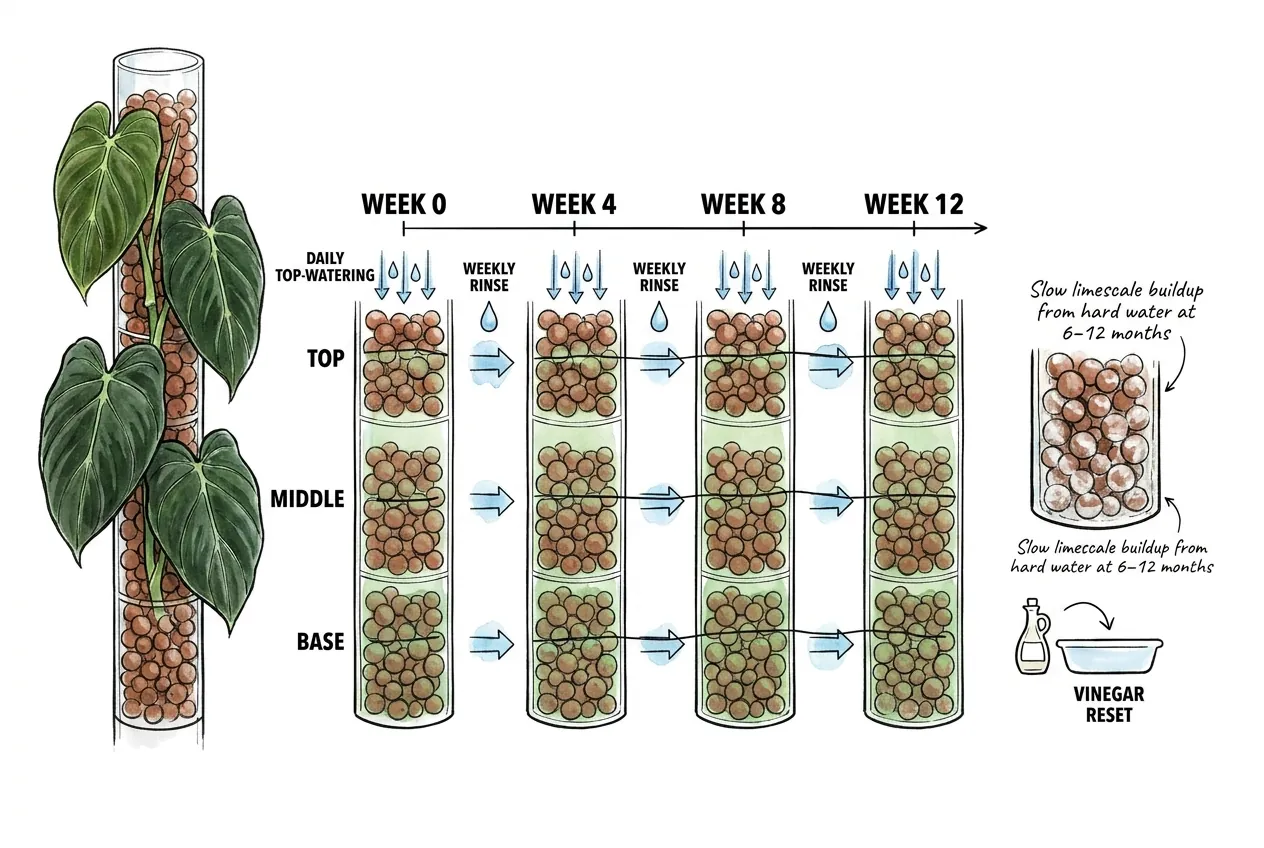
With regular top-watering that drains through, readings at the top, middle, and base tend to stay close to the bulk feed.
A periodic plain-water rinse clears minor build-up near the top back toward the feed baseline.
Over longer periods, hard tap water can leave limescale (calcium carbonate) on the pellets.
A faint chalky crust is a sign a clean-and-reset is due, but do not treat it as the only maintenance signal. Biofilm, algae, root debris, and dust are worth checking too.
A vinegar soak can dissolve scale, but only with attention to dilution, contact time, removing the plant, material compatibility, and a thorough rinse afterward.
How does LECA affect aerial-root attachment and leaf size?
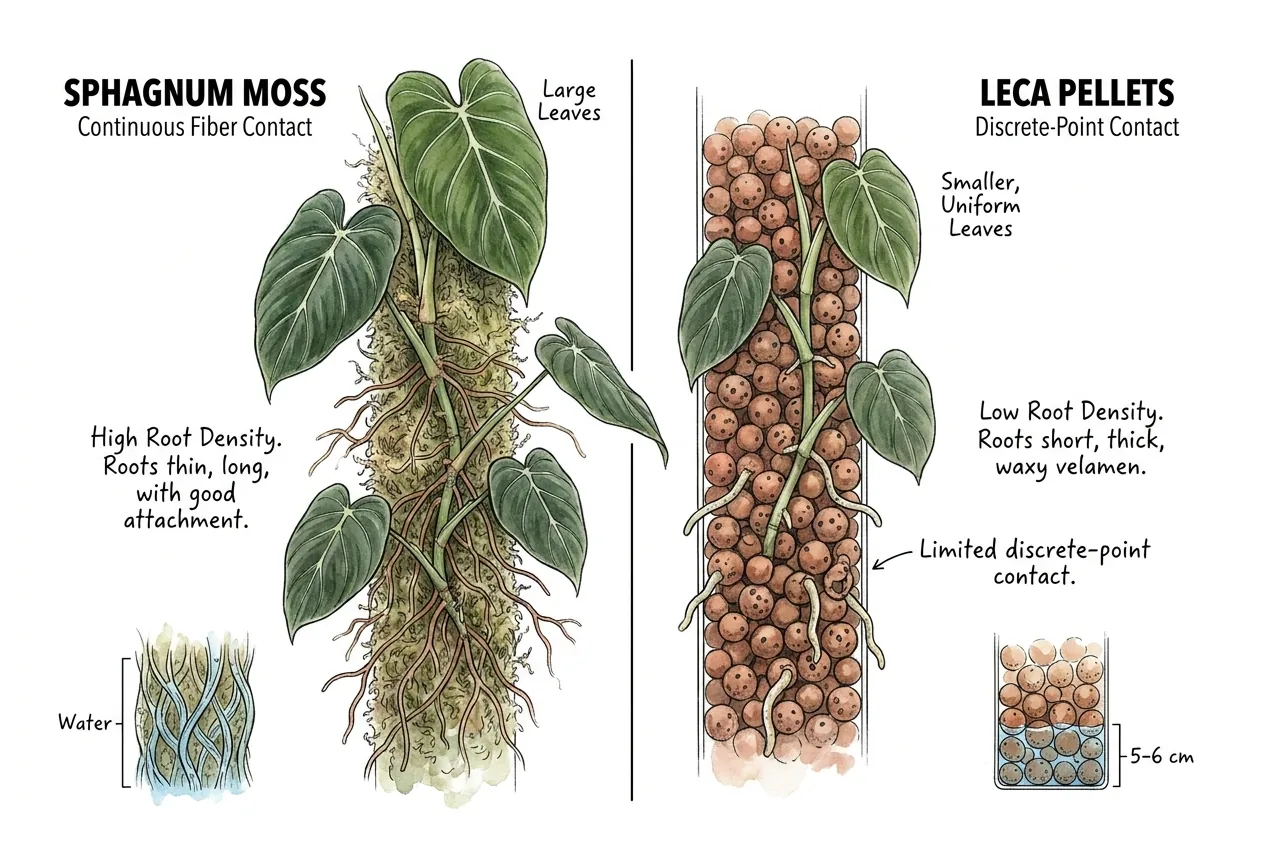
There may be a biological tradeoff for LECA's chemical stability. Aroid aerial roots do well on fibrous, rough, continuously damp surfaces, and the attachment review notes that host texture influences attachment, so smooth LECA pellets, which offer discrete-point rather than continuous-fiber contact, could plausibly support less aerial rooting.
Light, humidity, contact area, and feeding all affect aerial-root density and leaf size, so no percentage penalty can be assigned to LECA. Choose a fibrous surface for the strongest attachment, or choose LECA with reliable top-watering when a flatter salt profile matters more.
Expanded clay aggregate. Wikipedia
Choose the Substrate You Can Monitor
Buffered coco coir is a practical default for many home growers because it combines fibrous root contact with a more forgiving watering rhythm. This is a maintenance-based choice, not a proven growth ranking. The table summarizes qualitative differences.
Compare Failure Modes, Not a 12-Week Winner
These are qualitative tendencies, not measured outcomes from a controlled trial. Your own values will depend on your water, feed, pole size, and room.
| Property | NZ Sphagnum | Buffered Coco Coir | LECA (with top-watering) |
|---|---|---|---|
| Cation-exchange capacity | Highest | Lower (ranges overlap) | Very low |
| Starting EC (clean, rehydrated) | Low | Low, typically a little higher than fresh sphagnum | Very low |
| Salt-drift tendency if unflushed | Can build up the most late in a cycle | Generally gentler drift | Flattest, since top-watering flushes as it drains |
| Aerial-root attachment | Strong (fibrous surface) | Strong (fibrous surface) | Likely less (discrete-point contact), not quantified here |
| Main watering demand | Keep moist. Flush periodically | Keep moist. Flush periodically | Needs frequent top-water or an internal wick |
| Refresh trigger | Rising EC, compaction, or musty smell | Rising EC or loss of structure | Scale/biofilm build-up. Rinse and reset |
| Failure mode to watch | Salt build-up if never flushed | Sodium accumulation from hard tap water | Top-of-pole dry-out if watering lapses |
Which grower profile maps to which substrate?

Hands-on, frequent attention
Sphagnum suits you well. Its high exchange capacity is an asset when you flush on a regular schedule, and its fibrous surface supports strong aerial rooting.
Keep it moist, flush with plain water on a routine you can stick to, and refresh the top third when it starts to compact or smell.
Weekly routine, average attention
Buffered coco coir is a good fit. It generally tolerates a missed watering better and drifts more gently, which suits a realistic weekly rhythm.
Away often, wants automation
LECA with a drip or top-water schedule can work, in exchange for a flatter salt profile and an easy reset.
Plan for the automation itself, though. Reservoirs run dry, pumps and drippers clog, and lines can leak or lose power, so build in a fail-safe rather than assuming it is truly set-and-forget.
What is the minimum monitoring kit?
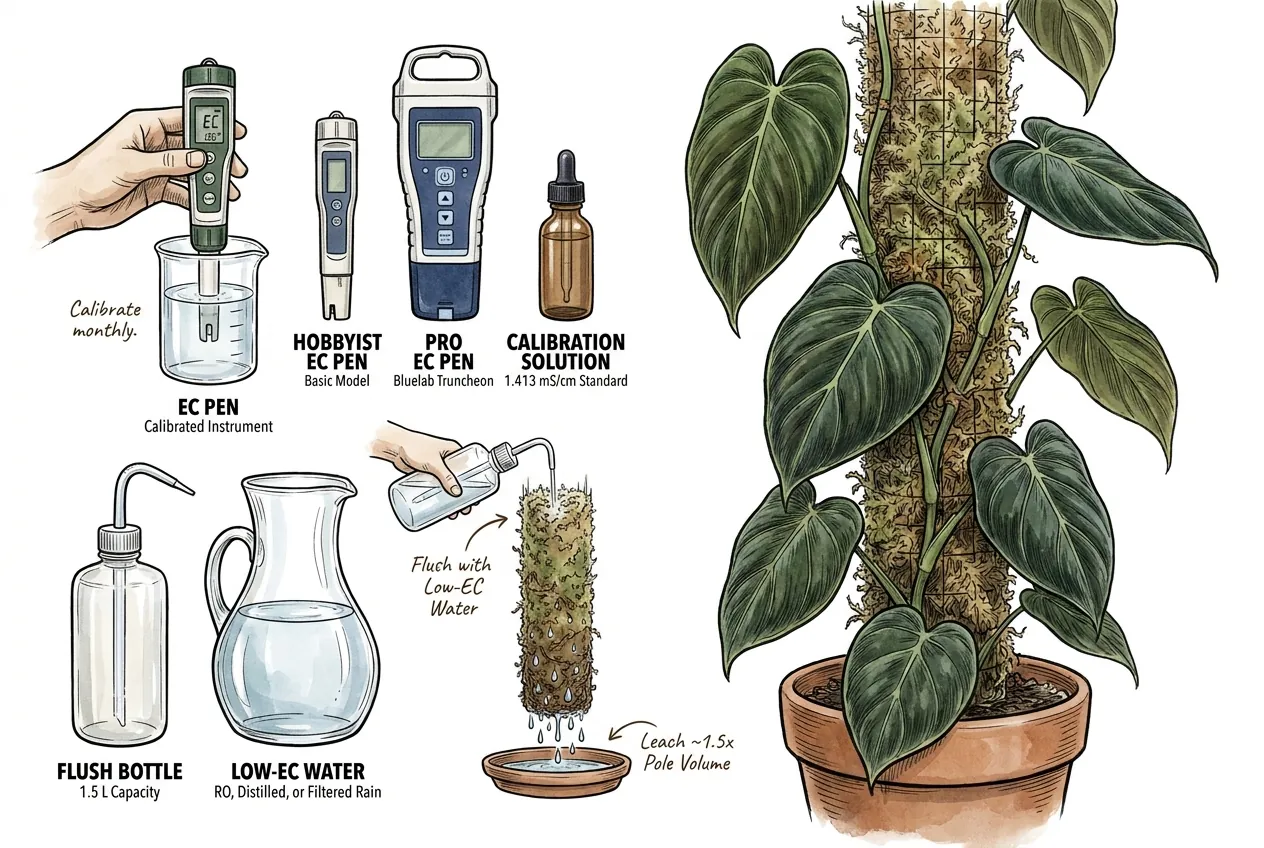
If you want to monitor salts instead of guessing, an EC meter is the core tool. Basic screen pens are inexpensive. Longer LED-scale meters read a fixed scale instead of a display. Display format does not determine the specs that matter, so match the meter to the water and extracts you intend to test. Check its measurement range and resolution (a typical hobby meter covers roughly 0.2 to 3.6 EC at about 0.1 resolution) and how it behaves in very dilute samples. Many meters will not read, or even power on, in near-pure water below their range, so a blank result on RO or distilled water is a range limit, not a zero.
Whichever you buy, use it with a defined extraction method above. Do not push it into the substrate.
Follow your meter’s own manual for calibration or accuracy checks. The required solution, cleaning routine, and whether you can recalibrate it vary by model. Use only the solution and procedure specified for the meter you chose.
For flushing, use low-EC water (RO, distilled, or filtered rain). How much to apply per flush depends on your pole's size and how much water it holds, so aim to wet it through and get clear drainage rather than following a fixed liter count.
For routine irrigation, container-nursery extension work uses a leaching fraction, the share of each watering that drains out, as a management tool.
A managed range of about 15 to 30 percent is common, but the target is not one-size-fits-all. Virginia Tech ties it to the applied-water EC (for example roughly 0.10 at low EC, 0.20 around 1.5, 0.30 above 2.0) and to the crop, substrate, weather, and system.
Treat it as a starting point to adjust, not a fixed pole standard.
Leaching Fraction. A Tool to Schedule Irrigation for Container-Grown Nursery Crops. Virginia Tech VCE
Dealing with salty irrigation water. e-GRO 2018
How do I troubleshoot a stalled melanochrysum on a climbing pole?
A stalled melanochrysum has many possible causes (light, temperature, root-zone pH, fertilizer balance, root disease, pests, recent repotting, pot or root problems, physical damage, genetics, and normal seasonal slowdown among them).
Substrate and salt problems are just three of those, so rule out the common environmental and cultural causes too rather than assuming it must be one of the three below.
Reading the aerial-root tips and doing a proper EC extraction helps you check whether the substrate is part of the story.
Is it salt creep on sphagnum or coir?
What to look for
Brown, recessed aerial-root tips, and often a faint white crust at the pole top. Confirm with an extracted EC reading rather than the symptoms alone. Browning and crust are not specific to salt, and a high extract EC (interpreted against your extraction method) is what actually points to soluble-salt excess, ideally with the top reading higher than the base.
How to fix
Run a slow flush of low-EC water from the top until it drains freely, using enough to wet the pole through.
Let it drain fully, then re-extract and re-read. A clear drop indicates the flush moved salts out. How much it falls depends on how much you flushed.
Why it works
The flush rinses soluble salts out of the water phase and shifts the exchange equilibrium back toward its starting point.
It lowers the soluble load but does not undo structural breakdown of the substrate.
Is it dry-out on LECA?
What to look for
Aerial-root tips intact but pale and slightly shrunken, and often a visibly dry zone at the upper third of the pole.
Note that you cannot read EC off dry aggregate, if there is no solution to sample, a near zero reading is a sign of dryness, not a real EC measurement.
Judge this one mainly by touch and by the dry zone.
How to fix
Move to a daily top-water schedule, or install a polyester wick from the reservoir to the upper pole interior, or convert to a hybrid bottom-LECA / top-sphagnum stack.
Why it works
LECA’s short passive-wicking range cannot keep tall pole tops moist on its own. Daily top-water or a wick insert solves the hydrology problem the substrate cannot solve passively.
Is it substrate decomposition?
What to look for
A sulfide or musty odor, dark sludgy moss when squeezed, and compacted coir that no longer holds air are warning signs of anaerobic breakdown at the pole base.
Smell alone is not a diagnosis, though. Also check for standing water and possible root disease, since those can produce similar signs.
How to fix
Refresh the affected section (top third, or a full repack depending on extent) with fresh substrate.
There is no universal calendar for this, how fast a substrate breaks down depends on grade, climate, packing, and hygiene, so check by feel and smell rather than by a fixed number of months.
Why it works
When organic substrate collapses, it loses aeration and can create low-oxygen zones around the aerial roots, independent of salt chemistry.
Flushing rinses salts but cannot rebuild structure, so a badly decomposed section needs replacing.
How to Flush Salt Buildup from Potted Plants. LiveToPlant
What is the bottom line for choosing a Philodendron melanochrysum climbing-pole substrate?
For many home growers with a single melanochrysum and average attention, buffered coco coir is a forgiving default.
It offers much of sphagnum's benefit while generally tolerating an irregular schedule better. A reasonable recommendation based on how these materials behave, not a head-to-head measured result.
If you enjoy flushing on a schedule, sphagnum's strong buffering and fibrous surface are a good match.
If you travel or want automation, LECA with reliable top-watering (and a fail-safe on the automation) trades some aerial-root attachment for a flatter salt profile and an easy reset.
The most useful way to think about the choice is by failure mode. Sphagnum's main risk is salt build-up if it is never flushed, coir's is sodium accumulation from hard water, and LECA's is dry-out near the top.
Those are not the only ways a pole can go wrong (dryness, low oxygen, disease, and nutrient problems can overlap on any substrate) but picking the failure mode you are best equipped to notice, and measuring EC with a defined method, gives you a realistic way to keep a pole healthy.