
Anthurium Warocqueanum Pollen Maturity: Reading the Spadix
How to read Anthurium warocqueanum pollen maturity on the spadix. Timing pollen collection, stigmatic receptivity, and the Queen Anthurium cross, with the limits of what is actually documented.
Priya Patel · Published 2026-06-03 · 17 min read
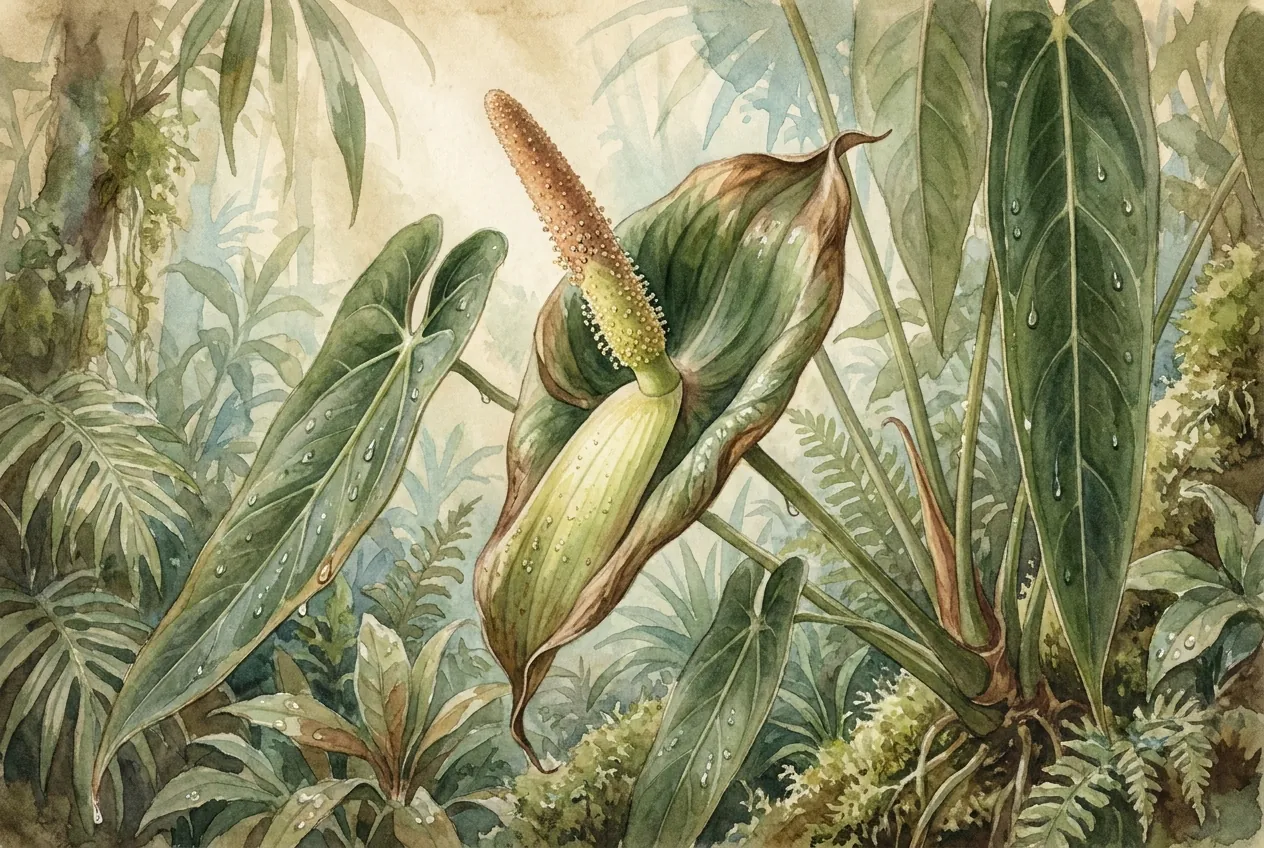
What does protogyny mean on a single spadix?
Read the Flowering Sequence
Anthurium warocqueanum is protogynous. The same spadix becomes female-receptive first and sheds pollen later.
There is no reliable day count for this species, so watch the spadix instead of working from a calendar.
The inflorescence has two parts. The spadix is the spike of hundreds of tiny bisexual flowers densely packed around a fleshy axis.
The spathe is the leaf-like bract behind it, which on warocqueanum stays narrow and green.
Every flower on the spadix carries both stigmas and stamens, but the protogynous schedule keeps them functionally separated in time.
I divide the spadix into lower, middle, and upper zones on a photograph and record stigmatic fluid, color change, and pollen appearance for each zone. The whole inflorescence rarely changes as one perfectly synchronized surface.
Each pollen application adds a mark to the zone where I placed it. If berries form unevenly, the map preserves timing information that a single pollinated date cannot.
Why the protogyny matters for breeders
Because of protogyny, a single spadix rarely self-pollinates within one flowering. By the time it sheds its own pollen, its own stigmas have usually passed peak receptivity.
That timing separation reduces self-pollination on the same inflorescence, but it is not an absolute mechanical barrier, and it does not mean the plant is self-incompatible.
A. warocqueanum self-pollinated offspring have in fact been reported in the karyotype literature, so a clone can set seed with its own pollen if a later inflorescence or stored pollen bridges the phase gap.
In practice, the easiest reliable route is still to outcross. Use pollen from a second plant whose spadix is in staminate phase while your recipient’s spadix is in female-receptive phase.
Outcrossing is preferred here for genetic diversity, not because selfing is impossible.
How long does each phase last?
The phases can last several days and receptivity typically moves from the base toward the tip. Record the visual cues on your own plant, because temperature and humidity can change the timing.
What does the spadix change actually look like?
Use Physical Cues Before Color
Watch the spadix, not the spathe. A glistening, sometimes beaded surface signals the female phase. Visible pollen powder signals the male phase. Color is only a supporting clue.
During early female phase the spadix typically sits pale-green to cream, often fairly uniform, with the stigmas glistening and sometimes carrying a clear droplet.
As the staminate phase opens, some growers report a yellow-cream cast spreading across the column as pollen appears.
Confirm the phase by the presence of stigmatic exudate or shed pollen, not by colour alone.
What does a receptive female-phase spadix look like?
The receptive spadix is pale green to cream, with no visible powder anywhere on its surface.
Hold a hand loupe close to the spadix and you should see the stigmatic surface glistening, and often tiny beaded droplets on individual pistils.
A loupe helps confirm the wet, beaded texture. It will not let you reliably score individual grains.
A clean fingertip will feel tacky on a receptive spadix. Touch lightly and use a clean, dry finger so you do not contaminate or damage the surface.
What does a staminate (pollen-shedding) spadix look like?
The staminate spadix may carry a faint yellow-cream cast that was not there a day or two earlier, and under a loupe individual staminate florets can show pale dust on their surfaces.
Visible pollen is the direct cue. The colour cast is a softer one.
Tap the spadix lightly over black card or dark paper. A fine cream powder confirms that pollen is shedding.
Why watch the spadix, not the calendar?
The plant’s own state tells you the pollination phase more reliably than a date counted from when the spathe opened.
If the green-to-yellow colour shift is easy to spot on your plants, use it as a memory aid, but confirm with physical cues. Look for stigmatic exudate during the female phase and visible powder on a black card during the male phase.
When should I collect pollen?
Collect When Powder Is Visible
Collect pollen as soon as fresh cream powder appears on a black card, then use it as soon as practical. Do not rely on a fixed number of hours or days.
How do I run the tap test?
Hold a piece of black paper or a clean black card about 5 cm under the spadix. Gently tap the spathe or the peduncle once or twice.
If pollen is shedding, a fine cream-yellow powder will visibly fall onto the card. No powder means either the staminate window has not opened yet or it has already closed.
Repeat the test daily during the watch period. Twice daily if the spadix has begun to fade.
What is the cleanest collection method?
Catch the falling powder onto a clean piece of paper, then transfer with a fine size 0 brush directly into a clean 1-2 dram borosilicate vial.
Do not collect by scraping the brush across the spadix (that picks up wax, micro-bracts, and mixes non-pollen tissue into the dose). Tap-and-catch is cleaner and preserves grain integrity.
A clean, dry, fine-tipped brush works whether it is natural hair or synthetic. Use a separate clean brush per donor to avoid mixing pollen.
Why does the timing window matter so much?
Humidity can affect when pollen releases, but there is no reliable humidity setting that opens a Queen Anthurium spadix. Look for shed pollen instead of changing the enclosure to chase a number.
When is the recipient stigma actually receptive?
Confirm a Wet, Sticky Surface
The recipient stigma is receptive when it shows a glistening, sticky stigmatic surface, often with a beaded droplet, that you can confirm under a loupe and feel as tackiness on a clean fingertip.
UF/IFAS describes the signal as a glistening shine of stigmatic surfaces and stickiness to the touch, noting droplets appear sometimes rather than always.
Rely on the shine and stickiness. A visible droplet is a strong positive cue, but its absence on a given pistil does not by itself prove the spadix is non-receptive.
How do I confirm receptivity?
Look first with the naked eye for a wet, slightly glistening texture across the spadix. Then move to a loupe and check whether individual pistils look shiny and sometimes beaded.
Finally, touch a clean, dry fingertip briefly to the spadix. Receptive stigmas feel tacky and leave a faint moisture trace.
Because receptivity progresses from the base of the spadix toward the tip, apply pollen while the surface is visibly wet and sticky, and re-apply over several days to catch flowers as they become receptive. There is no established rule that a fixed fraction of the spadix must be wet before you start.
How many mornings should I re-apply?
Re-apply on several days while the stigmatic surface stays wet and sticky. UF/IFAS recommends pollinating more than once for maximum seed set. It does not specify a fixed number of consecutive mornings, so a rough three-to-five-day span is a practical habit rather than a sourced figure.
Each application catches a slightly different cohort of pistils as receptivity advances from the base of the spadix toward the tip.
Many growers work in the morning for convenience and because household humidity is often higher then, but the deciding factor is the visible wet-stigma cue, not the clock.
What window am I working in?
Receptivity can move along the spadix over several days. Apply pollen whenever you see stigmatic fluid, rather than waiting for a humidity target or a particular time of day.
Which environmental drivers shift the window?
Environmental Variables That May Shift the Window
Humidity, temperature, and airflow can change the timing. Keep conditions stable, avoid strong fan flow during collection, and respond to the wet-stigma and visible-pollen cues rather than fixed settings.
How does humidity affect the window?
Higher humidity can help droplets stay visible and very dry air can dry them faster, but there is no fixed humidity threshold. If the spadix is not shedding, check for pollen instead of blaming a number.
What temperature range gives the longest female phase?
A. warocqueanum grows in cool cloud-forest conditions, so stable, moderate temperatures (very roughly the mid-teens to low-20s Celsius) suit it, but the cultivation comfort range is not the same as a measured reproductive optimum, and no trial has pinned female-phase duration to a temperature band in this species.
Sustained heat may speed droplet evaporation, and prolonged cold can injure tropical Anthurium tissue.
The often-quoted 12.5 degrees C figure comes from UC Davis postharvest guidance for harvested A. andraeanum cut flowers, where exposure duration matters. It is not evidence that a single cool night aborts an intact Queen cross, so avoid chilling but do not treat one cold night as a guaranteed loss.
Why does airflow matter?
Strong fan airflow mainly gets in the way of collection. It can blow loose pollen off the spadix before you tap-test or catch it, and it can dry stigmatic droplets faster when the air is already borderline dry.
Be cautious about the idea that a fan spreads pollen from plant to plant. Anthurium pollen is not wind-dispersed the way grass or pine pollen is, so most cross-contamination risk comes from insects, shared tools, and hands rather than the breeze.
Manage those directly. Separate clean brushes per donor, clean surfaces, and insect control.
For the actual application, it is convenient to reduce direct airflow briefly so pollen and droplets stay put (just don’t leave ventilation off so long that humidity or disease pressure climbs).
How do I store the pollen I collected?
Use pollen fresh whenever possible. If you must hold it briefly, keep it cool and covered in a clean vial, with humidity nearby but no liquid water touching the pollen.
There is no established shelf life for A. warocqueanum pollen.
How fast does Anthurium pollen lose viability at ambient conditions?
Probably quickly at warm, dry ambient conditions, but there is no published A. warocqueanum viability curve to quote.
Pollen longevity and drought tolerance are highly species-specific, so figures borrowed from squash, kiwifruit, or date palm cannot be used to predict how fast Queen pollen fails. Those analogs are not reliable here.
The one safe generalisation is that appearance does not equal viability. Pollen can look identical to fresh yet have lost the ability to set seed.
If timing or storage is in doubt, test viability (below) rather than trusting the powder’s look.
What is the practical refrigerator shelf life?
Use stored pollen as soon as you can and compare it with a fresh sample if the result matters. Do not assume that freezing is a reliable long-term storage method for this species.
How can I test viability without a lab?
An in-vitro germination test can give a rough sense of viability, but it needs to be treated as an approximation.
A sucrose-plus-boric-acid drop is the usual starting point (for example around 15 percent sucrose with a trace of boric acid in distilled water), yet the medium that actually works varies by species. Agar concentration, pH, and calcium, potassium, and magnesium levels all matter, and none of this has been optimised for A. Warocqueanum.
Dust pollen onto the drop, hold at room temperature, and look for pollen tubes emerging as visible threads.
A loupe can hint at whether tubes are forming, but reliable scoring really needs a microscope.
Do not declare pollen non-viable from one failed test. A no-tube result can mean the medium was wrong for this species, not that the pollen is non-viable, so you can throw away good pollen this way.
Always run a fresh, known-good pollen sample as a positive control alongside the test, and if fresh pollen germinates but your stored sample does not, that is a more trustworthy signal than a single test with no control.
What tools actually carry this workflow?
A small kit covers the hands-on part of the workflow. A hand loupe (10x is a practical field magnification), a fine size 0 spotter brush, a clean 1-2 dram borosilicate sample vial, and a reasonably accurate hygrometer.
These consumables handle observation, transfer, and storage. They do not, on their own, guarantee a successful cross.
Careful records (parent labels, dates), clean separate brushes per donor, and, ideally, a microscope for any real viability scoring matter just as much.
What loupe magnification do you need?
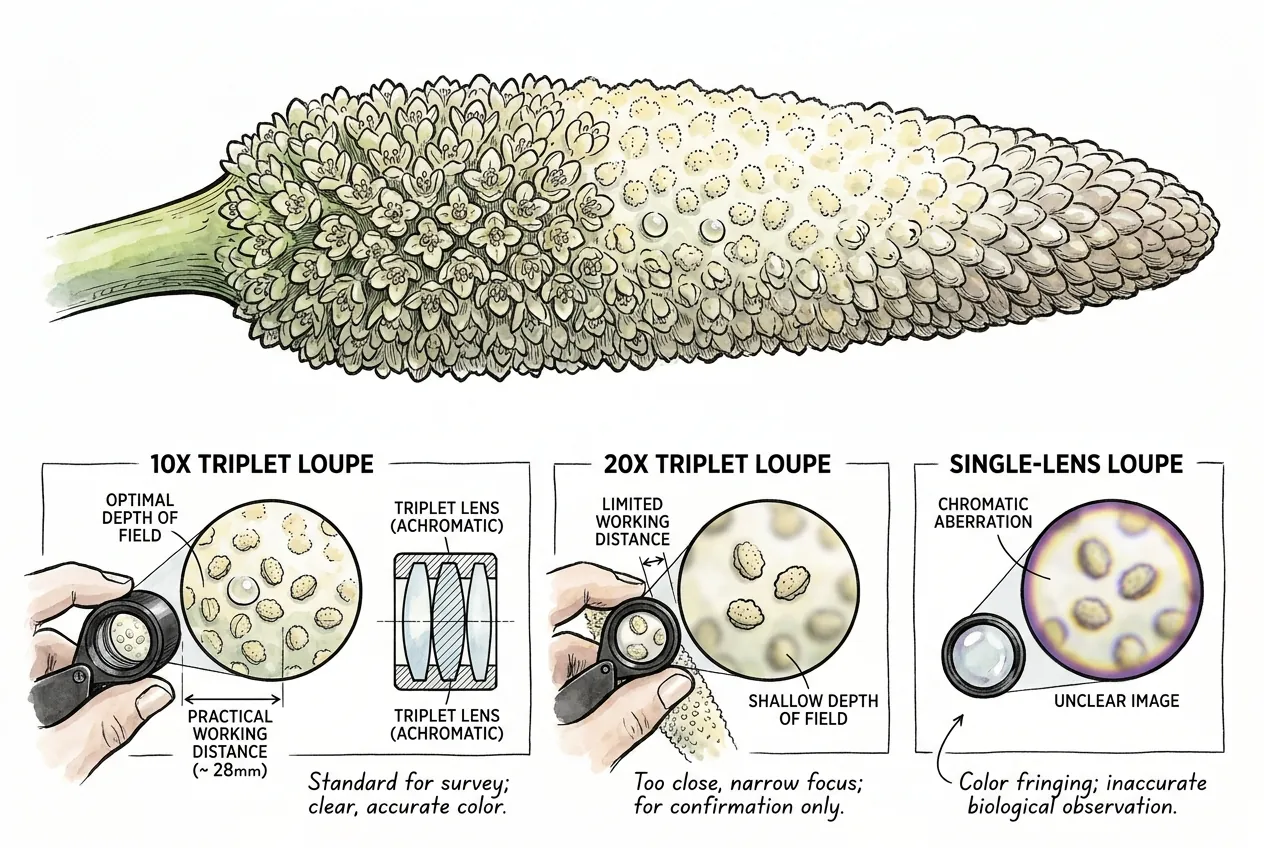
Around 10× is comfortable for a general check. A 20× loupe can help with a closer look, but its shorter working distance is awkward on a curved spadix.
Choose a loupe that gives a clear, comfortable view. You do not need a particular lens construction to see wet stigmas or shed pollen.
Matching loupe magnification to the task
Jeweler’s loupes are sold with different stated magnifications, fields of view, working distances, and lighting. Higher magnification usually narrows the visible area and shortens working distance, which may help with one stigma but hinder a general survey.
Choose the exact optic for the detail and area you need to inspect, and verify its usable view rather than assuming that a larger number on the box is automatically better.
Why does brush bristle material matter?
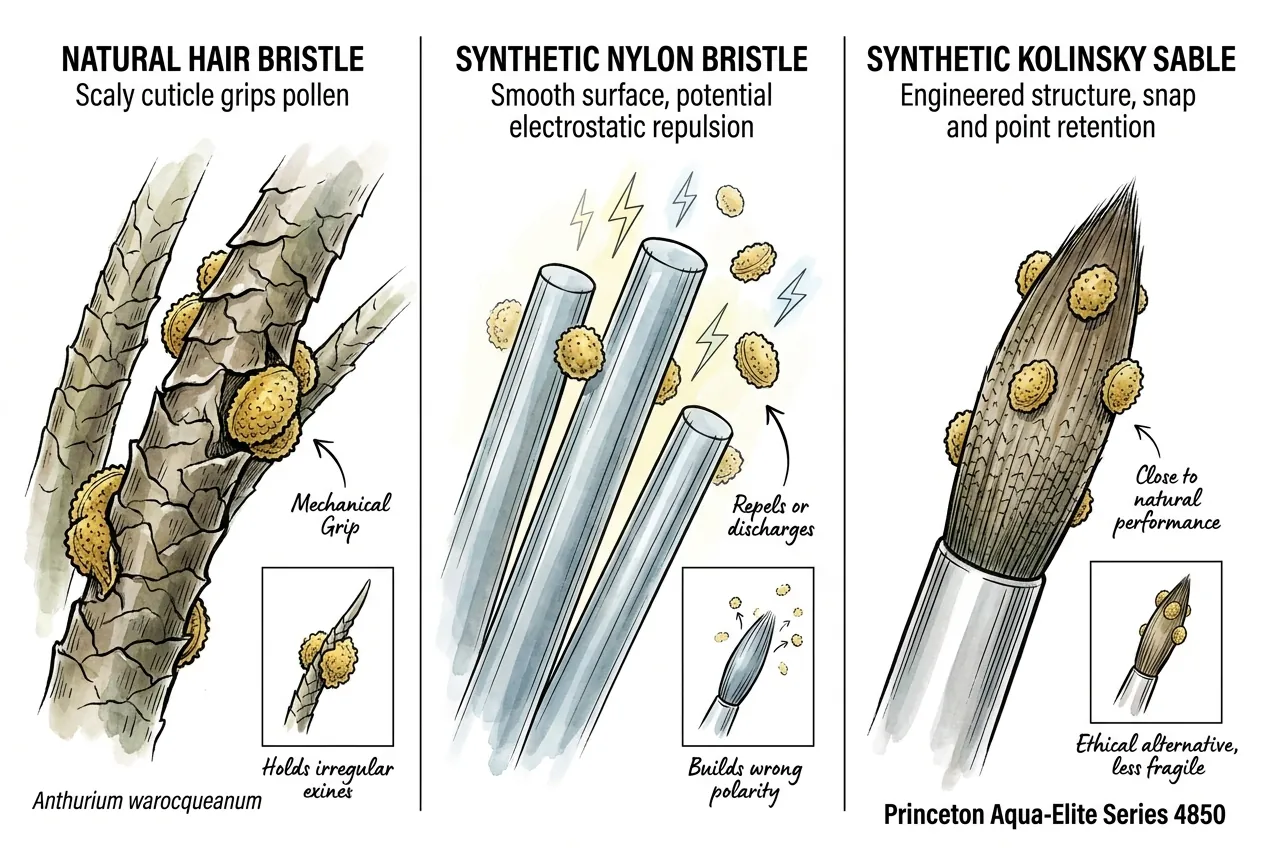
Use a clean, well-pointed size 0 brush that can place a small amount of pollen on a sticky stigma. Natural and synthetic bristles can both work. A clean point matters more than the material.
Choosing a fine spotter brush
A synthetic-filament round brush with a short handle that holds a fine point is a good, durable choice for this work.
The pollen-pickup and static claims above are unverified for this use, so choose a brush as a solid fine spotter, not on the basis of a proven pollen advantage.
Dab (do not drag) onto staminate florets to load, and dab onto receptive stigmas to deposit.
The most reliable way to avoid mixing donors is a separate clean, dry brush for each donor rather than cleaning one brush between plants, if you do clean a brush, let any alcohol dry off completely before reuse, since residual alcohol can damage pollen or the stigma.
Why borosilicate glass over polypropylene vials?
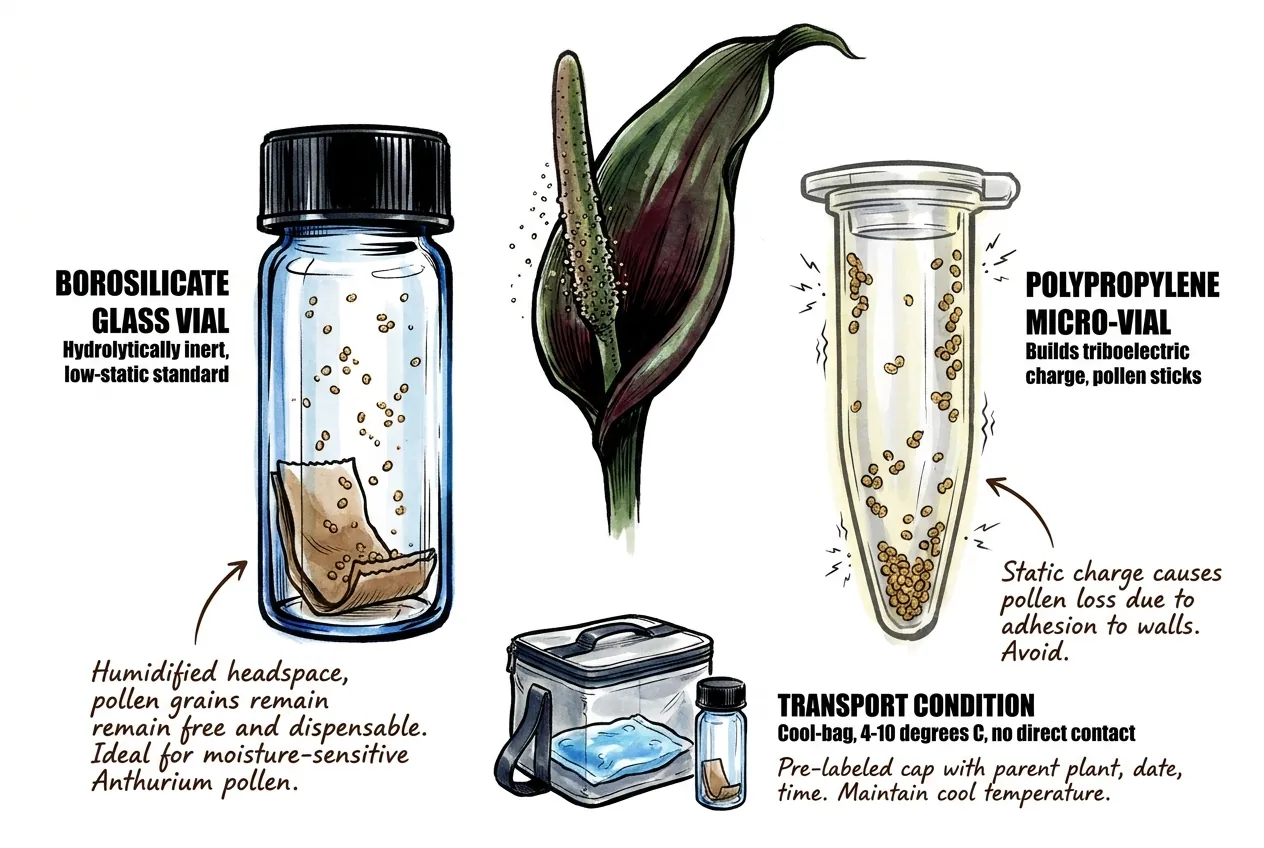
A clean glass vial is a sensible container for a small pollen dose. Keep it cool, label the parent plant and collection time, and keep water droplets or damp paper out of the vial.
For transport, use a closed cool bag with a cold pack that does not touch the vial directly.
Why does hygrometer accuracy matter?
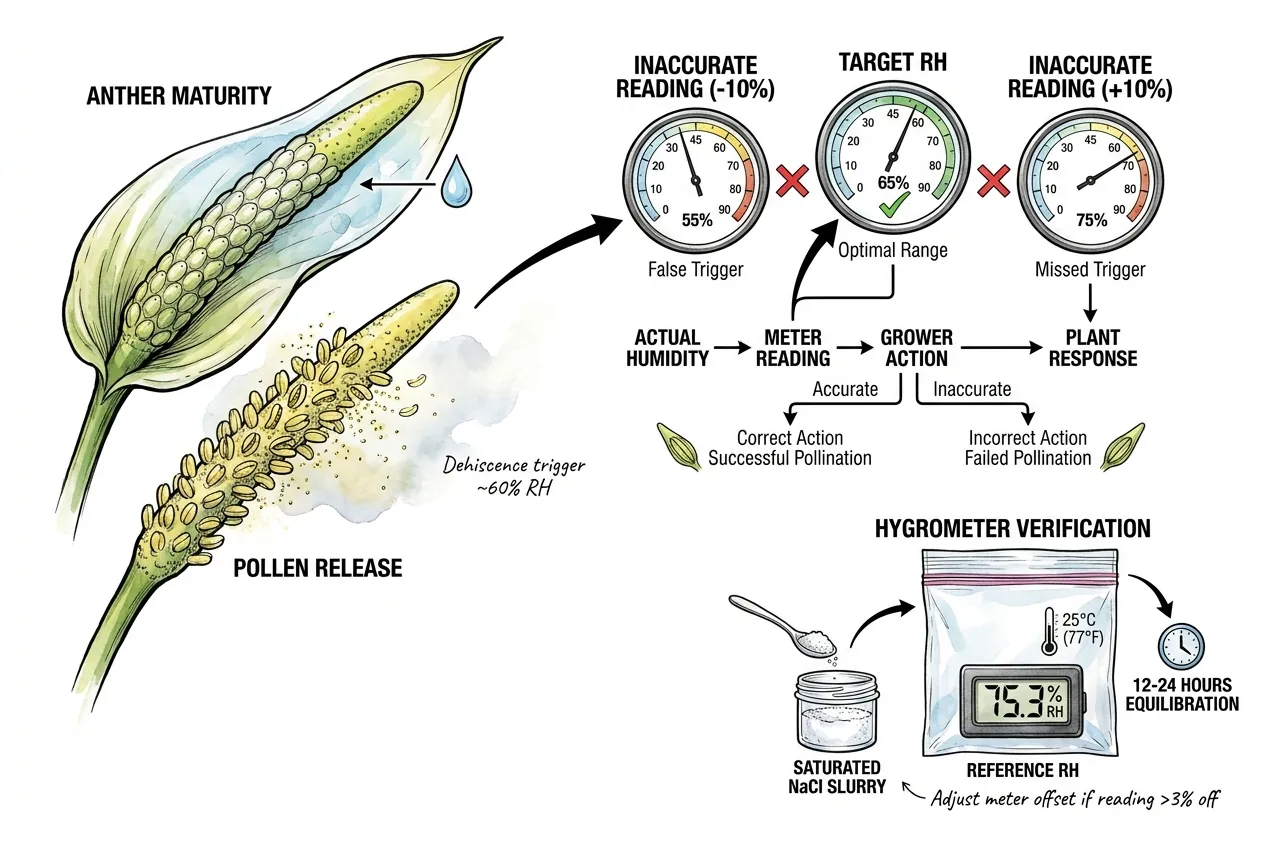
A hygrometer helps you understand the growing conditions, but it cannot tell you whether the spadix is ready. Confirm the phase by looking at the spadix, not by chasing a threshold.
How do I verify a hygrometer?
Run a saturated salt-slurry check. Fill a small cap about three-quarters with table salt, add distilled water to a wet-but-not-dissolved slurry, and seal it with the hygrometer in a zip-lock bag at a stable room temperature. Equilibrate for 12-24 hours.
Keep the temperature steady and read the reference value at the same temperature you actually held (saturated NaCl is about 75.3 percent RH at 25 degrees C, and only slightly different at 21 degrees C).
If the reading is off by more than about 3 percent, adjust the meter offset where possible or replace it.
Remember this is a single-point check near 75 percent. It confirms the meter at one humidity, but it does not verify accuracy down near 60 percent or account for hysteresis and temperature effects, so treat a good result as reassurance rather than a full calibration.
What are the most common reasons a cross fails?
Check Timing, Pollen, and Plant Stress
A failed cross can come from mistimed pollen, lost pollen viability, stress or chilling, incompatibility, disease, or poor growing conditions. Work through the whole list instead of assuming one cause.
Carbohydrate competition can abort a developing spadix
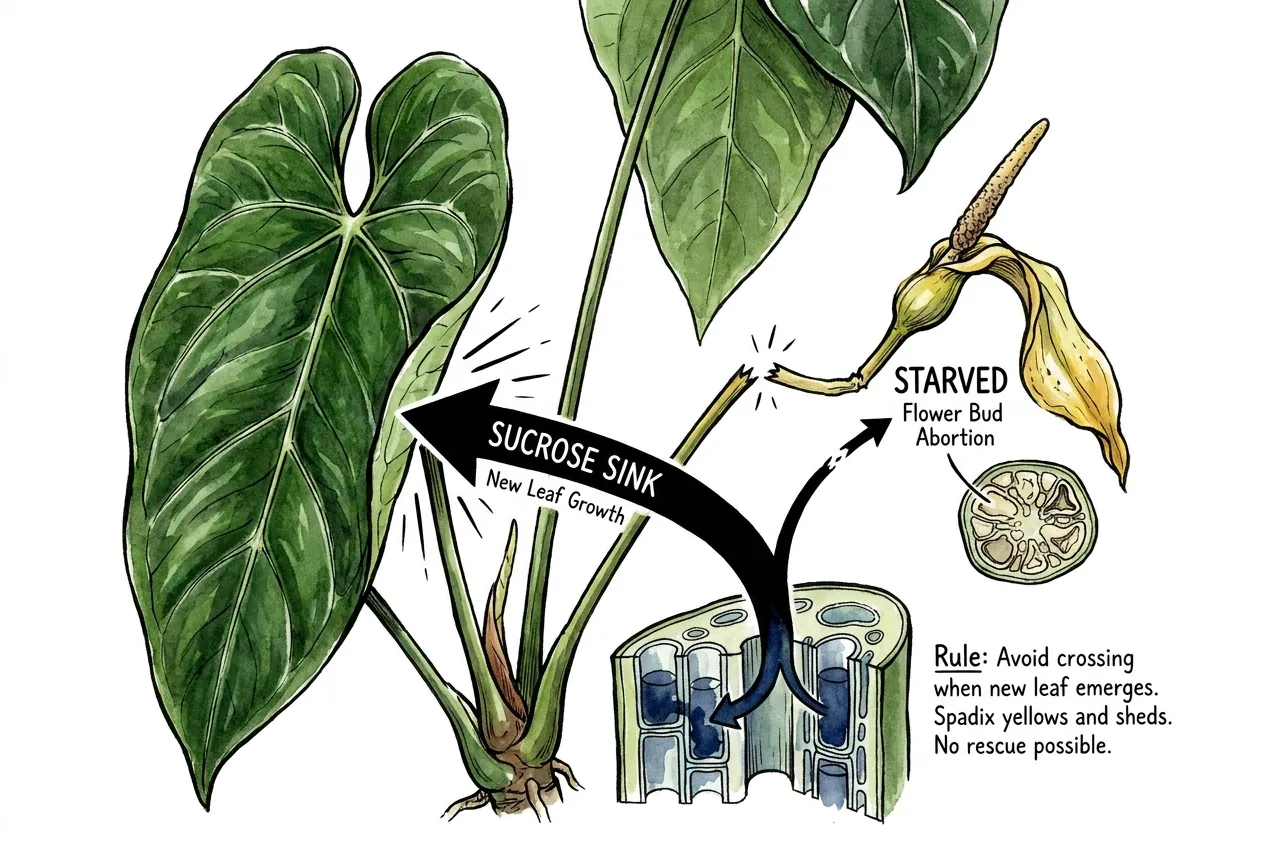
A vigorous new leaf can compete with a developing inflorescence for the plant’s resources. Avoid adding further stress to a plant that is already pushing hard, but do not assume leaf growth makes every cross fail.
Mistimed application is a common, avoidable failure
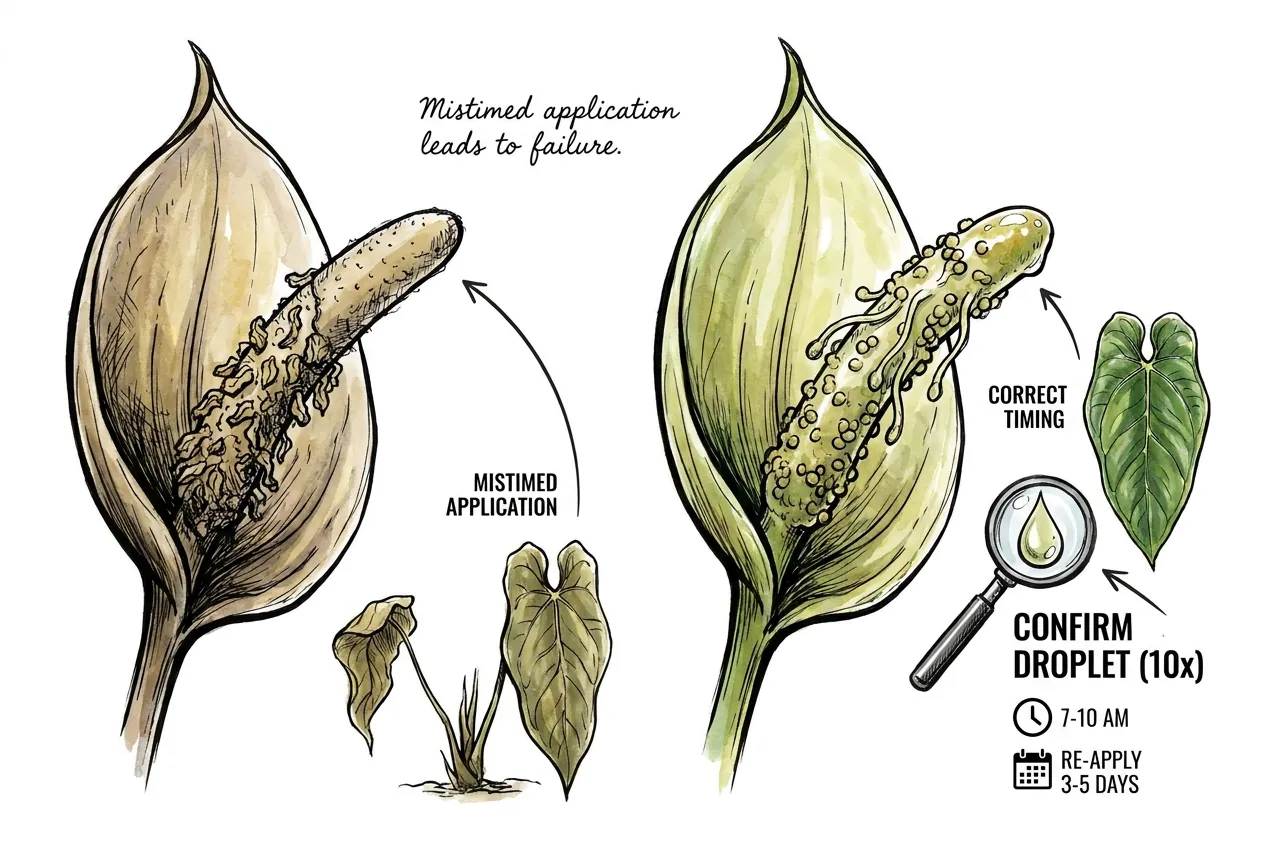
Applying pollen to a stigma that is not receptive means the grains land on a dry surface with little chance to hydrate.
The fix is simply to confirm the glistening, sticky stigma under a loupe before each application and to re-apply over several days so you catch flowers as they become receptive.
Many growers do this in the morning for convenience, but the wet-stigma cue, not a specific clock window, is what determines success.
Pollen desiccation is invisible until the test
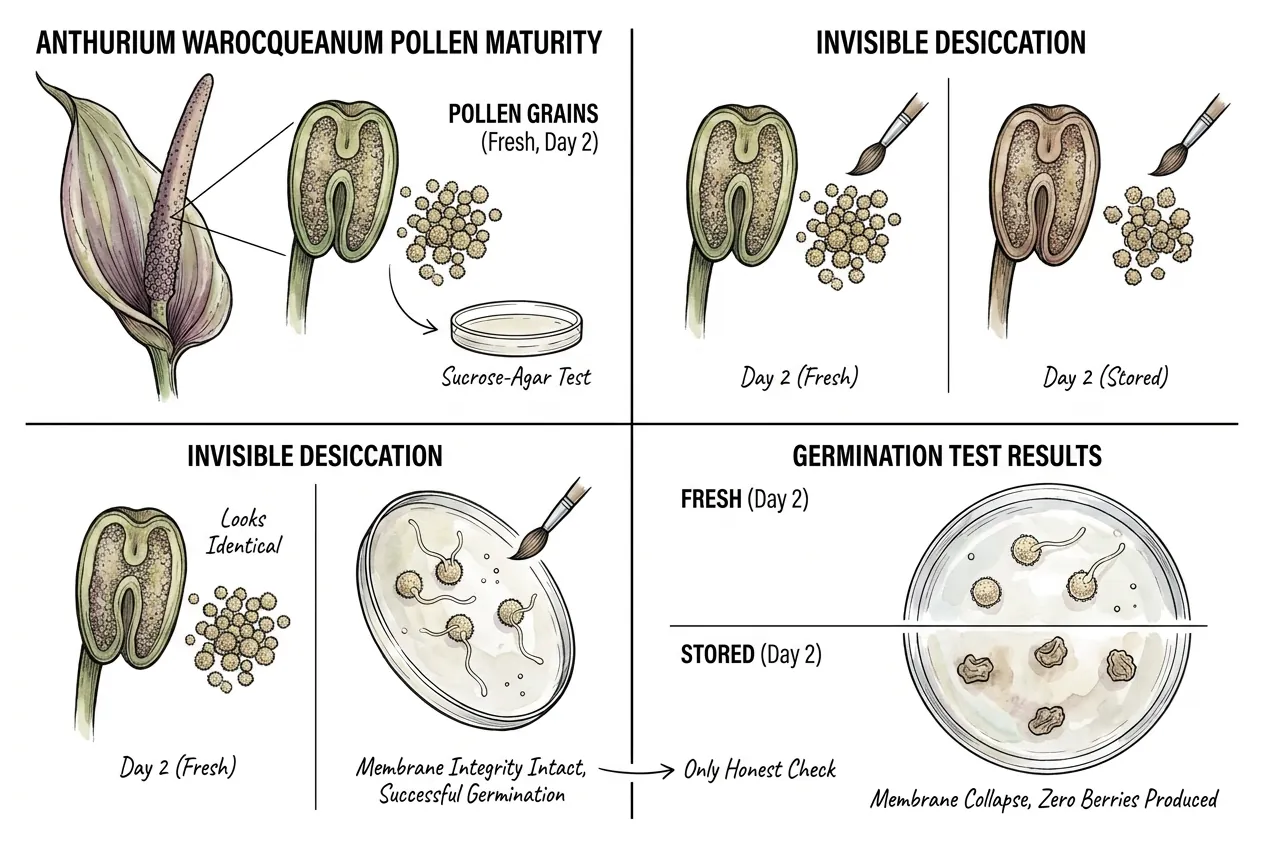
Stored pollen can look fresh and still fail. A germination test is only a rough guide, so compare it with a fresh known-good sample when the result matters.
Chilling injury is a real cold-stress risk
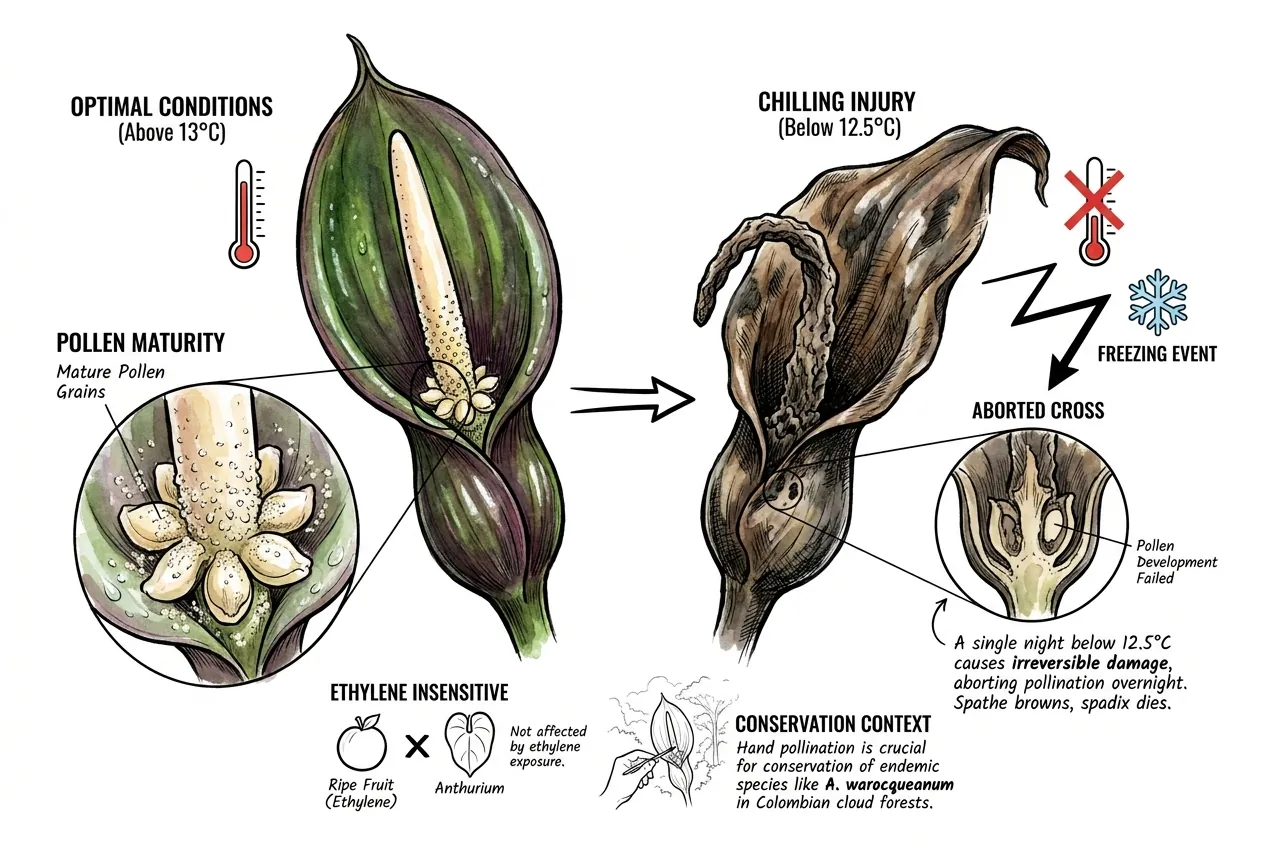
Prolonged cold can injure tropical Anthurium tissue and stress a developing cross. Keep the plant out of cold spells, but do not assume one cool night makes the cross irrecoverable.
Why does hand pollination matter for conservation?
Keep Provenance With the Cross
Choose nursery-propagated plants with legal, documented provenance rather than wild-collected stock. Handle fresh seed promptly.
Keep a breeding log with each parent, the cross date, the female and male cues, and germination outcomes. Clear records make the seed useful beyond one attempt.
How do I troubleshoot common scenarios?
Spadix looks ready but no visible pollen under the loupe
Use a higher magnification and examine the florets directly. If you still see no pollen, the flowers may simply not be shedding yet. Brief gentle ventilation is reasonable if the enclosure is saturated, but it is not a guaranteed fix.
Keep tap-testing onto a clean black card over the following days. The most likely explanation for no pollen is that the staminate window has not opened yet (or has closed), so let the plant progress rather than forcing conditions.
Brush picks up pollen but won’t release it on the stigma
First confirm the receiving stigma is actually receptive (glossy, sticky, ideally beaded).
If it is, the sticky exudate normally pulls pollen off the brush on contact, so a poor release usually points to a not-yet-receptive stigma rather than the brush material.
A fine synthetic brush works well here, so there is no need to switch materials.
Dab rather than drag onto the stigma so the sticky surface can lift the grains. Avoid breathing on the brush to neutralize static. There is no good evidence it helps, and it can add moisture and contaminants.
If a brush keeps holding pollen, load a smaller amount and make firmer, brief contact with the wet stigma.
Hygrometer reads 70% RH but the spadix behavior says otherwise
Run a salt test. A saturated NaCl slurry establishes about 75.3 percent RH at 25 degrees C (read the reference at the temperature you actually held).
This checks the meter at one point near 75 percent. It does not verify accuracy near 60 percent or rule out temperature-difference and equilibration errors, so before trusting or replacing a meter, make sure the setup temperature was stable.
If, after a clean single-point check, your reading is still more than about 3 percent off, adjust the offset where possible or replace the meter.
Capacitive RH sensors can drift over time as the polymer sensing film ages.
Cross set fruit, but berries drop at 2-3 months
Late fruit drop can have several causes. Failed fertilisation or embryo abortion despite an apparently good cross, genetic incompatibility, pathogens, or water, temperature, and general plant-health stress, as well as carbohydrate or resource stress.
Root disturbance from a mid-cycle repot is one avoidable stressor, so it is reasonable to hold off repotting and to keep watering and feeding steady through fruit development rather than assuming underfertilisation is the cause.
If drop keeps happening, look across these possibilities rather than treating it as a single fertiliser-or-root problem.
Key Takeaways
- Anthurium warocqueanum is protogynous, with the female phase first and pollen shed later on the same spadix. The exact lag is not documented for this species, so record your own.
- Confirm the phase by physical cues. A glistening, sticky stigma indicates the female phase and visible shed pollen indicates the male phase. Colour change is only a secondary hint.
- Apply pollen only when the recipient stigma is visibly wet and sticky under a loupe. Re-apply over several days as receptivity moves up the spadix.
- Use pollen fresh whenever possible. If you must hold it, keep it cool and humid without letting it touch water, and test viability against a fresh control before relying on it.
- Crosses fail for many reasons, including mistiming, non-viable pollen, incompatibility, failed fertilisation, disease, and plant stress. Troubleshoot the whole list.