
Anthurium Pollen Storage Product Chooser
An anthurium pollen storage product chooser: a desiccant, freezer-rated vial, hygrometer, and brush, with an honest caveat that no Anthurium-specific longevity data supports a single freeze-or-dry rule.
Elena Vargas · Published 2026-06-18 · 20 min read

Key Takeaways
- Anthurium spadices are protogynous. If a male and a female stage do not overlap, you may need to hold pollen to bridge the gap.
- No published study tracks Anthurium pollen longevity. In the closest relative tested, Caladium, an aroid, −20°C destroyed more than 99% of germination within a day, while 4°C at high humidity held far better. Treat any freeze-and-dry rule as unproven for Anthurium.
- UF/IFAS advises holding short-supply Anthurium pollen in a high-humidity refrigerator over damp paper without touching water. That differs from a dry-to-low-RH approach. Both are options, not a rule.
- Storage tools can keep a sample labeled, sealed, and separate. They cannot turn an untested drying or freezing method into a proven Anthurium protocol.
- Warm a sealed vial to room temperature before opening as a sensible precaution against condensation. The lethality of that condensation is not directly demonstrated in Anthurium.
What tools go into an Anthurium pollen-banking kit?
Start With the Biological Constraint
The shortest answer is four tools. An indicating silica gel desiccant, an airtight freezer-rated vial, a digital thermo-hygrometer, and a fine pollination brush.
Together they let you collect Anthurium pollen at the male stage, hold it, and apply it later to a female-receptive spadix.
No published home-storage method establishes how long Anthurium pollen remains viable. In Caladium, the closest tested aroid relative, freezing at −20°C destroyed almost all germination within a day. Treat every storage method as a short-term, labeled hold rather than a guaranteed recipe.
You may reach for a kit because the Anthurium spadix is protogynous. Each spadix is usually female-receptive before it sheds pollen, so the two phases often do not line up on a single spadix.
That said, a mature Anthurium can carry several inflorescences, and two plants (or two inflorescences) can reach opposite stages at the same time, in which case a same-day cross needs no storage at all.
When timing does not cooperate, the kit is one way to bridge the gap. Collect pollen when a spadix turns male, hold it, and deploy it when another spadix shows stigmatic fluid.
Whether to dry it, and how cold to store it, is exactly what remains unsettled for Anthurium.
Before trusting irreplaceable pollen, I run the complete cold-storage routine with an empty labeled vial and the planned desiccant. I move it through cooling, storage, and warming exactly as I intend to handle the real sample and watch where condensation appears.
I practice leaving the vial sealed until it has warmed, then check whether the label, cap, and duplicate record survive the cycle. This cheap rehearsal finds a leaking cap or unreadable label before the failure contains a cross I cannot repeat.
Desiccant
Wisesorb Orange Silica Gel is useful only if you are comparing a gentle drying hold with another labeled portion. Drying is not universally safe, and UF/IFAS also describes a high-humidity refrigerator hold for short-supply Anthurium pollen. Keep loose beads away from the pollen.
Airtight cold-rated vial
Globe Scientific RingSeal Vials suit small, labeled pollen portions that need a tight seal in a refrigerator. A cold-rated vial limits moisture re-entry, but it cannot make an unsuitable drying or freezing method safe for the pollen.
Thermo-hygrometer
Govee H5075 helps compare the humidity around a drying sample. It measures jar air, not the pollen’s internal moisture or viability, and it is not a freezer thermometer.
Fine pollination brush
Carolina Pollination Wands suit repeatable collection when you are tracking parents. Clean and dry the wand between parents. A clean fingertip can also transfer Anthurium pollen, so a wand is optional when you are not managing several labeled crosses.
You can skip storage entirely whenever a male and a female stage overlap, on one plant, across two inflorescences, or across two plants, because then a same-day cross works.
Storage only earns its cost when the stages do not line up.
Buy storage hardware only when the male and female stages do not overlap. A same-day cross needs a clean transfer tool, not a pollen-banking kit.
Tropical Foliage Plant Development. Breeding Techniques for Anthurium and Spathiphyllum (UF/IFAS EP366)
Phalaenopsis pollinia storage at sub-zero temperature and its pollen viability assessment
Why does stored Anthurium pollen die?
Separate General Rules From Anthurium Evidence
Stored pollen loses viability with warmth, with moisture, and with time, but how each factor plays out depends strongly on the species, the pollen’s developmental stage, oxygen, and handling.
The direction is general. The safe numbers are not, and for Anthurium they have not been measured.
The protogyny problem comes first. In Anthurium, flowers become receptive from the spadix base toward the tip over roughly a two-week window, signaled by a glistening, sticky stigmatic surface.
The exact timing varies by species, cultivar, and conditions.
Those stigmatic surfaces dry and brown before the same spadix sheds any pollen. So one spadix is almost never male and female at once, which is exactly why you must bank pollen to cross two specific plants.
How temperature sets the viability window
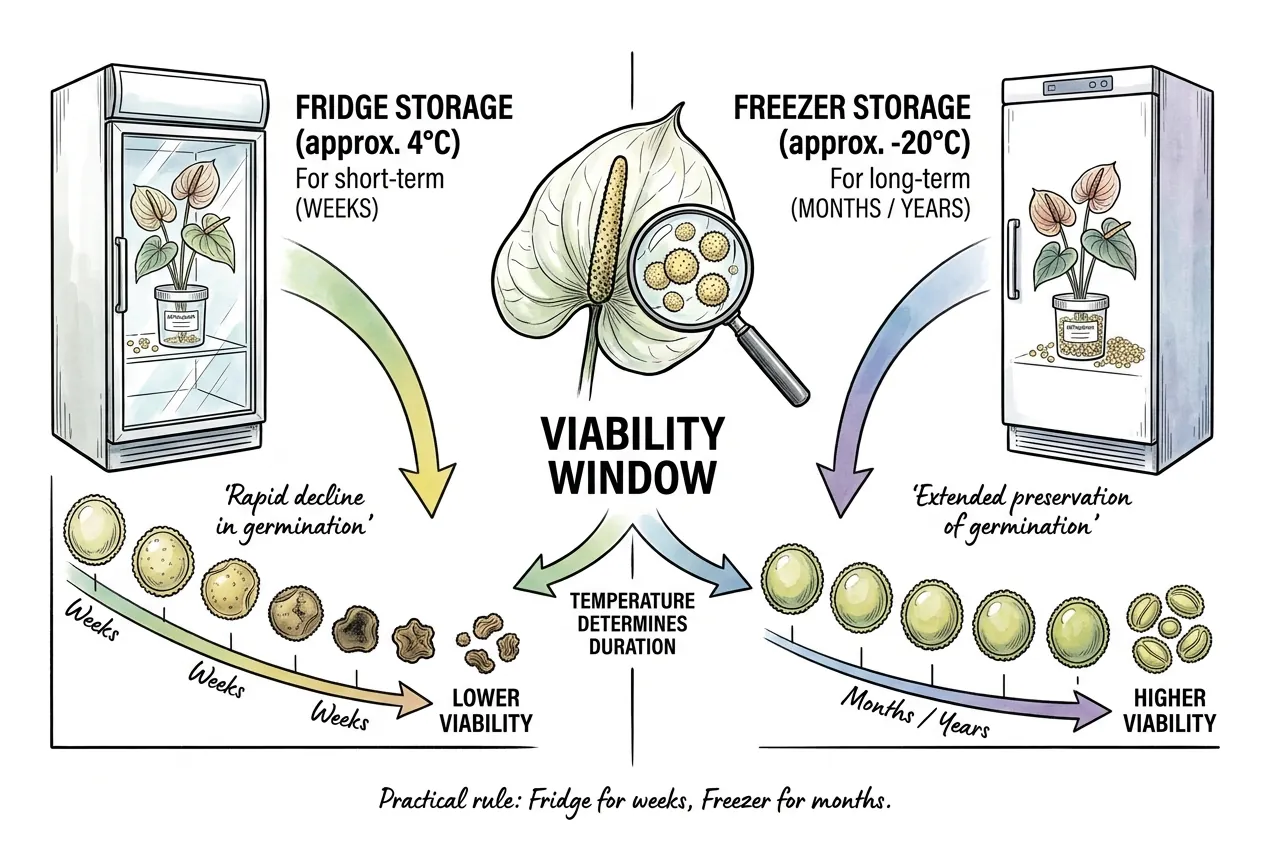
For several distant species, colder storage holds pollen viability longer, and the fridge-to-freezer step is often the largest one.
But that pattern has been measured in other plant groups, not in Anthurium, and it does not hold everywhere.
In a four-month juniper (conifer) study, pollen kept at 4 °C fell from a fresh germination of 67 to 89 percent down to 18 to 40 percent, while the same pollen at -20 °C held 68 to 94 percent.
The authors stress that the optimum differs by plant group.
An apple (woody dicot) study over six months showed a similar direction. The strongest cultivar retained only about 13 percent germination at 4 °C but about 56 percent at -20 °C, though cultivars varied widely.
Caladium, the nearest tested aroid relative, responded poorly to freezing. Germination fell from about 35.8% fresh to roughly 0.7% after one day at −20°C, even after drying. Its short refrigerator hold performed better.
Do not assume a household freezer is safe for Anthurium pollen. For irreplaceable pollen, begin with a sealed refrigerator hold and keep a small portion separate before trying another method.
Technique for In Vitro Pollen Germination and Short-term Pollen Storage in Caladium
Longevity and germination of Juniperus communis L. Pollen after storage
Impact of Storage Temperature on Pollen Viability and Germinability of Four Apple Cultivars
How moisture content and humidity set the floor
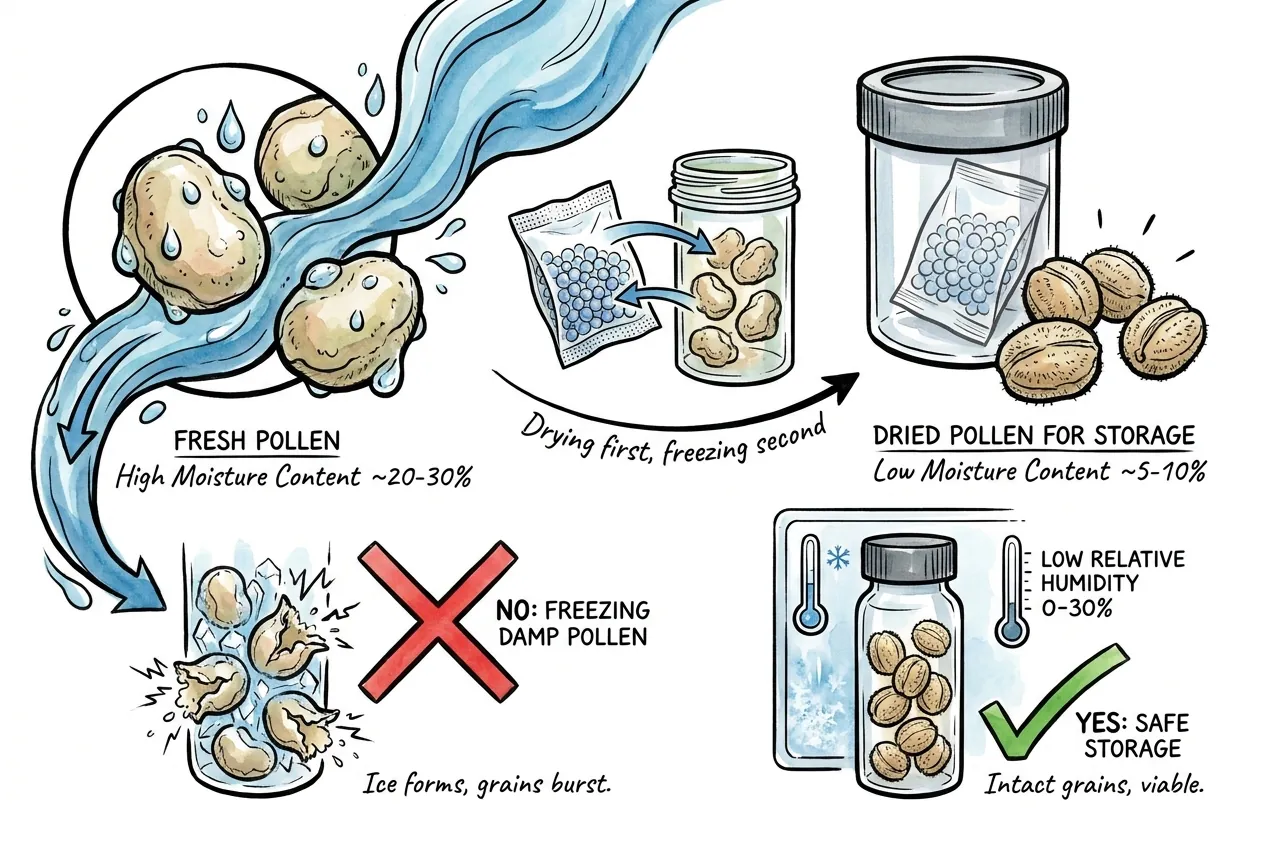
Some species store better when dried, but over-drying can also hurt viability. Anthurium’s safe moisture level has not been measured.
Do not copy dry-storage percentages from other plants. UF/IFAS describes a high-humidity refrigerator hold for short-supply Anthurium pollen, and Caladium also performed better under humid refrigeration than under freezing. Drying is one option to compare on a small portion, not a freezer workaround.
Cryopreservation of two-celled pollen. Cellular mechanisms of cryoinjury and recovery
Simple cryopreservation protocol for Luffa pollen. Enhancing breeding efficiency
Choose Tools by the Decision They Support
Choose a small sealable vial when you need to label separate pollen portions. Choose a hygrometer only if you are comparing a drying hold and need to see the air in the jar. Choose a clean fine tip when parentage matters.
None of these tools can tell you whether the pollen is still viable.
If you try a dry hold, keep the pollen physically separate from the desiccant and use a container small enough to avoid repeatedly opening it. If you use cold storage, choose a container rated for the temperature you actually plan to use.
A container’s cold rating protects the container, not the pollen from an unsuitable storage method.
Experimental characterization of silica gel adsorption and desorption isotherms
Phalaenopsis pollinia storage at sub-zero temperature and its pollen viability assessment
Which desiccant holds pollen in the low-RH band?
If you decide to dry pollen, an indicating silica gel lowers the jar’s humidity and its color signals when the beads are spent.
Whether drying is right for Anthurium is unsettled, so treat this as an optional step.
Wisesorb’s color-changing silica gel is useful when you need a visible reminder to replace or recharge the desiccant. Decant only what a small jar needs and follow its package directions for recharging.
Its color is a maintenance cue, not proof that a particular humidity is safe for Anthurium pollen.
The linked Fonday Indicating Silica Gel is a practical alternative when larger beads are easier for you to keep separate from the pollen. Skip desiccant when a same-day cross removes the need to store pollen at all.
Experimental characterization of silica gel adsorption and desorption isotherms
Longevity and germination of Juniperus communis L. Pollen after storage
What Makes a Vial Useful for a Pollen Hold?
Use a sealable, labeled vial to avoid contaminating or losing a very small pollen portion. A gasketed cold-rated vial is the more cautious choice if you are testing cold storage. It limits moisture re-entry better than a loose bag or snap cap.
It does not establish that freezing itself is safe for Anthurium pollen.
Globe Scientific RingSeal Vials suit small labeled portions that need a firm seal. They are a poor value when you need only a brief refrigerator hold and the pack size leaves you with far more vials than you will use.
Heathrow Microcentrifuge Tubes are a simpler option for short refrigerator holds. Their snap cap is less protective against moisture re-entry, so do not treat them as an equivalent substitute for a gasketed vial in a longer comparison.
Phalaenopsis pollinia storage at sub-zero temperature and its pollen viability assessment
Collecting and Storing Pollen (Journal of the American Rhododendron Society)
Which meters confirm the storage microclimate?
Two cheap meters help you check conditions. One for the humidity in a drying jar, one for the temperature of the cold box. They confirm the environment, not the pollen itself.
Govee H5075 is useful for comparing the humidity in a room-temperature drying jar. It reads the surrounding air rather than pollen moisture or viability, and it is not rated for freezer use.
Taylor 1443 is for checking whether a cold box warmed unexpectedly. It cannot show whether a temperature is biologically safe for Anthurium pollen, and it does not replace a hygrometer when you are comparing a dry hold.
Longevity and germination of Juniperus communis L. Pollen after storage
Simple cryopreservation protocol for Luffa pollen. Enhancing breeding efficiency
Which brush places pollen without carryover?
A fine tip helps because Anthurium sheds pollen in small amounts along the spadix. UF/IFAS actually describes transferring Anthurium pollen with a clean fingertip and mentions a brush for Spathiphyllum, so a brush is an option rather than a requirement.
Carolina Pollination Wands suit repeated, labeled crosses because you can clean a wand between parents. They are optional when you are doing a simple untracked cross, where a clean fingertip can transfer the pollen.
To protect parentage, sterilize (or use a fresh clean tip) between parents and label everything.
Note that clean tools reduce carryover but do not remove every source of mix-up. Handling, mislabeling, and airborne pollen still matter.
A clean fingertip also works and is what UF/IFAS describes for Anthurium. With sanitation and labeling it can serve tracked crosses too, not only self-pollination.
The Seeding Square Handheld Pollinator is designed for flowers that release pollen through vibration. There is no published basis for using it with Anthurium’s small pollen load, and the vibration could scatter the pollen. Do not treat it as a proven alternative to a clean fingertip or pollination wand.
Tropical Foliage Plant Development. Breeding Techniques for Anthurium and Spathiphyllum (UF/IFAS EP366)
Flowering phenology patterns promote pollination facilitation in coexisting Anthurium species
How do you bank Anthurium pollen step by step?
Set Up a Conservative Hold
Collect at the male stage, decide whether you need a short refrigerator hold, seal and label separate portions, then apply pollen when another spadix is receptive.
Only compare drying or freezing with a spare portion because neither method is validated for Anthurium.
Record the parent, collection date, storage condition, and pollination result. This makes a later success or failure useful without risking every sample on one unproven method.
Collect at the male stage
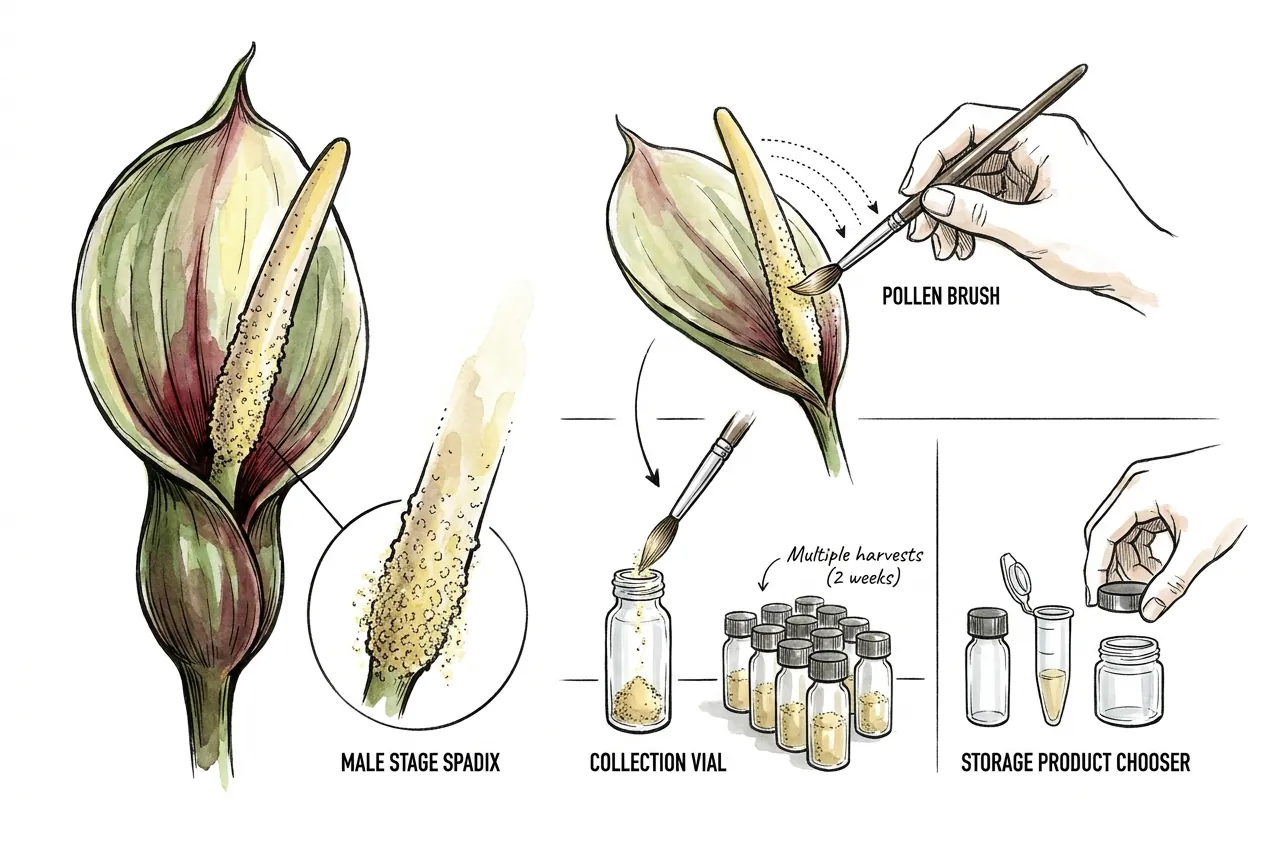
Wait until pollen appears along the spadix, usually from the base upward. Collect it gently onto a clean collection surface, a sterilized wand, a clean fingertip, or directly into a clean vial.
Anthurium produces pollen over roughly two weeks as different flowers mature, so collect across several visits rather than expecting one harvest.
Use a clean or sterilized tip per parent, and label each sample, to keep parentage straight.
Dry over indicating silica gel
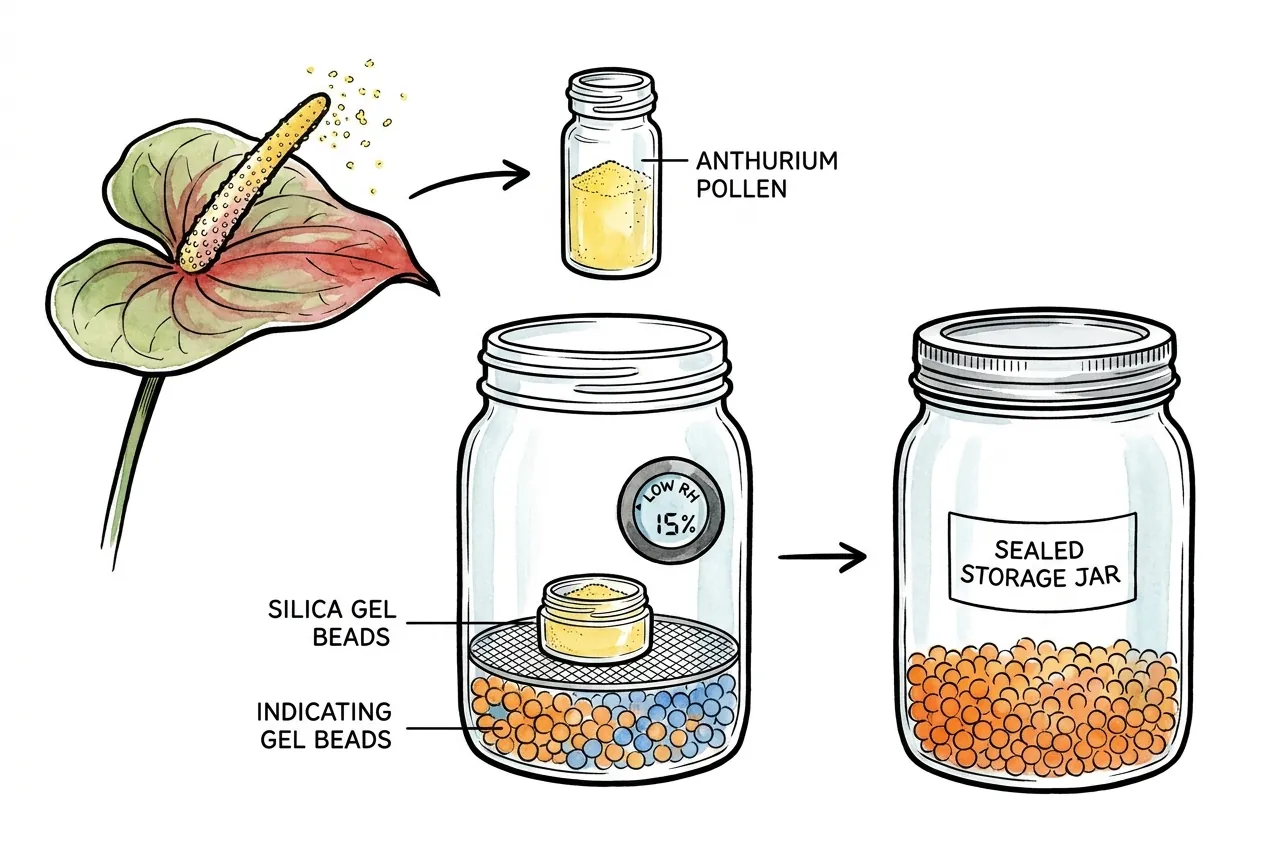
If you dry, place the pollen in a small jar with indicating desiccant at room temperature and read the RH on the hygrometer.
Keep the pollen physically separated from the beads, on a mesh or in an inner packet, so loose bead dust does not mix with the sample and so you do not lose the tiny load.
Humidity and drying time both matter, and there is no established Anthurium endpoint for either, so err toward gentle, brief drying and watch that you are not over-drying.
Cited protocols in other species range from tens of minutes to a few hours, which is a spread, not a proven setting.
Seal cold with desiccant
Transfer the pollen into the O-ring cryovial with minimal headspace. If you add fresh desiccant, keep it in a small inner packet or separate chamber so the beads never touch the pollen. Loose beads make the sample hard to recover and can contaminate it.
A small vial holds less air than a large jar, which limits the initial trapped moisture. That helps, but the sample, the container walls, and any leak also carry water, so a small vial is not the whole story.
Store (refrigerator first, and be cautious with freezing)
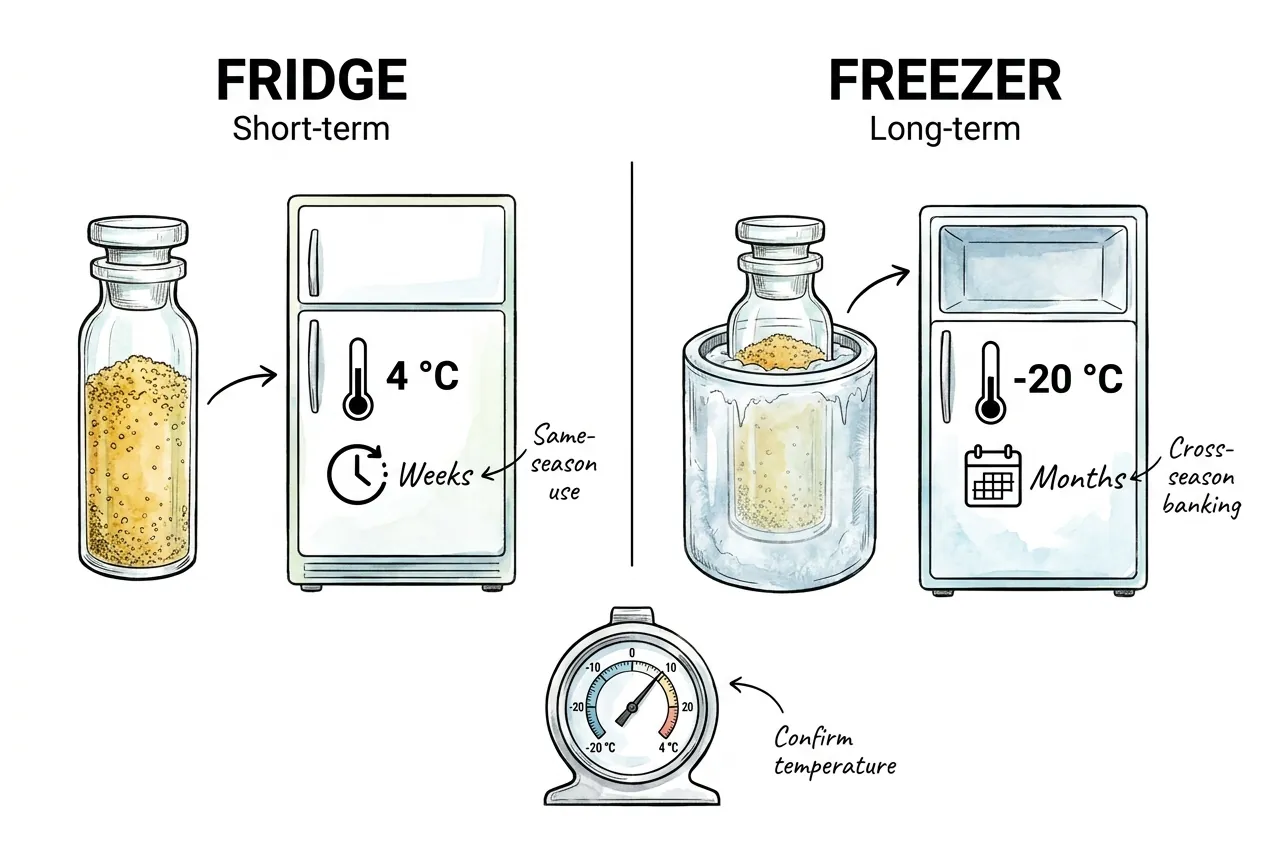
Start with the refrigerator near 4 °C, since that is the condition that held up best in the nearest tested relative (Caladium).
Keep the vial sealed and let it reach freezer temperature only if you have first tested that freezing does not destroy your pollen, because in Caladium -20 °C was rapidly destructive.
Confirm the box temperature with the thermometer.
There is no Anthurium evidence that freezing extends viability, and same-family evidence that it may not.
So do not commit irreplaceable pollen to a freezer on the strength of results from conifers, apples, or orchids. Run a small labeled trial with a refrigerator control first.
Apply to a female-receptive spadix
Warm the sealed vial to room temperature before opening, then transfer the pollen onto a spadix showing fresh stigmatic fluid.
Warming first is a sensible precaution against condensation on cold pollen, though how much that condensation actually harms Anthurium pollen has not been directly measured.
This last step closes the protogyny gap. The pollen you banked at one plant’s male stage now meets another plant’s female stage.
For the surrounding technique, read how to pollinate anthurium across the female and male stages and stigmatic fluid.
To time collection, learn to read anthurium pollen maturity and spadix fade before you brush.
Collecting and Storing Pollen (Journal of the American Rhododendron Society)
Simple cryopreservation protocol for Luffa pollen. Enhancing breeding efficiency
Who should skip each part of the kit?
Skip Storage When Stages Overlap
Not every breeder needs every tool, and a few should skip the kit entirely. Match the spend to how you actually cross.
Skip storage altogether whenever a male and a female stage overlap, on one plant, across two of its inflorescences, or across two plants, because a same-day cross needs no holding.
UF/IFAS notes a mature Anthurium keeps producing inflorescences, so these overlaps are not rare.
Skip the gasketed cryovial if you only hold pollen briefly in the fridge. UF/IFAS even describes a high-humidity refrigerator hold for short-supply pollen, so a simple sealed tube (or that damp-chamber method) can be enough for a short same-season hold. The case-quantity cryovials would be overkill.
Skip the hygrometer only if you dry over a defined-humidity salt chamber that sets the band for you.
Skip the freezer thermometer if your freezer has a readout you have already verified against a known reference.
A brush or wand is optional at all. UF/IFAS describes a clean fingertip for Anthurium. Whatever tool you use, sanitize it and label samples if parentage matters.
Split pollen into labeled portions so you do not reopen one vial repeatedly. If you compare storage methods, keep one portion refrigerated without freezing and record the parent, collection date, storage conditions, and pollination result.
If you are planning deliberate crosses, the storage kit sits alongside the wider work of anthurium hybridization and breeding cultivars, where tracked parentage is the whole point.
Tropical Foliage Plant Development. Breeding Techniques for Anthurium and Spathiphyllum (UF/IFAS EP366)
Impact of Storage Temperature on Pollen Viability and Germinability of Four Apple Cultivars
How do you maintain the kit and avoid failures?
Maintain the Drying and Labeling Loop
Maintain the kit by recharging the desiccant, re-testing viability, and keeping tips clean.
Failures can come from many sources, the wrong storage temperature, over-drying, immature pollen, a poor seal, contamination, or simply incompatibility, so there is no single dominant cause to name.
Recharge the indicating silica gel when its color signals it is spent by heating it at 200 to 250 °F for up to three hours, then cool it sealed. Do not leave spent desiccant in with a stored sample.
Expect viability to decay over time, and re-test before a season rather than trusting an old vial.
A meaningful in-vitro check needs a validated Anthurium germination medium, incubation conditions, a scoring criterion, and a microscope, so it is not truly quick. A test cross is slower still and its result also depends on recipient health and compatibility.
Keep pollination tools clean between parents. Sterilize the reusable Carolina wands in 70-95% alcohol and dry them, or use a fresh clean fingertip.
Clean tools reduce carryover, but labeling and careful handling matter just as much.
Warm a sealed vial to room temperature before opening. This limits condensation on cold pollen, a reasonable precaution even though the resulting harm has not been quantified for Anthurium.
Collecting and Storing Pollen (Journal of the American Rhododendron Society)
Simple cryopreservation protocol for Luffa pollen. Enhancing breeding efficiency
Frequently asked questions
Fridge or freezer for storing Anthurium pollen?
For irreplaceable pollen, start with the refrigerator near 4 °C. There is no Anthurium-specific evidence that a -20 °C freezer helps, and in Caladium, the nearest tested relative, -20 °C destroyed almost all germination within a day even after drying.
If you want to try freezing, do it on a spare portion alongside a refrigerated control and test the result before you rely on it.
Freezer results from conifers, apples, and orchids do not transfer to Anthurium.
How long does Anthurium pollen last in storage?
No study tracks Anthurium specifically, so any duration is a guess. In distant species, refrigerated pollen may last days to weeks, but that is not a promise for Anthurium.
An orchid (a distant comparison) stayed viable about 40 weeks at 4 °C and roughly two years at -20 °C, but only after 11 days of air-drying and on a very small sample.
Re-test any stored sample before relying on it.
Do I really need a hygrometer?
It is useful for a drying step, unless you dry over a defined-humidity salt chamber. It reads the jar-air RH so you are not guessing, but remember that RH is not the same as the pollen’s own moisture or its viability.
Keep the Govee in a room-temperature drying jar, not a freezer. Use a thermometer rated for the cold box and check any meter’s operating range before placing it there.
Affiliate Disclosure
This article contains Amazon affiliate links. As an Amazon Associate I earn from qualifying purchases. If you use these links, the site may earn a commission at no extra cost to you. Product availability, price, and specifications can change. Check the current listing before buying.