
Plant Cabinet VPD Control: Fan, Humidifier & Sensor
A plant cabinet chooser: size a circulation fan, humidifier, logging sensor, and RH controller, and understand why fixed-RH control only approximates a VPD target.
Jordan Cole · Published 2026-06-17 · 23 min read
Key Takeaways
- Think in VPD, not raw percent humidity. The same RH means different VPD at different temperatures, so an RH-only setpoint drifts in VPD when temperature moves.
- A single thermo-hygrometer computes air VPD, not leaf-to-air VPD. Leaf-to-air VPD also needs leaf temperature, so treat the reading as an estimate.
- Roughly 0.8-1.2 kPa is a common vegetative starting point across controlled-environment crops. Lower, about 0.3-0.5 kPa, is used for unrooted cuttings. Adjust by species, stage, and light.
- The four tools here do not talk to each other. The controller holds an RH band, but it does not read temperature or close a VPD loop.
- High humidity plus leaf wetness favors Botrytis and other leaf pathogens. Gentle air movement, sanitation, and healthy tissue all matter, not humidity alone.
- Check quantitative specs such as CFM, mL/hr, accuracy in %RH, and deadband. Also check cabinet size, leakage, electrical safety, and whether devices are rated for a wet enclosure.
Your IKEA-style cabinet swings from wet to dry, and your aroids show edge burn or leaf spot.
Those symptoms have many causes besides humidity, including root damage, salts, nutrition, watering, and pathogens, so diagnose before you buy.
Where humidity is the issue, the aim is a steadier vapor pressure deficit, held with the right tools and sized to numbers you can check.
What should you actually buy to control plant cabinet VPD?
Start With Measurement and Airflow
Most humidity-controlled cabinets use up to four things. An accurate canopy sensor, a circulation fan, a humidifier, and a humidity controller.
These are separate devices that do not communicate with each other. The controller does not read the sensor or the fan.
A sensor and a fan are the useful starting point, because you cannot judge or circulate a VPD you never measure.
I keep both cabinet sensors side by side for one 24-hour light-dark cycle, then swap their upper and lower positions for a second 24-hour cycle. The full day captures both the warm lit phase and cool dark phase. A difference that follows the sensor points to calibration, while one that stays on the shelf points to the cabinet zone.
I label the sensors and save both five-minute traces before buying a controller. Five-minute logging reveals drift and cycling that isolated display checks miss. Automation built on one biased probe can make a stable cabinet oscillate while appearing precise.
Add RH Control After the Basics
The controller is often the most useful next step once measurement and airflow are in place.
It holds relative humidity inside a narrow band automatically, which is steadier than a timer or a manual routine. Note the important limit. It stabilizes RH, not VPD.
If cabinet temperature changes, a fixed RH band still lets VPD move.
Match Each Tool to a Job
Here is the short verdict by role. Get a logging thermo-hygrometer so you can compute air VPD at canopy height. That is an estimate of leaf-to-air VPD, which also depends on leaf temperature.
Add a low-noise clip fan to thin the leaf boundary layer. If ambient humidity is too low, add a controller-gated humidifier so the RH band holds overnight, after you confirm the humidifier is safe to use with your setup.
Choose each tool for a defined job, then verify the result at canopy height instead of relying on a vague humidity feeling. A single number never settles cabinet fit. Use the companion guide below only if you need more detail on VPD physiology.
Master VPD in Plant Cabinets
Why does VPD, not percent humidity, control transpiration?
Read Temperature and Humidity Together
Vapor pressure deficit drives transpiration because water moves from the saturated air inside the leaf to the drier air outside, down a vapor-pressure gradient.
VPD measures that gradient in kilopascals. Relative humidity cannot, because the same percent reading means different VPD at different temperatures.
What is VPD and how does temperature change it?
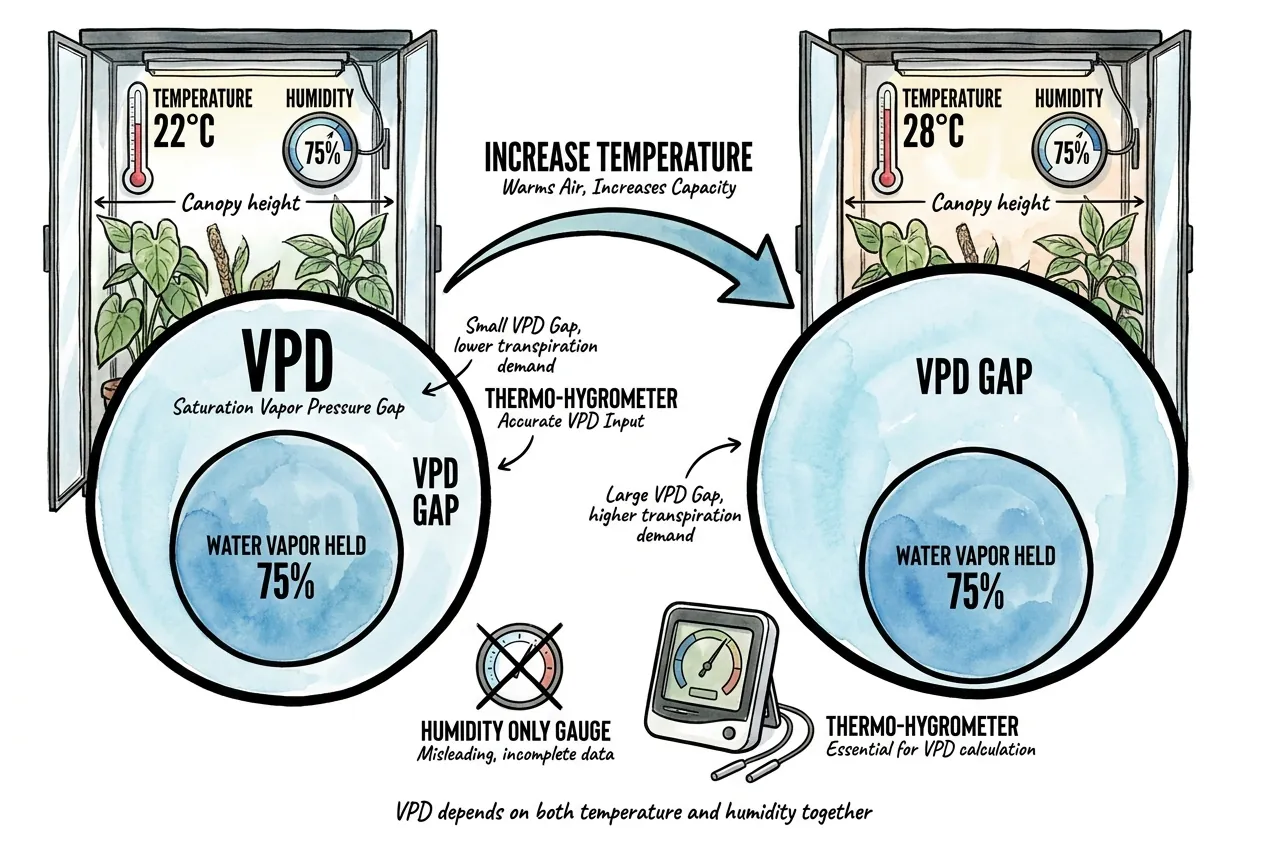
VPD is the gap between how much water vapor the air could hold when saturated and how much it currently holds. Saturation vapor pressure climbs steeply as air warms.
So a cabinet at 75 percent humidity and 22 degrees Celsius sits at a different air VPD (about 0.66 kPa) than the same 75 percent at 28 degrees (about 0.95 kPa).
That is why a single humidity dial is misleading.
You compute air VPD from temperature and humidity together, read at canopy height, which is why a thermo-hygrometer beats a humidity-only gauge.
Strictly, transpiration is driven by leaf-to-air VPD, which needs leaf temperature. With only air temperature you are computing an estimate that assumes leaf temperature equals air temperature.
How does VPD affect stomata and water loss?
As VPD rises, transpiration first increases, then in many species stomatal conductance falls as guard cells lose turgor and stomata partly close.
A peer-reviewed review notes that the exact sensing mechanism is not settled and that responses vary by species. The specific case where transpiration itself declines at high VPD is called a feed-forward response, which is not a synonym for all stomatal closure.
As VPD rises, stomata may close, which can limit carbon dioxide uptake and growth. The threshold and strength vary by species, so one universal cutoff is not reliable.
Many plants transpire comfortably at a moderate VPD.
Practical takeaway Keeping VPD in a moderate band tends to keep stomata open so water and nutrients keep moving, though the exact band and response depend on species and water status.
Why does VPD stability matter as much as the average?
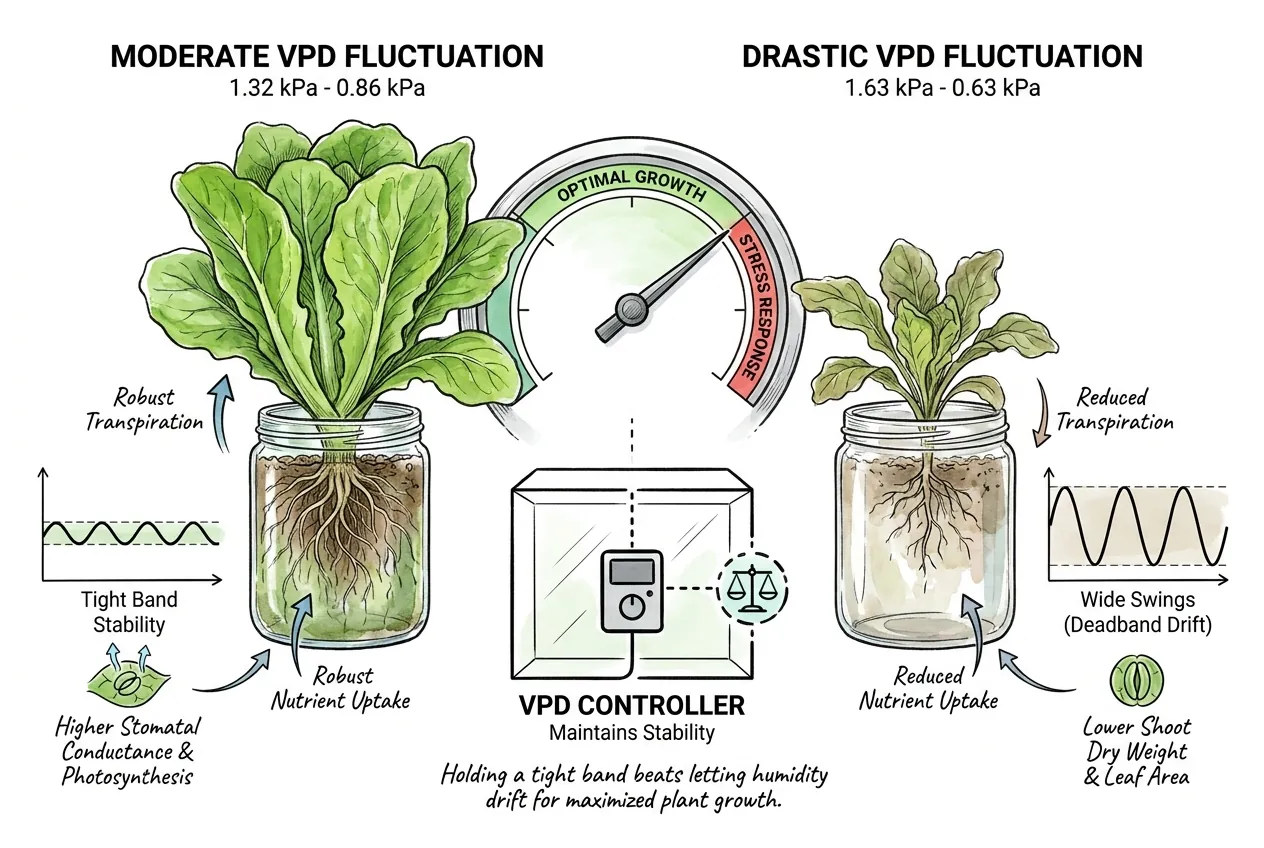
In at least one controlled study, VPD fluctuation affected growth even when the average was similar.
Researchers grew hydroponic lettuce at about 25 degrees Celsius under 200 micromoles per square meter per second, deliberately alternating two VPD regimes every few minutes.
The drastic regime alternated 1.63 kPa with 0.63 kPa, while the moderate regime alternated 1.32 kPa with 0.86 kPa.
After three weeks the drastic group showed 15 percent lower shoot dry weight and 29 percent lower leaf area.
This suggests fluctuation amplitude, not just the average, can matter. Note the limits. It was lettuce under fixed conditions with programmed minute-scale switching, not a test of a tropical aroid cabinet, a 5 percent RH deadband, or the Inkbird controller.
Read it as motivation for steadier conditions, not as validation of this specific kit.
Plant responses to rising vapor pressure deficit
It describes VPD closure, not all closure as feed-forward.
Minimizing VPD Fluctuations Maintains Higher Stomatal Conductance and Photosynthesis in Lettuce
What VPD band should a tropical aroid cabinet hold?
Set a Working Band, Then Recheck
A working band of roughly 0.8 to 1.2 kPa is a common vegetative starting point across many controlled-environment crops, and a reasonable default for tropical foliage. It keeps transpiration active without heavy water stress.
Unrooted cuttings are often kept lower, around 0.3 to 0.5 kPa, during callusing and rooting because they cannot yet replace lost water.
Treat both as starting points and adjust by species, growth stage, light, and irrigation rather than as aroid-specific rules.
What humidity does that band correspond to?
Because the mapping depends on temperature, there is no single humidity range that equals the band.
Working from saturation vapor pressure, 0.8 to 1.2 kPa of air VPD corresponds to roughly 70 to 55 percent RH at 22 degrees Celsius and roughly 76 to 64 percent RH at 26 degrees Celsius.
So 75 percent at 22 degrees (about 0.66 kPa) sits below the band, and 60 percent at 26 degrees (about 1.34 kPa) sits above it.
Set the target in VPD, then read off the RH your own temperature requires.
Then you translate the VPD target into a humidity setpoint at the cabinet’s actual temperature.
Fixing a humidity number and ignoring temperature is how cabinets drift out of band, and it is also why a fixed-RH controller does not, by itself, hold a fixed VPD.
This is also where a light plan intersects with humidity, since warmer canopies under strong light raise leaf temperature and leaf VPD.
Our guide to PPFD and DLI for houseplants covers that side of the balance.
Why can you not just maximize humidity?
Because prolonged high humidity and leaf wetness can favor fungal and bacterial leaf disease, though humidity is only one factor alongside inoculum, sanitation, and plant health.
University extension guidance on Botrytis describes the favorable conditions.
NC State Extension reports that Botrytis grows best at 60 to 70 degrees Fahrenheit combined with humidity above roughly 85 percent, and that it is managed by avoiding prolonged leaf wetness, limiting long high-humidity periods (over about three hours), keeping air moving, sanitation, and healthy plants together, not by air movement alone.
So the goal is a suitable, steady humidity for your plants plus gentle moving air, not the highest possible percent humidity.
That is why the fan and controller matter alongside the humidifier.
Botrytis Blight of Greenhouse Ornamentals
Managing Botrytis or Gray Mold in the Greenhouse
PPFD and DLI for Houseplants
How do you compare the four tools by measurable spec?
Match Specs to the Cabinet
The table below pairs each role with a key spec, a rough starting target, and a weakness to watch.
Treat these as filters, not the whole decision. Cabinet size, leakage, interoperability, and electrical safety still matter, and no single number settles fit on its own.
| Role | Critical spec | Sensible target | Honest weakness |
|---|---|---|---|
| Circulation fan | Rated airflow, speed control, and noise | Gentle leaf-level airflow, quiet at low speed. Size to cabinet, not to a fixed CFM | Rated max CFM is free-air, not what a small cabinet needs. Oscillation adds a wear part |
| Humidifier | Mist output, tank, and wet-use rating | Output above your cabinet's leak rate. Tank that lasts a cycle | Most room units are not rated for a wet enclosure. Ultrasonic aerosolizes minerals and tank microbes |
| Thermo-hygrometer | Stated accuracy and logging | ~+/-0.3 °C, +/-3% RH or better (check typical vs max), logs | Measures air, not leaf, VPD. RH accuracy can drift at sustained high humidity |
| Humidity controller | Setpoint, deadband, and probe type | Full RH range, adjustable differential, remote probe | Controls RH only, not VPD. Does not read temperature or auto-adjust when it changes |
How do you read this selection table?
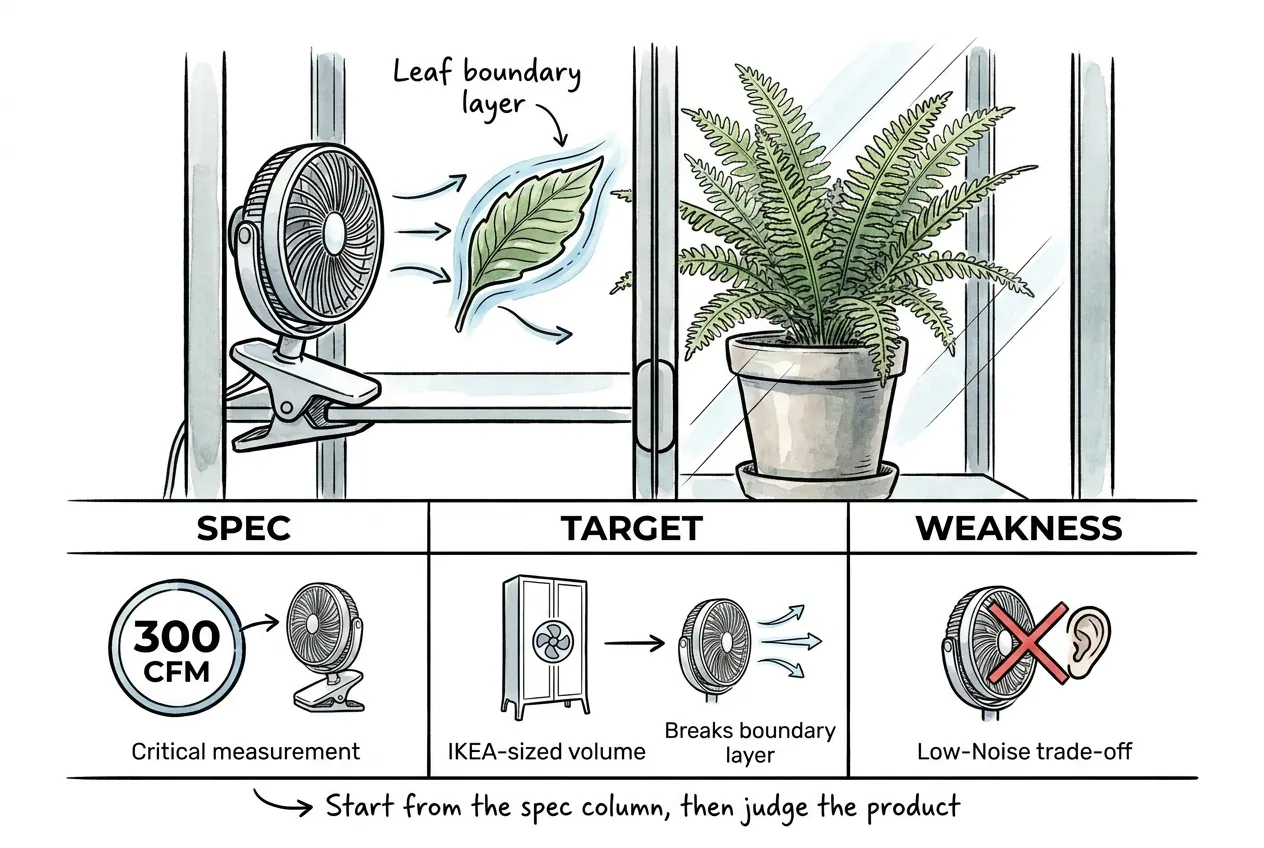
Start from the spec column, not the brand. Each row names a spec that helps judge fit, so you can compare any product, not only the ones here, but no single number decides fit on its own.
The target column is a rough starting point, not a hard rule. A fan sized to one cabinet may be wrong for another.
The weakness column is the counter-indication you accept when you buy that class.
Use the table as a filter. If a product does not publish the key spec, treat that as a reason to look elsewhere.
Which circulation fan breaks the leaf boundary layer?
Use Gentle Continuous Airflow
A low-noise clip fan run on a low continuous speed is usually enough for a small cabinet. The goal is gentle air over every leaf, not a specific CFM number.
Size it to your cabinet volume and how sealed it is rather than to a headline rating. The mechanism it addresses is the leaf boundary layer, the thin film of still, humid air clinging to each leaf.
Why does air movement matter physiologically?
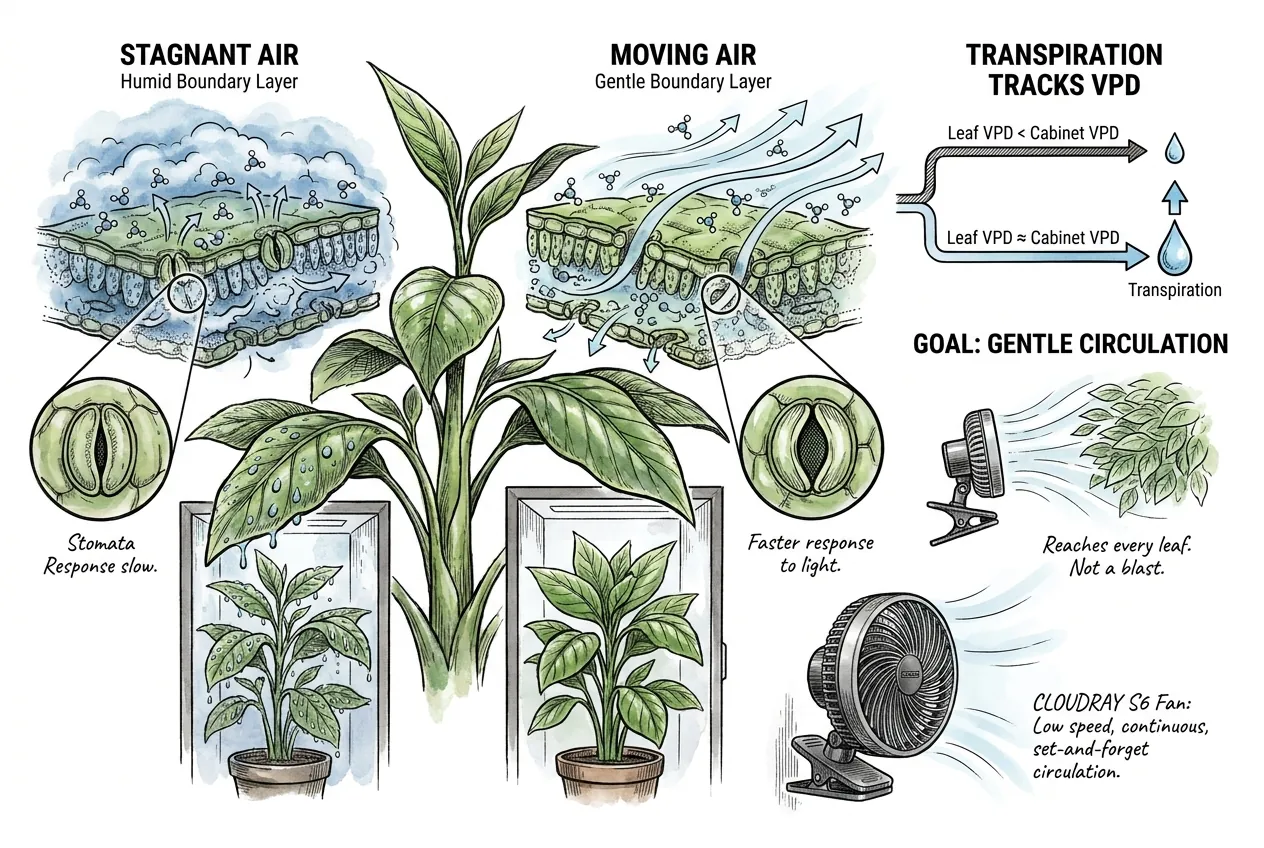
Water vapor leaving a leaf passes through stomatal and boundary-layer resistances in series, so total leaf conductance depends on both.
Boundary-layer conductance depends on airflow near the leaf surface.
When air is stagnant, that film thickens and leaf-zone humidity can climb, so the vapor gradient the leaf experiences differs from the bulk cabinet reading.
Moving air thins the film so conditions at the leaf track the cabinet more closely. The exact leaf VPD still depends on leaf temperature, so this brings the two closer rather than making them identical.
The goal is gentle, continuous circulation that reaches every leaf, not a high-velocity blast that desiccates foliage.
(Some sources also link airflow to faster stomatal response, but that is not the primary reason to run a fan here.)
What fan meets the spec?
AC Infinity Cloudray S6 Clip Fan suits a small cabinet when you need low, adjustable circulation instead of a fixed blast. Clip it to direct air across the canopy, not into one leaf. It is unnecessary for a cabinet that already has even gentle airflow, and its high free-air rating is not a target for a small enclosed space.
Use it clipped to a shelf and aimed across the canopy rather than straight at it.
Its speed range and oscillation are useful if you want set-and-forget circulation. A simpler, cheaper single-speed clip fan can also move enough air in one small cabinet, but you give up fine speed control, and any oscillation mechanism adds a moving part that can wear.
Boundary layer conductance, leaf temperature and transpiration of tree leaves
AC Infinity CLOUDRAY S6 6-inch Clip Fan
Which humidifier holds the band overnight?
Size for Leakage and Safety
Pick a humidifier whose mist output exceeds your cabinet’s leak rate at the target humidity, paired with a tank that survives an unattended cycle.
Just as important, check that it is safe for your setup. Most room humidifiers are not rated for use inside a wet enclosure, so plan to keep the unit outside the cabinet and feed mist in rather than sealing the appliance inside.
A unit with roughly 300 mL/hr output and a several-liter tank suits a small, fairly sealed cabinet, but measure your own leak rate rather than assuming any figure leaves enough headroom.
How do you size mist output and tank volume?
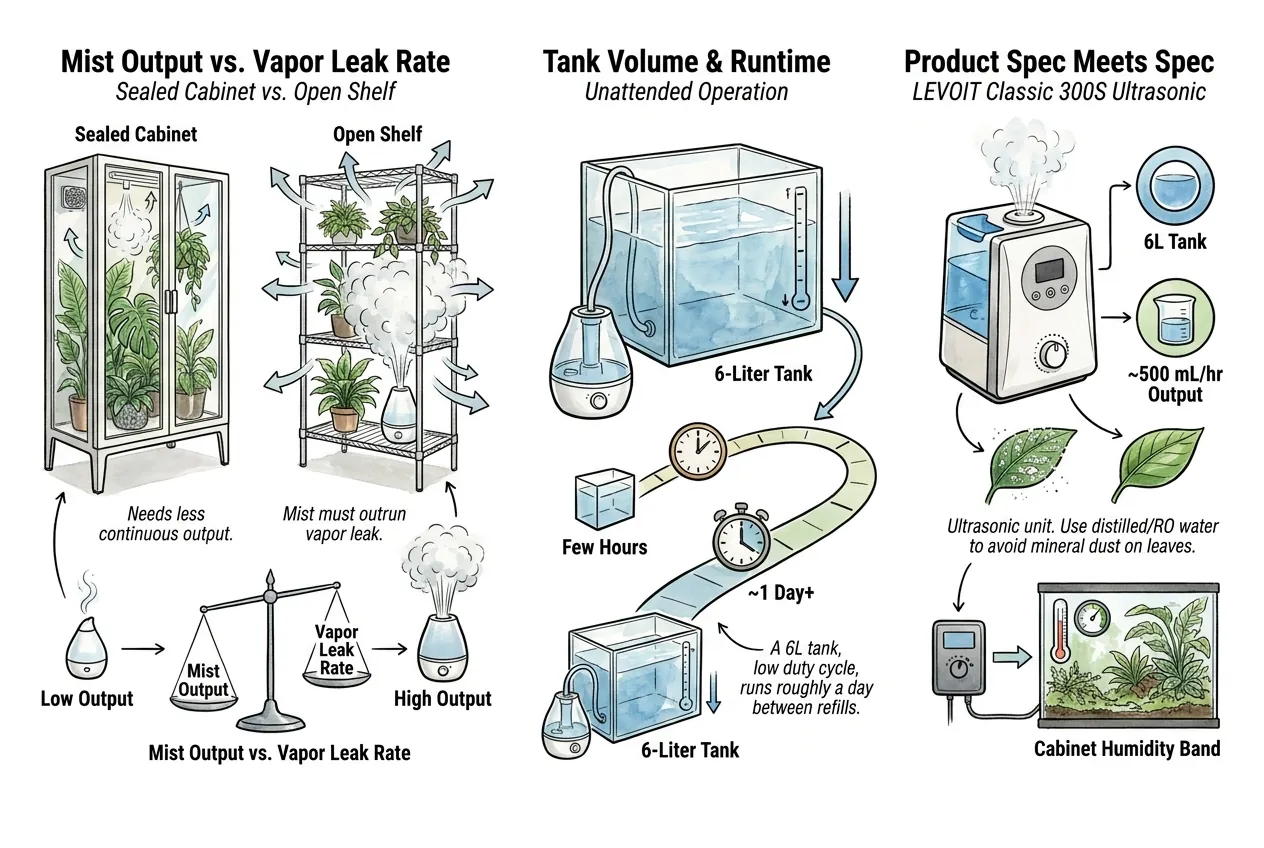
Mist output must outrun how fast your cabinet leaks vapor at the setpoint, and plant transpiration and any ventilation add to the load.
A sealed cabinet usually needs far less continuous output than an open shelf.
Tank volume decides how long it runs unattended. A several-liter tank at a low, controller-gated duty cycle can run roughly a day or more between refills, though actual runtime depends on duty cycle, output, and leakage.
Plan to empty, rinse, and refill with fresh water daily regardless of tank size (see maintenance below).
What humidifier meets the spec?
Levoit Classic300S Humidifier can suit a small cabinet that loses humidity faster than its plants tolerate. It is a room humidifier, not a device to seal inside a wet enclosure.
Keep it, the controller, and electrical outlets outside the cabinet and direct mist in without wetting appliances or foliage. Confirm that it restarts safely after a power cut before connecting a relay controller. Use distilled or reverse-osmosis water if mineral dust would be a problem, and use a separate canopy sensor rather than trusting its built-in reading.
One more caution applies to the onboard humidistat. Its built-in sensor is less placeable and less precise than a dedicated canopy sensor, so use a separate canopy sensor for your VPD reading rather than trusting the internal reading.
LEVOIT Classic 300S Smart Ultrasonic Humidifier
Which thermo-hygrometer lets you actually measure VPD?
Measure at Canopy Height
Choose a digital sensor with stated accuracy and logging, placed at canopy height. You cannot control a VPD you never measured, and VPD needs both temperature and humidity from where the leaves sit.
Why does placement and logging beat raw accuracy?
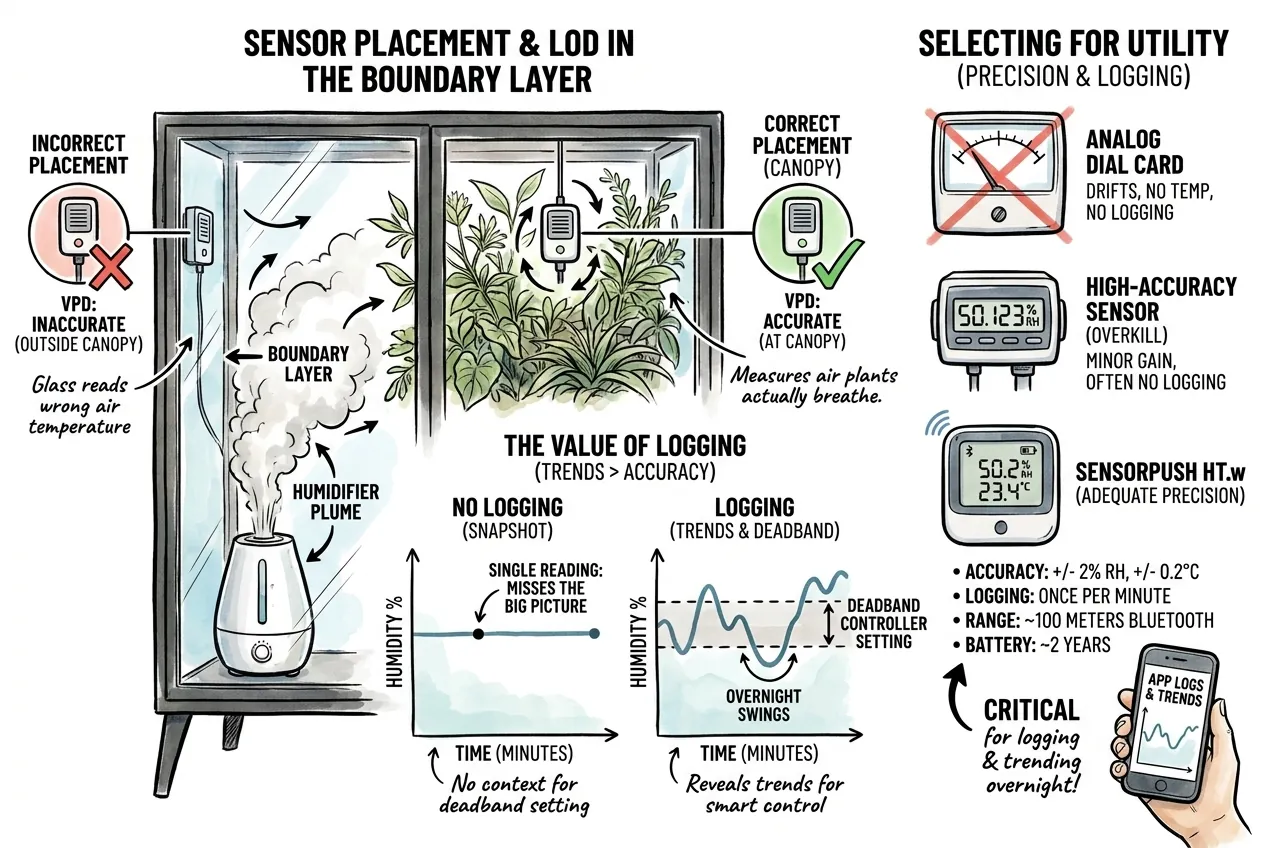
Air conditions at the canopy can differ from those at the door because of gradients, the humidifier plume, and cool glass.
A sensor on the glass or in the plume reads unrepresentative air. The canopy itself also has gradients, so one point is a sample, not the whole cabinet.
For setting a controller, an overnight trend is often more useful than the last decimal of accuracy, since it shows how far humidity drifts.
Sensor accuracy and response time still matter for the VPD number itself.
A stated humidity accuracy near plus or minus 2 to 3 percent and temperature near plus or minus 0.2 to 0.5 degrees Celsius is a reasonable target for hobby VPD monitoring, though how much error you can accept depends on how tight your band is. Many analog dial cards lack a thermometer and can drift, so they are hard to anchor a VPD reading to, but a calibrated thermo-hygrometer dial is a different case.
What precision sensor meets the spec?
HT.w climate sensor suits growers who want overnight temperature and humidity trends before changing a controller setpoint. It is not the best fit if you only want a glanceable display or need away-from-home alerts without adding its optional gateway. Check it against a reference periodically, especially in sustained high humidity.
What is the budget WiFi alternative?
Govee H5179 is the lower-cost choice when phone alerts and Wi-Fi access matter more than a premium sensor specification. It is not useful where the cabinet cannot reach a 2.4 GHz Wi-Fi network, and it still measures air rather than leaf VPD.
Use it when you want a notification the moment humidity leaves the band. Skip it if your cabinet sits out of 2.4 GHz WiFi range, since it does not use 5 GHz.
SensorPush HT.w Temperature and Humidity Smart Sensor
Govee Wi-Fi Thermo-Hygrometer H5179
Which humidity controller automates the RH band?
Stabilize RH Without Pretending It Is VPD
A relay controller with an adjustable setpoint and an adjustable deadband automates a relative-humidity band.
It switches the humidifier on below the setpoint and off above it, and the deadband stops rapid on-off chatter. Be clear about the limit. It stabilizes RH, not VPD.
Because it does not read temperature, VPD still drifts within a fixed RH band as temperature changes, so this is fixed-RH control, not temperature-aware VPD control.
Why does hysteresis stabilize the band?
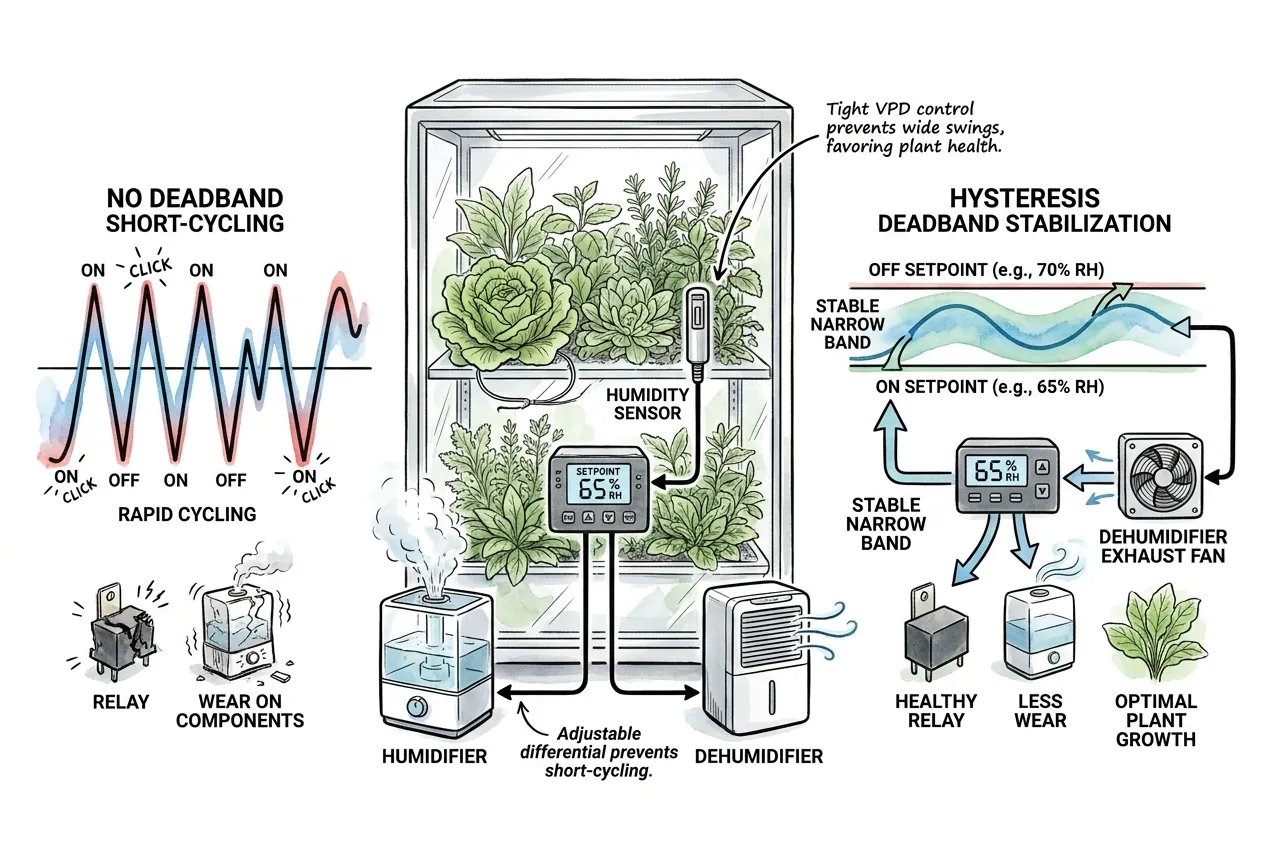
A setpoint with no deadband can short-cycle, clicking on and off frequently and wearing both relay and humidifier. How fast depends on the device, output, and inertia.
A deadband lets humidity ride inside a narrow band instead.
Steadier conditions are the general direction the lettuce study points toward, but that study did not test this RH deadband, so do not read it as a guarantee.
A dual-relay controller like this one can also drive a dehumidifier or exhaust on the second outlet to hold the band from both sides.
What controller meets the spec?
Inkbird IHC200 suits a cabinet that needs automatic RH control after you have measured its temperature and humidity pattern. Put its probe at canopy height and keep the controller and mains outlets dry outside the cabinet.
Use a modest RH band that avoids short cycling, then widen it if the humidifier turns on and off too often. This controller does not read temperature or calculate VPD, so cross-check it with the separate logging sensor and use that sensor for the VPD estimate.
Inkbird IHC-200 Digital Humidity Controller
How do you set up the cabinet in the right order?
Commission From Measurement Outward
Commission the system from measurement outward, so each tool is tuned to real data. Before that, handle safety. This setup mixes water, ultrasonic mist, and mains-powered devices.
Power the humidifier, controller, and fan from a GFCI/RCD-protected outlet, keep plugs and the controller box outside the cabinet in a dry spot, form a drip loop in each cord, place a tray or leak sensor under the humidifier, respect each device’s wet-location rating and load limits, watch for condensation, and never aim mist directly at plants, sensors, or appliances.
What is the commissioning sequence?
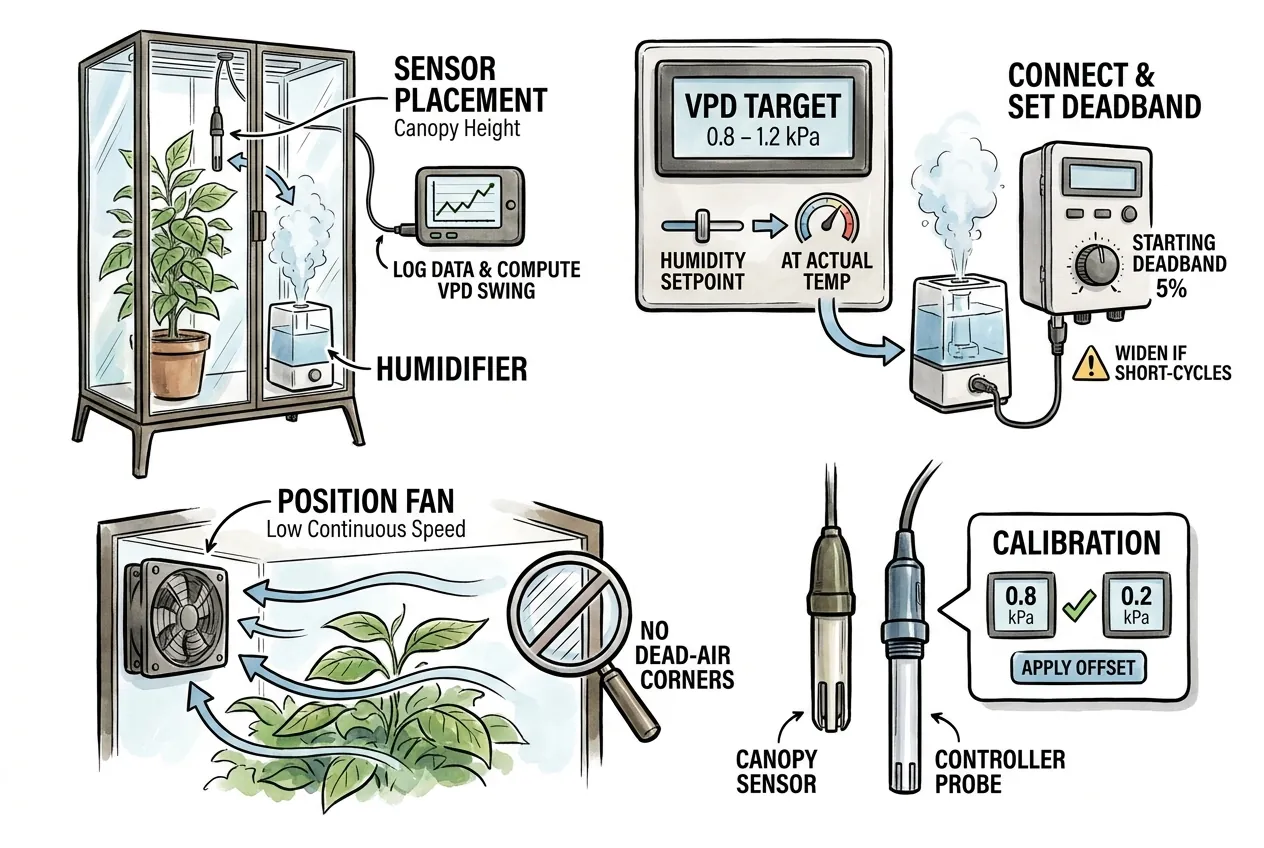
First, place the sensor at canopy height, away from the humidifier plume and the glass. Log temperature and humidity for a day or two and compute air VPD to learn the overnight swing.
Second, pick a VPD target near 0.8 to 1.2 kPa and translate it to a humidity setpoint at your cabinet’s actual temperature, because temperature drifts, revisit that setpoint if the cabinet warms or cools.
Third, plug the humidifier into the controller and set the band with a starting deadband around 5 percent (a common starting value, not a universal one), widening it if the unit short-cycles.
Fourth, position the fan to move air gently across the canopy on a low continuous speed and confirm no dead-air corners.
Finally, compare the canopy sensor against the controller probe under steady conditions and apply the controller’s calibration offset, remembering that offset is in percent RH.
How does this connect to a broader cabinet build?
Humidity and airflow are only one layer of an enclosed setup.
Light, substrate, and ventilation interact with them, and a sealed cabinet also raises questions of carbon dioxide replenishment, heat load, condensation, and electrical safety.
For the wider build context including airflow and grow lights, see our mini greenhouse indoor guide.
Think of VPD as the index that links temperature and humidity. Airflow and leaf temperature shift the leaf-level value, and no single RH relay controls all of these at once.
Mini Greenhouse Indoor Guide. VPD, Airflow and Grow Lights
Who should not buy each class of product?
Buy Only What the Cabinet Needs
Not every grower needs every tool, and some upgrades are wasted on a small build. Match the purchase to your cabinet and your tolerance for fuss.
When should you skip the premium options?
You can choose a simpler single-speed clip fan over an app-controlled oscillating model if you run one small cabinet, since either can move enough air. You mainly trade away speed control and oscillation.
Do not skip air movement entirely, since stagnant, humid air is one contributor to leaf disease alongside wetness, inoculum, and sanitation.
Skip a larger-tank humidifier if your cabinet is tiny and well sealed, since a smaller tank is less awkward to refill and empty daily.
Skip ultrasonic with tap water if mineral dust on leaves bothers you, and prefer distilled or RO water in any case.
Skip the premium logging sensor if you never log and only want a glance number, but check the accuracy and placement of any built-in humidistat you rely on instead.
Skip the controller only if your humidifier has a trustworthy, well-placed built-in humidistat and you accept wider swings.
How do you maintain the system and spot failure modes?
Plan for Cleaning and Drift
Plan for cleaning and drift, because every tool here degrades in a predictable way. Light, regular maintenance prevents the failures that quietly push your cabinet out of band.
What are the failure modes and service intervals?
The humidifier scales on its ultrasonic disc and grows biofilm in the tank, and ultrasonic units can aerosolize both minerals and microbes.
Empty, rinse, and refill with fresh water daily, clean the tank on the manufacturer’s schedule (Levoit calls for weekly cleaning. EPA suggests cleaning portable humidifiers roughly every three days), and rinse and dry thoroughly.
Descaling with vinegar removes mineral scale but is not a full disinfection step, so follow the manufacturer’s cleaning and disinfecting instructions and use low-mineral water.
The fan loads up with dust and its bearings eventually wear, so wipe the blades periodically and expect multi-year life from a quality EC motor.
Humidity sensors can drift, so periodically compare against a known reference and adjust if needed rather than assuming a fixed annual interval, and replace the SensorPush battery roughly every two years.
The controller relay has a finite number of switching cycles. A wider deadband reduces switching and extends relay life, and relay chatter is the warning sign that your deadband is too tight.
SensorPush HT.w (battery life and calibration context)
What do buyers still ask about plant cabinet VPD gear?
Start With the Practical Constraints
These are the common objections buyers raise before assembling a kit. Note that the biggest gaps are often practical. Wet-use rating, auto-restart after a power cut, GFCI protection, and condensation.
Can I skip the controller and run the humidifier on a timer?
A timer cannot react to humidity, so it overshoots at night and undershoots when the cabinet leaks. A controller with a deadband reacts to the actual reading.
That matters because VPD stability, not just the average, affected growth in at least one controlled-environment study.
Whether the controller is the best next spend depends on your ambient humidity, cabinet leakage, and budget.
Remember it stabilizes RH, not VPD, so temperature changes still move the VPD.
Is a cheap analog hygrometer dial good enough?
Usually not for VPD. Many analog cards give no temperature, so you cannot compute VPD, and they can drift over time.
A calibrated thermo-hygrometer dial that reads both temperature and humidity is a different case.
A digital sensor with stated accuracy, and known high-humidity behavior, is the practical baseline for this approach. Without a temperature reading, VPD is a guess.
What is the minimum viable kit versus the full kit?
The minimum viable kit is an accurate sensor plus a fan, so you can measure VPD and circulate air.
That helps with stagnant-air problems, but it will not fix conditions that are already too dry, or issues from wet leaves, pathogens, or poor sanitation.
The full kit adds a controller-gated humidifier to hold the RH band automatically overnight, provided the humidifier is safe to use and compatible with relay switching.
Build up to it as your collection and your tolerance for manual tweaking demand.
Affiliate Disclosure
This article contains Amazon affiliate links. As an Amazon Associate I earn from qualifying purchases. If you use these links, the site may earn a commission at no extra cost to you. Product availability, price, and specifications can change. Check the current listing before buying.