
Aroid Semi-Hydro Root Rot Fix: EC and Oxygen Diagnostic
Aroid semi-hydro root rot: how to read reservoir EC, keep the water oxygenated, and trim rot back to firm tissue. What the evidence supports, and what it does not.
Elena Vargas · Published 2026-07-27 · 38 min read
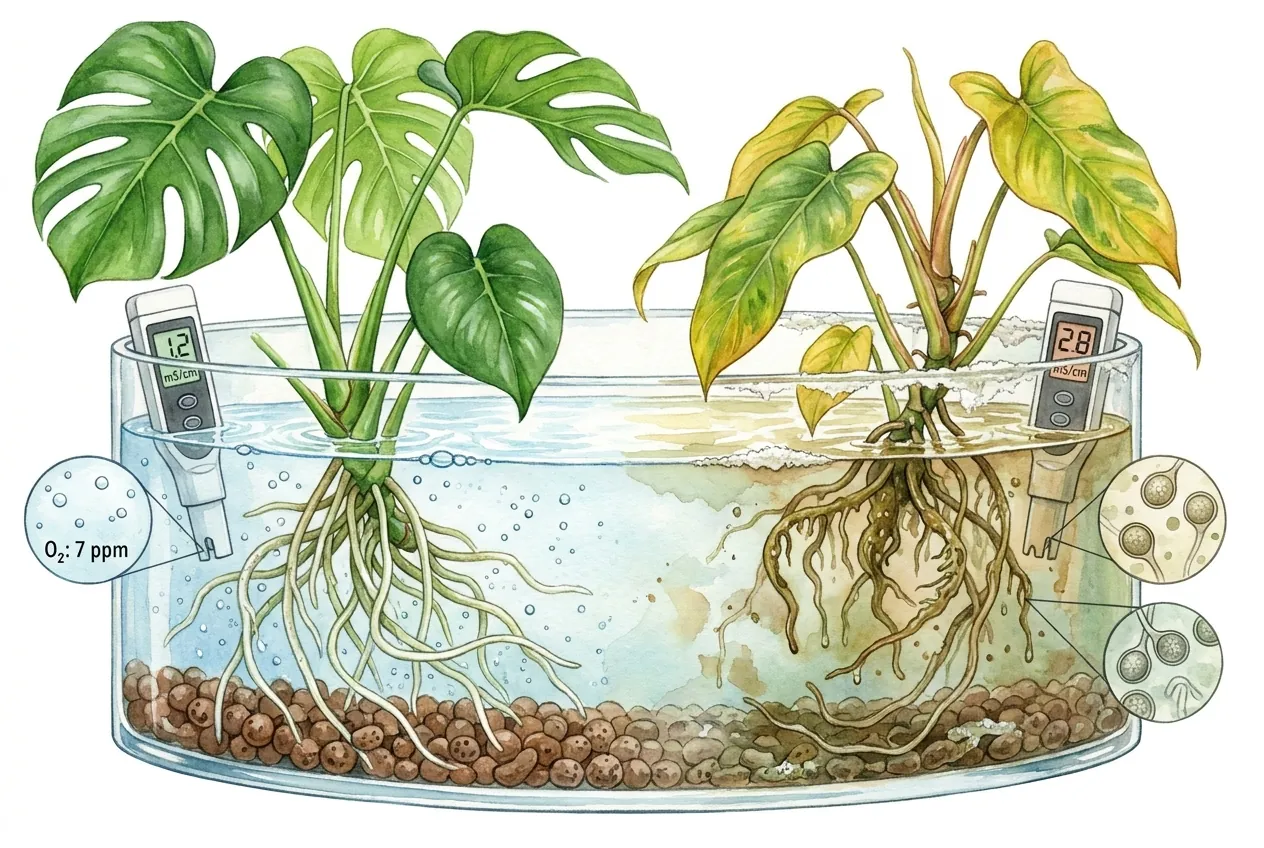
Key Takeaways
- A low-to-moderate reservoir EC around 0.8 to 1.5 mS/cm is a reasonable starting band for many aroids. Refine it against your water and plant rather than treating it as a hard threshold.
- Keep the reservoir oxygenated and avoid a persistently stagnant root zone. Hydroponic sources suggest holding dissolved oxygen above roughly 6 ppm, but the exact aroid threshold is not established.
- Anchor targets to EC because the same water can show very different ppm values on different conversion scales. A raw EC reading removes that hidden factor.
- The durable root-rot fix is trimming failed tissue back to firm root and re-establishing the plant in fresh, oxygenated, low-salt water. Hydrogen peroxide is not a proven plant treatment.
- Refresh the reservoir when readings, smell, and root condition indicate drift, then top off with plain water between changes. Adding more nutrients by reflex can worsen salt buildup.
Your Monstera looked fine for a week or two in LECA, and now the base is mushy and the water smells like a swamp.
A soft, foul-smelling base a couple of weeks into a conversion is a common failure pattern, not simply bad luck.
Soil roots and water roots behave differently. A soil-root ball held in still water can run short of oxygen even though it is fully wet.
Rescue a failing conversion with fresh, low-salt water, an air gap, and targeted removal of rotten tissue rather than a stronger chemical. Read EC as one clue, then inspect the roots before deciding what to change.
Why do aroids get root rot after converting to LECA?
A common pattern in failed conversions is oxygen starvation setting in first, with a pathogen following into already-weakened tissue.
This is a useful mental model rather than a proven sequence for every plant.
A soil-grown aroid root develops in a moist-but-aerated substrate. It depends on oxygen diffusing in from air-filled pore spaces, and dropping it into a reservoir can collapse that supply.
Roots that have adapted to water can move oxygen internally more effectively. Freshly converted soil roots have not yet made that adjustment, so they are especially vulnerable in a full, stagnant reservoir.
A barrier to radial oxygen loss helps the root system cope with waterlogging-induced hypoxia
Radial Oxygen Loss from Plant Roots. Methods
Against a grid, I photograph the cleaned root system and mark which roots were above, within, and below the reservoir line. Firm water-adapted roots and soft legacy roots can occupy different zones after conversion.
Before removing tissue, I update the overlay and repeat it when new roots appear. The map helps me compare the decline with the standing-water zone and damaged soil roots instead of blaming LECA as one uniform condition.
What actually happens during the week 2-4 melt?

Early decline is often an energy problem, not just a fungus.
When oxygen falls, roots cannot produce energy efficiently. Tissue weakens, microbes multiply more easily, and the outer root layer can begin to break down.
Do not use a dissolved-oxygen number from another crop as an aroid survival threshold. Treat stagnant water, sour smell, and soft roots as the practical warning signs to act on.
A review of soil waterlogging impacts, mechanisms, and adaptive strategies
The responses of pepper plants to nitrogen form and dissolved oxygen concentration of nutrient solution in hydroponics
Dissolved Oxygen and Water (USGS Water Science School)
Is the rot a disease or a plumbing problem?
Often both, and hypoxia frequently comes first. The classic dark, wet, disintegrating look can be Pythium or Phytophthora moving into tissue that low oxygen already weakened, but the same appearance can also come from non-infectious prolonged submersion or other bacteria, so appearance and timing alone do not confirm which pathogen, if any, is present.
Cornell’s greenhouse program describes Pythium causing a dark brown to black wet rot that makes roots soften and disintegrate, favored by wet, poorly drained conditions.
Warm water can make root-zone problems worse in two ways. Warmer water holds less oxygen, and warmth can speed some pathogens.
Pythium is a genus, though, and different species prefer different temperatures, so there is no single temperature window that suits all of them.
Summer conversions do seem to fail more readily, which fits the oxygen picture. Practically, treat visible rot as a sign of a poor root environment.
Cool the reservoir, keep water levels modest, and refresh regularly to limit the buildup of waste and microbes.
If you want to confirm a specific pathogen, that requires lab culture or molecular testing rather than a visual call.
A useful expectation during conversion
Expect some of the old soil roots to die back during a conversion. What matters most is whether new water roots establish before the base rots.
That does not mean deliberately stripping healthy original roots. Keep the firm, sound ones and remove only tissue that has actually failed.
Root Rot Diseases factsheet (Cornell University Greenhouse Horticulture)
Lechuza Pon Semi-Hydro Transition (plantblueprint.com)
What EC should a semi-hydro reservoir be for aroids?
A reasonable starting point for a converting aroid reservoir is roughly 0.8 to 1.5 mS/cm, with something above about 2.5 mS/cm worth investigating as possible salt buildup and something very low suggesting little is being fed.
Treat these as working guides, not measured aroid thresholds.
Aroids usually need lighter feeding than fruiting crops. The exact EC depends on the species, light, fertilizer, and starting water, so begin conservatively and adjust from new growth and reservoir drift rather than treating the band as a proven aroid threshold.
Electrical conductivity measures the total ion concentration a current can travel through.
In a sensible range, ions are available without the outside solution being salty enough to pull water back out of the root.
Too low can mean little to feed on. Too high can drop the water potential outside the root below the inside, so the root struggles to pull water even while submerged.
Alocasia has a reputation for salt sensitivity, so keeping it toward the low end is a conservative hedge, though this rests on grower experience rather than a genus-wide trial.
Aroid reservoir EC quick reference (mS/cm)
| Reading | Meaning | Action |
|---|---|---|
| Below 0.5 | Under-fed | Top up with nutrient solution |
| 0.8 to 1.5 | Healthy target band | Hold. Monitor drift |
| 1.5 to 2.5 | Getting salty | Dilute with plain water |
| Above 2.5 | Salt-buildup warning | Full reservoir change |
Testing Container Media (Neil Mattson, Cornell University Floriculture Extension)
Monitoring and Managing Soluble Salts in Ornamental Plant Production (FS848)
What does rising versus falling EC tell me?

Drift direction is a clue, not a diagnosis on its own. Between refreshes, EC reflects the combined effect of water uptake, nutrient uptake, evaporation, top-offs, and even precipitation, so read it as one signal among several rather than a verdict.
EC climbing, especially as the water level drops, is often the plant drinking water faster than it takes up ions while evaporation concentrates what is left.
If salts are genuinely building, diluting with plain or low-EC water is a reasonable short-term response, after checking your source water’s own EC and pH.
EC falling is consistent with the plant taking up ions faster than water, which can indicate active, healthy roots.
It can also come from simple dilution or from ions dropping out of solution, so it is not proof on its own.
If the plant is clearly growing, feeding on your next change is usually enough.
A flat or suddenly crashed EC on a declining plant is the one to take seriously, because roots that have stopped functioning stop taking up much of anything.
But a sensor error, low demand, or a balanced draw can also flatten the number, so confirm it rather than assume dead roots.
When a plant is visibly declining, do not reflexively add fertilizer. Inspect the roots directly and work through the oxygen and rot sections.
Stronger feeds tend to raise EC over time, but one reading cannot diagnose a reservoir by itself. Check the water level, source-water EC, visible growth, and root condition together.
The two-Philodendron test
Picture two failing Philodendrons. One reservoir reads EC 3.1 and is half empty, which is consistent with the plant drinking and concentrating salts.
Diluting is a sensible first move once you have checked the source water and meter.
The other reads EC 0.4, is full, and has browning roots. That combination points more toward roots that have stopped functioning than toward hunger, but pull the plant and inspect the roots to confirm before deciding.
Can EC read normal and still hide a problem?
Yes. EC is a sum, not a spectrum. It measures total ions, not the right ions.
EC can stay on target while the nutrient balance drifts. Different ions build up or are used at different speeds, especially with hard tap water and repeated top-offs.
That is why a normal EC is not an all-clear. Refresh the whole reservoir periodically instead of adding nutrient to the same water indefinitely.
So do not treat a single in-band EC as an all-clear, especially on hard water. A full reservoir refresh, rather than endless top-offs, resets the ion mix, which is why starting-water quality matters as much as the reading itself.
Recycling Nutrient Solution Can Reduce Growth Due to Nutrient Deficiencies in Hydroponic Production
Electrical conductivity of nutrient solution influenced photosynthesis, quality, and antioxidant enzyme activity of pakchoi in a hydroponic system
Corrective Procedures for High and Low Substrate pH and Electrical Conductivity (MSU Extension)
How do you convert EC mS/cm to TDS ppm?
Use EC whenever possible, because ppm depends on the conversion scale chosen by the meter. A 500-scale and 700-scale pen can display different ppm values for the same water.
Check the meter manual before comparing a ppm recipe with your own reading. If the scale is unknown, use a calibratable EC meter or treat the ppm number only as a trend on that one device.
Translate the aroid EC band to your meter
| EC (mS/cm) | 500-scale ppm | 700-scale ppm |
|---|---|---|
| 0.8 | 400 | 560 |
| 1.0 | 500 | 700 |
| 1.2 | 600 | 840 |
| 1.5 | 750 | 1050 |
| 2.0 | 1000 | 1400 |
The table is a quick conversion reference, not a feeding recipe. If a ppm-only meter does not state its scale, cross-check it against a known EC before using a target from another source.
Bluelab. What are the different conductivity scales? What do they mean?
Hanna Instruments. GroLine HI98131 Waterproof Pocket Tester
Myron L Company. Standard Solutions and Buffers
Why does my reading drift when the water warms?
Warm water can make raw conductivity look higher without a real salt increase. A meter with automatic temperature compensation makes readings easier to compare.
If your meter lacks that feature, read at a similar water temperature each time. A warm afternoon alone is not a reason to flush or fertilize.
What is ATC? (Bluelab)
What is Automatic Temperature Compensation in Hydroponics? (Growee)
How much dissolved oxygen do semi-hydro roots need?
A practical aim is to keep the water well oxygenated rather than stagnant. Hydroponic guidance often points to roughly 6 to 8 ppm dissolved oxygen as comfortable, with the low single digits being where roots in those studies begin to suffer.
These figures come from crops like pepper, lettuce, basil, and spinach, not from aroid trials, so treat them as a general direction rather than an exact aroid threshold.
Roots are living tissue that respire. They use oxygen dissolved in the water, and if that runs low the root cells can be stressed before the leaves show anything.
One physiology review points to slowed root growth and browning below roughly 3 to 4 mg/L in the systems it covers, and Cornell’s Neil Mattson recommends keeping the hydroponic root zone above about 6 ppm, ideally near saturation of 8 to 9 ppm, to help suppress disease.
Different crops and adaptation states shift these numbers. Established, water-adapted lettuce roots, for instance, have tolerated dissolved oxygen down to about 2.1 mg/L.
If you can measure dissolved oxygen, aiming for the higher end is a safe bet while soil roots are still adapting.
If you cannot, focus on the setup so the water never sits stagnant long enough to run low.
Oxygen in the root zone and its effect on plants
Pythium root rot on hydroponically grown basil and spinach (Neil Mattson, Cornell)
Why is warm water a double hit?
Warm water holds less oxygen and tends to make roots demand more of it. That two-way squeeze is one of the more important physical effects to keep in mind.
Oxygen solubility falls as water warms. At sea level, Auburn University data documents saturation dropping from about 10.07 mg/L at 15°C to 8.24 mg/L at 25°C and 6.41 mg/L at 40°C (values shift with pressure, altitude, and salinity).
Root respiration also tends to rise with temperature, roughly doubling per 10°C over the usual range as a rule of thumb rather than an exact law for every plant.
So a warm summer reservoir can get squeezed from both ends, with less supply and more demand.
A jar that stays healthy at 20°C in spring may be more likely to tip into rot at 28 to 30°C on a July windowsill.
Low oxygen plus warm water is also conditions many Pythium species favor. Oxygen-starved roots can leak more sugars and amino acids into the water, which chemically attract zoospores.
Keeping the root zone cooler, roughly the upper 60s to mid 70s Fahrenheit, and the water moving is sensible prevention, though some Pythium species remain active in cooler water too.
Oxygen saturation falls as water warms
| Water temp | Saturation DO (mg/L) | Root oxygen demand |
|---|---|---|
| 15°C (59°F) | 10.07 | Low |
| 20°C (68°F) | ~9.0 | Baseline |
| 25°C (77°F) | 8.24 | Higher |
| 30°C+ (86°F+) | ~7.5 and falling | Roughly double the 20°C rate |
Dissolved oxygen requirements in aquatic animal respiration (Claude E. Boyd, Auburn University)
Dissolved Oxygen. Fundamentals of Environmental Measurements (Fondriest Environmental)
Passive or active aeration (which does my reservoir need?)

Start passive. In passive semi-hydro, much of the oxygen comes from the air gap above the water line, with the medium’s pores and the water surface also contributing.
The medium wicks water upward while roots above the water line take in oxygen from the humid air column.
Keeping the water line a couple of centimetres below the main root mass, often around 2 to 3 cm, leaves most roots in the air gap. Do not top the reservoir to the crown.
As the Foliage Factory grower guide puts it, good semi-hydro care keeps roots supplied with water and oxygen at the same time, not constantly wet.
The right gap depends on your pot height, medium, wicking, and how fast the plant drinks, so adjust it to your setup.
Consider active aeration, a small air stone or pump, when the reservoir is deep, the room is persistently warm, the root ball is dense and submerged, or the plant is high-value.
Many houseplant-scale conversions get by without it, but that is a heuristic, not a tested rule.
If you do run a mains-powered air pump near water, follow the manufacturer’s instructions, plug it into a GFCI outlet, use a check valve to prevent back-siphoning, and leave a drip loop in the cord so any runoff drips off before it reaches the plug.
Keep the pump and cord rated for the use and protected from splashes.
The medium changes where you set the water line. Round LECA is usually rated a low-to-moderate wicker, so a low water line can leave the crown roots dry unless you add a cotton wick or cap the top with a finer medium.
Pon and Seramis are stronger wickers, which lets them support a lower water line, though stronger wicking also raises saturation near the crown, so watch that the top does not stay soggy.
The decision tree in one path
Lower the water for a 2 to 3 cm air gap. Fix wicking if the top dries. Refresh more often and move off hot surfaces.
Only then, if the reservoir is deep or the room stays hot, add an air stone on a GFCI outlet with a drip loop in the cord.
Semi-Hydro Substrates. LECA, Pon and Minerals (Foliage Factory)
Potting Configurations in Semi-Hydroponics (LECA Addict)
Effect of dissolved oxygen concentration on lettuce growth in floating hydroponics
How do you tell root rot from healthy water roots?
Judge mainly by firmness, then color, smell, and how the tissue holds together. Firm and springy roots are keepers.
Mushy tissue that is soft, foul-smelling, and whose outer layer slips off is what you remove.
Some extension sources describe healthy roots as white, but healthy roots can also be tan, brown, or reddish depending on species, age, and staining from the medium, so color alone is not reliable.
The most telling field test is the pinch. On a rotten root the outer layer slips off like wet skin, and the tissue often gives off a sour, swampy smell.
Firmness and that sloughing, together with the smell, tell you more than color.
The usual mechanism is that the soft outer cortex breaks down first in low-oxygen water while the tougher inner strand resists longer, which is why the sheath pulls away from a surviving thread.
A brand-new water root is firm and pale, not slimy, so do not mistake normal translucency for rot.
Identifying Root Rot. NC State Extension (Burke County Center)
Pythium Root Rot. UC Statewide IPM Program
How much root can I safely cut, and how do I do it?

Remove tissue that is clearly soft, sloughing, or foul-smelling, cutting back to firm root, and try to preserve as much sound tissue as you can.
What survives matters more than what you cut, so lean toward minimal, targeted removal rather than clearing every off-color spot, since staining and older healthy roots can look discolored without being rotten.
The more of the healthy root system that remains, the better the odds, and the reverse when little firm tissue is left.
There is no reliable published percentage that predicts recovery for an infected aroid, so treat any rule of thumb about a third or half as loose guidance rather than a number to act on.
Roots supply water and nutrients, so a plant left with few working roots can struggle to support its existing leaves.
In severe cases, reducing leaf area can ease that load, and a badly affected plant is sometimes better salvaged by re-rooting the healthiest growth point than by propping up a rotten stub.
How far to go is a judgment call for the individual plant, not a fixed ratio.
The do-no-harm sequence
Unpot and rinse under lukewarm water. Inspect under bright light. Trim failed roots back to firm tissue with a sanitized blade.
Let the cut surfaces drain and dry briefly before replanting, but do not leave exposed tropical roots out long enough to desiccate. Work efficiently rather than to a fixed timer.
Re-establish in freshly rinsed media with a lower-EC, better-oxygenated reservoir, and hold off on full-strength fertilizer while the roots recover.
Sanitize the blade, because a dirty blade can spread rot between cuts and between plants. First wipe off soil, sap, and debris, since disinfectants work poorly over grime.
Iowa State Extension gives two options.
A fresh 1-to-9 bleach dilution (add bleach to water, use it within a couple of hours) needs a soak of at least 10 minutes, then a rinse to prevent corrosion.
A 70 percent isopropyl alcohol wipe or dip acts quickly and does not corrode. Wear gloves and eye protection, and be aware that neither method is guaranteed against every pathogen.
For a quick single-plant rescue, the 70 percent isopropyl wipe on clean snips is fastest. If you are cutting through active rot across several plants, use a bleach soak cup and give the blade the full soak time between plants. A quick re-dip that skips the 10 minutes does little.
How Do I Sanitize My Pruning Shears? Iowa State University Extension
Does hydrogen peroxide cure root rot?
No. Hydrogen peroxide is a weak surface sanitizer at best, not a cure, and the available research does not support pouring or dipping it on aroid roots as a treatment.
It is also not a plant-labeled product.
The most relevant data is a controlled orchid study. Root systems were dipped for 3 minutes, once, in 0, 3, 6, or 12 percent hydrogen peroxide and tracked for 27 days on a 1-to-5 health scale.
Even the 3 percent dip lowered root-health score, from 5 to about 4.13, so it caused a real setback rather than being harmless.
It collapsed to 1.13 at 12 percent, with permanent damage and foliage wilt at 6 and 12 percent.
And the 3 percent dose did not control the target algae it was meant to. The authors’ takeaway was to be cautious with peroxide dips and focus on good basic care, not to recommend them.
Why a Peroxide Dip Is Not a Safe Default
There is no evidence that any concentration of hydrogen peroxide reliably and safely treats aroid root rot, and higher concentrations clearly damage roots.
If you nonetheless choose to experiment, the only concentration that is even arguably tolerable is ordinary household 3 percent, never the 10, 12, or 35 percent concentrates, and understand that it may still set the plant back and will not cure rot.
Peroxide is a reactive oxygen species. Plants can scavenge small amounts, but higher levels oxidize membranes and cause cell death, which is what the 12 percent orchid data shows.
Pouring concentrated peroxide on a rotting root ball can finish off roots that were still viable.
A separate ebb-and-flow hydroponics study is sometimes cited as support, but its three-percent peroxide treatment was 50 mL of three-percent stock added to a 40-gallon system, a final concentration around 10 mg/L, not a direct three-percent dip.
It found control and that diluted treatment grew the best lettuce while stronger products restricted growth, and no treatment controlled algae.
The reliable fix remains trimming plus fresh media plus oxygenated, low-EC water.
Protect yourself, not just the plant
Many aroids carry insoluble calcium-oxalate raphides in their sap, microscopic needle crystals that can cause burning, swelling, and dermatitis on contact and can injure eyes.
Wear nitrile gloves and eye protection during a trim, and keep cut sap away from eyes and mouth.
On skin contact, wash with soap and water, if sap gets in the eyes, flush with plenty of water for about 15 minutes and seek medical advice if irritation persists.
Contact severity varies between species, so err on the side of caution.
Characterizing the Phytotoxic Effects of Hydrogen Peroxide Root Dips on Hybrid Phalaenopsis Orchid Plants
Effects of Hydrogen Peroxide Products on Basil, Lettuce, and Algae in an Ebb and Flow Hydroponic System
Hydrogen Peroxide Signaling in the Maintenance of Plant Root Apical Meristem Activity
Dieffenbachia and Philodendron. Popular but Poisonous. National Capital Poison Center
Which meter, media, and nutrients should you actually buy?
The most useful single purchase is a temperature-compensated EC meter with a stated accuracy class. Everything else follows your specific failure mode.
The two specs worth prioritising are ATC and a published accuracy figure, often expressed as a percent of full scale.
Without ATC, a 30°C reservoir reads several percent high versus the same water at 25°C, so the meter can flag a salt buildup that is really just a warm afternoon.
A meter that reports EC in mS/cm directly is easier to work with, since ppm-only meters hide the 0.5, 0.65, or 0.7 factor.
Bear in mind that a good meter measures the water well. It does not confirm that a given target is right for your plant.
Which EC or TDS meter should I buy?
Apera EC60
This is a fit when you need a dedicated EC meter that compensates for temperature and can be recalibrated. Those features make repeated reservoir readings easier to compare, but it costs more than a basic pen and adds little if you already own a reliable, calibratable ATC meter.
Bluelab pen
This fits if mismatched ppm scales are your main problem, because it can display raw EC instead. Keep the probe clean and check it against a standard periodically. It measures conductivity and temperature, not pH, so it is not a one-tool solution for a grower who also needs pH readings.
Hanna DiST 1
The Hanna DiST 1 is a simpler option when you only need a consistent ppm trend. Its fixed 500-scale reading makes it less convenient for 700-scale or EC recipes, so check the conversion before acting on outside advice.
Apera Instruments EC60 Premium Pocket Conductivity/TDS Tester
Bluelab Conductivity Pen (EC/ppm/CF with ATC)
Hydroponics and Nutrient Application (Greenhouse Product News)
LECA or Pon (which media fits my failure mode?)
Match media to the failure. Airy LECA suits rot-from-stagnation, while a zeolite-based mineral mix like Pon buffers cations and wicks more steadily, which some growers prefer.
Check whether the specific product you buy is pre-fertilized or not, because that changes how you feed it.
LECA is thermally expanded clay fired at high temperature and is fairly pH-stable, though it is not perfectly inert and does hold some water and nutrients, with lot-to-lot variation.
It feeds little on its own, so pair it with a complete hydroponic nutrient. Rinse it thoroughly before first use to shed clay dust.
Lechuza BASIC-PON
Lechuza BASIC-PON suits a plant that needs steadier moisture than bare LECA provides. It is not pre-fertilized, so pair it with a complete nutrient from the start and do not choose it if your current failure is a persistently soggy crown.
LECA versus Pon
| Feature | LECA | Lechuza-Pon |
|---|---|---|
| Feeds the plant | Little on its own | Depends on product. BASIC-PON is not pre-fertilized |
| Air versus water hold | More air, less water | More water and wicking |
| Best for | Rot-from-stagnation, oxygen-first | Steadier moisture and EC |
| Prep | Rinse dust, add complete nutrient | Rinse. Feed on demand (BASIC-PON) |
| Cost | Cheaper, reusable | Pricier |
When BASIC-PON fits
This mineral mix suits a grower who wants steadier moisture and gentler EC swings than bare LECA, thanks to its zeolite fraction.
BASIC-PON feeding requirement
The Lechuza BASIC-PON product is not pre-fertilized, so you must feed it with a complete nutrient from the start rather than relying on a built-in charge.
Use it in a net pot with a passive reservoir and feed on demand.
The tradeoff is that it costs more than LECA and holds more water, which is less ideal if your actual problem is stagnation.
And because it is unfertilized, leaving it unfed for months will starve the plant.
LECA pebbles
LECA pebbles suit rot caused by stagnant conditions because their large pores support an air gap. They do not create oxygen on their own, so set the water line correctly, supply complete nutrition, and rinse the media thoroughly before first use and between plants.
The tradeoff is that it feeds little on its own, so you must supply a complete nutrient when you refresh the solution, and it wicks less moisture to the crown than Pon.
AC Infinity Net Cups
For pot geometry, slotted mesh net pots such as the AC Infinity net cups let more root surface sit in the air gap, though the mesh alone does not set your oxygen level. The water line and root size do.
Size up for a mature Monstera, since 3 inches is small for a large aroid.
AC Infinity Slotted Mesh Net Cups, 3 inch
What nutrient does inert media need?
LECA supplies almost no nutrition, so pair it with a complete hydroponic nutrient dosed low.
A starting EC around 0.8 to 1.2 mS/cm is reasonable for aroids, then adjust to your water and plant.
Look for a formula that includes calcium, magnesium, and sulfur, the secondary nutrients missing from many houseplant foods and important when the medium contributes little.
General Hydroponics MaxiGro
General Hydroponics MaxiGro fits a grower who wants one complete nutrient rather than a multi-bottle routine. Start with a low dose and confirm the mixed EC with your own meter. Its fixed ratio is less useful when you need to fine-tune individual nutrients.
General Hydroponics FloraSeries
General Hydroponics FloraSeries is a multi-part nutrient line. It makes sense when you are willing to mix separate parts and adjust feeding by growth stage, not when you want one simple complete solution.
Use the complete set and follow the maker’s feed chart rather than improvising with only part of the system. It offers more control than a one-part fertilizer, but the mixing and ratio adjustments are unnecessary complexity for a simple recovery setup.
Hydrogen peroxide boundary
Hydrogen peroxide is not a plant-labeled root treatment, and the evidence does not support dosing it into a reservoir or dipping roots in it to fix rot.
Products like household 3 percent peroxide are sold as topical antiseptics for people, and that human-use label says nothing about plant safety or efficacy.
If you keep some on hand, treat it as a general surface cleaner, not a root cure, and never use the 10 to 35 percent concentrates near roots.
How often should you refresh a semi-hydro reservoir?
Refresh the whole reservoir when EC rises, crust or odor appears, or a few weeks have passed, then use plain water for ordinary top-offs. Hard water, heat, and bright conditions usually shorten that interval.
A passive reservoir leaves dissolved salts behind as water is used or evaporates. Repeated nutrient top-offs can therefore concentrate the wrong mix even when the EC still looks reasonable.
Semi-Hydro Fertilizing. EC, pH, LECA and Pon (Foliage Factory)
A Simple Model for Salt Accumulation in Closed-Loop Hydroponics (ISHS Acta Horticulturae 614)
When do I top off versus do a full change?
A top-off replaces water that left the system. A full change replaces the chemistry. Confusing the two is the most common cadence mistake.
The top-off rule
If EC is above target, top off with plain water to dilute, since the water usually left faster than the nutrients did. Check your source water’s own EC and pH before you dilute.
If EC is on target but it has been several weeks or you see crust, slime, or smell, do a full change.
If EC is below target and the plant is clearly growing, that is consistent with active uptake and is usually fine. Feeding on your next full change is enough, rather than reflexively topping off with nutrients between changes.
A full change is the most reliable way to fix ratio drift, though adjusting the formulation, testing your water, or a partial exchange can help too.
Because plants absorb nutrients selectively, two reservoirs can read the same EC while having quite different ion ratios, one balanced and one heavy in leftover sodium.
EC cannot see that, so a stable number does not mean stable chemistry.
How do I flush salt out of the LECA?

Flushing is leaching, meaning you run enough extra water through the medium that the drainage carries accumulated salt out. Apply real excess water, not a token rinse.
The idea of a leaching fraction, water leached divided by water applied, comes from Virginia Tech guidance for container-grown nursery crops, where about 50 percent while learning and 15 to 30 percent operationally are suggested.
That is a helpful concept, but those figures are for potted nursery irrigation, not a specific rule for rinsing a LECA net pot, so use them as a mindset rather than a target.
When you see crust, lift the net pot and run several pot-volumes of lukewarm water through until the runoff reads low on your meter.
A longer soak in low-EC water can help for a deeper reset, then refill with fresh solution.
Do this by trigger, such as visible crust or a high reading, rather than on a fixed monthly schedule.
The biggest lever on easy cadence is starting water. RO or deionized water starts near-zero EC, so drift returns more slowly.
Ordinary carbon or sediment filters do not remove dissolved salts and barely lower EC, so filtered water is not the same as low-EC water here.
Refreshing also helps with oxygen. Warm, stagnant water holds less dissolved oxygen, dropping from about 9.45 mg/L at 18°C to 7.58 mg/L at 30°C at the same pressure.
A cool, fresh refresh restores oxygen and reduces the accumulated microbial and algal load, though it does not sterilize the system, so clean the vessel and watch for biofilm and source-water contamination separately.
In summer, shorten cadence and try to keep the solution cooler, around 18 to 22°C.
Leaching Fraction. A Tool to Schedule Irrigation for Container-Grown Nursery Crops (Virginia Tech, SPES-128)
Troubleshooting Semi-Hydro. Algae, Root Slime and Salt Buildup (HomePlantBot)
Everything a Grower Needs to Know About Dissolved Oxygen (Garden Culture Magazine)
Dissolved Oxygen in Hydroponic Systems (Sensorex)
Do different aroids need different settings?
The same general EC and oxygen framework is a reasonable default across common houseplant aroids, since many root readily as water roots.
But the family Araceae is diverse, spanning aquatic, terrestrial, and epiphytic plants with different root anatomy, nutrient demand, and waterlogging tolerance, so this is a starting point, not a one-size-fits-all law.
Among common houseplant aroids, growers report that species differ in heat and humidity tolerance and in how hard they transpire, which affects how fast EC drifts.
Hardy, fast-rooting Philodendron and Pothos tend to shrug off oxygen dips, while Alocasia and Anthurium are often described as less forgiving.
This is largely grower experience rather than a controlled genus-by-genus comparison.
Practically, it is sensible to tighten your tolerances for Alocasia and fussy Anthurium. Keep them cooler, better-aerated, and at a conservative water level, and intervene sooner.
Easy Pothos and heart-leaf Philodendron are lower-stakes plants to practice on first.
Anecdotally, a grower who succeeds with a Pothos and then uses the identical setup on an Alocasia in the same warm room sometimes sees only the Alocasia decline.
That is consistent with less margin, though plant history, root mass, and medium also play a part.
For context, UF/IFAS gives Anthurium an optimal air band of 70 to 90°F with high humidity, and Missouri Botanical Garden lists Monstera deliciosa as best in a warm, humid spot.
A study of giant Alocasia macrorrhiza leaves found stomatal conductance varying by about 69 percent across a single leaf, which illustrates leaf-level hydraulic limits. It does not directly measure root-zone oxygen tolerance or rank which genus is hardest in semi-hydro.
Cultural Guidelines for Commercial Production of Interiorscape Anthurium (UF/IFAS EDIS EP159)
Monstera deliciosa. Plant Finder (Missouri Botanical Garden)
Heterogeneity and Spatial Patterning across Giant Leaves of Alocasia macrorrhiza (PLOS ONE)
How does summer change the numbers?
Temperature is one of the strongest levers, and summer tends to move it against you on several axes at once.
Warming a reservoir from 20 to 30°C roughly doubles root oxygen demand as a rule of thumb, and at the same time it cuts the water’s oxygen-carrying capacity by over 25 percent, from about 9 to 10 ppm toward roughly 7 ppm at sea level.
Warm water in that range also suits several of the more damaging Pythium species. Cornell found chilling to about 68°F reduces, but does not eliminate, the warm-loving ones, and some Pythium species stay active in cooler water, so this is not a single clean cutoff.
If you manage one thing in summer, managing temperature helps on both the oxygen and the pathogen side.
Humidity works indirectly. Dry air raises vapor pressure deficit, which can make the plant transpire faster, pulling near-pure water out and concentrating salts, so EC often drifts up quicker in a dry, bright room.
The response is to check EC more often and top off with plain water rather than fertilizer.
Nutrient Temperature (Simply Hydroponics)
Minimizing VPD Fluctuations Maintains Higher Stomatal Conductance and Photosynthesis in Lettuce
What are the most common conversion mistakes?
Many common mistakes come down to low oxygen or a plant that was already predisposed, though pH, salinity, nutrient imbalance, mechanical injury, and pathogen load matter too.
Is overfilling really that bad?
It is one of the most common contributors to rot. A fully submerged root ball has little oxygen access and its interior can go anoxic quickly.
Drop the water line so most of the root column sits in the humid air gap and only the lower portion wicks.
Do I need to acclimate a soil plant before converting?
It helps. Soil roots dropped straight into a deep reservoir can rot before new water roots form.
Starting with a shallow water line and high air gap encourages the plant to grow adventitious water roots first, though not every plant needs a formal acclimation step.
Transplanting is itself a stressor, and mild prior stress measurably lowers a plant’s resistance to opportunistic root pathogens.
Can I reuse old reservoir water?
Better not to. Slime and biofilm can harbor pathogens and shelter them from treatment, and stale water can support algae that further deplete oxygen.
Change the solution, clean the vessel, and keep light off the reservoir with an opaque vessel to slow algae.
Should I convert a plant that is already struggling?
Usually stabilize first, then convert a healthy plant, since stacking conversion stress on an already-stressed aroid raises the risk of losing it.
The exception is when the current substrate is itself the problem, where a careful, minimal-intervention move may be safer than waiting.
My EC reading looks alarmingly high. Is my reservoir really that salty?
Sometimes not. A high-EC scare can be an unconverted ppm scale or a warm-water reading without ATC rather than real salt buildup, so convert to EC and temperature-correct before reacting.
It can also be genuine, so do not dismiss it out of hand.
Convert to EC and temperature-correct before you react.
Predisposition in Plant Disease
The Bottom Line
A failing aroid conversion is largely a measurement-and-environment problem. Work through it methodically and most of the fixes follow from what you observe, though a complex case involving pathogens or nutrition can take more than one session.
- Oxygen usually first, pathogen second. Freshly converted soil roots are not yet adapted to self-oxygenate underwater, so they are vulnerable early. Lower the water and open an air gap before reaching for any chemical.
- Use a reservoir EC around 0.8 to 1.5 mS/cm as a starting band, and read the drift as a clue alongside water level, roots, and source water rather than a stand-alone diagnosis.
- Anchor targets to EC, because ppm depends on a hidden 0.5, 0.65, or 0.7 scale that can make the same water read about 40 percent apart. An ATC meter keeps a warm afternoon from looking like a salt spike.
- Keep the water oxygenated rather than stagnant and the root zone on the cooler side, roughly the upper 60s to mid 70s Fahrenheit. Warm water is a double hit, less supply and more demand, which fits why summer conversions fail more.
- Rescue is mostly mechanical. Trim rotten tissue back to firm root with a sanitized blade, judge by firmness and smell rather than color alone, and wear gloves for aroid sap. Hydrogen peroxide is not a plant-labeled cure and is not recommended here as a root treatment.
- Reset the reservoir when your readings and senses call for it, often every few weeks, and top off with plain water in between. RO or deionized water stretches the intervals. Ordinary filtered water does not.
Affiliate Disclosure
This article contains Amazon affiliate links. As an Amazon Associate I earn from qualifying purchases. If you use these links, the site may earn a commission at no extra cost to you. Product availability, price, and specifications can change. Check the current listing before buying.