
Key Takeaways
- Wilting in wet soil is leaf-side hydraulic collapse, not root-side dryness — adding water makes it worse.
- VPD, not RH, is the controllable variable; compute it from any thermohygrometer using Tetens.
- Frydek’s hard VPD ceiling at 30–32°C is ~1.2 kPa; cannabis flower-stage numbers don’t apply.
- Misting above 28°C ambient extends leaf-wetness into the fungal-pressure zone — replace with airflow.
- Working stack: 6-in. oscillating clip fan + 4 L ultrasonic + distilled water + VPD sensor.
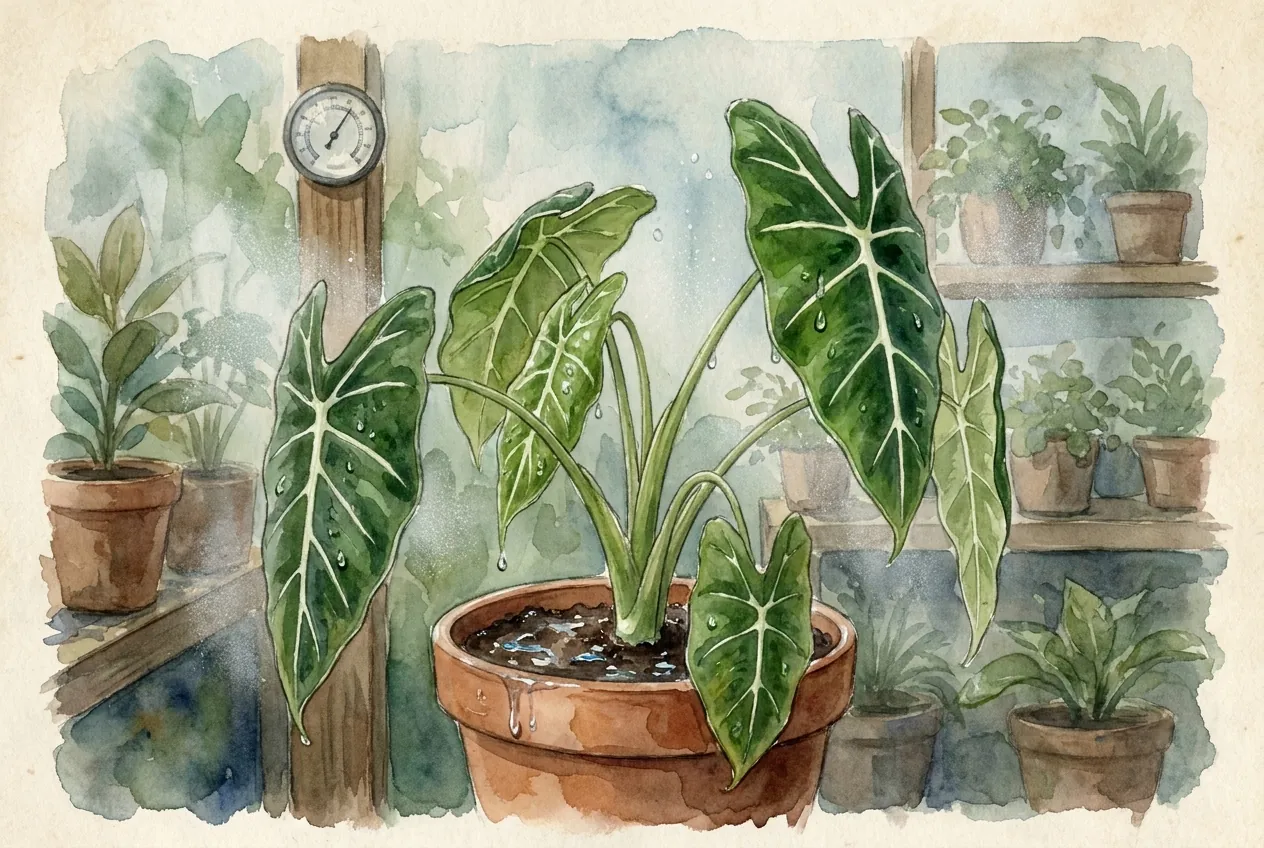
Your Frydek is drooping at 14:00, the soil is wet, and you are reaching for the spray bottle. Stop.
The single most common heat-wave intervention houseplant blogs recommend is also the one that measurably raises stress on velvet-leaf Alocasia. The fix is a small oscillating fan, a 4-liter ultrasonic humidifier filled with distilled water, and a vapor-pressure-deficit number you can read off any thermohygrometer in 60 seconds.
This guide gives you the physiology, the math, and the exact decision tree.
Warning
If your Frydek is wilting above 28°C ambient, do NOT mist and do NOT add water. Both make the failure mode worse. The correct interventions are airflow plus ambient humidification, in that order.
Why does Frydek wilt when the soil is still wet?
It is hydraulic supply collapse, not soil moisture. The leaf cannot pull water fast enough to match evaporative demand, so it closes its stomata, stops cooling itself, and goes limp — while the substrate sits saturated.
Alocasia micholitziana ‘Frydek’ is a Philippine understory aroid. Its native habitat is forest-floor, 60–80% relative humidity, 22–26°C vegetative-growth optimum, with rainfall above 2,000 mm/year.
The velvet leaf surface comes from dense trichomes selected for ornamental appeal. They do not improve heat dissipation. They trap droplets that flat-leaf aroids would shed.
When ambient temperature climbs past about 30°C and indoor humidity drops below roughly 60%, vapor pressure deficit (VPD) at the leaf surface rises into a band where protective stomatal closure dominates. Closed stomata mean no transpiration. No transpiration means no cooling.
Leaf temperature then rises above air temperature, which closes stomata further. The plant looks limp by mid-afternoon even though you watered yesterday.
How much can a Frydek leaf actually heat up?

A peer-reviewed Alocasia study found leaf temperatures in outer regions reached 40°C — about 8.8°C above central-region readings — during early-afternoon hours, paired with a 69% drop in stomatal conductance from leaf center to leaf periphery.
Li and co-authors measured giant Alocasia macrorrhiza leaves in field conditions. They attributed the pattern to hydraulic limitation. Xylem path-length increases moving away from the petiole.
Hydraulic supply lags transpirational demand. Stomata close protectively. Transpiration cooling stops.
Leaf temperature rises further. Positive feedback.
This is the exact mechanism behind the ‘crispy edges first, healthy center’ Frydek presentation. The leaf margin is not under-watered.
It is under-supplied because its xylem path is longest and its hydraulic conductance lowest. Marginal scorch on a wet-soil Frydek is a hydraulic-supply diagnosis, not an underwatering one.
The Heterogeneity and Spatial Patterning of Structure and Physiology across the Leaf Surface in Giant Leaves of Alocasia macrorrhiza
Is high VPD the same as drought stress?

Yes — and it kills plants without the soil ever drying out. Grossiord and co-authors frame rising VPD as a major driver of drought-induced plant mortality through stomatal closure, reduced photosynthesis, and elevated hydraulic-failure risk.
The mechanism is mechanical and chemical. Guard cells close passively when leaf water tension spikes. Abscisic acid (ABA) signaling reinforces closure.
Once stomata are closed, photosynthesis stops and the cooling pathway stops with it. The plant runs both carbon and water risks simultaneously. No amount of additional soil water rescues a plant in this state within the same diurnal cycle.
The implication for Frydek: VPD, not RH alone, is the controllable variable. Misting briefly drops near-leaf RH but does not lower bulk-air VPD long enough to reopen stomata.
What VPD targets does Frydek actually need?
Aim for VPD between 0.6 and 0.8 kPa at 24°C, climbing to a hard ceiling of 1.2 kPa at 30–32°C. Above 1.5 kPa, the Grossiord stomatal-closure framework predicts protective shutdown within hours.
Below 0.4 kPa, fungal sporulation thresholds are met. The middle is your operating zone.
VPD is computable from any consumer thermohygrometer using the Tetens (1930) saturation-vapor-pressure equation, which is accurate within 1 Pa up to 35°C. The formula is straightforward and runs in your phone calculator. Plug in air temperature in Celsius and relative humidity as a decimal.
The Tetens formula
Saturation vapor pressure SVP(T) = 0.61078 × exp(17.27 × T / (T + 237.3)), in kPa, with T in °C. Then actual vapor pressure AVP = SVP(T) × RH (as decimal). Finally, VPD = SVP(T) − AVP.
Take a 32°C / 50% RH heat-wave cabinet. SVP = 0.61078 × exp(17.27 × 32 / (32+237.3)) = 4.76 kPa. AVP = 4.76 × 0.50 = 2.38 kPa.
VPD = 2.38 kPa. That is roughly double the Frydek protective ceiling.
Tetens equation
What is the VPD ladder by air temperature?

The required RH at each temperature band falls out arithmetically once you fix the target VPD. The table below is the operating reference for a Frydek cabinet.
| Air Temp | SVP (kPa) | Target VPD (kPa) | Required RH to hit target | Risk if you exceed target |
|---|---|---|---|---|
| 24°C | 2.98 | 0.6–0.8 | 73–80% | Mild — vegetative band |
| 26°C | 3.36 | 0.7–0.9 | 73–79% | Mild — still in band |
| 28°C | 3.78 | 0.9–1.1 | 71–76% | Approaching ceiling |
| 30°C | 4.24 | 1.0–1.2 | 72–76% | Stomatal closure risk after 2–4 hr |
| 32°C | 4.76 | 1.1–1.3 | 73–77% | Hard ceiling — sustained stress |
| 35°C | 5.62 | 1.3–1.5 | 73–77% | Damage window — emergency only |
Notice the column pattern. A 75% RH reading feels like a stable target. It is not.
At 24°C, 75% RH delivers about 0.75 kPa VPD — perfect for Frydek. At 32°C, the same 75% RH delivers about 1.19 kPa VPD — right at the ceiling. Chase the VPD number, not the RH number.
Why not use the 1.5 kPa flower-stage VPD number?

Frydek is a slow-growth shade-adapted understory aroid. The 1.2–1.5 kPa flower-stage target you see in cannabis VPD content applies to short-cycle annual crops with strong root-to-leaf hydraulic conductance.
Frydek’s hydraulic conductance is the limiting factor, not its flower-stage transpiration demand.
The Aroidpedia 60–80% RH window plus the Grossiord stomatal-closure framework converge on a practical ~1.2 kPa ceiling. Imported cannabis numbers will hurt your Frydek even though they are technically published values. Use a Frydek-specific ceiling.
Why does misting raise heat-stress risk?
Misting wets the velvet trichome layer. It drops near-leaf VPD for roughly 20 minutes while the droplet film evaporates. After that, the leaf inherits three new problems.
First, a 30–90 minute leaf-wetness window during which fungal sporulation thresholds are met. Second, a thicker boundary layer disrupted by the wetting cycle. Third, dissolved-solids residue from spray water deposited into the trichome interstices.
Industry misting research is unambiguous on this. Flash-evaporative cooling — the technique that actually drops greenhouse temperature 10–20°F — is designed to never wet leaves. High-pressure systems produce sub-50-micron droplets that evaporate before reaching the canopy.
Hand-misting does not replicate this. Hand-misting produces 200–500 micron droplets that land, sit, and persist.
What does leaf wetness duration actually do?

Leaf wetness duration (LWD) is the established controlling variable for foliar fungal infection. Most phytopathogenic fungi require a continuous film of water on the leaf surface for spore germination and hyphal penetration. The minimum film duration depends on pathogen and temperature, but on Frydek’s velvet surface the trichome layer holds water 2–3 times longer than a glossy aroid leaf would.
A glossy Monstera dries about 10 minutes after misting. A velvet Frydek can hold visible droplets 30–60 minutes.
That difference is the difference between below-sporulation-threshold and above-sporulation-threshold for several pathogens.
Which pathogens actually threaten Frydek?

Phytophthora colocasiae — the taro leaf blight pathogen — is the most-studied Araceae fungal pathogen and has been confirmed to infect Alocasia macrorrhiza by artificial inoculation. Its temperature optimum is 28°C.
It requires wet foliage for sporulation. A heat-wave cabinet at 28–32°C with hand-misting is the textbook environment this pathogen prefers.
Natural infection of Alocasia is uncommon in the wild, but the capacity is documented. In a hobby cabinet, infected substrate, neighboring tropicals, and even tap-water reservoirs are plausible vectors. The brown-spot-with-yellow-halo presentation a Frydek owner sees after a week of heat-wave misting often matches the P. colocasiae pattern.
What about the white spots on velvet leaves?

Those are usually calcium and magnesium deposits from tap-water misting, not pests or fungus. RTINGS’ independent lab research on ultrasonic humidifiers documents that any mist source aerosolizes dissolved solids along with water. The minerals settle as visible residue proportionate to water hardness.
On a glossy aroid this residue wipes off. On Frydek’s velvet trichomes it deposits between and around the hairs and cannot be cleaned without damaging them.
The result is the persistent ‘calcium spotting’ Frydek owners complain about — and incorrectly attribute to scale insects or fungal scale. The fix is distilled water or a demineralization cartridge on whatever humidification source you use.
Preventing Humidifier White Dust And The Importance Of Distilled Water — RTINGS
What does correct airflow look like?
Sustained air velocity of 0.5–1.0 m/s at the leaf surface restores boundary-layer turnover without inducing windburn. Below 0.25 m/s, boundary-layer resistance dominates transpiration and the leaf is choked even with stomata wide open.
For a 6–12 in. Frydek crown, a 6-inch oscillating clip fan on its lowest setting at 30–45 cm from the canopy delivers this range.
Greenhouse engineering work has converged on 0.5–1.5 m/s as the canopy-zone target across most C3 species, with 0.5–1.0 m/s as the practical sweet spot. The physics is simple.
Air movement thins the laminar layer of saturated air clinging to the leaf. The VPD gradient across the stomatal opening increases. Transpirational water flux removes heat from the leaf.
How much does airflow actually help?

Doubling air velocity from still to roughly 0.8 m/s roughly doubles transpiration and photosynthesis.
Closed plant-production-system experiments with dwarf rice documented a 2.5-fold rise in evaporation and a 2-fold rise in net photosynthesis when horizontal air current increased from 0.01 to 0.8 m/s. Cucumber seedlings showed a 1.2-fold increase in net photosynthesis and a 2.8-fold increase in transpiration over a similar velocity range.
These are not marginal improvements. Going from no-fan to a small clip fan at 0.6 m/s is a step-change in the leaf energy budget.
A previously still-air Frydek visibly re-tensions within 30–60 minutes of correct airflow during the high-VPD window.
Spatial examination of leaf-boundary-layer conductance using artificial leaves
A CFD study on improving air flow uniformity in indoor plant factory system
Does oscillation matter or just velocity?

Oscillation matters. A fixed-direction high-velocity fan creates a scour zone — local boundary-layer thinning so aggressive that transpiration outpaces hydraulic supply and the leaf burns at that one spot.
Oscillation distributes boundary-layer thinning across the whole canopy and avoids scour-zone failure.
The 6-inch Spider Farmer clip fan with EC motor and 10-level wide-angle oscillation is purpose-built for this scenario. The Mars-Hydro 6-inch clip is the equivalent alternative.
The Honeywell HT-900 — frequently recommended for small plant airflow — produces up to 3.3 m/s at 15 cm on high but does NOT oscillate. It is fine as a room-level cross-circulation helper at 60 cm or more from the cabinet.
It is the wrong primary fan for a Frydek.
Specification: oscillating clip fan for Frydek airflow
Air velocity 0.5–1.0 m/s at the leaf surface, oscillation across the canopy footprint, EC motor for continuous low-speed performance, IP54 or better water-resistance for use near ultrasonic mist. The Spider Farmer 6-inch grow tent clip fan (10 speeds, 10-level oscillation, IP54) meets all four specs. Roughly $45 retail.
Honest tradeoff
More expensive than a generic $15 commodity clip fan, and some shipping batches arrive with noisy bearings (return-and-replace if so). If budget is tight, a Honeywell HT-900 (~$15) deployed as a room-level helper at 60 cm or greater from the cabinet, angled to graze across rather than blast into the canopy, is the workable budget alternative.
The 5-minute fan installation
Clip the fan at canopy height or slightly above, 30–45 cm horizontal distance from the nearest leaf, angled to graze across the canopy rather than down into it.
Down-angle pushes substrate water vapor away from the plant rather than cycling it through the leaf zone. Lowest oscillating speed.
Verify with a $15 vane anemometer or by the barely-visible leaf flutter test — leaves should just move, not flap.
Does bottom-up humidification really beat misting?
Yes. A 4-liter ultrasonic humidifier running at roughly 100 mL/hr delivers sustained ambient RH without ever wetting a leaf.
It replaces what hobbyists think misting does, without the failure modes. Plume placement is the only catch — direct mist away from leaves.
The cabinet-volume math anchors the output target. At 32°C, saturation vapor pressure is 4.76 kPa. Holding 70% RH means the cabinet must contain about 23.6 g/m³ of water vapor.
A 200-liter cabinet holds roughly 4.7 g of vapor at 70% RH. The delta against 50% RH ambient is about 1.3 g per cabinet volume. With 2–4 air changes per hour, you must inject 50–100 mL/hr to hold target, doubling to ~100–150 mL/hr during peak heat-wave hours.
A passive pebble tray delivers maybe 10–20 mL/hr in still air. That is fine for a winter day at 1.0 kPa VPD.
It is not enough at 2.4 kPa VPD on a heat-wave afternoon. An ultrasonic at 100 mL/hr is 5–10 times the output of the passive tray.
How do you place an ultrasonic so it doesn’t wet leaves?

Place the humidifier on the floor next to the cabinet with the plume directed parallel to the cabinet base or into a venturi diffuser. Alternatively, place it inside the cabinet at the bottom shelf with the plume pointed away from the canopy so mist diffuses to vapor before contacting any leaf. If you can see mist hitting leaves, you have a leaf-wetness problem just like misting.
Ultrasonic droplets are 1–5 microns. They evaporate within seconds if not concentrated. They persist as visible mist if the plume is concentrated and intercepted by a surface.
Plume placement is the failure mode. Test by looking before you walk away.
Specification: ultrasonic humidifier for a single Frydek cabinet
4-liter or larger top-fill tank, ~100 mL/hr minimum continuous output, Wi-Fi app with target-RH auto mode, demineralization-cartridge slot. The Levoit Classic 200S meets all four specs. 4L top-fill, approximately 40 hours runtime at low setting (which works out to roughly 100 mL/hr), VeSync Wi-Fi app with auto target RH, demineralization-cartridge slot, recommended for rooms up to 376 sq ft.
Honest tradeoff
Wi-Fi-only (no HomeKit, no Zigbee), the VeSync app is ad-supported, and the demineralization cartridge is a recurring consumable. Skip the cartridge dependency entirely by running distilled water through it.
Distilled water is mandatory regardless of cartridge presence when a velvet aroid is in the room. Roughly $5 of distilled water covers a week of heat-wave humidification per cabinet.
Should you use a warm-mist humidifier instead?

Warm-mist humidifiers boil water and leave the minerals behind in the heating element. No calcium dust ever reaches the air.
But during a 32°C heat wave you do not want extra heat input to the room. Warm-mist adds measurable thermal load.
For winter dryness, warm-mist is fine. For heat-wave triage, prefer ultrasonic with distilled water. The thermal-load tradeoff outweighs the no-mineral-dust benefit when ambient temperature is already the problem you are solving.
How do you measure VPD reliably?
A VPD-actionable thermohygrometer needs ±0.3°C / ±3% RH or better, 5-minute or faster sampling, and either native VPD readout or CSV export for manual computation. Below this — generic $10 analog hygrometers — accuracy floats ±10% RH and is not actionable.
VPD computation amplifies sensor error. At 32°C, a 3% RH measurement error translates to about 0.14 kPa of VPD uncertainty.
That is the difference between the Frydek decision tree’s State-B watch and State-C triage actions. The sensor matters.
Which sensor should you actually buy?

For most hobbyists, two sensors cover the realistic budget bands. SensorPush HT.w sits in the sweet spot. Govee H5179 covers the budget tier.
Specification: sweet-spot thermohygrometer
±0.2°C / ±2% RH accuracy, native VPD calculation, water-resistant housing, multi-year battery. The SensorPush HT.w meets all four specs. ±0.2°C / ±2% RH typical, VPD and dewpoint exposed natively in the SensorPush app, splash-resistant housing rated for cabinet humidity, >2-year battery life on a CR2032 coin cell.
Honest tradeoff
Bluetooth-only requires a nearby phone or the optional SensorPush G1 gateway for remote monitoring. About three times the price of the Govee.
The app is functional but not exceptional. Pick this if you will act on the data; pick Govee if budget is binding.
Specification: budget thermohygrometer
±0.3°C / ±3% RH accuracy, native Wi-Fi for remote monitoring, CSV export for analysis. The Govee H5179 meets all three specs. ±0.3°C / ±3% RH with a Swiss-made sensor, 2-second app refresh, native Wi-Fi (no gateway needed), 20-day cloud history with CSV export of up to 2 years through the Govee Home app.
Honest tradeoff
No native VPD readout (you compute it with the Tetens formula or any calculator), the Govee Home app is ad-supported, Wi-Fi 2.4 GHz only, and cloud history is limited to 20 days live before requiring CSV export.
As the heat-wave-week starter sensor it is the right answer at roughly $35.
Where do you place the sensor?

At the canopy. Not at the cabinet door. Not at the ceiling.
The plant’s VPD is whatever air the leaves are sitting in. Place one calibrated sensor at canopy height, in shade (so direct light doesn’t bias the temperature reading), and that is your VPD reference.
Multiple microclimates require multiple sensors. A 200 L cabinet can have 5°C variation top to bottom. If you have stacked shelves, sensor at each shelf.
What is the decision tree when conditions get hot?
Read T and RH from your canopy thermohygrometer. Compute VPD using the Tetens formula.
Match to one of four states. The decision time is 60 seconds.
| State | Trigger | Action |
|---|---|---|
| A — Safe | T ≤ 28°C AND VPD ≤ 1.0 kPa | No action |
| B — Watch | T 28–30°C AND VPD 1.0–1.2 kPa | Airflow only |
| C — Triage | T 30–32°C OR VPD 1.2–1.6 kPa | Airflow + bottom-up humidification |
| D — Emergency | T > 32°C OR VPD > 1.6 kPa | Maximum airflow + maximum humidification |
Misting is not in any state. That is intentional. Above 28°C ambient, misting is the wrong tool — the misting section above explained why.
Below 24°C with high RH, misting is the wrong tool for a different reason. It extends an already-long leaf-wetness duration into the fungal-pressure zone.
Print the table. Tape it to the cabinet. A VPD-aware sensor gets you to a decision in 60 seconds; a sensor that requires Tetens by hand takes 90.
What does the 24-hour recovery look like?

Once you move Frydek into State B or C, leaf-turgor return is the leading indicator that the intervention is working. Petioles re-tension within 2–8 hours once VPD drops below 1.2 kPa. Severe wilt may take a full diurnal cycle to fully rebound.
If turgor has not visibly improved at 12 hours post-intervention, the diagnosis was likely wrong. Suspect root rot, severe heat injury (>40°C leaf temperature for >2 hours), or a confounding pest issue.
Photograph the plant at intervention start and at 4, 8, 12, and 24 hours. The photo sequence tells you whether the trajectory is right.
What about substrate moisture during recovery?

Pause fertilizer through the entire heat wave. Heat-stressed Frydek cannot effectively uptake nutrients and salt accumulation accelerates root damage.
Do not water until substrate reads moderately dry at 5 cm depth.
Pro Tip
Better to under-water briefly than to over-water through a heat wave. Warm wet substrate above 28°C at the root level is the textbook condition for Pythium and Phytophthora optima.
If substrate is still saturated at 72 hours post-intervention, that is the real root-rot risk window. Warm wet substrate above 28°C at the root level is the textbook condition for Pythium and Phytophthora optima.
The combination of heat-wave panic-watering plus a warm room produces exactly this trap. Better to under-water briefly than to over-water through it.
When can you tell if recovery is complete?

At 7 days, new growth orientation reveals whether root function was preserved. Healthy recovery looks like a vertically-unfurling new leaf, fully turgid, normal color.
Compromised recovery looks like a new leaf emerging droopy or with marginal damage. That suggests reduced root hydraulic function — either heat-induced root damage or developing root rot.
If recovery is incomplete at day 7, consider an unpot-and-inspect at day 10. The diagnostic split is binary.
White firm roots, just slow = heat damage; root system will rebuild over weeks. Mushy brown roots with a fungal smell = active rot; emergency repot into a sterilized substrate is the only intervention with a chance of saving the plant.
What is the 48-hour pre-heat-wave checklist?
The single highest-ROI intervention during a forecasted heat wave is the 48-hour setup window. Once heat arrives, you are doing triage; before it arrives, you are doing prevention.
T minus 48 hours
Order the SensorPush HT.w (or Govee H5179 if budget tier), the Spider Farmer 6-inch oscillating clip fan (or Honeywell HT-900 plus careful placement), and the Levoit Classic 200S ultrasonic humidifier. Confirm overnight or same-day delivery.
T minus 36 hours
Buy three gallons of distilled water from the grocery store. Cheaper than Amazon. Sufficient for one cabinet over a week of continuous low-setting humidification.
T minus 24 hours
Place the sensor at canopy height. Baseline-log 24 hours of current conditions. This gives you the before-reference for evaluating intervention effectiveness.
T minus 12 hours
Set up the humidifier with distilled water. Target 72% RH via the app.
Position with mist plume away from leaves. Confirm RH stabilizes within 90 minutes.
T minus 6 hours
Install the clip fan at canopy height, 35 cm out, lowest oscillating speed. Verify barely-visible leaf flutter. Cross-check that ambient air at the leaf reads in the 0.5–1.0 m/s range if you own an anemometer.
T zero
Heat wave begins. Confirm VPD reads on app within the Frydek band by the decision-tree table.
Recheck every two hours during the day. Walk away with confidence at night.
How do you troubleshoot Frydek heat-wave wilt?
Issue 1 — Leaves droopy at 14:00 with wet soil

Symptoms
Limp leaves with downward-tilted petioles, no yellow, marginal silvering or crisp tips on the largest leaves first, soil reads moist to a finger probe.
Fix
Do NOT water. Drop air VPD via airflow plus ambient humidification.
Re-check turgor at 21:00. Full Frydek typically rebounds within 4–8 hours once leaf VPD drops below 1.2 kPa.
Mechanism
You are restoring the supply side (transpiration can match demand again) instead of flooding the demand side (more soil water the roots cannot transport fast enough).
Issue 2 — Persistent marginal crispiness on largest leaves only

Symptoms
Largest, oldest leaves show outer-edge necrosis; younger interior leaves look healthy.
Fix
Same hydraulic-path-length pattern Li and co-authors describe. Reduce afternoon leaf-VPD load and consider removing the most severely affected leaf to lower whole-plant transpirational demand.
Mechanism
Removing the highest-demand leaf reduces total water draw and gives the remaining canopy a hydraulic margin during the recovery window.
Issue 3 — White-haze deposits in the trichome layer

Symptoms
White deposits between trichomes that don’t wipe off and don’t move like scale insects.
Fix
Mineral deposition from tap-water misting or ultrasonic with tap water. Not pest, not fungus.
Stop the misting habit. Switch to distilled-water humidification. Soft-brush cleaning is risky for trichomes — accept some residue or remove the worst leaf.
Mechanism
Removes the calcium-and-magnesium delivery vector permanently.
Issue 4 — Brown-spot lesions with yellow halos during a heat wave

Symptoms
Brown necrotic spots with yellow halos on leaf margins where droplets accumulated.
Fix
Consistent with the P. colocasiae presentation on a susceptible aroid. Stop misting immediately.
Remove affected leaves into a sealed bag — do not compost. Improve airflow. Consider a copper-based foliar treatment if confirmed.
Mechanism
Removes the inoculum, stops the wet-foliage sporulation environment, and reduces ambient pathogen pressure.
Issue 5 — VPD won’t drop below 1.6 kPa even with full intervention

Symptoms
Cabinet RH climbing slowly or not at all despite humidifier running.
Fix
Cabinet too large for humidifier output, or air-changes-per-hour too high. Reduce cabinet ACH by closing gaps or hanging a fabric curtain. Step up to a 6L ultrasonic if needed.
Mechanism
Humidifier output must exceed cabinet leakage rate; if the cabinet leaks too fast, no humidifier matches.
What does an honest n=1 trial actually tell you?
A 7-day single-plant rotation trial comparing misting-only, airflow-only, and airflow-plus-humidification arms can demonstrate a directional effect on one Frydek in one cabinet. It cannot prove causation or generalize across cultivars and setups. That is the honest disclosure that must accompany any first-person framing.
The minimum instrumentation has three pieces. A thermohygrometer logging at 5-minute cadence (SensorPush HT.w meets the bar; Govee H5179 is the budget-acceptable floor). A $25 IR thermometer for daily 13:00 leaf-temperature point measurements.
Photographs at fixed times every day.
Light schedule, water cadence, and starting plant condition must be held constant across arms.
What the trial can show is the leaf-vs-air temperature delta swinging from positive (cooling failing) to near-zero or negative (cooling working) across the arms. What it cannot show is which mechanism causes the change for any individual plant.
The interpretation rests on the cited Alocasia and VPD physiology above — not on the trial alone.
First-person trials need explicit methodology disclosure. The trial described here is a reproducible protocol, not a claimed-as-published result.
Run it on your own plant if you want your own data. The rest of this post does not depend on it.
Key Takeaways
- Frydek’s wilting-in-wet-soil presentation is leaf-side hydraulic supply collapse, not root-side dryness.
- VPD, not RH, is the controllable variable; the Tetens formula computes it from any thermohygrometer.
- The Frydek VPD ladder targets 0.6–0.8 kPa at 24°C and a hard 1.2 kPa ceiling at 30–32°C.
- Misting raises heat-stress risk above 28°C ambient; replace it with airflow plus bottom-up humidification.
- A 6-inch oscillating clip fan at 0.6–0.8 m/s plus a 4L ultrasonic at ~100 mL/hr with distilled water is the working stack.
- The 48-hour pre-heat-wave checklist is the highest-ROI prevention move.
Some links in this post are Amazon affiliate links. If you buy through them, the site receives a small commission at no extra cost to you. We only recommend products we have used or that meet the technical specs discussed above.

Leave a Reply