
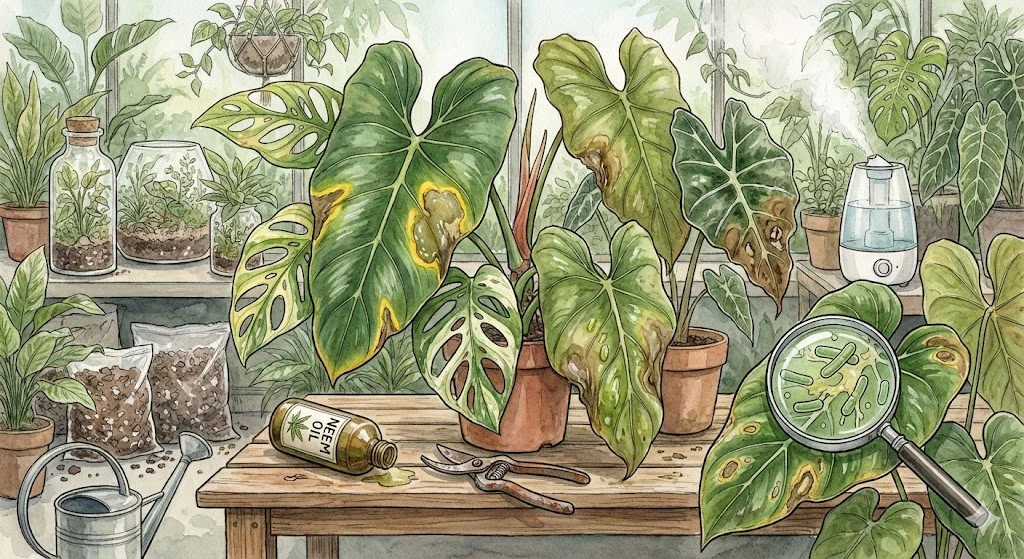
Key Takeaways
- The Guttation Trap: High humidity and misting trigger guttation (water droplets on leaf tips), which creates a nutrient-rich entry path for bacteria; stop misting to close this door.
- Diagnostic Geometry: Xanthomonas typically presents as greasy, V-shaped lesions originating at the leaf margin with a bright yellow halo, whereas fungal spots often feature concentric rings and abiotic damage is crispy and dry.
- No Chemical Cure: Systemic bacterial blight cannot be cured with sprays; management relies entirely on a 30-day quarantine for new plants and sterilizing tools between every cut to prevent transmission.
The Physiology Behind Aroid Leaf Disease Vulnerability
To effectively diagnose plant issues, it is essential to understand the host physiology. In this case, the host is the leaf of an Aroid.
While a leaf functions as a photosynthetic organ, it also possesses specific structural vulnerabilities. Understanding these weak points is the first step in understanding how aroid leaf disease establishes itself.

The Hydathode: A Vulnerable Entry Point
Most people are familiar with stomata—the microscopic pores on the underside of leaves used for gas exchange.
However, Aroids also possess specialized pores called hydathodes, located along the leaf margins and sometimes at the leaf tip.
Unlike stomata, which open and close in response to environmental conditions, hydathodes are essentially open valves connected directly to the plant’s vascular system (the xylem).
When humidity is high and the soil is wet, root pressure pushes excess water up the stem and out of these pores. This process is called guttation.
It appears as water droplets on the tips of plants like Alocasia in the morning.
However, research highlights a critical detail: Guttation fluid is not just water. It is a nutrient-rich solution containing amino acids, sugars, and salts.
Recent studies confirm that Xanthomonas bacteria are chemotactic—they can detect this nutrient source.
They move through the moisture film on the leaf surface, driven by chemical sensors that detect the amino acids in the guttation fluid.
They congregate at the hydathode, feed on the nutrients provided by the plant, and then move directly into the vascular system.
This explains the specific V-Shaped Lesion that is the hallmark of this particular aroid leaf disease. The infection starts at the edge (the pore) and progresses inward toward the vein, creating a wedge-shaped area of necrosis.
If you see guttation droplets on your indoor plants, you are seeing a potential entry point for bacteria. The presence of guttation is a significant risk factor for bacterial ingress in the Araceae family.
Anthurium Diseases: Identification and Control in Commercial Greenhouse Operations

The Cuticle and the Cell Wall
The first line of defense for any leaf is the cuticle—a waxy, hydrophobic layer that prevents water loss and creates a barrier against pathogens.
Philodendrons typically have a thicker, waxy cuticle compared to the velvety, thinner cuticle of many Anthuriums.
This physical difference explains why Anthuriums are the primary victims of Xanthomonas phaseoli pv. dieffenbachiae (Xpd).
The bacteria have a harder time breaching the surface of a Philodendron, but the delicate, matte surface of an Anthurium warocqueanum is more susceptible.
However, once inside, the bacteria encounter the cell wall. This is where recent research provides important context.
The cell wall is made of cellulose and pectin, a structural carbohydrate that binds cells together.
Xanthomonas and Pectobacterium (the cause of soft rot) possess enzymes called pectinases and cellulases. These enzymes dissolve the bonds holding the plant cells together.
When you see a water-soaked spot on a leaf, you are witnessing this process of enzymatic degradation.
The cell walls collapse, the internal cytoplasm leaks out, and the air spaces between cells (which normally reflect light and make the leaf look opaque) fill with liquid.
This liquid changes the refractive index of the tissue, making it look translucent or greasy when held up to the light.
The Vascular System
The ultimate goal of Xanthomonas is to reach the vascular system. The xylem vessels are the tubes that transport water from the roots to the leaves.
Once the bacteria enter the hydathode, they are inside the transport system. They multiply rapidly, producing extracellular polysaccharides (slime) that obstruct the tubes.
This systemic invasion turns a localized issue into a life-threatening condition for the plant. The bacteria can travel down the petiole, into the stem, and then back up into other leaves.
This is why a plant can wilt even when the soil is wet—the vessels are blocked by bacterial slime. We call this vascular occlusion, and it often leads to the death of the plant.
The Primary Pathogen in Aroid Leaf Disease – Xanthomonas
We will focus heavily on Xanthomonas phaseoli pv. dieffenbachiae (Xpd) because it is the most sophisticated and destructive pathogen likely to affect a high-end collection.
It has been the subject of significant genomic and pathological research in recent years, revealing just how adapted it is to causing aroid leaf disease.

The Genomic Blueprint of Virulence
Recent genomic sequencing projects have revealed important details about Xpd.
Researchers have identified specific gene clusters, notably the gumD gene, which is responsible for the biosynthesis of xanthan gum. This substance acts as a key virulence factor inside the plant.
When Xpd enters a plant, it produces copious amounts of this xanthan gum. This substance serves multiple purposes:
- Biofilm Protection: It encases the bacterial colony in a protective matrix that shields it from UV light, desiccation, and chemical attacks.
- Clogging Agent: It physically blocks the water transport in the xylem, causing the wilting symptoms associated with systemic infection.
- Virulence Factor: The slime helps the bacteria adhere to the leaf surface and hydathodes, facilitating entry.
The upregulation of the gumD gene is observed within just one hour of interaction with the host plant. This means the bacteria start establishing themselves almost immediately upon arrival.
This genomic insight explains why surface treatments are often ineffective once the infection is established—the bacteria are protected by this microscopic matrix.
Optimal Reference Gene Selection and Potential Target Gene Identification During Xanthomonas phaseoli pv. dieffenbachiae–Anthurium andreanum Infection

The Latency Period: Asymptomatic Incubation
One of the most challenging aspects of Xpd is its ability to remain latent.
Research shows that the bacteria can survive in a dormant state inside the plant for months without showing symptoms.
This is particularly common in cooler temperatures or in tissue-cultured plantlets that were not rigorously screened.
Consider this scenario: You acquire a seemingly healthy Anthurium from a reputable grower. It appears perfect. You place it in your collection.
Two weeks later, environmental stress occurs, such as a heat wave or irregular watering.
Suddenly, the latent bacteria, reacting to the host’s stress and favorable temperatures (Xpd thrives in 28-32°C), become active.
The incubation period—the time from active infection to visible symptoms—is typically 14 to 30 days.
This delay is a primary reason outbreaks of this aroid leaf disease occur in collections. You may introduce an infected carrier, and by the time it shows symptoms, the bacteria may have already spread to other plants via shared water, tools, or contact.

Diagnosing the Progression: A Four-Stage Analysis
To diagnose Xpd, it is necessary to recognize the symptoms at each stage of the infection. It presents as a predictable progression of symptoms.
Stage 1: The Water-Soaked Lesion (Initial Infection)
The first visible sign of Xpd is subtle. It usually appears on the underside of the leaf, near the margins (where the hydathodes are located). You will see small, angular spots that look dark green, greasy, or water-soaked.
Diagnostic Test: The Backlight Test
Hold the leaf up to a strong light source. If the spots are bacterial, they will appear translucent, like stained glass.
This is due to light passing through the liquid-filled intercellular spaces. If the spots are opaque or dark black without transparency, it is more likely fungal or abiotic.
At this stage, the lesion is small—maybe 1-3mm—but it is expanding as the bacteria digest the mesophyll cells and multiply.
Stage 2: The Chlorotic Halo (Toxin Release)
As the bacterial colony expands, it releases toxins that diffuse into the surrounding healthy tissue.
These toxins destroy chlorophyll, the green pigment responsible for photosynthesis. This creates a bright, lemon-yellow band separating the necrotic tissue from the healthy green leaf.
This halo is a strong indicator of Xanthomonas. While fungal infections can have halos, they are often diffuse, pale, or brownish.
The Xanthomonas halo is intense, distinct, and moves ahead of the necrosis.
The V-Shape Geometry
Because the bacteria move through the veins and diffuse into the tissue between them, the lesion often takes on a characteristic V-shape or wedge shape.
The wide part of the V is at the leaf margin (the entry point), and the point of the V aims inward toward the midrib.
This geometry is dictated by the vascular structure of the leaf. The major veins act as barriers, containing the infection initially, while the bacteria flow freely through the smaller vascular bundles.
Stage 3: Necrosis and Ooze (Advanced Infection)
The tissue in the center of the spot dies and turns brown or black. This is necrosis.
Unlike fungal spots, which often become dry and papery with concentric rings, bacterial spots often remain greasy or gummy at the margins.
In high humidity, the bacteria themselves may be visible. They exude from the stomata or the lesion surface as tiny, amber or yellow droplets.
This is bacterial ooze—a concentrated suspension of bacterial cells and xanthan gum.
Contact with this substance followed by contact with another plant will likely transmit the infection.
Stage 4: Systemic Infection (Vascular Collapse)
If the bacteria reach the midrib and travel down the petiole into the stem, the infection becomes systemic. This is Phase 4, and it is usually terminal for the plant.
Symptoms of Systemic Infection
- Systemic Chlorosis: The older leaves turn yellow, typically in a general pattern rather than spots. This is often mistaken for nutrient deficiency, but it occurs much faster.
- Petiole Abscission: The infected petioles become weak at the base. If you gently touch a yellowing leaf, it might snap off cleanly at the stem. This is the plant’s attempt to shed the infected limb.
- Vascular Discoloration: If you cut the petiole or stem, you will not see clean, white/green tissue. You will see brown dots or streaks running longitudinally through the vascular bundles. This is visual evidence of the xylem being obstructed and degraded by the bacteria.

Host Specificity and Variation
While discussing Aroids generally, different genera react slightly differently to Xpd.
- Anthurium: The most susceptible. Shows the classic V-shaped marginal blight and rapid systemic collapse. The bacteria can even infect the spadix, causing flower blight where the flower turns black and necrotic.
- Dieffenbachia: Also highly susceptible (hence the name pv. dieffenbachiae). Lesions often have a very pronounced yellow halo and can be circular if they enter through stomata rather than hydathodes.
- Philodendron: The thicker cuticle offers some protection, but once infected, they show Red Edge symptoms—necrotic spots surrounded by a reddish or rusty border rather than pure yellow. The lesions can be more irregular if the tissue dries out and falls away.
- Syngonium: Highly prone to leaf spots that coalesce rapidly. The leaves are thin, so the water-soaking is very apparent.
The 2025 research emphasizes that while X. phaseoli pv. dieffenbachiae is the primary culprit, there are other pathovars and species (like X. hortorum) that can infect multiple hosts, although they are less common in indoor collections.
However, from a practical standpoint, the management is the same: strict hygiene and isolation to prevent the spread of this aroid leaf disease.
Distinguishing Bacterial Blight from Look-Alikes
The most difficult part of diagnostics is differentiation. Many issues cause leaves to turn brown. We need to use the data to separate Xpd from other causes.
Comparative Diagnostics of Aroid Leaf Pathologies
| Feature | Bacterial Blight (Xanthomonas) | Fungal Leaf Spot (Colletotrichum) | Abiotic (Fertilizer/Salt Burn) | Abiotic (Iron Deficiency) |
|---|---|---|---|---|
| Emergence Time | 14-30 days post-infection (latency) | 5-7 days post-infection (faster) | 1-2 days (acute) to weeks (chronic) | Slow onset on new growth |
| Specific Texture | Water-soaked, greasy, translucent | Dry, papery, often zonate (rings) | Crispy, dry, brittle burned tips | Soft, limp, or normal texture |
| Specific Color | Brown/Black with Bright Yellow Halo | Tan/Brown with diffuse/dull halo | Brown/Orange crusty edges | Yellow leaf with Green Veins |
| Progression Speed | Rapid expansion (V-shape inward) | Moderate expansion (circular) | Stops if leaching occurs | Persists until nutrients corrected |
| Leaf Location | Margins (hydathodes) or Wounds | Anywhere on leaf blade | Tips and Margins (accumulation) | Newest leaves (immobile nutrient) |
| Systemic Signs | Petiole snap, vascular browning | Rare (unless stem rot) | Root burn, general stunt | Stunting, bleaching of new growth |
This table allows for a rapid assessment of the plant. If the spot is dry and has rings, it is likely fungal. If it is greasy and has a bright yellow halo, it is bacterial. If it is just crispy at the tip and you recently fertilized, it is abiotic.
Similar Pathogens – Bacterial Soft Rots & Aroid Leaf Disease
While Xanthomonas often incubates slowly, Pectobacterium (formerly Erwinia) causes rapid tissue collapse.
This group of bacteria causes Soft Rot, and it typically does not present with V-shapes or halos. Instead, it rapidly dissolves plant tissue.

Characteristic Odor
A primary diagnostic tool for Soft Rot is the smell. Pectobacterium produces volatile sulfur compounds as it breaks down plant tissue.
The result is a distinct, unpleasant odor often described as rotting fish or decaying vegetables. Xanthomonas lesions are generally odorless until the very late stages of decay.
If you detect a foul odor in your plant area, check your Philodendrons for signs of rot.
The Speed of Collapse
While Xanthomonas has a latency period of weeks, Pectobacterium operates on a timeline of hours and days.
Research on Pectobacterium carotovorum shows that under favorable conditions (high heat and humidity), it can destroy a leaf or stem in 24 to 48 hours.
Scenario
A Philodendron cutting rooting in water looks healthy on Monday. By Tuesday, the stem is soft. By Wednesday, the entire cutting has become a soft, decomposed mass.
This rapid progression is characteristic of Soft Rot. The bacteria produce massive amounts of pectolytic enzymes that separate cells almost instantly.
Symptoms on Unfurling Leaves
Soft Rot frequently affects the cataphyll—the sheath that protects a new leaf. If water gets trapped in the unfurling leaf coil, it creates an anaerobic environment perfect for Pectobacterium. The new leaf may turn into a brown, mushy paste before it even unfurls.
Diagnostic Criterion The Mush Test
Touch the lesion.
- Xanthomonas: The dead tissue might be dry or slightly gummy, but the surrounding tissue is firm.
- Pectobacterium: The tissue disintegrates under pressure. It feels like wet paper or slime, lacking structure.
The Role of Temperature
Recent climate studies linked to plant pathology suggest that rising global temperatures are expanding the range and severity of these bacterial diseases.
Pectobacterium thrives in temperatures between 25°C and 30°C (77°F – 86°F). This overlaps perfectly with the preferred temperature range of most tropical Aroids.
If your growing environment becomes hot and remains wet, you are creating an ideal environment for this type of aroid leaf disease.
Fungal Pathogens in Aroid Leaf Disease Diagnostics
Fungi are significant causes of leaf spots and are often confused with bacteria. However, their biology dictates a different set of symptoms.

Colletotrichum: Circular Lesion Formations
Colletotrichum gloeosporioides causes Anthracnose, a common fungal disease.
Unlike bacteria, fungi grow via hyphae (microscopic threads). This allows them to push through veins, creating circular spots rather than the angular ones restricted by veins in bacterial infections.
The Concentric Ring Pattern
Fungi often grow in diurnal cycles—expanding during the warm day and resting at night.
This growth pattern creates concentric rings within the lesion, resembling a target. Xanthomonas grows continuously, so it rarely forms these rings.
Spore Production
In high humidity, fungi produce fruiting bodies.
If you look closely at an Anthracnose spot (using a magnifying glass), you might see tiny black dots (acervuli) or pinkish/orange masses of spores arranged in rings.
Bacteria do not produce these structures; they produce amorphous ooze.
Growth Rate
Research on Colletotrichum growth rates on media shows an expansion of roughly 4-6mm per day at optimal temperatures.
While fast, this is often slower and more contained than the systemic collapse caused by bacteria.
The transition from healthy to dead tissue is often dry and distinct, without the broad, greasy yellow halo typical of bacterial aroid leaf disease.
Phytophthora: The Water Mold
Phytophthora is an Oomycote (water mold), not a true fungus, and it is a major pathogen for Taro (Colocasia) growers.
Phytophthora colocasiae causes Taro Leaf Blight, which can destroy a crop rapidly.
Symptoms
Phytophthora lesions are initially small, dark, and water-soaked, similar to bacteria.
However, they expand incredibly fast—up to several centimeters a day. The key diagnostic is the white fuzz (sporangia) that appears on the lesion surface, particularly in the morning dew.
Xanthomonas produces slime; Phytophthora produces fuzz.
Additionally, Phytophthora lesions often exude a clear, amber fluid that turns purple or dark brown as it dries. This is distinct from the yellow bacterial ooze of Xanthomonas.
Fungal vs. Bacterial Identification Markers
| Diagnostic Feature | Fungal (Colletotrichum) | Bacterial (Xanthomonas) |
|---|---|---|
| Lesion Shape | Circular / Irregular | Angular / V-shaped / Vein-limited |
| Internal Pattern | Concentric Rings (Zonate) | Uniform or mottled, no rings |
| Surface Signs | Black dots (Acervuli) or fuzzy mold | Shiny slime (Ooze) or nothing |
| Halo | Dull, diffuse, or absent | Bright, intense yellow |
| Smell | Earthy / Mushroomy | Odorless or Sour |
| Microscope Check | Hyphae and Spores visible | Streaming mass of rods (Ooze) |
Abiotic Errors vs. Aroid Leaf Disease
Before implementing quarantine measures, you must rule out abiotic factors.
These are non-living causes of damage, usually related to care errors. They mimic disease, but they have distinct patterns that biology doesn’t replicate.

Fertilizer Burn: Salt Accumulation
Rapid growth goals often lead to heavy fertilizer use. This leads to a buildup of soluble salts in the soil.
Fertilizer Burn: Symptoms & Signs, How To Spot And Prevent
Mechanism
High salt concentration in the soil creates osmotic pressure that prevents roots from taking up water (physiological drought).
The salts also accumulate in the leaf tips and margins, where the water evaporates, leaving the salt behind to burn the tissue.
Symptoms
- Crispy Tips: The damage is almost always at the very tip or the margins of the leaf.
- Texture: The dead tissue is dry, brittle, and brown. It is not mushy.
- Sharp Demarcation: The line between dead and living tissue is sharp. There is rarely a yellow halo.
- Timing: Symptoms appear 1-2 days after a heavy liquid feed, or gradually if using slow-release pellets.
Differential Diagnosis: If the spot is greasy and has a bright yellow halo, it is bacterial aroid leaf disease. If it is dry, crispy, and located only at the tip, flush your soil; you likely overfed it.

Cold Damage: Immediate Necrosis
Aroids are tropical and are sensitive to cold. Exposure to temperatures below 10°C (50°F), even for a short time during shipping or from a drafty window, causes cellular damage.
A visual guide to diagnosing cold damage in Philodendrons, helping distinguish it from bacterial rot.
Mechanism
The fluid inside the cells crystallizes or the membrane phase changes, causing the cells to rupture. This releases the cytoplasm immediately.
Symptoms
- Rapid Onset: Damage appears within hours of exposure.
- Pattern: Large, diffuse patches of dark, water-soaked tissue. It often affects the parts of the plant closest to the cold source (e.g., the side facing the window).
- Color: The tissue turns dark green/black and mushy rapidly, then dries to a crispy brown.
- No Progression: Unlike bacteria, cold damage does not spread. Once the plant is warm, the damage stops expanding (though the dead tissue will rot).

Iron Deficiency vs. Viral Chlorosis
Systemic bacterial infection causes yellowing, but so do nutrient deficiencies. The key is location.
Identifying and Correcting Iron Deficiencies in Ornamentals – Oklahoma State University
Iron Deficiency
Iron is an immobile nutrient. The plant cannot move it from old leaves to new ones. Therefore, deficiency symptoms always appear on the newest leaves.
- Symptom: Interveinal Chlorosis. The leaf blade is yellow, but the veins remain green.
- Differentiation: Bacterial systemic infection usually yellows the oldest leaves first (senescence) or causes random yellowing. It rarely leaves the veins green; it usually browns the veins (vascular necrosis).
Nitrogen Deficiency
Nitrogen is mobile. The plant steals it from old leaves to fuel new growth.
- Symptom: The entire oldest leaf turns pale yellow uniformly.
- Differentiation: Bacterial yellowing is often patchy or accompanied by wilting and petiole snapping. Nitrogen deficiency is a slow, uniform fade of the oldest foliage.
The Diagnostic Toolkit for Managing Aroid Leaf Disease

Effective diagnostics can be performed using common items, without the need for advanced laboratory equipment.
The Bacterial Streaming Test (The Ooze Test)
This is the primary method for differentiating bacterial aroid leaf disease from fungal spots.
- Method: Take a clear glass of water. Cut a small piece of the infected leaf tissue (about 1cm square), ensuring you include the border between the dead brown part and the green live part. Cut through a vein if possible.
- Action: Suspend the leaf piece in the water (use a paperclip or tweezers to hold it just touching the surface).
- Observation: Shine a flashlight through the glass from the side or back.
- Positive Result (Bacterial): Within 1-5 minutes, you will see a milky, white stream oozing out of the cut vein and drifting down to the bottom of the glass. This streaming indicates the presence of bacteria exiting the xylem.
- Negative Result (Fungal): No stream. The water remains clear. Fungal hyphae do not release a stream of particles like bacteria.
The Snap Test (For Systemic Infection)
If you suspect the infection has entered the stem of your Anthurium, try this method.
- Method: Gently bend the petiole of a yellowing leaf downward.
- Observation:
- Healthy/Abiotic: The petiole bends, creases, or resists. It remains tough.
- Systemic Bacterial: The petiole snaps off cleanly at the abscission zone (the base where it meets the stem) with minimal force. This is a physiological response to the infection—the plant is shedding the limb.
The Smell Test
- Fungal Rots: Smell like mushrooms, damp earth, or a forest floor.
- Bacterial Soft Rots (Pectobacterium): Smell like rotting fish or old potatoes.
- Xanthomonas: Often odorless in early stages, but becomes sour in late stages.

Limitations of Chemical Control
It is important to note that there is no cure for Systemic Bacterial Blight. Once the bacteria are in the stem (the vascular system), the plant is effectively compromised.
The xylem is obstructed. Antibiotics cannot be effectively injected into a plant to clear this. Remedies sold online promising a full cure are likely ineffective.
Copper Fungicides/Bactericides
Liquid Copper is the only treatment that effectively targets bacteria. It acts as a protective barrier. The copper ions (Cu++) disrupt bacterial enzyme systems on contact.
However, it is a surface treatment. It does not penetrate the leaf tissue effectively. Once the bacteria are inside the mesophyll, the copper cannot reach them. It can only prevent the spread to healthy leaves.
Warning: Copper can burn Aroid leaves (phytotoxicity), especially Dendrobiums and thin-leaf Philodendrons. Test a spot first. Do not apply when hot/sunny.
Antibiotics
These are available in some agricultural sectors (e.g., Agri-Mycin), but they are generally not recommended for home use. Resistance develops rapidly, and they are expensive.
Furthermore, they are essentially bacteriostatic (stop growth) rather than bactericidal (kill) at safe doses, meaning the infection often returns when treatment stops.

The Real Cure: Cultural Control
Since a cure is often unavailable, prevention is key. Research points to three non-negotiable rules for Aroid keepers to avoid aroid leaf disease:
- Stop Misting: Bacteria need a water film to move. Misting provides a path for them to travel from a sick leaf to a healthy one. It creates the humidity spike that triggers guttation, opening the hydathode pores. A fan is better than a mister. Dry foliage reduces surface bacteria.
- The 30-Day Quarantine: The latency period of Xanthomonas is 14-30 days. A 7-day quarantine is insufficient. Keep new plants isolated for a full month. If they remain symptom-free, they are likely safe.
- Sanitize Tools: If you cut a leaf with a V-shaped lesion, and then use those shears to trim a healthy Monstera, you have likely inoculated the Monstera. The bacteria adhere to the metal blades in the sap. Flame your tools or soak them in 10% bleach or 70% alcohol for at least 30 seconds between every single cut.
Conclusion: Managing Aroid Leaf Disease
The diagnosis of Araceae leaf pathology requires careful observation. It requires you to look past the superficial discoloration and understand the underlying cause. When you see a spot, do not just reach for a spray.
Look at the shape. Look at the halo. Check the texture. Perform the ooze test.
Your plants are biological systems susceptible to microscopic invaders. Your role is not just to water them, but to serve as a steward in the prevention of aroid leaf disease.
Respect the biology, understand the mechanism, and keep your tools sterile. Good luck.

Leave a Reply