
Moss Yard Guide: Site Choice, Establishment & Care
Turn a shady, failing-turf patch into a moss yard. Choose the right moss, prepare the surface, water during establishment, and understand why moss is not an air-cleaning device.
Priya Patel · Published 2025-12-28 · 11 min read
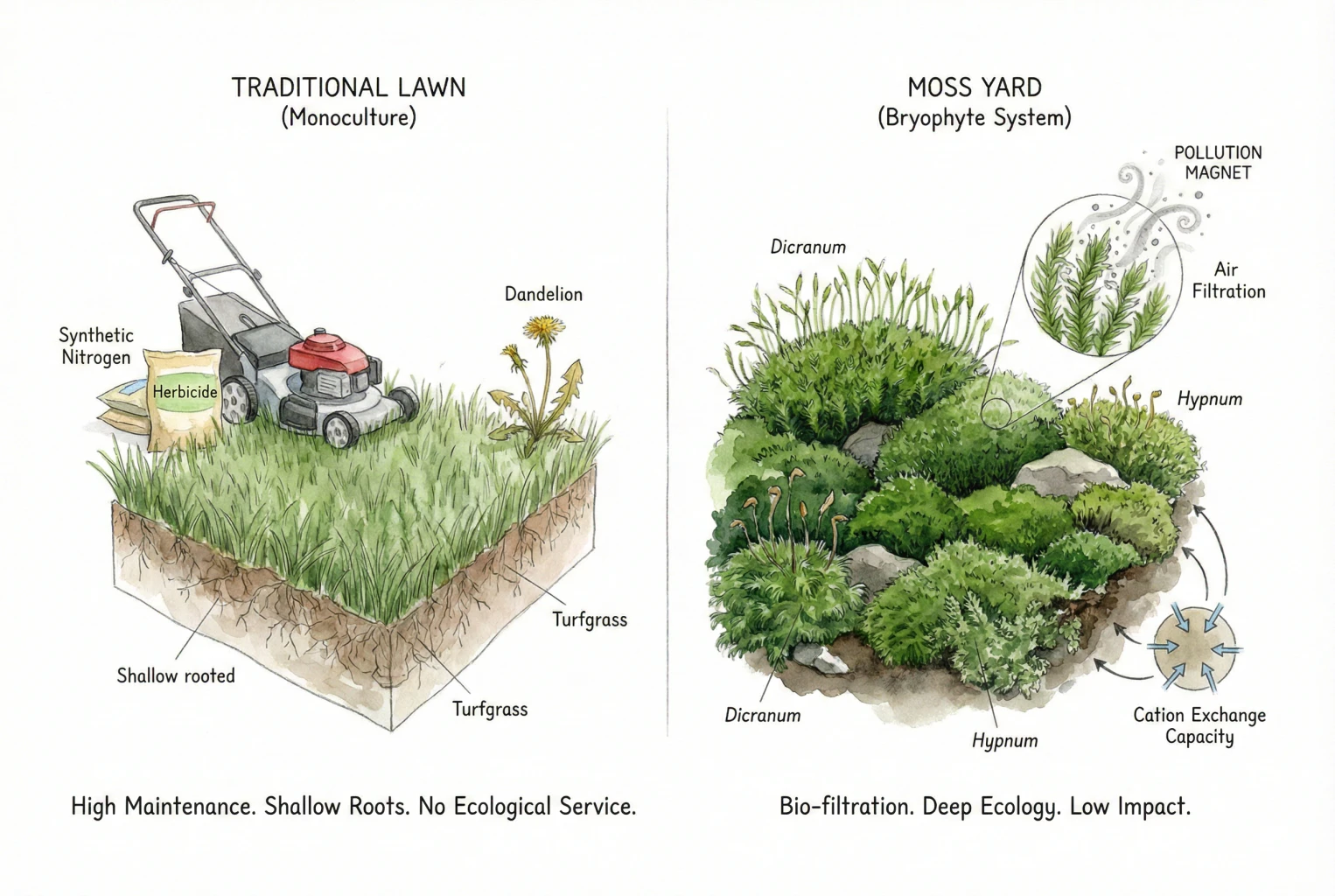
Key Takeaways
- Moss can hold some particles on its surface, but a flat moss yard is not a proven way to improve the air you breathe.
- A moss yard is a low-mow groundcover for a shady patch where turf repeatedly fails. It is not a health device or a replacement for every lawn.
- Any soil acidifier is a regulated pesticide. Test the soil first, follow the product label exactly for rate, annual limit, safety, and runoff warnings, and treat the acidifier as optional rather than a default step.
Use Moss Where Turf Repeatedly Fails
When a shady, damp site repeatedly fails to support turf, moss can be a sensible low-mow groundcover. A moss yard is not a proven air-cleaning device or a replacement for every lawn or tree.
I mark 30-centimeter test squares across deep shade, shifting shade, compacted soil, slope, and runoff zones before replacing turf. I photograph moss cover and surface moisture at the same hour weekly for 12 weeks, including once after 48 rain-free hours. The fixed area and dry-weather check reveal persistence without requiring a full turf removal first.
Expansion begins only in squares where moss persists without constant irrigation. The yard itself selects the workable area more honestly than a blanket claim that moss needs no maintenance.
Before importing material, I document the moss already thriving on similar soil and exposure. Local success is useful evidence, but I still follow collection rules and avoid moving wild habitat into the yard.
The short version
Moss surfaces can hold airborne particles under controlled conditions, but that does not show a yard will measurably improve the air you breathe. Use moss for a shady patch where turf keeps failing, then establish it with the species, soil, moisture, and foot traffic in mind.
2. Moss Is Not an Air Filter
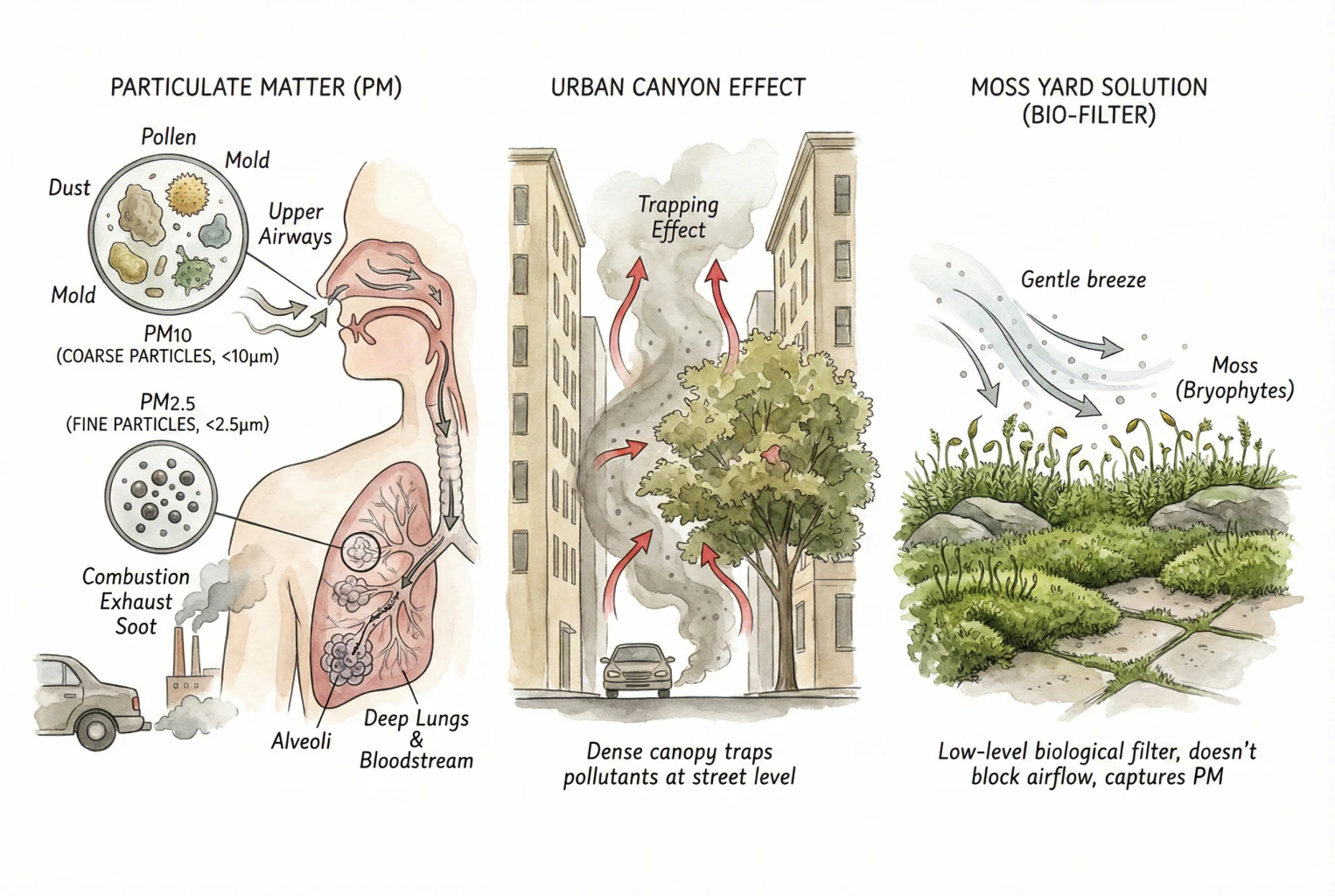
Moss surfaces can collect some airborne particles. That is not the same as lowering pollution at breathing height, and no field trial has shown that a flat, passive moss yard does so.
Use ventilation, source control, and proven air-cleaning equipment for air quality. Choose moss because it fits the site and you like its appearance.
3. What Moss Can and Cannot Do Outdoors
Moss can catch and hold some particles that land on it, but wind and rain can move those particles again. A moss mat has no active airflow system and does not pull pollution from distant air.
Do not choose a moss species for a supposed pollution-filtering strength. Choose it for its fit with the site’s shade, moisture, soil, and foot traffic.
5. Choose Moss by Form and Site
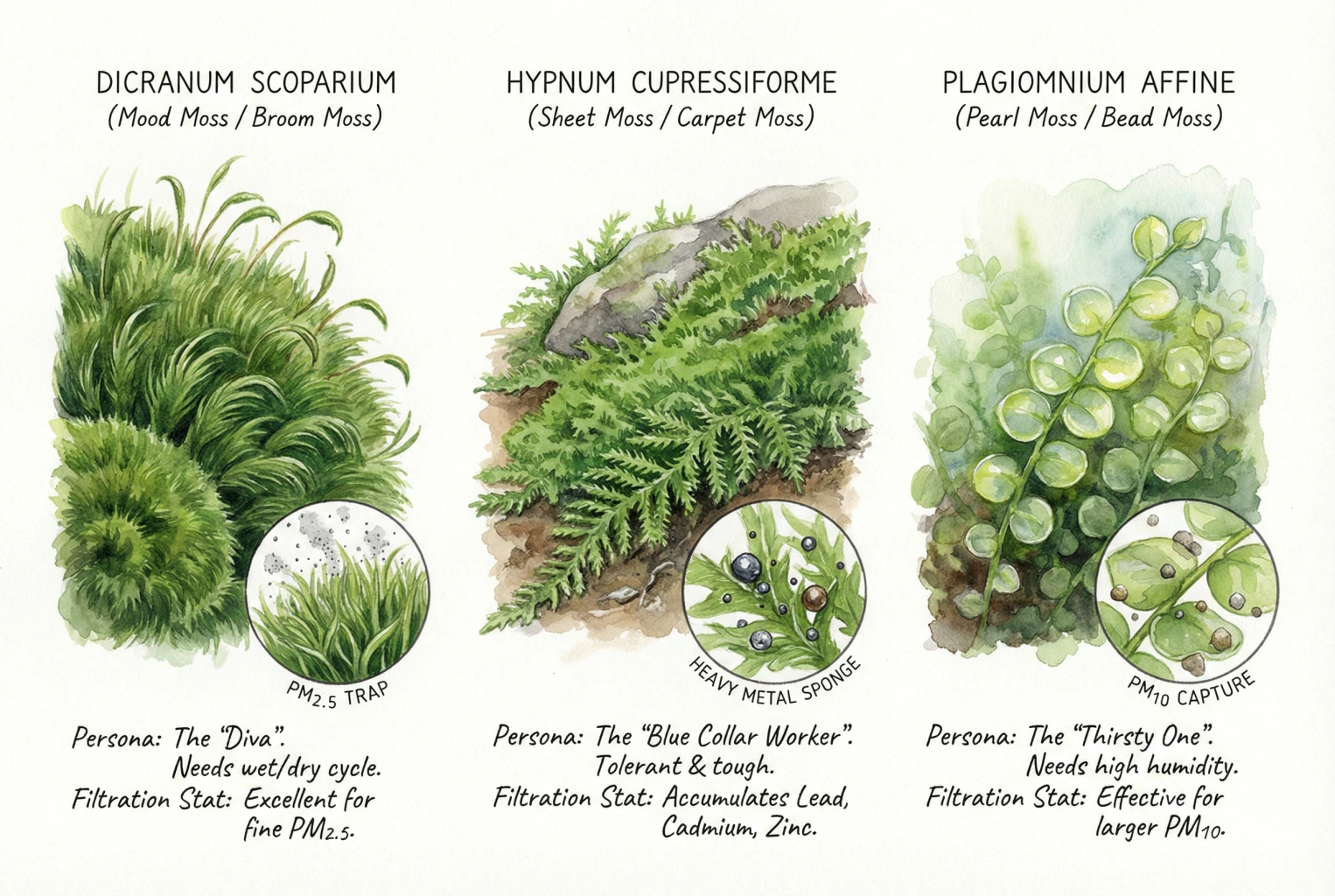
Confirm the identity of what you buy, then match it to your climate and site. Do not treat any of these descriptions as a ranking of air-cleaning ability.
5.1 Dicranum scoparium (Broom / Mood Moss)
Appearance
Grows in dense, velvety cushions. The leaves curve to one side, as if swept, hence the common name.
Growth habit
A cushion-forming moss that makes small mounds, useful as a specimen or accent rather than a flat lawn.
Conditions
Generally prefers acidic substrate and shade, but exact tolerances vary with provenance and climate. It does not like sitting waterlogged, and there is no single wet-dry threshold that applies everywhere.
5.2 Hypnum cupressiforme (Sheet / Carpet Moss)
Appearance
A pleurocarpous, or creeping, moss that grows flat and forms spreading mats on soil, rock, and logs.
Traffic
Its mat-forming habit is often suggested for larger areas, but a sheet-like growth form is not the same as tolerance of regular foot traffic. Extension guidance advises avoiding sustained walking on moss.
5.3 Plagiomnium affine (Pearl Moss)
Appearance
Distinct broad, rounded leaves, unlike the other two.
Conditions
Tends to favor consistently humid settings, which makes it better suited to a terrarium or paludarium than an open, exposed yard. Its distribution, hardiness, and microhabitat needs depend on local provenance.
6. How to Establish a Moss Yard
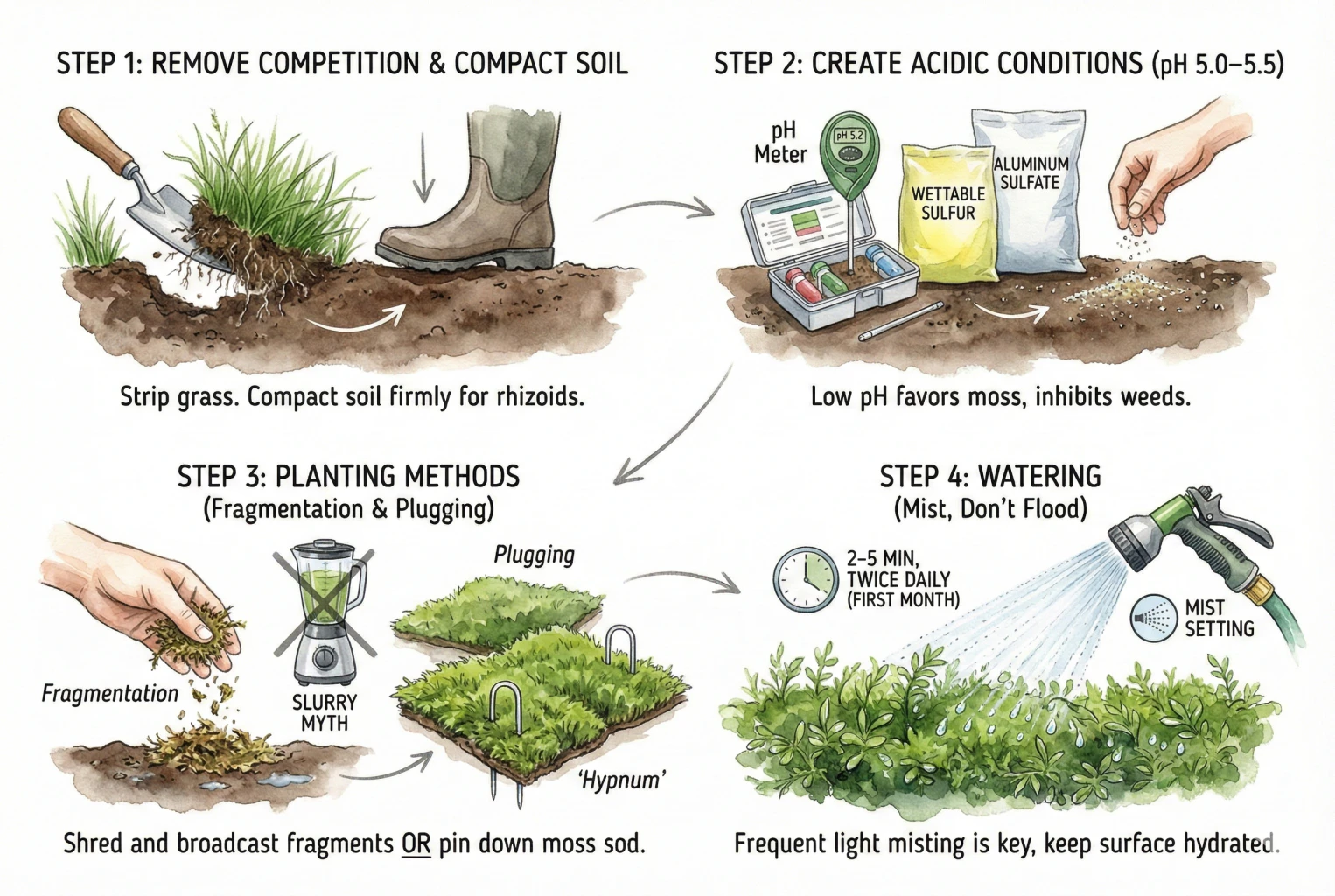
If you have a shady patch where turf keeps thinning out, moss can be a good low-maintenance groundcover.
Start small. Try a test patch before committing a whole yard, so you can see how a given species behaves on your site.
6.1 Step 1. Prepare the Area
It is a myth that you cannot grow moss in grass. Moss and grass frequently coexist, and moss usually appears because a site is already too shady, damp, acidic, or compacted for vigorous turf, not because it strangles the grass.
There is no evidence that grass roots strangle moss. The competition is mainly for light and space.
So moss does not require bared, sterilized ground everywhere, though clearing thin turf from the test area gives new moss a head start.
- On soil firmness. Good surface contact helps moss anchor with its rhizoids, so pressing new moss firmly onto the surface is worthwhile. That is different from deliberately compacting your yard soil. Heavy compaction reduces water infiltration, harms the rooting and gas exchange of surrounding plants, and can increase runoff, so aim for firm contact at the surface, not a compacted site.
- Avoid rototilling the whole area if you can. It disturbs the surface, brings up weed seed, and can worsen erosion. Small-scale surface preparation is usually enough.
6.2 Step 2. Test the Soil First (pH Is Optional, Not Automatic)
Moss species are diverse, and not all of them need strongly acidic soil. The presence of moss alone does not diagnose your pH.
So the honest first step is a laboratory soil test, plus identifying the species you plan to grow.
Only if the test shows your soil is genuinely too alkaline for your chosen species should you consider adjusting pH, and modestly.
Rather than a universal 5.0–5.5, aim for a range appropriate to your target species and existing vegetation, and remember that acidifying the soil can harm nearby plants, soil organisms, and waterways.
It is also not true that most weeds hate acid. Many weeds tolerate acidic soil, and lowering pH does not remove competition from light, moisture, and seed banks.
If You Choose to Acidify, Treat the Product as a Regulated Pesticide
Bagged elemental-sulfur soil acidifiers differ in sulfur content, formulation, registration, and permitted sites. Use one only when its current label explicitly covers soil acidification at the intended site. The label you have and local rules determine whether a moss yard is a permitted use.
Elemental sulfur soil acidifier
Set the amount from a soil test and the exact product label. Application method, rate, and annual limit vary by formulation and site, so do not borrow numbers from another sulfur product.
Sulfur acts slowly as soil microbes convert it, and the speed varies with soil temperature, moisture, and buffering. Test and re-check over a season. Slow action does not make the treatment automatically gentle, and it will not change soil overnight.
Safety Before Using Sulfur
Elemental-sulfur products can irritate the eyes, skin, nose, and throat. Dust can create an inhalation and fire hazard, and labels may include aquatic-toxicity, temperature, oil-spray, runoff, protective-equipment, and re-entry restrictions.
Read every precaution and interval from the exact label rather than carrying another formulation’s directions over. Stop if you cannot meet its handling requirements.
Aluminum sulfate is sometimes suggested as a faster option, but it is not recommended here without a soil test. It adds a salt and aluminum load, can harm non-target plants, and its safe rate depends on drainage, runoff risk, and soil buffering that most home users cannot measure.
Do not substitute it casually for a labeled, tested approach.
Use a registered sulfur product only if a soil test shows you need it and the label permits the site and purpose. Follow that label’s rate, annual limit, safety instructions, aquatic precautions, and runoff restrictions.
Extension guidance on moss in the landscape
6.3 Step 3. Planting
You will see tutorials telling you to blend moss with yogurt or beer and paint the slurry onto surfaces.
Dairy or beer can raise the risk of mold and odor, so many people avoid it, though there is no reliable figure for its failure rate. Two more predictable options.
Fragmentation
Many mosses regenerate from small fragments, but this is not guaranteed for every piece. Regeneration depends on species, tissue, age, and condition. Shred healthy moss, spread it over damp, prepared soil, and press it into firm contact.
Plugging
Lay sheets or plugs of moss and pin them down with landscape staples or twigs. Soil contact helps, but success still depends on matching species to site and protecting the moss from desiccation, frost, birds, and pathogen transfer, so it is not instant or certain.
If You Collect Wild Moss
First identify the species, get the landowner's or managing agency's permission, avoid protected habitats and species, take only a small proportion so the source can recover, and quarantine against pests and pathogens.
Moving moss between regions carries its own risks.
Buying live moss from a nursery that identifies the species and documents its outdoor suitability for your region is one alternative to collecting. Match the species to the site and inspect the material for pests and pathogens before planting.
Unidentified Live Sheet Moss
Live sheet moss is often sold in small quantities (roughly quart-sized bags are common) described as live and never dried, preserved, or dormant, and marketed for terrarium, vivarium, paludarium, bonsai, and craft use.
The catch is what these listings leave out. Vendor pages routinely skip the species identity (for instance, whether it is Hypnum cupressiforme), the outdoor hardiness, the regional suitability, and how much area one bag actually covers. A sustainable-picking description is usually the seller's own claim, without independent certification.
Do not treat an unidentified terrarium product as a ready-made moss-yard transplant. Use it only for the enclosure or craft purposes it documents. For outdoor establishment, choose a source that names the species and provides hardiness and site information, then inspect the lot for pests and pathogens before planting.
6.4 Step 4. Watering
The common claim that grass drinks through its roots while moss drinks through its leaves is too simple. Many mosses also draw on substrate moisture and capillary supply, so it is inaccurate to say deep watering does nothing. Both watering frequency and volume matter, and their relative importance depends on the moss species and substrate.
Establishment watering
Keep the surface reliably damp without waterlogging it. Aim for frequent light watering, and adjust for your climate, drainage, and how the moss responds.
Use measurements instead of a timer
Minutes alone do not describe an amount of water because that depends on nozzle output, area, and weather. Keep the surface moist and back off if you see standing water, mold, or heat stress. Watch for recovery signs before assuming a schedule is working.
7. Grow Indoor Moss as Decor
Preserved moss walls are decorative. They do not have a verified air-cleaning capacity. A terrarium can provide humidity for moss, but a closed terrarium exchanges very little air with the room, so it is also a display rather than an air device.
Fan-driven commercial moss systems are a different technology from a passive moss yard. Do not transfer their performance claims to a lawn or terrarium.
Start With a Small, Site-Matched Patch
A moss yard is a reasonable, low-maintenance groundcover for a shady, damp spot where turf keeps failing.
That is a fair reason to try it, and it is a milder ambition than the biological air filter framing this topic usually gets.
A moss yard is not a proven way to clean outdoor air. Use it as a practical groundcover for a site that suits moss.
Start with a small test patch, do a soil test before adjusting anything, and choose a species that fits the local shade and moisture. Treat any acidifier as a regulated pesticide, follow its full label, and keep it out of drains and waterways.
Table 1 (Quick Reference – Three Common Moss Species)
Growth-habit notes, not an air-filtration ranking.
| Species | Common name | Growth form | Typical use / conditions |
|---|---|---|---|
| Dicranum scoparium | Broom / mood moss | Dense cushion mounds | Specimen accents. Generally acidic, shaded, not waterlogged |
| Hypnum cupressiforme | Sheet / carpet moss | Creeping flat mat | Larger areas. Avoid sustained foot traffic |
| Plagiomnium affine | Pearl moss | Broad, rounded leaves | Humid enclosures more than open yards |
Table 2 (Troubleshooting Your Moss Yard)
Most symptoms have several possible causes. Check the reversible ones first, and get help from a local Extension office or nursery if the moss keeps declining.
| Symptom | Possible causes to check | What to do |
|---|---|---|
| Moss turning brown | Could be seasonal dormancy, but also heat, salt, pollution, disease, or death. Do not assume it is just sleeping. | Check species, whether it rehydrates and greens up when moistened, and tissue viability before deciding. Rehydrate gently, if it does not recover, look for other causes rather than waiting indefinitely. |
| Grass or weeds coming in | Often just competition where turf can still grow, not necessarily a pH problem. Do not assume too alkaline. | Remove invaders by hand. Only test and adjust pH if a soil test supports it. Avoid repeated acidifying as a reflex. |
| Moss lifting or peeling | Loss of contact, but also birds, frost heave, erosion, animals, dead substrate, or desiccation. | Re-pin with staples or twigs and improve surface contact. Identify which cause applies before repeating. |
| Slimy or moldy patches | Waterlogging is common, but also poor airflow, organic debris, a contaminated transplant, temperature, or pathogens. | Reduce standing water and improve drainage and airflow. Remove debris. Investigate further if it persists. |
| Moss drying out while establishing | Surface drying out between waterings. Species and substrate also matter. | Keep the surface reliably moist with light, frequent watering. Adjust volume for your climate and drainage. |