Terrarium Glass Containers: The Science Behind Choosing the Right Vessel
Stop killing your plants in bad jars. We break down the physics of light transmission, gas exchange, and the material science behind the best terrarium glass containers.
Summary
Choosing the correct glass is vital for plant health, as low-iron glass offers superior light transmission for photosynthesis compared to standard green-tinted soda-lime glass.
Flat-sided containers are scientifically preferred over cylindrical jars, which cause visual distortion and can create dangerous solar ‘hot spots’ that scorch plant leaves.
A thriving closed ecosystem requires avoiding toxic lead crystal vessels, ensuring an airtight seal with rubber gaskets, and selecting slow-growing plants compatible with limited gas exchange.
Key Takeaways
Material Science: Standard glass blocks ~15-20% of light; use Low-Iron (Starphire) glass for maximum PAR efficiency.
Toxicology: Never use vintage lead crystal; lead leaches into acidic soil and poisons plants and microfauna.
Physics: Curved glass acts as a lens, distorting views and potentially burning plants; flat glass is superior.
The Seal: Glass-on-glass lids leak moisture; use jars with silicone or rubber gaskets (like Bormioli Rocco) or create a DIY silicone seal.
Myth Busting: ‘Breathable glass’ does not exist; glass is non-porous, and gas exchange only happens through physical openings.
1. Introduction: It’s Not Just a Jar, It’s a Life Support System
Building a terrarium isn’t interior design; it’s engineering a closed-loop ecosystem. Most people see a clear box, but the glass you choose dictates the thermodynamics, gas exchange, and light transmission that keep your plants alive.
We’re skipping the overpriced ‘terrarium-specific’ marketing to dive into the physics of condensation, the chemistry of low-iron vs. soda-lime glass, and why that vintage crystal decanter might actually be poisoning your moss.
2. The Material Science of Transparency: Glass Composition
Not all clear materials are created equal. In the world of horticulture and vivarium design, the chemical composition of your transparent barrier dictates how much energy your plants receive, how true the colors appear to your eye, and how the vessel reacts to thermal stress.
2.1 Soda-Lime Glass: The Ubiquitous Standard
About 90% of the glass manufactured globally is soda-lime glass. It is the workhorse of the container industry, used for everything from pickle jars to window panes.
2.1.1 Chemical Matrix
Soda-lime glass is composed primarily of three components:
Silica (SiO2): About 70-74%. This is the glass former, derived from sand.
Soda Ash (Sodium Carbonate, Na2CO3): About 13-16%. This acts as a flux, lowering the melting point of the silica to make it workable.
Lime (Calcium Oxide, CaO): About 10-13%. This acts as a stabilizer. Without it, the glass would be water-soluble (which would be a disaster for a terrarium).
2.1.2 The Iron Problem
The defining characteristic of standard soda-lime glass, particularly for our purposes, is its impurity content. Most silica sand sources contain iron oxide (Fe2O3), usually around 0.1%. While this seems negligible, iron oxide is a potent pigment. It is responsible for the characteristic green tint you see when you look at the edge of a glass pane.
2.1.3 The Photosynthetic Impact
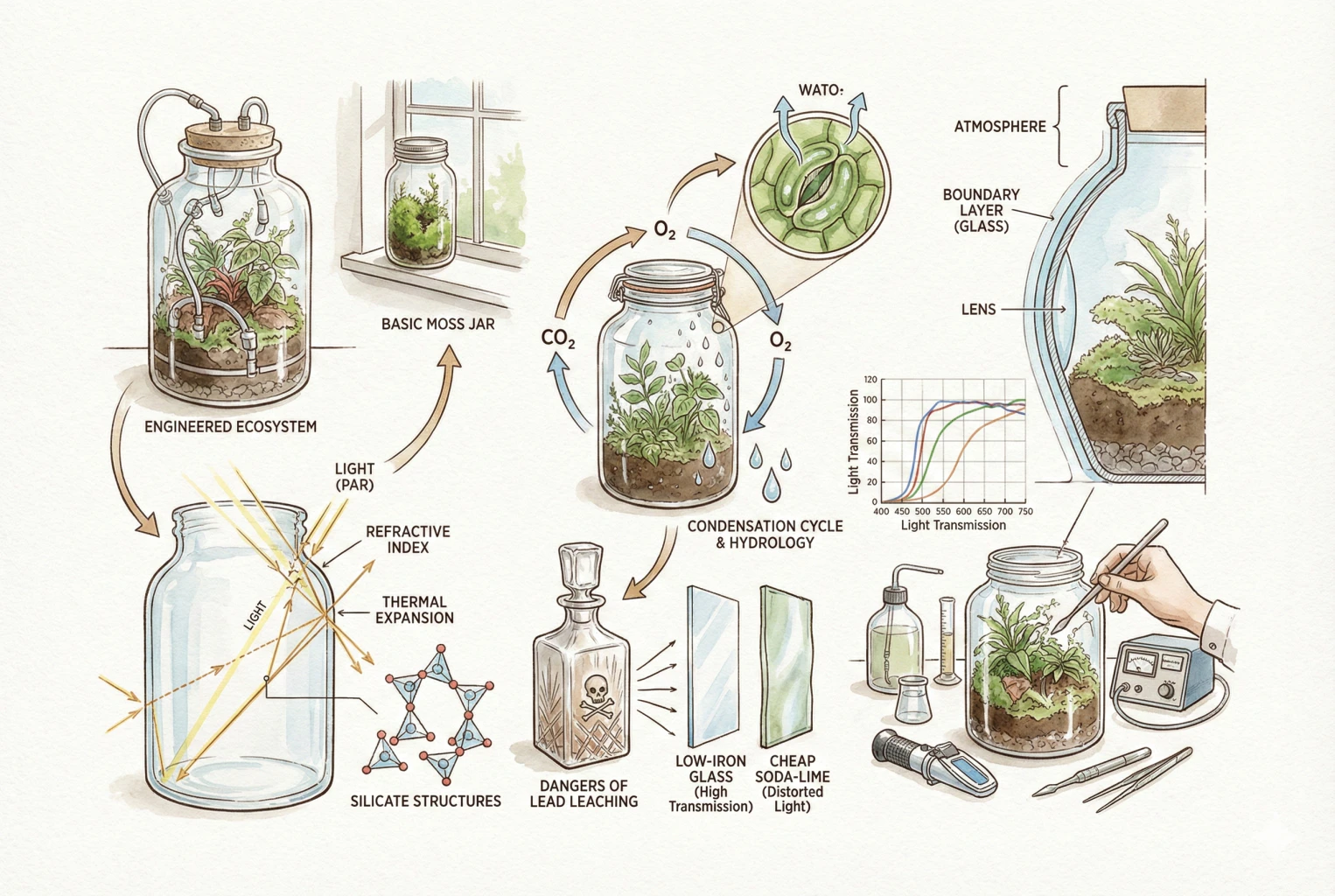
That green tint isn’t just an aesthetic annoyance; it represents an absorption band. Iron oxide absorbs light in the infrared (IR) and ultraviolet (UV) spectrums, but it also creates a significant reduction in visible light transmission. Standard soda-lime glass typically transmits only about 80-85% of visible light depending on the thickness of the pane.
For a houseplant on a windowsill, a 15% loss might be acceptable. But in a terrarium, you are often working with low-light plants like Fittonia, Begonia, or mosses, frequently illuminated by artificial lights or indirect window light. Losing 15-20% of your photon energy before it even hits the cuticle of the leaf is a significant metabolic handicap. You are essentially putting sunglasses on your plants.
2.2 Low-Iron (Starphire/Diamant) Glass: The Photosynthetic Advantage
If you are serious about aesthetics and photosynthetic efficiency, you move to low-iron glass. This is often marketed under trade names like Starphire, Diamant, or Ultra-Clear.
2.2.1 Refining the Chemistry
To create low-iron glass, manufacturers must source high-purity silica sand with naturally low iron levels or process the sand to remove ferric oxide. The target is to reduce the iron content to approximately 0.01%—ten times less than standard glass.
2.2.2 Transmission Metrics
This reduction in iron results in a ‘water white’ transparency. The light transmission rates push from the mid-80s up to 91% or even 98% if anti-reflective (AR) coatings are applied.
Color Fidelity: For the viewer, this means the green cast is gone. The soil looks brown, the moss looks emerald, and the reds of a Cryptanthus pop with true color fidelity.
PAR Efficiency: More importantly, low-iron glass ensures that the red (600-700nm) and blue (400-500nm) spectrums—the wavelengths most critical for chlorophyll a and b absorption—are not filtered out. When you see high-end aquascaping tanks from brands like UNS (Ultum Nature Systems) or Landen, they are exclusively using this material. They do this because in a planted tank, light penetration through water is already difficult; adding a green filter (standard glass) makes it worse. The same logic applies to terrariums.
Recommended Gear: Landen 60P 17.1 Gallon Rimless Low Iron Aquarium
Why: This is the gold standard for ‘open’ terrarium or intricate scape designs. It uses 6mm thick low-iron glass with >91% transparency. The rimless design and 45° mitered edges mean zero visual obstruction. It’s technically an aquarium, but expert terrarium builders use these for high-humidity setups (with a custom lid) because the glass quality is superior to almost any standard ‘terrarium’ jar.
You might know this as ‘Pyrex’ (the old formula) or lab glass. It is the material of choice for beakers, test tubes, and high-end kitchenware.
2.3.1 Composition and Structure
Borosilicate glass is defined by the substitution of soda and lime with boric oxide (at least 5%). This changes the structural network of the glass, binding the silicate more tightly.
2.3.2 Thermal Expansion and Durability
The magic here is the Coefficient of Thermal Expansion (CTE). Borosilicate has a very low CTE, expanding about one-third as much as soda-lime glass when heated.
Thermal Shock: This makes it incredibly resistant to thermal shock. You can take it from a freezer to an oven (or a cold windowsill to a hot heat mat) without it shattering. Standard soda-lime glass is prone to cracking under rapid temperature gradients.
Hardness: Borosilicate is harder (7.5 on Mohs scale vs. 6 for soda-lime). This makes it less prone to scratching over years of cleaning. If you are scrubbing hard water deposits (calcium carbonate) off your terrarium walls, borosilicate is more forgiving.
Chemical Resistance: It is highly resistant to acid corrosion. While terrarium environments are mildly acidic (due to peat/sphagnum substrates and carbonic acid from CO2 respiration), this is rarely enough to corrode soda-lime glass significantly over a human lifespan. However, for long-term clarity, borosilicate is superior.
2.4 Comparative Material Data Table
Feature
Soda-Lime Glass
Low-Iron Glass (Starphire)
Borosilicate Glass
Lead Crystal
Primary Composition
Silica, Soda, Lime
Silica (low iron)
Silica, Boron Trioxide
Silica, Lead Oxide
Visual Tint
Greenish (edges)
Colorless / Blueish
Clear / Slight Amber
High Sparkle
Light Transmission
~80-85%
91% +
~90%
Variable
UV Transmission
Low
Moderate
Moderate/High
Low
Refractive Index
~1.51-1.52
~1.52
~1.47
~1.54 – 1.70
Thermal Shock Resistance
Poor
Poor
Excellent
Poor
Chemical Leaching
Negligible
Negligible
Extremely Low
High (Lead)
Best Use Case
Budget Jars
High-End Display
Lab-style / Durable
Display Only (No Soil)
3. Optical Physics: Refraction, Geometry, and PAR Loss
The shape of your container is not just an artistic choice; it is an optical filter that distorts reality and energy.
3.1 The Cylinder Problem: Distortion and Lensing
Cylindrical jars are popular because they are cheap to manufacture and easy to find (cookie jars, apothecaries). However, they are optically flawed for viewing and can be dangerous for plants.
3.1.1 Refractive Mechanics
Glass has a refractive index () of approximately 1.5, while air has an index of roughly 1.0. When light passes from air into glass, and then back into the air inside the jar, it bends.
Planar Glass: In a square tank (like the Landen 60P), the light enters and exits parallel surfaces. The image is shifted slightly but not distorted.
Cylindrical Glass: In a curved jar, the angle of incidence changes constantly across the surface. This creates a ‘lensing’ effect. The cylinder acts as a complex lens, magnifying horizontally but not vertically.
3.1.2 Visual Distortion
If you are trying to view minute details—like the springtails cleaning your mold or the delicate stomata of a moss frond—a cylinder will stretch and warp the image depending on your viewing angle. It makes photographing your work nearly impossible without specialized equipment.
3.1.3 The Solar Death Ray
Direct sunlight hitting a curved jar can be focused into a beam. The curved glass acts as a converging lens. This can create intense ‘hot spots’ within the terrarium that significantly exceed the ambient light levels, potentially scorching leaves. This is the ‘magnifying glass vs. ant’ effect, but your prized Begonia is the ant.
3.2 PAR Loss Through Lids and Condensation
Even flat glass eats light.
Fresnel Reflection: Whenever light moves from a medium of one refractive index to another, reflection occurs. You lose about 4% of light at each surface due to Fresnel reflection. A standard pane of glass has two surfaces (entry and exit), so you lose ~8% instantly, regardless of the glass clarity.
The Condensation Factor: A healthy closed terrarium has water droplets on the glass. These droplets act as thousands of tiny lenses. While they diffuse light (which can be good for understory plants by reducing shadowing), they also increase backscatter. Research in reef keeping (where PAR is tracked religiously) indicates that dirty or condensation-covered glass can reduce PAR transmission by significantly more than the base loss of the glass itself.
The Takeaway: If you are using a closed system with a glass lid, you need to output more light than you think. You are fighting the iron content, the surface reflection, and the condensation layer.
Video Tutorial: SerpaDesign – ‘How to Make a Terrarium for Free’
Why: Tanner Serpa is the king of repurposing glass. This video shows how to evaluate different glass shapes and sources (like thrift store finds) for optical clarity and suitability. He understands that the ‘terrarium glass containers’ is just a vessel for the ecosystem and demonstrates how to select glass that minimizes distortion.
4. The Toxicology of Vintage Glass: The Lead Crystal Trap
This is a massive point of contention in the hobby, but the science is unequivocally clear. Vintage crystal decanters look cool, but they are chemical time bombs for terrariums.
4.1 The Leaching Mechanism
‘Lead crystal’ is glass that contains lead oxide (often >24%) to increase the refractive index (making it sparkle) and soften the glass for cutting.
Acid Interaction: Lead is not chemically inert in this matrix. It leaches out of the glass, especially in the presence of acids. Terrarium substrates (peat moss, sphagnum, akadama) are naturally acidic, often buffering to a pH between 3.5 and 6.0. Acetic acid (vinegar) is often used in leaching tests, and it mimics the organic acids (humic and fulvic acids) present in soil decomposition.
The Data: Studies on wine storage show that lead levels can spike to 1,000+ µg/L within days in lead crystal containers. Even a few minutes of contact can release measurable lead.
4.2 Bioaccumulation and Toxicity
While you aren’t drinking your terrarium water (I hope), the ecosystem is absorbing it.
Root Uptake: Plants absorb lead through their roots. Lead ions () are taken up by the same pathways as essential nutrients like Calcium (). Once inside, lead blocks enzyme function, disrupts the electron transport chain in photosynthesis, and causes chlorosis (yellowing) and stunted growth.
The Phytoremediation Irony: Some plants are used to clean lead from soil (phytoremediation). They hyper-accumulate it. If you use these plants in a lead crystal bowl, they will pull the lead out of the glass and store it in their tissues. When those leaves die and rot, the lead is released back into the soil, concentrating over time.
Microfauna: If you are running a bioactive setup with springtails and isopods, lead is a neurotoxin. You are essentially poisoning your cleanup crew.
Recommendation: Use lead-free crystal or standard glass. If you must use a vintage piece, test it. But honestly, is it worth the risk?
5. Thermodynamics: The Greenhouse in Your Living Room
A closed terrarium is a thermodynamic trap. This creates the self-sustaining water cycle, but it also creates the potential for rapid system collapse via overheating.
5.1 The Greenhouse Effect Mechanism
Glass is transparent to visible light (shortwave radiation) but largely opaque to infrared radiation (heat/longwave).
Input: Light enters the jar (400-700nm).
Conversion: Plants and soil absorb the light energy and re-radiate it as heat (infrared).
Trap: The glass blocks the infrared from escaping. The thermal conductivity of glass is relatively low (~0.937 W/m·K), meaning it insulates well.
Result: Rapid temperature spikes. If you place a closed jar in direct sunlight, the internal temperature can rise to 100°F+ (38°C+) within minutes. This cooks the enzymes in your plants (denaturation) and kills the microfauna. This is why the #1 rule of terrariums is Bright, Indirect Light.
5.2 The Water Cycle and Entropy
A closed terrarium works on the principle of the water cycle:
Evaporation → Condensation → Precipitation.
Dynamic Equilibrium: The system isn’t static; it’s a dynamic equilibrium. Water transpires from leaves (stomata) and evaporates from the soil. It hits the glass surface.
Condensation Point: Condensation occurs because the glass is cooler than the internal air (due to contact with the ambient room air). The water vapor loses energy to the glass, phase-changes to liquid, and runs down.
The ‘Fog’ Indicator:
Heavy Fog (All Day): Thermodynamics are off. It is either too hot relative to the room, or there is too much water volume.
No Fog: The air is too dry, or the temperature differential is too low.
Morning/Evening Dew: This is the Goldilocks zone. As room temperatures fluctuate, you should see a light misting cycle. This indicates a healthy hydrological loop.
6. The Great Seal: Engineering Airtight Systems
For a terrarium to be truly ‘closed’ (like the famous David Latimer jar that hasn’t been opened in 50 years), the seal must be hermetic. However, most commercial jars leak like a sieve.
6.1 Glass-on-Glass vs. Gaskets
Glass-on-Glass: Many ‘Apothecary’ jars (like the Anchor Hocking Heritage Hill) feature a heavy glass lid that sits directly on the glass rim. This is not airtight. Air molecules are small. Over weeks or months, gas exchange occurs, water vapor escapes, and the system dries out.
Rubber/Silicone Gaskets: This is required for a true seal. Brands like Kilner and Bormioli Rocco use vulcanized rubber or silicone rings compressed by a metal bail mechanism. This creates a pressure seal that prevents water vapor loss. It essentially creates a vacuum seal if the temperature drops.
6.2 The ‘Silicone Hack’ for Cheap Jars
You can buy cheap glass-on-glass jars and engineer them to be airtight.
The Problem: The Anchor Hocking 2-gallon jar is a classic, widely used in the hobby because it is huge and affordable. But the lid rattles and leaks moisture.
The Solution: You can cast a custom gasket using aquarium-safe silicone.
Apply a bead of 100% silicone (GE Silicone I or aquarium specific) to the rim of the lid.
Cover the jar rim with plastic wrap (to prevent the lid from gluing to the jar).
Place the lid on the jar and let it cure for 24 hours.
Remove the lid and the plastic wrap. You now have a custom-molded silicone gasket attached to the lid that fits the imperfections of the jar perfectly.
Recommended Gear: Anchor Hocking 2-Gallon Heritage Hill Jar
Why: This is the ‘workhorse’ of the terrarium hobby. It’s huge, affordable, made in the USA, and the glass clarity is surprisingly decent for soda-lime. It effectively becomes a high-end terrarium if you apply the silicone seal hack mentioned above or buy a third-party gasket.
7. Biological Implications of Terrarium Glass Containers Choice
Your glass choice dictates your plant list. You cannot fight the biology.
7.1 Gas Exchange Rates & Plant Physiology
In a truly sealed jar (Tier 2/Hermetic), Carbon Dioxide () becomes the limiting factor.
The Cycle: Plants use during the day (photosynthesis) and produce it at night (respiration). Soil bacteria also produce as they break down organic matter.
The Bottleneck: If you seal a jar tight, the net gas exchange with the outside world is zero. If you plant fast-growing species (like Pothos, Tradescantia, or Syngonium), they will rapidly deplete the available during the day. They will grow leggy, weak, and eventually stall or crash as the carbon cycle hits a bottleneck.
Selection: You must choose slow-growing plants for sealed environments. This matches the slow rate of carbon recycling from the soil bacteria.
Best Plants for Sealed Glass: Slow-growing mosses (Leucobryum glaucum, Dicranum scoparium), miniature ferns (Nephrolepis ‘Cotton Candy’), and slow creepers like Fittonia or Ficus pumila (which will eventually need pruning).
7.2 Humidity Retention & Mold
The tighter the seal, the higher the sustained humidity.
90-100% Humidity (Hermetic Seal): This environment requires plants with thin cuticles that are prone to desiccation in open air. Selaginella (Spike Moss) is the king of this environment. It will die in hours in a room, but thrives in a sealed Bormioli jar. However, stagnant air at 100% humidity is a breeding ground for mold. You must include a bioactive cleanup crew (Springtails) to eat the mold.
50-70% Humidity (Loose Lids/Cork): This is better for plants like Begonias or Peperomias that might ‘melt’ (bacterial rot) if their leaves stay wet constantly. A cork lid allows just enough gas exchange to lower the humidity slightly and provide fresh airflow, reducing rot risk.
8. The ‘Breathable Glass’ Myth and Other Nonsense
We need to address the pseudoscience pervasive in online plant communities.
8.1 ‘Breathable Glass’
I have seen listings on dropshipping sites for ‘breathable glass’ pots. Let’s be clear: Glass is non-porous. Unless it is sintered glass (used in lab filters) or physically drilled with holes, air does not pass through the molecular structure of silicate glass.
If a product claims to be ‘breathable glass,’ it is either lying, or it isn’t glass (it might be a permeable ceramic glaze or plastic). Do not buy this for a terrarium expecting gas exchange through the walls. If you want breathability, use terracotta.
8.2 ‘Zero Maintenance’
There is no such thing as a zero-maintenance ecosystem. Even a sealed jar requires:
Light management: Moving it if seasons change and the sun angle shifts.
Pruning: Plants grow. In a closed system, leaves will eventually press against the glass. Due to the condensation, that contact point becomes a site for water accumulation, which leads to bacterial rot. You must open the jar and prune back growth before it touches the walls.
Entropy: Systems degrade. Soil compacts. Nutrients deplete (though slowly recycled). You are the steward, not just the observer.
8.3 The Blue/Green Glass Mistake
Tinted glass looks pretty on a shelf, but it is functional death for plants.
Chlorophyll Absorption: Chlorophyll absorbs light primarily in the blue (~430nm) and red (~660nm) regions. Green glass allows green light to pass (which plants reflect/don’t use) and blocks red/blue light.
The Result: Putting a plant in a green or blue jar is equivalent to putting it in the dark. It will starve. Always use clear glass.
9. Recommended Terrarium Glass Containers: The Expert Tier List
Based on glass quality, seal mechanics, and geometry, here is the definitive ranking of terrarium glass containers.
Tier 1: The High-Performance Systems (Rimless Low-Iron)
These are technically aquariums, but they make the best open or custom-lidded terrariums due to superior glass clarity and geometry.
Model:UNS 60U or Landen 60P.
Material: 91% clarity Diamant/Low-Iron glass.
Pros: Zero visual distortion, perfect color rendering, massive volume for hardscape depth.
Cons: Expensive, requires a custom-cut glass or acrylic lid for closed setups.
Best For: Aquascaping-style moss walls, intricate dioramas, ‘Display’ pieces.
Recommended Gear: UNS 5N Ultra Clear Rimless Nano Tank
Why: If you want a desktop setup that looks like a jewel box, this is it. 45° mitered edges and ultra-clear glass. It puts standard mason jars to shame.
Material: Often thinner glass, susceptible to breaking.
Pros: Very ‘Pinterest-worthy.’ Minimalist.
Cons: Cork molds. Mold loves cork. It acts as a wick for moisture and will rot if kept constantly humid.
Fix: Seal the bottom of the cork with silicone or wrap it in plastic wrap to prevent moisture contact.
Video Guide: Worcester Terrariums – ‘Choosing The Best Terrarium Glass’
Why: Ben from Worcester Terrariums breaks down the aesthetic considerations and the practicalities of planting in bottles vs. wide-mouth jars. He’s a master of the ‘bottled garden’ aesthetic.
10. Conclusion: The Glass is the Limit
Building a terrarium is an exercise in control. You are controlling light via glass composition, humidity via seal mechanics, and energy via geometry.
Don’t buy the cheap, green-tinted glass from the dollar store if you want your moss to look emerald green. Don’t use your grandmother’s lead crystal decanter unless you want a heavy metal toxicity experiment. And for the love of botany, don’t put a cactus in a closed jar.
Invest in low-iron glass if you can afford it. Use a Bormioli Rocco if you want a set-and-forget system. And always, always wash your glass before you build—not just for clarity, but to remove manufacturing residues (oils, release agents) that could nuke your microbiome before it even starts.
Science doesn’t care about your aesthetic, but if you understand the science, you can make the aesthetic thrive.



Leave a Reply